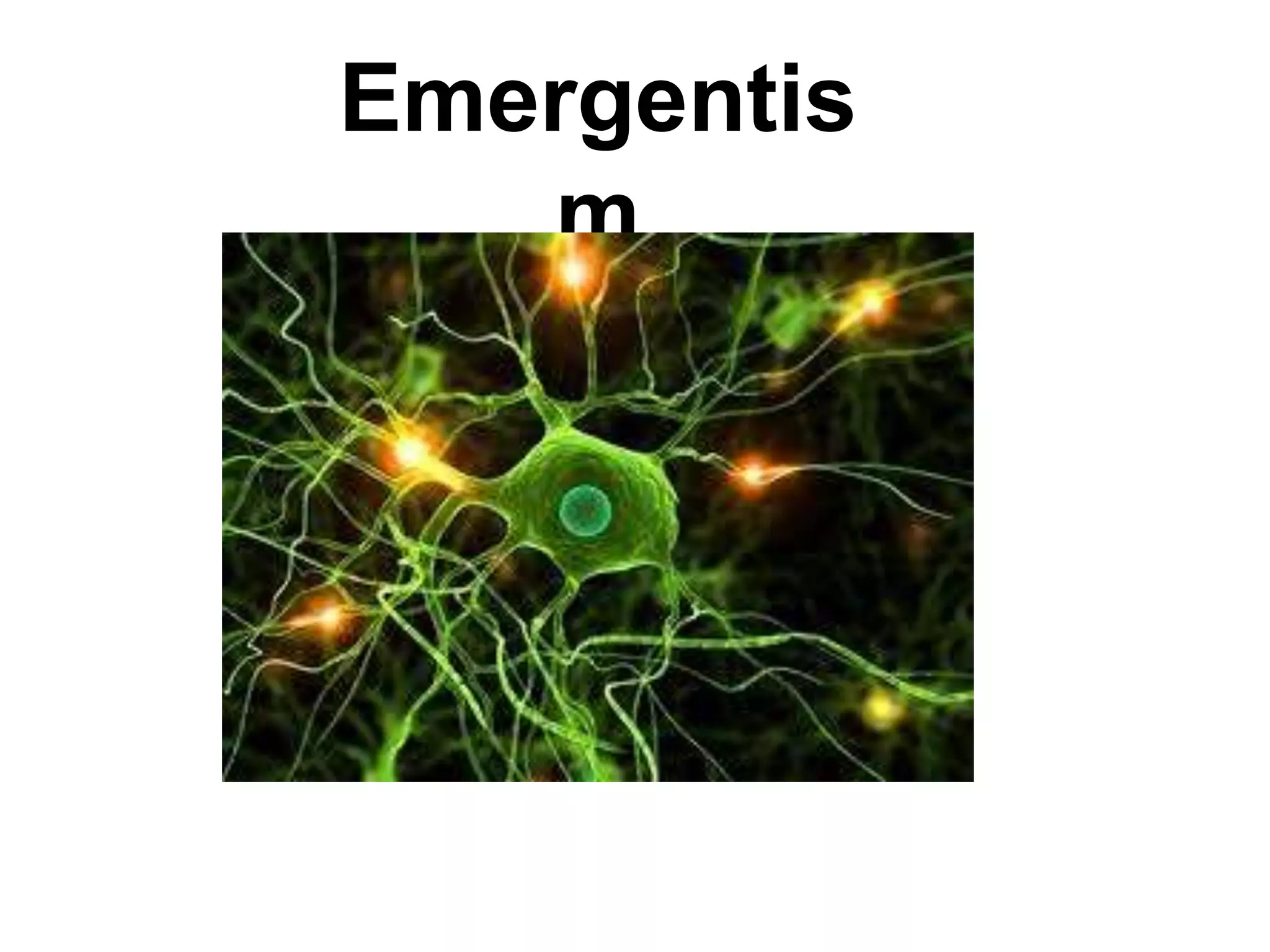
Emergentis
m
Nate, David, Lina
Reading Summary
Interlanguage Process - Gass and Selinker
Connectionist/Emergentist Approaches
The connectionist (also called constructivist) approach’s emphasis is on
usage. It views language as the extraction of regularities or patterns from
input. According to this approach, comprehension is determined by the
statistical information the speaker or learner has about the linguistic items in
their language, as opposed to a UG view that sees competence as a byproduct
of an innate faculty, equipped with innate knowledge that forms underlying
rules governing linguistic knowledge. Accordingly, connectionist approaches
view learning as based on input alone, and the resultant ‘linguistic knowledge’
as a network of interconnected exemplars (see CREED summary).
Interlanguage Process - Gass and Selinker
Models of the Connectionism/Emergentism Approach
Parallel Distributed Processing (PDP)
PDP is a neural network model (biologically inspired), composed of nodes that
are connected by pathways. These pathways are strengthened or weakened
through activation or use (similar to the well-known Hebbian neuropsychology
paraphrase: ‘neurons that fire together wire together’). According to PDP,
learning happens in the network itself. The strength of associations change ‘as a
function of interaction’ with the environment, which basically means that
changes in the environmental input influence associations by making them
stronger or weaker. In the case of an L1 speaker who already has an established
network of fixed-strength associations based on the L1 linguistic input and cues,
there is a distinct possibility of cross-linguistic interference of an L2 network.
Competition Model
This model was also discussed in the MacWhinney article. A fundamental view of this
model is that forms cannot be separated from function, unlike in UG models. One of
the main tenets of this model is that a variety of environmental cues are in
compete, and contribute to different resolutions in sentence interpretation. Another
tenet is that although the range of cues is universal, there are language-specific
instantiation (evidence) of cues, and language-specific strength assigned to these
cues. An example of this would be English’s relatively fixed word order, and L1
speaker’s reliance on this as a major cue for interpretation. In the event of
ambiguity, or irregularity in an English sentence like ‘The grass eats the cow,’ a native
English speaker would have to abandon the word order cue, and thus all other cues
would come into competition to try to resolve an interpretation.
This leads to the question in SLA of how learners adjust internal speech processing
mechanisms from native-language-appropriate to target-language-appropriate. One
possibility is that a learner’s initial hypothesis(-es) are consistent with native-language
interpretations, thus relying heavily on native-language-prominent cues. Some
research supports this (Sasaki 1991, 1994), but other research (Rounds and
Kanagy, 1998) shows that it’s more complex than this.
Interlanguage Process - Gass and Selinker
Problems with this Approach
Processing Uniqueness - is there only this one way of arriving at an
interpretation?
Differences between syntax-based (ie. English) and meaning/pragmatic-based
(ie. Italian, Japanese) languages - according to this view of language, certain
languages have certain advantages over other languages in learning another
particular language.
The Competition Model: Input, Context, and the Brain – MacWhinney
The competition model treats L1 and L2
acquisition as constructive, data-driven processes
that rely not on universals of linguistic structures,
but on universals of cognitive structures. Thus,
learning and transfer instead of principles and
parameters of UG are the main force in language
acquisition.
Within the competition framework, the input, the learner, and
the context are the three components. The role of input would
be analyzed using the concept of cue availability and reliability.
The Input
In competition model, the claim of input is that cues and their reliability and
availability would be detected in language comprehension. Cues with high
reliability and availability would control comprehension strongly. Some cues
include nominal case-marking, word order patterns, stress patterns, noun-verb
agreement markers, clitic pronouns, and verb voice markings. Cues are used in
select certain words for assignment to certain roles in a sentence. In other words,
words compete for certain roles in a sentence which is also how the Competition
Model gets its name. As to output, lexical items are activated in the neural network
based on cues before they are put in the correct structures as if they are
competing for certain places in a structure. However, it is worth pointing out that
certain forms don’t always express the same function; therefore, the correlations
on the level of forms and functions respectively are as important as the
competition of forms for functions driven by cues. The cooperation and
competition are driven by cue reliability which is the “conditional probability that
an interpretation X should be selected given the presence of a cue Y, i. e. p(XIY). Y
would be a reliable cue if the probability is high. Cue reliability includes four
dimensions: Task frequency, availability, simple reliability, and conflict reliability.
The Competition Model: Input, Context, and the Brain – MacWhinney
The Learner
The Competition Model views the brain as a huge collection of neurons connected through axons which
pass activation or inhibition to other connected neurons. From this perspective, the mental processing is
viewed in terms of interaction and connection, rather than strict modularity and separation. The
interconnected nature of brain promotes the transfer of information between emergent modules. The L1
well-organized neurolinguistic system is where the L2 new lexicon and phonology are parasitic, which
indicates that L2 system relies on the L1 structures. By building direct linkage between new L2 forms and
conceptual representations, the learner develops language acquisition. Another important aspect in SLA
theory concerning the learner is that the brain loses its plasticity and capacity for new forms of learning.
Neuronal commitment, related to the decline in flexibility as discussed in the theory of critical period,
illustrates that “once a local neural area has been committed, it then takes in large amounts of input data
that tightly tune the activation weights.” Furthermore, the competition model also provides an account
of the difficulties in achieving automaticity in language acquisition. In addition, the problems caused by
commitment and parasitism can be solved by relying on functional circuits. Functional circuits allow adult
learners to maintain focused contact with certain aspects of input that can be used to correct negative
transfer and to reduce the parasitism of L2 on L1. Finally, perspective-taking in neural processing is “that
way in which language imposes demands on during sentence interpretation.” Perspective can be
understood easily as the starting point from which the sentence can be interpreted. For example (my
own), in “a black handmade Chinese water pot”, pot will be taken as the perspective since other lexicons
kind of serve to make the meaning of pot fuller and specific.
The Competition Model: Input, Context, and the Brain – MacWhinney
The Context
The third and final component of language learning system is the interactional
context. The Competition Model holds that input should be maximized which can be
supported socially. It is suggested that in situations where learners don’t have ample
natural input, they should develop a system of “autosupport” by listening to TV,
radio, movies, rehearsing taped dialogues, and direct study of grammatical theory.
The Associative-Cognitive CREED Model - Ellis
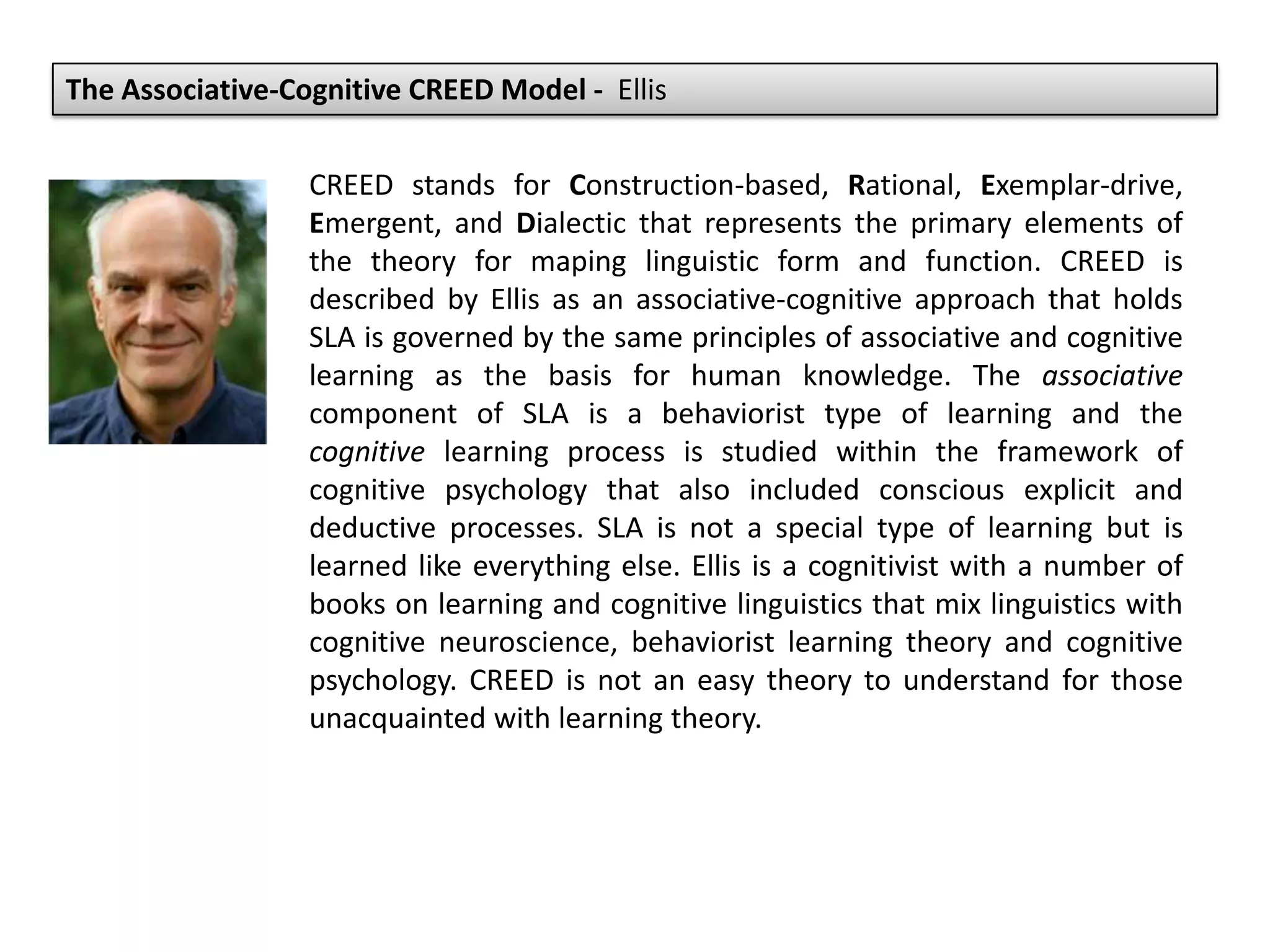
CREED stands for Construction-based, Rational, Exemplar-drive,
Emergent, and Dialectic that represents the primary elements of
the theory for maping linguistic form and function. CREED is
described by Ellis as an associative-cognitive approach that holds
SLA is governed by the same principles of associative and cognitive
learning as the basis for human knowledge. The associative
component of SLA is a behaviorist type of learning and the
cognitive learning process is studied within the framework of
cognitive psychology that also included conscious explicit and
deductive processes. SLA is not a special type of learning but is
learned like everything else. Ellis is a cognitivist with a number of
books on learning and cognitive linguistics that mix linguistics with
cognitive neuroscience, behaviorist learning theory and cognitive
psychology. CREED is not an easy theory to understand for those
unacquainted with learning theory.
The basic units of language representation are referred to as
constructions that are symbolic and define morphological, syntactic and
lexical from properties that are associated with particular language
functions (semantic, pragmatic, discourse). They range from a simple
greeting such as “hello” to more complex formulas such as counting
“one, two, three.” These patterns are fundamentally problematic because
they can be associated with more than one reality and requires a
unconscious process to evaluate the most probable
meaning. Constructions are based of specific lexical items that are
learned as the result of repeated usage. As a result, high frequency
constructions are readily processed compared to their low-frequency
counterparts demonstrate associative learns and is used to argue the
behaviorist framework for CREED. As such, a learner’s experience
develops expectancies (associations) in his perceptual system for certain
constructions based on the probability of their input occurrence. A
learner’s experience creates an expectation in his/her perceptual system
to expect certain constructions.
The Associative-Cognitive CREED Model - Ellis
A detector unit for new words signals (fires neuron) the word’s
presence when its features are present and then added to the
perceptual system. As a result, a virtual threshold is established that
increases its resting level and therefore requires less activation from
the environment to reach the new threshold to fire again when the
word features occur. In this sense, language learning is an intuitive
statistical learning problem involving words subject to pattern
recognition that recognizes sensory data, stores the information in
memory and modifies perceptual sensitivity to the occurrence and
features of words. For Ellis, the three fundamental influences on
cognition and language alike are 1) frequency, 2) recency and 3)
context.
The Associative-Cognitive CREED Model - Ellis
Emergentist approaches, including the CREED theory, are described by Ellis
as complex systems such as “weather” or “ecosystems: involve many parts
that interact with each other and are adaptive, dynamic and change
(emerge) over time such as the principles and parameters of UG. The
emergentist study of language acquisition is viewed as how these elements
emerge as perceptual, cognitive, motor and social functions. Emergent
language representation is based on a neural model with a highly plastic
initial state with genetic constraints on the neural network that responds to
input patterns through associative learning to provide native tongue fluency.
Ellis uses a meta-analysis study by Goldschneider and Dekeyser of 12
morpheme order studies as an exemplary study for his cognitive-associative
position. These pooled studies on acquisition order are used to support the
cognitive associative learning model for SLA.
The Associative-Cognitive CREED Model - Ellis
The ten observed findings in SLA summarize Ellis’ cognitive-associative CREED
model in pages 88-91. The observations stress the input-driven framework of
CREED that happens incidentally where learners know more about their world
than they are taught or aware such as seen in UG competence. Speech output
follows predictable SLA acquisition stages but learning has variable outcomes
that are dynamic conceptual categories and vary across lexical, morphological,
syntactical (and other) subsystems. Limits exist on the effects of input frequency,
learner’s first language, explicit instruction and output production in SLA.
Discussion Summary
Emergentism & Negative Evidence
*We posed the question, "how would emergentism view/explain the negative evidence
that plays a large role in UG theory?"
*Key points from the discussion
the primary role of positive evidence, and observability in emergentist
explanations of language acquisition
certain key differences between Universal Grammar Theory and
emergentist/connectionist viewssimilarities bewteen
o innatism - represented by a priori knowledge of language + an LAD-
type faculty in the brain + linguistic input = a grammar of a
lang. vs.
o pattern recognition - observable input + frequency statistics taking =
system of networked associations representing pattern extraction
similarities and differences between emergentism and behaviorism:
o behaviorism's view of language as stimulus + response
associations in the presence of reinforcement vs.
o emergentism's view of language as pattern extraction through
observable input
poverty-of-stimulus & creoles - how emergentism might treat indirect
negative evidence and language creation
cues and cue detection -salience of cues through reliability and
availability
the role of correction (direct negative evidence) in language acquisition -
how emergentism might explain this
*After an in-depth discussion, we decided that emergentism does have the
ability to explain and incorporate certain aspects of the negative evidence that
plays a vital role in UG/generativist views of language
Emergentism & Negative Evidence
*We posed the question, "how would emergentism view/explain the negative evidence that
plays a large role in UG theory?"
How is the parasitic view of transfer compared to CAH? How is parasitic view of transfer compared to
interlanguage? How the perspective of parasitic view of transfer affects your understanding of the role
of L1 in SLA? What are the implications for teaching?
One participant views such transfer under parasitism as akin to interlanguage
in that L1 has a strong influence on L2 acquisition as offering a certain kind of
foundation. An example is Spanish learners would use Spanish words in an
English syntax. Thus, Spanish lexicons are like parasiting on learners’ native
language structures. To this end, this participant proposed that offering
learners plenty negative examples of L2 rules and comparing them with the
correct forms is beneficial. Such knowledge may help learners monitor their
speech. Besides, one way to get positive input example is to interact with
fluent or native speakers. Finally, ample reading materials are equally
important in offering positive examples.
How is the parasitic view of transfer compared to CAH? How is parasitic view of transfer compared to
interlanguage? How the perspective of parasitic view of transfer affects your understanding of the role
of L1 in SLA? What are the implications for teaching?
Some other participant was also concerned about how MacWhinney’s
Parasitism compared to UG. One question being raised in the discussion is
that whether an error is caused by parasitism or by UG. In other words,
how do we know if an error is produced because the learner is
consciously drawing rules from L1 structures or because the learner is
having access to UG. Along this line of thinking, how can fossilized errors
and high plateau phenomenon be explained. To this end, this participant
quoted MacWhinney that the parasitism view may shed light on
explaining the declining ability in learning since L2 is built from the start
on L1. In other words, it may be hard to separate or insulate L1 and L2
completely.
How is the parasitic view of transfer compared to CAH? How is parasitic view of transfer compared to
interlanguage? How the perspective of parasitic view of transfer affects your understanding of the role
of L1 in SLA? What are the implications for teaching?
Another participant suggested we should investigate the origin of the Competition
Theory in order to better understand parasitism in SLA. This participant reminded us the
data-drive nature of the competition model in that by processing the data learner figure
out rules and patterns which would be strengthened. The strengthened rules or
patterns would allow internal grammar to emerge. Thus, rules emerge rather than occur
as the parameters setting. It is because of L1’s role in providing an existing well-
established conceptual representation, learners have great difficulties in making a new
and separate set of representations of L2. In relation to Contrastive Analysis, this
participant also pointed out errors would occur when L2 has no place to latch onto in
L1. Furthermore, frequency plays an important role in building L2 structures in that cue
strength is based on frequency of data. The teaching implication may be for teachers to
provide opportunities to exercise the functional neural circuits that would allow leaners
to stay in contact with the input. Example activities include monologues, word games,
poems, TV, radio programs, etc. And this participant favor the use of songs for they may
stuck in learners’ head for a long time.
How is the parasitic view of transfer compared to CAH? How is parasitic view of transfer compared to
interlanguage? How the perspective of parasitic view of transfer affects your understanding of the role
of L1 in SLA? What are the implications for teaching?
One more question generated from the discussion is whether errors are good
indicators of learners’ developmental stages. Does more error mean more reliance
on L1. One participant holds that errors are good indicators for predicting the
stages of learning. Yet, he/she has doubt that more errors mean more interference
is taking place. Furthermore, L1 L2 interference is not always a bad thing in that
learners don’t have to relearn certain aspects of syntax before they produce L2.
Another sound reason why errors should not be indicators of L1 reliance is that
some errors are due to natural order and developmental sequence.
Another interesting point made by one participant is the idea that learning
another language may help develop one’s knowledge of their L1. This participant
also indicate that interlanguage is a more friendly term in describing L1 and L2
relationship in that parasitism may have negative connotations as if one may harm
the other.
Discussion summary emergentism

Discussion summary emergentism

  • 1.
  • 2.
  • 3.
    Interlanguage Process -Gass and Selinker Connectionist/Emergentist Approaches The connectionist (also called constructivist) approach’s emphasis is on usage. It views language as the extraction of regularities or patterns from input. According to this approach, comprehension is determined by the statistical information the speaker or learner has about the linguistic items in their language, as opposed to a UG view that sees competence as a byproduct of an innate faculty, equipped with innate knowledge that forms underlying rules governing linguistic knowledge. Accordingly, connectionist approaches view learning as based on input alone, and the resultant ‘linguistic knowledge’ as a network of interconnected exemplars (see CREED summary).
  • 4.
    Interlanguage Process -Gass and Selinker Models of the Connectionism/Emergentism Approach Parallel Distributed Processing (PDP) PDP is a neural network model (biologically inspired), composed of nodes that are connected by pathways. These pathways are strengthened or weakened through activation or use (similar to the well-known Hebbian neuropsychology paraphrase: ‘neurons that fire together wire together’). According to PDP, learning happens in the network itself. The strength of associations change ‘as a function of interaction’ with the environment, which basically means that changes in the environmental input influence associations by making them stronger or weaker. In the case of an L1 speaker who already has an established network of fixed-strength associations based on the L1 linguistic input and cues, there is a distinct possibility of cross-linguistic interference of an L2 network.
  • 5.
    Competition Model This modelwas also discussed in the MacWhinney article. A fundamental view of this model is that forms cannot be separated from function, unlike in UG models. One of the main tenets of this model is that a variety of environmental cues are in compete, and contribute to different resolutions in sentence interpretation. Another tenet is that although the range of cues is universal, there are language-specific instantiation (evidence) of cues, and language-specific strength assigned to these cues. An example of this would be English’s relatively fixed word order, and L1 speaker’s reliance on this as a major cue for interpretation. In the event of ambiguity, or irregularity in an English sentence like ‘The grass eats the cow,’ a native English speaker would have to abandon the word order cue, and thus all other cues would come into competition to try to resolve an interpretation. This leads to the question in SLA of how learners adjust internal speech processing mechanisms from native-language-appropriate to target-language-appropriate. One possibility is that a learner’s initial hypothesis(-es) are consistent with native-language interpretations, thus relying heavily on native-language-prominent cues. Some research supports this (Sasaki 1991, 1994), but other research (Rounds and Kanagy, 1998) shows that it’s more complex than this. Interlanguage Process - Gass and Selinker
  • 6.
    Interlanguage Process -Gass and Selinker Problems with this Approach Processing Uniqueness - is there only this one way of arriving at an interpretation? Differences between syntax-based (ie. English) and meaning/pragmatic-based (ie. Italian, Japanese) languages - according to this view of language, certain languages have certain advantages over other languages in learning another particular language.
  • 7.
    The Competition Model:Input, Context, and the Brain – MacWhinney The competition model treats L1 and L2 acquisition as constructive, data-driven processes that rely not on universals of linguistic structures, but on universals of cognitive structures. Thus, learning and transfer instead of principles and parameters of UG are the main force in language acquisition. Within the competition framework, the input, the learner, and the context are the three components. The role of input would be analyzed using the concept of cue availability and reliability.
  • 8.
    The Input In competitionmodel, the claim of input is that cues and their reliability and availability would be detected in language comprehension. Cues with high reliability and availability would control comprehension strongly. Some cues include nominal case-marking, word order patterns, stress patterns, noun-verb agreement markers, clitic pronouns, and verb voice markings. Cues are used in select certain words for assignment to certain roles in a sentence. In other words, words compete for certain roles in a sentence which is also how the Competition Model gets its name. As to output, lexical items are activated in the neural network based on cues before they are put in the correct structures as if they are competing for certain places in a structure. However, it is worth pointing out that certain forms don’t always express the same function; therefore, the correlations on the level of forms and functions respectively are as important as the competition of forms for functions driven by cues. The cooperation and competition are driven by cue reliability which is the “conditional probability that an interpretation X should be selected given the presence of a cue Y, i. e. p(XIY). Y would be a reliable cue if the probability is high. Cue reliability includes four dimensions: Task frequency, availability, simple reliability, and conflict reliability. The Competition Model: Input, Context, and the Brain – MacWhinney
  • 9.
    The Competition Model:Input, Context, and the Brain – MacWhinney The Learner The Competition Model views the brain as a huge collection of neurons connected through axons which pass activation or inhibition to other connected neurons. From this perspective, the mental processing is viewed in terms of interaction and connection, rather than strict modularity and separation. The interconnected nature of brain promotes the transfer of information between emergent modules. The L1 well-organized neurolinguistic system is where the L2 new lexicon and phonology are parasitic, which indicates that L2 system relies on the L1 structures. By building direct linkage between new L2 forms and conceptual representations, the learner develops language acquisition. Another important aspect in SLA theory concerning the learner is that the brain loses its plasticity and capacity for new forms of learning. Neuronal commitment, related to the decline in flexibility as discussed in the theory of critical period, illustrates that “once a local neural area has been committed, it then takes in large amounts of input data that tightly tune the activation weights.” Furthermore, the competition model also provides an account of the difficulties in achieving automaticity in language acquisition. In addition, the problems caused by commitment and parasitism can be solved by relying on functional circuits. Functional circuits allow adult learners to maintain focused contact with certain aspects of input that can be used to correct negative transfer and to reduce the parasitism of L2 on L1. Finally, perspective-taking in neural processing is “that way in which language imposes demands on during sentence interpretation.” Perspective can be understood easily as the starting point from which the sentence can be interpreted. For example (my own), in “a black handmade Chinese water pot”, pot will be taken as the perspective since other lexicons kind of serve to make the meaning of pot fuller and specific.
  • 10.
    The Competition Model:Input, Context, and the Brain – MacWhinney The Context The third and final component of language learning system is the interactional context. The Competition Model holds that input should be maximized which can be supported socially. It is suggested that in situations where learners don’t have ample natural input, they should develop a system of “autosupport” by listening to TV, radio, movies, rehearsing taped dialogues, and direct study of grammatical theory.
  • 11.
    The Associative-Cognitive CREEDModel - Ellis CREED stands for Construction-based, Rational, Exemplar-drive, Emergent, and Dialectic that represents the primary elements of the theory for maping linguistic form and function. CREED is described by Ellis as an associative-cognitive approach that holds SLA is governed by the same principles of associative and cognitive learning as the basis for human knowledge. The associative component of SLA is a behaviorist type of learning and the cognitive learning process is studied within the framework of cognitive psychology that also included conscious explicit and deductive processes. SLA is not a special type of learning but is learned like everything else. Ellis is a cognitivist with a number of books on learning and cognitive linguistics that mix linguistics with cognitive neuroscience, behaviorist learning theory and cognitive psychology. CREED is not an easy theory to understand for those unacquainted with learning theory.
  • 12.
    The basic unitsof language representation are referred to as constructions that are symbolic and define morphological, syntactic and lexical from properties that are associated with particular language functions (semantic, pragmatic, discourse). They range from a simple greeting such as “hello” to more complex formulas such as counting “one, two, three.” These patterns are fundamentally problematic because they can be associated with more than one reality and requires a unconscious process to evaluate the most probable meaning. Constructions are based of specific lexical items that are learned as the result of repeated usage. As a result, high frequency constructions are readily processed compared to their low-frequency counterparts demonstrate associative learns and is used to argue the behaviorist framework for CREED. As such, a learner’s experience develops expectancies (associations) in his perceptual system for certain constructions based on the probability of their input occurrence. A learner’s experience creates an expectation in his/her perceptual system to expect certain constructions. The Associative-Cognitive CREED Model - Ellis
  • 13.
    The Associative-Cognitive CREEDModel - Ellis A detector unit for new words signals (fires neuron) the word’s presence when its features are present and then added to the perceptual system. As a result, a virtual threshold is established that increases its resting level and therefore requires less activation from the environment to reach the new threshold to fire again when the word features occur. In this sense, language learning is an intuitive statistical learning problem involving words subject to pattern recognition that recognizes sensory data, stores the information in memory and modifies perceptual sensitivity to the occurrence and features of words. For Ellis, the three fundamental influences on cognition and language alike are 1) frequency, 2) recency and 3) context.
  • 14.
    The Associative-Cognitive CREEDModel - Ellis Emergentist approaches, including the CREED theory, are described by Ellis as complex systems such as “weather” or “ecosystems: involve many parts that interact with each other and are adaptive, dynamic and change (emerge) over time such as the principles and parameters of UG. The emergentist study of language acquisition is viewed as how these elements emerge as perceptual, cognitive, motor and social functions. Emergent language representation is based on a neural model with a highly plastic initial state with genetic constraints on the neural network that responds to input patterns through associative learning to provide native tongue fluency. Ellis uses a meta-analysis study by Goldschneider and Dekeyser of 12 morpheme order studies as an exemplary study for his cognitive-associative position. These pooled studies on acquisition order are used to support the cognitive associative learning model for SLA.
  • 15.
    The Associative-Cognitive CREEDModel - Ellis The ten observed findings in SLA summarize Ellis’ cognitive-associative CREED model in pages 88-91. The observations stress the input-driven framework of CREED that happens incidentally where learners know more about their world than they are taught or aware such as seen in UG competence. Speech output follows predictable SLA acquisition stages but learning has variable outcomes that are dynamic conceptual categories and vary across lexical, morphological, syntactical (and other) subsystems. Limits exist on the effects of input frequency, learner’s first language, explicit instruction and output production in SLA.
  • 16.
  • 17.
    Emergentism & NegativeEvidence *We posed the question, "how would emergentism view/explain the negative evidence that plays a large role in UG theory?" *Key points from the discussion the primary role of positive evidence, and observability in emergentist explanations of language acquisition certain key differences between Universal Grammar Theory and emergentist/connectionist viewssimilarities bewteen o innatism - represented by a priori knowledge of language + an LAD- type faculty in the brain + linguistic input = a grammar of a lang. vs. o pattern recognition - observable input + frequency statistics taking = system of networked associations representing pattern extraction similarities and differences between emergentism and behaviorism: o behaviorism's view of language as stimulus + response associations in the presence of reinforcement vs. o emergentism's view of language as pattern extraction through observable input
  • 18.
    poverty-of-stimulus & creoles- how emergentism might treat indirect negative evidence and language creation cues and cue detection -salience of cues through reliability and availability the role of correction (direct negative evidence) in language acquisition - how emergentism might explain this *After an in-depth discussion, we decided that emergentism does have the ability to explain and incorporate certain aspects of the negative evidence that plays a vital role in UG/generativist views of language Emergentism & Negative Evidence *We posed the question, "how would emergentism view/explain the negative evidence that plays a large role in UG theory?"
  • 19.
    How is theparasitic view of transfer compared to CAH? How is parasitic view of transfer compared to interlanguage? How the perspective of parasitic view of transfer affects your understanding of the role of L1 in SLA? What are the implications for teaching? One participant views such transfer under parasitism as akin to interlanguage in that L1 has a strong influence on L2 acquisition as offering a certain kind of foundation. An example is Spanish learners would use Spanish words in an English syntax. Thus, Spanish lexicons are like parasiting on learners’ native language structures. To this end, this participant proposed that offering learners plenty negative examples of L2 rules and comparing them with the correct forms is beneficial. Such knowledge may help learners monitor their speech. Besides, one way to get positive input example is to interact with fluent or native speakers. Finally, ample reading materials are equally important in offering positive examples.
  • 20.
    How is theparasitic view of transfer compared to CAH? How is parasitic view of transfer compared to interlanguage? How the perspective of parasitic view of transfer affects your understanding of the role of L1 in SLA? What are the implications for teaching? Some other participant was also concerned about how MacWhinney’s Parasitism compared to UG. One question being raised in the discussion is that whether an error is caused by parasitism or by UG. In other words, how do we know if an error is produced because the learner is consciously drawing rules from L1 structures or because the learner is having access to UG. Along this line of thinking, how can fossilized errors and high plateau phenomenon be explained. To this end, this participant quoted MacWhinney that the parasitism view may shed light on explaining the declining ability in learning since L2 is built from the start on L1. In other words, it may be hard to separate or insulate L1 and L2 completely.
  • 21.
    How is theparasitic view of transfer compared to CAH? How is parasitic view of transfer compared to interlanguage? How the perspective of parasitic view of transfer affects your understanding of the role of L1 in SLA? What are the implications for teaching? Another participant suggested we should investigate the origin of the Competition Theory in order to better understand parasitism in SLA. This participant reminded us the data-drive nature of the competition model in that by processing the data learner figure out rules and patterns which would be strengthened. The strengthened rules or patterns would allow internal grammar to emerge. Thus, rules emerge rather than occur as the parameters setting. It is because of L1’s role in providing an existing well- established conceptual representation, learners have great difficulties in making a new and separate set of representations of L2. In relation to Contrastive Analysis, this participant also pointed out errors would occur when L2 has no place to latch onto in L1. Furthermore, frequency plays an important role in building L2 structures in that cue strength is based on frequency of data. The teaching implication may be for teachers to provide opportunities to exercise the functional neural circuits that would allow leaners to stay in contact with the input. Example activities include monologues, word games, poems, TV, radio programs, etc. And this participant favor the use of songs for they may stuck in learners’ head for a long time.
  • 22.
    How is theparasitic view of transfer compared to CAH? How is parasitic view of transfer compared to interlanguage? How the perspective of parasitic view of transfer affects your understanding of the role of L1 in SLA? What are the implications for teaching? One more question generated from the discussion is whether errors are good indicators of learners’ developmental stages. Does more error mean more reliance on L1. One participant holds that errors are good indicators for predicting the stages of learning. Yet, he/she has doubt that more errors mean more interference is taking place. Furthermore, L1 L2 interference is not always a bad thing in that learners don’t have to relearn certain aspects of syntax before they produce L2. Another sound reason why errors should not be indicators of L1 reliance is that some errors are due to natural order and developmental sequence. Another interesting point made by one participant is the idea that learning another language may help develop one’s knowledge of their L1. This participant also indicate that interlanguage is a more friendly term in describing L1 and L2 relationship in that parasitism may have negative connotations as if one may harm the other.