Computer Organisation and
Architecture
Course Code: CO206
Module-5- Input Output Organisation-Modes of Transfer
Dr. Pawan Singh Mehra
Asst. Professor
Dept. of CSE
1
By
Dr.
Pawan
Singh
Mehra
Contents of Module 5
Programmed I/O
Interrupt initiated I/O
Direct Memory Access
I/O Channels and Processors
Serial Communication: Synchronous Communication
Asynchronous Communication
Standard Communication Interfaces
2
By
Dr.
Pawan
Singh
Mehra
Modes of Data Transfer in I/O
3
Programmed I/O
Interrupt Driven I/O
Direct Memory Access(DMA)
By
Dr.
Pawan
Singh
Mehra
Programmed I/O
4
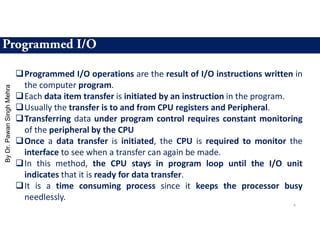
Programmed I/O operations are the result of I/O instructions written in
the computer program.
Each data item transfer is initiated by an instruction in the program.
Usually the transfer is to and from CPU registers and Peripheral.
Transferring data under program control requires constant monitoring
of the peripheral by the CPU
Once a data transfer is initiated, the CPU is required to monitor the
interface to see when a transfer can again be made.
In this method, the CPU stays in program loop until the I/O unit
indicates that it is ready for data transfer.
It is a time consuming process since it keeps the processor busy
needlessly.
By
Dr.
Pawan
Singh
Mehra
Programmed I/O
5
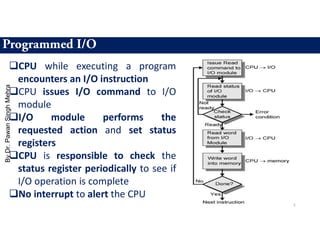
CPU while executing a program
encounters an I/O instruction
CPU issues I/O command to I/O
module
I/O module performs the
requested action and set status
registers
CPU is responsible to check the
status register periodically to see if
I/O operation is complete
No interrupt to alert the CPU
By
Dr.
Pawan
Singh
Mehra
Interrupt Initiated I/O
6
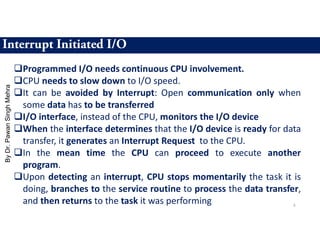
Programmed I/O needs continuous CPU involvement.
CPU needs to slow down to I/O speed.
It can be avoided by Interrupt: Open communication only when
some data has to be transferred
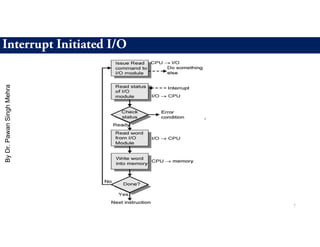
I/O interface, instead of the CPU, monitors the I/O device
When the interface determines that the I/O device is ready for data
transfer, it generates an Interrupt Request to the CPU.
In the mean time the CPU can proceed to execute another
program.
Upon detecting an interrupt, CPU stops momentarily the task it is
doing, branches to the service routine to process the data transfer,
and then returns to the task it was performing
By
Dr.
Pawan
Singh
Mehra
Interrupt Initiated I/O
7
By
Dr.
Pawan
Singh
Mehra
Direct Memory Access
8
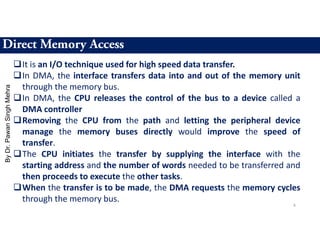
It is an I/O technique used for high speed data transfer.
In DMA, the interface transfers data into and out of the memory unit
through the memory bus.
In DMA, the CPU releases the control of the bus to a device called a
DMA controller
Removing the CPU from the path and letting the peripheral device
manage the memory buses directly would improve the speed of
transfer.
The CPU initiates the transfer by supplying the interface with the
starting address and the number of words needed to be transferred and
then proceeds to execute the other tasks.
When the transfer is to be made, the DMA requests the memory cycles
through the memory bus.
By
Dr.
Pawan
Singh
Mehra
Direct Memory Access
9
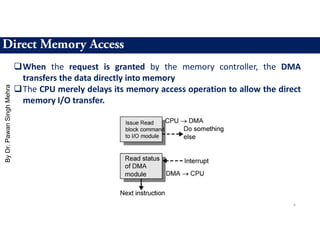
When the request is granted by the memory controller, the DMA
transfers the data directly into memory
The CPU merely delays its memory access operation to allow the direct
memory I/O transfer.
By
Dr.
Pawan
Singh
Mehra
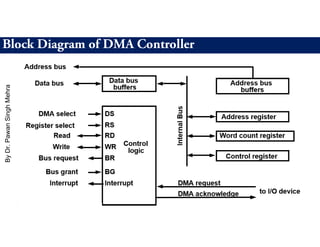
Block Diagram of DMA Controller
10
By
Dr.
Pawan
Singh
Mehra
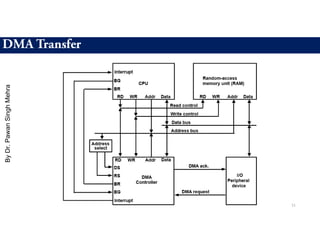
DMA Transfer
11
By
Dr.
Pawan
Singh
Mehra
Burst Transfer and Cycle Stealing
12
When the DMA takes control of the bus system, it communicates
directly with the memory. The transfer can be made in several ways.
In DMA burst transfer, a block sequence consisting of a number of
memory words is transferred in a continuous burst while the DMA
controller is master of the memory buses.
This mode of transfer is needed for fast devices such as magnetic disks,
where data transmission cannot be stopped or slowed down until an
entire block is transferred.
An alternative technique called cycle stealing allows the DMA controller
to transfer one data word at a time, after which it must return control
of the buses to the CPU.
The CPU merely delays its operation for one memory cycle to allow the
direct memory I/O transfer to “steal” one memory cycle.
By
Dr.
Pawan
Singh
Mehra
I/O Processors
13
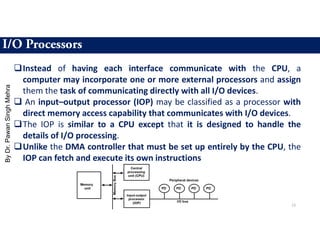
Instead of having each interface communicate with the CPU, a
computer may incorporate one or more external processors and assign
them the task of communicating directly with all I/O devices.
 An input–output processor (IOP) may be classified as a processor with
direct memory access capability that communicates with I/O devices.
The IOP is similar to a CPU except that it is designed to handle the
details of I/O processing.
Unlike the DMA controller that must be set up entirely by the CPU, the
IOP can fetch and execute its own instructions
By
Dr.
Pawan
Singh
Mehra
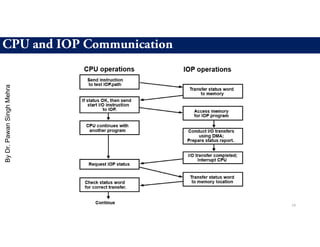
CPU and IOP Communication
14
By
Dr.
Pawan
Singh
Mehra

modes of transfer computer architecture.

  • 1.
    Computer Organisation and Architecture CourseCode: CO206 Module-5- Input Output Organisation-Modes of Transfer Dr. Pawan Singh Mehra Asst. Professor Dept. of CSE 1 By Dr. Pawan Singh Mehra
  • 2.
    Contents of Module5 Programmed I/O Interrupt initiated I/O Direct Memory Access I/O Channels and Processors Serial Communication: Synchronous Communication Asynchronous Communication Standard Communication Interfaces 2 By Dr. Pawan Singh Mehra
  • 3.
    Modes of DataTransfer in I/O 3 Programmed I/O Interrupt Driven I/O Direct Memory Access(DMA) By Dr. Pawan Singh Mehra
  • 4.
    Programmed I/O 4 Programmed I/Ooperations are the result of I/O instructions written in the computer program. Each data item transfer is initiated by an instruction in the program. Usually the transfer is to and from CPU registers and Peripheral. Transferring data under program control requires constant monitoring of the peripheral by the CPU Once a data transfer is initiated, the CPU is required to monitor the interface to see when a transfer can again be made. In this method, the CPU stays in program loop until the I/O unit indicates that it is ready for data transfer. It is a time consuming process since it keeps the processor busy needlessly. By Dr. Pawan Singh Mehra
  • 5.
    Programmed I/O 5 CPU whileexecuting a program encounters an I/O instruction CPU issues I/O command to I/O module I/O module performs the requested action and set status registers CPU is responsible to check the status register periodically to see if I/O operation is complete No interrupt to alert the CPU By Dr. Pawan Singh Mehra
  • 6.
    Interrupt Initiated I/O 6 ProgrammedI/O needs continuous CPU involvement. CPU needs to slow down to I/O speed. It can be avoided by Interrupt: Open communication only when some data has to be transferred I/O interface, instead of the CPU, monitors the I/O device When the interface determines that the I/O device is ready for data transfer, it generates an Interrupt Request to the CPU. In the mean time the CPU can proceed to execute another program. Upon detecting an interrupt, CPU stops momentarily the task it is doing, branches to the service routine to process the data transfer, and then returns to the task it was performing By Dr. Pawan Singh Mehra
  • 7.
  • 8.
    Direct Memory Access 8 Itis an I/O technique used for high speed data transfer. In DMA, the interface transfers data into and out of the memory unit through the memory bus. In DMA, the CPU releases the control of the bus to a device called a DMA controller Removing the CPU from the path and letting the peripheral device manage the memory buses directly would improve the speed of transfer. The CPU initiates the transfer by supplying the interface with the starting address and the number of words needed to be transferred and then proceeds to execute the other tasks. When the transfer is to be made, the DMA requests the memory cycles through the memory bus. By Dr. Pawan Singh Mehra
  • 9.
    Direct Memory Access 9 Whenthe request is granted by the memory controller, the DMA transfers the data directly into memory The CPU merely delays its memory access operation to allow the direct memory I/O transfer. By Dr. Pawan Singh Mehra
  • 10.
    Block Diagram ofDMA Controller 10 By Dr. Pawan Singh Mehra
  • 11.
  • 12.
    Burst Transfer andCycle Stealing 12 When the DMA takes control of the bus system, it communicates directly with the memory. The transfer can be made in several ways. In DMA burst transfer, a block sequence consisting of a number of memory words is transferred in a continuous burst while the DMA controller is master of the memory buses. This mode of transfer is needed for fast devices such as magnetic disks, where data transmission cannot be stopped or slowed down until an entire block is transferred. An alternative technique called cycle stealing allows the DMA controller to transfer one data word at a time, after which it must return control of the buses to the CPU. The CPU merely delays its operation for one memory cycle to allow the direct memory I/O transfer to “steal” one memory cycle. By Dr. Pawan Singh Mehra
  • 13.
    I/O Processors 13 Instead ofhaving each interface communicate with the CPU, a computer may incorporate one or more external processors and assign them the task of communicating directly with all I/O devices.  An input–output processor (IOP) may be classified as a processor with direct memory access capability that communicates with I/O devices. The IOP is similar to a CPU except that it is designed to handle the details of I/O processing. Unlike the DMA controller that must be set up entirely by the CPU, the IOP can fetch and execute its own instructions By Dr. Pawan Singh Mehra
  • 14.
    CPU and IOPCommunication 14 By Dr. Pawan Singh Mehra