www.arabnubia.com
Modern Mining
December 2015
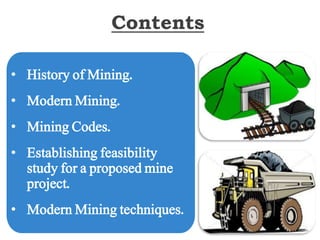
• History of Mining.
• Modern Mining.
• Mining Codes.
• Establishing feasibility
study for a proposed mine
project.
• Modern Mining techniques.
Contents
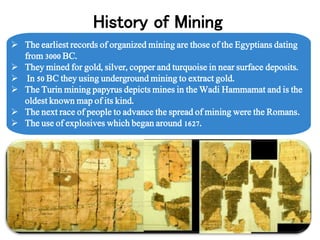
 The earliest records of organized mining are those of the Egyptians dating
from 3000 BC.
 They mined for gold, silver, copper and turquoise in near surface deposits.
 In 50 BC they using underground mining to extract gold.
 The Turin mining papyrus depicts mines in the Wadi Hammamat and is the
oldest known map of its kind.
 The next race of people to advance the spread of mining were the Romans.
 The use of explosives which began around 1627.
History of Mining
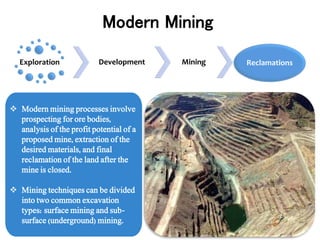
 Modern mining processes involve
prospecting for ore bodies,
analysis of the profit potential of a
proposed mine, extraction of the
desired materials, and final
reclamation of the land after the
mine is closed.
 Mining techniques can be divided
into two common excavation
types: surface mining and sub-
surface (underground) mining.
Modern Mining
Exploration Development Mining Reclamations
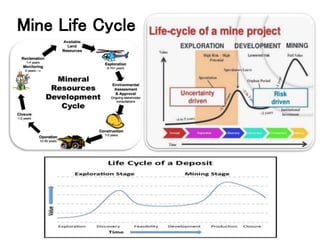
Mine Life Cycle
Exploration
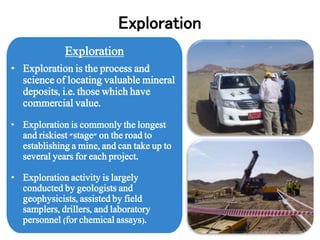
• Exploration is the process and
science of locating valuable mineral
deposits, i.e. those which have
commercial value.
• Exploration is commonly the longest
and riskiest "stage" on the road to
establishing a mine, and can take up to
several years for each project.
• Exploration activity is largely
conducted by geologists and
geophysicists, assisted by field
samplers, drillers, and laboratory
personnel (for chemical assays).
Exploration
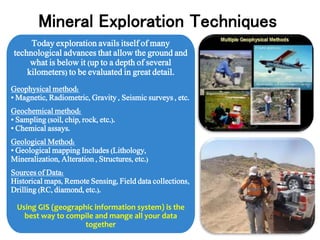
Today exploration avails itself of many
technological advances that allow the ground and
what is below it (up to a depth of several
kilometers) to be evaluated in great detail.
Geophysical method:
• Magnetic, Radiometric, Gravity , Seismic surveys , etc.
Geochemical method:
• Sampling (soil, chip, rock, etc.).
• Chemical assays.
Geological Method:
• Geological mapping Includes (Lithology,
Mineralization, Alteration , Structures, etc.)
Sources of Data:
Historical maps, Remote Sensing, Field data collections,
Drilling (RC, diamond, etc.).
Using GIS (geographic information system) is the
best way to compile and mange all your data
together
Mineral Exploration Techniques
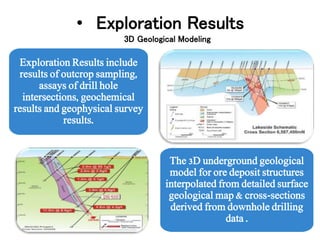
Exploration Results include
results of outcrop sampling,
assays of drill hole
intersections, geochemical
results and geophysical survey
results.
3D Geological Modeling
The 3D underground geological
model for ore deposit structures
interpolated from detailed surface
geological map & cross-sections
derived from downhole drilling
data .
• Exploration Results
• Mineral Resource
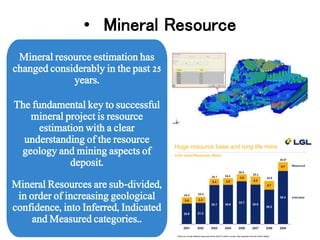
Mineral resource estimation has
changed considerably in the past 25
years.
The fundamental key to successful
mineral project is resource
estimation with a clear
understanding of the resource
geology and mining aspects of
deposit.
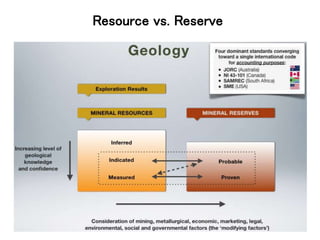
Mineral Resources are sub-divided,
in order of increasing geological
confidence, into Inferred, Indicated
and Measured categories..
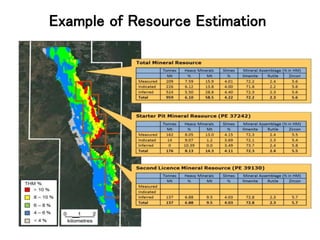
Example of Resource Estimation
• Mineral Reserve
Ore Reserves are those
portions of Mineral
Resources that, after the
application of all Modifying
Factors, result in an
estimated tonnage and grade
Ore Reserves are sub-
divided in order of increasing
confidence into Probable Ore
Reserves and Proved Ore
Reserves.
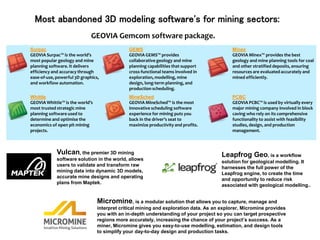
Most abandoned 3D modeling software's for mining sectors:
Surpac
GEOVIA Surpac™ is the world’s
most popular geology and mine
planning software. It delivers
efficiency and accuracy through
ease-of-use, powerful 3D graphics,
and workflow automation.
GEMS
GEOVIA GEMS™ provides
collaborative geology and mine
planning capabilities that support
cross-functional teams involved in
exploration, modelling, mine
design, long-term planning, and
production scheduling.
Minex
GEOVIA Minex™ provides the best
geology and mine planning tools for coal
and other stratified deposits, ensuring
resources are evaluated accurately and
mined efficiently.
Whittle
GEOVIA Whittle™ is the world’s
most trusted strategic mine
planning software used to
determine and optimise the
economics of open pit mining
projects.
MineSched
GEOVIA MineSched™ is the most
innovative scheduling software
experience for mining puts you
back in the driver’s seat to
maximize productivity and profits.
PCBC
GEOVIA PCBC™ is used by virtually every
major mining company involved in block
caving who rely on its comprehensive
functionality to assist with feasibility
studies, design, and production
management.
GEOVIA Gemcom software package.
Vulcan, the premier 3D mining
software solution in the world, allows
users to validate and transform raw
mining data into dynamic 3D models,
accurate mine designs and operating
plans from Maptek.
Leapfrog Geo, is a workflow
solution for geological modelling. It
harnesses the full power of the
Leapfrog engine, to create the time
and opportunity to reduce risk
associated with geological modelling..
Micromine, is a modular solution that allows you to capture, manage and
interpret critical mining and exploration data. As an explorer, Micromine provides
you with an in-depth understanding of your project so you can target prospective
regions more accurately, increasing the chance of your project’s success. As a
miner, Micromine gives you easy-to-use modelling, estimation, and design tools
to simplify your day-to-day design and production tasks.
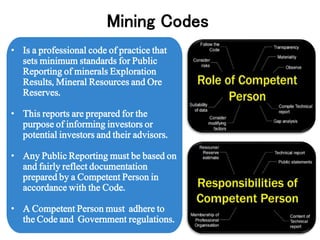
• Is a professional code of practice that
sets minimum standards for Public
Reporting of minerals Exploration
Results, Mineral Resources and Ore
Reserves.
• This reports are prepared for the
purpose of informing investors or
potential investors and their advisors.
• Any Public Reporting must be based on
and fairly reflect documentation
prepared by a Competent Person in
accordance with the Code.
• A Competent Person must adhere to
the Code and Government regulations.
Mining Codes
Resource vs. Reserve
Establishing feasibility study for a proposed
mine project
“Mining is more prone to risk than most businesses and often
projects initiated fail to achieve their expectations in terms of
cost and timing of project or operational performance such as
the size of reserves or grade recovery”
• Collecting more data about your mine project at the exploration stage
could reduce the risk of your mining stage and help taking the right
decision about your investment direction.
• The Feasibility study should defines the ore reserves, the mining
methods, the mineral processing concepts and the scale of the project.
Project Evaluation
Phases of the development of a mineral project
• Scoping Studies
• Pre-feasibility studies
• Full Feasibility studies
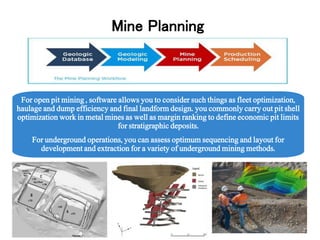
Mine Planning
For open pit mining , software allows you to consider such things as fleet optimization,
haulage and dump efficiency and final landform design. you commonly carry out pit shell
optimization work in metal mines as well as margin ranking to define economic pit limits
for stratigraphic deposits.
For underground operations, you can assess optimum sequencing and layout for
development and extraction for a variety of underground mining methods.
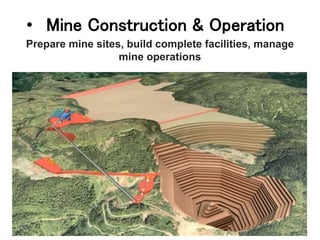
• Mine Construction & Operation
Prepare mine sites, build complete facilities, manage
mine operations
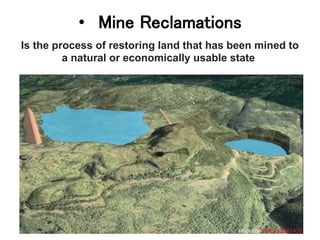
• Mine Reclamations
Is the process of restoring land that has been mined to
a natural or economically usable state

Modern mining

  • 1.
  • 2.
    • History ofMining. • Modern Mining. • Mining Codes. • Establishing feasibility study for a proposed mine project. • Modern Mining techniques. Contents
  • 3.
     The earliestrecords of organized mining are those of the Egyptians dating from 3000 BC.  They mined for gold, silver, copper and turquoise in near surface deposits.  In 50 BC they using underground mining to extract gold.  The Turin mining papyrus depicts mines in the Wadi Hammamat and is the oldest known map of its kind.  The next race of people to advance the spread of mining were the Romans.  The use of explosives which began around 1627. History of Mining
  • 4.
     Modern miningprocesses involve prospecting for ore bodies, analysis of the profit potential of a proposed mine, extraction of the desired materials, and final reclamation of the land after the mine is closed.  Mining techniques can be divided into two common excavation types: surface mining and sub- surface (underground) mining. Modern Mining Exploration Development Mining Reclamations
  • 5.
  • 6.
    Exploration • Exploration isthe process and science of locating valuable mineral deposits, i.e. those which have commercial value. • Exploration is commonly the longest and riskiest "stage" on the road to establishing a mine, and can take up to several years for each project. • Exploration activity is largely conducted by geologists and geophysicists, assisted by field samplers, drillers, and laboratory personnel (for chemical assays). Exploration
  • 7.
    Today exploration availsitself of many technological advances that allow the ground and what is below it (up to a depth of several kilometers) to be evaluated in great detail. Geophysical method: • Magnetic, Radiometric, Gravity , Seismic surveys , etc. Geochemical method: • Sampling (soil, chip, rock, etc.). • Chemical assays. Geological Method: • Geological mapping Includes (Lithology, Mineralization, Alteration , Structures, etc.) Sources of Data: Historical maps, Remote Sensing, Field data collections, Drilling (RC, diamond, etc.). Using GIS (geographic information system) is the best way to compile and mange all your data together Mineral Exploration Techniques
  • 8.
    Exploration Results include resultsof outcrop sampling, assays of drill hole intersections, geochemical results and geophysical survey results. 3D Geological Modeling The 3D underground geological model for ore deposit structures interpolated from detailed surface geological map & cross-sections derived from downhole drilling data . • Exploration Results
  • 9.
    • Mineral Resource Mineralresource estimation has changed considerably in the past 25 years. The fundamental key to successful mineral project is resource estimation with a clear understanding of the resource geology and mining aspects of deposit. Mineral Resources are sub-divided, in order of increasing geological confidence, into Inferred, Indicated and Measured categories..
  • 10.
  • 11.
    • Mineral Reserve OreReserves are those portions of Mineral Resources that, after the application of all Modifying Factors, result in an estimated tonnage and grade Ore Reserves are sub- divided in order of increasing confidence into Probable Ore Reserves and Proved Ore Reserves.
  • 12.
    Most abandoned 3Dmodeling software's for mining sectors: Surpac GEOVIA Surpac™ is the world’s most popular geology and mine planning software. It delivers efficiency and accuracy through ease-of-use, powerful 3D graphics, and workflow automation. GEMS GEOVIA GEMS™ provides collaborative geology and mine planning capabilities that support cross-functional teams involved in exploration, modelling, mine design, long-term planning, and production scheduling. Minex GEOVIA Minex™ provides the best geology and mine planning tools for coal and other stratified deposits, ensuring resources are evaluated accurately and mined efficiently. Whittle GEOVIA Whittle™ is the world’s most trusted strategic mine planning software used to determine and optimise the economics of open pit mining projects. MineSched GEOVIA MineSched™ is the most innovative scheduling software experience for mining puts you back in the driver’s seat to maximize productivity and profits. PCBC GEOVIA PCBC™ is used by virtually every major mining company involved in block caving who rely on its comprehensive functionality to assist with feasibility studies, design, and production management. GEOVIA Gemcom software package. Vulcan, the premier 3D mining software solution in the world, allows users to validate and transform raw mining data into dynamic 3D models, accurate mine designs and operating plans from Maptek. Leapfrog Geo, is a workflow solution for geological modelling. It harnesses the full power of the Leapfrog engine, to create the time and opportunity to reduce risk associated with geological modelling.. Micromine, is a modular solution that allows you to capture, manage and interpret critical mining and exploration data. As an explorer, Micromine provides you with an in-depth understanding of your project so you can target prospective regions more accurately, increasing the chance of your project’s success. As a miner, Micromine gives you easy-to-use modelling, estimation, and design tools to simplify your day-to-day design and production tasks.
  • 13.
    • Is aprofessional code of practice that sets minimum standards for Public Reporting of minerals Exploration Results, Mineral Resources and Ore Reserves. • This reports are prepared for the purpose of informing investors or potential investors and their advisors. • Any Public Reporting must be based on and fairly reflect documentation prepared by a Competent Person in accordance with the Code. • A Competent Person must adhere to the Code and Government regulations. Mining Codes
  • 14.
  • 15.
    Establishing feasibility studyfor a proposed mine project “Mining is more prone to risk than most businesses and often projects initiated fail to achieve their expectations in terms of cost and timing of project or operational performance such as the size of reserves or grade recovery” • Collecting more data about your mine project at the exploration stage could reduce the risk of your mining stage and help taking the right decision about your investment direction. • The Feasibility study should defines the ore reserves, the mining methods, the mineral processing concepts and the scale of the project. Project Evaluation Phases of the development of a mineral project • Scoping Studies • Pre-feasibility studies • Full Feasibility studies
  • 16.
    Mine Planning For openpit mining , software allows you to consider such things as fleet optimization, haulage and dump efficiency and final landform design. you commonly carry out pit shell optimization work in metal mines as well as margin ranking to define economic pit limits for stratigraphic deposits. For underground operations, you can assess optimum sequencing and layout for development and extraction for a variety of underground mining methods.
  • 17.
    • Mine Construction& Operation Prepare mine sites, build complete facilities, manage mine operations
  • 18.
    • Mine Reclamations Isthe process of restoring land that has been mined to a natural or economically usable state