Introduction to MIning
Mine: an excavation made in the earth to
extract minerals
Mining: the activity,occupation,and industry
concerned with the extraction of minerals
Mining engineering: the practice of applying
engineering principles to the development,
planning, operation,closure, and reclamation
of mines
2.
Mineral: anaturally occurring inorganic
element or compound having an orderly
internal structure and a characteristic
chemical composition, crystal form,and
physical properties
Rock: any naturally formed aggregate of one
or more types of mineral particles
3.
Ore: amineral deposit that has sufficient
utility and value to be mined at a profit.
Gangue: the valueless mineral particles
within an ore deposit that must be discarded.
Waste: the material associated with an ore
deposit that must be mined to get at the ore
and must then be discarded. Gangue is a
particular type of waste.
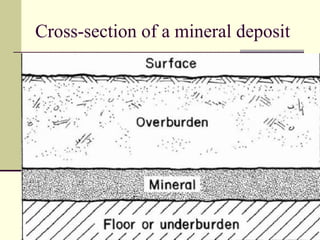
Overburden: the overlying rock strata above
mineral deposit
STAGES IN THELIFE OF A MINE
The overall sequence of activities in modern
mining is often compared with the five stages
in the life of a mine: prospecting, exploration,
development, exploitation, and reclamation/
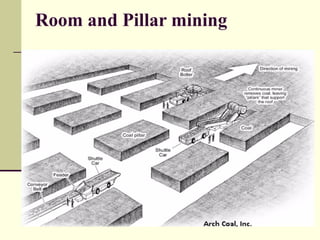
mine closure activities.
6.
Prospecting
The crustof the Earth is made of rocks and minerals,
and many minerals can be found with little difficulty.
In general, the challenge is not finding the mineral of
interest; but rather finding an economic concentration
of the mineral.
Despite the fact that minerals are everywhere, it is a
rarity to find most of them in sufficient concentration
to justify the cost of developing a mine and extracting
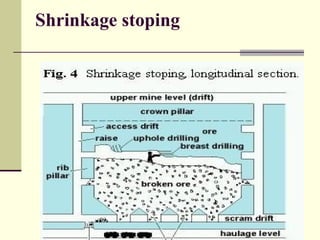
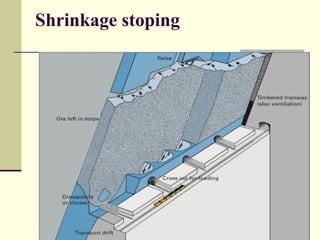
the mineral of interest.
In most instances, prospecting is about finding
geologic anomalies! The professionals that lead this
first stage of the life cycle are geoscientists, e.g.,
geologists, geochemists, and geophysicists.
7.
Prospecting
Prospecting, thefirst stage in the Life cycle of a mine,
is the search for ores or other valuable minerals (coal
or nonmetallics).
Because mineral deposits may be located either at or
below the surface of the earth, both direct and
indirect prospecting techniques are employed.
The direct method of discovery, normally limited to
surface deposits, consists of visual examination of
either the exposure (outcrop) of the deposit or the
loose fragments (float) that have weathered away
from the outcrop.
8.
Prospecting
Prospecting, thefirst stage in the utilization of a
mineral deposit, is the search for ores or other
valuable minerals (coal or nonmetallics).
Because mineral deposits may be located either at or
below the surface of the earth, both direct and
indirect prospecting techniques are employed.
The direct method of discovery, normally limited to
surface deposits, consists of visual examination of
either the exposure (outcrop) of the deposit or the
loose fragments (float) that have weathered away
from the outcrop.
9.
Prospecting
By meansof aerial photography, geologic maps, and
structural assessment of an area, drilling, prospecting
trenches etc. the geologist gathers evidence by direct
methods to locate mineral deposits.
Precise mapping and structural analysis plus
microscopic studies of samples also enable the
geologist to locate the hidden as well as surface
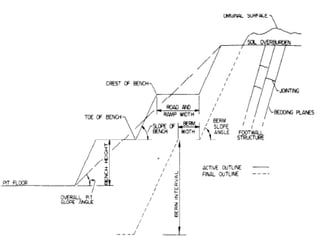
mineralization.
Geophysics, the science of detecting anomalies
using physical measurements of gravitational,
seismic, magnetic, electrical, electromagnetic, and
radiometric variables of the earth. The methods are
applied from the air, using aircraft and satellites; on
the surface of the earth; and beneath the earth.
10.
Exploration
The secondstage in the life of a mine, exploration,
determines as accurately as possible the size and
value of a mineral deposit, utilizing techniques similar
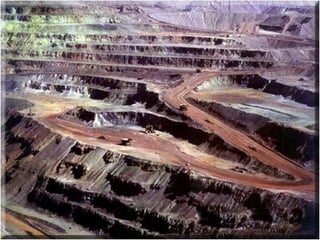
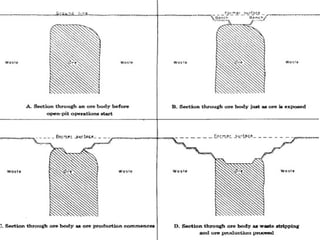
to but more refined than those used in prospecting.
Exploration generally shifts to surface and subsurface
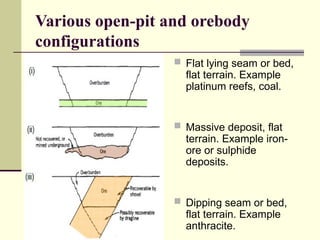
locations, using a variety of measurements to obtain
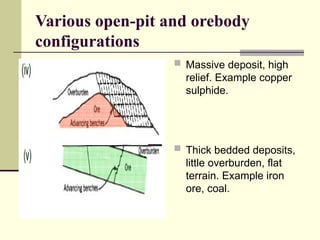
a more positive picture of the extent and grade of the
ore body.
Representative samples may be subjected to
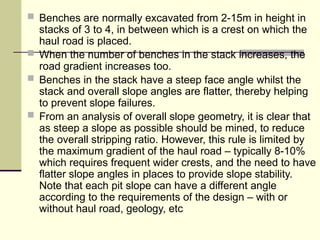
chemical, metallurgical, X ray, spectrographic, or
radiometric evaluation techniques that are meant to
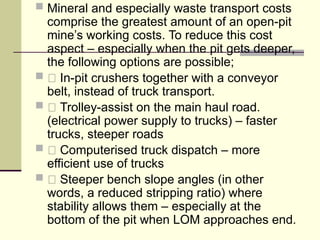
enhance the investigator’s knowledge of the mineral
deposit.
Samples are also obtained by chipping outcrops,
trenching, tunneling,and drilling methods.
11.
Exploration
In addition,borehole logs may be provided to study
the geologic and structural makeup of the deposit.
Rotary, percussion, or diamond drills can be used for
exploration purposes. However, diamond drills are
favored because the cores they yield provide
knowledge of the geologic structure.
An evaluation of the samples enables the geologist or
mining engineer to calculate the tonnage and grade,
or richness, of the mineral deposit.
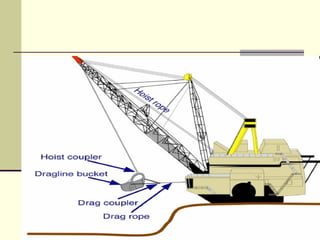
Estimation of mining costs, evaluation of recovery of
the valuable minerals, associated environmental
costs, and assessment of other foreseeable factors in
an effort helps in reaching a conclusion about the
profitability of the mineral deposit.
12.
Development
In thethird stage, development, the work of opening a
mineral deposit for exploitation is performed. With it
begins the actual mining of the deposit, now called the
ore.
We have a deposit that we believe is economically viable.
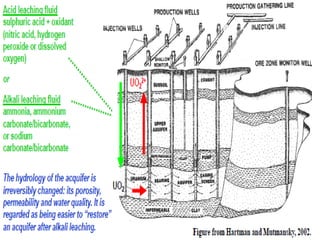
Through the exploration program, we’ve defined the size
and quality of the deposit. Are we ready to start excavating
ore and collecting revenue for our hard work?
A significant amount of capital must be available to open a
mine. In many cases, this money must be raised from
investors; whereas, in other cases, the company will have
its own capital to invest in the project.
13.
In eithercase, additional engineering studies will be
conducted to establish the feasibility of opening a mine.
A company with its own capital will have many competing
projects for that money, and they will want to allocate it to
the project that bests meets their criteria for a return on
their capital.
Investors, on the other hand, will also want to understand
the income potential of their investment. And in either
scenario, both will want to understand the risks associated
with the project. Consequently, we will have to perform a
prefeasibility study to satisfy either potential investors or
the company’s board of directors, that we have a deposit
with good potential to provide a return on the investment
of their money.
14.
Development
In thethird stage, development, the work of opening
a mineral deposit for exploitation is performed. With it
begins the actual mining of the deposit, now called
the ore.
Access to the deposit must be gained either
(1) by stripping the overburden,which is the soil and/or
rock covering the deposit, to expose the near-surface
ore for mining or
(2) by excavating openings from the surface to access
more deeply buried deposits to prepare for
underground mining.
15.
Development
In eithercase, certain preliminary development work,
such as acquiring water and mineral rights, buying
surface lands, arranging for financing, and preparing
permit applications and an environmental impact
statement (EIS), will generally be required before any
development takes place.
When these steps have been achieved, the provision
of a number of requirements—access roads, power
sources, mineral transportation systems, mineral
processing facilities, waste disposal areas, offices,
and other support facilities—must precede actual
mining in most cases.
16.
Exploitation
Exploitation, thefourth stage of mining, is
associated with the actual recovery of
minerals from the earth in quantity. Although
development may continue, the emphasis in
the exploitation stage is on production.
Usually only enough development is done
prior to exploitation to ensure that production,
once started, can continue uninterrupted
throughout the life of the mine.
17.
Reclaimation/Mine Closure
Closureand reclamation of the mine site has become
a necessary part of the mine life cycle because of the
demands of society for a cleaner environment and
stricter laws regulating the abandonment of a mine.
The final stage in the operation of most mines is
reclamation. It is the process of closing a mine and
recontouring, revegetating, and restoring the water
and land values.
The best time to begin the reclamation process of a
mine is before the first excavations are initiated.
In planning for the reclamation of any given mine,
there are many concerns that must be addressed.
18.
The firstof these is the safety of the mine site, particularly if the
area is open to the general public.
The removal of office buildings, processing facilities,
transportation equipment, utilities, and other surface structures
must generally be accomplished.
The mining company is then required to seal all mine shafts,
adits, and other openings that may present physical hazards.
Any existing highwalls or other geologic structures may require
mitigation to prevent injuries or death due to geologic failures.
The second major issue to be addressed during reclamation of
a mine site is restoration of the land surface, the water quality,
and the waste disposal areas so that long-term water pollution,
soil erosion, dust generation, or vegetation problems do not
occur.
19.
Methods of Mining
The essence of mining in extracting mineral wealth
from the earth is to drive an excavation or
excavations from the surface to the mineral deposit.
Normally, these openings into the earth are meant to
allow personnel to enter into the underground
deposit.
If the excavation used for mining is entirely open or
operated from the surface, it is termed a surface
mine.
If the excavation consists of openings for human
entry below the earth’s surface, it is called an
underground mine.
20.
Methods of Mining
The mining method selected for exploitation is determined
mainly by the characteristics of the mineral deposit and the
limits imposed by safety, technology, environmental concerns,
and economics.
Geologic conditions, such as the dip, shape, and strength of the
ore and the surrounding rock, play a key role in selecting the
method.
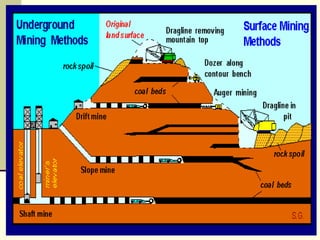
Traditional exploitation methods fall into two broad categories :
surface or underground.
Surface mining includes mechanical excavation methods such
as open pit and open cast (strip mining),and aqueous methods
such as placer and solution mining.
Underground mining is usually classified in three categories of
methods: unsupported, supported, and caving.
21.
Methods of Mining
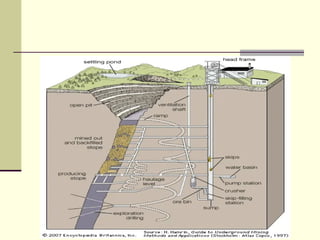
Ores closer to the surface are accessed by creating
an open pit and then excavating the ore below for
further processing. In most cases, a significant
amount of overburden, which is a layer of rock or soil
that covers the deposit, must be removed.
Ores in buried bedrock deposits are usually accessed
through the construction of access shafts and
tunnels. They provide for less waste rock removal
and they offer less environmental impact than open-
pit mining because these deposits typically have
much higher ore grades.
23.
Mining Methods
Thedefinition of the method permits: 1. establish the
configuration of the mine; 2. choose mining
equipment; 3. perform an economic evaluation of the
project.
The choice of method is largely determined by:
Spatial characteristics of the deposit
Geologic and hydrologic conditions
Geotechnical (soil and rock mechanics)
properties
Economic considerations
Technological factors
Safety, Health, Environmental concerns
24.
Spatial characteristicsof the deposit play a
dominant role in the choice of a mining method
because they largely decide the choice between
surface and underground mining, affect the
production rate, and determine the method of
materials handling and the layout of the mine in the
ore body.
The simple aim in selecting and implementing a
particular mine plan is always to mine a mineral
deposit so that profit is maximised given the
unique characteristics of the deposit and its location,
current market prices for the mined mineral, and the
limits imposed by safety, economy, environment”
25.
The choice ofmining method depends on many factors,
including:
Shape of the orebody: tabular, cylindrical, spherical, vein
Orientation of the orebody: sub-horizontal, sub-vertical.
Continuity of the orebody.
Ore-grade: high-grade, low-grade.
Distribution of ore-bearing minerals within the orebody:
massive or disseminated (with a cut-off grade).
Depth to the orebody.
mineralogy and petrography (e.g., sulfides vs. oxides in copper)
chemical composition (primary and secondary minerals)
deposit structure (folds, faults, discontinuities, intrusions)
planes of weakness (joints, fractures, shear zones, cleavage in
minerals, cleat in coal)
uniformity of grade
alteration and weathered zones
existence of strata gases
26.
Strength ofthe orebody and overburden/host-rocks
Area of land available for waste disposal –open-pit mines cover a
larger surface area and generate a greater volume of wastes.
reserves (tonnage and grade)
production rate (output per unit time)
mine life (total operating period for development and exploitation)
productivity (tons /employee hour)
comparative mining costs of suitable methods
comparative capital costs of suitable methods
Impacts on surface: environmental, surface drainage and sub-
surface aquifers, land-use changes, social.
Rehabilitation concerns.
Projected production rates.
Capital costs, rate of (financial recovery), cash-flow
Safety concerns –surface mining methods have a better safety
record.
27.
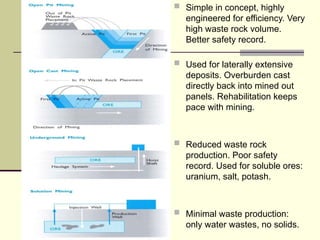
Simple inconcept, highly
engineered for efficiency. Very
high waste rock volume.
Better safety record.
Used for laterally extensive
deposits. Overburden cast
directly back into mined out
panels. Rehabilitation keeps
pace with mining.
Reduced waste rock
production. Poor safety
record. Used for soluble ores:
uranium, salt, potash.
Minimal waste production:
only water wastes, no solids.
29.
Open-pit isby and large regarded to be
advantageous over underground methods, especially
as regards recovery, production capacity,
mechanizeability, grade control and cut off grade, ore
loss and dilution, economics, and safety.
Underground mining however can be considered as
being more acceptable than surface mining from
environmental and social perspectives.
In addition, underground mining will often have a
smaller footprint than an open-pit of comparable
capacity.
30.
Underground Mining Methods
Underground mining methods become necessary
when the stripping ratio becomes uneconomical, or
occasionally when the surface use of the land would
prohibit surface mining.
A large number of underground mining methods have
been developed primarily in response to the
requirements of differing geometry and
geomechanical properties of the host and
surrounding rock.
Underground methods are traditionally broken into
three classes: unsupported, supported, and caving
methods.
31.
These classesreflect the competency of the orebody and host
rock more than anything else. If you excavate an underground
opening in the ore or the rock:
(a) is the opening stable -- i.e., will it remain open for an
extended period, or will it begin to fall in?
(b) If it is unstable, i.e., the surrounding ore or rock breaks up
and falls into the opening, how much support would be required
to keep the opening from caving in?
The answers to these questions lead us to choose mining
methods from one of the three classes.
Unsupported methods require the addition of minimal artificial
supports to secure a stable opening, whereas the supported
methods require the addition of major support to keep the
openings from caving in.
32.
Unsupported Methods:
Unsupportedmethods of mining are used to extract
mineral deposits that are roughly tabular (plus flat or
steeply dipping) and are generally associated with
strong ore and surrounding rock.
These methods are termed unsupported because
they use pillars to assist in the support of the
openings.
However, generous amounts of roof bolting and
localized support measures are often used.
33.
Unsupported Methods:
Room andPillar mining
This method of mining is used to recover bedded
deposits that are horizontal or nearly horizontal when
the orebody and the surrounding rock are reasonably
competent.
Parallel openings are mined in the ore, i.e., rooms,
and blocks of ore, i.e., pillars, are left in place to
support the overlying strata.
Other than the pillars, little artificial support is
required and often consists of bolts placed into the
overlying strata to pin the layers together, making
them behave like a strong laminated beam.
A few examples of commodities mined by this
method would include coal, lead, limestone, and salt.
34.
As longas the rock layers over the opening
are sufficiently strong (think beam), the
weight of the overlying members will be
transferred to the points where the beam is
supported. Those points are the pillars.
And from an engineering perspective, it is
essential that you do not make the beam too
long, because if you do, the beam will fail in
the middle, and you will have a cave-in.
Room and Pillarmining
The mined-out areas in the sketch are given special names, and
these may vary depending on the type of deposit that is being
mined.
There is one term of special significance: the mined-out areas in
the direction of mining are known as rooms. Hence, the name of
the mining method, room and pillar.
Typically, the pillars are laid out in this regular checkerboard
pattern in coal mines, and now in most other commodities as
well.
That was not always the case for the noncoal mines. The size,
spacing, and even location of the pillars would vary significantly,
as would the dimensions of the openings. In those mines, the
method was known as stope and pillar.
37.
Stope and Pillarmining
It is a similar method used in noncoal mines where
thicker, more irregular ore bodies occur; the pillars
are spaced randomly and located in low-grade ore so
that the high-grade ore can be extracted.
Stoping is the process of extracting the desired ore or
other mineral from an underground mine, leaving
behind an open space known as a stope.
Stoping is used when the country rock is sufficiently
strong not to cave into the stope, although in most
cases artificial support is also provided.
39.
Mining Terminology
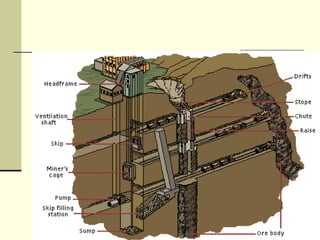
Adit- An opening driven horizontally into the side of a mountain
or hill for providing access to a mineral deposit.
Backfill - Waste material used to fill the void created by mining
an orebody.
Blasthole - A drill hole in a mine that is filled with explosives in
order to blast loose a quantity of rock.
Breast - A working face in a mine, usually restricted to a stope.
Cable bolt - A steel cable, capable of withstanding tens of
tonnes, cemented into a drillhole to lend support in blocky
ground.
Cage - The conveyance used to transport men and equipment
between the surface and the mine levels.
40.
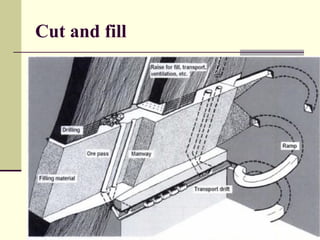
Cut-and-fill -A method of stoping in which ore is removed in
slices, or lifts, and then the excavation is filled with rock or other
waste material (backfill), before the subsequent slice is
extracted.
Deck - The area around the shaft collar where men and
materials enter the cage to be lowered underground.
Decline - A sloping underground opening for machine access
from level to level or from surface; also called a ramp.
Dip - The angle at which a vein, structure or rock bed is inclined
from the horizontal as measured at right angles to the strike.
Disseminated ore - Ore carrying small particles of valuable
minerals spread more or less uniformly through the host rock.
41.
Drawpoint -An underground opening at the bottom of a stope
through which broken ore from the stope is extracted.
Drift - A horizontal underground opening that follows along the
length of a vein or rock formation as opposed to a crosscut
which crosses the rock formation.
Face - The end of a drift, crosscut or stope in which work is
taking place.
Host rock - The rock surrounding an ore deposit.
Pillar - A block of solid ore or other rock left in place to
structurally support the shaft, walls or roof of a mine.
Raise - A vertical or inclined underground working that has been
excavated from the bottom upward.
Shaft - A vertical or inclined excavation in rock for the purpose
of providing access to an orebody. Usually equipped with a hoist
at the top, which lowers and raises a conveyance for handling
workers and materials.
42.
Skip -A self-dumping bucket used in a shaft for hoisting ore or
rock.
Stope - An excavation in a mine from which ore is, or has been,
extracted.
Strike - The direction, or bearing from true north, of a vein or
rock formation measure on a horizontal surface.
Sublevel - A level or working horizon in a mine between main
working levels.
Tunnel - A horizontal underground opening, open to the
atmosphere at both ends.
Footwall – the area below where ore is present in a mine.
Hanging wall – the area above where the ore is present in a
mine.
43.
Inbye –the direction in a coal mine away from the pit shaft
towards the coal face.
Outbye – going towards the pit shaft from the coal face.
Run of Mine (ROM) – Run of Mine (ROM) – ore that’s mined
and ready to go to the processing plant.
Working face – the location where ore and waste is removed
from solid rock
Vein – a fracture or crack in a rock that contains mineralised
material.
Lode – a mineral deposit contained in solid rock.
Seam – an underground layer of a mineral such as coal.
44.
Shrinkage stoping
Shrinkagestoping is used in steeply dipping, relatively narrow
ore bodies with regular boundaries.
Ore and waste (both the hanging wall and the footwall) should
be strong, and the ore should not be affected by storage in the
stope.
In shrinkage stoping, mining progresses upward, with horizontal
slices of ore being blasted along the length of the stope.
A stope, i.e., a large section of the mine where active production
is occurring, is mined, but the broken ore is not removed, but
rather is left in place to support the walls of the stope until the
time when all of the broken ore will be removed.
Since rock swells, i.e., increases in volume when it is broken, it
is necessary to draw off some of the broken ore as the stope is
progressively mined.
45.
From 30to 40 percent of the broken ore is withdrawn from
the bottom of the stope, and the ore in the slice is blasted
down, replacing the volume withdrawn.
The miners then reenter the stope and work off the newly
blasted ore.The name of this method derives from this
drawing off or shrinkage of the stope. A modern and
important variant of this method is known as vertical crater
retreat (VCR) mining.
Once the top of the stope is reached all the ore is
removed from the stope.
The stope is emptied when all of the ore has been blasted.
The stope may be backfilled or left empty, depending on
the rock conditions.
46.
Shrinkage stopingis rather difficult to mechanize; in
addition, a significant period can elapse between the
commencement of mining in the stope and the final
withdrawal of all the broken ore.
A few examples of commodities mined by this
method include iron and palladium.
Although it is very selective and allows for low
dilution, since the most of the ore stays in the stope
until mining is completed there is a delayed return on
capital investments.
Shrinkage stoping is more suitable than sublevel
stoping for stronger ore and weaker wallrock.
Supported Methods
Thismethods are often used in mines with weak rock
structure.
In “Artificially supported” mining, the mine-workings
are supported temporarily only for as long as needed
to keep the active face open to mining.
After mining, the support (e.g. hydraulic props or
wood packs) is removed (or becomes crushed), and
the mining cavities close up under the pressure of the
overburden material.
50.
Supported Methods
Cut andfill
It is one of the more popular methods used for vein
deposits.
It is an expensive but selective mining method, with
low ore loss and dilution.
Is relatively expensive and therefore is done only in
high grade mineralization.
Ore is drilled, blasted and removed from stope. The
ore is mined in slices: As each horizontal or slightly
inclined slice is taken, the voids (Opens) are
backfilled with a variety of fill types to support the
walls (i.e., the fill can be rock waste, tailings,
cemented tailings, or other suitable materials).
51.
Supported Methods
Cut andfill
Cut and fill is used to recover ore from weaker
strength materials, in which the openings will not
remain stable after the ore is removed, and the
overlying strata cannot be allowed to cave.
A slice of the orebody is mined and immediately after
the ore is removed, backfill is placed into the opening
to support the ore above. The next slice is removed,
the cut is then backfilled, and the process repeats.
This is a very expensive method to use, and
consequently, it would be used only for the recovery
of high value ores. An example of a commodity mined
by this method is gold.
Stull Stoping
Stullstoping is a form of stoping used in hardrock
mining that uses systematic or random timbering
("stulls") placed between the foot and hangingwall of
the vein.
Stull stoping is a supported mining method using
timber or rock bolts in tabular, pitching ore bodies.
It is one of the methods that can be applied to ore
bodies that have dips between 10° and 45° .
The method requires that the hangingwall and often
the footwall be of competent rock as the stulls
provide the only artificial support. It often utilizes
artificial pillars of waste to support the roof.
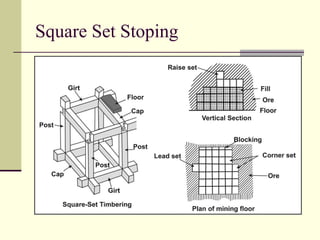
54.
Square Set Stoping
The square-set stoping method is used where the ore is weak,
and the walls are not strong enough to support themselves.
In square-set stoping, one small block of ore is removed and
replaced by a "set" or cubic frame of timber which is
immediately set into place.
The timber sets interlock and are filled with broken waste rock
or sand fill, for they are not strong enough to support the stope
walls. The waste rock or sand fill is usually added after one tier
of sets, or stope cut, is made.
Square-set timbers are set into place as support and are then
filled with cement.
The cement commonly uses fine tailings. Square-set stoping
also involves backfilling mine voids; however, it relies mainly on
timber sets to support the walls during mining.
occasional use in mining high-grade ores or in countries where
labour costs are low.
Caving methods
Cavingmining is advantageous in that it
maximizes ore recovery (as little ore as
possible is left behind) the method comes
with significant problems:
Surface subsidence in the case of shallow
mines.
Rock-bursts underground, causing injury and
death in deep level mines.
The cavity closure is either partial, for shallow
mining, or complete, for deep level mining.
57.
Caving methods
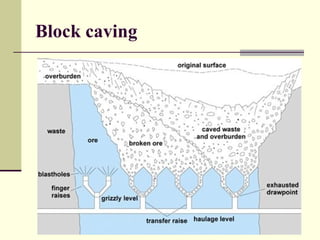
Block caving
This method is used in weak and massive
orebodies, in which the ore is undercut, and
then as the broken ore is removed the
remainder of the orebody collapses into this
void, and as more ore is withdrawn, the
caving continues.
Typically the host rock is fairly strong,
although ultimately it tends to cave into the
void created from removing the ore.
The fracturing and caving often break through
to the surface.
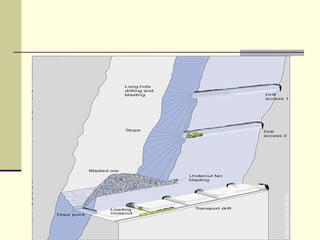
Sublevel caving
Thistype of caving is used in strong and massive orebodies in
which the host rock is very weak and quickly caves into the void
created by removing the core. As in block caving, the cave will
ultimately reach the surface.
The ore is extracted via sublevels which are developed in the
orebody at regular vertical spacing.
Each sublevel has a systematic layout of parallel drifts, along or
across the orebody.
Sublevel stoping recovers the ore from open stopes separated
by access drifts each connected to a ramp.
The orebody is divided into sections about 100 m high and
further divided laterally into alternating stopes and pillars.
61.
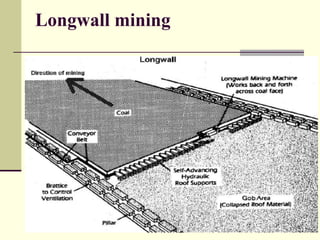
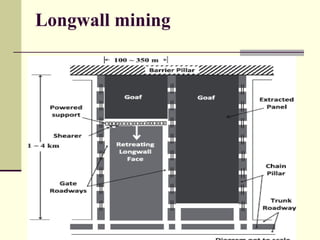
Longwall mining
Longwallmining is a type of caving, applied
to a horizontal tabular deposit such as coal.
While block and sublevel caving are
essentially vertically advancing metal mining
methods, longwall mining is applied to
relatively thin and flat-lying deposits – most
often coal.
The coal seam is extracted completely
between the access roads, and then as
mining retreats, the overlying strata caves
into the void left by removing the coal.
62.
Longwall mining
Longwallmining is a fast and mechanized
method of coal mining where a large “wall” of
coal is mined with a high-powered cutting
system and the coal is transported out of the
mine through a network of conveyors.
The method is a “caving” method and the
surface above the “gob” or mined areas
typically subside.
This method requires a uniform coal seam
thickness with low dip and minimal geological
disturbances like faults or folds.
63.
Longwall mining
Becauseof high production rate and safe track record,
longwall has been adopted as the most preferred
underground coal mining method all over the world
wherever suitable geology is proved.
Installation of first mechanized Longwall Powered
support face at Moonidih in August 1978. - In between
1978 to 1985.
A major number of first generation Longwall faces
started in various mines of CIL such as Moonidih,
Jhanjra, Seetalpur, Dhemomain and Pathakhera
Colliery and in SCCL at GDK- 7 & VK-7 Incline.
Unit operations inUnderground
Mining
Production operations:
Drilling and Blasting/ Cutting
Loading
MaterialTransport
Auxiliary Operations:
Dressing and Support
Ventilation
Lighting
Pumping
67.
Drilling ofblast holes and holes required for
installation of roof bolts and cable support
Machines used:
Jack Hammer Drills
Drill Jumbos
Electric Rotary Coal Drilling Machine
Airleg Drills
68.
Blasting Offthe solid:
Conventional blasting coal off-the-solid (B-O-
S) or solid blasting in underground coal mines
involves use of permitted P5 category
explosive cartridges charged end-to-end and
initiated using permitted category delay
detonators.
69.
Blasting inmining is a chemical and physical process that
occurs through the firing of explosives. It breaks mineral-bearing
materials. These materials can be coal, ore and mineral stone.
Blasting fragments materials, splits off rock blocks, and
demolishes existing structures. The process of blasting goes
through blast design prior any blasting operation.
The design of a blast operation includes:
layout of the blasthole pattern
Selection of explosives
Decking
Delay times
Initiation pattern
Stemming
Necessary safety measures
70.
High explosivesdetonate whereas low explosives deflagrate.
Both high and low explosives initiation is by a single No. 8
blasting cap. As opposed to blasting agents which cannot be so
initiated. Blasting agents also include slow burning compositions
used for initiation systems. These are detonators, detonating
relays and fuse heads. Classification of explosives is into four
main groups:
High explosives – TNT, dynamite, gelatins, hybrid charges,
ANFO, slurries, emulsions and ANFO-slurry
Low explosives – Black powder
Special explosives – Seismic, trimming, permissible, shaped
charge, binary, LOX and liquid
Explosive substitutes – Expand agents, mechanical methods,
water jet, jet piercing and compressed air.
71.
Characterisation ofexplosives depends
several factors. Density, detonation velocity,
explosive heat, mass strength, critical
diameter and water resistance. The total
amount of explosive used for a specific task
varies. This also affects explosive
performance and fragmentation results.
72.
Blasting inmining is a chemical and physical process that
occurs through the firing of explosives. It breaks mineral-bearing
materials. These materials can be coal, ore and mineral stone.
Blasting fragments materials, splits off rock blocks, and
demolishes existing structures. The process of blasting goes
through blast design prior any blasting operation.
The design of a blast operation includes:
layout of the blasthole pattern
Selection of explosives
Decking
Delay times
Initiation pattern
Stemming
Necessary safety measures
Transport
Manwinders likecage winding
Skip winding
Haulage tubs and Locomotives
Shuttle cars
Chain Conveyors
Belt Conveyors
Underground Dump Trucks
75.
Ventilation
Ventilation isrequired to clear toxic fumes from
blasting and removing exhaust fumes from diesel
equipment.
In deep hot mines ventilation is also required for
cooling the workplace for miners.
Ventilation raises are excavated to provide ventilation
for the workplaces, and can be modified for use as
emergency escape routes.
The primary sources of heat in underground hard rock
mines are virgin rock temperature, machinery, auto
compression, and fissure water. Other small
contributing factors are human body heat and
blasting.
76.
Ground Support
Groundsupport is necessary when voids
(empty spaces) are created underground.
Some means of support is required in order
to maintain the stability of the openings that
are excavated.
The competency of the rock being mined will
determine how large a void may be created
and what ground support methods will be
necessary to maintain a safe working
environment.
77.
Types of Supports
Timber supports such as stulls/Propos,
Chocks/cogs etc
Steel Supports such as steel propos,
hydraulic props
Roof bolts, Cable supports
Wire meshing, shot creting
Advancing supports like powered supports
78.
Surface mining
isa type of mining in which soil and rock
overlying the mineral deposit (the overburden)
are removed.
Surface mining is used when deposits of
commercially useful minerals or rock are found
near the surface; that is, where the overburden
is relatively thin or the material of interest is
structurally unsuitable for tunneling (as would
usually be the case for sand, and gravel (.
79.
Surface miningrequires large capital
investment (primarily expensive
transportation equipment), but generally
results in:
High productivity (i.e., high output rate of ore)
Low operating costs
Safer working conditions and a better safety
record than underground mining
80.
In mostforms of surface mining, heavy equipment,
such as earthmovers, first remove the overburden.
Next, huge machines, such as dragline excavators
or Bucket wheel excavators, extract the mineral.
Where minerals occur deep below the surface—
where the overburden is thick or the mineral occurs
as veins in hard rock— underground mining methods
are used to extract the valued material.
Surface mines are typically enlarged until either the
mineral deposit is exhausted, or the cost of removing
larger volumes of overburden makes further mining
no longer economically viable.
81.
In open-pitmining a Stripping Ratio refers to
the amount of waste rock removed to recover
ore. For example, a stripping ratio of 3:1
means to recover one ton of ore you must
remove three tons of waste rock.
A large Stripping Ratio is less economical
efficient than a small one, because that
means more rock will need to be moved
without generating revenue. If The ratio is
going to be too large, then underground
mining will usually be more efficient.
82.
Ore reservessuitable for surface mining can be
classified initially as;
1. Relatively horizontal stratified reserves with a thin or
thick covering of overburden
2. Stratified vein-type deposits with an inclination
steeper than the natural angle of repose of the
material so that waste cannot be tipped inside the pit
3. Massive deposits, deep and very large laterally such
that dumping of the waste within the pit is not
possible.
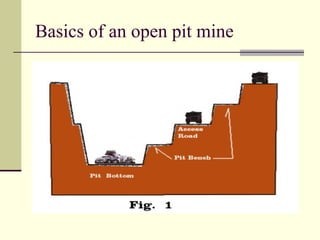
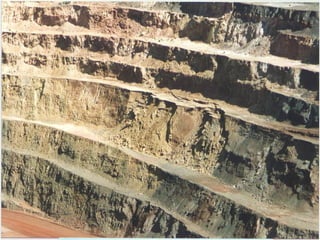
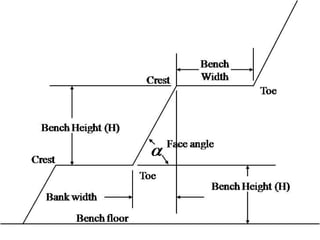
84.
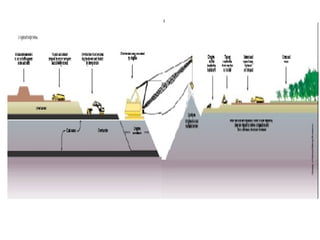
Open-pit minesare dug on benches, which describe vertical
levels of the hole. These benches are usually on four meter to
sixty meter intervals, depending on the size of the machinery
that is being used. Many quarries do not use benches, as they
are usually shallow.
Most walls of the pit are generally dug on an angle less than
vertical, to prevent and minimize damage and danger from rock
falls. This depends on how weathered the rocks are, and the
type of rock, and also how many structural weaknesses occur
within the rocks, such as a fault, shears, joints or foliations.
The walls are stepped. The inclined section of the wall is known
as the batter, and the flat part of the step is known as the bench
or berm.
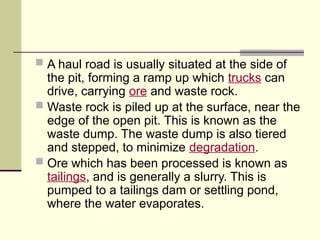
85.
A haulroad is usually situated at the side of
the pit, forming a ramp up which trucks can
drive, carrying ore and waste rock.
Waste rock is piled up at the surface, near the
edge of the open pit. This is known as the
waste dump. The waste dump is also tiered
and stepped, to minimize degradation.
Ore which has been processed is known as
tailings, and is generally a slurry. This is
pumped to a tailings dam or settling pond,
where the water evaporates.
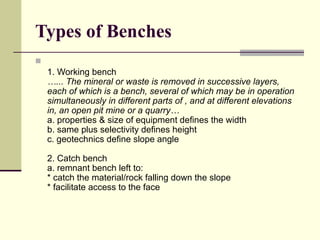
Types of Benches
1.Working bench
…... The mineral or waste is removed in successive layers,
each of which is a bench, several of which may be in operation
simultaneously in different parts of , and at different elevations
in, an open pit mine or a quarry…
a. properties & size of equipment defines the width
b. same plus selectivity defines height
c. geotechnics define slope angle
2. Catch bench
a. remnant bench left to:
* catch the material/rock falling down the slope
* facilitate access to the face
91.
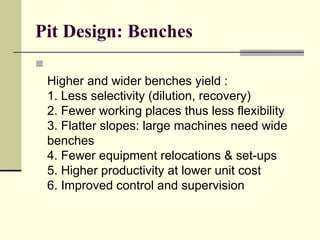
Pit Design: Benches
Higherand wider benches yield :
1. Less selectivity (dilution, recovery)
2. Fewer working places thus less flexibility
3. Flatter slopes: large machines need wide
benches
4. Fewer equipment relocations & set-ups
5. Higher productivity at lower unit cost
6. Improved control and supervision
92.
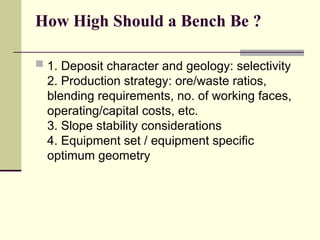
How High Shoulda Bench Be ?
1. Deposit character and geology: selectivity
2. Production strategy: ore/waste ratios,
blending requirements, no. of working faces,
operating/capital costs, etc.
3. Slope stability considerations
4. Equipment set / equipment specific
optimum geometry
93.
Reduced Bench Heights
Advantages
1.ramp volume reduced (fill ramps)
2. contour areas easier to drill & blast
3. ore grading and selective mining is easier
4. multi-row blasts easier to blast
5. single pass drilling easier
Disadvantages
1. poor bench grade control by shovel is accentuated
2. reduced drilling yield and increased drill and blast
cost
3. sub grade costs more (relatively larger)
4. reduced shovel productivity
94.
Slope Design:
1. Maximizethe height of the benches
* at the expense of mining selectivity?
2. Minimize the width of working benches
* at the expense of productivity?
3. Minimize the number & width of catch
benches
* at the expense of safety?
4. Minimize the width & number of haul roads
* at the expense of productivity & safety?
96.
An openpit mine is "an excavation or cut made at the
surface of the ground for the purpose of extracting
ore and which is open to the surface for the duration
of the mine’s life."
To expose and mine the ore, it is generally necessary
to excavate and relocate large quantities of waste
rock. The main objective in any commercial mining
operation is the exploitation of the mineral deposit at
the lowest possible cost with a view of maximizing
profits.
97.
A benchmay be defined as a ledge that
forms a single level of operation above which
mineral or waste materials are mined back to
a bench face. The mineral or waste is
removed in successive layers, each of which
is a bench. Several benches may be in
operation simultaneously in different parts of,
and at different elevations in the open pit
mine.
98.
Various open-pit andorebody
configurations
Flat lying seam or bed,
flat terrain. Example
platinum reefs, coal.
Massive deposit, flat
terrain. Example iron-
ore or sulphide
deposits.
Dipping seam or bed,
flat terrain. Example
anthracite.
99.
Various open-pit andorebody
configurations
Massive deposit, high
relief. Example copper
sulphide.
Thick bedded deposits,
little overburden, flat
terrain. Example iron
ore, coal.
100.
Open-pit Mining
Thisis the traditional cone-shaped excavation
(although it can be any shape, depending on the size
and shape of the orebody) that is used when the ore
body is typically pipe-shaped, vein-type, steeply
dipping stratified or irregular. Although it is most often
associated with metallic orebodies.
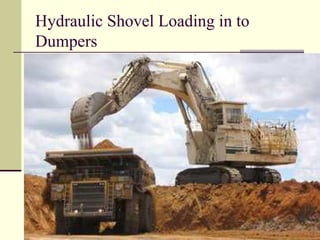
The excavation is normally by rope- or hydraulic
shovels with trucks carrying both ore and waste. Drill
and blast is most often used, which makes the
process cyclic. Waste is dumped outside the mined-
out area since no room is available within the pit.
Waste is placed as close to the edge of the pit as
possible, to minimise transport costs.
102.
Benches arenormally excavated from 2-15m in height in
stacks of 3 to 4, in between which is a crest on which the
haul road is placed.
When the number of benches in the stack increases, the
road gradient increases too.
Benches in the stack have a steep face angle whilst the
stack and overall slope angles are flatter, thereby helping
to prevent slope failures.
From an analysis of overall slope geometry, it is clear that
as steep a slope as possible should be mined, to reduce
the overall stripping ratio. However, this rule is limited by
the maximum gradient of the haul road – typically 8-10%
which requires frequent wider crests, and the need to have
flatter slope angles in places to provide slope stability.
Note that each pit slope can have a different angle
according to the requirements of the design – with or
without haul road, geology, etc
104.
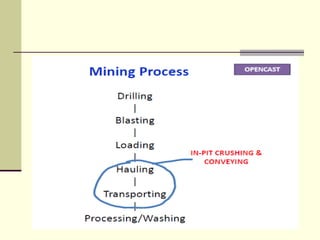
Mineral andespecially waste transport costs
comprise the greatest amount of an open-pit
mine’s working costs. To reduce this cost
aspect – especially when the pit gets deeper,
the following options are possible;
In-pit crushers together with a conveyor
belt, instead of truck transport.
Trolley-assist on the main haul road.
(electrical power supply to trucks) – faster
trucks, steeper roads
Computerised truck dispatch – more
efficient use of trucks
Steeper bench slope angles (in other
words, a reduced stripping ratio) where
stability allows them – especially at the
bottom of the pit when LOM approaches end.
105.
As aresult of the high cost of rock transport –
up to 50% of an open-pit’s total operating
costs, many large pits consider continuous
transport systems.
Continuous transport systems (and the
associated in-pit crusher if drill and blast is
used) begin to out-perform truck based
systems – since they are run on electricity,
not diesel fuel.
106.
UNIT OPERATIONS OFMINING
During the development and exploitation stages of
mining when natural materials are extracted from the
earth, remarkably similar unit operations are normally
employed.
The unit operations of mining are the basic steps
used to produce mineral from the deposit,and the
auxiliary operations that are used to support them.
The steps contributing directly to mineral extraction
are production operations,which constitute the
production cycle of operations.
The ancillary steps that support the production cycle
are termed auxiliary operations.
107.
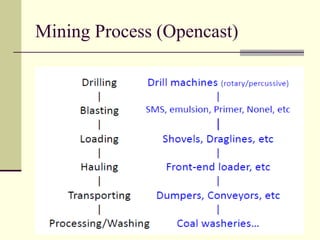
The productioncycle employs unit operations
that are normally grouped into rock breakage
and materials handling.
Breakage generally consists of drilling and
blasting, and materials handling
encompasses loading or excavation and
haulage (horizontal transport) and sometimes
hoisting (vertical or inclined transport).
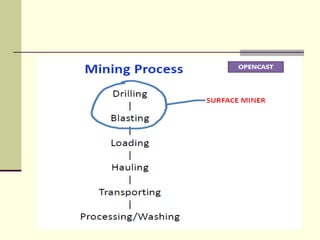
Thus,the basic production cycle consists of
these unit operations:
Production cycle= drill + blast + load + haul
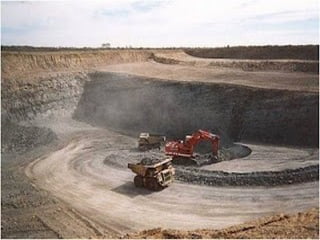
Open-cast or stripmining
Used for near-surface, laterally continuous,
bedded deposits such as coal, stratified ores
such as iron ore, and surficial deposits (nickel
laterite or bauxite).
The pits are shallower that open-pit mines,
and the overburden is casted directly into
adjacent mined out panels.
It is a very low-cost, high-productivity method
of mining.
118.
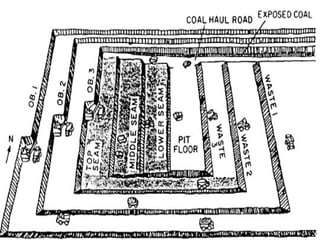
Opencast miningis ideally applied where the surface of the
ground and the ore body itself are relatively horizontal and not
too deep under the surface, and a wide area is available to be
mined in a series of strips.
Favourable conditions are:
Relatively thin overburden (0-50m maximum other wise
stripping ration and cost of stripping becomes too high)
Regular and constant surface topography and coal layers (not
more than 20º variation from horizontal on the coal seam –
topography can vary more since pre-stripping can be used to
level it – but this is expensive to apply)
Extensive area of reserves (to give adequate life of mine (LOM)
119.
Opencast Mining Technique
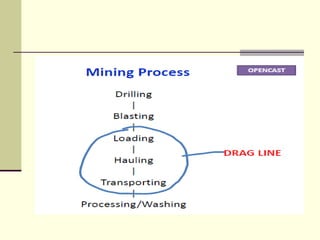
Walking draglines are for many years the most
popular machine for this type of mining due to their
flexibility, utility and availability, but more importantly,
their low operating costs for waste mining (R/t or
R/BCM).
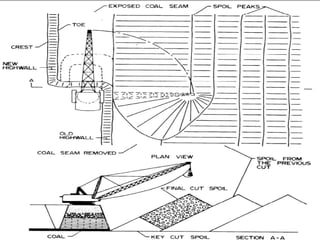
The dragline is a typical combined cyclic excavator
and material carrier since it both excavates material
and dumps it without the use of trucks or conveyor
belts.
The dragline sits above the waste or overburden
block, usually 50m or so wide, on the highwall side
and excavates the material in front of itself, to dump it
on the low-wall or spoil side of the strip to uncover
the coal seam below it.
124.
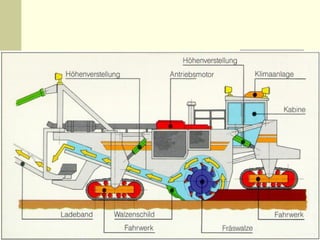
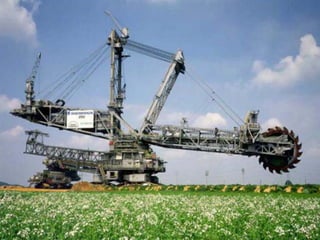
Bucket WheelExcavators (BWE) are continuous
cutting machines for soft to semi hard materials like
clay, sand, gravel, marl and their blendings as well as
lignite and hard coal.
The primary function of BWEs is to act as a
continuous digging machine in large-scale
open pit mining operations.
BWEs are used for continuous overburden removal in
surface mining applications. They use their cutting
wheels to strip away a section of earth (the working
block) dictated by the size of the excavator.
126.
Applications
Lignite mining:
Theprimary application of BWEs is in lignite
(brown coal) mining, where they are used for
soft rock overburden removal in the absence
of blasting. They are useful in this capacity for
their ability to continuously deliver large
volumes of materials to processors, which is
especially important given the continuous
demand for lignite.
127.
Materials handling
Bucketwheel technology is used extensively in bulk
materials handling. Bucket wheel reclaimers are used
to pick up material that has been positioned by a
stacker for transport to a processing plant.
Stacker/reclaimers, which combine tasks to reduce
the number of required machines, also use bucket
wheels to carry out their tasks.
In shipyards, bucket wheels are used for the
continuous loading and unloading of ships, where
they pick up material from the yard for transfer to the
delivery system
128.
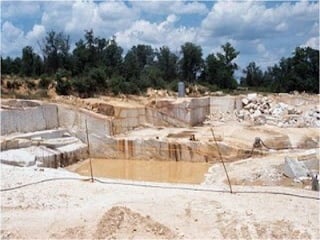
Quarry
Open-pit minesthat manufacture building
materials and dimension stone are usually
referred to as quarries.
Quarries are normally shallower than other
kinds of open-pit mines.
130.
Kinds ofrock extracted from quarries comprise:
• Chalk
• China Clay
• Clay
• Construction aggregate (sand and gravel)
• Granite
• Gypsum
• Limestone
• Marble
• Ores
• Phosphate rock
• Sandstone
• Slate
131.
Solution mining:
In-situ Leachingor Borehole Mining:
In-situ leaching (ISL), also known as in-situ recovery (ISR) or
solution mining, is a method of recovering minerals like copper
and uranium throughout boreholes drilled into the deposit. The
process primarily involves drilling of holes into the ore deposit.
Explosive or hydraulic fracturing may be used to create open
pathways in the deposit for solution to penetrate. Leaching
solution is pumped into the deposit where it makes contact with
the ore. The solution bearing the liquefied ore content is then
pumped to the layer and processed. This process permits the
extraction of metals and salts from an ore body without the
requirement for conventional mining entailing drill-and-blast,
open-cut or underground mining.
Used most commonly on evaporite (e.g. salt and potash) and
sediment-hosted uranium deposits, and also to a far lesser
extent to recover copper from low-grade oxidised ore.
132.
In-situ leachmining entails pumping of a leachate
solution into the ore body via a borehole, which
circulates via the porous rock dissolving the ore and
is extracted by means of a second borehole.
The leachate solution differs according to the ore
deposit - for salt deposits the leachate may be fresh
water into which salts may willingly dissolve. For
copper, acids are generally required to improve
solubility of the ore minerals within the solution. For
uranium ores, the leachate might be acid or sodium
bicarbonate.
133.
Evaporite deposits
Has been used for many decades to extract soluble
evaporite salts such as halite (NaCl), trona (3Na2O ·
4CO2), nahcolite (NaHCO3), epsomite (MgSO4 ·
7H2O), carnallite (KMgCl3 · 6H2O), borax (Na2B4O7 ·
10H2O) from buried evaporite deposits in UK, Russia,
Germany, Turkey, Thailand and USA).
A low salinity fluid, either heated or not, is injected
underground directly into the evaporite layer; the
“pregnant” solutions (brines) are withdrawn from
recovery boreholes and are pumped into evaporation
ponds, to allow the salts to crystallise out as the water
evaporates.
134.
Uranium deposits
Uranium minerals are soluble in acidic or
alkaline solutions.
The production (“pregnant”) fluid
consisting of the water soluble uranyl
oxyanion (UO2
2+
) is subject to further
processing on surface to precipitate the
concentrated mineral product U3O8or
UO3(yellowcake).
136.
Leaching
Heap Leaching:Heap leaching is an industrial
mining method to dig out precious metals and
copper compounds from ore heaps.
The mined ore is crushed into tiny chunks and
heaped on an impermeable plastic and/or clay lined
leach pad where it may be irrigated with a leach
solution to melt the valuable metals. Sprinklers, or
frequently drip irrigation, are used to minimize
evaporation.
The solution then percolates through the heap and
leaches out the precious metal. This can take many
weeks. The leach solution having the dissolved
metals is then accumulated.
137.
Placer Mining
Placermining is the mining of alluvial
sediments for minerals.
The name comes from Spanish, placera,
meaning "alluvial sand." It means that mining
the precious metal deposits (mainly gold and
gemstones) found in alluvial deposits
sediments of sand and gravel in modern or
very old stream beds.
138.
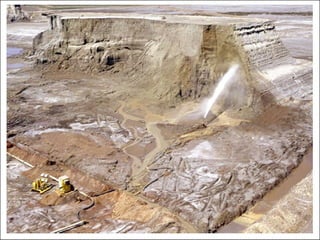
Hydraulic mining:
Hydraulicmining, or hydraulicking, is a type
of mining that uses water to displace rock
material or move deposit.
Generally used for weakly cemented near-
surface ore deposits.
The current form of hydraulicking, using jets
of water directed under very elevated
pressure via hoses and nozzles
140.
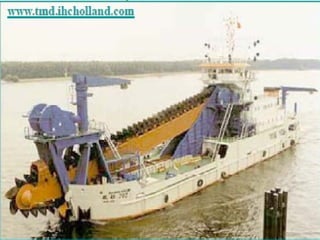
Dredging:
Used mostoften for mineral-sands and some
near-shore alluvial diamond mining
operations
Dredging" is a method often used to bring up
underwater mineral deposits. Although
dredging is usually employed to clear or
enlarge waterways for boats, it can also
recover significant amounts of underwater
minerals relatively efficiently and cheaply.