ORE
MINERALS:
How they are
found, Mined,
and Processed
or Human Use
Objectives:
At the end of the lesson, you will be able to:
• Understand the life cycle of mineral resources; and
• Understand the impact of mining.
ORE MINERALS
• How Ore Minerals are Found?
• How Ore Minerals are Mined?
• How Ore Minerals are Processed for human use?
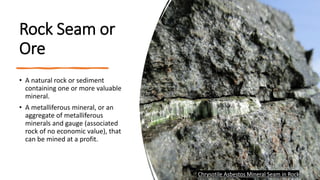
Rock Seam or
Ore
• A natural rock or sediment
containing one or more valuable
mineral.
• A metalliferous mineral, or an
aggregate of metalliferous
minerals and gauge (associated
rock of no economic value), that
can be mined at a profit.
Chrysotile Asbestos Mineral Seam in Rock
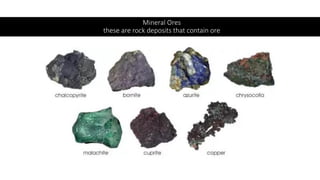
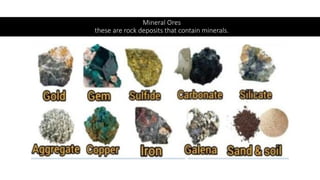
Mineral Ores
these are rock deposits that contain ore
Mineral Ores
these are rock deposits that contain minerals.
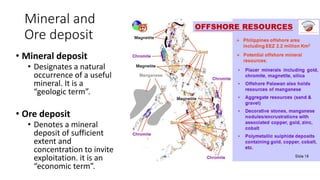
Mineral and
Ore deposit
• Mineral deposit
• Designates a natural
occurrence of a useful
mineral. It is a
“geologic term”.
• Ore deposit
• Denotes a mineral
deposit of sufficient
extent and
concentration to invite
exploitation. it is an
“economic term”.
HOW MINERALS
ARE FOUND?
“Mineral Exploration”
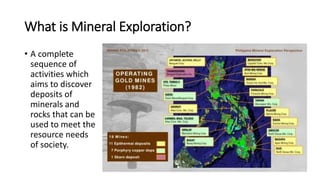
What is Mineral Exploration?
• A complete
sequence of
activities which
aims to discover
deposits of
minerals and
rocks that can be
used to meet the
resource needs
of society.
MINERAL EXPLORATION
•Major Stages in Mineral Exploration
• Project Design
• Field Exploration
• Regional Reconnaissance
• Detailed Exploration
• Prospect Evaluation
• Pre-production Feasibility Study
Major Stages in Mineral Exploration
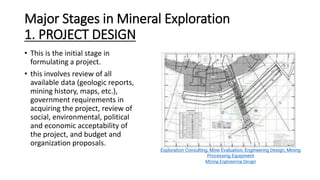
1. PROJECT DESIGN
• This is the initial stage in
formulating a project.
• this involves review of all
available data (geologic reports,
mining history, maps, etc.),
government requirements in
acquiring the project, review of
social, environmental, political
and economic acceptability of
the project, and budget and
organization proposals.
Exploration Consulting, Mine Evaluation, Engineering Design, Mining
Processing Equipment
Mining Engineering Design
Major Stages in Mineral Exploration
2. FIELD EXPLORATION
This stage involves physical
activities in the selected
project area. This can be
subdivided into three phases:
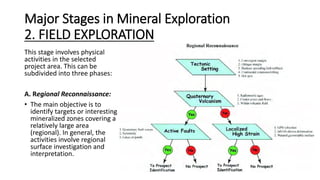
A. Regional Reconnaissance:
• The main objective is to
identify targets or interesting
mineralized zones covering a
relatively large area
(regional). In general, the
activities involve regional
surface investigation and
interpretation.
Major Stages in Mineral Exploration
2. FIELD EXPLORATION
This stage involves physical
activities in the selected
project area. This can be
subdivided into three
phases:
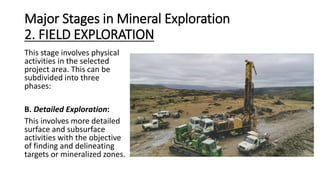
B. Detailed Exploration:
This involves more detailed
surface and subsurface
activities with the objective
of finding and delineating
targets or mineralized zones.
Major Stages in Mineral Exploration
2. FIELD EXPLORATION
This stage involves physical
activities in the selected project
area. This can be subdivided into
three phases:
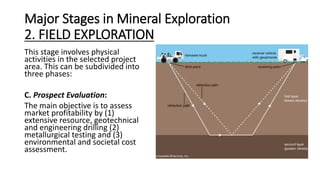
C. Prospect Evaluation:
The main objective is to assess
market profitability by (1)
extensive resource, geotechnical
and engineering drilling (2)
metallurgical testing and (3)
environmental and societal cost
assessment.
Major Stages in Mineral Exploration
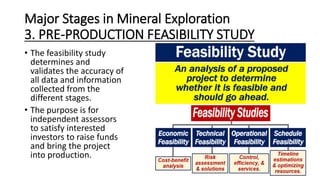
3. PRE-PRODUCTION FEASIBILITY STUDY
• The feasibility study
determines and
validates the accuracy of
all data and information
collected from the
different stages.
• The purpose is for
independent assessors
to satisfy interested
investors to raise funds
and bring the project
into production.
HOW MINERALS ARE
MINED?
“Different Types of
Mining”
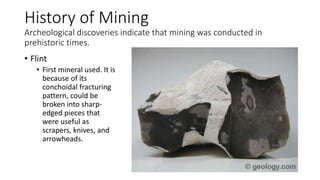
History of Mining
Archeological discoveries indicate that mining was conducted in
prehistoric times.
• Flint
• First mineral used. It is
because of its
conchoidal fracturing
pattern, could be
broken into sharp-
edged pieces that
were useful as
scrapers, knives, and
arrowheads.
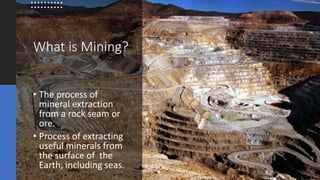
What is Mining?
• The process of
mineral extraction
from a rock seam or
ore.
• Process of extracting
useful minerals from
the surface of the
Earth, including seas.
Types of Mining
•Surface Mining
A.Open-pit mining
B.Strip mining
C.Dredging
D.Quarrying
E.Placer Mining
•Underground mining
Types of
Mining
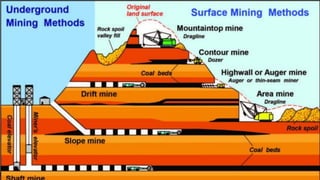
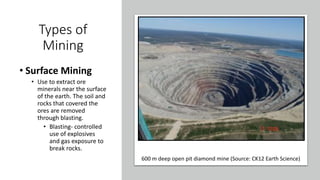
• Surface Mining
• Use to extract ore
minerals near the surface
of the earth. The soil and
rocks that covered the
ores are removed
through blasting.
• Blasting- controlled
use of explosives
and gas exposure to
break rocks.
600 m deep open pit diamond mine (Source: CK12 Earth Science)
Types of Mining
• Examples of Surface
Mining:
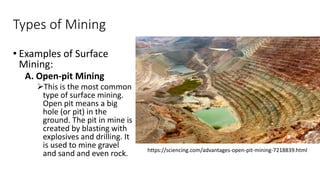
A. Open-pit Mining
➢This is the most common
type of surface mining.
Open pit means a big
hole (or pit) in the
ground. The pit in mine is
created by blasting with
explosives and drilling. It
is used to mine gravel
and sand and even rock. https://sciencing.com/advantages-open-pit-mining-7218839.html
Types of Mining
Examples of Surface Mining:
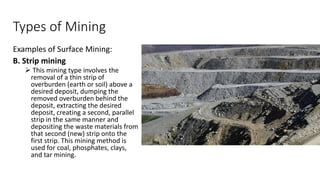
B. Strip mining
➢ This mining type involves the
removal of a thin strip of
overburden (earth or soil) above a
desired deposit, dumping the
removed overburden behind the
deposit, extracting the desired
deposit, creating a second, parallel
strip in the same manner and
depositing the waste materials from
that second (new) strip onto the
first strip. This mining method is
used for coal, phosphates, clays,
and tar mining.
Types of Mining
Examples of Surface
Mining:
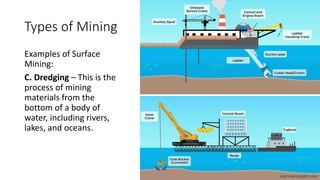
C. Dredging – This is the
process of mining
materials from the
bottom of a body of
water, including rivers,
lakes, and oceans.
Types of Mining
Examples of Surface
Mining:
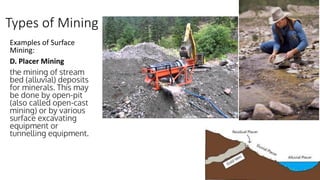
D. Placer Mining
the mining of stream
bed (alluvial) deposits
for minerals. This may
be done by open-pit
(also called open-cast
mining) or by various
surface excavating
equipment or
tunnelling equipment.
Types of Mining
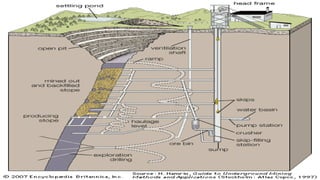
• Underground mining
➢ is used to extract the rocks, minerals and other precious stones that can be
found beneath the earth’s surface. In underground mining, miners need to
create a tunnel so they can reach the ore minerals. This kind of mining is more
expensive and dangerous as compared to surface mining because miners
need to use explosive devices to remove the minerals from the rocks that
cover them.
HOW MINERALS ARE
MINED?
“Milling or Mineral
Processing”
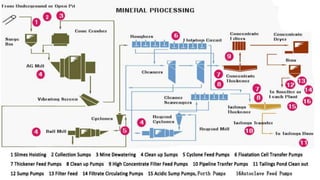
WHAT IS MILLING OR MINERAL PROCESSING?
• It is the process of extracting minerals from the ore, refining them,
and preparing these minerals for use.
• It is an art of treating crude ores and mineral products in order to
separate the valuable minerals from the waste rock, or gangue.
MILLING OR MINERAL PROCESSING
Primary Steps in Processing Minerals
1. Sampling- is the removal of a portion which represents a whole needed
for the analysis of this material.
2. Analysis- is important to evaluate the valuable component in an ore.
Includes chemical, mineral and particle size analysis.
3. Comminution- is the process where the valuable components of the ore
are separated through crushing and grinding.
4. Concentration- involves the separation of the valuable minerals from the
raw materials.
5. Dewatering- this involves filtration and sedimentation of the suspension
and drying of the solid materials harvested from this suspension.
MILLING OR MINERAL PROCESSING
Example of Milling or Recovery Methods or Processes
1. Heavy Media Separation- the crushed rocks are submerged in liquid
where the heavier/ denser minerals sink thus are separated from the
lighter minerals.
2. Magnetic separation- if the metal or mineral is magnetic, the crushed
ore is separated from the waste materials using a powerful magnet.
3. Floatation- the powdered ore is placed into an agitated and frothy slurry
where some minerals and metals based on physical and chemical
properties may either sink to the bottom or may stick to the bubbles and
rise to the top thus separating the minerals and metals from the waste.
4. Cyanide Heap Leaching- this method used for low-grade gold ore where
the crushed rock is placed on a leach “pile” where cyanide solution is
sprayed or dripped on top of the pile.

Q1-ESci-Lesson-3.1. pdf.

  • 1.
    ORE MINERALS: How they are found,Mined, and Processed or Human Use
  • 2.
    Objectives: At the endof the lesson, you will be able to: • Understand the life cycle of mineral resources; and • Understand the impact of mining.
  • 3.
    ORE MINERALS • HowOre Minerals are Found? • How Ore Minerals are Mined? • How Ore Minerals are Processed for human use?
  • 4.
    Rock Seam or Ore •A natural rock or sediment containing one or more valuable mineral. • A metalliferous mineral, or an aggregate of metalliferous minerals and gauge (associated rock of no economic value), that can be mined at a profit. Chrysotile Asbestos Mineral Seam in Rock
  • 5.
    Mineral Ores these arerock deposits that contain ore
  • 6.
    Mineral Ores these arerock deposits that contain minerals.
  • 7.
    Mineral and Ore deposit •Mineral deposit • Designates a natural occurrence of a useful mineral. It is a “geologic term”. • Ore deposit • Denotes a mineral deposit of sufficient extent and concentration to invite exploitation. it is an “economic term”.
  • 9.
  • 10.
    What is MineralExploration? • A complete sequence of activities which aims to discover deposits of minerals and rocks that can be used to meet the resource needs of society.
  • 11.
    MINERAL EXPLORATION •Major Stagesin Mineral Exploration • Project Design • Field Exploration • Regional Reconnaissance • Detailed Exploration • Prospect Evaluation • Pre-production Feasibility Study
  • 12.
    Major Stages inMineral Exploration 1. PROJECT DESIGN • This is the initial stage in formulating a project. • this involves review of all available data (geologic reports, mining history, maps, etc.), government requirements in acquiring the project, review of social, environmental, political and economic acceptability of the project, and budget and organization proposals. Exploration Consulting, Mine Evaluation, Engineering Design, Mining Processing Equipment Mining Engineering Design
  • 13.
    Major Stages inMineral Exploration 2. FIELD EXPLORATION This stage involves physical activities in the selected project area. This can be subdivided into three phases: A. Regional Reconnaissance: • The main objective is to identify targets or interesting mineralized zones covering a relatively large area (regional). In general, the activities involve regional surface investigation and interpretation.
  • 14.
    Major Stages inMineral Exploration 2. FIELD EXPLORATION This stage involves physical activities in the selected project area. This can be subdivided into three phases: B. Detailed Exploration: This involves more detailed surface and subsurface activities with the objective of finding and delineating targets or mineralized zones.
  • 15.
    Major Stages inMineral Exploration 2. FIELD EXPLORATION This stage involves physical activities in the selected project area. This can be subdivided into three phases: C. Prospect Evaluation: The main objective is to assess market profitability by (1) extensive resource, geotechnical and engineering drilling (2) metallurgical testing and (3) environmental and societal cost assessment.
  • 16.
    Major Stages inMineral Exploration 3. PRE-PRODUCTION FEASIBILITY STUDY • The feasibility study determines and validates the accuracy of all data and information collected from the different stages. • The purpose is for independent assessors to satisfy interested investors to raise funds and bring the project into production.
  • 17.
  • 18.
    History of Mining Archeologicaldiscoveries indicate that mining was conducted in prehistoric times. • Flint • First mineral used. It is because of its conchoidal fracturing pattern, could be broken into sharp- edged pieces that were useful as scrapers, knives, and arrowheads.
  • 19.
    What is Mining? •The process of mineral extraction from a rock seam or ore. • Process of extracting useful minerals from the surface of the Earth, including seas.
  • 20.
    Types of Mining •SurfaceMining A.Open-pit mining B.Strip mining C.Dredging D.Quarrying E.Placer Mining •Underground mining
  • 22.
    Types of Mining • SurfaceMining • Use to extract ore minerals near the surface of the earth. The soil and rocks that covered the ores are removed through blasting. • Blasting- controlled use of explosives and gas exposure to break rocks. 600 m deep open pit diamond mine (Source: CK12 Earth Science)
  • 23.
    Types of Mining •Examples of Surface Mining: A. Open-pit Mining ➢This is the most common type of surface mining. Open pit means a big hole (or pit) in the ground. The pit in mine is created by blasting with explosives and drilling. It is used to mine gravel and sand and even rock. https://sciencing.com/advantages-open-pit-mining-7218839.html
  • 24.
    Types of Mining Examplesof Surface Mining: B. Strip mining ➢ This mining type involves the removal of a thin strip of overburden (earth or soil) above a desired deposit, dumping the removed overburden behind the deposit, extracting the desired deposit, creating a second, parallel strip in the same manner and depositing the waste materials from that second (new) strip onto the first strip. This mining method is used for coal, phosphates, clays, and tar mining.
  • 25.
    Types of Mining Examplesof Surface Mining: C. Dredging – This is the process of mining materials from the bottom of a body of water, including rivers, lakes, and oceans.
  • 26.
    Types of Mining Examplesof Surface Mining: D. Placer Mining the mining of stream bed (alluvial) deposits for minerals. This may be done by open-pit (also called open-cast mining) or by various surface excavating equipment or tunnelling equipment.
  • 27.
    Types of Mining •Underground mining ➢ is used to extract the rocks, minerals and other precious stones that can be found beneath the earth’s surface. In underground mining, miners need to create a tunnel so they can reach the ore minerals. This kind of mining is more expensive and dangerous as compared to surface mining because miners need to use explosive devices to remove the minerals from the rocks that cover them.
  • 28.
    HOW MINERALS ARE MINED? “Millingor Mineral Processing”
  • 30.
    WHAT IS MILLINGOR MINERAL PROCESSING? • It is the process of extracting minerals from the ore, refining them, and preparing these minerals for use. • It is an art of treating crude ores and mineral products in order to separate the valuable minerals from the waste rock, or gangue.
  • 31.
    MILLING OR MINERALPROCESSING Primary Steps in Processing Minerals 1. Sampling- is the removal of a portion which represents a whole needed for the analysis of this material. 2. Analysis- is important to evaluate the valuable component in an ore. Includes chemical, mineral and particle size analysis. 3. Comminution- is the process where the valuable components of the ore are separated through crushing and grinding. 4. Concentration- involves the separation of the valuable minerals from the raw materials. 5. Dewatering- this involves filtration and sedimentation of the suspension and drying of the solid materials harvested from this suspension.
  • 32.
    MILLING OR MINERALPROCESSING Example of Milling or Recovery Methods or Processes 1. Heavy Media Separation- the crushed rocks are submerged in liquid where the heavier/ denser minerals sink thus are separated from the lighter minerals. 2. Magnetic separation- if the metal or mineral is magnetic, the crushed ore is separated from the waste materials using a powerful magnet. 3. Floatation- the powdered ore is placed into an agitated and frothy slurry where some minerals and metals based on physical and chemical properties may either sink to the bottom or may stick to the bubbles and rise to the top thus separating the minerals and metals from the waste. 4. Cyanide Heap Leaching- this method used for low-grade gold ore where the crushed rock is placed on a leach “pile” where cyanide solution is sprayed or dripped on top of the pile.