Stochastic geological modelling
using implicit boundary simulation
     Alejandro Cáceres, Xavier Emery, Luis Aedo, Osvaldo Gálvez
                      Geoinnova Consultores Ltda
           Department of Mining Engineering, University of Chile
          Advanced Mining Technology Centre, University of Chile
                Compañía Minera Doña Inés de Collahuasi
Introduction

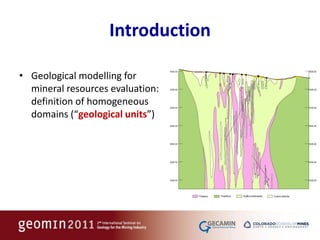
• Geological modelling for
  mineral resources evaluation:
  definition of homogeneous
  domains (“geological units”)
Introduction

Main issues with geological modelling

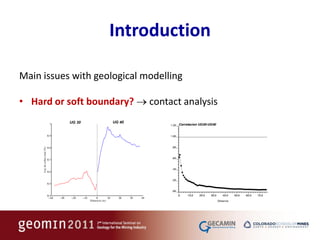
• Hard or soft boundary?     contact analysis
Introduction

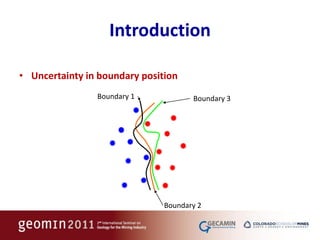
• Uncertainty in boundary position
                Boundary 1            Boundary 3


                               Boundary 2
Current modelling approaches

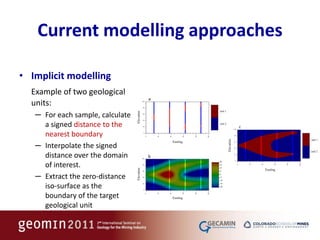
Deterministic modelling
• Hand contouring, wireframing
Current modelling approaches

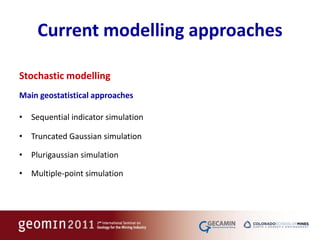
• Implicit modelling
  Example of two geological
  units:
   ─ For each sample, calculate
     a signed distance to the
     nearest boundary
   ─ Interpolate the signed
     distance over the domain
     of interest.
   ─ Extract the zero-distance
     iso-surface as the
     boundary of the target
     geological unit
Current modelling approaches

Stochastic modelling
Main geostatistical approaches

• Sequential indicator simulation

• Truncated Gaussian simulation

• Plurigaussian simulation

• Multiple-point simulation
Proposed approach

• Implicit boundary simulation
  Principle: A combination of implicit and stochastic
  modelling. Instead of interpolating the signed distance
  function, one can simulate this function using geostatistical
  algorithms
Proposed approach

• Implicit boundary simulation from available data

   –   Calculate the distance of each sample to the nearest boundary
   –   Transform the calculated distances into normal scores
   –   Perform variogram analysis of the transformed distances
   –   Simulate the transformed distances
   –   Truncate the resulting realisations to the zero distance
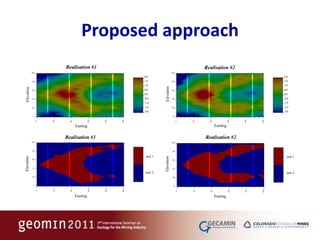
Proposed approach
Proposed approach

• Implicit boundary simulation using a reference model

   – In the reference model, calculate the distance Dtrue of each node to
     the nearest boubdary. Transform the calculated distances into
     normal scores and perform variogram analysis of the transformed
     distances

   – In the sample data base, calculate the distance Dsample of each
     sample to the nearest boundary. The true distance to the boundary
     (Dtrue) belongs to the interval [0,Dsample]
Proposed approach

– Using the transformation function and variogram determined with
  the reference model, simulate Dtrue conditionally to the previous
  interval constraint, at the data locations first (Gibbs sampler), then
  over the domain of interest

– Truncate the realisations to obtain the simulated geological units
Application

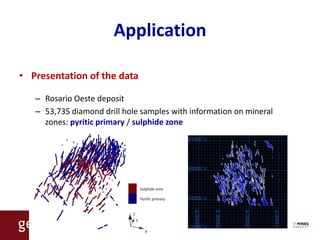
• Presentation of the data

   – Rosario Oeste deposit
   – 53,735 diamond drill hole samples with information on mineral
     zones: pyritic primary / sulphide zone
Application

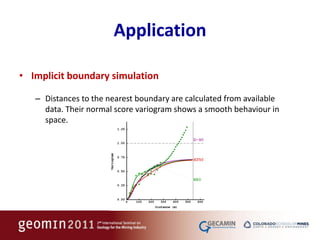
• Implicit boundary simulation

   – Distances to the nearest boundary are calculated from available
     data. Their normal score variogram shows a smooth behaviour in
     space.
Application
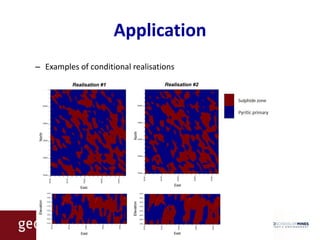
– Examples of conditional realisations
Application

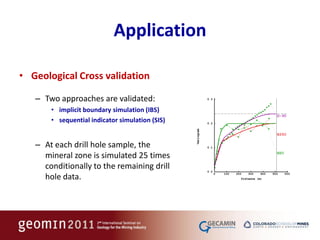
• Geological Cross validation

   – Two approaches are validated:
       • implicit boundary simulation (IBS)
       • sequential indicator simulation (SIS)


   – At each drill hole sample, the
     mineral zone is simulated 25 times
     conditionally to the remaining drill
     hole data.
Application
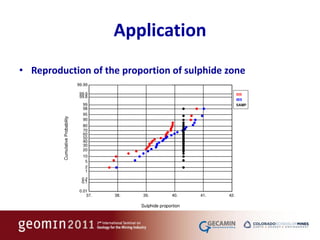
• Reproduction of the proportion of sulphide zone
Application
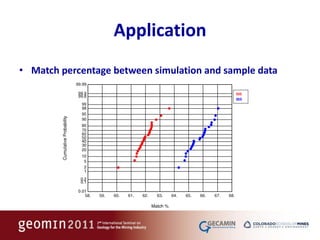
• Match percentage between simulation and sample data
Application
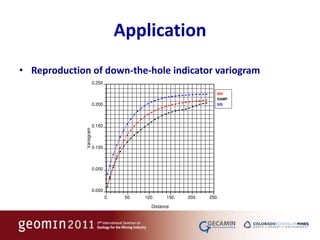
• Reproduction of down-the-hole indicator variogram
Application
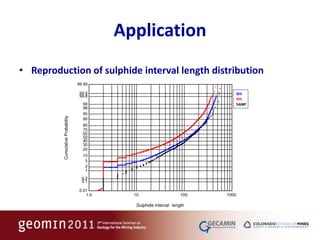
• Reproduction of sulphide interval length distribution
Conclusions

Implicit boundary simulation (IBS) better reproduces sulphide
indicator variogram and interval length distribution. It is able to
reproduce regular boundaries and connected patterns

Unlike sequential indicator simulation, IBS also provides the
distance to the nearest boundary, which conveys information
about the configuration of the mineral zones.
Acknowledgements

• Compañia minera Doña Inés de Collahuasi


• Geoinnova


• ALGES Laboratory at University of Chile

Geological simulation using implicit approach

  • 1.
    Stochastic geological modelling usingimplicit boundary simulation Alejandro Cáceres, Xavier Emery, Luis Aedo, Osvaldo Gálvez Geoinnova Consultores Ltda Department of Mining Engineering, University of Chile Advanced Mining Technology Centre, University of Chile Compañía Minera Doña Inés de Collahuasi
  • 2.
    Introduction • Geological modellingfor mineral resources evaluation: definition of homogeneous domains (“geological units”)
  • 3.
    Introduction Main issues withgeological modelling • Hard or soft boundary? contact analysis
  • 4.
    Introduction • Uncertainty inboundary position Boundary 1 Boundary 3 Boundary 2
  • 5.
    Current modelling approaches Deterministicmodelling • Hand contouring, wireframing
  • 6.
    Current modelling approaches •Implicit modelling Example of two geological units: ─ For each sample, calculate a signed distance to the nearest boundary ─ Interpolate the signed distance over the domain of interest. ─ Extract the zero-distance iso-surface as the boundary of the target geological unit
  • 7.
    Current modelling approaches Stochasticmodelling Main geostatistical approaches • Sequential indicator simulation • Truncated Gaussian simulation • Plurigaussian simulation • Multiple-point simulation
  • 8.
    Proposed approach • Implicitboundary simulation Principle: A combination of implicit and stochastic modelling. Instead of interpolating the signed distance function, one can simulate this function using geostatistical algorithms
  • 9.
    Proposed approach • Implicitboundary simulation from available data – Calculate the distance of each sample to the nearest boundary – Transform the calculated distances into normal scores – Perform variogram analysis of the transformed distances – Simulate the transformed distances – Truncate the resulting realisations to the zero distance
  • 10.
  • 11.
    Proposed approach • Implicitboundary simulation using a reference model – In the reference model, calculate the distance Dtrue of each node to the nearest boubdary. Transform the calculated distances into normal scores and perform variogram analysis of the transformed distances – In the sample data base, calculate the distance Dsample of each sample to the nearest boundary. The true distance to the boundary (Dtrue) belongs to the interval [0,Dsample]
  • 12.
    Proposed approach – Usingthe transformation function and variogram determined with the reference model, simulate Dtrue conditionally to the previous interval constraint, at the data locations first (Gibbs sampler), then over the domain of interest – Truncate the realisations to obtain the simulated geological units
  • 13.
    Application • Presentation ofthe data – Rosario Oeste deposit – 53,735 diamond drill hole samples with information on mineral zones: pyritic primary / sulphide zone
  • 14.
    Application • Implicit boundarysimulation – Distances to the nearest boundary are calculated from available data. Their normal score variogram shows a smooth behaviour in space.
  • 15.
    Application – Examples ofconditional realisations
  • 16.
    Application • Geological Crossvalidation – Two approaches are validated: • implicit boundary simulation (IBS) • sequential indicator simulation (SIS) – At each drill hole sample, the mineral zone is simulated 25 times conditionally to the remaining drill hole data.
  • 17.
    Application • Reproduction ofthe proportion of sulphide zone
  • 18.
    Application • Match percentagebetween simulation and sample data
  • 19.
    Application • Reproduction ofdown-the-hole indicator variogram
  • 20.
    Application • Reproduction ofsulphide interval length distribution
  • 21.
    Conclusions Implicit boundary simulation(IBS) better reproduces sulphide indicator variogram and interval length distribution. It is able to reproduce regular boundaries and connected patterns Unlike sequential indicator simulation, IBS also provides the distance to the nearest boundary, which conveys information about the configuration of the mineral zones.
  • 22.
    Acknowledgements • Compañia mineraDoña Inés de Collahuasi • Geoinnova • ALGES Laboratory at University of Chile