
ALLUVIAL
               DIAMONDS
          Retrospect & Prospect


     By
S.G SURENDER
“All works of history are interim reports,
what people did in the past is not
preserved in amber……Each generation
looks back and drawing from its own
experience and presumes to find patterns
tat illustrate past and present”.

               -- John Noble Wilfred
Introduction
“A mineral is defined as a naturally occurring
 homogenous solid with a definite chemical
 composition and highly ordered atomic structure”.
 Minerals with their intricate properties, that marks
 its presence in the industry.

Diamond the mineral form of element carbon, the
 mere mention of its word fills the mind with
 multitude of concepts and images. Peerless “King
 of Gems” that glitters, dazzles that symbolizes
 purity and strength.
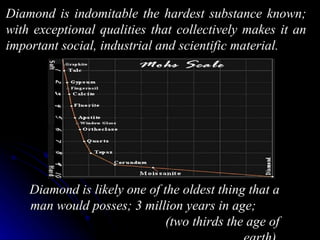
Diamond is indomitable the hardest substance known;
with exceptional qualities that collectively makes it an
important social, industrial and scientific material.


    Diamond is likely one of the oldest thing that a
    man would posses; 3 million years in age;
                              (two thirds the age of
Classification
   Bruton (1978), have classified diamonds into
                  three major groups
                          DIAMOND


   GEM                         INDUSTRIAL                     DIAMOND
DIAMONDS                         STONES                         BORT*


                     Shaped                  Rough
                    Diamonds                 Stones


 * bort- Minutely and randomly crystallized and shapeless diamond
 extremely hard and has high abrasive value.
Properties and Uses
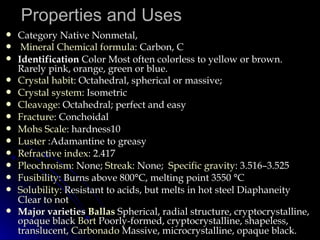
   Category Native Nonmetal,
    Mineral Chemical formula: Carbon, C
   Identification Color Most often colorless to yellow or brown.
    Rarely pink, orange, green or blue.
   Crystal habit: Octahedral, spherical or massive;
   Crystal system: Isometric
   Cleavage: Octahedral; perfect and easy
   Fracture: Conchoidal
   Mohs Scale: hardness10
   Luster :Adamantine to greasy
   Refractive index: 2.417
   Pleochroism: None; Streak: None; Specific gravity: 3.516–3.525
   Fusibility: Burns above 800°C, melting point 3550 °C
   Solubility: Resistant to acids, but melts in hot steel Diaphaneity
    Clear to not
   Major varieties Ballas Spherical, radial structure, cryptocrystalline,
    opaque black Bort Poorly-formed, cryptocrystalline, shapeless,
    translucent, Carbonado Massive, microcrystalline, opaque black.
Due to its exceptional properties diamond is used for a
  variety of purposes, namely:
 Due to its hardness; diamond is either used as single
  crystals or finely ground powder are used in cutting
  abrading, polishing tools. (it is imbedded in another
  material and used as a tool or abrasive).
 Industrial diamond are extensively used in drill bits
  & cutting devices.
 Other applications include their use in mining,
  electronic, optical, thermal, machining, dentistry
  and medicinal industries.
 Scientific applications include radiation, photo
  detection, etc.
MARKET
   Of the several billion dollars of annual transaction in
    gems, 90% of the value are accounted for by diamonds.

   80% Eighty percent of the diamonds mined annually are
    used in industry; 4 times that production is grown
    synthetically for industry - that's a total of over 500
    million carats or 100 metric tons.

   Compared to most other gem minerals the percentage of
    gem quality crystals recovered is quite high in diamond.
    20% of the diamond is of gem quality.
Brief Geology of Angola
      THE GEOLOGY OF ANGOLA IS RELATIVELY
COMPLEX, IMPERFECTLY KNOWN IN SPITE OF A BIG
RECENT PROGRESS, THE FORMATIONS BEING
DISTRIBUTED PARALLEL TO THE COAST, NNW TO THE
NORTH, NNE TO THE SOUTH.


 The CrysTalline BasemenT; a Big parT of The
CounTry is formed By The preCamBrian
BasemenT of The "Basis Complex", wiTh Twi
very Big BaTholiThs of graniTe To The n. and
To The s. of The Cuanza. The exTreme ne is a
parT of The very old Kasaï shield (2,500 my
or more); a zone TheoreTiCally favoraBle To
The KimBerliTiC inTrusions.
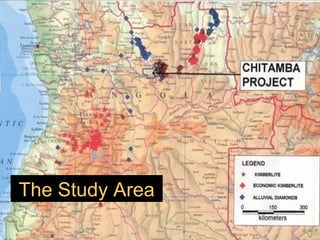
The Study Area
Alluvial Diamonds- Chitamba Area
Economic viability & Feasibility of the
Chitamba Area for alluvial diamonds.
FIELD
PHOTOGRAPHS
SAMPLING METHODS
The sampling methods vary from simple grab samples on
existing exposures to sophisticated drilling methods. The
disposition and density of sampling must be adapted to each
placer. The rule is: "A minimum of samples for a maximum
of information.


Existing Exposures
Hand-Dug Excavations ( Pits & Trenches)
Backhoe Trenches
Bulldozer Trenches
Churn Drills
Other Machine-Dug Excavations

   Machine-dug excavations are shafts or pits that
    are dug using powered equipment such as large
    augers, bucket drills, or clamshell-type
    excavators. Digging shafts with the aid of
    powered equipment requires experienced
    operators and suitable machine access. Dry,
    stable ground is also needed for successful
    sampling operations when digging shafts and
    pits.
Some of the Special Problems Associated
         with Placer Sampling
Large Rocks and Boulders: In sampling alluvial, there is
  a tendency to bypass areas containing many boulders or
  to sample the easily collected finer material around the
  boulders. In many cases, this is essentially salting the
  sample since the valuable material in a placer deposit
  usually occurs in the finer material.

Uncased Holes: The use of uncased drill holes should be
 discouraged in placer sampling, especially in sampling
 ground with a high unit value mineral. If uncased holes
 are used, there is a tendency to unintentionally salt the
 sample and get overvalued sample results.
Data Processing and Record Keeping
Accurate, systematic records must be kept for proper placer
evaluation. As an example, data that must be recorded on a
log sheet when churn drilling a placer gold deposit
includes:
1) Name of property
2) Location
3) Date
4) Pits – trench hole line number
5) Hole number
6) Hole collar elevation
7) Time (the time is given for each bailing. A summary of
time consumed in drilling, pulling, moving, repairs, etc. )
8) Depth of the drive shoe for each sample interval
9) Depth of pumping for each drive or sample interval
10) Total hole depth
11) Core rise in the pipe for each drive
14) Volume bucket measurement
18) Depth and nature of overburden
19) Labour used
20) Depth of the pay gravel
21) Depth to bedrock
22) Nature of bedrock
23) Thickness of pay zone
24) Diameter of the drive shoe
30) Value in milligrams, grams or cents per cubic meter
      (cubic yard)
31) Price of gold used in calculations if cents per volume are
      used
32) Signature of the driller, panner, and helper
RENDERING POINTS

   The detailed records can be efficiently used to
    determine the value of the deposit and its
    mineablity.

   Information obtained from the drill logs can be
    used in selecting its mining method.

   The value of the placer material is reported as
    bank cubic yards.
Reserve Estimation and Valuation
After samples have been collected, washed, and assayed,
reserves for a deposit can be estimated. There are many
placer reserve estimation methods available. Some of these
are the block, triangle, polygonal, traverses, and diamond
methods.
Methods that can be used for reserve estimation and
placer valuation are:
     (1) block method
     (2) triangle method
     (3) polygonal method
     (4) cross-section method
     (5) method of diamonds.
CONCLUSION
   It is important to remember to use care in sampling and to
    select the method that best suits the type of occurrence
    that is being sampled

    Placers formed in cold climates like Alaska or Yukon, are
    very different from tropical placers formed under
    laterization processes.

   Geological Province/Terrain characteristics must be kept
    in consent.

   Prospection for one mineral may lead to the discovery of
    many other essential minerals.
?

Ppt diam-2

  • 1.
    ALLUVIAL DIAMONDS Retrospect & Prospect By S.G SURENDER
  • 2.
    “All works ofhistory are interim reports, what people did in the past is not preserved in amber……Each generation looks back and drawing from its own experience and presumes to find patterns tat illustrate past and present”. -- John Noble Wilfred
  • 3.
    Introduction “A mineral isdefined as a naturally occurring homogenous solid with a definite chemical composition and highly ordered atomic structure”. Minerals with their intricate properties, that marks its presence in the industry. Diamond the mineral form of element carbon, the mere mention of its word fills the mind with multitude of concepts and images. Peerless “King of Gems” that glitters, dazzles that symbolizes purity and strength.
  • 4.
    Diamond is indomitablethe hardest substance known; with exceptional qualities that collectively makes it an important social, industrial and scientific material. Diamond is likely one of the oldest thing that a man would posses; 3 million years in age; (two thirds the age of
  • 5.
    Classification Bruton (1978), have classified diamonds into three major groups DIAMOND GEM INDUSTRIAL DIAMOND DIAMONDS STONES BORT* Shaped Rough Diamonds Stones * bort- Minutely and randomly crystallized and shapeless diamond extremely hard and has high abrasive value.
  • 6.
    Properties and Uses  Category Native Nonmetal,  Mineral Chemical formula: Carbon, C  Identification Color Most often colorless to yellow or brown. Rarely pink, orange, green or blue.  Crystal habit: Octahedral, spherical or massive;  Crystal system: Isometric  Cleavage: Octahedral; perfect and easy  Fracture: Conchoidal  Mohs Scale: hardness10  Luster :Adamantine to greasy  Refractive index: 2.417  Pleochroism: None; Streak: None; Specific gravity: 3.516–3.525  Fusibility: Burns above 800°C, melting point 3550 °C  Solubility: Resistant to acids, but melts in hot steel Diaphaneity Clear to not  Major varieties Ballas Spherical, radial structure, cryptocrystalline, opaque black Bort Poorly-formed, cryptocrystalline, shapeless, translucent, Carbonado Massive, microcrystalline, opaque black.
  • 7.
    Due to itsexceptional properties diamond is used for a variety of purposes, namely:  Due to its hardness; diamond is either used as single crystals or finely ground powder are used in cutting abrading, polishing tools. (it is imbedded in another material and used as a tool or abrasive).  Industrial diamond are extensively used in drill bits & cutting devices.  Other applications include their use in mining, electronic, optical, thermal, machining, dentistry and medicinal industries.  Scientific applications include radiation, photo detection, etc.
  • 8.
    MARKET  Of the several billion dollars of annual transaction in gems, 90% of the value are accounted for by diamonds.  80% Eighty percent of the diamonds mined annually are used in industry; 4 times that production is grown synthetically for industry - that's a total of over 500 million carats or 100 metric tons.  Compared to most other gem minerals the percentage of gem quality crystals recovered is quite high in diamond. 20% of the diamond is of gem quality.
  • 9.
    Brief Geology ofAngola THE GEOLOGY OF ANGOLA IS RELATIVELY COMPLEX, IMPERFECTLY KNOWN IN SPITE OF A BIG RECENT PROGRESS, THE FORMATIONS BEING DISTRIBUTED PARALLEL TO THE COAST, NNW TO THE NORTH, NNE TO THE SOUTH. The CrysTalline BasemenT; a Big parT of The CounTry is formed By The preCamBrian BasemenT of The "Basis Complex", wiTh Twi very Big BaTholiThs of graniTe To The n. and To The s. of The Cuanza. The exTreme ne is a parT of The very old Kasaï shield (2,500 my or more); a zone TheoreTiCally favoraBle To The KimBerliTiC inTrusions.
  • 10.
  • 11.
  • 12.
    Economic viability &Feasibility of the Chitamba Area for alluvial diamonds.
  • 13.
  • 16.
    SAMPLING METHODS The samplingmethods vary from simple grab samples on existing exposures to sophisticated drilling methods. The disposition and density of sampling must be adapted to each placer. The rule is: "A minimum of samples for a maximum of information. Existing Exposures Hand-Dug Excavations ( Pits & Trenches) Backhoe Trenches Bulldozer Trenches Churn Drills
  • 17.
    Other Machine-Dug Excavations  Machine-dug excavations are shafts or pits that are dug using powered equipment such as large augers, bucket drills, or clamshell-type excavators. Digging shafts with the aid of powered equipment requires experienced operators and suitable machine access. Dry, stable ground is also needed for successful sampling operations when digging shafts and pits.
  • 19.
    Some of theSpecial Problems Associated with Placer Sampling Large Rocks and Boulders: In sampling alluvial, there is a tendency to bypass areas containing many boulders or to sample the easily collected finer material around the boulders. In many cases, this is essentially salting the sample since the valuable material in a placer deposit usually occurs in the finer material. Uncased Holes: The use of uncased drill holes should be discouraged in placer sampling, especially in sampling ground with a high unit value mineral. If uncased holes are used, there is a tendency to unintentionally salt the sample and get overvalued sample results.
  • 20.
    Data Processing andRecord Keeping Accurate, systematic records must be kept for proper placer evaluation. As an example, data that must be recorded on a log sheet when churn drilling a placer gold deposit includes: 1) Name of property 2) Location 3) Date 4) Pits – trench hole line number 5) Hole number 6) Hole collar elevation 7) Time (the time is given for each bailing. A summary of time consumed in drilling, pulling, moving, repairs, etc. ) 8) Depth of the drive shoe for each sample interval 9) Depth of pumping for each drive or sample interval
  • 21.
    10) Total holedepth 11) Core rise in the pipe for each drive 14) Volume bucket measurement 18) Depth and nature of overburden 19) Labour used 20) Depth of the pay gravel 21) Depth to bedrock 22) Nature of bedrock 23) Thickness of pay zone 24) Diameter of the drive shoe 30) Value in milligrams, grams or cents per cubic meter (cubic yard) 31) Price of gold used in calculations if cents per volume are used 32) Signature of the driller, panner, and helper
  • 22.
    RENDERING POINTS  The detailed records can be efficiently used to determine the value of the deposit and its mineablity.  Information obtained from the drill logs can be used in selecting its mining method.  The value of the placer material is reported as bank cubic yards.
  • 24.
    Reserve Estimation andValuation After samples have been collected, washed, and assayed, reserves for a deposit can be estimated. There are many placer reserve estimation methods available. Some of these are the block, triangle, polygonal, traverses, and diamond methods. Methods that can be used for reserve estimation and placer valuation are: (1) block method (2) triangle method (3) polygonal method (4) cross-section method (5) method of diamonds.
  • 25.
    CONCLUSION  It is important to remember to use care in sampling and to select the method that best suits the type of occurrence that is being sampled  Placers formed in cold climates like Alaska or Yukon, are very different from tropical placers formed under laterization processes.  Geological Province/Terrain characteristics must be kept in consent.  Prospection for one mineral may lead to the discovery of many other essential minerals.
  • 26.