Presented by
 Md. Anisul Haque
Fahmida Sharmin
 Bushra E Tamanna
 Rasel Shikdar
 Shah Md. Mohsinul Haque
Sueb 1
History of English
Language has three periods
 Old English (450-1150)
Middle English (1150-
1500)
 Modern English (1500- ) 2
Middle
English
1150-1500 AD
 Middle English started with the Norman
Conquest
English becomes official language of the law
courts. More and more authors are writing in
English
 A Period of Great Change
 Decay of Inflectional Endings
French Influence on the Vocabulary of Middle
English
The Period of Greatest Influence
 Hw became Wh
3
Decay of Inflectional Endings
 Middle English Grammar
Changes
Reduction of Inflections
 Change in phonetics
 Old English Manuscripts had
disappeared by the using of press
4
The Verbs
The original English verb
destroyed
 French dominating
The weak verbs became
strong gradually
 The strong verb declined
5
Losses among the
Strong Verbs
 Almost one third strong verbs of OE
disappeared
 No reference of strong verbs in the books
after 1150
 Few strong verbs now use in spoken language
 Some strong verbs were rare and other were
in competition.
About a dozen more strong verbs appeared in
twelfth century texts.
 Today more than half of the strong verbs have
disappeared from the standard language. 6
Strong Verbs That
Became Weak
 The weak conjugation offered a smoothly structure for
the past and past participle.
 Past participle survive in the resemblance of past tense.
 Past tense were lost and become weak.
 The past participle were not used as past participle but
as adjective
 For Example;
Laden- in OE Past participle
Laden- in Modern Adjective
 Once a time English language was used only by the
people of lower classes.
 Many strong verbs also had weak forms such as blowed
for blew and knowed for knew. 7
Survival of Strong Principle
 Past form of the OE survived as the past
participles of strong verbs.
In the verb, beat the participle beaten has
remained the standard form.
Other verbs of the strong participle cloven,
laden are still used especially as adjectives.
8
Loss of Grammatical
Gender
 Leaving of inflections, Grammatical gender become
ambiguous.
The gender of old English nouns did not depend on
meaning.
Sometimes it was in contradiction with the meaning.
Thus Woman ( Wif- mann in OE) was masculine because
the second element in the compound was masculine.
 In the Middle English after the losing of inflections,
adjectives and demonstratives help to remove the
problem of masculine and feminine.
In the north, grammatical gender disappeared first.
In the south it long lasted because there the decay of
inflection was slower.
9
Middle English Syntax
 Syntactic and Semantic relationship became complex
because of leaving inflections
 Avoid the ambiguity word order of ME became limited
and restricted
 Development of Middle English as a separate stage of the
language grammatically and phonologically in SV.
Development of grammar increased in the Middle English
after Norman Conquest
 Burce Mitchell writes in book The Language of the
Peterborough Chronicle “Middle English is a process of
transition”
A Latin sentence – “Nero interfecit Agrippinam” is changed
it’s formation in ME
 Language became syntactic to analytic
10
French Influence on the Vocabulary
 French Language influenced in the Germanic Tribes
because of Norman Conquest
 They transferred French to English in the case of
governmental, administrative, ecclesiastical, legal, military,
food & social life
 Over 10000 French words entered in English gradually
 The number of French word was so large because of it’s
domination
Most of the French word used till in present Modern English
The example of French borrowed word for animals and
their meat
Animal Meat
Sheep Mutton
Cow Beef
Swine Pork 11
Period of
Greatest Change
 Otto Jespersen’s statistical study of 1000
words borrowed from French
Last half of 12 century- Slightly increased
 1200-1250= more rapidity
 After 1250- not great
 1250- 1400= 40% French came
 15000 words came and 75% still in use in
English
12
Assimilation
 French words were assimilated
 English words were added with French origin in ending
 The compounds and derivatives occur with the
adaptations of adjectives. Ex- ‘Gentle’ recorded in 1225
 The adverbial endings-ly have been adopted. Ex- ‘Gently’
recorded in 1330
 Gentle recorded in 1225
 gentlewoman recorded in 1230
 Gentleman recorded in 1275
 gentleness recorded in 1300
 Gently recorded in 1330
13
Loss of Native
Words
 Duplicate words appeared from French
 Both English and French words used side
by side
After time being huge number of English
words died out
 In the same way French words also
expired
 Thus OE (Old English) eam meaning uncle
in French is still used in Scotland
14
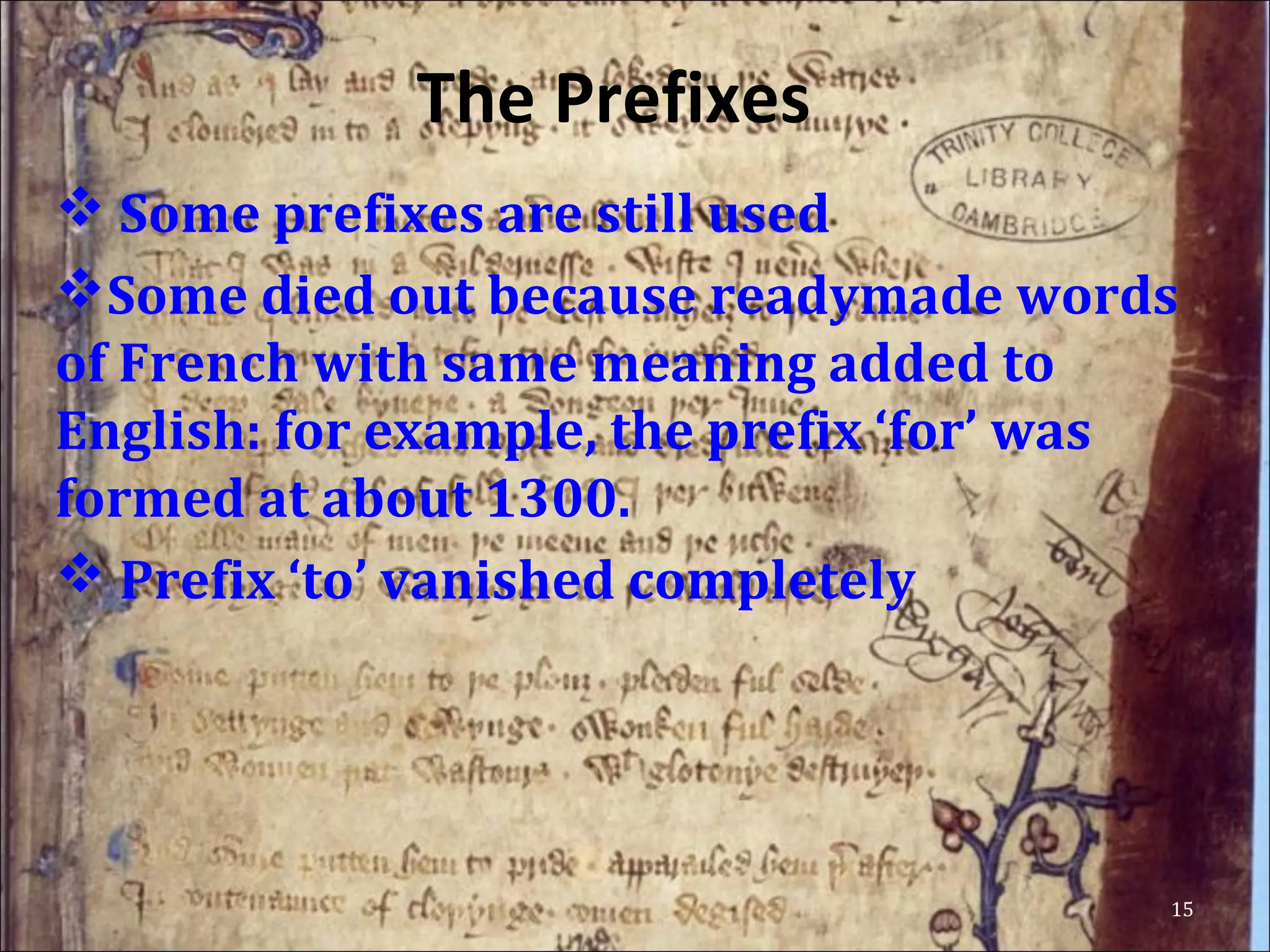
The Prefixes
 Some prefixes are still used
Some died out because readymade words
of French with same meaning added to
English: for example, the prefix ‘for’ was
formed at about 1300.
 Prefix ‘to’ vanished completely
15
Suffixes
 Some suffixes are still used
 Some died out because readymade words
of French with same meaning added to
English
 Some words newly formed by using the
suffix ‘dom’
 But a few words formed with falsedom,
richdom died out
16
Middle English Dialects
Four Dialects in Middle English-
1. Northern
2.East Midland
3. West Midland
4.Southern
East Midland Dialect was
dominating 17
The Rise of Standard English
Four reason regarding The Rise of
Standard English
1. Flexibility of the Language
2. Regional Advantage
3. Because of Cambridge & Oxford
Universities.
4. Influence of Chaucer
18
Importance of
London English
 The London English was the
language of the capital of England
 London was politically and
commercially center of England
 London English became the
language of court
19
Chaucer’s Canterbury Tales
A page from the Canterbury Tales by
Geoffrey Chaucer
20
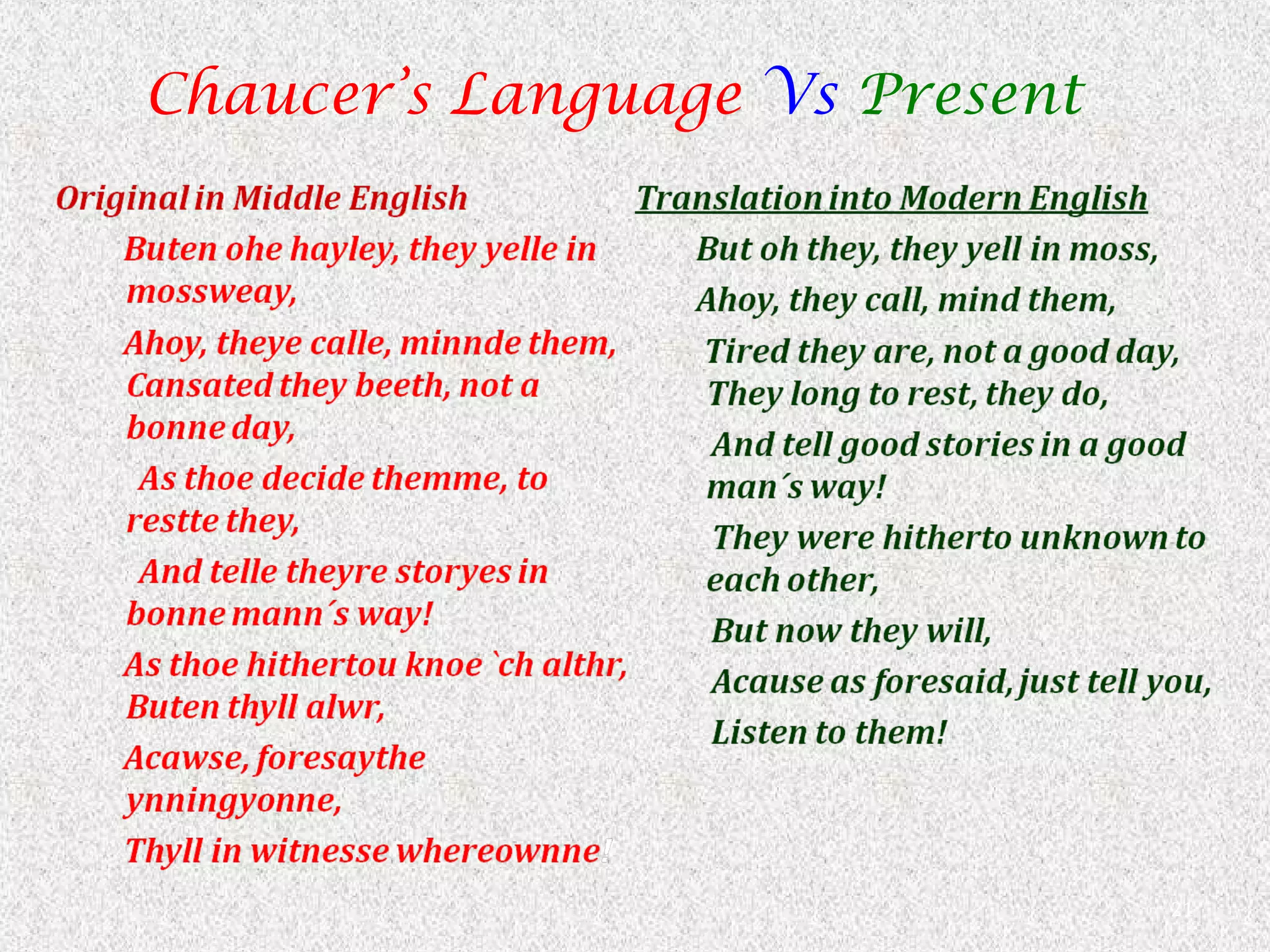
Chaucer’s Language Vs Present
21
THANK YOU
ALL
22

Middle English

  • 1.
    Presented by  Md.Anisul Haque Fahmida Sharmin  Bushra E Tamanna  Rasel Shikdar  Shah Md. Mohsinul Haque Sueb 1
  • 2.
    History of English Languagehas three periods  Old English (450-1150) Middle English (1150- 1500)  Modern English (1500- ) 2
  • 3.
    Middle English 1150-1500 AD  MiddleEnglish started with the Norman Conquest English becomes official language of the law courts. More and more authors are writing in English  A Period of Great Change  Decay of Inflectional Endings French Influence on the Vocabulary of Middle English The Period of Greatest Influence  Hw became Wh 3
  • 4.
    Decay of InflectionalEndings  Middle English Grammar Changes Reduction of Inflections  Change in phonetics  Old English Manuscripts had disappeared by the using of press 4
  • 5.
    The Verbs The originalEnglish verb destroyed  French dominating The weak verbs became strong gradually  The strong verb declined 5
  • 6.
    Losses among the StrongVerbs  Almost one third strong verbs of OE disappeared  No reference of strong verbs in the books after 1150  Few strong verbs now use in spoken language  Some strong verbs were rare and other were in competition. About a dozen more strong verbs appeared in twelfth century texts.  Today more than half of the strong verbs have disappeared from the standard language. 6
  • 7.
    Strong Verbs That BecameWeak  The weak conjugation offered a smoothly structure for the past and past participle.  Past participle survive in the resemblance of past tense.  Past tense were lost and become weak.  The past participle were not used as past participle but as adjective  For Example; Laden- in OE Past participle Laden- in Modern Adjective  Once a time English language was used only by the people of lower classes.  Many strong verbs also had weak forms such as blowed for blew and knowed for knew. 7
  • 8.
    Survival of StrongPrinciple  Past form of the OE survived as the past participles of strong verbs. In the verb, beat the participle beaten has remained the standard form. Other verbs of the strong participle cloven, laden are still used especially as adjectives. 8
  • 9.
    Loss of Grammatical Gender Leaving of inflections, Grammatical gender become ambiguous. The gender of old English nouns did not depend on meaning. Sometimes it was in contradiction with the meaning. Thus Woman ( Wif- mann in OE) was masculine because the second element in the compound was masculine.  In the Middle English after the losing of inflections, adjectives and demonstratives help to remove the problem of masculine and feminine. In the north, grammatical gender disappeared first. In the south it long lasted because there the decay of inflection was slower. 9
  • 10.
    Middle English Syntax Syntactic and Semantic relationship became complex because of leaving inflections  Avoid the ambiguity word order of ME became limited and restricted  Development of Middle English as a separate stage of the language grammatically and phonologically in SV. Development of grammar increased in the Middle English after Norman Conquest  Burce Mitchell writes in book The Language of the Peterborough Chronicle “Middle English is a process of transition” A Latin sentence – “Nero interfecit Agrippinam” is changed it’s formation in ME  Language became syntactic to analytic 10
  • 11.
    French Influence onthe Vocabulary  French Language influenced in the Germanic Tribes because of Norman Conquest  They transferred French to English in the case of governmental, administrative, ecclesiastical, legal, military, food & social life  Over 10000 French words entered in English gradually  The number of French word was so large because of it’s domination Most of the French word used till in present Modern English The example of French borrowed word for animals and their meat Animal Meat Sheep Mutton Cow Beef Swine Pork 11
  • 12.
    Period of Greatest Change Otto Jespersen’s statistical study of 1000 words borrowed from French Last half of 12 century- Slightly increased  1200-1250= more rapidity  After 1250- not great  1250- 1400= 40% French came  15000 words came and 75% still in use in English 12
  • 13.
    Assimilation  French wordswere assimilated  English words were added with French origin in ending  The compounds and derivatives occur with the adaptations of adjectives. Ex- ‘Gentle’ recorded in 1225  The adverbial endings-ly have been adopted. Ex- ‘Gently’ recorded in 1330  Gentle recorded in 1225  gentlewoman recorded in 1230  Gentleman recorded in 1275  gentleness recorded in 1300  Gently recorded in 1330 13
  • 14.
    Loss of Native Words Duplicate words appeared from French  Both English and French words used side by side After time being huge number of English words died out  In the same way French words also expired  Thus OE (Old English) eam meaning uncle in French is still used in Scotland 14
  • 15.
    The Prefixes  Someprefixes are still used Some died out because readymade words of French with same meaning added to English: for example, the prefix ‘for’ was formed at about 1300.  Prefix ‘to’ vanished completely 15
  • 16.
    Suffixes  Some suffixesare still used  Some died out because readymade words of French with same meaning added to English  Some words newly formed by using the suffix ‘dom’  But a few words formed with falsedom, richdom died out 16
  • 17.
    Middle English Dialects FourDialects in Middle English- 1. Northern 2.East Midland 3. West Midland 4.Southern East Midland Dialect was dominating 17
  • 18.
    The Rise ofStandard English Four reason regarding The Rise of Standard English 1. Flexibility of the Language 2. Regional Advantage 3. Because of Cambridge & Oxford Universities. 4. Influence of Chaucer 18
  • 19.
    Importance of London English The London English was the language of the capital of England  London was politically and commercially center of England  London English became the language of court 19
  • 20.
    Chaucer’s Canterbury Tales Apage from the Canterbury Tales by Geoffrey Chaucer 20
  • 21.
  • 22.