
The Historical,
Ideological and
Cultural Forces
  that Shaped
     English
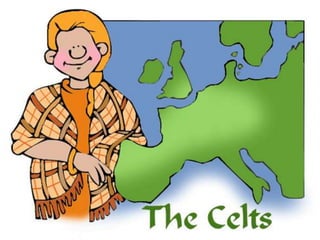
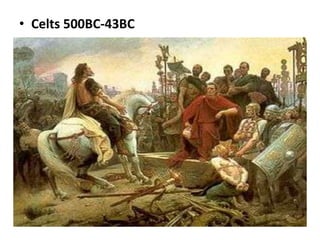
• Celts 500BC-43BC
Early in habitants of these islands
• The Celts are the earliest inhabitants of the
  British Isles to leave a mark on our language.
Celtic words
• In fact, very few Celtic words have lived on in
  the English language. But many of our place
  names have Celtic origins, such as London,
  Dover and Kent, & the rivers Thames & Wye.
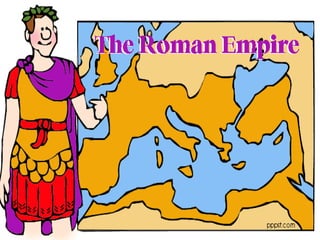
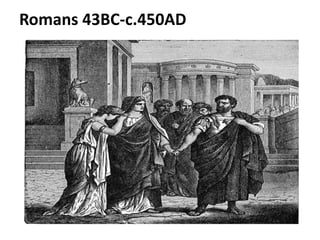
Romans 43BC-c.450AD
Romans invade and rule British Isles for over
  400 years
• Only around 200 Latin loanwords are inherited
  from the Romans - although by the 6th century
  the Church will have brought many more.
Roman words
• Many of the words passed on from this era are
  those coined by Roman merchants and
  soldiers. These
  include win (wine), candel (candle), belt(belt)
  and weall (wall).
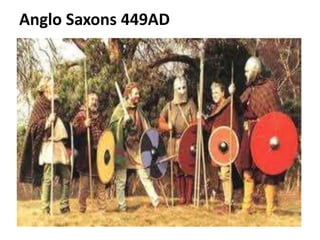
Anglo Saxons 449AD
Germanic tribes - Angles, Saxons and Jutes
  begin to arrive
• Anglo Saxon dialects form the basis of the
  language we now call Old English. About 400
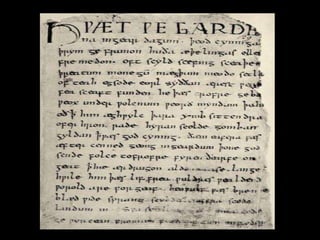
  Anglo Saxon texts survive from this era,
  including many beautiful poems - these tell
  tales of wild battles and heroic journeys.
Anglo Saxon words
• Approximately one third of Anglo-Saxon
  vocabulary survives into modern English,
  including many of our most basic,
  everyday words: earth, house, food, sing,
  night and sleep. By the 7th century Latin
  speakers refer to this country as Anglia - the
  land of the Angles - a name that will later
  develop intoEngland.
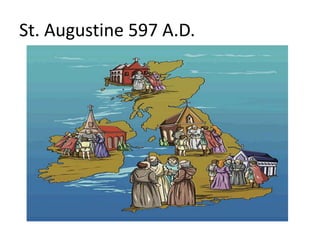
St. Augustine 597 A.D.
Christian missionaries arrive from the Continent
• Christian missionaries, led by St. Augustine, move
  through the land, converting the Anglo-Saxons
  from their Pagan beliefs to a Catholic Christian
  faith. Throughout Europe, the language of the
  Church is Latin, and the missionaries inject
  hundreds of new Latin words into the English
  language. English is spoken differently in different
  counties, but four main dialects exist and
  resemble the English we know today. These
  dialects are Northumbrian, Mercian, West Saxon
  and Kentish.
Latin words
• Many of the new words derived from Latin
  refer to religion, such as altar, mass,
  school, andmonk, but others are more
  domestic and mundane such as fork, spade,
  spider, tower, androse.
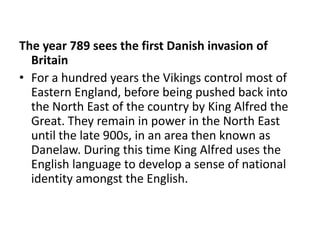
Vikings 789AD
The year 789 sees the first Danish invasion of
  Britain
• For a hundred years the Vikings control most of
  Eastern England, before being pushed back into
  the North East of the country by King Alfred the
  Great. They remain in power in the North East
  until the late 900s, in an area then known as
  Danelaw. During this time King Alfred uses the
  English language to develop a sense of national
  identity amongst the English.
Norse words
• These raiders and settlers bring almost 2000
  new words into the English vocabulary. Words
  derived from Norse include anger, awkward,
  cake, die, egg, freckle, muggy, reindeer, silver,
  skirt andsmile. Many Northern English dialect
  words still bear traces of Scandinavian
  languages, as do many place names such as
  Whitby and Grimsby.
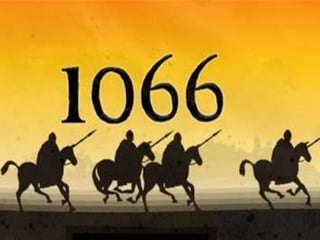
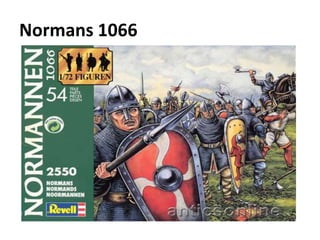
Normans 1066
The Normans invade
• The Normans transform England, both
  culturally and linguistically. For over 300 years
  French is the language spoken by the most
  powerful people - royalty, aristocrats and high-
  powered officials - some of whom can't speak
  English at all. French is used in political
  documents, in administration, and
  in literature. Latin is still the language of the
  church and of scholars, but most of the general
  population speak English in their everday lives.
French words
• Thousands of French words become
  embedded in the English vocabulary, most of
  which are words of power, such as crown,
  castle, court, parliament, army, mansion,
  gown, beauty, banquet, art, poet, romance,
  chess, colour, duke, servant, peasant,
  traitor and governor.
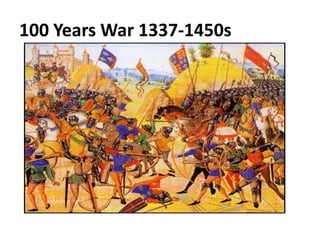
100 Years War 1337-1450s
100 Years War fought between England and
  France
• Following the 100 Years War, many people
  regard French as the language of the enemy.
  The status of English rises. The universities of
  Oxford & Cambridge are established. Literacy
  increases but books are still copied by hand
  and are therefore extremely expensive.
New Latin words
• Many thousands of Latin words come into the
  language, most of which are connected to
  religion, medicine, law or literature. These
  words include scripture, collect, immortal,
  history, library, solar, recipe and genius.
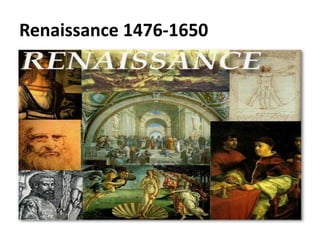
Renaissance 1476-1650
A time of great cultural and intellectual development
• In 1476, Caxton introduces the printing press to England.
   He prints all kinds of texts: mythic tales, popular stories,
   poems, phrasebooks, devotional pieces & grammars. In the
   following 150 years around 20,000 books are printed. Books
   become cheaper and are therefore increasingly popular.
   Literacy rates rise. Printers have to make a choice about
   which words, grammar and spellings to use. The choices
   they make help to set and spread a standard language.
   They base their decisions on the dialects of the South East -
   the most socially and economically influencial region. But
   these rules are not set in stone, and people continue to
   speak in different accents and dialects, and to write with
   different spellings. Over the next 200 years wonderful
   discoveries and innovations are made in the fields of art,
   theatre and science. There is a fresh interest amongst
   scholars in classical languages, while intrepid explorers and
   opportunistic traders travel to the New World.
New words
• With these fresh findings come new words from
  across the globe, including atmosphere, explain,
  enthusiasm, skeleton and utopian (from
  Latin);bizarre, chocolate, explore,
  moustache andvogue (from French); carnival,
  macaroni andviolin (from Italian) harem, jar,
  magazine andsherbet from Arabic); and coffee,
  yoghurt andkiosk (from Turkish); tomato,
  potato and tobacco(from Spanish)
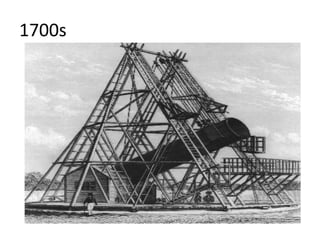
1700s
An age of dictionaries, grammars and rules and
  regulations
• Human knowledge continues to stretch into
  new areas, with discoveries in the fields of
  medicine, astrology, botany & engineering.
  Many scholars believe that the English
  language is chaotic, and in desperate need of
  some firm rules. Books teaching 'correct'
  grammar, pronunciation & spelling are
  increasingly popular. Samuel Johnson
  publishes his famous dictionary in 1755.
Derided words
• Words hated by Johnson, and omited from his
  dictionary, include bang, budge, fuss, gambler,
  shabby, and touchy.
Industrial Revolution 1760-1800s
Transformation of the western world
• In an age of inventions and contraptions, of
  science & industry, of expanding cities &
  smog-gurgling factories the language must
  swell to accommodate new ideas.
New words
• Newly coined words include biology,
  taxonomy, caffeine, cityscape, centigrade,
  watt, bacterium,
  chromosome and claustrophobia. In the world
  of burgeoning capitalism, money can
  suddenlyslump, inflate, boom and
  cause depressions.Victorian writers pen over
  60,000 novels.
1990s
English of today
• A century of world wars,
  technological transformation, and
  globalisation. The language continues to grow,
  expanding to incorporate new jargons, slangs,
  technologies, toys, foods and gadgets.
Familiar words
• It is in this century that we get doodlebugs,
  gasmasks, gobstoppers, mini
  skirts and modsand rockers; we enjoy dim
  sum, cappuccino, chicken
  tikka masala and pizzerias; we talk ofchavs,
  mingers and weirdos; and we are addicted
  to tellies, websites, cybercafes and compact
  discs.
Dionisio  report

Dionisio report

  • 1.
    The Historical, Ideological and CulturalForces that Shaped English
  • 5.
  • 6.
    Early in habitantsof these islands • The Celts are the earliest inhabitants of the British Isles to leave a mark on our language. Celtic words • In fact, very few Celtic words have lived on in the English language. But many of our place names have Celtic origins, such as London, Dover and Kent, & the rivers Thames & Wye.
  • 8.
  • 9.
    Romans invade andrule British Isles for over 400 years • Only around 200 Latin loanwords are inherited from the Romans - although by the 6th century the Church will have brought many more. Roman words • Many of the words passed on from this era are those coined by Roman merchants and soldiers. These include win (wine), candel (candle), belt(belt) and weall (wall).
  • 11.
  • 12.
    Germanic tribes -Angles, Saxons and Jutes begin to arrive • Anglo Saxon dialects form the basis of the language we now call Old English. About 400 Anglo Saxon texts survive from this era, including many beautiful poems - these tell tales of wild battles and heroic journeys.
  • 13.
    Anglo Saxon words •Approximately one third of Anglo-Saxon vocabulary survives into modern English, including many of our most basic, everyday words: earth, house, food, sing, night and sleep. By the 7th century Latin speakers refer to this country as Anglia - the land of the Angles - a name that will later develop intoEngland.
  • 14.
  • 15.
    Christian missionaries arrivefrom the Continent • Christian missionaries, led by St. Augustine, move through the land, converting the Anglo-Saxons from their Pagan beliefs to a Catholic Christian faith. Throughout Europe, the language of the Church is Latin, and the missionaries inject hundreds of new Latin words into the English language. English is spoken differently in different counties, but four main dialects exist and resemble the English we know today. These dialects are Northumbrian, Mercian, West Saxon and Kentish.
  • 16.
    Latin words • Manyof the new words derived from Latin refer to religion, such as altar, mass, school, andmonk, but others are more domestic and mundane such as fork, spade, spider, tower, androse.
  • 17.
  • 18.
    The year 789sees the first Danish invasion of Britain • For a hundred years the Vikings control most of Eastern England, before being pushed back into the North East of the country by King Alfred the Great. They remain in power in the North East until the late 900s, in an area then known as Danelaw. During this time King Alfred uses the English language to develop a sense of national identity amongst the English.
  • 19.
    Norse words • Theseraiders and settlers bring almost 2000 new words into the English vocabulary. Words derived from Norse include anger, awkward, cake, die, egg, freckle, muggy, reindeer, silver, skirt andsmile. Many Northern English dialect words still bear traces of Scandinavian languages, as do many place names such as Whitby and Grimsby.
  • 21.
  • 22.
    The Normans invade •The Normans transform England, both culturally and linguistically. For over 300 years French is the language spoken by the most powerful people - royalty, aristocrats and high- powered officials - some of whom can't speak English at all. French is used in political documents, in administration, and in literature. Latin is still the language of the church and of scholars, but most of the general population speak English in their everday lives.
  • 23.
    French words • Thousandsof French words become embedded in the English vocabulary, most of which are words of power, such as crown, castle, court, parliament, army, mansion, gown, beauty, banquet, art, poet, romance, chess, colour, duke, servant, peasant, traitor and governor.
  • 24.
    100 Years War1337-1450s
  • 25.
    100 Years Warfought between England and France • Following the 100 Years War, many people regard French as the language of the enemy. The status of English rises. The universities of Oxford & Cambridge are established. Literacy increases but books are still copied by hand and are therefore extremely expensive.
  • 26.
    New Latin words •Many thousands of Latin words come into the language, most of which are connected to religion, medicine, law or literature. These words include scripture, collect, immortal, history, library, solar, recipe and genius.
  • 28.
  • 29.
    A time ofgreat cultural and intellectual development • In 1476, Caxton introduces the printing press to England. He prints all kinds of texts: mythic tales, popular stories, poems, phrasebooks, devotional pieces & grammars. In the following 150 years around 20,000 books are printed. Books become cheaper and are therefore increasingly popular. Literacy rates rise. Printers have to make a choice about which words, grammar and spellings to use. The choices they make help to set and spread a standard language. They base their decisions on the dialects of the South East - the most socially and economically influencial region. But these rules are not set in stone, and people continue to speak in different accents and dialects, and to write with different spellings. Over the next 200 years wonderful discoveries and innovations are made in the fields of art, theatre and science. There is a fresh interest amongst scholars in classical languages, while intrepid explorers and opportunistic traders travel to the New World.
  • 30.
    New words • Withthese fresh findings come new words from across the globe, including atmosphere, explain, enthusiasm, skeleton and utopian (from Latin);bizarre, chocolate, explore, moustache andvogue (from French); carnival, macaroni andviolin (from Italian) harem, jar, magazine andsherbet from Arabic); and coffee, yoghurt andkiosk (from Turkish); tomato, potato and tobacco(from Spanish)
  • 31.
  • 32.
    An age ofdictionaries, grammars and rules and regulations • Human knowledge continues to stretch into new areas, with discoveries in the fields of medicine, astrology, botany & engineering. Many scholars believe that the English language is chaotic, and in desperate need of some firm rules. Books teaching 'correct' grammar, pronunciation & spelling are increasingly popular. Samuel Johnson publishes his famous dictionary in 1755.
  • 33.
    Derided words • Wordshated by Johnson, and omited from his dictionary, include bang, budge, fuss, gambler, shabby, and touchy.
  • 34.
    Industrial Revolution 1760-1800s Transformationof the western world • In an age of inventions and contraptions, of science & industry, of expanding cities & smog-gurgling factories the language must swell to accommodate new ideas.
  • 35.
    New words • Newlycoined words include biology, taxonomy, caffeine, cityscape, centigrade, watt, bacterium, chromosome and claustrophobia. In the world of burgeoning capitalism, money can suddenlyslump, inflate, boom and cause depressions.Victorian writers pen over 60,000 novels.
  • 36.
  • 37.
    English of today •A century of world wars, technological transformation, and globalisation. The language continues to grow, expanding to incorporate new jargons, slangs, technologies, toys, foods and gadgets.
  • 38.
    Familiar words • Itis in this century that we get doodlebugs, gasmasks, gobstoppers, mini skirts and modsand rockers; we enjoy dim sum, cappuccino, chicken tikka masala and pizzerias; we talk ofchavs, mingers and weirdos; and we are addicted to tellies, websites, cybercafes and compact discs.