Chapter 9
          Language Change

By: Angelica Becerra, Alexandra Garcia-Meza
             and Jennifer Duran
Historical or Diachronic
              Linguistics
                               A language for which no
                                written evidence exists but
                                that is assumed to have been
 Historical linguistics is     spoken at one time is a
  the study of language         Proto-Language.
  change.                      Ex: Proto-Germanic and
 Historical linguistics        Proto-Indo-European
  grew out of comparative
                               Dead Languages are those
  linguistics.                  that no longer have any living
                                native speakers.
                               Ex: Old English
Semantic Change
When linguists talk about semantic
 change they are talking about changes
 in the sense (literal meaning) of the
 word.
A core concept in studying semantic
 change is etymology, which is the
 history and development of a word.
Types of Semantic Change
         Generalization
         Specialization
          Amelioration
           Pejoration
             Taboo
           Metaphor
          Association
            Dilution
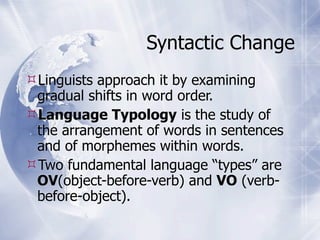
Syntactic Change
Linguists approach it by examining
 gradual shifts in word order.
Language Typology is the study of
 the arrangement of words in sentences
 and of morphemes within words.
Two fundamental language “types” are
 OV(object-before-verb) and VO (verb-
 before-object).
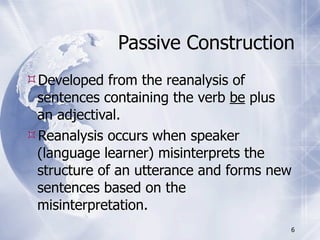
Passive Construction
Developed from the reanalysis of
 sentences containing the verb be plus
 an adjectival.
Reanalysis occurs when speaker
 (language learner) misinterprets the
 structure of an utterance and forms new
 sentences based on the
 misinterpretation.
                                       6
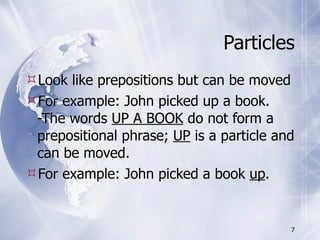
Particles
Look like prepositions but can be moved
For example: John picked up a book.
 -The words UP A BOOK do not form a
 prepositional phrase; UP is a particle and
 can be moved.
For example: John picked a book up.


                                          7
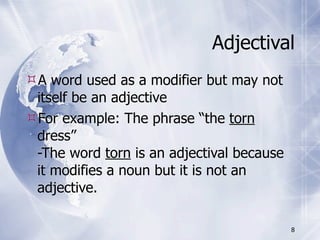
Adjectival
A word used as a modifier but may not
 itself be an adjective
For example: The phrase “the torn
 dress”
 -The word torn is an adjectival because
 it modifies a noun but it is not an
 adjective.

                                           8
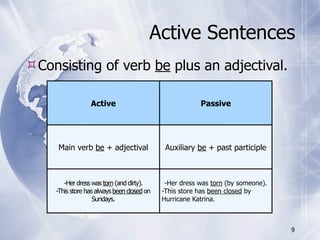
Active Sentences
Consisting of verb be plus an adjectival.

                 Active                                 Passive


     Main verb be + adjectival               Auxiliary be + past participle


       -Her dress was torn (and dirty).      -Her dress was torn (by someone).
    -This store has always been closed on   -This store has been closed by
                   Sundays.                 Hurricane Katrina.


                                                                                 9
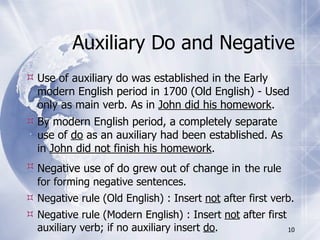
Auxiliary Do and Negative
 Use of auxiliary do was established in the Early
  modern English period in 1700 (Old English) - Used
  only as main verb. As in John did his homework.
 By modern English period, a completely separate
  use of do as an auxiliary had been established. As
  in John did not finish his homework.
 Negative use of do grew out of change in the rule
  for forming negative sentences.
 Negative rule (Old English) : Insert not after first verb.
 Negative rule (Modern English) : Insert not after first
  auxiliary verb; if no auxiliary insert do.              10
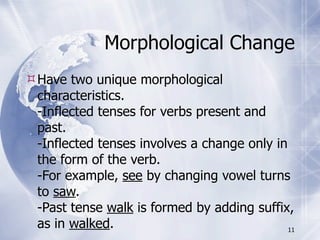
Morphological Change
Have two unique morphological
 characteristics.
 -Inflected tenses for verbs present and
 past.
 -Inflected tenses involves a change only in
 the form of the verb.
 -For example, see by changing vowel turns
 to saw.
 -Past tense walk is formed by adding suffix,
 as in walked.                               11
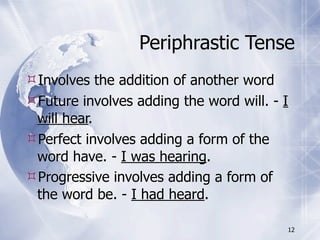
Periphrastic Tense
Involves the addition of another word
Future involves adding the word will. - I
 will hear.
Perfect involves adding a form of the
 word have. - I was hearing.
Progressive involves adding a form of
 the word be. - I had heard.

                                         12
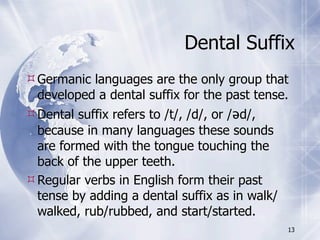
Dental Suffix
 Germanic languages are the only group that
  developed a dental suffix for the past tense.
 Dental suffix refers to /t/, /d/, or /əd/,
  because in many languages these sounds
  are formed with the tongue touching the
  back of the upper teeth.
 Regular verbs in English form their past
  tense by adding a dental suffix as in walk/
  walked, rub/rubbed, and start/started.
                                              13
Weak Verbs and Strong Verbs
 Weak verbs are what linguists call “regular
  verbs”
 Strong verbs are verbs which form their past
  tense solely with a vowel change. As in drive/
  drove, sing/sang, and give/gave.
 There are verbs that form their past tense with
  both dental suffix and a vowel change. As in
  bring/brought.
 Dental suffix is what’s relevant and makes it a
  weak verb.
                                                    14
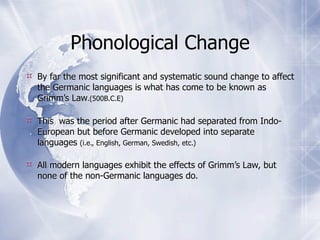
Phonological Change
 By far the most significant and systematic sound change to affect
  the Germanic languages is what has come to be known as
  Grimm’s Law.(500B.C.E)

 This was the period after Germanic had separated from Indo-
  European but before Germanic developed into separate
  languages (i.e., English, German, Swedish, etc.)

 All modern languages exhibit the effects of Grimm’s Law, but
  none of the non-Germanic languages do.
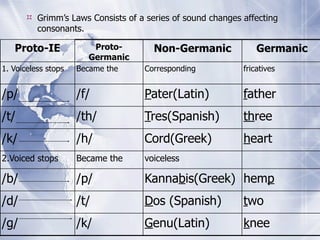
 Grimm’s Laws Consists of a series of sound changes affecting
        consonants.

   Proto-IE             Proto-       Non-Germanic              Germanic
                       Germanic
1. Voiceless stops   Became the    Corresponding           fricatives


/p/                  /f/           Pater(Latin)            father
/t/                  /th/          Tres(Spanish)           three
/k/                  /h/           Cord(Greek)             heart
2.Voiced stops       Became the    voiceless

/b/                  /p/           Kannabis(Greek) hemp
/d/                  /t/           Dos (Spanish)           two
/g/                  /k/           Genu(Latin)             knee
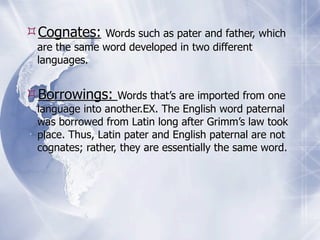
Cognates:    Words such as pater and father, which
 are the same word developed in two different
 languages.


Borrowings:      Words that’s are imported from one
 language into another.EX. The English word paternal
 was borrowed from Latin long after Grimm’s law took
 place. Thus, Latin pater and English paternal are not
 cognates; rather, they are essentially the same word.
Causes of Change
 Functionalism:Language is thought to change in order to help
  speakers communicate more efficiently.Ex. Caramel changed from/
  kaeremel/ to karmel because it is easier to pronounce.
 Misapprehension:Language is thought to change when
  speakers make a mistake in processing it due to structures that can be
  interpreted ambiguously. Misapprehension can also account for
  numerous changes in other components of the grammar.
 Internal Change: are due to misapprehension rather than
  functional considerations.
 External Change: we distinguish such apparently
  spontaneous changes from those that are caused by social
  factors.
Helpful Tips as Educators
Keep language typology into
 consideration when teaching ELLs.
Particles and reanalysis of sentences
 containing the main verb be plus an
 adjectival can be the most challenging
 for language learners.
Cause of language change can be both
 external and internal.

Chapter 9 lingustics[2]

  • 1.
    Chapter 9 Language Change By: Angelica Becerra, Alexandra Garcia-Meza and Jennifer Duran
  • 2.
    Historical or Diachronic Linguistics  A language for which no written evidence exists but that is assumed to have been  Historical linguistics is spoken at one time is a the study of language Proto-Language. change.  Ex: Proto-Germanic and  Historical linguistics Proto-Indo-European grew out of comparative  Dead Languages are those linguistics. that no longer have any living native speakers.  Ex: Old English
  • 3.
    Semantic Change When linguiststalk about semantic change they are talking about changes in the sense (literal meaning) of the word. A core concept in studying semantic change is etymology, which is the history and development of a word.
  • 4.
    Types of SemanticChange  Generalization  Specialization  Amelioration  Pejoration  Taboo  Metaphor  Association  Dilution
  • 5.
    Syntactic Change Linguists approachit by examining gradual shifts in word order. Language Typology is the study of the arrangement of words in sentences and of morphemes within words. Two fundamental language “types” are OV(object-before-verb) and VO (verb- before-object).
  • 6.
    Passive Construction Developed fromthe reanalysis of sentences containing the verb be plus an adjectival. Reanalysis occurs when speaker (language learner) misinterprets the structure of an utterance and forms new sentences based on the misinterpretation. 6
  • 7.
    Particles Look like prepositionsbut can be moved For example: John picked up a book. -The words UP A BOOK do not form a prepositional phrase; UP is a particle and can be moved. For example: John picked a book up. 7
  • 8.
    Adjectival A word usedas a modifier but may not itself be an adjective For example: The phrase “the torn dress” -The word torn is an adjectival because it modifies a noun but it is not an adjective. 8
  • 9.
    Active Sentences Consisting ofverb be plus an adjectival. Active Passive Main verb be + adjectival Auxiliary be + past participle -Her dress was torn (and dirty). -Her dress was torn (by someone). -This store has always been closed on -This store has been closed by Sundays. Hurricane Katrina. 9
  • 10.
    Auxiliary Do andNegative  Use of auxiliary do was established in the Early modern English period in 1700 (Old English) - Used only as main verb. As in John did his homework.  By modern English period, a completely separate use of do as an auxiliary had been established. As in John did not finish his homework.  Negative use of do grew out of change in the rule for forming negative sentences.  Negative rule (Old English) : Insert not after first verb.  Negative rule (Modern English) : Insert not after first auxiliary verb; if no auxiliary insert do. 10
  • 11.
    Morphological Change Have twounique morphological characteristics. -Inflected tenses for verbs present and past. -Inflected tenses involves a change only in the form of the verb. -For example, see by changing vowel turns to saw. -Past tense walk is formed by adding suffix, as in walked. 11
  • 12.
    Periphrastic Tense Involves theaddition of another word Future involves adding the word will. - I will hear. Perfect involves adding a form of the word have. - I was hearing. Progressive involves adding a form of the word be. - I had heard. 12
  • 13.
    Dental Suffix  Germaniclanguages are the only group that developed a dental suffix for the past tense.  Dental suffix refers to /t/, /d/, or /əd/, because in many languages these sounds are formed with the tongue touching the back of the upper teeth.  Regular verbs in English form their past tense by adding a dental suffix as in walk/ walked, rub/rubbed, and start/started. 13
  • 14.
    Weak Verbs andStrong Verbs  Weak verbs are what linguists call “regular verbs”  Strong verbs are verbs which form their past tense solely with a vowel change. As in drive/ drove, sing/sang, and give/gave.  There are verbs that form their past tense with both dental suffix and a vowel change. As in bring/brought.  Dental suffix is what’s relevant and makes it a weak verb. 14
  • 15.
    Phonological Change  Byfar the most significant and systematic sound change to affect the Germanic languages is what has come to be known as Grimm’s Law.(500B.C.E)  This was the period after Germanic had separated from Indo- European but before Germanic developed into separate languages (i.e., English, German, Swedish, etc.)  All modern languages exhibit the effects of Grimm’s Law, but none of the non-Germanic languages do.
  • 16.
     Grimm’s LawsConsists of a series of sound changes affecting consonants. Proto-IE Proto- Non-Germanic Germanic Germanic 1. Voiceless stops Became the Corresponding fricatives /p/ /f/ Pater(Latin) father /t/ /th/ Tres(Spanish) three /k/ /h/ Cord(Greek) heart 2.Voiced stops Became the voiceless /b/ /p/ Kannabis(Greek) hemp /d/ /t/ Dos (Spanish) two /g/ /k/ Genu(Latin) knee
  • 17.
    Cognates: Words such as pater and father, which are the same word developed in two different languages. Borrowings: Words that’s are imported from one language into another.EX. The English word paternal was borrowed from Latin long after Grimm’s law took place. Thus, Latin pater and English paternal are not cognates; rather, they are essentially the same word.
  • 18.
    Causes of Change Functionalism:Language is thought to change in order to help speakers communicate more efficiently.Ex. Caramel changed from/ kaeremel/ to karmel because it is easier to pronounce.  Misapprehension:Language is thought to change when speakers make a mistake in processing it due to structures that can be interpreted ambiguously. Misapprehension can also account for numerous changes in other components of the grammar.  Internal Change: are due to misapprehension rather than functional considerations.  External Change: we distinguish such apparently spontaneous changes from those that are caused by social factors.
  • 19.
    Helpful Tips asEducators Keep language typology into consideration when teaching ELLs. Particles and reanalysis of sentences containing the main verb be plus an adjectival can be the most challenging for language learners. Cause of language change can be both external and internal.