LANGUISTIC
CHANGES AND
ADAPTATIONS
OVER TIME
Prepared by: Aljon Lariosa Añasco
The evolution of modern English has been marked by a
series of linguistic changes and adaptations, reflecting the
dynamic nature of language and its responsiveness to
external influences. These changes have occurred across
various aspects of language, including pronunciation,
grammar, vocabulary, and syntax.
01
PHONOLOGICAL
CHANGES
02GRAMMATICAL
CHANGES
03
LEXICAL CHANGES
04SYNTACTIC CHANGES
PHONOLOGICAL
CHANGES
• The Great Vowel Shift
• Loss of final unstressed vowels
• Merging of vowel sounds
PHONOLOGICAL
CHANGES
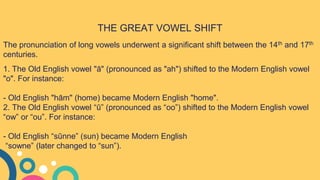
THE GREAT VOWEL SHIFT
The pronunciation of long vowels underwent a significant shift between the 14th and 17th
centuries.
1. The Old English vowel "ā" (pronounced as "ah") shifted to the Modern English vowel
"o". For instance:
- Old English "hām" (home) became Modern English "home".
2. The Old English vowel “ū” (pronounced as “oo”) shifted to the Modern English vowel
“ow” or “ou”. For instance:
- Old English “sūnne” (sun) became Modern English
“sowne” (later changed to “sun”).
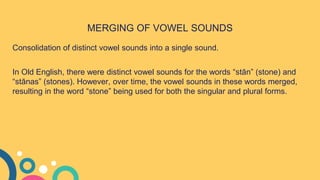
MERGING OF VOWEL SOUNDS
Consolidation of distinct vowel sounds into a single sound.
In Old English, there were distinct vowel sounds for the words “stān” (stone) and
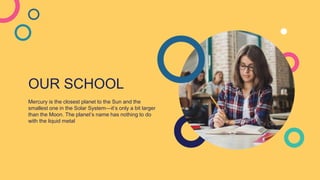
“stānas” (stones). However, over time, the vowel sounds in these words merged,
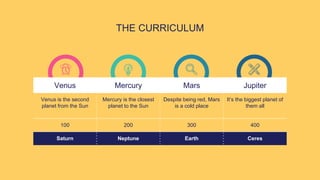
resulting in the word “stone” being used for both the singular and plural forms.
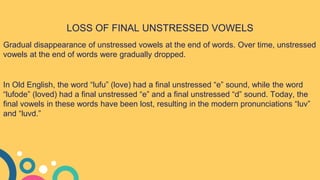
LOSS OF FINAL UNSTRESSED VOWELS
Gradual disappearance of unstressed vowels at the end of words. Over time, unstressed
vowels at the end of words were gradually dropped.
In Old English, the word “lufu” (love) had a final unstressed “e” sound, while the word
“lufode” (loved) had a final unstressed “e” and a final unstressed “d” sound. Today, the
final vowels in these words have been lost, resulting in the modern pronunciations “luv”
and “luvd.”
GRAMMATICAL
CHANGES
01
SIMPLIFICATION OF VERB
CONJUGATIONS
LOSS OF NOUN CASE ENDINGS
02
DEVELOPMENT OF PERIPHRASTIC
CONSTRUCTIONS
03
SIMPLIFICATION OF VERB CONJUGATIONS
Reduction in the number of verb forms, particularly in the present and past tenses. The
old english verb system was highly complex, featuring a variety of endings
depending on tense, person, and number. Over time, these conjugations were
simplified, leading to the more streamlined verb system of modern english.
For example, the old english verb “lufian” (to love) had numerous conjugations, including
“ic lufige” (I love), “þū lufast” (you love), “he lufaþ” (he loves), “wē lufige” (we love),
“gē lufige” (you love, plural), and “hie lufige” (they love). In modern english, the verb
“to love” has a much simpler conjugation system: “I love,” “you love,” “he loves,” “we
love,” “you love” (plural), and “they love.”
LOSS OF NOUN CASE ENDINGS
Elimination of grammatical markers that indicate the function of nouns in sentences. Old
English nouns had distinct endings that indicated their function in a sentence, such
as nominative (subject), accusative (direct object), and dative (indirect object). These
case endings gradually disappeared in Middle English and are almost entirely absent
in Modern English.
For instance, the noun “dēor” (animal) had different forms depending on its role in the
sentence: “dēor” (nominative, subject), “dēor” (accusative, direct object), and “dēore”
(dative, indirect object).
DEVELOPMENT OF PERIPHRASTIC CONSTRUCTIONS
Use of auxiliary verbs and phrases to express grammatical concepts previously
conveyed by inflections. To express grammatical concepts that were previously
conveyed through inflections, Modern English has developed periphrastic
constructions, which involve combining auxiliary verbs and phrases.
For example, the verb "lufian" (to love) in the future tense would be "ic lufige" (I will love).
In Modern English, the future tense is typically expressed using the auxiliary verb
"will." So, instead of adding a suffix to the verb, we use the auxiliary verb "will" before
the base form of the verb. We would say "I will love" to express the future tense.
LEXICAL
CHANGES
Adoption of vocabulary from languages like Latin, French, Greek, and
more recent encounters. The English language has drawn from a rich
tapestry of languages, incorporating words from Latin, French, Greek,
Arabic, and many other sources. This borrowing reflects the historical
interactions and cultural influences that have shaped English. For
instance, words like “education,” “government,” and “geography” stem
from Latin, while words like “rendezvous,” “cuisine,” and
“entrepreneur” derive from French.
BORROWING OF WORDS FROM OTHER LANGUAGES
Creation of new words through processes like compounding,
affixation, and blending. English is a dynamic language, constantly
expanding its vocabulary through the creation of new words. This
process often involves compounding (e.g., "brainwash," "keyword"),
affixation (e.g., "unfriend," "repetition"), and blending (e.g., "brunch,"
"smog"). These new words reflect the evolving concepts,
technologies, and cultural trends that shape modern society.
COINAGE OF NEW WORDS
Changes in the meaning of existing words, often reflecting cultural
shifts or new contexts. The meanings of words can evolve over time,
adapting to changing contexts and cultural norms. For example, the
word “nice” originally meant “foolish” or “ignorant,” but it has gradually
acquired a more positive meaning, signifying “pleasant” or
“agreeable.” This semantic shift reflects the changing values and
perceptions of society.
SEMANTIC SHIFTS
SYNTACTIC
CHANGES
Fixed word order
Loss of grammatical
agreement
Rise of new sentence
structures
1
2
3
Development of a more rigid word order, particularly in subject-verb-
object constructions. Modern English has developed a relatively fixed
word order, with the subject typically preceding the verb and the
object typically following the verb. This word order pattern was less
rigid in Old English, allowing for more flexibility in sentence structure.
FIXED WORD ORDER
Reduction in the requirement for agreement between subjects and
verbs or nouns and modifiers. In Old English, nouns were categorized
into three genders: masculine, feminine, and neuter. This gender
assignment influenced the form of adjectives and articles that
modified the noun. For instance, the word “se mann” (the man) was
masculine, and its modifiers would also be masculine, such as “se
gode mann” (the good man). Similarly, the word “sēo wif” (the
woman) was feminine, and its modifiers would also be feminine, such
as “sēo gōde wif” (the good woman).
LOSS OF GRAMMATICAL AGREEMENT
Emergence of new syntactic patterns, such as cleft sentences and
existential constructions. Modern English has witnessed the
emergence of new syntactic patterns that were not prevalent in Old
English. For instance, cleft sentences have become common,
allowing for emphasis on a particular element in the sentence. For
example, instead of saying “John broke the vase,” one might say “It
was John who broke the vase.” Additionally, existential constructions
have gained prominence, providing a means to introduce or identify
entities. For instance, instead of saying “There is a book on the table,”
one might say “There exists a book on the table.”
RISE OF NEW SENTENCE STRUCTURES
These linguistic changes and adaptations have been driven by various factors, including:
• Contact with other languages
- Interaction with speakers of different languages has led to the borrowing of words and
grammatical features.
• Cultural shifts
- Changes in societal norms and beliefs have influenced the vocabulary and usage of English.
• Technological advancements
- New technologies have introduced new concepts and terminology, expanding the English lexicon.
• Literary influences
- Prominent writers and literary works have shaped the style and usage of English.
• Geographical dispersion
- The spread of English to different regions has resulted in regional variations and dialects.
CREDITS: This presentation template was created by
Slidesgo, including icons by Flaticon, and infographics
& images by Freepik.
THANKS!
Do you have any questions?
aljonanasco@gmail.com
+63 928 951 695
Aljon Lariosa Añasco
Mercury is the closest planet to the Sun and the
smallest one in the Solar System—it’s only a bit
larger than the Moon. The planet’s name has nothing
to do with the liquid metal
INTRODUCTION
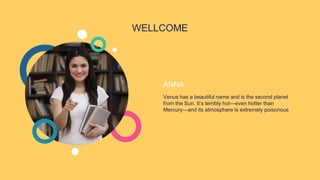
WELLCOME
ANNA
Venus has a beautiful name and is the second planet
from the Sun. It’s terribly hot—even hotter than
Mercury—and its atmosphere is extremely poisonous
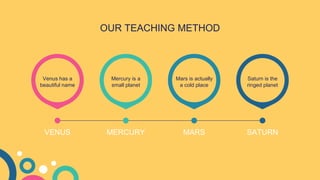
OUR TEACHING METHOD
Mercury is a
small planet
MERCURY
VENUS MARS
Venus has a
beautiful name
Mars is actually
a cold place
Saturn is the
ringed planet
SATURN
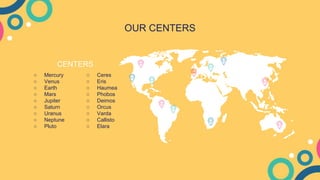
OUR CENTERS
CENTERS
○ Mercury
○ Venus
○ Earth
○ Mars
○ Jupiter
○ Saturn
○ Uranus
○ Neptune
○ Pluto
○ Ceres
○ Eris
○ Haumea
○ Phobos
○ Deimos
○ Orcus
○ Varda
○ Callisto
○ Elara
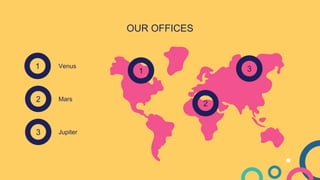
OUR OFFICES
1
1
2
3
2
3
Venus
Mars
Jupiter
Distance between Earth and the Moon
384,400 km
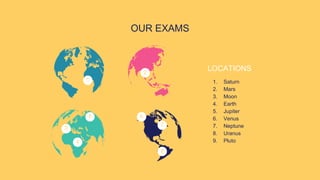
OUR EXAMS
LOCATIONS
1. Saturn
2. Mars
3. Moon
4. Earth
5. Jupiter
6. Venus
7. Neptune
8. Uranus
9. Pluto
3
5
4
6
8
7
2
1
OUR TEACHING METHOD
EARTH
JUPITER NEPTUNE VENUS
“This is a quote, words full of wisdom that someone
important said and can make the reader get inspired.”
—Someone Famous
3,200
Students
—Someone Famous
“This is a quote, words full of wisdom
that someone important said and can
make the reader get inspired.”
THE SCHOOL
Despite being red, Mars is actually a cold
place. It’s full of iron oxide dust, which
gives the planet its reddish cast
Mercury is the closest planet to the Sun
and the smallest one in the Solar
System—it’s a bit larger than the Moon
MARS MERCURY
THE CLASSROOM
Mercury is the closest planet to the
Sun and the smallest one in the
Solar System
MERCURY
Saturn is the ringed one. It’s a gas
giant, composed mostly of hydrogen
and helium
SATURN
THE LESSONS
MARS
Despite being red, Mars is actually a
cold place. It’s full of iron oxide dust
atmosphere
MERCURY
Mercury is the closest planet to the
Sun and the smallest one in the
Solar System
OUR SCHOOL
Mercury is the closest planet to the Sun and the
smallest one in the Solar System—it’s only a bit larger
than the Moon. The planet’s name has nothing to do
with the liquid metal
THE CURRICULUM
Venus Mercury Mars Jupiter
Venus is the second
planet from the Sun
Mercury is the closest
planet to the Sun
Despite being red, Mars
is a cold place
It’s the biggest planet of
them all
100 200 300 400
Saturn Neptune Earth Ceres
WHAT SETS US APART
Mercury is the closest planet to
the Sun and the smallest one in
the Solar System
MERCURY
Venus has a beautiful name and
is the second planet from the
Sun. It’s terribly hot
VENUS
Saturn is the ringed one. It’s a
gas giant, composed mostly of
hydrogen and helium
SATURN
WHAT SETS US APART
Mercury is the closest planet to the
Sun and the smallest one in the
Solar System
MERCURY
SATURN
Saturn is the ringed planet,
composed mostly of hydrogen and
helium
MARS
Despite being red, Mars is actually
a cold place. It’s full of iron oxide
dust
OUR FACILITIES
It’s the closest planet to the Sun and the
smallest one in the Solar System. It’s only
a bit larger than the Moon
MERCURY
OUR FACILITIES
MARS
Despite being red, Mars is actually a cold
place. It’s full of iron oxide dust, which gives
the planet its reddish cast
OUR FACILITIES
It’s the closest planet to the Sun and the
smallest one in the Solar System. It’s only
a bit larger than the Moon
MERCURY
OUR ACADEMIC AREAS
Jupiter is a gas giant and the
biggest planet in the entire
Solar System
JUPITER
Despite being red, Mars is
actually a cold place. It’s full of
iron oxide dust
MARS
Saturn is the ringed planet,
composed mostly of hydrogen
and helium
SATURN
Venus has a beautiful name
and is the second planet from
the Sun
VENUS
Neptune is the farthest planet
from the Sun and the fourth-
largest
NEPTUNE
Mercury is the smallest planet
in the Solar System and the
closest to the Sun
MERCURY
OTHERS ACADEMIC AREAS
Despite being red, Mars is
actually a cold place. It’s full
of iron oxide dust
MARS MERCURY
Mercury is the smallest planet
in the Solar System and the
closest to the Sun
SATURN
Saturn is the ringed planet,
composed mostly of hydrogen
and helium
NEPTUNE
Neptune is the farthest planet
from the Sun and the fourth-
largest
VENUS
Venus has a beautiful name
and is the second planet from
the Sun
JUPITER
Jupiter is a gas giant and the
biggest planet in the entire
Solar System
OUR MISSION AND VISION
Mission
Despite being red, Mars is
actually a cold place. It’s full
of iron oxide dust, which
gives the planet its beautiful
reddish cast
Vision
Mercury is the closest planet
to the Sun and the smallest
one in the Solar System—it’s
only a bit larger than the
Moon
OUR MISSION AND VISION
VISION
Saturn is the ringed one. It’s a gas
giant, composed mostly of hydrogen
and helium
MISION
Mercury is the closest planet to the
Sun and the smallest one in the
Solar System
OUR VALUES
Despite being red, Mars is actually a cold place
Saturn is the ringed planet and a gas giant
Mercury is the closest planet to the Sun
Venus is the second planet from the Sun
OUR VALUES
Despite being red, Mars is
actually a cold place
Saturn is the ringed planet
and a gas giant
Mercury is the closest planet
to the Sun
Venus is the second planet
from the Sun
OUR SERVICES
MERCURY
Mercury is the
smallest planet
VENUS
Venus is a terribly
hot place
MARS
Despite being red,
Mars is cold
SATURN
Saturn is a gas giant
and has rings
NEPTUNE
It’s the farthest one
from the Sun
EARTH
This planet is where
we live on
95%
Venus has a beautiful name
9/10
Mercury is the smallest of them all
2,500
Saturn is the ringed planet
OUR SUCCESS
Awesome
words
Because key words are great for catching your
audience’s attention
03
THIS IS A SECTION TITLE
MERCURY SATURN
Despite being red, Mars is
actually a cold place. It’s full of
iron oxide dust
OUR SUCCESS
Mercury is the closest planet to
the Sun and the smallest one in
the Solar System
Saturn is the ringed planet,
composed mostly of hydrogen
and helium
MARS
A PICTURE IS WORTH A
THOUSAND WORDS
STATISTICS
To modify this graph, click on it, follow the
link, change the data and paste the new
graph here, replacing this one
LANGUAGE CENTER
OTHER STATISTICS
MARS
JUPITER
SATURN
VENUS
To modify this graph, click on it, follow the link,
change the data and paste the new graph here
IN DEPTH
15 pt
33 pt
56 pt
82 pt
Mercury
Mars
7 pt
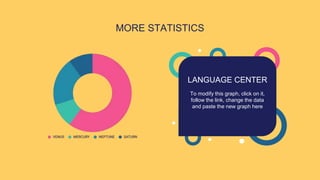
MORE STATISTICS
LANGUAGE CENTER
To modify this graph, click on it,
follow the link, change the data
and paste the new graph here
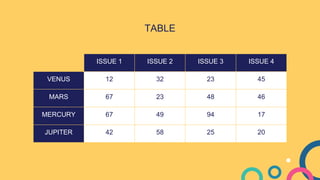
TABLE
ISSUE 1 ISSUE 2 ISSUE 3 ISSUE 4
VENUS 12 32 23 45
MARS 67 23 48 46
MERCURY 67 49 94 17
JUPITER 42 58 25 20
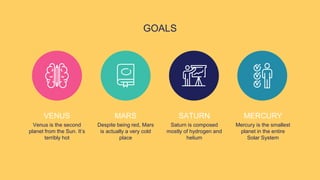
GOALS
VENUS
Venus is the second
planet from the Sun. It’s
terribly hot
MARS
Despite being red, Mars
is actually a very cold
place
SATURN
Saturn is composed
mostly of hydrogen and
helium
MERCURY
Mercury is the smallest
planet in the entire
Solar System
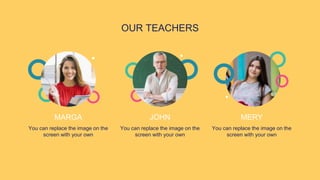
OUR TEACHERS
You can replace the image on the
screen with your own
JENNA DOE
You can replace the image on the
screen with your own
LISA JAMES
You can replace the image on the
screen with your own
JANE PATTERSON
OUR TEACHERS
You can replace the image on the
screen with your own
MARGA
You can replace the image on the
screen with your own
JOHN
You can replace the image on the
screen with your own
MERY
OUR GOALS
Despite being red,
Mars is actually a
cold place full of iron
oxide dust
Saturn is composed
mostly of hydrogen
and helium. It has
several rings!
Mercury is the
closest planet to the
Sun and the
smallest of them all
1. 2. 3.
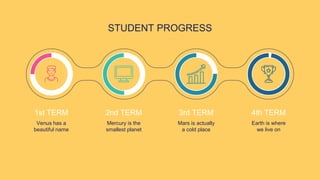
STUDENT PROGRESS
Mercury is the
smallest planet
2nd TERM
1st TERM 3rd TERM
Venus has a
beautiful name
Mars is actually
a cold place
Earth is where
we live on
4th TERM
STUDENT PROGRESS
5th TERM
Venus is the second
planet from the Sun. It’s
terribly hot!
6th TERM
Despite being red, Mars
is actually a very cold
place
7th TERM
Saturn is composed
mostly of hydrogen and
helium
8th TERM
Mercury is the smallest
planet in the entire
Solar System
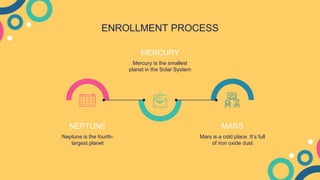
ENROLLMENT PROCESS
Mercury is the smallest
planet in the Solar System
MERCURY
NEPTUNE MARS
Neptune is the fourth-
largest planet
Mars is a cold place. It’s full
of iron oxide dust
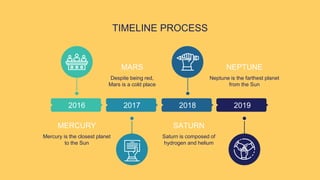
TIMELINE PROCESS
2018
SATURN
Saturn is composed of
hydrogen and helium
2019
NEPTUNE
Neptune is the farthest planet
from the Sun
2017
MARS
Despite being red,
Mars is a cold place
2016
Mercury is the closest planet
to the Sun
MERCURY
SPECIAL REMINDERS
Mercury is the closest
planet to the Sun and
the smallest in the
Solar System
MERCURY
VENUS MARS
Despite being red,
Mars is actually a cold
place full of iron oxide
dust
Venus has a beautiful
name and is the
second planet from
the Sun
OTHER REMINDERS
Mercury is the closest planet to the Sun and the
smallest one in the Solar System
MERCURY
SATURN
Saturn is the ringed one. It’s a gas giant, composed
mostly of hydrogen and helium
MARS
Despite being red, Mars is actually a cold place. It’s full
of iron oxide dust
ALTERNATIVE RESOURCES
PHOTOS:
○ University entrance
○ Backpack full of school supplies
○ Desks and chairs in empty classroom
○ Smiling teenager on desk
○ Group of students with books looking at camera
○ Teacher helping students with tablet
○ Speech bubbles and notebook
○ Language learning phone application
○ Group of students at the library
○ People talking in a meeting
○ Girl with headphones reading some notes
○ Group of people holding books and talking
○ Couple of friends looking at the phone
ALTERNATIVE RESOURCES
PHOTOS:
○ College teen boy with books
○ Young teacher paying attention to her students
○ Female teacher at home holding an online
○ Cheerful teen girl student with classmates
○ Portrait of young student happy to be back at university
○ Hands of writing student
PHOTOS:
○ Flags of different countries
○ Content black man posing
○ Senior professor with arms crossed
○ Charming brunette studying alone
○ Happy classmates at table in library
○ Young tutor at home teaching online
○ Festive graduation composition on yellow
○ App for learning a new language
○ Written paper speech bubbles
○ Woman with medical mask
○ Medium shot girl studying
○ Medium shot smiley student studying
○ Teenage student sitting at table with notebook
RESOURCES
PHOTOS:
○ Portrait of adult woman holding books
○ Girl sitting at table with notebooks writing
○ Back to school concept with woman studying in library
○ Portrait male student with books
○ Young woman attending online class
RESOURCES
PHOTOS:
○ Blue empty chairs in classroom
○ Group of students happy
○ Pretty girl on porch
○ Portrait of a happy young woman holding diary
○ Smart young student smiles
○ Smiley teacher standing in classroom
○ Relaxed teenager reading book
○ Set of books and ladders
○ Close-up of hand holding small globe
○ Close-up handsome student reading notes
○ University colleagues talking in the library
○ Portrait of young student in class
○ Group of teenagers discussing university
○ Male and female student holding books in hand walking
RESOURCES
In order to use this template, you must credit Slidesgo by keeping the Thanks slide.
You are allowed to:
- Modify this template.
- Use it for both personal and commercial projects.
You are not allowed to:
- Sublicense, sell or rent any of Slidesgo Content (or a modified version of Slidesgo Content).
- Distribute Slidesgo Content unless it has been expressly authorized by Slidesgo.
- Include Slidesgo Content in an online or offline database or file.
- Offer Slidesgo templates (or modified versions of Slidesgo templates) for download.
- Acquire the copyright of Slidesgo Content.
Instructions for use
For more information about editing slides, please read our FAQs or visit Slidesgo School:
https://slidesgo.com/faqs and https://slidesgo.com/slidesgo-school
Instructions for use (premium users)
In order to use this template, you must be a Premium user on Slidesgo.
You are allowed to:
● Modify this template.
● Use it for both personal and commercial purposes.
● Hide or delete the “Thanks” slide and the mention to Slidesgo in the credits.
● Share this template in an editable format with people who are not part of your team.
You are not allowed to:
● Sublicense, sell or rent this Slidesgo Template (or a modified version of this Slidesgo Template).
● Distribute this Slidesgo Template (or a modified version of this Slidesgo Template) or include it in a database or in
any other product or service that offers downloadable images, icons or presentations that may be subject to
distribution or resale.
● Use any of the elements that are part of this Slidesgo Template in an isolated and separated way from this
Template.
● Register any of the elements that are part of this template as a trademark or logo, or register it as a work in an
intellectual property registry or similar.
For more information about editing slides, please read our FAQs or visit Slidesgo School:
https://slidesgo.com/faqs and https://slidesgo.com/slidesgo-school
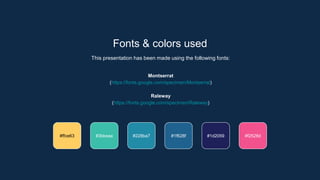
Fonts & colors used
This presentation has been made using the following fonts:
Montserrat
(https://fonts.google.com/specimen/Montserrat)
Raleway
(https://fonts.google.com/specimen/Raleway)
#3bbeaa #228ba7 #1f628f
#ffce63 #1d2059 #f2528d
Use our editable graphic resources...
You can easily resize these resources without quality. To change the color, just ungroup the resource and click
on the object you want to change. Then, click on the paint bucket and select the color you want. Don’t forget to
group the resource again when you’re done.
JANUARY FEBRUARY MARCH APRIL
PHASE 1
Task 1
Task 2
JANUARY FEBRUARY MARCH APRIL MAY JUNE
PHASE 1
PHASE 2
Task 1
Task 2
Task 1
Task 2
...and our sets of editable icons
You can resize these icons without losing quality.
You can change the stroke and fill color; just select the icon and click on the paint bucket/pen.
In Google Slides, you can also use Flaticon’s extension, allowing you to customize and add even more icons.
Educational Icons Medical Icons
Business Icons Teamwork Icons
Help & Support Icons Avatar Icons
Creative Process Icons Performing Arts Icons
Nature Icons
SEO & Marketing Icons
Premium infographics...
Add the title here
Text 1 Text 2 Text 3
Text 4 Text 5 Text 6
2016 2017 2018 2019 2020
“Despite being red,
Mars is actually a
very cold place”
“Mercury is closest
planet to the Sun
and the smallest”
“Neptune is the
farthest-known
planet from the Sun”
“Saturn is a gas
giant and has
several rings”
“Venus has a
beautiful name and
is the second planet”
Premium infographics...
“Mercury is closest
planet to the Sun
and the smallest”
TITLE 1
75% “Mercury is closest
planet to the Sun
and the smallest”
“Mercury is closest
planet to the Sun
and the smallest”
“Mercury is closest
planet to the Sun
and the smallest”
75%
Premium Icons
Premium Icons
Premium Icons
Premium Icons
Premium Icons
Evolution of language - Linguistic Changes and  Adaptations Over Time

Evolution of language - Linguistic Changes and Adaptations Over Time

  • 1.
  • 2.
    The evolution ofmodern English has been marked by a series of linguistic changes and adaptations, reflecting the dynamic nature of language and its responsiveness to external influences. These changes have occurred across various aspects of language, including pronunciation, grammar, vocabulary, and syntax.
  • 3.
  • 4.
  • 5.
    • The GreatVowel Shift • Loss of final unstressed vowels • Merging of vowel sounds PHONOLOGICAL CHANGES
  • 6.
    THE GREAT VOWELSHIFT The pronunciation of long vowels underwent a significant shift between the 14th and 17th centuries. 1. The Old English vowel "ā" (pronounced as "ah") shifted to the Modern English vowel "o". For instance: - Old English "hām" (home) became Modern English "home". 2. The Old English vowel “ū” (pronounced as “oo”) shifted to the Modern English vowel “ow” or “ou”. For instance: - Old English “sūnne” (sun) became Modern English “sowne” (later changed to “sun”).
  • 7.
    MERGING OF VOWELSOUNDS Consolidation of distinct vowel sounds into a single sound. In Old English, there were distinct vowel sounds for the words “stān” (stone) and “stānas” (stones). However, over time, the vowel sounds in these words merged, resulting in the word “stone” being used for both the singular and plural forms.
  • 8.
    LOSS OF FINALUNSTRESSED VOWELS Gradual disappearance of unstressed vowels at the end of words. Over time, unstressed vowels at the end of words were gradually dropped. In Old English, the word “lufu” (love) had a final unstressed “e” sound, while the word “lufode” (loved) had a final unstressed “e” and a final unstressed “d” sound. Today, the final vowels in these words have been lost, resulting in the modern pronunciations “luv” and “luvd.”
  • 9.
  • 10.
    01 SIMPLIFICATION OF VERB CONJUGATIONS LOSSOF NOUN CASE ENDINGS 02 DEVELOPMENT OF PERIPHRASTIC CONSTRUCTIONS 03
  • 11.
    SIMPLIFICATION OF VERBCONJUGATIONS Reduction in the number of verb forms, particularly in the present and past tenses. The old english verb system was highly complex, featuring a variety of endings depending on tense, person, and number. Over time, these conjugations were simplified, leading to the more streamlined verb system of modern english. For example, the old english verb “lufian” (to love) had numerous conjugations, including “ic lufige” (I love), “þū lufast” (you love), “he lufaþ” (he loves), “wē lufige” (we love), “gē lufige” (you love, plural), and “hie lufige” (they love). In modern english, the verb “to love” has a much simpler conjugation system: “I love,” “you love,” “he loves,” “we love,” “you love” (plural), and “they love.”
  • 12.
    LOSS OF NOUNCASE ENDINGS Elimination of grammatical markers that indicate the function of nouns in sentences. Old English nouns had distinct endings that indicated their function in a sentence, such as nominative (subject), accusative (direct object), and dative (indirect object). These case endings gradually disappeared in Middle English and are almost entirely absent in Modern English. For instance, the noun “dēor” (animal) had different forms depending on its role in the sentence: “dēor” (nominative, subject), “dēor” (accusative, direct object), and “dēore” (dative, indirect object).

  • 13.
    DEVELOPMENT OF PERIPHRASTICCONSTRUCTIONS Use of auxiliary verbs and phrases to express grammatical concepts previously conveyed by inflections. To express grammatical concepts that were previously conveyed through inflections, Modern English has developed periphrastic constructions, which involve combining auxiliary verbs and phrases. For example, the verb "lufian" (to love) in the future tense would be "ic lufige" (I will love). In Modern English, the future tense is typically expressed using the auxiliary verb "will." So, instead of adding a suffix to the verb, we use the auxiliary verb "will" before the base form of the verb. We would say "I will love" to express the future tense.
  • 14.
  • 15.
    Adoption of vocabularyfrom languages like Latin, French, Greek, and more recent encounters. The English language has drawn from a rich tapestry of languages, incorporating words from Latin, French, Greek, Arabic, and many other sources. This borrowing reflects the historical interactions and cultural influences that have shaped English. For instance, words like “education,” “government,” and “geography” stem from Latin, while words like “rendezvous,” “cuisine,” and “entrepreneur” derive from French. BORROWING OF WORDS FROM OTHER LANGUAGES

  • 16.
    Creation of newwords through processes like compounding, affixation, and blending. English is a dynamic language, constantly expanding its vocabulary through the creation of new words. This process often involves compounding (e.g., "brainwash," "keyword"), affixation (e.g., "unfriend," "repetition"), and blending (e.g., "brunch," "smog"). These new words reflect the evolving concepts, technologies, and cultural trends that shape modern society. COINAGE OF NEW WORDS
  • 17.
    Changes in themeaning of existing words, often reflecting cultural shifts or new contexts. The meanings of words can evolve over time, adapting to changing contexts and cultural norms. For example, the word “nice” originally meant “foolish” or “ignorant,” but it has gradually acquired a more positive meaning, signifying “pleasant” or “agreeable.” This semantic shift reflects the changing values and perceptions of society. SEMANTIC SHIFTS
  • 18.
  • 19.
    Fixed word order Lossof grammatical agreement Rise of new sentence structures 1 2 3
  • 20.
    Development of amore rigid word order, particularly in subject-verb- object constructions. Modern English has developed a relatively fixed word order, with the subject typically preceding the verb and the object typically following the verb. This word order pattern was less rigid in Old English, allowing for more flexibility in sentence structure. FIXED WORD ORDER
  • 21.
    Reduction in therequirement for agreement between subjects and verbs or nouns and modifiers. In Old English, nouns were categorized into three genders: masculine, feminine, and neuter. This gender assignment influenced the form of adjectives and articles that modified the noun. For instance, the word “se mann” (the man) was masculine, and its modifiers would also be masculine, such as “se gode mann” (the good man). Similarly, the word “sēo wif” (the woman) was feminine, and its modifiers would also be feminine, such as “sēo gōde wif” (the good woman). LOSS OF GRAMMATICAL AGREEMENT
  • 22.
    Emergence of newsyntactic patterns, such as cleft sentences and existential constructions. Modern English has witnessed the emergence of new syntactic patterns that were not prevalent in Old English. For instance, cleft sentences have become common, allowing for emphasis on a particular element in the sentence. For example, instead of saying “John broke the vase,” one might say “It was John who broke the vase.” Additionally, existential constructions have gained prominence, providing a means to introduce or identify entities. For instance, instead of saying “There is a book on the table,” one might say “There exists a book on the table.” RISE OF NEW SENTENCE STRUCTURES
  • 23.
    These linguistic changesand adaptations have been driven by various factors, including: • Contact with other languages - Interaction with speakers of different languages has led to the borrowing of words and grammatical features. • Cultural shifts - Changes in societal norms and beliefs have influenced the vocabulary and usage of English. • Technological advancements - New technologies have introduced new concepts and terminology, expanding the English lexicon. • Literary influences - Prominent writers and literary works have shaped the style and usage of English. • Geographical dispersion - The spread of English to different regions has resulted in regional variations and dialects.
  • 24.
    CREDITS: This presentationtemplate was created by Slidesgo, including icons by Flaticon, and infographics & images by Freepik. THANKS! Do you have any questions? aljonanasco@gmail.com +63 928 951 695 Aljon Lariosa Añasco
  • 25.
    Mercury is theclosest planet to the Sun and the smallest one in the Solar System—it’s only a bit larger than the Moon. The planet’s name has nothing to do with the liquid metal INTRODUCTION
  • 26.
    WELLCOME ANNA Venus has abeautiful name and is the second planet from the Sun. It’s terribly hot—even hotter than Mercury—and its atmosphere is extremely poisonous
  • 27.
    OUR TEACHING METHOD Mercuryis a small planet MERCURY VENUS MARS Venus has a beautiful name Mars is actually a cold place Saturn is the ringed planet SATURN
  • 28.
    OUR CENTERS CENTERS ○ Mercury ○Venus ○ Earth ○ Mars ○ Jupiter ○ Saturn ○ Uranus ○ Neptune ○ Pluto ○ Ceres ○ Eris ○ Haumea ○ Phobos ○ Deimos ○ Orcus ○ Varda ○ Callisto ○ Elara
  • 29.
  • 30.
    Distance between Earthand the Moon 384,400 km
  • 31.
    OUR EXAMS LOCATIONS 1. Saturn 2.Mars 3. Moon 4. Earth 5. Jupiter 6. Venus 7. Neptune 8. Uranus 9. Pluto 3 5 4 6 8 7 2 1
  • 32.
  • 33.
    “This is aquote, words full of wisdom that someone important said and can make the reader get inspired.” —Someone Famous
  • 34.
  • 35.
    —Someone Famous “This isa quote, words full of wisdom that someone important said and can make the reader get inspired.”
  • 36.
    THE SCHOOL Despite beingred, Mars is actually a cold place. It’s full of iron oxide dust, which gives the planet its reddish cast Mercury is the closest planet to the Sun and the smallest one in the Solar System—it’s a bit larger than the Moon MARS MERCURY
  • 37.
    THE CLASSROOM Mercury isthe closest planet to the Sun and the smallest one in the Solar System MERCURY Saturn is the ringed one. It’s a gas giant, composed mostly of hydrogen and helium SATURN
  • 38.
    THE LESSONS MARS Despite beingred, Mars is actually a cold place. It’s full of iron oxide dust atmosphere MERCURY Mercury is the closest planet to the Sun and the smallest one in the Solar System
  • 39.
    OUR SCHOOL Mercury isthe closest planet to the Sun and the smallest one in the Solar System—it’s only a bit larger than the Moon. The planet’s name has nothing to do with the liquid metal
  • 40.
    THE CURRICULUM Venus MercuryMars Jupiter Venus is the second planet from the Sun Mercury is the closest planet to the Sun Despite being red, Mars is a cold place It’s the biggest planet of them all 100 200 300 400 Saturn Neptune Earth Ceres
  • 41.
    WHAT SETS USAPART Mercury is the closest planet to the Sun and the smallest one in the Solar System MERCURY Venus has a beautiful name and is the second planet from the Sun. It’s terribly hot VENUS Saturn is the ringed one. It’s a gas giant, composed mostly of hydrogen and helium SATURN
  • 42.
    WHAT SETS USAPART Mercury is the closest planet to the Sun and the smallest one in the Solar System MERCURY SATURN Saturn is the ringed planet, composed mostly of hydrogen and helium MARS Despite being red, Mars is actually a cold place. It’s full of iron oxide dust
  • 43.
    OUR FACILITIES It’s theclosest planet to the Sun and the smallest one in the Solar System. It’s only a bit larger than the Moon MERCURY
  • 44.
    OUR FACILITIES MARS Despite beingred, Mars is actually a cold place. It’s full of iron oxide dust, which gives the planet its reddish cast
  • 45.
    OUR FACILITIES It’s theclosest planet to the Sun and the smallest one in the Solar System. It’s only a bit larger than the Moon MERCURY
  • 46.
    OUR ACADEMIC AREAS Jupiteris a gas giant and the biggest planet in the entire Solar System JUPITER Despite being red, Mars is actually a cold place. It’s full of iron oxide dust MARS Saturn is the ringed planet, composed mostly of hydrogen and helium SATURN Venus has a beautiful name and is the second planet from the Sun VENUS Neptune is the farthest planet from the Sun and the fourth- largest NEPTUNE Mercury is the smallest planet in the Solar System and the closest to the Sun MERCURY
  • 47.
    OTHERS ACADEMIC AREAS Despitebeing red, Mars is actually a cold place. It’s full of iron oxide dust MARS MERCURY Mercury is the smallest planet in the Solar System and the closest to the Sun SATURN Saturn is the ringed planet, composed mostly of hydrogen and helium NEPTUNE Neptune is the farthest planet from the Sun and the fourth- largest VENUS Venus has a beautiful name and is the second planet from the Sun JUPITER Jupiter is a gas giant and the biggest planet in the entire Solar System
  • 48.
    OUR MISSION ANDVISION Mission Despite being red, Mars is actually a cold place. It’s full of iron oxide dust, which gives the planet its beautiful reddish cast Vision Mercury is the closest planet to the Sun and the smallest one in the Solar System—it’s only a bit larger than the Moon
  • 49.
    OUR MISSION ANDVISION VISION Saturn is the ringed one. It’s a gas giant, composed mostly of hydrogen and helium MISION Mercury is the closest planet to the Sun and the smallest one in the Solar System
  • 50.
    OUR VALUES Despite beingred, Mars is actually a cold place Saturn is the ringed planet and a gas giant Mercury is the closest planet to the Sun Venus is the second planet from the Sun
  • 51.
    OUR VALUES Despite beingred, Mars is actually a cold place Saturn is the ringed planet and a gas giant Mercury is the closest planet to the Sun Venus is the second planet from the Sun
  • 52.
    OUR SERVICES MERCURY Mercury isthe smallest planet VENUS Venus is a terribly hot place MARS Despite being red, Mars is cold SATURN Saturn is a gas giant and has rings NEPTUNE It’s the farthest one from the Sun EARTH This planet is where we live on
  • 53.
    95% Venus has abeautiful name 9/10 Mercury is the smallest of them all 2,500 Saturn is the ringed planet OUR SUCCESS
  • 54.
    Awesome words Because key wordsare great for catching your audience’s attention
  • 55.
    03 THIS IS ASECTION TITLE
  • 56.
    MERCURY SATURN Despite beingred, Mars is actually a cold place. It’s full of iron oxide dust OUR SUCCESS Mercury is the closest planet to the Sun and the smallest one in the Solar System Saturn is the ringed planet, composed mostly of hydrogen and helium MARS
  • 57.
    A PICTURE ISWORTH A THOUSAND WORDS
  • 58.
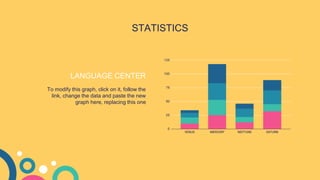
    STATISTICS To modify thisgraph, click on it, follow the link, change the data and paste the new graph here, replacing this one LANGUAGE CENTER
  • 59.
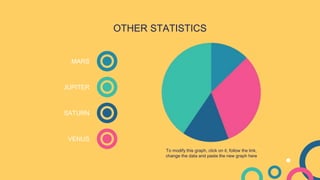
    OTHER STATISTICS MARS JUPITER SATURN VENUS To modifythis graph, click on it, follow the link, change the data and paste the new graph here
  • 60.
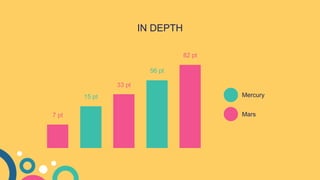
    IN DEPTH 15 pt 33pt 56 pt 82 pt Mercury Mars 7 pt
  • 61.
    MORE STATISTICS LANGUAGE CENTER Tomodify this graph, click on it, follow the link, change the data and paste the new graph here
  • 62.
    TABLE ISSUE 1 ISSUE2 ISSUE 3 ISSUE 4 VENUS 12 32 23 45 MARS 67 23 48 46 MERCURY 67 49 94 17 JUPITER 42 58 25 20
  • 63.
    GOALS VENUS Venus is thesecond planet from the Sun. It’s terribly hot MARS Despite being red, Mars is actually a very cold place SATURN Saturn is composed mostly of hydrogen and helium MERCURY Mercury is the smallest planet in the entire Solar System
  • 64.
    OUR TEACHERS You canreplace the image on the screen with your own JENNA DOE You can replace the image on the screen with your own LISA JAMES You can replace the image on the screen with your own JANE PATTERSON
  • 65.
    OUR TEACHERS You canreplace the image on the screen with your own MARGA You can replace the image on the screen with your own JOHN You can replace the image on the screen with your own MERY
  • 66.
    OUR GOALS Despite beingred, Mars is actually a cold place full of iron oxide dust Saturn is composed mostly of hydrogen and helium. It has several rings! Mercury is the closest planet to the Sun and the smallest of them all 1. 2. 3.
  • 67.
    STUDENT PROGRESS Mercury isthe smallest planet 2nd TERM 1st TERM 3rd TERM Venus has a beautiful name Mars is actually a cold place Earth is where we live on 4th TERM
  • 68.
    STUDENT PROGRESS 5th TERM Venusis the second planet from the Sun. It’s terribly hot! 6th TERM Despite being red, Mars is actually a very cold place 7th TERM Saturn is composed mostly of hydrogen and helium 8th TERM Mercury is the smallest planet in the entire Solar System
  • 69.
    ENROLLMENT PROCESS Mercury isthe smallest planet in the Solar System MERCURY NEPTUNE MARS Neptune is the fourth- largest planet Mars is a cold place. It’s full of iron oxide dust
  • 70.
    TIMELINE PROCESS 2018 SATURN Saturn iscomposed of hydrogen and helium 2019 NEPTUNE Neptune is the farthest planet from the Sun 2017 MARS Despite being red, Mars is a cold place 2016 Mercury is the closest planet to the Sun MERCURY
  • 71.
    SPECIAL REMINDERS Mercury isthe closest planet to the Sun and the smallest in the Solar System MERCURY VENUS MARS Despite being red, Mars is actually a cold place full of iron oxide dust Venus has a beautiful name and is the second planet from the Sun
  • 72.
    OTHER REMINDERS Mercury isthe closest planet to the Sun and the smallest one in the Solar System MERCURY SATURN Saturn is the ringed one. It’s a gas giant, composed mostly of hydrogen and helium MARS Despite being red, Mars is actually a cold place. It’s full of iron oxide dust
  • 73.
  • 74.
    ALTERNATIVE RESOURCES PHOTOS: ○ Universityentrance ○ Backpack full of school supplies ○ Desks and chairs in empty classroom ○ Smiling teenager on desk ○ Group of students with books looking at camera ○ Teacher helping students with tablet ○ Speech bubbles and notebook ○ Language learning phone application ○ Group of students at the library ○ People talking in a meeting ○ Girl with headphones reading some notes ○ Group of people holding books and talking ○ Couple of friends looking at the phone
  • 75.
    ALTERNATIVE RESOURCES PHOTOS: ○ Collegeteen boy with books ○ Young teacher paying attention to her students ○ Female teacher at home holding an online ○ Cheerful teen girl student with classmates ○ Portrait of young student happy to be back at university ○ Hands of writing student
  • 76.
    PHOTOS: ○ Flags ofdifferent countries ○ Content black man posing ○ Senior professor with arms crossed ○ Charming brunette studying alone ○ Happy classmates at table in library ○ Young tutor at home teaching online ○ Festive graduation composition on yellow ○ App for learning a new language ○ Written paper speech bubbles ○ Woman with medical mask ○ Medium shot girl studying ○ Medium shot smiley student studying ○ Teenage student sitting at table with notebook RESOURCES
  • 77.
    PHOTOS: ○ Portrait ofadult woman holding books ○ Girl sitting at table with notebooks writing ○ Back to school concept with woman studying in library ○ Portrait male student with books ○ Young woman attending online class RESOURCES
  • 78.
    PHOTOS: ○ Blue emptychairs in classroom ○ Group of students happy ○ Pretty girl on porch ○ Portrait of a happy young woman holding diary ○ Smart young student smiles ○ Smiley teacher standing in classroom ○ Relaxed teenager reading book ○ Set of books and ladders ○ Close-up of hand holding small globe ○ Close-up handsome student reading notes ○ University colleagues talking in the library ○ Portrait of young student in class ○ Group of teenagers discussing university ○ Male and female student holding books in hand walking RESOURCES
  • 79.
    In order touse this template, you must credit Slidesgo by keeping the Thanks slide. You are allowed to: - Modify this template. - Use it for both personal and commercial projects. You are not allowed to: - Sublicense, sell or rent any of Slidesgo Content (or a modified version of Slidesgo Content). - Distribute Slidesgo Content unless it has been expressly authorized by Slidesgo. - Include Slidesgo Content in an online or offline database or file. - Offer Slidesgo templates (or modified versions of Slidesgo templates) for download. - Acquire the copyright of Slidesgo Content. Instructions for use For more information about editing slides, please read our FAQs or visit Slidesgo School: https://slidesgo.com/faqs and https://slidesgo.com/slidesgo-school
  • 80.
    Instructions for use(premium users) In order to use this template, you must be a Premium user on Slidesgo. You are allowed to: ● Modify this template. ● Use it for both personal and commercial purposes. ● Hide or delete the “Thanks” slide and the mention to Slidesgo in the credits. ● Share this template in an editable format with people who are not part of your team. You are not allowed to: ● Sublicense, sell or rent this Slidesgo Template (or a modified version of this Slidesgo Template). ● Distribute this Slidesgo Template (or a modified version of this Slidesgo Template) or include it in a database or in any other product or service that offers downloadable images, icons or presentations that may be subject to distribution or resale. ● Use any of the elements that are part of this Slidesgo Template in an isolated and separated way from this Template. ● Register any of the elements that are part of this template as a trademark or logo, or register it as a work in an intellectual property registry or similar. For more information about editing slides, please read our FAQs or visit Slidesgo School: https://slidesgo.com/faqs and https://slidesgo.com/slidesgo-school

  • 81.
    Fonts & colorsused This presentation has been made using the following fonts: Montserrat (https://fonts.google.com/specimen/Montserrat) Raleway (https://fonts.google.com/specimen/Raleway) #3bbeaa #228ba7 #1f628f #ffce63 #1d2059 #f2528d
  • 82.
    Use our editablegraphic resources... You can easily resize these resources without quality. To change the color, just ungroup the resource and click on the object you want to change. Then, click on the paint bucket and select the color you want. Don’t forget to group the resource again when you’re done.
  • 85.
    JANUARY FEBRUARY MARCHAPRIL PHASE 1 Task 1 Task 2 JANUARY FEBRUARY MARCH APRIL MAY JUNE PHASE 1 PHASE 2 Task 1 Task 2 Task 1 Task 2
  • 88.
    ...and our setsof editable icons You can resize these icons without losing quality. You can change the stroke and fill color; just select the icon and click on the paint bucket/pen. In Google Slides, you can also use Flaticon’s extension, allowing you to customize and add even more icons.
  • 89.
  • 90.
  • 91.
    Help & SupportIcons Avatar Icons
  • 92.
    Creative Process IconsPerforming Arts Icons
  • 93.
  • 94.
  • 95.
    Premium infographics... Add thetitle here Text 1 Text 2 Text 3 Text 4 Text 5 Text 6 2016 2017 2018 2019 2020 “Despite being red, Mars is actually a very cold place” “Mercury is closest planet to the Sun and the smallest” “Neptune is the farthest-known planet from the Sun” “Saturn is a gas giant and has several rings” “Venus has a beautiful name and is the second planet”
  • 96.
    Premium infographics... “Mercury isclosest planet to the Sun and the smallest” TITLE 1 75% “Mercury is closest planet to the Sun and the smallest” “Mercury is closest planet to the Sun and the smallest” “Mercury is closest planet to the Sun and the smallest” 75%
  • 97.
  • 98.
  • 99.
  • 100.
  • 101.