Modern Cheese
making
Group 4
DEFINITION OF TERMS
 Pasteurization - Pasteurization is the process of heat
processing a liquid or a food to kill pathogenic
bacteria to make the food safe to eat
 Whey - the watery part of milk that remains after the
formation of curds
 Curds - a soft, white substance formed when milk
sours, used as the basis for cheese
 Rennet - a milk clotting enzyme
 Starter Culture - a bacterial culture used to initiate
souring in making yogurt, cheese, or butter.
WHEY
BRIEF HISTORY
 The first factory for the industrial production of
cheese opened in Switzerland in 1815, but it was in
the United States where large-scale production first
found real success. Credit usually goes to Jesse
Williams, a dairy farmer from Rome, New York, who
in 1851 started making cheese in an assembly-line
fashion using the milk from neighboring farms.
Within decades hundreds of such dairy associations
existed.
 The 1860s saw the beginnings of mass-
produced rennet, and by the turn of the
century scientists were producing pure
microbial cultures. Before then, bacteria in
cheese making had come from the
environment or from recycling an earlier
batch's whey; the pure cultures meant a
more standardized cheese could be
produced.
 Factory-made cheese overtook traditional cheese
making in the World War II era, and factories
have been the source of most cheese in America
and Europe ever since. Today, Americans buy
more processed cheese than "real", factory-made
or not.
PROCESSES
 Milk Intake
 Standardization
 Starter Culture and Coagulant
 Cutting
 Stirring, Heating, and Draining
 Curd Transformation
 Pressing
 Curing
MILK INTAKE
 Quality cheese with one key ingredient – quality
milk. Before the cheese making process begins,
incoming milk is first tested for quality and
purity.
STANDARDIZATION
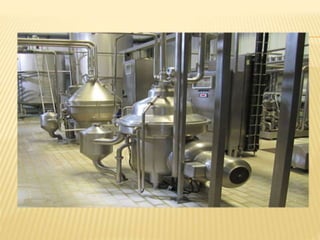
 Next, cheese makers weigh, heat or pasteurize the
milk to ensure product safety and uniformity.
Milk is cooled after pasteurization or heat
treatment to 90°F (32°C) to bring it to the
temperature needed for the starter bacteria to
grow. If raw milk is used the milk must be heated
to 90°F (32°C).
STARTER CULTURE AND COAGULANT
 Starter cultures, or good bacteria, are added to
start the cheese making process and held at 90°F
(32°C) for 30 minutes to ripen. The ripening step
allows the bacteria to grow and begin
fermentation, which lowers the pH and develops
the flavor of the cheese. They help determine the
ultimate flavor and texture of the cheese.
STARTER CULTURE
 Next, a milk clotting enzyme called rennet is
added to coagulate the milk, forming a custard-
like mass. After the rennet is added, the curd is
not disturbed for approximately 30 minutes so
a firm coagulum forms.
COAGULUM FORMS
RENNET
CUTTING
 It’s then cut into small pieces to begin the process
of separating the liquid (whey) from the milk
solids (curds). The curd is allowed to ferment
until it reaches pH 6.4. The curd is then cut with
cheese knives into small pieces and heated to
100°F (38°C). The heating step helps to separate
the whey from the curd.
 Large curds are cooked at lower temperatures,
yielding softer Wisconsin cheeses like
mascarpone and ricotta. Small curds are cooked
at higher temperatures, yielding harder cheeses
like parmesan and romano.
PARMERSAN
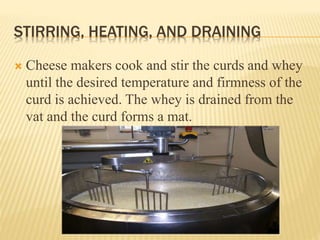
STIRRING, HEATING, AND DRAINING
 Cheese makers cook and stir the curds and whey
until the desired temperature and firmness of the
curd is achieved. The whey is drained from the
vat and the curd forms a mat.
CURD TRANSFORMATION
 The curd mats are cut into sections and piled on
top of each other and flipped periodically. This
step is called cheddaring. Cheddaring helps to
expel more whey, allows the fermentation to
continue until a pH of 5.1 to 5.5 is reached, and
allows the mats to "knit" together and form a
tighter matted structure. The curd mats are then
milled (cut) into smaller pieces.
 For cheddar cheese, the smaller, milled curd
pieces are put back in the vat and salted by
sprinkling dry salt on the curd and mixing in the
salt. In some cheese varieties, such as mozzarella,
the curd is formed into loaves and then the loaves
are placed in a brine (salt water solution).
PRESSING
 Pressing determines the characteristic shape of
the cheese and helps complete the curd formation.
Pressing is done by a mechanical weight or by the
weight itself. Most cheeses are pressed in three to
12 hours, depending on their size.
CURING
 Depending on the variety and style of cheese,
another step may be curing. Curing is used for aged
cheeses and helps fully develop its flavor and
texture. The cheese is placed in a room that is
controlled for required humidity and temperature and
may be aged from weeks to several years.
CURING
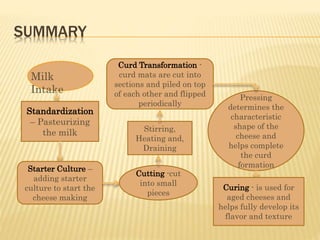
SUMMARY
Milk
Intake
Standardization
– Pasteurizing
the milk
Starter Culture –
adding starter
culture to start the
cheese making
Cutting -cut
into small
pieces
Stirring,
Heating and,
Draining
Curd Transformation -
curd mats are cut into
sections and piled on top
of each other and flipped
periodically
Pressing
determines the
characteristic
shape of the
cheese and
helps complete
the curd
formation
Curing - is used for
aged cheeses and
helps fully develop its
flavor and texture
Thanks for
listening!
Group 4 8 Newton:
Bernadette Bernardino
Angel Mediavillo
Joaquin Coronado
Marianne Mary
Jayson Lim
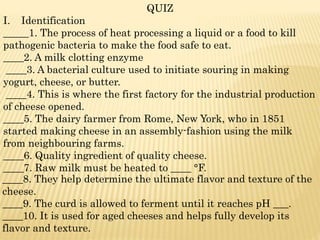
QUIZ
I. Identification
_____1. The process of heat processing a liquid or a food to kill
pathogenic bacteria to make the food safe to eat.
____2. A milk clotting enzyme
____3. A bacterial culture used to initiate souring in making
yogurt, cheese, or butter.
____4. This is where the first factory for the industrial production
of cheese opened.
____5. The dairy farmer from Rome, New York, who in 1851
started making cheese in an assembly-fashion using the milk
from neighbouring farms.
____6. Quality ingredient of quality cheese.
____7. Raw milk must be heated to ____ °F.
____8. They help determine the ultimate flavor and texture of the
cheese.
____9. The curd is allowed to ferment until it reaches pH ___.
____10. It is used for aged cheeses and helps fully develop its
flavor and texture.
___11. The watery part of milk that remains after the
formation of curds.
___12. What year did the first factory or cheese open?
___13. When did #5 start making cheese in an assembly-line
fashion using the milk in neighbouring farms?
___14. The 1860s saw the beginnings of mass-produced ___.
___15. ___ cheese overtook traditional cheese making in the
World War II era.
___16. A milk clotting enzyme called #2 is added to ___ the
milk, the forming of custard like mass.
___17. Large curds are cooked at lower temperatures, yielding
softer ___ cheeses like mascarpone and ricotta.
___18. The ___ are cut into sections and piled on top of each
other and flipped periodically in curd transformation.
___19. In some cheese varieties, such as mozzarella, the curd
is formed into loaves and then the loaves are placed in a ___
(salt water solution).
___20. How long does it need to press most cheeses?
21-28. Enumerate in order the processes in modern
cheesemaking.
ANSWERS NEXT SLIDE.
Answers:
1. Pasteurization
2. Rennet
3. Starter culture
4. Switzerland
5. Jesse Williams
6. Quality Milk
7. 90 degrees Fahrenheit
8. Starter cultures/good bacteria
9. pH 6.4
10. Curing
11. Whey
12. 1815
13. 1851
14. Rennet
15. Factory-made
16. Coagulate
17. Wisconsin
18. Curd mats
19. Brine
20. 3-12 hours

Modern Cheese-Making

  • 1.
  • 2.
    DEFINITION OF TERMS Pasteurization - Pasteurization is the process of heat processing a liquid or a food to kill pathogenic bacteria to make the food safe to eat  Whey - the watery part of milk that remains after the formation of curds  Curds - a soft, white substance formed when milk sours, used as the basis for cheese  Rennet - a milk clotting enzyme  Starter Culture - a bacterial culture used to initiate souring in making yogurt, cheese, or butter.
  • 3.
  • 4.
    BRIEF HISTORY  Thefirst factory for the industrial production of cheese opened in Switzerland in 1815, but it was in the United States where large-scale production first found real success. Credit usually goes to Jesse Williams, a dairy farmer from Rome, New York, who in 1851 started making cheese in an assembly-line fashion using the milk from neighboring farms. Within decades hundreds of such dairy associations existed.
  • 5.
     The 1860ssaw the beginnings of mass- produced rennet, and by the turn of the century scientists were producing pure microbial cultures. Before then, bacteria in cheese making had come from the environment or from recycling an earlier batch's whey; the pure cultures meant a more standardized cheese could be produced.
  • 6.
     Factory-made cheeseovertook traditional cheese making in the World War II era, and factories have been the source of most cheese in America and Europe ever since. Today, Americans buy more processed cheese than "real", factory-made or not.
  • 7.
    PROCESSES  Milk Intake Standardization  Starter Culture and Coagulant  Cutting  Stirring, Heating, and Draining  Curd Transformation  Pressing  Curing
  • 8.
    MILK INTAKE  Qualitycheese with one key ingredient – quality milk. Before the cheese making process begins, incoming milk is first tested for quality and purity.
  • 9.
    STANDARDIZATION  Next, cheesemakers weigh, heat or pasteurize the milk to ensure product safety and uniformity. Milk is cooled after pasteurization or heat treatment to 90°F (32°C) to bring it to the temperature needed for the starter bacteria to grow. If raw milk is used the milk must be heated to 90°F (32°C).
  • 11.
    STARTER CULTURE ANDCOAGULANT  Starter cultures, or good bacteria, are added to start the cheese making process and held at 90°F (32°C) for 30 minutes to ripen. The ripening step allows the bacteria to grow and begin fermentation, which lowers the pH and develops the flavor of the cheese. They help determine the ultimate flavor and texture of the cheese.
  • 12.
  • 13.
     Next, amilk clotting enzyme called rennet is added to coagulate the milk, forming a custard- like mass. After the rennet is added, the curd is not disturbed for approximately 30 minutes so a firm coagulum forms.
  • 14.
  • 15.
    CUTTING  It’s thencut into small pieces to begin the process of separating the liquid (whey) from the milk solids (curds). The curd is allowed to ferment until it reaches pH 6.4. The curd is then cut with cheese knives into small pieces and heated to 100°F (38°C). The heating step helps to separate the whey from the curd.
  • 16.
     Large curdsare cooked at lower temperatures, yielding softer Wisconsin cheeses like mascarpone and ricotta. Small curds are cooked at higher temperatures, yielding harder cheeses like parmesan and romano.
  • 17.
  • 18.
    STIRRING, HEATING, ANDDRAINING  Cheese makers cook and stir the curds and whey until the desired temperature and firmness of the curd is achieved. The whey is drained from the vat and the curd forms a mat.
  • 19.
    CURD TRANSFORMATION  Thecurd mats are cut into sections and piled on top of each other and flipped periodically. This step is called cheddaring. Cheddaring helps to expel more whey, allows the fermentation to continue until a pH of 5.1 to 5.5 is reached, and allows the mats to "knit" together and form a tighter matted structure. The curd mats are then milled (cut) into smaller pieces.
  • 20.
     For cheddarcheese, the smaller, milled curd pieces are put back in the vat and salted by sprinkling dry salt on the curd and mixing in the salt. In some cheese varieties, such as mozzarella, the curd is formed into loaves and then the loaves are placed in a brine (salt water solution).
  • 21.
    PRESSING  Pressing determinesthe characteristic shape of the cheese and helps complete the curd formation. Pressing is done by a mechanical weight or by the weight itself. Most cheeses are pressed in three to 12 hours, depending on their size.
  • 22.
    CURING  Depending onthe variety and style of cheese, another step may be curing. Curing is used for aged cheeses and helps fully develop its flavor and texture. The cheese is placed in a room that is controlled for required humidity and temperature and may be aged from weeks to several years.
  • 23.
  • 24.
    SUMMARY Milk Intake Standardization – Pasteurizing the milk StarterCulture – adding starter culture to start the cheese making Cutting -cut into small pieces Stirring, Heating and, Draining Curd Transformation - curd mats are cut into sections and piled on top of each other and flipped periodically Pressing determines the characteristic shape of the cheese and helps complete the curd formation Curing - is used for aged cheeses and helps fully develop its flavor and texture
  • 25.
    Thanks for listening! Group 48 Newton: Bernadette Bernardino Angel Mediavillo Joaquin Coronado Marianne Mary Jayson Lim
  • 26.
    QUIZ I. Identification _____1. Theprocess of heat processing a liquid or a food to kill pathogenic bacteria to make the food safe to eat. ____2. A milk clotting enzyme ____3. A bacterial culture used to initiate souring in making yogurt, cheese, or butter. ____4. This is where the first factory for the industrial production of cheese opened. ____5. The dairy farmer from Rome, New York, who in 1851 started making cheese in an assembly-fashion using the milk from neighbouring farms. ____6. Quality ingredient of quality cheese. ____7. Raw milk must be heated to ____ °F. ____8. They help determine the ultimate flavor and texture of the cheese. ____9. The curd is allowed to ferment until it reaches pH ___. ____10. It is used for aged cheeses and helps fully develop its flavor and texture.
  • 27.
    ___11. The waterypart of milk that remains after the formation of curds. ___12. What year did the first factory or cheese open? ___13. When did #5 start making cheese in an assembly-line fashion using the milk in neighbouring farms? ___14. The 1860s saw the beginnings of mass-produced ___. ___15. ___ cheese overtook traditional cheese making in the World War II era. ___16. A milk clotting enzyme called #2 is added to ___ the milk, the forming of custard like mass. ___17. Large curds are cooked at lower temperatures, yielding softer ___ cheeses like mascarpone and ricotta. ___18. The ___ are cut into sections and piled on top of each other and flipped periodically in curd transformation. ___19. In some cheese varieties, such as mozzarella, the curd is formed into loaves and then the loaves are placed in a ___ (salt water solution). ___20. How long does it need to press most cheeses?
  • 28.
    21-28. Enumerate inorder the processes in modern cheesemaking.
  • 29.
  • 30.
    Answers: 1. Pasteurization 2. Rennet 3.Starter culture 4. Switzerland 5. Jesse Williams 6. Quality Milk 7. 90 degrees Fahrenheit 8. Starter cultures/good bacteria 9. pH 6.4 10. Curing 11. Whey 12. 1815 13. 1851 14. Rennet 15. Factory-made 16. Coagulate 17. Wisconsin 18. Curd mats 19. Brine 20. 3-12 hours