CHEESE
BY : DIVYA BHARDWAJ
MSc. FMT 3RD SEM
ROLL NO. 110077
CHEESE
• The word cheese comes from Latin caseus,from which the
modern word casein is also derived. The earliest source is
from the proto-Indo-European root *kwat-, which means "to
ferment, become sour".
• Cheese is a dairy product derived from milk that is produced
in a wide range of flavours, textures, and forms by
coagulation of the milk protein casein.
• It comprises proteins and fat from milk, usually the milk of
cows, buffalo, goats, or sheep.
• During production, the milk is usually acidified, and adding
the enzyme rennet causes coagulation.
• The solids are separated and pressed into final form.
• Some cheeses have molds on the rind, the outer layer, or
throughout.
• Most cheeses melt at cooking temperature.
• Hundreds of types of cheese from various countries are produced.
• Their styles, textures and flavours depend on the origin of the milk
(including the animal's diet), whether they have been pasteurized, the
butterfat content, the bacteria and mold, the processing, and aging.
• Herbs, spices, or wood smoke may be used as flavoring agents.
• The yellow to red color of many cheeses, such as Red Leicester, is
produced by adding annatto.
• Other ingredients may be added to some cheeses, such as black
pepper, garlic, chives or cranberries.
• For a few cheeses, the milk is curdled by adding acids such as vinegar
or lemon juice. Most cheeses are acidified to a lesser degree by
bacteria, which turn milk sugars into lactic acid, then the addition of
rennet completes the curdling.
HISTORY OF CHEESE
• The origin of cheese making range from around 8000 BC, when sheep
were first domesticated.
• Since animal skins and inflated internal organs have, since ancient times,
provided storage vessels for a range of foodstuffs, it is probable that the
process of cheese making was discovered accidentally by storing milk in a
container made from the stomach of an animal, resulting in the milk
being turned to curd and whey by the rennet from the stomach.
• The earliest cheeses were likely quite sour and salty, similar in texture to
rustic cottage cheese or feta, a crumbly, flavorful Greek cheese. Cheese
produced in Europe, where climates are cooler than the Middle East,
required less salt for preservation. With less salt and acidity, the cheese
became a suitable environment for useful microbes and molds, giving
aged cheeses their respective flavors.
CHEESE PRODUCTION
• Cultures for cheese making are called lactic acid bacteria (LAB) because
their primary source of energy is the lactose in milk and their primary
metabolic product is lactic acid. There is a wide variety of bacterial cultures
available that provide distinct flavor and textural characteristics to cheeses.
• Starter cultures are used early in the cheese making process to assist with
coagulation by lowering the pH prior to rennet addition. The metabolism of
the starter cultures contribute desirable flavor compounds, and help
prevent the growth of spoilage organisms and pathogens. Typical starter
bacteria include Lactococcus lactis subsp. lactis or cremoris, Streptococcus
salivarius subsp. thermophilus, Lactobacillus delbruckii subsp. bulgaricus,
and Lactobacillus helveticus.
• General Manufacturing Procedure
• The temperatures, times, and target pH for different steps, the sequence of
processing steps, the use of salting or brining, block formation, and aging
vary considerably between cheese types.
General Cheese Processing Steps
• Standardize Milk
• Pasteurize/Heat Treat Milk
• Cool Milk
• Inoculate with Starter & Non-Starter Bacteria and Ripen
• Add Rennet and Form Curd
• Cut Curd and Heat
• Drain Whey
• Texture Curd
• Dry Salt or Brine
• Form Cheese into Blocks
• Store and Age
• Package
• 1. Standardize Milk
Milk is often standardized before cheese making to optimize the
protein to fat ratio to make a good quality cheese with a high yield.
• 2. Pasteurize/Heat Treat Milk
Depending on the desired cheese, the milk may be pasteurized or
mildly heat-treated to reduce the number of spoilage organisms and
improve the environment for the starter cultures to grow. Some
varieties of milk are made from raw milk so they are not pasteurized
or heat-treated. Raw milk cheeses must be aged for at least 60 days
to reduce the possibility of exposure to disease causing
microorganisms (pathogens) that may be present in the milk.
• 3. Cool Milk
Milk is cooled after pasteurization or heat treatment to 90°F (32°C) to
bring it to the temperature needed for the starter bacteria to grow. If
raw milk is used the milk must be heated to 90°F (32°C).
• 4. Inoculate with Starter & Non-Starter Bacteria and Ripen
The starter cultures and any non-starter adjunct bacteria are added to
the milk and held at 90°F (32°C) for 30 minutes to ripen. The ripening
step allows the bacteria to grow and begin fermentation, which lowers
the pH and develops the flavor of the cheese.
• 5. Add Rennet and Form Curd
The rennet is the enzyme that acts on the milk proteins to form the
curd. After the rennet is added, the curd is not disturbed for
approximately 30 minutes so a firm coagulum forms.
• 6. Cut Curd and Heat
• The curd is allowed to ferment until it reaches pH 6.4. The curd is
then cut with cheese knives into small pieces and heated to 100°F
(38°C). The heating step helps to separate the whey from the curd.
• 7. Drain whey
The whey is drained from the vat and the curd forms a mat.
• 8. Texture curd
The curd mats are cut into sections and piled on top of each other and
flipped periodically. This step is called cheddaring. Cheddaring helps to
expel more whey, allows the fermentation to continue until a pH of 5.1
to 5.5 is reached, and allows the mats to "knit" together and form a
tighter matted structure. The curd mats are then milled (cut) into
smaller pieces.
• 9. Dry Salt or Brine
For cheddar cheese, the smaller, milled curd pieces are put back in the
vat and salted by sprinkling dry salt on the curd and mixing in the salt.
In some cheese varieties, such as mozzarella, the curd is formed into
loaves and then the loaves are placed in a brine (salt water solution).
• 10. Form Cheese into Blocks
The salted curd pieces are placed in cheese hoops and pressed into
blocks to form the cheese.
• 11. Store and Age
The cheese is stored in coolers until the desired age is reached.
Depending on the variety, cheese can be aged from several months to
several years.
• 12. Package
Cheese may be cut and packaged into blocks or it may be waxed.
TYPES OF CHEESE
• 1. Unripened Cheese ( Unripened cheeses are made by coagulating
milk proteins (casein) with acid.)
a) Fresh Cheese – example – Cottage Cheese
b) Soft Cheese – example – Mozzarella cheese
• 2. Ripened Cheese (Ripened cheeses are made by coagulating milk
proteins with enzymes (rennet) and culture acids. )
a) Soft Cheese – example – Brie Cheese
b) Semi Hard Cheese – example - Gouda Cheese , Blue Cheese
c) Hard Cheese – example – Cheddar Cheese , Swiss Cheese
• FRESH –
Requires high acidity by bacterial action E.g., Cottage cheese, Cream
cheese
• SOFT-
Requires slow acid development, washing to control lactose and
minimal cooking time E.g., Brie, Camembert, Mozzarella and Gouda
• HARD-
Requires high acid development and high temperature E.g., Cheddar,
Parmesan, and Edam
Fresh cheese
• Fresh cheese is cheese in its youngest, purest form. Fluffy ricotta, creamy
goat cheese, soft mozzarella, crumbly feta...these are all delicious examples
of fresh cheese.
• Cheese that falls into the category of "fresh cheese" is loved for its simple
but satisfying flavor.
• Fresh cheese usually tastes mild, sometimes salty or tangy.
• Fresh cheese does not have a rind and is not aged for a significant amount
of time.
• The texture ranges from creamy and spreadable, to soft and pliable, to
crumbly.
• Most fresh cheeses are sold in tubs or plastic packaging and are just as
likely to be found at a grocery store as they are in a specialty cheese shop.
• During the cheese making process, the milk for fresh cheese is
"ripened" by adding starter cultures, which convert the milk sugar
(lactose) into lactic acid. This encourages the milk to thicken. For
denser, thicker, full-fledged curds, rennet is then added to thicken the
milk even more. Once curds form, the liquid (whey) is drained away
and what remains is turned into cheese.
• To make fresh cheese like ricotta or goat cheese at home, ingredients
such as lemon juice, vinegar or buttermilk can be used instead of
starter culture and/or rennet as a short-cut method for ripening milk.
For some types of fresh dairy products, like creme fraiche, the milk or
cream can be thickened simply by leaving it out on a warm counter (if
it's unpasteurized) or by adding buttermilk or yogurt with live
cultures.
• However, serious cheesemakers use starter culture because it yields
more consistent results and better flavor.
1. COTTAGE CHEESE
• Cottage cheese is a fresh cheese curd product with a mild flavor.
• The first known use of the term "cottage cheese" dates back to
1831.
• It is believed to have originated because the simple cheese was
usually made in cottages from any milk left over after making
butter.
• The ancient Mesopotamians made a type of salty, sour cheese very
similar to cottage cheese that dates back to at least 3000 B.C.
• A common legend is that it was invented when a desert traveller
filled his sheep stomach saddle bags with milk prior to beginning
his journey.
MANUFACTURE
• Cottage cheese is drained, but not pressed, so some whey remains
and the individual curds remain loose.
• The curd is usually washed to remove acidity, giving sweet-curd
cheese.
• It is not aged or coloured.
• Different styles of cottage cheese are made from milk with different
fat levels and in small-curd or large-curd preparations.
• Pressed cottage cheese becomes hoop cheese, farmer cheese, pot
cheese, or queso blanco.
NUTRITION
• A 113-g (4-oz) serving of 4% fat product has about 120 calories, 5 g fat
(3 g saturated), 3 g carbohydrates, and 12 g protein. It also contains
about 500 mg sodium, 70 mg calcium, and 20 mg cholesterol.
• Some manufacturers also produce low-fat and nonfat varieties. A fat-
free kind of a similar serving size has 80 calories, 0 g fat (0 g
saturated), 6 g carbohydrates, and 14 g protein.
• Cottage cheese is popular among dieters and some health food
devotees. It is also a favorite food among bodybuilders, runners,
swimmers, and weightlifters for its high content of casein protein (a
long-lasting protein) while being relatively low in fat.
• Pregnant women are advised that cottage cheese is safe to eat, in
contrast to some cheese products that are not recommended during
pregnancy.
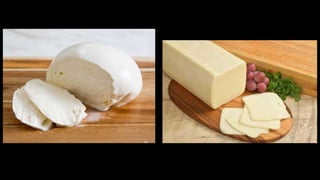
2. MOZZARELLA CHEESE (Comes under soft cheese)
• Mozzarella cheese is a sliceable curd cheese originating in
Italy.
• Traditional Mozzarella cheese is made from milk of water
buffalos herded in very few countries such as Italy and
Bulgaria.
• As a result, most of the Mozzarella cheeses available now are
made from cow's milk.
• An Italian Traditional Specialty Guaranteed (TSG) food
product, Mozzarella cheese is not aged like most cheeses. It is
eaten fresh and within few hours after it is made.
• Fresh Mozzarella cheese is one of those easy-to-make-at-
home cheeses used while making variety of recipes, including
salads, meats, seafood, and vegetables.
• Fresh mozzarella is generally white, but may vary seasonally to slightly
yellow depending on the animal's diet.
• Due to its high moisture content, it is traditionally served the day
after it is made, but can be kept in brine for up to a week or longer
when sold in vacuum-sealed packages.
• Low-moisture mozzarella can be kept refrigerated for up to a month,
though some shredded low-moisture mozzarella is sold with a shelf
life of up to six months.
• Mozzarella of several kinds is also used for most types of pizza and
several pasta dishes etc.
• A process of manufacturing a mozzarella (or mozzarella-like) cheese
comprising the steps of :
a) pasteurizing cow's milk;
b) acidifying the milk to convert it to a cheese milk;
c) coagulating the cheese milk to obtain a coagulum comprised of
curd and whey;
d) cutting the coagulum and draining the whey therefrom, thereby
leaving a cheese curd;
e) heating, kneading, and stretching the cheese curd until it is a
homogeneous, fibrous mass of heated, unripened cheese;
f) forming the heated cheese into a shape;
g) cooling the shaped cheese in cold brine; and
h) removing the cooled cheese from the brine.
MANUFACTURE
• The process is improved by mixing an emulsifier such as a sodium
phosphate or citrate into the heated cheese after it has been heated,
kneaded, and stretched, but before it has been formed into a shape.
The resultant cheese provides good baking performance over a wider
range of conditions than the equivalent cheese without emulsifier,
and it is particularly useful as the stuffing cheese for stuffed crust
pizza or as the exposed topping cheese on pizzas.
NUTRITION
• 1 ounce of mozzarella made with part skim milk contains 72 calories
and 4.5 grams of fat. This serving also provides almost 7 grams of
protein but less than 1 gram of sugar or carbohydrates.
• One ounce of mozzarella contains niacin, riboflavin, thiamine, biotin
and vitamin B6.
• One ounce of mozzarella cheese has 183 milligrams of calcium, which
is over 18 percent of the recommended daily intake.
SOFT CHEESE
• Cream cheeses are not matured. Brie and Neufchâtel are soft-type
cheeses that mature for more than a month.
• Neufchâtel is a soft cheese which can be sold after 10 days of
maturation.
1. BRIE
• Brie s a soft cow's-milk cheese named after Brie, the French region
from which it originated.
• It is pale in color with a slight grayish tinge under a rind of
white mould.
• The rind is typically eaten, with its flavor depending largely upon the
ingredients used and its manufacturing environment.
PRODUCTION
• Brie may be produced from whole or semi-skimmed milk. The curd is
obtained by adding rennet to raw milk and warming it to a maximum
temperature of 37 °C (99 °F).
• The cheese is then cast into molds, sometimes with a traditional
perforated ladle called a pelle à brie.
• The 20 cm mold is filled with several thin layers of cheese and drained
for approximately 18 hours.
• The cheese is then taken out of the molds, salted, inoculated with
cheese culture (Penicillium candidum, Penicillium camemberti)
or Brevibacterium linens, and aged in a controlled environment for at
least four or five weeks.
NUTRITION
• A thirty-gram serving of brie contains 101 calories (420 kJ) and
8.4 grams of fat, of which 5.2 grams are saturated fat.
• Brie is a good source of protein; a serving of brie can provide 5 to
6 grams of protein.
• Brie contains a good amount of both vitamin B12 and vitamin B2.
SEMI HARD CHEESE
• A perfect balance of moisture and aridity, these cheeses provide a
firm, slightly springy texture with a delicate blend of savory and tangy
flavors.
• Usually dense in consistency, the cheese is often made by
compressing curds into a solid, draining them of any remaining whey
in the process.
• Taken directly from their molds, some cheeses (i.e. Gouda, Edam and
Jarlsberg) receive a coating of wax, thus avoiding the need for brine.
• Typically, semi-hard cheeses are aged anywhere between one and six
months depending on type.
1. GOUDA CHEESE
• Gouda is a mild, yellow cheese made from cow's milk.
• It is one of the most popular cheeses worldwide.
• The name is used today as a general term for numerous
similar cheeses produced in the traditional Dutch manner.
• The first mention of Gouda cheese dates from 1184, making it
one of the oldest recorded cheeses in the world still made
today.
• Cheese making traditionally was a woman's task in Dutch
culture, with farmers' wives passing their cheese making skills
on to their daughters.
• The cheese is named after the city of Gouda not because it
was produced in or around that city, but because it was
traded there.
PRODUCTION
• The cultured milk is first curdled.
• After cultured milk is curdled, some of the whey is then drained and
water is added. This is called "washing the curd", and creates a
sweeter cheese, as the washing removes some of the lactose,
resulting in a reduction of lactic acid produced.
• About 10% of the mixture is curds, which are pressed into
circular molds for several hours.
• These molds are the essential reason behind its traditional,
characteristic shape.
• The cheese is then soaked in a brine solution, which gives the cheese
and its rind a distinctive taste.
• The cheese is dried for a few days before being coated with a yellow
coating to prevent it from drying out, then it is aged, during which
process the cheese changes from semi - hard to hard.
• Dutch cheesemakers generally use six gradations to classify the
cheese:
• Young cheese (4 weeks)
• Young matured (8–10 weeks)
• Matured (16–18 weeks)
• Extra matured (7–8 months)
• Old cheese (10–12 months)
• Very old cheese (12 months and more)
• As it ages, it develops a caramel sweetness and has a slight
crunchiness from cheese crystals, especially in older cheeses.
2. BLUE CHEESE
• Blue cheese is a general classification of cheeses that have had cultures
of the mold Penicillium added so that the final product is spotted or
veined throughout with blue, or blue-grey mold and carries a distinct
smell, either from that or various specially cultivated bacteria.
• Some blue cheeses are injected with spores before the curds form, and
others have spores mixed in with the curds after they form.
• Blue cheeses are typically aged in a temperature-controlled
environment such as a cave.
• Blue cheese can be eaten by itself or can be spread, crumbled or
melted into or over foods.
• The characteristic flavor of blue cheeses tends to be sharp and salty.
• The smell of this food is due both to the mold and to types of bacteria
encouraged to grow on the cheese: for example, the
bacterium Brevibacterium linens is responsible for the smell of many
blue cheeses,as well as foot odour and other human body odours.
PRODUCTION
• Similarly to other varieties of cheese, the process of making blue cheese
consists of six standard steps, as well as further additions that give this
blue-veined cheese its unique properties.
• The first step is acidification where a starter culture is added to milk in
order to change lactose to lactic acid, thus changing the acidity of the milk
and turning it from liquid to solid.
• The next step is coagulation, where rennet, a mixture of rennin and other
material found in the stomach lining of a calf is added to solidify the milk
further.
• Following this, thick curds are cut typically with a knife to encourage the
release of liquid or whey.
• The smaller the curds are cut, the thicker and harder the resulting
cheese will become. Salt is then added to provide flavor as well as to
act as a preservative so the cheese does not spoil.
• Next, the cheese is given its form and further pressed with weights if
necessary to expel any excess liquid.
• The final step is ripening the cheese by aging it. The temperature and
the level of humidity in the room where the cheese is aging is
monitored to ensure the cheese does not spoil or lose its optimal
flavor and texture
HARD CHEESE
• Harder cheeses have a lower moisture content than softer cheeses.
• They are generally packed into moulds under more pressure and aged
for a longer time than the soft cheeses.
• Cheeses that are classified as semi-hard to hard include the
familiar Cheddar, originating in the village of Cheddar in England but
now used as a generic term for this style of cheese, of which varieties
are imitated worldwide and are marketed by strength or the length of
time they have been aged.
• Examples of hard cheese are : Cheddar cheese and Swiss cheese.
1. CHEDDAR CHEESE
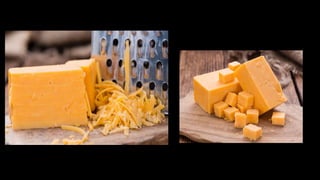
• Cheddar cheese is a relatively hard, off-white (or
orange if spices such as annatto are added),
sometimes sharp-tasting, natural cheese.
• Originating in the English village
of Cheddar in Somerset, cheeses of this style are
produced beyond the region and in several countries
around the world.
• Cheddar Gorge on the edge of the village contains a
number of caves, which provided the ideal humidity
and steady temperature for maturing the cheese.
PRODUCTION
• The curds and whey are separated using rennet, an enzyme complex
normally produced from the stomachs of new born calves
(in vegetarian or kosher cheeses, bacterial, yeast or mould-
derived chymosin is used).
• "Cheddaring" refers to an additional step in the production of Cheddar
cheese where, after heating, the curd is kneaded with salt, cut into cubes
to drain the whey, and then stacked and turned.
• Strong, extra-mature Cheddar, sometimes called vintage, needs to be
matured for 15 months or more.
• The cheese is kept at a constant temperature, often requiring special
facilities.
• As with other hard cheese varieties produced worldwide, caves provide an
ideal environment for maturing cheese; still, today, some Cheddar cheese
is matured in the caves at Wookey Hole and Cheddar Gorge.
• Additionally, some versions of Cheddar cheese are smoked.
2. SWISS CHEESE
• Swiss cheese is a generic name in North America for several related
varieties of cheese, mainly of North American manufacture, which
resemble Emmental cheese, a yellow, medium-hard cheese that
originated in the area around Emmental, in Switzerland.
• Some types of Swiss cheese have a distinctive appearance, as the
blocks of the cheese are riddled with holes known as "eyes".
• Swiss cheese without eyes is known as "blind".
PRODUCTION
• Three types of bacteria are used in the production of Emmental
cheese: Streptococcus salivarius subspecies thermophilus (also known
as Streptococcus thermophilus), Lactobacillus (Lactobacillus
helveticus or Lactobacillus delbruckii subspecies bulgaricus),
and Propionibacterium (Propionibacterium freudenreichii subspecies shermani).
• In a late stage of cheese production, the propionic bacteria consume the lactic
acid excreted by the other bacteria and release acetate, propionic acid,
and carbon dioxide gas.
• The carbon dioxide slowly forms the bubbles that develop the "eyes".
• The acetate and propionic acid give Swiss its nutty and sweet flavor.
• A hypothesis proposed by Swiss researchers in 2015 notes that particulate
matter may also play a role in the holes' development and that modern sanitation
eliminated debris such as hay dust in the milk played a role in reduced hole size in
Swiss cheeses, or even "blind cheese".
• Historically, the holes were seen as a sign of imperfection and cheese makers
originally tried to avoid them by pressing during production. In modern times, the
holes have become an identifier of the cheese.
THANK YOU

Cheese

  • 1.
    CHEESE BY : DIVYABHARDWAJ MSc. FMT 3RD SEM ROLL NO. 110077
  • 2.
    CHEESE • The wordcheese comes from Latin caseus,from which the modern word casein is also derived. The earliest source is from the proto-Indo-European root *kwat-, which means "to ferment, become sour". • Cheese is a dairy product derived from milk that is produced in a wide range of flavours, textures, and forms by coagulation of the milk protein casein. • It comprises proteins and fat from milk, usually the milk of cows, buffalo, goats, or sheep. • During production, the milk is usually acidified, and adding the enzyme rennet causes coagulation. • The solids are separated and pressed into final form. • Some cheeses have molds on the rind, the outer layer, or throughout. • Most cheeses melt at cooking temperature.
  • 3.
    • Hundreds oftypes of cheese from various countries are produced. • Their styles, textures and flavours depend on the origin of the milk (including the animal's diet), whether they have been pasteurized, the butterfat content, the bacteria and mold, the processing, and aging. • Herbs, spices, or wood smoke may be used as flavoring agents. • The yellow to red color of many cheeses, such as Red Leicester, is produced by adding annatto. • Other ingredients may be added to some cheeses, such as black pepper, garlic, chives or cranberries. • For a few cheeses, the milk is curdled by adding acids such as vinegar or lemon juice. Most cheeses are acidified to a lesser degree by bacteria, which turn milk sugars into lactic acid, then the addition of rennet completes the curdling.
  • 4.
    HISTORY OF CHEESE •The origin of cheese making range from around 8000 BC, when sheep were first domesticated. • Since animal skins and inflated internal organs have, since ancient times, provided storage vessels for a range of foodstuffs, it is probable that the process of cheese making was discovered accidentally by storing milk in a container made from the stomach of an animal, resulting in the milk being turned to curd and whey by the rennet from the stomach. • The earliest cheeses were likely quite sour and salty, similar in texture to rustic cottage cheese or feta, a crumbly, flavorful Greek cheese. Cheese produced in Europe, where climates are cooler than the Middle East, required less salt for preservation. With less salt and acidity, the cheese became a suitable environment for useful microbes and molds, giving aged cheeses their respective flavors.
  • 5.
    CHEESE PRODUCTION • Culturesfor cheese making are called lactic acid bacteria (LAB) because their primary source of energy is the lactose in milk and their primary metabolic product is lactic acid. There is a wide variety of bacterial cultures available that provide distinct flavor and textural characteristics to cheeses. • Starter cultures are used early in the cheese making process to assist with coagulation by lowering the pH prior to rennet addition. The metabolism of the starter cultures contribute desirable flavor compounds, and help prevent the growth of spoilage organisms and pathogens. Typical starter bacteria include Lactococcus lactis subsp. lactis or cremoris, Streptococcus salivarius subsp. thermophilus, Lactobacillus delbruckii subsp. bulgaricus, and Lactobacillus helveticus. • General Manufacturing Procedure • The temperatures, times, and target pH for different steps, the sequence of processing steps, the use of salting or brining, block formation, and aging vary considerably between cheese types.
  • 6.
    General Cheese ProcessingSteps • Standardize Milk • Pasteurize/Heat Treat Milk • Cool Milk • Inoculate with Starter & Non-Starter Bacteria and Ripen • Add Rennet and Form Curd • Cut Curd and Heat • Drain Whey • Texture Curd • Dry Salt or Brine • Form Cheese into Blocks • Store and Age • Package
  • 7.
    • 1. StandardizeMilk Milk is often standardized before cheese making to optimize the protein to fat ratio to make a good quality cheese with a high yield. • 2. Pasteurize/Heat Treat Milk Depending on the desired cheese, the milk may be pasteurized or mildly heat-treated to reduce the number of spoilage organisms and improve the environment for the starter cultures to grow. Some varieties of milk are made from raw milk so they are not pasteurized or heat-treated. Raw milk cheeses must be aged for at least 60 days to reduce the possibility of exposure to disease causing microorganisms (pathogens) that may be present in the milk. • 3. Cool Milk Milk is cooled after pasteurization or heat treatment to 90°F (32°C) to bring it to the temperature needed for the starter bacteria to grow. If raw milk is used the milk must be heated to 90°F (32°C).
  • 8.
    • 4. Inoculatewith Starter & Non-Starter Bacteria and Ripen The starter cultures and any non-starter adjunct bacteria are added to the milk and held at 90°F (32°C) for 30 minutes to ripen. The ripening step allows the bacteria to grow and begin fermentation, which lowers the pH and develops the flavor of the cheese. • 5. Add Rennet and Form Curd The rennet is the enzyme that acts on the milk proteins to form the curd. After the rennet is added, the curd is not disturbed for approximately 30 minutes so a firm coagulum forms. • 6. Cut Curd and Heat • The curd is allowed to ferment until it reaches pH 6.4. The curd is then cut with cheese knives into small pieces and heated to 100°F (38°C). The heating step helps to separate the whey from the curd.
  • 9.
    • 7. Drainwhey The whey is drained from the vat and the curd forms a mat. • 8. Texture curd The curd mats are cut into sections and piled on top of each other and flipped periodically. This step is called cheddaring. Cheddaring helps to expel more whey, allows the fermentation to continue until a pH of 5.1 to 5.5 is reached, and allows the mats to "knit" together and form a tighter matted structure. The curd mats are then milled (cut) into smaller pieces. • 9. Dry Salt or Brine For cheddar cheese, the smaller, milled curd pieces are put back in the vat and salted by sprinkling dry salt on the curd and mixing in the salt. In some cheese varieties, such as mozzarella, the curd is formed into loaves and then the loaves are placed in a brine (salt water solution).
  • 10.
    • 10. FormCheese into Blocks The salted curd pieces are placed in cheese hoops and pressed into blocks to form the cheese. • 11. Store and Age The cheese is stored in coolers until the desired age is reached. Depending on the variety, cheese can be aged from several months to several years. • 12. Package Cheese may be cut and packaged into blocks or it may be waxed.
  • 12.
    TYPES OF CHEESE •1. Unripened Cheese ( Unripened cheeses are made by coagulating milk proteins (casein) with acid.) a) Fresh Cheese – example – Cottage Cheese b) Soft Cheese – example – Mozzarella cheese • 2. Ripened Cheese (Ripened cheeses are made by coagulating milk proteins with enzymes (rennet) and culture acids. ) a) Soft Cheese – example – Brie Cheese b) Semi Hard Cheese – example - Gouda Cheese , Blue Cheese c) Hard Cheese – example – Cheddar Cheese , Swiss Cheese
  • 13.
    • FRESH – Requireshigh acidity by bacterial action E.g., Cottage cheese, Cream cheese • SOFT- Requires slow acid development, washing to control lactose and minimal cooking time E.g., Brie, Camembert, Mozzarella and Gouda • HARD- Requires high acid development and high temperature E.g., Cheddar, Parmesan, and Edam
  • 14.
    Fresh cheese • Freshcheese is cheese in its youngest, purest form. Fluffy ricotta, creamy goat cheese, soft mozzarella, crumbly feta...these are all delicious examples of fresh cheese. • Cheese that falls into the category of "fresh cheese" is loved for its simple but satisfying flavor. • Fresh cheese usually tastes mild, sometimes salty or tangy. • Fresh cheese does not have a rind and is not aged for a significant amount of time. • The texture ranges from creamy and spreadable, to soft and pliable, to crumbly. • Most fresh cheeses are sold in tubs or plastic packaging and are just as likely to be found at a grocery store as they are in a specialty cheese shop.
  • 15.
    • During thecheese making process, the milk for fresh cheese is "ripened" by adding starter cultures, which convert the milk sugar (lactose) into lactic acid. This encourages the milk to thicken. For denser, thicker, full-fledged curds, rennet is then added to thicken the milk even more. Once curds form, the liquid (whey) is drained away and what remains is turned into cheese. • To make fresh cheese like ricotta or goat cheese at home, ingredients such as lemon juice, vinegar or buttermilk can be used instead of starter culture and/or rennet as a short-cut method for ripening milk. For some types of fresh dairy products, like creme fraiche, the milk or cream can be thickened simply by leaving it out on a warm counter (if it's unpasteurized) or by adding buttermilk or yogurt with live cultures. • However, serious cheesemakers use starter culture because it yields more consistent results and better flavor.
  • 16.
    1. COTTAGE CHEESE •Cottage cheese is a fresh cheese curd product with a mild flavor. • The first known use of the term "cottage cheese" dates back to 1831. • It is believed to have originated because the simple cheese was usually made in cottages from any milk left over after making butter. • The ancient Mesopotamians made a type of salty, sour cheese very similar to cottage cheese that dates back to at least 3000 B.C. • A common legend is that it was invented when a desert traveller filled his sheep stomach saddle bags with milk prior to beginning his journey.
  • 17.
    MANUFACTURE • Cottage cheeseis drained, but not pressed, so some whey remains and the individual curds remain loose. • The curd is usually washed to remove acidity, giving sweet-curd cheese. • It is not aged or coloured. • Different styles of cottage cheese are made from milk with different fat levels and in small-curd or large-curd preparations. • Pressed cottage cheese becomes hoop cheese, farmer cheese, pot cheese, or queso blanco.
  • 18.
    NUTRITION • A 113-g(4-oz) serving of 4% fat product has about 120 calories, 5 g fat (3 g saturated), 3 g carbohydrates, and 12 g protein. It also contains about 500 mg sodium, 70 mg calcium, and 20 mg cholesterol. • Some manufacturers also produce low-fat and nonfat varieties. A fat- free kind of a similar serving size has 80 calories, 0 g fat (0 g saturated), 6 g carbohydrates, and 14 g protein. • Cottage cheese is popular among dieters and some health food devotees. It is also a favorite food among bodybuilders, runners, swimmers, and weightlifters for its high content of casein protein (a long-lasting protein) while being relatively low in fat. • Pregnant women are advised that cottage cheese is safe to eat, in contrast to some cheese products that are not recommended during pregnancy.
  • 20.
    2. MOZZARELLA CHEESE(Comes under soft cheese) • Mozzarella cheese is a sliceable curd cheese originating in Italy. • Traditional Mozzarella cheese is made from milk of water buffalos herded in very few countries such as Italy and Bulgaria. • As a result, most of the Mozzarella cheeses available now are made from cow's milk. • An Italian Traditional Specialty Guaranteed (TSG) food product, Mozzarella cheese is not aged like most cheeses. It is eaten fresh and within few hours after it is made. • Fresh Mozzarella cheese is one of those easy-to-make-at- home cheeses used while making variety of recipes, including salads, meats, seafood, and vegetables.
  • 21.
    • Fresh mozzarellais generally white, but may vary seasonally to slightly yellow depending on the animal's diet. • Due to its high moisture content, it is traditionally served the day after it is made, but can be kept in brine for up to a week or longer when sold in vacuum-sealed packages. • Low-moisture mozzarella can be kept refrigerated for up to a month, though some shredded low-moisture mozzarella is sold with a shelf life of up to six months. • Mozzarella of several kinds is also used for most types of pizza and several pasta dishes etc.
  • 22.
    • A processof manufacturing a mozzarella (or mozzarella-like) cheese comprising the steps of : a) pasteurizing cow's milk; b) acidifying the milk to convert it to a cheese milk; c) coagulating the cheese milk to obtain a coagulum comprised of curd and whey; d) cutting the coagulum and draining the whey therefrom, thereby leaving a cheese curd; e) heating, kneading, and stretching the cheese curd until it is a homogeneous, fibrous mass of heated, unripened cheese; f) forming the heated cheese into a shape; g) cooling the shaped cheese in cold brine; and h) removing the cooled cheese from the brine. MANUFACTURE
  • 23.
    • The processis improved by mixing an emulsifier such as a sodium phosphate or citrate into the heated cheese after it has been heated, kneaded, and stretched, but before it has been formed into a shape. The resultant cheese provides good baking performance over a wider range of conditions than the equivalent cheese without emulsifier, and it is particularly useful as the stuffing cheese for stuffed crust pizza or as the exposed topping cheese on pizzas.
  • 24.
    NUTRITION • 1 ounceof mozzarella made with part skim milk contains 72 calories and 4.5 grams of fat. This serving also provides almost 7 grams of protein but less than 1 gram of sugar or carbohydrates. • One ounce of mozzarella contains niacin, riboflavin, thiamine, biotin and vitamin B6. • One ounce of mozzarella cheese has 183 milligrams of calcium, which is over 18 percent of the recommended daily intake.
  • 26.
    SOFT CHEESE • Creamcheeses are not matured. Brie and Neufchâtel are soft-type cheeses that mature for more than a month. • Neufchâtel is a soft cheese which can be sold after 10 days of maturation.
  • 27.
    1. BRIE • Bries a soft cow's-milk cheese named after Brie, the French region from which it originated. • It is pale in color with a slight grayish tinge under a rind of white mould. • The rind is typically eaten, with its flavor depending largely upon the ingredients used and its manufacturing environment.
  • 28.
    PRODUCTION • Brie maybe produced from whole or semi-skimmed milk. The curd is obtained by adding rennet to raw milk and warming it to a maximum temperature of 37 °C (99 °F). • The cheese is then cast into molds, sometimes with a traditional perforated ladle called a pelle à brie. • The 20 cm mold is filled with several thin layers of cheese and drained for approximately 18 hours. • The cheese is then taken out of the molds, salted, inoculated with cheese culture (Penicillium candidum, Penicillium camemberti) or Brevibacterium linens, and aged in a controlled environment for at least four or five weeks.
  • 29.
    NUTRITION • A thirty-gramserving of brie contains 101 calories (420 kJ) and 8.4 grams of fat, of which 5.2 grams are saturated fat. • Brie is a good source of protein; a serving of brie can provide 5 to 6 grams of protein. • Brie contains a good amount of both vitamin B12 and vitamin B2.
  • 31.
    SEMI HARD CHEESE •A perfect balance of moisture and aridity, these cheeses provide a firm, slightly springy texture with a delicate blend of savory and tangy flavors. • Usually dense in consistency, the cheese is often made by compressing curds into a solid, draining them of any remaining whey in the process. • Taken directly from their molds, some cheeses (i.e. Gouda, Edam and Jarlsberg) receive a coating of wax, thus avoiding the need for brine. • Typically, semi-hard cheeses are aged anywhere between one and six months depending on type.
  • 32.
    1. GOUDA CHEESE •Gouda is a mild, yellow cheese made from cow's milk. • It is one of the most popular cheeses worldwide. • The name is used today as a general term for numerous similar cheeses produced in the traditional Dutch manner. • The first mention of Gouda cheese dates from 1184, making it one of the oldest recorded cheeses in the world still made today. • Cheese making traditionally was a woman's task in Dutch culture, with farmers' wives passing their cheese making skills on to their daughters. • The cheese is named after the city of Gouda not because it was produced in or around that city, but because it was traded there.
  • 33.
    PRODUCTION • The culturedmilk is first curdled. • After cultured milk is curdled, some of the whey is then drained and water is added. This is called "washing the curd", and creates a sweeter cheese, as the washing removes some of the lactose, resulting in a reduction of lactic acid produced. • About 10% of the mixture is curds, which are pressed into circular molds for several hours. • These molds are the essential reason behind its traditional, characteristic shape. • The cheese is then soaked in a brine solution, which gives the cheese and its rind a distinctive taste.
  • 34.
    • The cheeseis dried for a few days before being coated with a yellow coating to prevent it from drying out, then it is aged, during which process the cheese changes from semi - hard to hard. • Dutch cheesemakers generally use six gradations to classify the cheese: • Young cheese (4 weeks) • Young matured (8–10 weeks) • Matured (16–18 weeks) • Extra matured (7–8 months) • Old cheese (10–12 months) • Very old cheese (12 months and more) • As it ages, it develops a caramel sweetness and has a slight crunchiness from cheese crystals, especially in older cheeses.
  • 36.
    2. BLUE CHEESE •Blue cheese is a general classification of cheeses that have had cultures of the mold Penicillium added so that the final product is spotted or veined throughout with blue, or blue-grey mold and carries a distinct smell, either from that or various specially cultivated bacteria. • Some blue cheeses are injected with spores before the curds form, and others have spores mixed in with the curds after they form. • Blue cheeses are typically aged in a temperature-controlled environment such as a cave. • Blue cheese can be eaten by itself or can be spread, crumbled or melted into or over foods. • The characteristic flavor of blue cheeses tends to be sharp and salty. • The smell of this food is due both to the mold and to types of bacteria encouraged to grow on the cheese: for example, the bacterium Brevibacterium linens is responsible for the smell of many blue cheeses,as well as foot odour and other human body odours.
  • 37.
    PRODUCTION • Similarly toother varieties of cheese, the process of making blue cheese consists of six standard steps, as well as further additions that give this blue-veined cheese its unique properties. • The first step is acidification where a starter culture is added to milk in order to change lactose to lactic acid, thus changing the acidity of the milk and turning it from liquid to solid. • The next step is coagulation, where rennet, a mixture of rennin and other material found in the stomach lining of a calf is added to solidify the milk further. • Following this, thick curds are cut typically with a knife to encourage the release of liquid or whey.
  • 38.
    • The smallerthe curds are cut, the thicker and harder the resulting cheese will become. Salt is then added to provide flavor as well as to act as a preservative so the cheese does not spoil. • Next, the cheese is given its form and further pressed with weights if necessary to expel any excess liquid. • The final step is ripening the cheese by aging it. The temperature and the level of humidity in the room where the cheese is aging is monitored to ensure the cheese does not spoil or lose its optimal flavor and texture
  • 40.
    HARD CHEESE • Hardercheeses have a lower moisture content than softer cheeses. • They are generally packed into moulds under more pressure and aged for a longer time than the soft cheeses. • Cheeses that are classified as semi-hard to hard include the familiar Cheddar, originating in the village of Cheddar in England but now used as a generic term for this style of cheese, of which varieties are imitated worldwide and are marketed by strength or the length of time they have been aged. • Examples of hard cheese are : Cheddar cheese and Swiss cheese.
  • 41.
    1. CHEDDAR CHEESE •Cheddar cheese is a relatively hard, off-white (or orange if spices such as annatto are added), sometimes sharp-tasting, natural cheese. • Originating in the English village of Cheddar in Somerset, cheeses of this style are produced beyond the region and in several countries around the world. • Cheddar Gorge on the edge of the village contains a number of caves, which provided the ideal humidity and steady temperature for maturing the cheese.
  • 42.
    PRODUCTION • The curdsand whey are separated using rennet, an enzyme complex normally produced from the stomachs of new born calves (in vegetarian or kosher cheeses, bacterial, yeast or mould- derived chymosin is used). • "Cheddaring" refers to an additional step in the production of Cheddar cheese where, after heating, the curd is kneaded with salt, cut into cubes to drain the whey, and then stacked and turned. • Strong, extra-mature Cheddar, sometimes called vintage, needs to be matured for 15 months or more. • The cheese is kept at a constant temperature, often requiring special facilities. • As with other hard cheese varieties produced worldwide, caves provide an ideal environment for maturing cheese; still, today, some Cheddar cheese is matured in the caves at Wookey Hole and Cheddar Gorge. • Additionally, some versions of Cheddar cheese are smoked.
  • 44.
    2. SWISS CHEESE •Swiss cheese is a generic name in North America for several related varieties of cheese, mainly of North American manufacture, which resemble Emmental cheese, a yellow, medium-hard cheese that originated in the area around Emmental, in Switzerland. • Some types of Swiss cheese have a distinctive appearance, as the blocks of the cheese are riddled with holes known as "eyes". • Swiss cheese without eyes is known as "blind".
  • 45.
    PRODUCTION • Three typesof bacteria are used in the production of Emmental cheese: Streptococcus salivarius subspecies thermophilus (also known as Streptococcus thermophilus), Lactobacillus (Lactobacillus helveticus or Lactobacillus delbruckii subspecies bulgaricus), and Propionibacterium (Propionibacterium freudenreichii subspecies shermani). • In a late stage of cheese production, the propionic bacteria consume the lactic acid excreted by the other bacteria and release acetate, propionic acid, and carbon dioxide gas. • The carbon dioxide slowly forms the bubbles that develop the "eyes". • The acetate and propionic acid give Swiss its nutty and sweet flavor. • A hypothesis proposed by Swiss researchers in 2015 notes that particulate matter may also play a role in the holes' development and that modern sanitation eliminated debris such as hay dust in the milk played a role in reduced hole size in Swiss cheeses, or even "blind cheese". • Historically, the holes were seen as a sign of imperfection and cheese makers originally tried to avoid them by pressing during production. In modern times, the holes have become an identifier of the cheese.
  • 47.

Editor's Notes

  • #4 Annatto is an orange-red condiment and food coloring derived from the seeds of the achiote tree native to tropical regions from Mexico to Brazil. It is often used to impart a yellow or orange color to foods, but sometimes also for its flavor and aroma.