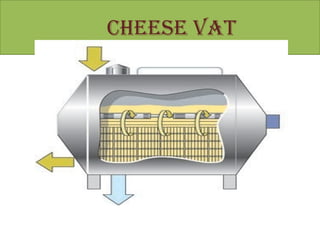
Terms
• Coagulation- Changefrom a fluid to a thickened
mass; curdle; congeal.
•
• Whey- The watery part of milk that separates after
the milk sours and thickens.
•
• Brine- Water strongly saturated with salt.
•
• Rennin- A stomach enzyme that coagulates casein
and is used to commercially curdle milk in the
making of cheese.
• Coagulation- Change from a fluid to a thickened
mass; curdle
•
• Whey- The watery part of milk that separates after
the milk sours and thickens.
Brine- Water strongly saturated with salt.
•
•
•
• Rennin- A stomach enzyme that coagulates casein
and is used to commercially curdle milk in the
making of cheese.
3.
Introduction
• Cheese isa generic term for a diverse group of
milk- based food products. Cheese is produced
throughout the world in wide-ranging flavours,
textures, and forms.
• Cheese consists of proteins and fat from milk,
usually the milk of cows, buffalo, goats, or sheep.
It is produced by coagulation of the milk protein
casein.
5.
Objective of cheese
making
Toobtain the optimum cheese composition with
respect to moisture, acidity (pH), fat, protein and
minerals (especially calcium)
Establish the correct structure of the cheese at the
microscopic level
Ripen to perfection.
Grouped according to texture and basic
manufacturing procedures there are seven families
of cheese.
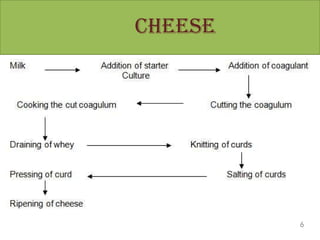
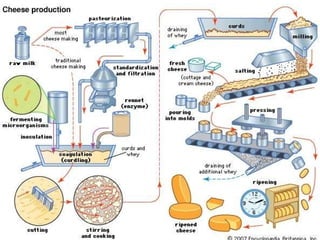
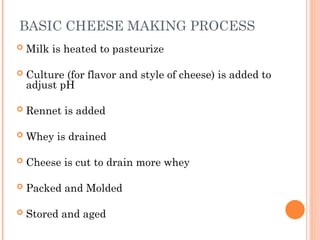
BASIC CHEESE MAKINGPROCESS
Milk is heated to pasteurize
Culture (for flavor and style of cheese) is added to
adjust pH
Rennet is added
Whey is drained
Cheese is cut to drain more whey
Packed and Molded
Stored and aged
10.
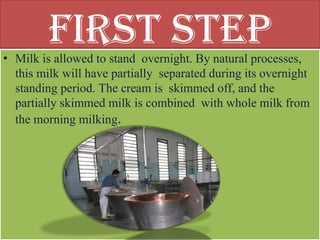
First Step
• Milkis allowed to stand overnight. By natural processes,
this milk will have partially separated during its overnight
standing period. The cream is skimmed off, and the
partially skimmed milk is combined with whole milk from
the morning milking.
11.
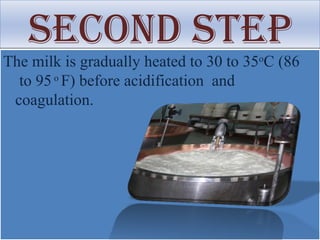
Second Step
The milkis gradually heated to 30 to 35o
C (86
to 95o
F) before acidification and
coagulation.
12.
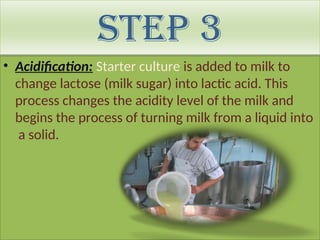
Step 3
• Acidification:Starter culture is added to milk to
change lactose (milk sugar) into lactic acid. This
process changes the acidity level of the milk and
begins the process of turning milk from a liquid into
a solid.
13.
Starter culture
• Astarter culture is a microbiological culture which
actually performs fermentation.
14.
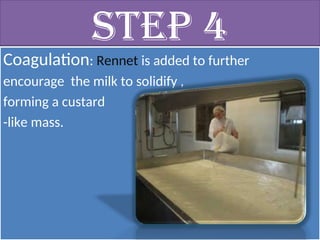
Step 4
Coagulation: Rennetis added to further
encourage the milk to solidify ,
forming a custard
-like mass.
15.
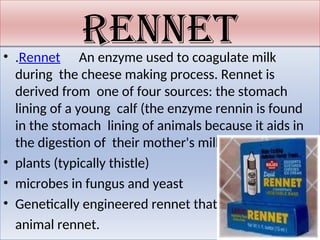
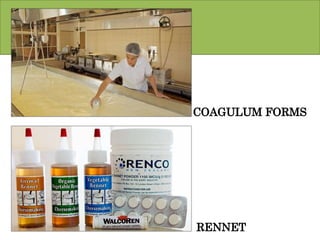
rennet
• .Rennet Anenzyme used to coagulate milk
during the cheese making process. Rennet is
derived from one of four sources: the stomach
lining of a young calf (the enzyme rennin is found
in the stomach lining of animals because it aids in
the digestion of their mother's milk)
• plants (typically thistle)
• microbes in fungus and yeast
• Genetically engineered rennet that imitates
animal rennet.
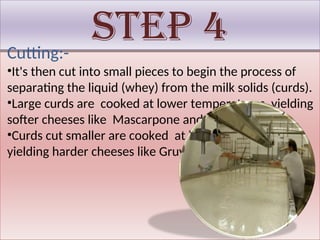
Step 4
Cutting:-
•It's thencut into small pieces to begin the process of
separating the liquid (whey) from the milk solids (curds).
•Large curds are cooked at lower temperatures, yielding
softer cheeses like Mascarpone and Ricotta.
•Curds cut smaller are cooked at higher temperatures,
yielding harder cheeses like Gruyere and Romano
18.
Step 5
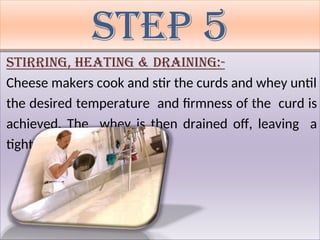
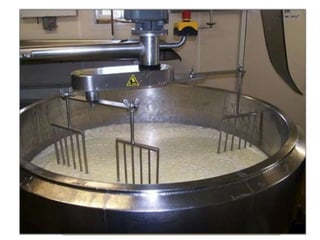
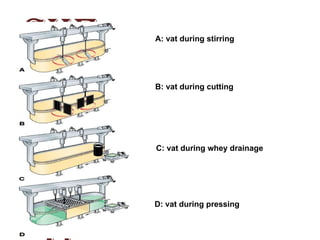
Stirring, HeatingDraining:-
Cheese makers cook and stir the curds and whey until
the desired temperature and firmness of the curd is
achieved. The whey is then drained off, leaving a
tightly formed curd.
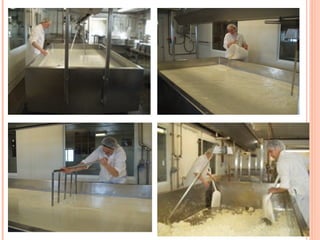
20.
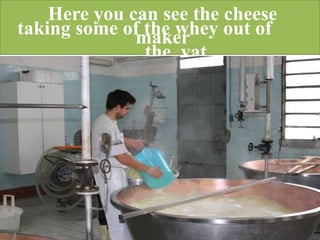
Here you cansee the cheese
maker
taking some of the whey out of
the vat.
21.
Step
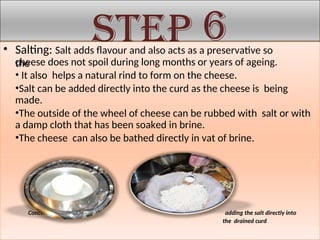
• Salting: Saltadds flavour and also acts as a preservative so
the
cheese does not spoil during long months or years of ageing.
• It also helps a natural rind to form on the cheese.
•Salt can be added directly into the curd as the cheese is being
made.
•The outside of the wheel of cheese can be rubbed with salt or with
a damp cloth that has been soaked in brine.
•The cheese can also be bathed directly in vat of brine.
Concentrated brine. adding the salt directly into
the drained curd
22.
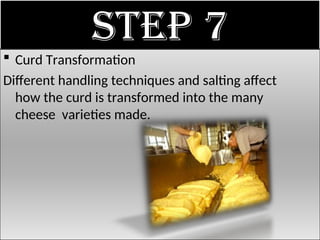
Step 7
CurdTransformation
Different handling techniques and salting affect
how the curd is transformed into the many
cheese varieties made.
23.
Curd Manipulation
Heat treatments
Theapplication of heat to cheese curd at any of several
different times during the manufacture of particular
cheese varieties, such as Cheddar, Mozzarella or
Emmentaler, is to selectively stop the growth of certain
types of bacteria and consequently influence the
maturation pathway of the cheeses
It also alters the composition and texture of the cheese
by increasing the syneresis without increasing the acidity.
24.
Stretching the curd
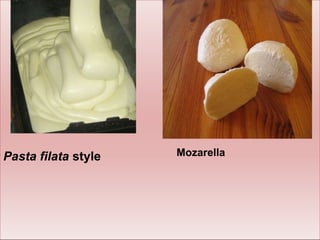
Stretchingthe curd is an important operation for several
kinds of cheese, in particular the pasta filata style,
Mozzarella being the best known.
Traditionally the curd was immersed in hot (about 800C)
water, and the fluid mass of cheese was pulled into strands
to align the protein fibers and then poured into a container
to cool.
It was then immersed in brine
Large scale production means that special machines are
used for stretching.
Cheddaring
Cheddaring is amild form of stretching in which the
cheese curd is piled up and held warm so that water flows
under the force of gravity.
The pH of the curd falls during this process and whey
continues to exude.
Again, in large scale manufacture, this is done in large
machines
27.
Washing
Washing the curdeither in the cheese vat or after de-wheying
helps remove more lactose which changes the pH of the
cheese.
It also reduces syneresis and is important in the manufacture
of cheeses such as Colby, Gouda and Egmont.
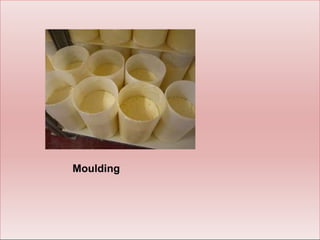
Moulding
The formation of the final cheese shape into spheres, flattened
spheres, discs, cylinders or rectangular blocks is traditional but
for some varieties, e.g. Camembert, it affects the maturation
pathway.
Some cheeses are pressed in moulds (nowadays made of
plastic or stainless steel) under the whey for a short time
whereas others are compressed at high pressures for several
hours.
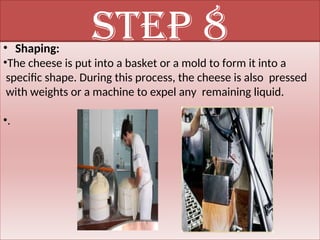
Step 8
• Shaping:
•Thecheese is put into a basket or a mold to form it into a
specific shape. During this process, the cheese is also pressed
with weights or a machine to expel any remaining liquid.
•.
30.
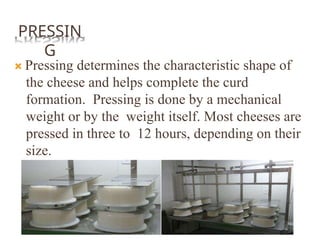
PRESSIN
G
Pressing determinesthe characteristic shape of
the cheese and helps complete the curd
formation. Pressing is done by a mechanical
weight or by the weight itself. Most cheeses are
pressed in three to 12 hours, depending on their
size.
31.
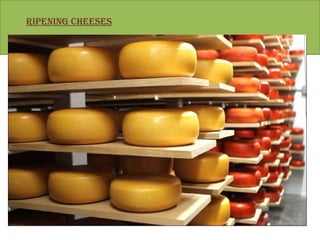
Maturation or ripening
Cheeseripening is basically about the breakdown
of proteins, lipids and carbohydrates (acids and sugars)
which releases flavour compounds and modifies cheese
texture.
Ripening varies from fresh cheese to 5 years for some
hard ripened cheese.
Like a good wine, a good aged cheese should get better
and better with age.
Ripening processes are broadly classified as interior and
surface ripened.
32.
Step 9
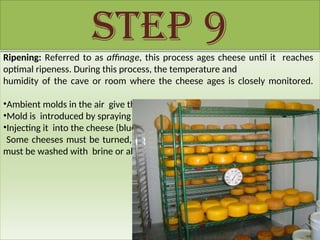
Ripening: Referredto as affinage, this process ages cheese until it reaches
optimal ripeness. During this process, the temperature and
humidity of the cave or room where the cheese ages is closely monitored.
•Ambient molds in the air give the cheese a distinct flavour.
•Mold is introduced by spraying it on the cheese
•Injecting it into the cheese (blue cheese).
Some cheeses must be turned, some must be brushed with oil, and some
must be washed with brine or alcohol.
33.
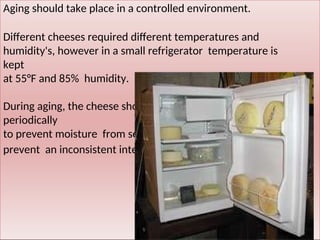
Aging should takeplace in a controlled environment.
Different cheeses required different temperatures and
humidity's, however in a small refrigerator temperature is
kept
at 55°F and 85% humidity.
During aging, the cheese should be rotated or flipped
periodically
to prevent moisture from settling in the cheese and to
prevent an inconsistent internal consistency.
GREAT CHEESE FROMAROUND THE
WORLD
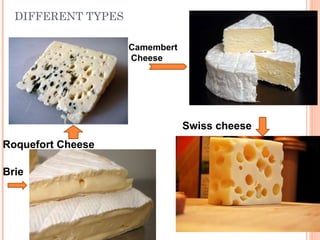
Parmigianino Reggiano (the King of Cheeses)
Hard/Ripened
Aged for 18 months
Gruyere (Most useful in a French Kitchen)
Semi-Hard/Ripened
Various aging times
Brie
Soft/Ripened
Manchego (Spanish Sheep’s Milk)
Semi-Hard/Ripened
47.
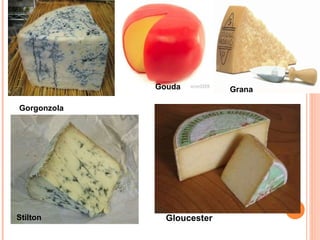
BLUE CHEESE
Whatis Blue Cheese?
Any cheese made from any milk that has been
injected with penicillium bacteria to cause the blue
veins or streaks