Defects in Cheese
Presenting by,
Tasrova Sultana
Md. Al Emam
Afia Rahman Promi
Shimu Akter
Course code & title: DS-513; Quality Control of Dairy Products
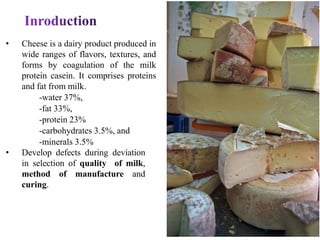
• Cheese is a dairy product produced in
wide ranges of flavors, textures, and
forms by coagulation of the milk
protein casein. It comprises proteins
and fat from milk.
-water 37%,
-fat 33%,
-protein 23%
-carbohydrates 3.5%, and
-minerals 3.5%
• Develop defects during deviation
in selection of quality of milk,
method of manufacture and
curing.
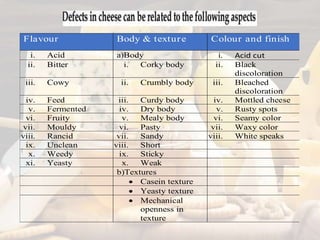
Flavour Body & texture Colour and finish
i. Acid a)Body i. Acid cut
ii. Bitter i. Corky body ii. Black
discoloration
iii. Cowy ii. Crumbly body iii. Bleached
discoloration
iv. Feed iii. Curdy body iv. Mottled cheese
v. Fermented iv. Dry body v. Rusty spots
vi. Fruity v. Mealy body vi. Seamy color
vii. Mouldy vi. Pasty vii. Waxy color
viii. Rancid vii. Sandy viii. White speaks
ix. Unclean viii. Short
x. Weedy ix. Sticky
xi. Yeasty x. Weak
b)Textures
 Casein texture
 Yeasty texture
 Mechanical
openness in
texture
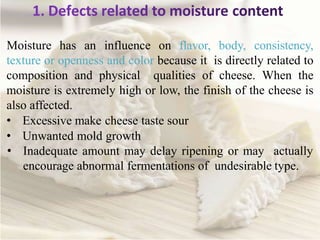
Moisture has an influence on flavor, body, consistency,
texture or openness and color because it is directly related to
composition and physical qualities of cheese. When the
moisture is extremely high or low, the finish of the cheese is
also affected.
• Excessive make cheese taste sour
• Unwanted mold growth
• Inadequate amount may delay ripening or may actually
encourage abnormal fermentations of undesirable type.
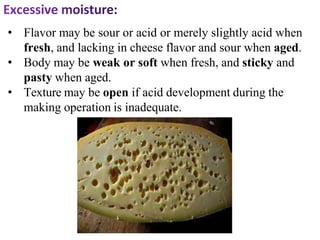
• Flavor may be sour or acid or merely slightly acid when
fresh, and lacking in cheese flavor and sour when aged.
• Body may be weak or soft when fresh, and sticky and
pasty when aged.
• Texture may be open if acid development during the
making operation is inadequate.
o An unusually high fat content in milk fat.
o Lack of acid development during making.
o Insufficient heating or heating too rapidly.
o Incomplete removal or elimination of whey.
o Proper time temperature maintaining during
manufactuing.
o Complete removal of whey
o Good quality milk
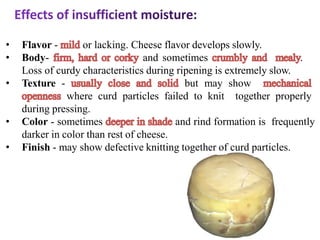
• Flavor - or lacking. Cheese flavor develops slowly.
• Body- and sometimes .
Loss of curdy characteristics during ripening is extremely slow.
• Texture - but may show
where curd particles failed to knit together properly
during pressing.
• Color - sometimes and rind formation is frequently
darker in color than rest of cheese.
• Finish - may show defective knitting together of curd particles.
• Maximum throughout making
process.
• Use of excessive amounts of
or breaking of the curd.
• Heating and holding .
of the curd while the whey is being
removed.
• Lack of piling during cheddaring operation.
• Addition of .
• Holding the cheese in a warm drying room long before
paraffining.
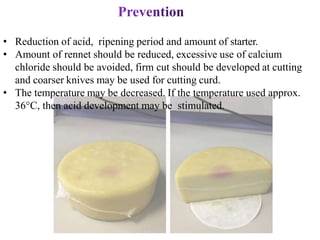
• Reduction of acid, ripening period and amount of starter.
• Amount of rennet should be reduced, excessive use of calcium
chloride should be avoided, firm cut should be developed at cutting
and coarser knives may be used for cutting curd.
• The temperature may be decreased. If the temperature used approx.
36°C, then acid development may be stimulated.
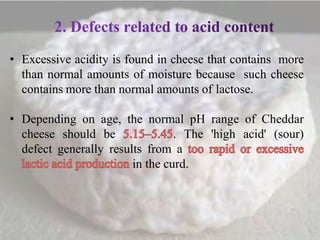
• Excessive acidity is found in cheese that contains more
than normal amounts of moisture because such cheese
contains more than normal amounts of lactose.
• Depending on age, the normal pH range of Cheddar
cheese should be . The 'high acid' (sour)
defect generally results from a
in the curd.
• Flavor – . is sometimes associated with too
much acid development during making. is
lacking or slows in development.
• Body – Acidity promotes syneresis and therefore, affect the
moisture content of cheese. level tend to have
. On the other hand, lower pH level tend to be
.
• Texture – the curd particles may be so together that
numerous mechanical openings will be formed.
• Color – t and sometimes .
• pH – usually <5.05 when cheese is 3-4 days old.
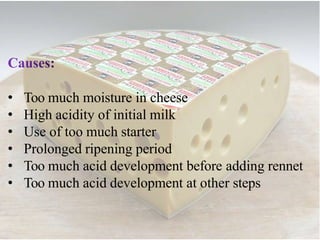
• Too much moisture in cheese
• High acidity of initial milk
• Use of too much starter
• Prolonged ripening period
• Too much acid development before adding rennet
• Too much acid development at other steps
• Flavor - when fresh and fermented, when
aged. True cheese flavor develops slowly.
• Body - . Cheese remains .
• Texture - open, with large . Cheese with
insufficient acidity may also show effects of uncontrolled
fermentations of gas producing yeasts or bacteria.
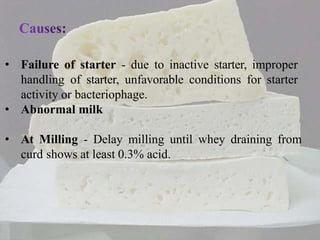
• Failure of starter - due to inactive starter, improper
handling of starter, unfavorable conditions for starter
activity or bacteriophage.
• Abnormal milk
• At Milling - Delay milling until whey draining from
curd shows at least 0.3% acid.
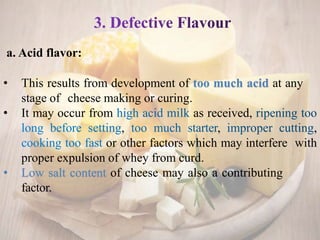
a. Acid flavor:
• This results from development of too much acid at any
stage of cheese making or curing.
• It may occur from as received,
, , ,
or other factors which may interfere with
proper expulsion of whey from curd.
• Low salt content of cheese may also a contributing
factor.
• Associated with and , with
and and using and
.
• Relatively higher temperature and use of as starter
cause the defect.
• Unclean conditions
• Conditions associated directly with manufacturing operations
may also be responsible e.g. excess acid, excess moisture, lack
of salt, and high curing temperature.
• Characteristics of odor of fermented whey and possess combined
odors of .
• This flavor usually develop of cheese,
caused by . These organisms may get into milk in
farms by contact with unclean and non- sterile surfaces of
utensils, milking machines, and milk cans.
• Prevention: utmost precaution in plant sanitation, clean and active
starter and ripening at 7°C or below.
• Described as pineapple, raspberry or pear-like flavor in cheese.
• Compounds responsible:
and .
• Associated with curing conditions.
• Caused by growth of mold in or on cheese.
• Mold grows slowly on cheese held at low temperature and under
dry conditions; grows rapidly at high temperature and humidity;
grows most luxuriantly on non-paraffined cheese.
• Prevention – Proper paraffining, close texture, sound rind,
curing at 7°C and relative humidity below 75% minimize the
defect.
• Flavor characteristic of the odor of . It is believed
to be present in all normal Cheddar.
• This flavor may come from the milk itself.
• Flavors that are to milk and cheese but which
usually described “unclean”.
• Unclean flavors are often attributed to the
in the milk, curd or cheese.
4. Defects related to body
Firmness Cohesiveness
Elasticity Plasticity
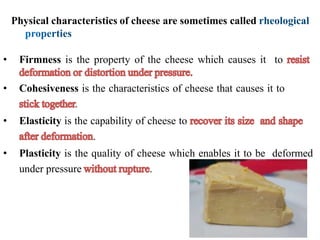
Physical characteristics of cheese are sometimes called
• Firmness is the property of the cheese which causes it to
• Cohesiveness is the characteristics of cheese that causes it to
.
• Elasticity is the capability of cheese to
.
• Plasticity is the quality of cheese which enables it to be deformed
under pressure .
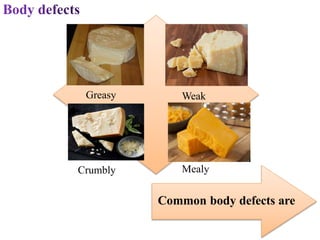
Common body defects are
Greasy Weak
Crumbly Mealy
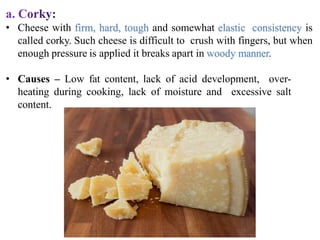
• Cheese with firm, hard, tough and somewhat elastic consistency is
called corky. Such cheese is difficult to crush with fingers, but when
enough pressure is applied it breaks apart in woody manner.
• Causes – Low fat content, lack of acid development, over-
heating during cooking, lack of moisture and excessive salt
content.
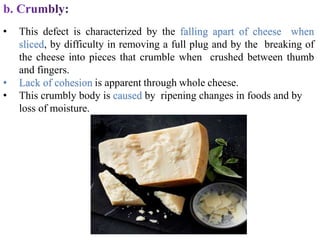
• This defect is characterized by the falling apart of cheese when
sliced, by difficulty in removing a full plug and by the breaking of
the cheese into pieces that crumble when crushed between thumb
and fingers.
• Lack of cohesion is apparent through whole cheese.
• This crumbly body is caused by ripening changes in foods and by
loss of moisture.
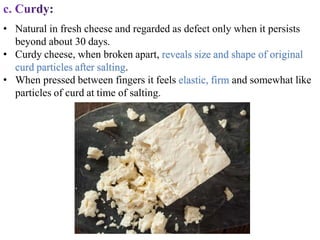
• Natural in fresh cheese and regarded as defect only when it persists
beyond about 30 days.
• Curdy cheese, when broken apart, reveals size and shape of original
curd particles after salting.
• When pressed between fingers it feels elastic, firm and somewhat like
particles of curd at time of salting.
• Appears when cheese is crushed and rubbed between thumb and
fingers, structure of curd looks and feels rough, the characteristic
is the opposite of waxy, smoothness desired in normal cheese.
• Mealy body can be most readily detected after curdy characteristics of
cheese have fully disappeared; it is actually apparent during first week
of curing but is not so easily discovered.
• Cause - Excessive acidity.
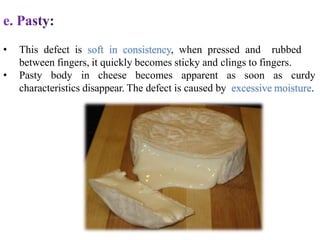
• This defect is soft in consistency, when pressed and rubbed
between fingers, it quickly becomes sticky and clings to fingers.
• Pasty body in cheese becomes apparent as soon as curdy
characteristics disappear. The defect is caused by excessive moisture.
Contamination of cheese with gas
producing bacteria and yeasts
Lack of acidity
Free whey
trapped in
curd
Lack of sufficient
pressure during
pressing of cheese
Moisture
content
Open texture is most common defect in cheese. It may be due to the
formation of gas or mechanical faults.
• Holes of irregular shape caused by trapped whey.
• Trapped whey makes the impression in the cheese during pressing,
but during ripening the moisture is dispersed throughout the cheese
leaving the hole behind.
• Mechanical openings can lead to discolouration around the
opening due to local acid development.
• Undesired mechanical openings can be reduced or closed by
vacuum packaging.
which are desirable in many types of cheese. Gas hole defects include:
defects due to coliforms.
-These appear as small, spherical, shiny holes.
-The defect is often associated with unclean flavour.
due to Clostridium tyrobutryricum or perfringens,
Clostridia spores are often present in American cheese as well but do
not normally cause problems. However, they may be activated by heat
treatment and therefore, sometimes cause gas defect in processed
cheese.
Defect can be controlled by:
• Eliminating source of contamination,
• Using pure culture and
• Pasteurizing the milk efficiently.
Acidity of 0.16% LA at draining, milling at acidity 0.60% LA, and
curing below 10°C helps in controlling defect.
sources of contamination Pure culture Pasteurization
6. Colour Defects in Cheese
In cheeses with colorants, such as annatto, pink discoloration is
thought to be a result of factors (oxidation, precipitation,
temperature, and photooxidation)
Other than traditional colour preferences, such as orange Cheddar
and white goat cheese, the most important colour parameter is
uniformity. Non-uniformity may signal a manufacturing defect.
Color defects
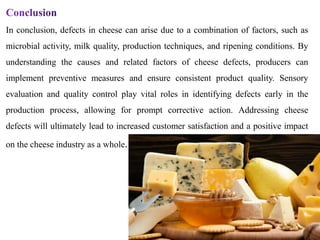
In conclusion, defects in cheese can arise due to a combination of factors, such as
microbial activity, milk quality, production techniques, and ripening conditions. By
understanding the causes and related factors of cheese defects, producers can
implement preventive measures and ensure consistent product quality. Sensory
evaluation and quality control play vital roles in identifying defects early in the
production process, allowing for prompt corrective action. Addressing cheese
defects will ultimately lead to increased customer satisfaction and a positive impact
on the cheese industry as a whole.
Defects in Cheese.pptx

Defects in Cheese.pptx

  • 1.
    Defects in Cheese Presentingby, Tasrova Sultana Md. Al Emam Afia Rahman Promi Shimu Akter Course code & title: DS-513; Quality Control of Dairy Products
  • 2.
    • Cheese isa dairy product produced in wide ranges of flavors, textures, and forms by coagulation of the milk protein casein. It comprises proteins and fat from milk. -water 37%, -fat 33%, -protein 23% -carbohydrates 3.5%, and -minerals 3.5% • Develop defects during deviation in selection of quality of milk, method of manufacture and curing.
  • 3.
    Flavour Body &texture Colour and finish i. Acid a)Body i. Acid cut ii. Bitter i. Corky body ii. Black discoloration iii. Cowy ii. Crumbly body iii. Bleached discoloration iv. Feed iii. Curdy body iv. Mottled cheese v. Fermented iv. Dry body v. Rusty spots vi. Fruity v. Mealy body vi. Seamy color vii. Mouldy vi. Pasty vii. Waxy color viii. Rancid vii. Sandy viii. White speaks ix. Unclean viii. Short x. Weedy ix. Sticky xi. Yeasty x. Weak b)Textures  Casein texture  Yeasty texture  Mechanical openness in texture
  • 4.
    Moisture has aninfluence on flavor, body, consistency, texture or openness and color because it is directly related to composition and physical qualities of cheese. When the moisture is extremely high or low, the finish of the cheese is also affected. • Excessive make cheese taste sour • Unwanted mold growth • Inadequate amount may delay ripening or may actually encourage abnormal fermentations of undesirable type.
  • 5.
    • Flavor maybe sour or acid or merely slightly acid when fresh, and lacking in cheese flavor and sour when aged. • Body may be weak or soft when fresh, and sticky and pasty when aged. • Texture may be open if acid development during the making operation is inadequate.
  • 6.
    o An unusuallyhigh fat content in milk fat. o Lack of acid development during making. o Insufficient heating or heating too rapidly. o Incomplete removal or elimination of whey. o Proper time temperature maintaining during manufactuing. o Complete removal of whey o Good quality milk
  • 7.
    • Flavor -or lacking. Cheese flavor develops slowly. • Body- and sometimes . Loss of curdy characteristics during ripening is extremely slow. • Texture - but may show where curd particles failed to knit together properly during pressing. • Color - sometimes and rind formation is frequently darker in color than rest of cheese. • Finish - may show defective knitting together of curd particles.
  • 8.
    • Maximum throughoutmaking process. • Use of excessive amounts of or breaking of the curd. • Heating and holding . of the curd while the whey is being removed. • Lack of piling during cheddaring operation. • Addition of . • Holding the cheese in a warm drying room long before paraffining.
  • 9.
    • Reduction ofacid, ripening period and amount of starter. • Amount of rennet should be reduced, excessive use of calcium chloride should be avoided, firm cut should be developed at cutting and coarser knives may be used for cutting curd. • The temperature may be decreased. If the temperature used approx. 36°C, then acid development may be stimulated.
  • 10.
    • Excessive acidityis found in cheese that contains more than normal amounts of moisture because such cheese contains more than normal amounts of lactose. • Depending on age, the normal pH range of Cheddar cheese should be . The 'high acid' (sour) defect generally results from a in the curd.
  • 11.
    • Flavor –. is sometimes associated with too much acid development during making. is lacking or slows in development. • Body – Acidity promotes syneresis and therefore, affect the moisture content of cheese. level tend to have . On the other hand, lower pH level tend to be . • Texture – the curd particles may be so together that numerous mechanical openings will be formed. • Color – t and sometimes . • pH – usually <5.05 when cheese is 3-4 days old.
  • 12.
    • Too muchmoisture in cheese • High acidity of initial milk • Use of too much starter • Prolonged ripening period • Too much acid development before adding rennet • Too much acid development at other steps
  • 13.
    • Flavor -when fresh and fermented, when aged. True cheese flavor develops slowly. • Body - . Cheese remains . • Texture - open, with large . Cheese with insufficient acidity may also show effects of uncontrolled fermentations of gas producing yeasts or bacteria.
  • 14.
    • Failure ofstarter - due to inactive starter, improper handling of starter, unfavorable conditions for starter activity or bacteriophage. • Abnormal milk • At Milling - Delay milling until whey draining from curd shows at least 0.3% acid.
  • 15.
    a. Acid flavor: •This results from development of too much acid at any stage of cheese making or curing. • It may occur from as received, , , , or other factors which may interfere with proper expulsion of whey from curd. • Low salt content of cheese may also a contributing factor.
  • 16.
    • Associated withand , with and and using and . • Relatively higher temperature and use of as starter cause the defect. • Unclean conditions • Conditions associated directly with manufacturing operations may also be responsible e.g. excess acid, excess moisture, lack of salt, and high curing temperature.
  • 17.
    • Characteristics ofodor of fermented whey and possess combined odors of . • This flavor usually develop of cheese, caused by . These organisms may get into milk in farms by contact with unclean and non- sterile surfaces of utensils, milking machines, and milk cans. • Prevention: utmost precaution in plant sanitation, clean and active starter and ripening at 7°C or below.
  • 18.
    • Described aspineapple, raspberry or pear-like flavor in cheese. • Compounds responsible: and . • Associated with curing conditions. • Caused by growth of mold in or on cheese. • Mold grows slowly on cheese held at low temperature and under dry conditions; grows rapidly at high temperature and humidity; grows most luxuriantly on non-paraffined cheese. • Prevention – Proper paraffining, close texture, sound rind, curing at 7°C and relative humidity below 75% minimize the defect.
  • 19.
    • Flavor characteristicof the odor of . It is believed to be present in all normal Cheddar. • This flavor may come from the milk itself. • Flavors that are to milk and cheese but which usually described “unclean”. • Unclean flavors are often attributed to the in the milk, curd or cheese.
  • 20.
    4. Defects relatedto body Firmness Cohesiveness Elasticity Plasticity
  • 21.
    Physical characteristics ofcheese are sometimes called • Firmness is the property of the cheese which causes it to • Cohesiveness is the characteristics of cheese that causes it to . • Elasticity is the capability of cheese to . • Plasticity is the quality of cheese which enables it to be deformed under pressure .
  • 22.
    Common body defectsare Greasy Weak Crumbly Mealy
  • 23.
    • Cheese withfirm, hard, tough and somewhat elastic consistency is called corky. Such cheese is difficult to crush with fingers, but when enough pressure is applied it breaks apart in woody manner. • Causes – Low fat content, lack of acid development, over- heating during cooking, lack of moisture and excessive salt content.
  • 24.
    • This defectis characterized by the falling apart of cheese when sliced, by difficulty in removing a full plug and by the breaking of the cheese into pieces that crumble when crushed between thumb and fingers. • Lack of cohesion is apparent through whole cheese. • This crumbly body is caused by ripening changes in foods and by loss of moisture.
  • 25.
    • Natural infresh cheese and regarded as defect only when it persists beyond about 30 days. • Curdy cheese, when broken apart, reveals size and shape of original curd particles after salting. • When pressed between fingers it feels elastic, firm and somewhat like particles of curd at time of salting.
  • 26.
    • Appears whencheese is crushed and rubbed between thumb and fingers, structure of curd looks and feels rough, the characteristic is the opposite of waxy, smoothness desired in normal cheese. • Mealy body can be most readily detected after curdy characteristics of cheese have fully disappeared; it is actually apparent during first week of curing but is not so easily discovered. • Cause - Excessive acidity.
  • 27.
    • This defectis soft in consistency, when pressed and rubbed between fingers, it quickly becomes sticky and clings to fingers. • Pasty body in cheese becomes apparent as soon as curdy characteristics disappear. The defect is caused by excessive moisture.
  • 28.
    Contamination of cheesewith gas producing bacteria and yeasts Lack of acidity Free whey trapped in curd Lack of sufficient pressure during pressing of cheese Moisture content Open texture is most common defect in cheese. It may be due to the formation of gas or mechanical faults.
  • 29.
    • Holes ofirregular shape caused by trapped whey. • Trapped whey makes the impression in the cheese during pressing, but during ripening the moisture is dispersed throughout the cheese leaving the hole behind. • Mechanical openings can lead to discolouration around the opening due to local acid development. • Undesired mechanical openings can be reduced or closed by vacuum packaging.
  • 30.
    which are desirablein many types of cheese. Gas hole defects include: defects due to coliforms. -These appear as small, spherical, shiny holes. -The defect is often associated with unclean flavour. due to Clostridium tyrobutryricum or perfringens, Clostridia spores are often present in American cheese as well but do not normally cause problems. However, they may be activated by heat treatment and therefore, sometimes cause gas defect in processed cheese.
  • 31.
    Defect can becontrolled by: • Eliminating source of contamination, • Using pure culture and • Pasteurizing the milk efficiently. Acidity of 0.16% LA at draining, milling at acidity 0.60% LA, and curing below 10°C helps in controlling defect. sources of contamination Pure culture Pasteurization
  • 32.
    6. Colour Defectsin Cheese In cheeses with colorants, such as annatto, pink discoloration is thought to be a result of factors (oxidation, precipitation, temperature, and photooxidation) Other than traditional colour preferences, such as orange Cheddar and white goat cheese, the most important colour parameter is uniformity. Non-uniformity may signal a manufacturing defect. Color defects
  • 34.
    In conclusion, defectsin cheese can arise due to a combination of factors, such as microbial activity, milk quality, production techniques, and ripening conditions. By understanding the causes and related factors of cheese defects, producers can implement preventive measures and ensure consistent product quality. Sensory evaluation and quality control play vital roles in identifying defects early in the production process, allowing for prompt corrective action. Addressing cheese defects will ultimately lead to increased customer satisfaction and a positive impact on the cheese industry as a whole.