Traditional Process Models 
A quick overview
2 
Waterfall Model 
(Diagram) 
Communication 
Project initiation 
Requirements 
gathering 
Planning 
Estimating 
Scheduling 
Tracking Modeling 
Analysis 
Design Construction 
Code 
Test Deployment 
Delivery 
Support 
Feedback
3 
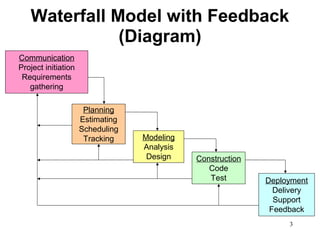
Waterfall Model with Feedback 
(Diagram) 
Communication 
Project initiation 
Requirements 
gathering 
Planning 
Estimating 
Scheduling 
Tracking Modeling 
Analysis 
Design Construction 
Code 
Test Deployment 
Delivery 
Support 
Feedback
Deploymen 
Deploymen 
Deploy…… 
4 
Incremental Model 
(Diagram) 
Increment #1 
Communication 
Increment #2 
Increment #3 
Planning 
Modeling Constructio 
n Deploymen 
t 
Communication t 
Planning 
Modeling Constructio 
n Deploymen 
t 
t 
Communication 
Planning 
Modeling Constructio 
n Deploy…… 
… 
…
5 
Prototyping Model 
(Diagram) 
Communication 
Quick 
Planning 
Modeling 
Quick 
Design 
Construction 
Of Prototype 
Deployment, 
Delivery, 
and 
Feedback 
Start
6 
Spiral Model 
(Diagram) 
Communication 
Start 
Start 
Planning 
Modeling 
Deployment Construction
Agile Development
Common Fears for Developers 
• The project will produce the wrong product. 
• The project will produce a product of inferior 
quality. 
• The project will be late. 
• We’ll have to work 80 hour weeks. 
• We’ll have to break commitments. 
• We won’t be having fun.
What is “Agility”? 
• Effective (rapid and adaptive) response to change 
• Effective communication among all stakeholders 
• Drawing the customer onto the team 
• Organizing a team so that it is in control of the work 
performed 
Yielding … 
• Rapid, incremental delivery of software
An Agile Process 
• Is driven by customer descriptions of what is required 
(scenarios) 
• Recognizes that plans are short-lived 
• Develops software iteratively with a heavy emphasis 
on construction activities 
• Delivers multiple ‘software increments’ 
• Adapts as changes occur
Principles of agile methods
Agile process models 
• Extreme Programming (XP) 
• Scrum 
• Adaptive Software Development 
• Dynamic System Development Method (DSDM) 
• Crystal 
• Feature Driven Development 
• Agile Modeling (AM)
Extreme Programming (XP) 
• Perhaps the best-known and most widely used agile 
method. 
• Extreme Programming (XP) takes an ‘extreme’ approach 
to iterative development. 
– New versions may be built several times per day; 
– Increments are delivered to customers every 2 weeks; 
– All tests must be run for every build and the build is only 
accepted if tests run successfully. 
• XP Values 
– Communication 
– Simplicity 
– Feedback 
– Courage 
– Respect
Extreme Programming (XP)
Extreme Programming (XP) 
• XP Planning 
– Begins with the creation of user stories 
– Agile team assesses each story and assigns a cost 
– Stories are grouped to for a deliverable increment 
– A commitment is made on delivery date 
– After the first increment project velocity is used to 
help define subsequent delivery dates for other 
increments
Extreme Programming (XP) 
• XP Design 
– Follows the (keep it simple) principle 
– Encourage the use of CRC (class-responsibility-cards) 
cards 
– For difficult design problems, suggests the 
creation of spike solutions — a design prototype 
– Encourages refactoring — an iterative 
refinement of the internal program design 
• XP Coding 
– Recommends the construction of a unit test for 
a story before coding commences 
– Encourages pair programming
Extreme Programming (XP) 
• XP Testing 
– All unit tests are executed daily 
– Acceptance tests are defined by the customer and 
executed to assess customer visible functionality
XP and agile principles 
• Incremental development is supported through small, frequent 
system releases. 
• Customer involvement means full-time customer engagement with 
the team. 
• People not process through pair programming, collective ownership 
and a process that avoids long working hours. 
• Change supported through regular system releases. 
• Maintaining simplicity through constant refactoring of code.
Customer involvement 
• Customer involvement is a key part of XP where 
the customer is part of the development team. 
• The role of the customer is: 
– To help develop stories that define the requirements 
– To help prioritize the features to be implemented in 
each release 
– To help develop acceptance tests which assess 
whether or not the system meets its requirements.
Requirements scenarios 
• In XP, user requirements are expressed as scenarios or user 
stories. 
• These are written on cards and the development team break them 
down into implementation tasks. These tasks are the basis of 
schedule and cost estimates. 
• The customer chooses the stories for inclusion in the next release 
based on their priorities and the schedule estimates.
Story card for document 
downloading 
Downloading and printing an article 
First, you select the article that you want from a displayed liYsto. u 
then have to tell the system how you will pay for it - this can either 
be through a subscription, through a company account or by credit 
card. 
After this, you get a copyright form from the system to fill in and, 
when you have submitted this, the article you want is downloaded 
onto your compute.r 
You then choose a printer and a copy of the article is printedY.o u 
tell the system if printing has been successful. 
If the article is a print-only article, you cant Õkeep the PDF version 
so it is automatically deleted from your comput.er
XP and change 
• Conventional wisdom in software engineering is to 
design for change. It is worth spending time and effort 
anticipating changes as this reduces costs later in the life 
cycle. 
• XP, however, maintains that this is not worthwhile as 
changes cannot be reliably anticipated. 
• Rather, it proposes constant code improvement 
(refactoring) to make changes easier when they have to 
be implemented.
Refactoring 
• Refactoring is the process of code improvement where 
code is reorganised and rewritten to make it more 
efficient, easier to understand, etc. 
• Refactoring is required because frequent releases mean 
that code is developed incrementally and therefore tends 
to become messy. 
• Refactoring should not change the functionality of the 
system. 
• Automated testing simplifies refactoring as you can see if 
the changed code still runs the tests successfully.
Testing in XP 
• Test-first development. 
• Incremental test development from scenarios. 
• User involvement in test development and validation. 
• Automated test harnesses are used to run all component 
tests each time that a new release is built.
Task cards for document 
downloading 
Task 1: Implement principal workf low 
Task 2: Implement article catalog and selection 
Task 3: Implement payment collection 
Payment may be made in 3 different ways. The user 
selects which way they wish to p.a Iyf the user 
has a library subscription, then they can input the 
subscriber key which should be checked by the 
system. Alternatively, they can input an organisational 
account number. If this is valid, a debit of the cost 
of the article is posted to this account. Final, ltyhey 
may input a 16 digit credit card number and expiry 
date. This should be checked for validity and, if 
valid a debit is posted to that credit card account.
Test case description 
Test 4: Test credit card validity 
Input: 
A string representing the credit card number and two integers representing 
the month and year when the card expires 
Tests: 
Check that all bytes in the string are digits 
Check that the month lies between 1 and 12 and the 
year is greater than or equal to the current ye.ar 
Using the first 4 digits of the credit card numb,er 
check that the card issuer is valid by looking up the 
card issuer table. Check credit card validity by submitting the card 
number and expiry date information to the card 
issuer 
Output: 
OK or error message indicating that the card is invalid
Test-first development 
• Writing tests before code clarifies the 
requirements to be implemented. 
• Tests are written as programs rather than data 
so that they can be executed automatically. The 
test includes a check that it has executed 
correctly. 
• All previous and new tests are automatically run 
when new functionality is added. Thus checking 
that the new functionality has not introduced 
errors.
Pair programming 
• In XP, programmers work in pairs, sitting together to 
develop code. 
• This helps develop common ownership of code and 
spreads knowledge across the team. 
• It serves as an informal review process as each line of 
code is looked at by more than 1 person. 
• It encourages refactoring as the whole team can benefit 
from this. 
• Measurements suggest that development productivity 
with pair programming is similar to that of two people 
working independently.
Problems with XP 
• Customer involvement 
– This is perhaps the most difficult problem. It may be difficult or 
impossible to find a customer who can represent all stakeholders 
and who can be taken off their normal work to become part of 
the XP team. For generic products, there is no ‘customer’ - the 
marketing team may not be typical of real customers. 
• Architectural design 
– The incremental style of development can mean that 
inappropriate architectural decisions are made at an 
early stage of the process. 
– Problems with these may not become clear until 
many features have been implemented and 
refactoring the architecture is very expensive.
• Test complacency 
– It is easy for a team to believe that because it has 
many tests, the system is properly tested. 
– Because of the automated testing approach, there is 
a tendency to develop tests that are easy to automate 
rather than tests that are ‘good’ tests.
Key points 
• Extreme programming includes practices such as 
systematic testing, continuous improvement and 
customer involvement. 
• Customers are involved in developing requirements 
which are expressed as simple scenarios. 
• The approach to testing in XP is a particular strength 
where executable tests are developed before the code is 
written. 
• Key problems with XP include difficulties of getting 
representative customers and problems of architectural 
design.
Scrum 
• Emphasizes use of a set of software patterns 
– Backlog 
– Sprints 
– Scrum meetings
Scrum
Scrum’s Roles 
• The Product Owner 
• The Scrum Master 
• The Team 
• Everyone else is not part of Scrum
Scrum’s Practices 
• The Sprint Planning Meeting 
• The Sprint 
• The Sprint Review Meeting 
• The Daily Scrum 
• Everything else is not part of Scrum
The Sprint Planning Meeting 
• Product Owner describes highest priority features to the Team. 
• Team decides what the can commit to delivering in the Sprint.
The Sprint Review Meeting 
• Time boxed to one hour of prep and four hours of meeting. 
• Team demonstrates product increment to product owner’s 
satisfaction. 
• Informality is encouraged. PowerPoint is discouraged.
The Daily Scrum 
• Time boxed to fifteen minutes! 
• The Team and the Scrum Master only. 
• What have you accomplished since yesterday? 
• Are your Sprint Backlog estimates accurate? 
• What are you working on today? 
• Is there anything blocking you?
The Sprint Retrospective 
• Time boxed to three hours. 
• Team, Scrum Master, and (optionally) Product Owner review the 
last Sprint 
• What went well? 
• What can be improved? 
• Actionable items are presented to the Product Owner for 
prioritization as non-functional requirements.
Scrum’s Artefacts 
• The Product Backlog 
• The Sprint Backlog 
• The Sprint Burndown Chart 
• The Product Increment 
• Everything else is not part of Scrum
The Product Backlog
The Sprint Backlog
The Sprint Burndown Chart
The Product Increment 
• Delivers measurable value 
• “Potentially Shippable”: the process can be halted after every Sprint 
and there will be some value, some ROI 
• Must be a product, no matter how incomplete
Some reasons to avoid Scrum 
• Your current software development produces acceptable results 
• Your project cannot be decomposed into good, increment-able requirements 
(“big ball of mud”) 
• Your engineering practices embrace heavy, up-front design, the 
construction of baroque frameworks, and throw-it-over-the-wall attitudes 
towards QA. 
• Nobody can agree on ‘done-ness’ 
• Your management practices embrace ‘do it now and forget what I told you to 
do yesterday’.
Quiz (10 minutes) 
• You are designing a web-based application using a components-based 
model for Managing Students Records, where teacher can 
enter/view/change data and send to examination/academic 
department. 
– Components should be reusable 
– Identify the main components 
– Identify their interfaces 
– Make component composition diagram 
– Show how teacher will get attendance record of a student and pass it to 
the academic department

Agile Development | Agile Process Models

  • 1.
    Traditional Process Models A quick overview
  • 2.
    2 Waterfall Model (Diagram) Communication Project initiation Requirements gathering Planning Estimating Scheduling Tracking Modeling Analysis Design Construction Code Test Deployment Delivery Support Feedback
  • 3.
    3 Waterfall Modelwith Feedback (Diagram) Communication Project initiation Requirements gathering Planning Estimating Scheduling Tracking Modeling Analysis Design Construction Code Test Deployment Delivery Support Feedback
  • 4.
    Deploymen Deploymen Deploy…… 4 Incremental Model (Diagram) Increment #1 Communication Increment #2 Increment #3 Planning Modeling Constructio n Deploymen t Communication t Planning Modeling Constructio n Deploymen t t Communication Planning Modeling Constructio n Deploy…… … …
  • 5.
    5 Prototyping Model (Diagram) Communication Quick Planning Modeling Quick Design Construction Of Prototype Deployment, Delivery, and Feedback Start
  • 6.
    6 Spiral Model (Diagram) Communication Start Start Planning Modeling Deployment Construction
  • 7.
  • 8.
    Common Fears forDevelopers • The project will produce the wrong product. • The project will produce a product of inferior quality. • The project will be late. • We’ll have to work 80 hour weeks. • We’ll have to break commitments. • We won’t be having fun.
  • 9.
    What is “Agility”? • Effective (rapid and adaptive) response to change • Effective communication among all stakeholders • Drawing the customer onto the team • Organizing a team so that it is in control of the work performed Yielding … • Rapid, incremental delivery of software
  • 10.
    An Agile Process • Is driven by customer descriptions of what is required (scenarios) • Recognizes that plans are short-lived • Develops software iteratively with a heavy emphasis on construction activities • Delivers multiple ‘software increments’ • Adapts as changes occur
  • 11.
  • 12.
    Agile process models • Extreme Programming (XP) • Scrum • Adaptive Software Development • Dynamic System Development Method (DSDM) • Crystal • Feature Driven Development • Agile Modeling (AM)
  • 13.
    Extreme Programming (XP) • Perhaps the best-known and most widely used agile method. • Extreme Programming (XP) takes an ‘extreme’ approach to iterative development. – New versions may be built several times per day; – Increments are delivered to customers every 2 weeks; – All tests must be run for every build and the build is only accepted if tests run successfully. • XP Values – Communication – Simplicity – Feedback – Courage – Respect
  • 14.
  • 15.
    Extreme Programming (XP) • XP Planning – Begins with the creation of user stories – Agile team assesses each story and assigns a cost – Stories are grouped to for a deliverable increment – A commitment is made on delivery date – After the first increment project velocity is used to help define subsequent delivery dates for other increments
  • 16.
    Extreme Programming (XP) • XP Design – Follows the (keep it simple) principle – Encourage the use of CRC (class-responsibility-cards) cards – For difficult design problems, suggests the creation of spike solutions — a design prototype – Encourages refactoring — an iterative refinement of the internal program design • XP Coding – Recommends the construction of a unit test for a story before coding commences – Encourages pair programming
  • 17.
    Extreme Programming (XP) • XP Testing – All unit tests are executed daily – Acceptance tests are defined by the customer and executed to assess customer visible functionality
  • 18.
    XP and agileprinciples • Incremental development is supported through small, frequent system releases. • Customer involvement means full-time customer engagement with the team. • People not process through pair programming, collective ownership and a process that avoids long working hours. • Change supported through regular system releases. • Maintaining simplicity through constant refactoring of code.
  • 19.
    Customer involvement •Customer involvement is a key part of XP where the customer is part of the development team. • The role of the customer is: – To help develop stories that define the requirements – To help prioritize the features to be implemented in each release – To help develop acceptance tests which assess whether or not the system meets its requirements.
  • 20.
    Requirements scenarios •In XP, user requirements are expressed as scenarios or user stories. • These are written on cards and the development team break them down into implementation tasks. These tasks are the basis of schedule and cost estimates. • The customer chooses the stories for inclusion in the next release based on their priorities and the schedule estimates.
  • 21.
    Story card fordocument downloading Downloading and printing an article First, you select the article that you want from a displayed liYsto. u then have to tell the system how you will pay for it - this can either be through a subscription, through a company account or by credit card. After this, you get a copyright form from the system to fill in and, when you have submitted this, the article you want is downloaded onto your compute.r You then choose a printer and a copy of the article is printedY.o u tell the system if printing has been successful. If the article is a print-only article, you cant Õkeep the PDF version so it is automatically deleted from your comput.er
  • 22.
    XP and change • Conventional wisdom in software engineering is to design for change. It is worth spending time and effort anticipating changes as this reduces costs later in the life cycle. • XP, however, maintains that this is not worthwhile as changes cannot be reliably anticipated. • Rather, it proposes constant code improvement (refactoring) to make changes easier when they have to be implemented.
  • 23.
    Refactoring • Refactoringis the process of code improvement where code is reorganised and rewritten to make it more efficient, easier to understand, etc. • Refactoring is required because frequent releases mean that code is developed incrementally and therefore tends to become messy. • Refactoring should not change the functionality of the system. • Automated testing simplifies refactoring as you can see if the changed code still runs the tests successfully.
  • 24.
    Testing in XP • Test-first development. • Incremental test development from scenarios. • User involvement in test development and validation. • Automated test harnesses are used to run all component tests each time that a new release is built.
  • 25.
    Task cards fordocument downloading Task 1: Implement principal workf low Task 2: Implement article catalog and selection Task 3: Implement payment collection Payment may be made in 3 different ways. The user selects which way they wish to p.a Iyf the user has a library subscription, then they can input the subscriber key which should be checked by the system. Alternatively, they can input an organisational account number. If this is valid, a debit of the cost of the article is posted to this account. Final, ltyhey may input a 16 digit credit card number and expiry date. This should be checked for validity and, if valid a debit is posted to that credit card account.
  • 26.
    Test case description Test 4: Test credit card validity Input: A string representing the credit card number and two integers representing the month and year when the card expires Tests: Check that all bytes in the string are digits Check that the month lies between 1 and 12 and the year is greater than or equal to the current ye.ar Using the first 4 digits of the credit card numb,er check that the card issuer is valid by looking up the card issuer table. Check credit card validity by submitting the card number and expiry date information to the card issuer Output: OK or error message indicating that the card is invalid
  • 27.
    Test-first development •Writing tests before code clarifies the requirements to be implemented. • Tests are written as programs rather than data so that they can be executed automatically. The test includes a check that it has executed correctly. • All previous and new tests are automatically run when new functionality is added. Thus checking that the new functionality has not introduced errors.
  • 28.
    Pair programming •In XP, programmers work in pairs, sitting together to develop code. • This helps develop common ownership of code and spreads knowledge across the team. • It serves as an informal review process as each line of code is looked at by more than 1 person. • It encourages refactoring as the whole team can benefit from this. • Measurements suggest that development productivity with pair programming is similar to that of two people working independently.
  • 29.
    Problems with XP • Customer involvement – This is perhaps the most difficult problem. It may be difficult or impossible to find a customer who can represent all stakeholders and who can be taken off their normal work to become part of the XP team. For generic products, there is no ‘customer’ - the marketing team may not be typical of real customers. • Architectural design – The incremental style of development can mean that inappropriate architectural decisions are made at an early stage of the process. – Problems with these may not become clear until many features have been implemented and refactoring the architecture is very expensive.
  • 30.
    • Test complacency – It is easy for a team to believe that because it has many tests, the system is properly tested. – Because of the automated testing approach, there is a tendency to develop tests that are easy to automate rather than tests that are ‘good’ tests.
  • 31.
    Key points •Extreme programming includes practices such as systematic testing, continuous improvement and customer involvement. • Customers are involved in developing requirements which are expressed as simple scenarios. • The approach to testing in XP is a particular strength where executable tests are developed before the code is written. • Key problems with XP include difficulties of getting representative customers and problems of architectural design.
  • 32.
    Scrum • Emphasizesuse of a set of software patterns – Backlog – Sprints – Scrum meetings
  • 33.
  • 34.
    Scrum’s Roles •The Product Owner • The Scrum Master • The Team • Everyone else is not part of Scrum
  • 35.
    Scrum’s Practices •The Sprint Planning Meeting • The Sprint • The Sprint Review Meeting • The Daily Scrum • Everything else is not part of Scrum
  • 36.
    The Sprint PlanningMeeting • Product Owner describes highest priority features to the Team. • Team decides what the can commit to delivering in the Sprint.
  • 37.
    The Sprint ReviewMeeting • Time boxed to one hour of prep and four hours of meeting. • Team demonstrates product increment to product owner’s satisfaction. • Informality is encouraged. PowerPoint is discouraged.
  • 38.
    The Daily Scrum • Time boxed to fifteen minutes! • The Team and the Scrum Master only. • What have you accomplished since yesterday? • Are your Sprint Backlog estimates accurate? • What are you working on today? • Is there anything blocking you?
  • 39.
    The Sprint Retrospective • Time boxed to three hours. • Team, Scrum Master, and (optionally) Product Owner review the last Sprint • What went well? • What can be improved? • Actionable items are presented to the Product Owner for prioritization as non-functional requirements.
  • 40.
    Scrum’s Artefacts •The Product Backlog • The Sprint Backlog • The Sprint Burndown Chart • The Product Increment • Everything else is not part of Scrum
  • 41.
  • 42.
  • 43.
  • 44.
    The Product Increment • Delivers measurable value • “Potentially Shippable”: the process can be halted after every Sprint and there will be some value, some ROI • Must be a product, no matter how incomplete
  • 45.
    Some reasons toavoid Scrum • Your current software development produces acceptable results • Your project cannot be decomposed into good, increment-able requirements (“big ball of mud”) • Your engineering practices embrace heavy, up-front design, the construction of baroque frameworks, and throw-it-over-the-wall attitudes towards QA. • Nobody can agree on ‘done-ness’ • Your management practices embrace ‘do it now and forget what I told you to do yesterday’.
  • 46.
    Quiz (10 minutes) • You are designing a web-based application using a components-based model for Managing Students Records, where teacher can enter/view/change data and send to examination/academic department. – Components should be reusable – Identify the main components – Identify their interfaces – Make component composition diagram – Show how teacher will get attendance record of a student and pass it to the academic department

Editor's Notes

  • #37 Nobody else can offer unsolicited advice: everyone else
  • #45 Talk about training, QA