Machine Learning
Dr.M.Pyingkodi
Dept of MCA
Kongu Engineering College
Erode, Tamilnadu, India
Modeling and Evaluation - Unit II
Modelling and Evaluation
Dr.M.Pyingkodi, AP(Sr.Gr), Dept of MCA, Kongu Engineering College, Erode, Tamilnadu, India
Modelling
Modeling
It tries to emulate human learning by applying mathematical and statistical
formulations.
1. Data Input
2. Abstraction(Learning Process)
3. Generalization
Model
•This structured representation of raw input data to the meaningful pattern is called a model.
•when the problem is related to prediction and the target field is numeric and continuous, the
regression model is assigned.
•The process of assigning a model, and fitting a specific model to a data set is called model
training.
•Once the model is trained, the raw input data is summarized into an abstracted form.
•If the outcome is systematically incorrect, the learning is said to have a bias.
Dr.M.Pyingkodi, AP(Sr.Gr), Dept of MCA, Kongu Engineering College, Erode, Tamilnadu, India
Modelling
Target Function
A machine learning algorithm creates its cognitive capability by building a mathematical
formulation or function, known as target function, based on the features in the input data set.
Hyper-parameters
•Just like a child learning things for the first time needs her parents guidance to decide
whether she is right or wrong,
•In machine learning someone has to provide some non-learnable parameters, also called
hyper-parameters.
•Without these human inputs, machine learning algorithms cannot be successful.
Dr.M.Pyingkodi, AP(Sr.Gr), Dept of MCA, Kongu Engineering College, Erode, Tamilnadu, India
SELECTING A MODEL
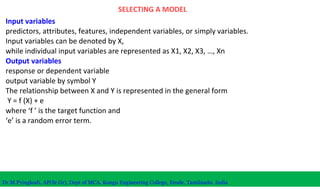
Input variables
predictors, attributes, features, independent variables, or simply variables.
Input variables can be denoted by X,
while individual input variables are represented as X1, X2, X3, …, Xn
Output variables
response or dependent variable
output variable by symbol Y
The relationship between X and Y is represented in the general form
Y = f (X) + e
where ‘f ’ is the target function and
‘e’ is a random error term.
Dr.M.Pyingkodi, AP(Sr.Gr), Dept of MCA, Kongu Engineering College, Erode, Tamilnadu, India
Modelling and Evaluation
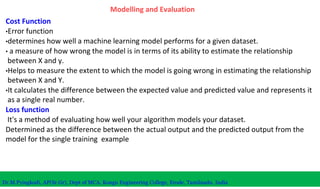
Cost Function
•Error function
•determines how well a machine learning model performs for a given dataset.
• a measure of how wrong the model is in terms of its ability to estimate the relationship
between X and y.
•Helps to measure the extent to which the model is going wrong in estimating the relationship
between X and Y.
•It calculates the difference between the expected value and predicted value and represents it
as a single real number.
Loss function
It's a method of evaluating how well your algorithm models your dataset.
Determined as the difference between the actual output and the predicted output from the
model for the single training example
Dr.M.Pyingkodi, AP(Sr.Gr), Dept of MCA, Kongu Engineering College, Erode, Tamilnadu, India
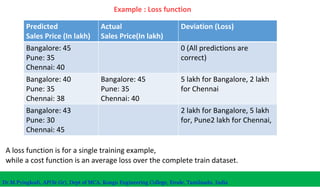
Example : Loss function
A loss function is for a single training example,
while a cost function is an average loss over the complete train dataset.
Predicted
Sales Price (In lakh)
Actual
Sales Price(In lakh)
Deviation (Loss)
Bangalore: 45
Pune: 35
Chennai: 40
0 (All predictions are
correct)
Bangalore: 40
Pune: 35
Chennai: 38
Bangalore: 45
Pune: 35
Chennai: 40
5 lakh for Bangalore, 2 lakh
for Chennai
Bangalore: 43
Pune: 30
Chennai: 45
2 lakh for Bangalore, 5 lakh
for, Pune2 lakh for Chennai,
Dr.M.Pyingkodi, AP(Sr.Gr), Dept of MCA, Kongu Engineering College, Erode, Tamilnadu, India
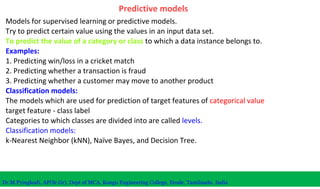
Predictive models
Models for supervised learning or predictive models.
Try to predict certain value using the values in an input data set.
To predict the value of a category or class to which a data instance belongs to.
Examples:
1. Predicting win/loss in a cricket match
2. Predicting whether a transaction is fraud
3. Predicting whether a customer may move to another product
Classification models:
The models which are used for prediction of target features of categorical value
target feature - class label
Categories to which classes are divided into are called levels.
Classification models:
k-Nearest Neighbor (kNN), Naïve Bayes, and Decision Tree.
Dr.M.Pyingkodi, AP(Sr.Gr), Dept of MCA, Kongu Engineering College, Erode, Tamilnadu, India
Predictive models
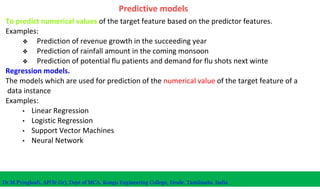
To predict numerical values of the target feature based on the predictor features.
Examples:
❖ Prediction of revenue growth in the succeeding year
❖ Prediction of rainfall amount in the coming monsoon
❖ Prediction of potential flu patients and demand for flu shots next winte
Regression models.
The models which are used for prediction of the numerical value of the target feature of a
data instance
Examples:
• Linear Regression
• Logistic Regression
• Support Vector Machines
• Neural Network
Dr.M.Pyingkodi, AP(Sr.Gr), Dept of MCA, Kongu Engineering College, Erode, Tamilnadu, India
Descriptive models
Models for unsupervised learning(clustering).
No target feature or single feature of interest in case of unsupervised learning.
Which group together similar data instances.
Data instances having a similar value of the different features are called clustering models.
Examples:
❖ Customer grouping or segmentation based on social, demographic, ethnic,
❖ etc. factors
❖ Grouping of music based on different aspects like genre, language, time_x0002_period,
etc.
❖ Grouping of commodities in an inventory
Models:
K-means
Dr.M.Pyingkodi, AP(Sr.Gr), Dept of MCA, Kongu Engineering College, Erode, Tamilnadu, India
TRAINING A MODEL (FOR SUPERVISED LEARNING)
Holdout method
 This method of partitioning the input data into two parts – training and test data
 which is by holding back a part of the input data for validating the trained model
 Subset of the input data is used as the test data for evaluating the performance of a
trained model.
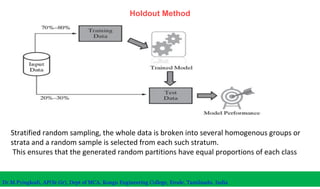
 In general 70%–80% of the input data (which is obviously labelled) is used for model
training
 The remaining 20%–30% is used as test data for validation of the performance of the
model.
 Once the model is trained using the training data, the labels of the test data are
predicted using the model’s target function.
 Then the predicted value is compared with the actual value of the label
 The performance of the model is in general measured by the accuracy of prediction of
the label value.
Dr.M.Pyingkodi, AP(Sr.Gr), Dept of MCA, Kongu Engineering College, Erode, Tamilnadu, India
Holdout Method
Stratified random sampling, the whole data is broken into several homogenous groups or
strata and a random sample is selected from each such stratum.
This ensures that the generated random partitions have equal proportions of each class
Dr.M.Pyingkodi, AP(Sr.Gr), Dept of MCA, Kongu Engineering College, Erode, Tamilnadu, India
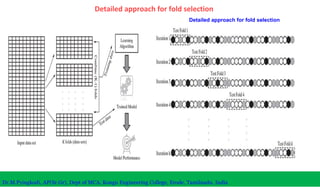
K-fold Cross-validation method
Process of repeated holdout is the basis of k-fold cross- validation technique.
In k-fold cross-validation, the data set is divided into k-completely distinct or non-overlapping
random partitions called folds.
A special variant of holdout method, called repeated holdout, is sometimes employed to
ensure the randomness of the composed data sets.
In repeated holdout, several random holdouts are used to measure the model performance.
In the end, the average of all performances is taken.
The value of ‘k’ in k-fold cross-validation can be set to any number.
K-Fold is validation technique in which we split the data into k-subsets
holdout method is repeated k-times where each of the k subsets are used as test set
other k-1 subsets are used for the training purpose
Two approaches
❖10-fold cross-validation (10-fold CV)
❖Leave-one-out cross-validation (LOOCV)
Dr.M.Pyingkodi, AP(Sr.Gr), Dept of MCA, Kongu Engineering College, Erode, Tamilnadu, India
Detailed approach for fold selection
Dr.M.Pyingkodi, AP(Sr.Gr), Dept of MCA, Kongu Engineering College, Erode, Tamilnadu, India
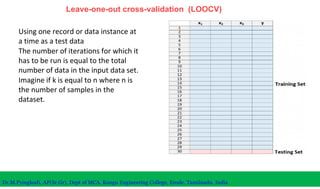
Leave-one-out cross-validation (LOOCV)
Using one record or data instance at
a time as a test data
The number of iterations for which it
has to be run is equal to the total
number of data in the input data set.
Imagine if k is equal to n where n is
the number of samples in the
dataset.
Dr.M.Pyingkodi, AP(Sr.Gr), Dept of MCA, Kongu Engineering College, Erode, Tamilnadu, India
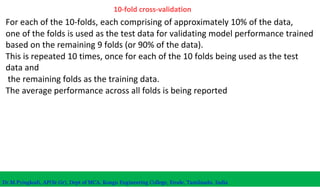
10-fold cross-validation
For each of the 10-folds, each comprising of approximately 10% of the data,
one of the folds is used as the test data for validating model performance trained
based on the remaining 9 folds (or 90% of the data).
This is repeated 10 times, once for each of the 10 folds being used as the test
data and
the remaining folds as the training data.
The average performance across all folds is being reported
Dr.M.Pyingkodi, AP(Sr.Gr), Dept of MCA, Kongu Engineering College, Erode, Tamilnadu, India
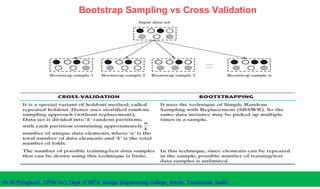
Bootstrap Sampling vs Cross Validation
Dr.M.Pyingkodi, AP(Sr.Gr), Dept of MCA, Kongu Engineering College, Erode, Tamilnadu, India
Eager learner
Eager Learning learner
When a machine learning algorithm builds a model soon after receiving training data set, it is called
eager learning.
It is called eager; because, when it gets the data set, the first thing it does – build the model. Then it
forgets the training data.
Later, when an input data comes, it uses this model to evaluate it. Most machine learning algorithms
are eager learners.
A learning algorithm that explores an entire training record set during a training phase to build a
decision structure that it can exploit during the testing phase
Given a set of training set, constructs a classification model before receiving new (e.g., test) data to
classify.
An eager learner abstracts away from the data during training and uses this abstraction to make
predictions
❖When it receive data set it starts classifying (learning)
❖Then it does not wait for test data to learn
❖So it takes long time learning and less time classifying data
Example: Decision Tree, Naive Bayes, Artificial Neural Networks,Support Vector Machine
Dr.M.Pyingkodi, AP(Sr.Gr), Dept of MCA, Kongu Engineering College, Erode, Tamilnadu, India
Lazy learner
when a machine learning algorithm does not build a model immediately after receiving the
training data, rather waits till it is provided with an input data to evaluate
Completely skips the abstraction and generalization processes
Any machine learning process that defers the majority of computation to consultation time.
It uses training data as-is,
it is also known as rote learning (i.e. memorization technique based on repetition
It is heavy dependency on the given training data instance, it is also known as instance
learning.
also called non-parametric learning
❖Just store Data set without learning from it
❖Start classifying data when it receive Test data
❖So it takes less time learning and more time classifying data
Example
K - Nearest Neighbour, Case - Based Reasoning
Dr.M.Pyingkodi, AP(Sr.Gr), Dept of MCA, Kongu Engineering College, Erode, Tamilnadu, India
MODEL REPRESENTATION AND INTERPRETABILITY
The goal of supervised machine learning is to learn or derive a target
function which can best determine the target variable from the set of
input variables.
A key consideration in learning the target function from the training
data is the extent of generalization.
Fitness of a target function approximated by a learning algorithm
determines how correctly it is able to classify a set of data it has never
seen.
Dr.M.Pyingkodi, AP(Sr.Gr), Dept of MCA, Kongu Engineering College, Erode, Tamilnadu, India
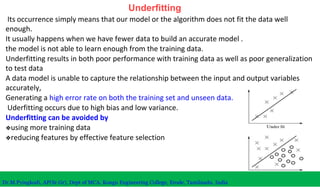
Underfitting
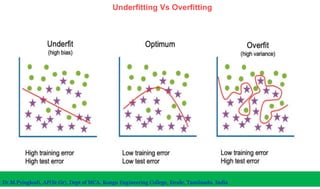
Its occurrence simply means that our model or the algorithm does not fit the data well
enough.
It usually happens when we have fewer data to build an accurate model .
the model is not able to learn enough from the training data.
Underfitting results in both poor performance with training data as well as poor generalization
to test data
A data model is unable to capture the relationship between the input and output variables
accurately,
Generating a high error rate on both the training set and unseen data.
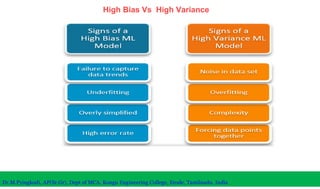
Uderfitting occurs due to high bias and low variance.
Underfitting can be avoided by
❖using more training data
❖reducing features by effective feature selection
Dr.M.Pyingkodi, AP(Sr.Gr), Dept of MCA, Kongu Engineering College, Erode, Tamilnadu, India
Overfitting
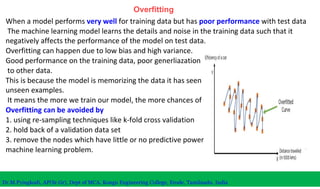
When a model performs very well for training data but has poor performance with test data
The machine learning model learns the details and noise in the training data such that it
negatively affects the performance of the model on test data.
Overfitting can happen due to low bias and high variance.
Good performance on the training data, poor generliazation
to other data.
This is because the model is memorizing the data it has seen and is unable to generalize to
unseen examples.
It means the more we train our model, the more chances of occurring the overfitted model.
Overfitting can be avoided by
1. using re-sampling techniques like k-fold cross validation
2. hold back of a validation data set
3. remove the nodes which have little or no predictive power for the given
machine learning problem.
Dr.M.Pyingkodi, AP(Sr.Gr), Dept of MCA, Kongu Engineering College, Erode, Tamilnadu, India
Underfitting Vs Overfitting
Dr.M.Pyingkodi, AP(Sr.Gr), Dept of MCA, Kongu Engineering College, Erode, Tamilnadu, India
Bias
If the machine learning model is not accurate, it can make predictions errors, and
these prediction errors are usually known as Bias and Variance.
An error is a measure of how accurately an algorithm can make predictions for the previously
unknown dataset.
Difference between the model predictions and actual predictions.
A model has either:
Low Bias
A low bias model will make fewer assumptions about the form of the target function.
High Bias
A model with a high bias makes more assumptions, and the model becomes unable to capture
the important features of our dataset.
A high bias model also cannot perform well on new data.
High in biasing gives a large error in training as well as testing data.
Dr.M.Pyingkodi, AP(Sr.Gr), Dept of MCA, Kongu Engineering College, Erode, Tamilnadu, India
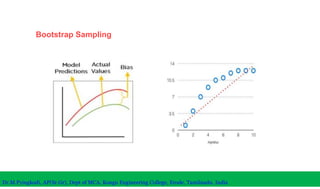
Bootstrap Sampling
Dr.M.Pyingkodi, AP(Sr.Gr), Dept of MCA, Kongu Engineering College, Erode, Tamilnadu, India
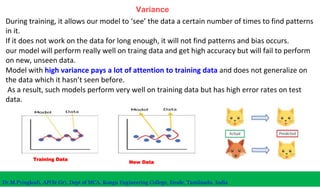
Variance
During training, it allows our model to ‘see’ the data a certain number of times to find patterns
in it.
If it does not work on the data for long enough, it will not find patterns and bias occurs.
our model will perform really well on traing data and get high accuracy but will fail to perform
on new, unseen data.
Model with high variance pays a lot of attention to training data and does not generalize on
the data which it hasn’t seen before.
As a result, such models perform very well on training data but has high error rates on test
data.
Training Data
New Data
Dr.M.Pyingkodi, AP(Sr.Gr), Dept of MCA, Kongu Engineering College, Erode, Tamilnadu, India
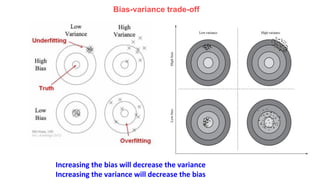
Bias-variance trade-off
Increasing the bias will decrease the variance
Increasing the variance will decrease the bias
High Bias Vs High Variance
Dr.M.Pyingkodi, AP(Sr.Gr), Dept of MCA, Kongu Engineering College, Erode, Tamilnadu, India
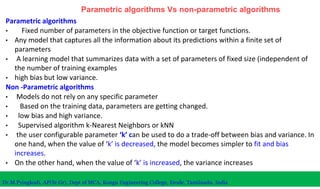
Parametric algorithms Vs non-parametric algorithms
Parametric algorithms
• Fixed number of parameters in the objective function or target functions.
• Any model that captures all the information about its predictions within a finite set of
parameters
• A learning model that summarizes data with a set of parameters of fixed size (independent of
the number of training examples
• high bias but low variance.
Non -Parametric algorithms
• Models do not rely on any specific parameter
• Based on the training data, parameters are getting changed.
• low bias and high variance.
• Supervised algorithm k-Nearest Neighbors or kNN
• the user configurable parameter ‘k’ can be used to do a trade-off between bias and variance. In
one hand, when the value of ‘k’ is decreased, the model becomes simpler to fit and bias
increases.
• On the other hand, when the value of ‘k’ is increased, the variance increases
Dr.M.Pyingkodi, AP(Sr.Gr), Dept of MCA, Kongu Engineering College, Erode, Tamilnadu, India
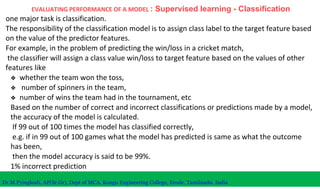
EVALUATING PERFORMANCE OF A MODEL : Supervised learning - Classification
one major task is classification.
The responsibility of the classification model is to assign class label to the target feature based
on the value of the predictor features.
For example, in the problem of predicting the win/loss in a cricket match,
the classifier will assign a class value win/loss to target feature based on the values of other
features like
❖ whether the team won the toss,
❖ number of spinners in the team,
❖ number of wins the team had in the tournament, etc
Based on the number of correct and incorrect classifications or predictions made by a model,
the accuracy of the model is calculated.
If 99 out of 100 times the model has classified correctly,
e.g. if in 99 out of 100 games what the model has predicted is same as what the outcome
has been,
then the model accuracy is said to be 99%.
1% incorrect prediction
Dr.M.Pyingkodi, AP(Sr.Gr), Dept of MCA, Kongu Engineering College, Erode, Tamilnadu, India
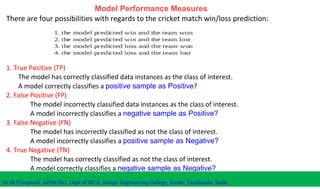
Model Performance Measures
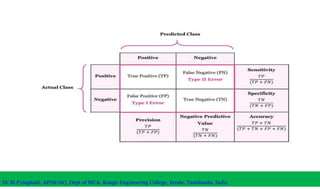
There are four possibilities with regards to the cricket match win/loss prediction:
1. True Positive (TP)
The model has correctly classified data instances as the class of interest.
A model correctly classifies a positive sample as Positive?
2. False Positive (FP)
The model incorrectly classified data instances as the class of interest.
A model incorrectly classifies a negative sample as Positive?
3. False Negative (FN)
The model has incorrectly classified as not the class of interest.
A model incorrectly classifies a positive sample as Negative?
4. True Negative (TN)
The model has correctly classified as not the class of interest.
A model correctly classifies a negative sample as Negative?
Dr.M.Pyingkodi, AP(Sr.Gr), Dept of MCA, Kongu Engineering College, Erode, Tamilnadu, India
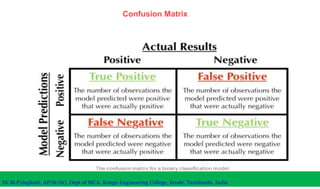
Confusion Matrix
Dr.M.Pyingkodi, AP(Sr.Gr), Dept of MCA, Kongu Engineering College, Erode, Tamilnadu, India
Confusion Matrix
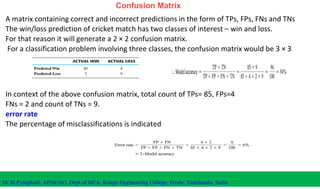
A matrix containing correct and incorrect predictions in the form of TPs, FPs, FNs and TNs
The win/loss prediction of cricket match has two classes of interest – win and loss.
For that reason it will generate a 2 × 2 confusion matrix.
For a classification problem involving three classes, the confusion matrix would be 3 × 3
In context of the above confusion matrix, total count of TPs= 85, FPs=4
FNs = 2 and count of TNs = 9.
error rate
The percentage of misclassifications is indicated
Dr.M.Pyingkodi, AP(Sr.Gr), Dept of MCA, Kongu Engineering College, Erode, Tamilnadu, India
Kappa
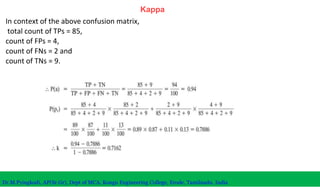
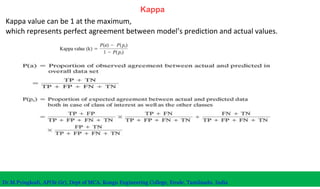
Kappa value can be 1 at the maximum,
which represents perfect agreement between model’s prediction and actual values.
Dr.M.Pyingkodi, AP(Sr.Gr), Dept of MCA, Kongu Engineering College, Erode, Tamilnadu, India
Kappa
In context of the above confusion matrix,
total count of TPs = 85,
count of FPs = 4,
count of FNs = 2 and
count of TNs = 9.
Dr.M.Pyingkodi, AP(Sr.Gr), Dept of MCA, Kongu Engineering College, Erode, Tamilnadu, India
Sensitivity
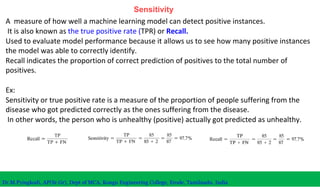
A measure of how well a machine learning model can detect positive instances.
It is also known as the true positive rate (TPR) or Recall.
Used to evaluate model performance because it allows us to see how many positive instances
the model was able to correctly identify.
Recall indicates the proportion of correct prediction of positives to the total number of
positives.
Ex:
Sensitivity or true positive rate is a measure of the proportion of people suffering from the
disease who got predicted correctly as the ones suffering from the disease.
In other words, the person who is unhealthy (positive) actually got predicted as unhealthy.
Dr.M.Pyingkodi, AP(Sr.Gr), Dept of MCA, Kongu Engineering College, Erode, Tamilnadu, India
Specificity
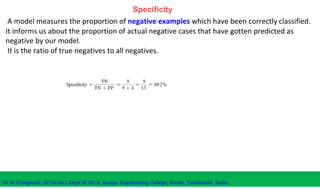
A model measures the proportion of negative examples which have been correctly classified.
It informs us about the proportion of actual negative cases that have gotten predicted as
negative by our model.
It is the ratio of true negatives to all negatives.
Dr.M.Pyingkodi, AP(Sr.Gr), Dept of MCA, Kongu Engineering College, Erode, Tamilnadu, India
Precision
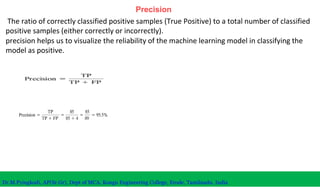
The ratio of correctly classified positive samples (True Positive) to a total number of classified
positive samples (either correctly or incorrectly).
precision helps us to visualize the reliability of the machine learning model in classifying the
model as positive.
Dr.M.Pyingkodi, AP(Sr.Gr), Dept of MCA, Kongu Engineering College, Erode, Tamilnadu, India
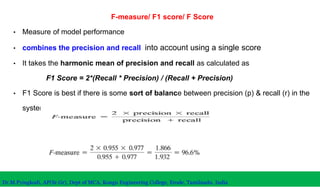
F-measure/ F1 score/ F Score
• Measure of model performance
• combines the precision and recall into account using a single score
• It takes the harmonic mean of precision and recall as calculated as
F1 Score = 2*(Recall * Precision) / (Recall + Precision)
• F1 Score is best if there is some sort of balance between precision (p) & recall (r) in the
system.
Dr.M.Pyingkodi, AP(Sr.Gr), Dept of MCA, Kongu Engineering College, Erode, Tamilnadu, India
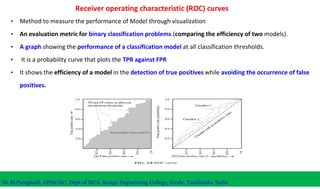
Receiver operating characteristic (ROC) curves
• Method to measure the performance of Model through visualization
• An evaluation metric for binary classification problems.(comparing the efficiency of two models).
• A graph showing the performance of a classification model at all classification thresholds.
• It is a probability curve that plots the TPR against FPR
• It shows the efficiency of a model in the detection of true positives while avoiding the occurrence of false
positives.
Dr.M.Pyingkodi, AP(Sr.Gr), Dept of MCA, Kongu Engineering College, Erode, Tamilnadu, India
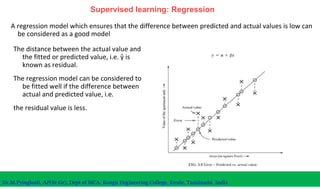
Supervised learning: Regression
A regression model which ensures that the difference between predicted and actual values is low can
be considered as a good model
The distance between the actual value and
the fitted or predicted value, i.e. ŷ is
known as residual.
The regression model can be considered to
be fitted well if the difference between
actual and predicted value, i.e.
the residual value is less.
Dr.M.Pyingkodi, AP(Sr.Gr), Dept of MCA, Kongu Engineering College, Erode, Tamilnadu, India
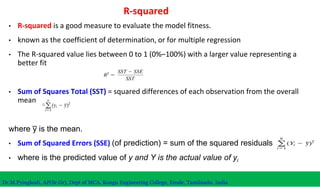
R-squared
• R-squared is a good measure to evaluate the model fitness.
• known as the coefficient of determination, or for multiple regression
• The R-squared value lies between 0 to 1 (0%–100%) with a larger value representing a
better fit
• Sum of Squares Total (SST) = squared differences of each observation from the overall
mean
where y
̅ is the mean.
• Sum of Squared Errors (SSE) (of prediction) = sum of the squared residuals
• where is the predicted value of y and Y is the actual value of yi
Dr.M.Pyingkodi, AP(Sr.Gr), Dept of MCA, Kongu Engineering College, Erode, Tamilnadu, India
Unsupervised learning : Clustering
Two inherent challenges which lie in the process of clustering
It is generally not known how many clusters can be formulated from a
1. Depends on the data set. It is completely open-ended in most cases and provided as a
user input to a clustering algorithm.
2. Even if the number of clusters is given, the same number of clusters can be formed with
different groups of data instances.
Internal evaluation
Measure cluster quality based on homogeneity of data belonging to the same cluster and
heterogeneity of data belonging to different clusters.
The homogeneity/heterogeneity is decided by some similarity measure.
Dr.M.Pyingkodi, AP(Sr.Gr), Dept of MCA, Kongu Engineering College, Erode, Tamilnadu, India
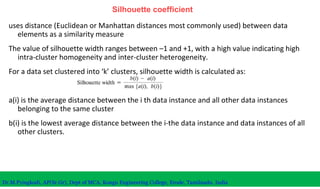
Silhouette coefficient
uses distance (Euclidean or Manhattan distances most commonly used) between data
elements as a similarity measure
The value of silhouette width ranges between –1 and +1, with a high value indicating high
intra-cluster homogeneity and inter-cluster heterogeneity.
For a data set clustered into ‘k’ clusters, silhouette width is calculated as:
a(i) is the average distance between the i th data instance and all other data instances
belonging to the same cluster
b(i) is the lowest average distance between the i-the data instance and data instances of all
other clusters.
Dr.M.Pyingkodi, AP(Sr.Gr), Dept of MCA, Kongu Engineering College, Erode, Tamilnadu, India
Silhouette coefficient
There are four clusters namely cluster 1, 2, 3, and 4.
data element ‘i’ in cluster 1, resembled by the asterisk. a(i) is the
average of the distances a ,
ai1,ai2,ai3, …ain
a of the different data elements from the ith data element in cluster 1
assuming there are n data elements in cluster 1.
Dr.M.Pyingkodi, AP(Sr.Gr), Dept of MCA, Kongu Engineering College, Erode, Tamilnadu, India
where n is the total number of elements in cluster 4. In the same way, we
can calculate the values of b (average) and b (average).
b (i) is the minimum of all these values.
b(i) = minimum [b (average), b (average), b (average)]
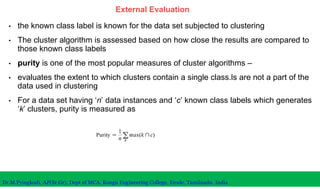
External Evaluation
• the known class label is known for the data set subjected to clustering
• The cluster algorithm is assessed based on how close the results are compared to
those known class labels
• purity is one of the most popular measures of cluster algorithms –
• evaluates the extent to which clusters contain a single class.ls are not a part of the
data used in clustering
• For a data set having ‘n’ data instances and ‘c’ known class labels which generates
‘k’ clusters, purity is measured as
Dr.M.Pyingkodi, AP(Sr.Gr), Dept of MCA, Kongu Engineering College, Erode, Tamilnadu, India
IMPROVING PERFORMANCE OF A MODEL
• Model selection is done one several aspects:
1. Type of learning the task in hand, i.e. supervised or unsupervised
2. Type of the data, i.e. categorical or numeric
3. Sometimes on the problem domain
4. Above all, experience in working with different models to solve problems of
diverse domains
Dr.M.Pyingkodi, AP(Sr.Gr), Dept of MCA, Kongu Engineering College, Erode, Tamilnadu, India
IMPROVING PERFORMANCE OF A MODEL
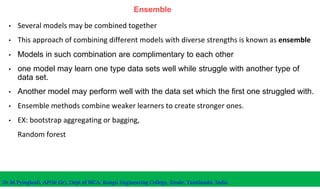
• Model parameter tuning is the process of adjusting the model fitting options. For example,
in the popular classification model k-Nearest Neighbour (kNN),
• using different values of ‘k’ or the number of nearest neighbours to be considered, the
model can be tuned.
• In the same way, a number of hidden layers can be adjusted to tune the performance in
neural networks model.
Dr.M.Pyingkodi, AP(Sr.Gr), Dept of MCA, Kongu Engineering College, Erode, Tamilnadu, India
Ensemble
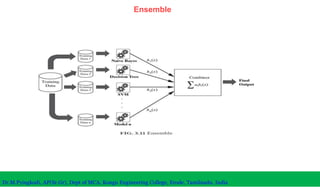
• Several models may be combined together
• This approach of combining different models with diverse strengths is known as ensemble
• Models in such combination are complimentary to each other
• one model may learn one type data sets well while struggle with another type of
data set.
• Another model may perform well with the data set which the first one struggled with.
• Ensemble methods combine weaker learners to create stronger ones.
• EX: bootstrap aggregating or bagging,
Random forest
Dr.M.Pyingkodi, AP(Sr.Gr), Dept of MCA, Kongu Engineering College, Erode, Tamilnadu, India
Ensemble
Dr.M.Pyingkodi, AP(Sr.Gr), Dept of MCA, Kongu Engineering College, Erode, Tamilnadu, India
Steps in Ensemble Process
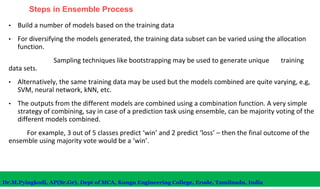
• Build a number of models based on the training data
• For diversifying the models generated, the training data subset can be varied using the allocation
function.
Sampling techniques like bootstrapping may be used to generate unique training
data sets.
• Alternatively, the same training data may be used but the models combined are quite varying, e.g,
SVM, neural network, kNN, etc.
• The outputs from the different models are combined using a combination function. A very simple
strategy of combining, say in case of a prediction task using ensemble, can be majority voting of the
different models combined.
For example, 3 out of 5 classes predict ‘win’ and 2 predict ‘loss’ – then the final outcome of the
ensemble using majority vote would be a ‘win’.
Dr.M.Pyingkodi, AP(Sr.Gr), Dept of MCA, Kongu Engineering College, Erode, Tamilnadu, India
Ensemble Methods
Bagging
• Uses bootstrap sampling method (to generate multiple training data sets. These training data sets
are used to generate (or train) a set of models using the same learning algorithm.
• Then the outcomes of the models are combined by majority voting (classification) or by average
(regression).
• Bagging is a very simple ensemble technique which can perform really well for unstable learners
like a decision tree, in which a slight change in data can impact the outcome of a model significantly
Boosting
• Weaker learning models are trained on resampled data and the outcomes are combined using a
weighted voting approach based on the performance of different models.
Algorithms: Adaptive boosting or AdaBoost
Random forest
Another ensemble-based technique. It is an ensemble of decision trees – hence the name random
forest to indicate a forest of decision trees.
Dr.M.Pyingkodi, AP(Sr.Gr), Dept of MCA, Kongu Engineering College, Erode, Tamilnadu, India

Machine Learning Model Evaluation Methods

  • 1.
    Machine Learning Dr.M.Pyingkodi Dept ofMCA Kongu Engineering College Erode, Tamilnadu, India Modeling and Evaluation - Unit II
  • 2.
    Modelling and Evaluation Dr.M.Pyingkodi,AP(Sr.Gr), Dept of MCA, Kongu Engineering College, Erode, Tamilnadu, India
  • 3.
    Modelling Modeling It tries toemulate human learning by applying mathematical and statistical formulations. 1. Data Input 2. Abstraction(Learning Process) 3. Generalization Model •This structured representation of raw input data to the meaningful pattern is called a model. •when the problem is related to prediction and the target field is numeric and continuous, the regression model is assigned. •The process of assigning a model, and fitting a specific model to a data set is called model training. •Once the model is trained, the raw input data is summarized into an abstracted form. •If the outcome is systematically incorrect, the learning is said to have a bias. Dr.M.Pyingkodi, AP(Sr.Gr), Dept of MCA, Kongu Engineering College, Erode, Tamilnadu, India
  • 4.
    Modelling Target Function A machinelearning algorithm creates its cognitive capability by building a mathematical formulation or function, known as target function, based on the features in the input data set. Hyper-parameters •Just like a child learning things for the first time needs her parents guidance to decide whether she is right or wrong, •In machine learning someone has to provide some non-learnable parameters, also called hyper-parameters. •Without these human inputs, machine learning algorithms cannot be successful. Dr.M.Pyingkodi, AP(Sr.Gr), Dept of MCA, Kongu Engineering College, Erode, Tamilnadu, India
  • 5.
    SELECTING A MODEL Inputvariables predictors, attributes, features, independent variables, or simply variables. Input variables can be denoted by X, while individual input variables are represented as X1, X2, X3, …, Xn Output variables response or dependent variable output variable by symbol Y The relationship between X and Y is represented in the general form Y = f (X) + e where ‘f ’ is the target function and ‘e’ is a random error term. Dr.M.Pyingkodi, AP(Sr.Gr), Dept of MCA, Kongu Engineering College, Erode, Tamilnadu, India
  • 6.
    Modelling and Evaluation CostFunction •Error function •determines how well a machine learning model performs for a given dataset. • a measure of how wrong the model is in terms of its ability to estimate the relationship between X and y. •Helps to measure the extent to which the model is going wrong in estimating the relationship between X and Y. •It calculates the difference between the expected value and predicted value and represents it as a single real number. Loss function It's a method of evaluating how well your algorithm models your dataset. Determined as the difference between the actual output and the predicted output from the model for the single training example Dr.M.Pyingkodi, AP(Sr.Gr), Dept of MCA, Kongu Engineering College, Erode, Tamilnadu, India
  • 7.
    Example : Lossfunction A loss function is for a single training example, while a cost function is an average loss over the complete train dataset. Predicted Sales Price (In lakh) Actual Sales Price(In lakh) Deviation (Loss) Bangalore: 45 Pune: 35 Chennai: 40 0 (All predictions are correct) Bangalore: 40 Pune: 35 Chennai: 38 Bangalore: 45 Pune: 35 Chennai: 40 5 lakh for Bangalore, 2 lakh for Chennai Bangalore: 43 Pune: 30 Chennai: 45 2 lakh for Bangalore, 5 lakh for, Pune2 lakh for Chennai, Dr.M.Pyingkodi, AP(Sr.Gr), Dept of MCA, Kongu Engineering College, Erode, Tamilnadu, India
  • 8.
    Predictive models Models forsupervised learning or predictive models. Try to predict certain value using the values in an input data set. To predict the value of a category or class to which a data instance belongs to. Examples: 1. Predicting win/loss in a cricket match 2. Predicting whether a transaction is fraud 3. Predicting whether a customer may move to another product Classification models: The models which are used for prediction of target features of categorical value target feature - class label Categories to which classes are divided into are called levels. Classification models: k-Nearest Neighbor (kNN), Naïve Bayes, and Decision Tree. Dr.M.Pyingkodi, AP(Sr.Gr), Dept of MCA, Kongu Engineering College, Erode, Tamilnadu, India
  • 9.
    Predictive models To predictnumerical values of the target feature based on the predictor features. Examples: ❖ Prediction of revenue growth in the succeeding year ❖ Prediction of rainfall amount in the coming monsoon ❖ Prediction of potential flu patients and demand for flu shots next winte Regression models. The models which are used for prediction of the numerical value of the target feature of a data instance Examples: • Linear Regression • Logistic Regression • Support Vector Machines • Neural Network Dr.M.Pyingkodi, AP(Sr.Gr), Dept of MCA, Kongu Engineering College, Erode, Tamilnadu, India
  • 10.
    Descriptive models Models forunsupervised learning(clustering). No target feature or single feature of interest in case of unsupervised learning. Which group together similar data instances. Data instances having a similar value of the different features are called clustering models. Examples: ❖ Customer grouping or segmentation based on social, demographic, ethnic, ❖ etc. factors ❖ Grouping of music based on different aspects like genre, language, time_x0002_period, etc. ❖ Grouping of commodities in an inventory Models: K-means Dr.M.Pyingkodi, AP(Sr.Gr), Dept of MCA, Kongu Engineering College, Erode, Tamilnadu, India
  • 11.
    TRAINING A MODEL(FOR SUPERVISED LEARNING) Holdout method  This method of partitioning the input data into two parts – training and test data  which is by holding back a part of the input data for validating the trained model  Subset of the input data is used as the test data for evaluating the performance of a trained model.  In general 70%–80% of the input data (which is obviously labelled) is used for model training  The remaining 20%–30% is used as test data for validation of the performance of the model.  Once the model is trained using the training data, the labels of the test data are predicted using the model’s target function.  Then the predicted value is compared with the actual value of the label  The performance of the model is in general measured by the accuracy of prediction of the label value. Dr.M.Pyingkodi, AP(Sr.Gr), Dept of MCA, Kongu Engineering College, Erode, Tamilnadu, India
  • 12.
    Holdout Method Stratified randomsampling, the whole data is broken into several homogenous groups or strata and a random sample is selected from each such stratum. This ensures that the generated random partitions have equal proportions of each class Dr.M.Pyingkodi, AP(Sr.Gr), Dept of MCA, Kongu Engineering College, Erode, Tamilnadu, India
  • 13.
    K-fold Cross-validation method Processof repeated holdout is the basis of k-fold cross- validation technique. In k-fold cross-validation, the data set is divided into k-completely distinct or non-overlapping random partitions called folds. A special variant of holdout method, called repeated holdout, is sometimes employed to ensure the randomness of the composed data sets. In repeated holdout, several random holdouts are used to measure the model performance. In the end, the average of all performances is taken. The value of ‘k’ in k-fold cross-validation can be set to any number. K-Fold is validation technique in which we split the data into k-subsets holdout method is repeated k-times where each of the k subsets are used as test set other k-1 subsets are used for the training purpose Two approaches ❖10-fold cross-validation (10-fold CV) ❖Leave-one-out cross-validation (LOOCV) Dr.M.Pyingkodi, AP(Sr.Gr), Dept of MCA, Kongu Engineering College, Erode, Tamilnadu, India
  • 14.
    Detailed approach forfold selection Detailed approach for fold selection Dr.M.Pyingkodi, AP(Sr.Gr), Dept of MCA, Kongu Engineering College, Erode, Tamilnadu, India
  • 15.
    Leave-one-out cross-validation (LOOCV) Usingone record or data instance at a time as a test data The number of iterations for which it has to be run is equal to the total number of data in the input data set. Imagine if k is equal to n where n is the number of samples in the dataset. Dr.M.Pyingkodi, AP(Sr.Gr), Dept of MCA, Kongu Engineering College, Erode, Tamilnadu, India
  • 16.
    10-fold cross-validation For eachof the 10-folds, each comprising of approximately 10% of the data, one of the folds is used as the test data for validating model performance trained based on the remaining 9 folds (or 90% of the data). This is repeated 10 times, once for each of the 10 folds being used as the test data and the remaining folds as the training data. The average performance across all folds is being reported Dr.M.Pyingkodi, AP(Sr.Gr), Dept of MCA, Kongu Engineering College, Erode, Tamilnadu, India
  • 17.
    Bootstrap Sampling vsCross Validation Dr.M.Pyingkodi, AP(Sr.Gr), Dept of MCA, Kongu Engineering College, Erode, Tamilnadu, India
  • 18.
    Eager learner Eager Learninglearner When a machine learning algorithm builds a model soon after receiving training data set, it is called eager learning. It is called eager; because, when it gets the data set, the first thing it does – build the model. Then it forgets the training data. Later, when an input data comes, it uses this model to evaluate it. Most machine learning algorithms are eager learners. A learning algorithm that explores an entire training record set during a training phase to build a decision structure that it can exploit during the testing phase Given a set of training set, constructs a classification model before receiving new (e.g., test) data to classify. An eager learner abstracts away from the data during training and uses this abstraction to make predictions ❖When it receive data set it starts classifying (learning) ❖Then it does not wait for test data to learn ❖So it takes long time learning and less time classifying data Example: Decision Tree, Naive Bayes, Artificial Neural Networks,Support Vector Machine Dr.M.Pyingkodi, AP(Sr.Gr), Dept of MCA, Kongu Engineering College, Erode, Tamilnadu, India
  • 19.
    Lazy learner when amachine learning algorithm does not build a model immediately after receiving the training data, rather waits till it is provided with an input data to evaluate Completely skips the abstraction and generalization processes Any machine learning process that defers the majority of computation to consultation time. It uses training data as-is, it is also known as rote learning (i.e. memorization technique based on repetition It is heavy dependency on the given training data instance, it is also known as instance learning. also called non-parametric learning ❖Just store Data set without learning from it ❖Start classifying data when it receive Test data ❖So it takes less time learning and more time classifying data Example K - Nearest Neighbour, Case - Based Reasoning Dr.M.Pyingkodi, AP(Sr.Gr), Dept of MCA, Kongu Engineering College, Erode, Tamilnadu, India
  • 20.
    MODEL REPRESENTATION ANDINTERPRETABILITY The goal of supervised machine learning is to learn or derive a target function which can best determine the target variable from the set of input variables. A key consideration in learning the target function from the training data is the extent of generalization. Fitness of a target function approximated by a learning algorithm determines how correctly it is able to classify a set of data it has never seen. Dr.M.Pyingkodi, AP(Sr.Gr), Dept of MCA, Kongu Engineering College, Erode, Tamilnadu, India
  • 21.
    Underfitting Its occurrence simplymeans that our model or the algorithm does not fit the data well enough. It usually happens when we have fewer data to build an accurate model . the model is not able to learn enough from the training data. Underfitting results in both poor performance with training data as well as poor generalization to test data A data model is unable to capture the relationship between the input and output variables accurately, Generating a high error rate on both the training set and unseen data. Uderfitting occurs due to high bias and low variance. Underfitting can be avoided by ❖using more training data ❖reducing features by effective feature selection Dr.M.Pyingkodi, AP(Sr.Gr), Dept of MCA, Kongu Engineering College, Erode, Tamilnadu, India
  • 22.
    Overfitting When a modelperforms very well for training data but has poor performance with test data The machine learning model learns the details and noise in the training data such that it negatively affects the performance of the model on test data. Overfitting can happen due to low bias and high variance. Good performance on the training data, poor generliazation to other data. This is because the model is memorizing the data it has seen and is unable to generalize to unseen examples. It means the more we train our model, the more chances of occurring the overfitted model. Overfitting can be avoided by 1. using re-sampling techniques like k-fold cross validation 2. hold back of a validation data set 3. remove the nodes which have little or no predictive power for the given machine learning problem. Dr.M.Pyingkodi, AP(Sr.Gr), Dept of MCA, Kongu Engineering College, Erode, Tamilnadu, India
  • 23.
    Underfitting Vs Overfitting Dr.M.Pyingkodi,AP(Sr.Gr), Dept of MCA, Kongu Engineering College, Erode, Tamilnadu, India
  • 24.
    Bias If the machinelearning model is not accurate, it can make predictions errors, and these prediction errors are usually known as Bias and Variance. An error is a measure of how accurately an algorithm can make predictions for the previously unknown dataset. Difference between the model predictions and actual predictions. A model has either: Low Bias A low bias model will make fewer assumptions about the form of the target function. High Bias A model with a high bias makes more assumptions, and the model becomes unable to capture the important features of our dataset. A high bias model also cannot perform well on new data. High in biasing gives a large error in training as well as testing data. Dr.M.Pyingkodi, AP(Sr.Gr), Dept of MCA, Kongu Engineering College, Erode, Tamilnadu, India
  • 25.
    Bootstrap Sampling Dr.M.Pyingkodi, AP(Sr.Gr),Dept of MCA, Kongu Engineering College, Erode, Tamilnadu, India
  • 26.
    Variance During training, itallows our model to ‘see’ the data a certain number of times to find patterns in it. If it does not work on the data for long enough, it will not find patterns and bias occurs. our model will perform really well on traing data and get high accuracy but will fail to perform on new, unseen data. Model with high variance pays a lot of attention to training data and does not generalize on the data which it hasn’t seen before. As a result, such models perform very well on training data but has high error rates on test data. Training Data New Data Dr.M.Pyingkodi, AP(Sr.Gr), Dept of MCA, Kongu Engineering College, Erode, Tamilnadu, India
  • 27.
    Bias-variance trade-off Increasing thebias will decrease the variance Increasing the variance will decrease the bias
  • 28.
    High Bias VsHigh Variance Dr.M.Pyingkodi, AP(Sr.Gr), Dept of MCA, Kongu Engineering College, Erode, Tamilnadu, India
  • 29.
    Parametric algorithms Vsnon-parametric algorithms Parametric algorithms • Fixed number of parameters in the objective function or target functions. • Any model that captures all the information about its predictions within a finite set of parameters • A learning model that summarizes data with a set of parameters of fixed size (independent of the number of training examples • high bias but low variance. Non -Parametric algorithms • Models do not rely on any specific parameter • Based on the training data, parameters are getting changed. • low bias and high variance. • Supervised algorithm k-Nearest Neighbors or kNN • the user configurable parameter ‘k’ can be used to do a trade-off between bias and variance. In one hand, when the value of ‘k’ is decreased, the model becomes simpler to fit and bias increases. • On the other hand, when the value of ‘k’ is increased, the variance increases Dr.M.Pyingkodi, AP(Sr.Gr), Dept of MCA, Kongu Engineering College, Erode, Tamilnadu, India
  • 30.
    EVALUATING PERFORMANCE OFA MODEL : Supervised learning - Classification one major task is classification. The responsibility of the classification model is to assign class label to the target feature based on the value of the predictor features. For example, in the problem of predicting the win/loss in a cricket match, the classifier will assign a class value win/loss to target feature based on the values of other features like ❖ whether the team won the toss, ❖ number of spinners in the team, ❖ number of wins the team had in the tournament, etc Based on the number of correct and incorrect classifications or predictions made by a model, the accuracy of the model is calculated. If 99 out of 100 times the model has classified correctly, e.g. if in 99 out of 100 games what the model has predicted is same as what the outcome has been, then the model accuracy is said to be 99%. 1% incorrect prediction Dr.M.Pyingkodi, AP(Sr.Gr), Dept of MCA, Kongu Engineering College, Erode, Tamilnadu, India
  • 31.
    Model Performance Measures Thereare four possibilities with regards to the cricket match win/loss prediction: 1. True Positive (TP) The model has correctly classified data instances as the class of interest. A model correctly classifies a positive sample as Positive? 2. False Positive (FP) The model incorrectly classified data instances as the class of interest. A model incorrectly classifies a negative sample as Positive? 3. False Negative (FN) The model has incorrectly classified as not the class of interest. A model incorrectly classifies a positive sample as Negative? 4. True Negative (TN) The model has correctly classified as not the class of interest. A model correctly classifies a negative sample as Negative? Dr.M.Pyingkodi, AP(Sr.Gr), Dept of MCA, Kongu Engineering College, Erode, Tamilnadu, India
  • 32.
    Confusion Matrix Dr.M.Pyingkodi, AP(Sr.Gr),Dept of MCA, Kongu Engineering College, Erode, Tamilnadu, India
  • 33.
    Dr.M.Pyingkodi, AP(Sr.Gr), Deptof MCA, Kongu Engineering College, Erode, Tamilnadu, India
  • 34.
    Confusion Matrix A matrixcontaining correct and incorrect predictions in the form of TPs, FPs, FNs and TNs The win/loss prediction of cricket match has two classes of interest – win and loss. For that reason it will generate a 2 × 2 confusion matrix. For a classification problem involving three classes, the confusion matrix would be 3 × 3 In context of the above confusion matrix, total count of TPs= 85, FPs=4 FNs = 2 and count of TNs = 9. error rate The percentage of misclassifications is indicated Dr.M.Pyingkodi, AP(Sr.Gr), Dept of MCA, Kongu Engineering College, Erode, Tamilnadu, India
  • 35.
    Kappa Kappa value canbe 1 at the maximum, which represents perfect agreement between model’s prediction and actual values. Dr.M.Pyingkodi, AP(Sr.Gr), Dept of MCA, Kongu Engineering College, Erode, Tamilnadu, India
  • 36.
    Kappa In context ofthe above confusion matrix, total count of TPs = 85, count of FPs = 4, count of FNs = 2 and count of TNs = 9. Dr.M.Pyingkodi, AP(Sr.Gr), Dept of MCA, Kongu Engineering College, Erode, Tamilnadu, India
  • 37.
    Sensitivity A measure ofhow well a machine learning model can detect positive instances. It is also known as the true positive rate (TPR) or Recall. Used to evaluate model performance because it allows us to see how many positive instances the model was able to correctly identify. Recall indicates the proportion of correct prediction of positives to the total number of positives. Ex: Sensitivity or true positive rate is a measure of the proportion of people suffering from the disease who got predicted correctly as the ones suffering from the disease. In other words, the person who is unhealthy (positive) actually got predicted as unhealthy. Dr.M.Pyingkodi, AP(Sr.Gr), Dept of MCA, Kongu Engineering College, Erode, Tamilnadu, India
  • 38.
    Specificity A model measuresthe proportion of negative examples which have been correctly classified. It informs us about the proportion of actual negative cases that have gotten predicted as negative by our model. It is the ratio of true negatives to all negatives. Dr.M.Pyingkodi, AP(Sr.Gr), Dept of MCA, Kongu Engineering College, Erode, Tamilnadu, India
  • 39.
    Precision The ratio ofcorrectly classified positive samples (True Positive) to a total number of classified positive samples (either correctly or incorrectly). precision helps us to visualize the reliability of the machine learning model in classifying the model as positive. Dr.M.Pyingkodi, AP(Sr.Gr), Dept of MCA, Kongu Engineering College, Erode, Tamilnadu, India
  • 40.
    F-measure/ F1 score/F Score • Measure of model performance • combines the precision and recall into account using a single score • It takes the harmonic mean of precision and recall as calculated as F1 Score = 2*(Recall * Precision) / (Recall + Precision) • F1 Score is best if there is some sort of balance between precision (p) & recall (r) in the system. Dr.M.Pyingkodi, AP(Sr.Gr), Dept of MCA, Kongu Engineering College, Erode, Tamilnadu, India
  • 41.
    Receiver operating characteristic(ROC) curves • Method to measure the performance of Model through visualization • An evaluation metric for binary classification problems.(comparing the efficiency of two models). • A graph showing the performance of a classification model at all classification thresholds. • It is a probability curve that plots the TPR against FPR • It shows the efficiency of a model in the detection of true positives while avoiding the occurrence of false positives. Dr.M.Pyingkodi, AP(Sr.Gr), Dept of MCA, Kongu Engineering College, Erode, Tamilnadu, India
  • 42.
    Supervised learning: Regression Aregression model which ensures that the difference between predicted and actual values is low can be considered as a good model The distance between the actual value and the fitted or predicted value, i.e. ŷ is known as residual. The regression model can be considered to be fitted well if the difference between actual and predicted value, i.e. the residual value is less. Dr.M.Pyingkodi, AP(Sr.Gr), Dept of MCA, Kongu Engineering College, Erode, Tamilnadu, India
  • 43.
    R-squared • R-squared isa good measure to evaluate the model fitness. • known as the coefficient of determination, or for multiple regression • The R-squared value lies between 0 to 1 (0%–100%) with a larger value representing a better fit • Sum of Squares Total (SST) = squared differences of each observation from the overall mean where y ̅ is the mean. • Sum of Squared Errors (SSE) (of prediction) = sum of the squared residuals • where is the predicted value of y and Y is the actual value of yi Dr.M.Pyingkodi, AP(Sr.Gr), Dept of MCA, Kongu Engineering College, Erode, Tamilnadu, India
  • 44.
    Unsupervised learning :Clustering Two inherent challenges which lie in the process of clustering It is generally not known how many clusters can be formulated from a 1. Depends on the data set. It is completely open-ended in most cases and provided as a user input to a clustering algorithm. 2. Even if the number of clusters is given, the same number of clusters can be formed with different groups of data instances. Internal evaluation Measure cluster quality based on homogeneity of data belonging to the same cluster and heterogeneity of data belonging to different clusters. The homogeneity/heterogeneity is decided by some similarity measure. Dr.M.Pyingkodi, AP(Sr.Gr), Dept of MCA, Kongu Engineering College, Erode, Tamilnadu, India
  • 45.
    Silhouette coefficient uses distance(Euclidean or Manhattan distances most commonly used) between data elements as a similarity measure The value of silhouette width ranges between –1 and +1, with a high value indicating high intra-cluster homogeneity and inter-cluster heterogeneity. For a data set clustered into ‘k’ clusters, silhouette width is calculated as: a(i) is the average distance between the i th data instance and all other data instances belonging to the same cluster b(i) is the lowest average distance between the i-the data instance and data instances of all other clusters. Dr.M.Pyingkodi, AP(Sr.Gr), Dept of MCA, Kongu Engineering College, Erode, Tamilnadu, India
  • 46.
    Silhouette coefficient There arefour clusters namely cluster 1, 2, 3, and 4. data element ‘i’ in cluster 1, resembled by the asterisk. a(i) is the average of the distances a , ai1,ai2,ai3, …ain a of the different data elements from the ith data element in cluster 1 assuming there are n data elements in cluster 1. Dr.M.Pyingkodi, AP(Sr.Gr), Dept of MCA, Kongu Engineering College, Erode, Tamilnadu, India where n is the total number of elements in cluster 4. In the same way, we can calculate the values of b (average) and b (average). b (i) is the minimum of all these values. b(i) = minimum [b (average), b (average), b (average)]
  • 47.
    External Evaluation • theknown class label is known for the data set subjected to clustering • The cluster algorithm is assessed based on how close the results are compared to those known class labels • purity is one of the most popular measures of cluster algorithms – • evaluates the extent to which clusters contain a single class.ls are not a part of the data used in clustering • For a data set having ‘n’ data instances and ‘c’ known class labels which generates ‘k’ clusters, purity is measured as Dr.M.Pyingkodi, AP(Sr.Gr), Dept of MCA, Kongu Engineering College, Erode, Tamilnadu, India
  • 48.
    IMPROVING PERFORMANCE OFA MODEL • Model selection is done one several aspects: 1. Type of learning the task in hand, i.e. supervised or unsupervised 2. Type of the data, i.e. categorical or numeric 3. Sometimes on the problem domain 4. Above all, experience in working with different models to solve problems of diverse domains Dr.M.Pyingkodi, AP(Sr.Gr), Dept of MCA, Kongu Engineering College, Erode, Tamilnadu, India
  • 49.
    IMPROVING PERFORMANCE OFA MODEL • Model parameter tuning is the process of adjusting the model fitting options. For example, in the popular classification model k-Nearest Neighbour (kNN), • using different values of ‘k’ or the number of nearest neighbours to be considered, the model can be tuned. • In the same way, a number of hidden layers can be adjusted to tune the performance in neural networks model. Dr.M.Pyingkodi, AP(Sr.Gr), Dept of MCA, Kongu Engineering College, Erode, Tamilnadu, India
  • 50.
    Ensemble • Several modelsmay be combined together • This approach of combining different models with diverse strengths is known as ensemble • Models in such combination are complimentary to each other • one model may learn one type data sets well while struggle with another type of data set. • Another model may perform well with the data set which the first one struggled with. • Ensemble methods combine weaker learners to create stronger ones. • EX: bootstrap aggregating or bagging, Random forest Dr.M.Pyingkodi, AP(Sr.Gr), Dept of MCA, Kongu Engineering College, Erode, Tamilnadu, India
  • 51.
    Ensemble Dr.M.Pyingkodi, AP(Sr.Gr), Deptof MCA, Kongu Engineering College, Erode, Tamilnadu, India
  • 52.
    Steps in EnsembleProcess • Build a number of models based on the training data • For diversifying the models generated, the training data subset can be varied using the allocation function. Sampling techniques like bootstrapping may be used to generate unique training data sets. • Alternatively, the same training data may be used but the models combined are quite varying, e.g, SVM, neural network, kNN, etc. • The outputs from the different models are combined using a combination function. A very simple strategy of combining, say in case of a prediction task using ensemble, can be majority voting of the different models combined. For example, 3 out of 5 classes predict ‘win’ and 2 predict ‘loss’ – then the final outcome of the ensemble using majority vote would be a ‘win’. Dr.M.Pyingkodi, AP(Sr.Gr), Dept of MCA, Kongu Engineering College, Erode, Tamilnadu, India
  • 53.
    Ensemble Methods Bagging • Usesbootstrap sampling method (to generate multiple training data sets. These training data sets are used to generate (or train) a set of models using the same learning algorithm. • Then the outcomes of the models are combined by majority voting (classification) or by average (regression). • Bagging is a very simple ensemble technique which can perform really well for unstable learners like a decision tree, in which a slight change in data can impact the outcome of a model significantly Boosting • Weaker learning models are trained on resampled data and the outcomes are combined using a weighted voting approach based on the performance of different models. Algorithms: Adaptive boosting or AdaBoost Random forest Another ensemble-based technique. It is an ensemble of decision trees – hence the name random forest to indicate a forest of decision trees. Dr.M.Pyingkodi, AP(Sr.Gr), Dept of MCA, Kongu Engineering College, Erode, Tamilnadu, India