Internet of Things: Types of Testing
Dr.M.Pyingkodi
Dept of MCA
Kongu Engineering College
Erode,Tamilnadu,India
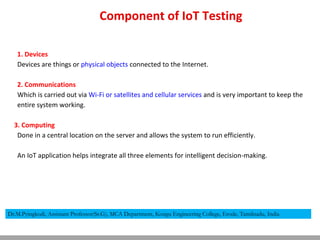
Component of IoT Testing
1. Devices
Devices are things or physical objects connected to the Internet.
2. Communications
Which is carried out via Wi-Fi or satellites and cellular services and is very important to keep the
entire system working.
3. Computing
Done in a central location on the server and allows the system to run efficiently.
An IoT application helps integrate all three elements for intelligent decision-making.
Dr.M.Pyingkodi, Assistant Professor(Sr.G), MCA Department, Kongu Engineering College, Erode, Tamilnadu, India
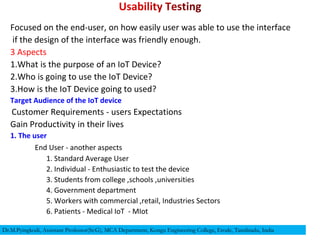
Focused on the end-user, on how easily user was able to use the interface
if the design of the interface was friendly enough.
3 Aspects
1.What is the purpose of an IoT Device?
2.Who is going to use the IoT Device?
3.How is the IoT Device going to used?
Target Audience of the IoT device
Customer Requirements - users Expectations
Gain Productivity in their lives
1. The user
End User - another aspects
1. Standard Average User
2. Individual - Enthusiastic to test the device
3. Students from college ,schools ,universities
4. Government department
5. Workers with commercial ,retail, Industries Sectors
6. Patients - Medical IoT - MIot
Dr.M.Pyingkodi, Assistant Professor(Sr.G), MCA Department, Kongu Engineering College, Erode, Tamilnadu, India
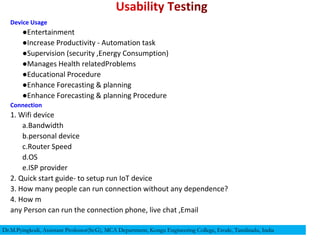
Device Usage
●Entertainment
●Increase Productivity - Automation task
●Supervision (security ,Energy Consumption)
●Manages Health relatedProblems
●Educational Procedure
●Enhance Forecasting & planning
●Enhance Forecasting & planning Procedure
Connection
1. Wifi device
a.Bandwidth
b.personal device
c.Router Speed
d.OS
e.ISP provider
2. Quick start guide- to setup run IoT device
3. How many people can run connection without any dependence?
4. How m
any Person can run the connection phone, live chat ,Email
Dr.M.Pyingkodi, Assistant Professor(Sr.G), MCA Department, Kongu Engineering College, Erode, Tamilnadu, India
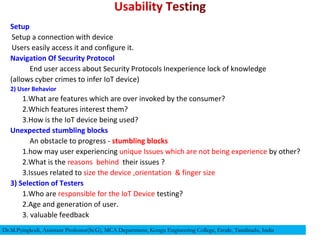
Setup
Setup a connection with device
Users easily access it and configure it.
Navigation Of Security Protocol
End user access about Security Protocols Inexperience lock of knowledge
(allows cyber crimes to infer IoT device)
2) User Behavior
1.What are features which are over invoked by the consumer?
2.Which features interest them?
3.How is the IoT device being used?
Unexpected stumbling blocks
An obstacle to progress - stumbling blocks
1.how may user experiencing unique Issues which are not being experience by other?
2.What is the reasons behind their issues ?
3.Issues related to size the device ,orientation & finger size
3) Selection of Testers
1.Who are responsible for the IoT Device testing?
2.Age and generation of user.
3. valuable feedback
Dr.M.Pyingkodi, Assistant Professor(Sr.G), MCA Department, Kongu Engineering College, Erode, Tamilnadu, India
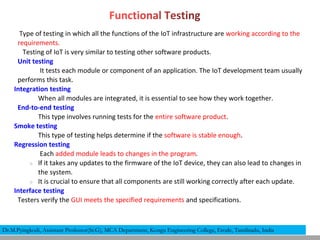
Type of testing in which all the functions of the IoT infrastructure are working according to the
requirements.
Testing of IoT is very similar to testing other software products.
Unit testing
It tests each module or component of an application. The IoT development team usually
performs this task.
Integration testing
When all modules are integrated, it is essential to see how they work together.
End-to-end testing
This type involves running tests for the entire software product.
Smoke testing
This type of testing helps determine if the software is stable enough.
Regression testing
Each added module leads to changes in the program.
○ If it takes any updates to the firmware of the IoT device, they can also lead to changes in
the system.
○ It is crucial to ensure that all components are still working correctly after each update.
Interface testing
Testers verify the GUI meets the specified requirements and specifications.
Dr.M.Pyingkodi, Assistant Professor(Sr.G), MCA Department, Kongu Engineering College, Erode, Tamilnadu, India
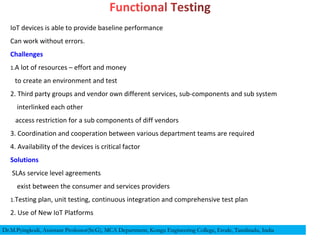
IoT devices is able to provide baseline performance
Can work without errors.
Challenges
1.A lot of resources – effort and money
to create an environment and test
2. Third party groups and vendor own different services, sub-components and sub system
interlinked each other
access restriction for a sub components of diff vendors
3. Coordination and cooperation between various department teams are required
4. Availability of the devices is critical factor
Solutions
SLAs service level agreements
exist between the consumer and services providers
1.Testing plan, unit testing, continuous integration and comprehensive test plan
2. Use of New IoT Platforms
Dr.M.Pyingkodi, Assistant Professor(Sr.G), MCA Department, Kongu Engineering College, Erode, Tamilnadu, India
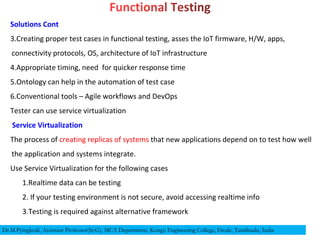
Solutions Cont
3.Creating proper test cases in functional testing, asses the IoT firmware, H/W, apps,
connectivity protocols, OS, architecture of IoT infrastructure
4.Appropriate timing, need for quicker response time
5.Ontology can help in the automation of test case
6.Conventional tools – Agile workflows and DevOps
Tester can use service virtualization
Service Virtualization
The process of creating replicas of systems that new applications depend on to test how well
the application and systems integrate.
Use Service Virtualization for the following cases
1.Realtime data can be testing
2. If your testing environment is not secure, avoid accessing realtime info
3.Testing is required against alternative framework
Dr.M.Pyingkodi, Assistant Professor(Sr.G), MCA Department, Kongu Engineering College, Erode, Tamilnadu, India
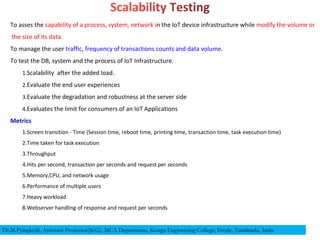
To asses the capability of a process, system, network in the IoT device infrastructure while modify the volume or
the size of its data.
To manage the user traffic, frequency of transactions counts and data volume.
To test the DB, system and the process of IoT Infrastructure.
1.Scalability after the added load.
2.Evaluate the end user experiences
3.Evaluate the degradation and robustness at the server side
4.Evaluates the limit for consumers of an IoT Applications
Metrics
1.Screen transition - Time (Session time, reboot time, printing time, transaction time, task execution time)
2.Time taken for task execution
3.Throughput
4.Hits per second, transaction per seconds and request per seconds
5.Memory,CPU, and network usage
6.Performance of multiple users
7.Heavy workload
8.Webserver handling of response and request per seconds
Dr.M.Pyingkodi, Assistant Professor(Sr.G), MCA Department, Kongu Engineering College, Erode, Tamilnadu, India
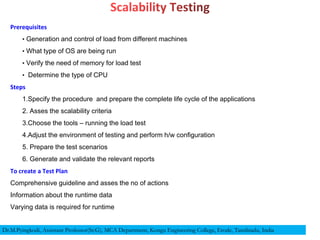
Prerequisites
• Generation and control of load from different machines
• What type of OS are being run
• Verify the need of memory for load test
• Determine the type of CPU
Steps
1.Specify the procedure and prepare the complete life cycle of the applications
2. Asses the scalability criteria
3.Choose the tools – running the load test
4.Adjust the environment of testing and perform h/w configuration
5. Prepare the test scenarios
6. Generate and validate the relevant reports
To create a Test Plan
Comprehensive guideline and asses the no of actions
Information about the runtime data
Varying data is required for runtime
Dr.M.Pyingkodi, Assistant Professor(Sr.G), MCA Department, Kongu Engineering College, Erode, Tamilnadu, India
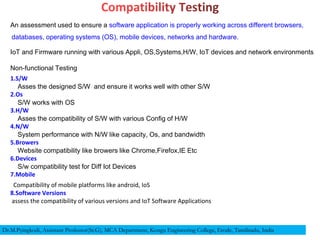
An assessment used to ensure a software application is properly working across different browsers,
databases, operating systems (OS), mobile devices, networks and hardware.
IoT and Firmware running with various Appli, OS,Systems,H/W, IoT devices and network environments
Non-functional Testing
1.S/W
Asses the designed S/W and ensure it works well with other S/W
2.Os
S/W works with OS
3.H/W
Asses the compatibility of S/W with various Config of H/W
4.N/W
System performance with N/W like capacity, Os, and bandwidth
5.Browers
Website compatibility like browers like Chrome,Firefox,IE Etc
6.Devices
S/w compatibility test for Diff Iot Devices
7.Mobile
Compatibility of mobile platforms like android, IoS
8.Software Versions
assess the compatibility of various versions and IoT Software Applications
Dr.M.Pyingkodi, Assistant Professor(Sr.G), MCA Department, Kongu Engineering College, Erode, Tamilnadu, India
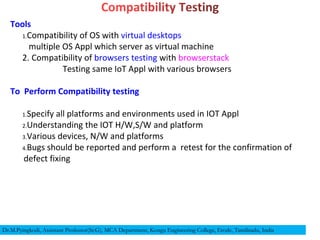
Tools
1.Compatibility of OS with virtual desktops
multiple OS Appl which server as virtual machine
2. Compatibility of browsers testing with browserstack
Testing same IoT Appl with various browsers
To Perform Compatibility testing
1.Specify all platforms and environments used in IOT Appl
2.Understanding the IOT H/W,S/W and platform
3.Various devices, N/W and platforms
4.Bugs should be reported and perform a retest for the confirmation of
defect fixing
Dr.M.Pyingkodi, Assistant Professor(Sr.G), MCA Department, Kongu Engineering College, Erode, Tamilnadu, India
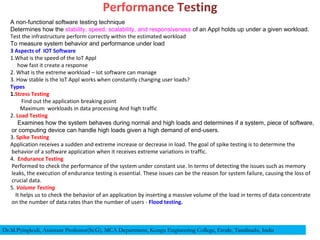
A non-functional software testing technique
Determines how the stability, speed, scalability, and responsiveness of an Appl holds up under a given workload.
Test the infrastructure perform correctly within the estimated workload
To measure system behavior and performance under load
3 Aspects of IOT Software
1.What is the speed of the IoT Appl
how fast it create a response
2. What is the extreme workload – Iot software can manage
3. How stable is the IoT Appl works when constantly changing user loads?
Types
1.Stress Testing
Find out the application breaking point
Maximum workloads in data processing And high traffic
2. Load Testing
Examines how the system behaves during normal and high loads and determines if a system, piece of software,
or computing device can handle high loads given a high demand of end-users.
3. Spike Testing
Application receives a sudden and extreme increase or decrease in load. The goal of spike testing is to determine the
behavior of a software application when it receives extreme variations in traffic.
4. Endurance Testing
Performed to check the performance of the system under constant use. In terms of detecting the issues such as memory
leaks, the execution of endurance testing is essential. These issues can be the reason for system failure, causing the loss of
crucial data.
5. Volume Testing
It helps us to check the behavior of an application by inserting a massive volume of the load in terms of data concentrate
on the number of data rates than the number of users - Flood testing.
Dr.M.Pyingkodi, Assistant Professor(Sr.G), MCA Department, Kongu Engineering College, Erode, Tamilnadu, India
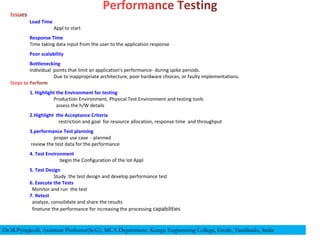
Load Time
Appl to start
Response Time
Time taking data input from the user to the application response
Poor scalability
Bottlenecking
Individual points that limit an application's performance- during spike periods.
Due to inappropriate architecture, poor hardware choices, or faulty implementations.
1. Highlight the Environment for testing
Production Environment, Physical Test Environment and testing tools
assess the h/W details
2.Highlight the Acceptance Criteria
restriction and goal for resource allocation, response time and throughput
3.performance Test planning
proper use case - planned
review the test data for the performance
4. Test Environment
begin the Configuration of the Iot Appl
5. Test Design
Study the test design and develop performance test
6. Execute the Tests
Monitor and run the test
7. Retest
analyze, consolidate and share the results
finetune the performance for increasing the processing capabilities
Dr.M.Pyingkodi, Assistant Professor(Sr.G), MCA Department, Kongu Engineering College, Erode, Tamilnadu, India

IoT_Testing.ppt

  • 1.
    Internet of Things:Types of Testing Dr.M.Pyingkodi Dept of MCA Kongu Engineering College Erode,Tamilnadu,India
  • 2.
    Component of IoTTesting 1. Devices Devices are things or physical objects connected to the Internet. 2. Communications Which is carried out via Wi-Fi or satellites and cellular services and is very important to keep the entire system working. 3. Computing Done in a central location on the server and allows the system to run efficiently. An IoT application helps integrate all three elements for intelligent decision-making. Dr.M.Pyingkodi, Assistant Professor(Sr.G), MCA Department, Kongu Engineering College, Erode, Tamilnadu, India
  • 3.
    Focused on theend-user, on how easily user was able to use the interface if the design of the interface was friendly enough. 3 Aspects 1.What is the purpose of an IoT Device? 2.Who is going to use the IoT Device? 3.How is the IoT Device going to used? Target Audience of the IoT device Customer Requirements - users Expectations Gain Productivity in their lives 1. The user End User - another aspects 1. Standard Average User 2. Individual - Enthusiastic to test the device 3. Students from college ,schools ,universities 4. Government department 5. Workers with commercial ,retail, Industries Sectors 6. Patients - Medical IoT - MIot Dr.M.Pyingkodi, Assistant Professor(Sr.G), MCA Department, Kongu Engineering College, Erode, Tamilnadu, India
  • 4.
    Device Usage ●Entertainment ●Increase Productivity- Automation task ●Supervision (security ,Energy Consumption) ●Manages Health relatedProblems ●Educational Procedure ●Enhance Forecasting & planning ●Enhance Forecasting & planning Procedure Connection 1. Wifi device a.Bandwidth b.personal device c.Router Speed d.OS e.ISP provider 2. Quick start guide- to setup run IoT device 3. How many people can run connection without any dependence? 4. How m any Person can run the connection phone, live chat ,Email Dr.M.Pyingkodi, Assistant Professor(Sr.G), MCA Department, Kongu Engineering College, Erode, Tamilnadu, India
  • 5.
    Setup Setup a connectionwith device Users easily access it and configure it. Navigation Of Security Protocol End user access about Security Protocols Inexperience lock of knowledge (allows cyber crimes to infer IoT device) 2) User Behavior 1.What are features which are over invoked by the consumer? 2.Which features interest them? 3.How is the IoT device being used? Unexpected stumbling blocks An obstacle to progress - stumbling blocks 1.how may user experiencing unique Issues which are not being experience by other? 2.What is the reasons behind their issues ? 3.Issues related to size the device ,orientation & finger size 3) Selection of Testers 1.Who are responsible for the IoT Device testing? 2.Age and generation of user. 3. valuable feedback Dr.M.Pyingkodi, Assistant Professor(Sr.G), MCA Department, Kongu Engineering College, Erode, Tamilnadu, India
  • 6.
    Type of testingin which all the functions of the IoT infrastructure are working according to the requirements. Testing of IoT is very similar to testing other software products. Unit testing It tests each module or component of an application. The IoT development team usually performs this task. Integration testing When all modules are integrated, it is essential to see how they work together. End-to-end testing This type involves running tests for the entire software product. Smoke testing This type of testing helps determine if the software is stable enough. Regression testing Each added module leads to changes in the program. ○ If it takes any updates to the firmware of the IoT device, they can also lead to changes in the system. ○ It is crucial to ensure that all components are still working correctly after each update. Interface testing Testers verify the GUI meets the specified requirements and specifications. Dr.M.Pyingkodi, Assistant Professor(Sr.G), MCA Department, Kongu Engineering College, Erode, Tamilnadu, India
  • 7.
    IoT devices isable to provide baseline performance Can work without errors. Challenges 1.A lot of resources – effort and money to create an environment and test 2. Third party groups and vendor own different services, sub-components and sub system interlinked each other access restriction for a sub components of diff vendors 3. Coordination and cooperation between various department teams are required 4. Availability of the devices is critical factor Solutions SLAs service level agreements exist between the consumer and services providers 1.Testing plan, unit testing, continuous integration and comprehensive test plan 2. Use of New IoT Platforms Dr.M.Pyingkodi, Assistant Professor(Sr.G), MCA Department, Kongu Engineering College, Erode, Tamilnadu, India
  • 8.
    Solutions Cont 3.Creating propertest cases in functional testing, asses the IoT firmware, H/W, apps, connectivity protocols, OS, architecture of IoT infrastructure 4.Appropriate timing, need for quicker response time 5.Ontology can help in the automation of test case 6.Conventional tools – Agile workflows and DevOps Tester can use service virtualization Service Virtualization The process of creating replicas of systems that new applications depend on to test how well the application and systems integrate. Use Service Virtualization for the following cases 1.Realtime data can be testing 2. If your testing environment is not secure, avoid accessing realtime info 3.Testing is required against alternative framework Dr.M.Pyingkodi, Assistant Professor(Sr.G), MCA Department, Kongu Engineering College, Erode, Tamilnadu, India
  • 9.
    To asses thecapability of a process, system, network in the IoT device infrastructure while modify the volume or the size of its data. To manage the user traffic, frequency of transactions counts and data volume. To test the DB, system and the process of IoT Infrastructure. 1.Scalability after the added load. 2.Evaluate the end user experiences 3.Evaluate the degradation and robustness at the server side 4.Evaluates the limit for consumers of an IoT Applications Metrics 1.Screen transition - Time (Session time, reboot time, printing time, transaction time, task execution time) 2.Time taken for task execution 3.Throughput 4.Hits per second, transaction per seconds and request per seconds 5.Memory,CPU, and network usage 6.Performance of multiple users 7.Heavy workload 8.Webserver handling of response and request per seconds Dr.M.Pyingkodi, Assistant Professor(Sr.G), MCA Department, Kongu Engineering College, Erode, Tamilnadu, India
  • 10.
    Prerequisites • Generation andcontrol of load from different machines • What type of OS are being run • Verify the need of memory for load test • Determine the type of CPU Steps 1.Specify the procedure and prepare the complete life cycle of the applications 2. Asses the scalability criteria 3.Choose the tools – running the load test 4.Adjust the environment of testing and perform h/w configuration 5. Prepare the test scenarios 6. Generate and validate the relevant reports To create a Test Plan Comprehensive guideline and asses the no of actions Information about the runtime data Varying data is required for runtime Dr.M.Pyingkodi, Assistant Professor(Sr.G), MCA Department, Kongu Engineering College, Erode, Tamilnadu, India
  • 11.
    An assessment usedto ensure a software application is properly working across different browsers, databases, operating systems (OS), mobile devices, networks and hardware. IoT and Firmware running with various Appli, OS,Systems,H/W, IoT devices and network environments Non-functional Testing 1.S/W Asses the designed S/W and ensure it works well with other S/W 2.Os S/W works with OS 3.H/W Asses the compatibility of S/W with various Config of H/W 4.N/W System performance with N/W like capacity, Os, and bandwidth 5.Browers Website compatibility like browers like Chrome,Firefox,IE Etc 6.Devices S/w compatibility test for Diff Iot Devices 7.Mobile Compatibility of mobile platforms like android, IoS 8.Software Versions assess the compatibility of various versions and IoT Software Applications Dr.M.Pyingkodi, Assistant Professor(Sr.G), MCA Department, Kongu Engineering College, Erode, Tamilnadu, India
  • 12.
    Tools 1.Compatibility of OSwith virtual desktops multiple OS Appl which server as virtual machine 2. Compatibility of browsers testing with browserstack Testing same IoT Appl with various browsers To Perform Compatibility testing 1.Specify all platforms and environments used in IOT Appl 2.Understanding the IOT H/W,S/W and platform 3.Various devices, N/W and platforms 4.Bugs should be reported and perform a retest for the confirmation of defect fixing Dr.M.Pyingkodi, Assistant Professor(Sr.G), MCA Department, Kongu Engineering College, Erode, Tamilnadu, India
  • 13.
    A non-functional softwaretesting technique Determines how the stability, speed, scalability, and responsiveness of an Appl holds up under a given workload. Test the infrastructure perform correctly within the estimated workload To measure system behavior and performance under load 3 Aspects of IOT Software 1.What is the speed of the IoT Appl how fast it create a response 2. What is the extreme workload – Iot software can manage 3. How stable is the IoT Appl works when constantly changing user loads? Types 1.Stress Testing Find out the application breaking point Maximum workloads in data processing And high traffic 2. Load Testing Examines how the system behaves during normal and high loads and determines if a system, piece of software, or computing device can handle high loads given a high demand of end-users. 3. Spike Testing Application receives a sudden and extreme increase or decrease in load. The goal of spike testing is to determine the behavior of a software application when it receives extreme variations in traffic. 4. Endurance Testing Performed to check the performance of the system under constant use. In terms of detecting the issues such as memory leaks, the execution of endurance testing is essential. These issues can be the reason for system failure, causing the loss of crucial data. 5. Volume Testing It helps us to check the behavior of an application by inserting a massive volume of the load in terms of data concentrate on the number of data rates than the number of users - Flood testing. Dr.M.Pyingkodi, Assistant Professor(Sr.G), MCA Department, Kongu Engineering College, Erode, Tamilnadu, India
  • 14.
    Load Time Appl tostart Response Time Time taking data input from the user to the application response Poor scalability Bottlenecking Individual points that limit an application's performance- during spike periods. Due to inappropriate architecture, poor hardware choices, or faulty implementations. 1. Highlight the Environment for testing Production Environment, Physical Test Environment and testing tools assess the h/W details 2.Highlight the Acceptance Criteria restriction and goal for resource allocation, response time and throughput 3.performance Test planning proper use case - planned review the test data for the performance 4. Test Environment begin the Configuration of the Iot Appl 5. Test Design Study the test design and develop performance test 6. Execute the Tests Monitor and run the test 7. Retest analyze, consolidate and share the results finetune the performance for increasing the processing capabilities Dr.M.Pyingkodi, Assistant Professor(Sr.G), MCA Department, Kongu Engineering College, Erode, Tamilnadu, India