Cloud Computing - Unit - I
Dr.M.Pyingkodi
Dept of Computer Applications
Kongu Engineering College
Erode, India
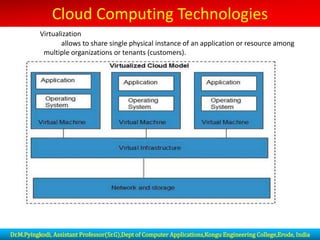
Virtualization
allows to share single physical instance of an application or resource among
multiple organizations or tenants (customers).
Cloud Computing Technologies
Dr.M.Pyingkodi, Assistant Professor(Sr.G),Dept of Computer Applications,Kongu Engineering College,Erode, India
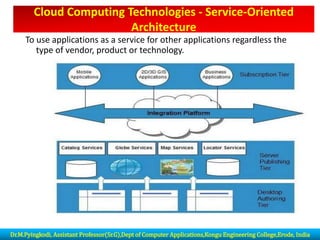
To use applications as a service for other applications regardless the
type of vendor, product or technology.
Cloud Computing Technologies - Service-Oriented
Architecture
Dr.M.Pyingkodi, Assistant Professor(Sr.G),Dept of Computer Applications,Kongu Engineering College,Erode, India
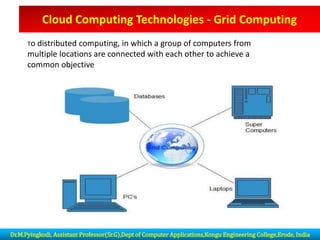
To distributed computing, in which a group of computers from
multiple locations are connected with each other to achieve a
common objective
Cloud Computing Technologies - Grid Computing
Dr.M.Pyingkodi, Assistant Professor(Sr.G),Dept of Computer Applications,Kongu Engineering College,Erode, India
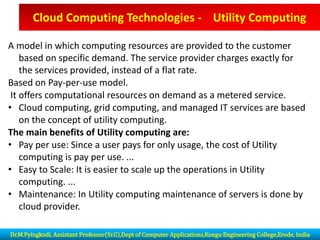
A model in which computing resources are provided to the customer
based on specific demand. The service provider charges exactly for
the services provided, instead of a flat rate.
Based on Pay-per-use model.
It offers computational resources on demand as a metered service.
• Cloud computing, grid computing, and managed IT services are based
on the concept of utility computing.
The main benefits of Utility computing are:
• Pay per use: Since a user pays for only usage, the cost of Utility
computing is pay per use. ...
• Easy to Scale: It is easier to scale up the operations in Utility
computing. ...
• Maintenance: In Utility computing maintenance of servers is done by
cloud provider.
Cloud Computing Technologies - Utility Computing
Dr.M.Pyingkodi, Assistant Professor(Sr.G),Dept of Computer Applications,Kongu Engineering College,Erode, India
Types of Cloud Services
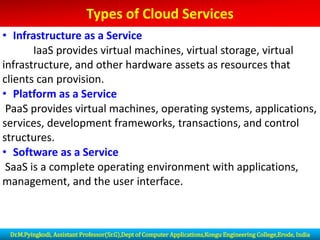
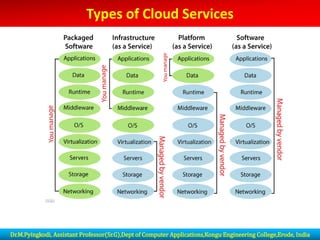
• Infrastructure as a Service
IaaS provides virtual machines, virtual storage, virtual
infrastructure, and other hardware assets as resources that
clients can provision.
• Platform as a Service
PaaS provides virtual machines, operating systems, applications,
services, development frameworks, transactions, and control
structures.
• Software as a Service
SaaS is a complete operating environment with applications,
management, and the user interface.
Dr.M.Pyingkodi, Assistant Professor(Sr.G),Dept of Computer Applications,Kongu Engineering College,Erode, India
Types of Cloud Services
Dr.M.Pyingkodi, Assistant Professor(Sr.G),Dept of Computer Applications,Kongu Engineering College,Erode, India
Essential Concepts
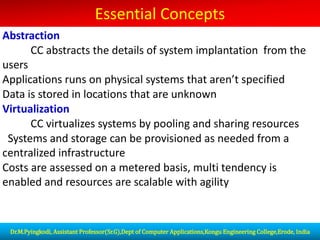
Abstraction
CC abstracts the details of system implantation from the
users
Applications runs on physical systems that aren’t specified
Data is stored in locations that are unknown
Virtualization
CC virtualizes systems by pooling and sharing resources
Systems and storage can be provisioned as needed from a
centralized infrastructure
Costs are assessed on a metered basis, multi tendency is
enabled and resources are scalable with agility
Dr.M.Pyingkodi, Assistant Professor(Sr.G),Dept of Computer Applications,Kongu Engineering College,Erode, India
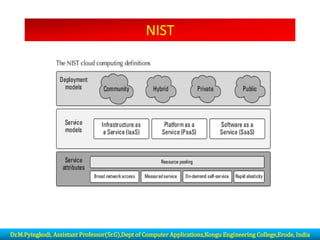
NIST
Dr.M.Pyingkodi, Assistant Professor(Sr.G),Dept of Computer Applications,Kongu Engineering College,Erode, India
Cloud Types
Deployment Models
To the Location and management of the cloud’s
infrastructure
Public
Private
Hybrid
Community
Services Models
IaaS (infrastructure as a Services)
Paas ( Platform as a Services)
Saas (Software as a Services)
Dr.M.Pyingkodi, Assistant Professor(Sr.G),Dept of Computer Applications,Kongu Engineering College,Erode, India
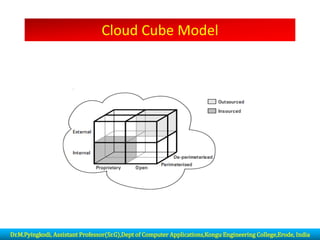
Cloud Cube Model
Dr.M.Pyingkodi, Assistant Professor(Sr.G),Dept of Computer Applications,Kongu Engineering College,Erode, India
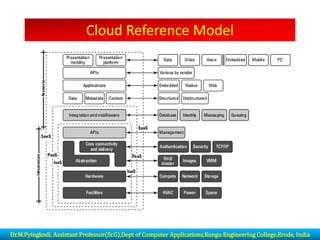
Cloud Reference Model
Dr.M.Pyingkodi, Assistant Professor(Sr.G),Dept of Computer Applications,Kongu Engineering College,Erode, India
IaaS Service Provider
❖Amazon Elastic Compute Cloud(EC2)
❖Eucalyptus
❖GoGrid
❖FlexiScale
❖RackSpace Cloud
❖Linode
❖Terremark
All these vendors offer direct access to hardware
resources
A client would provision a computer in the form of a
virtual machine image, provision storage, and then go
on to install the operating system and applications
onto that virtual system.
Dr.M.Pyingkodi, Assistant Professor(Sr.G),Dept of Computer Applications,Kongu Engineering College,Erode, India
PaaS
• A PaaS service adds integration features,
middleware, and other orchestration and
choreography services to the IaaS model.
Examples of PaaS services are
❖Force.com
❖GoGrid CloudCenter
❖Google AppEngine
❖Windows Azure Platform
Dr.M.Pyingkodi, Assistant Professor(Sr.G),Dept of Computer Applications,Kongu Engineering College,Erode, India
SaaS
• When a cloud computing vendor offers software
running in the cloud with use of the application on a
pay-as-you-go model, it is referred to as SaaS.
• With SaaS, the customer uses the application as
needed and is not responsible for the installation of
the application, its maintenance, or its upkeep.
• A good example of an SaaS offering is an online
accounting package
❖GoogleApps
❖Oracle On Demand
❖SalesForce.com
❖SQL Azure
Dr.M.Pyingkodi, Assistant Professor(Sr.G),Dept of Computer Applications,Kongu Engineering College,Erode, India
Top five cloud applications
• Collaboration applications
• Web applications/Web serving
• Cloud backup
• Business applications
• Personal productivity applications
Dr.M.Pyingkodi, Assistant Professor(Sr.G),Dept of Computer Applications,Kongu Engineering College,Erode, India
Benefits of Cloud
• On-demand self-service:
A client can provision computer resources without the need for
interaction with cloud service provider personnel.
• Broad network access:
Access to resources in the cloud is available over the network using
standard methods in a manner that provides platform-independent
access to clients of all types.
This includes a mixture of heterogeneous operating systems, and thick
and thin platforms such as laptops, mobile phones, and PDA.
• Resource pooling:
A cloud service provider creates resources that are pooled together in a
system that supports multi-tenant usage
Dr.M.Pyingkodi, Assistant Professor(Sr.G),Dept of Computer Applications,Kongu Engineering College,Erode, India
Benefits of Cloud
• Rapid elasticity
Resources can be rapidly and elastically provisioned.
The system can add resources by either scaling up
systems (more powerful computers) or scaling out
systems (more computers of the same kind), and
scaling may be automatic or manual.
• Measured service:
The use of cloud system resources is measured,
audited, and reported to the customer based on a
metered system.
Dr.M.Pyingkodi, Assistant Professor(Sr.G),Dept of Computer Applications,Kongu Engineering College,Erode, India
Benefits of Cloud
• Lower costs:
Because cloud networks operate at higher efficiencies and with
greater utilization, significant cost reductions are often encountered.
• Ease of utilization:
Depending upon the type of service being offered, you may find that
you do not require hardware or software licenses to implement your
service.
• Quality of Service:
The Quality of Service (QoS) is something that you can obtain under
contract from your vendor.
• Reliability
The scale of cloud computing networks and their ability to provide
load balancing and failover makes them highly reliable, often much
more reliable than what you can achieve in a single organization.
Dr.M.Pyingkodi, Assistant Professor(Sr.G),Dept of Computer Applications,Kongu Engineering College,Erode, India
• Outsourced IT management
A cloud computing deployment lets someone else
manage
your computing infrastructure while you manage your
business.
• Simplified maintenance and upgrade:
Because the system is centralized, you can easily apply
patches and upgrades. This means your users always have
access to the latest software versions.
• Low Barrier to Entry:
In particular, upfront capital expenditures are dramatically
reduced. In cloud computing, anyone can be a giant at any
time.
Dr.M.Pyingkodi, Assistant Professor(Sr.G),Dept of Computer Applications,Kongu Engineering College,Erode, India
Disadvantages of Cloud
• if your application needs large amounts of data transfer, cloud
computing may not be the best model for you.
• cloud computing is a stateless system, That lack of state allows
messages to travel over different routes and for data to arrive out of
sequence
• additional overhead in the form of service brokers, transaction
managers, and other middleware must be added to the system
• When your data travels over and rests on systems that are no longer
underyour control, you have increased risk due to the interception and
malfeasance of others.
• You can’t count on a cloud provider maintaining your privacy in the
face of government actions.
Dr.M.Pyingkodi, Assistant Professor(Sr.G),Dept of Computer Applications,Kongu Engineering College,Erode, India
Virtual Appliances
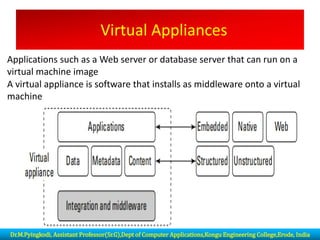
Applications such as a Web server or database server that can run on a
virtual machine image
A virtual appliance is software that installs as middleware onto a virtual
machine
Dr.M.Pyingkodi, Assistant Professor(Sr.G),Dept of Computer Applications,Kongu Engineering College,Erode, India
Virtual Appliances
• Virtual appliances are software installed on virtual
servers—application modules that are meant to run a
particular machine instance or image type.
• A virtual appliance is a platform instance.
• user can run across virtual appliances in IaaS systems
such as Amazon’s Elastic Compute Cloud (EC2)
Amazon Machine Images are a collection of virtual
appliances that you can install on their Xen hypervisor
servers
• Bagvapp
(http://bagside.com/bagvapp/) offers virtual appliances,
including ones based on Windows, all of which run on
VMware Player.
Dr.M.Pyingkodi, Assistant Professor(Sr.G),Dept of Computer Applications,Kongu Engineering College,Erode, India
Virtual Appliances
HelpdeskLive
(http://helpdesklive.info/download/VirtualBox%20
VDI%20free%20images.html) offers various Linux distributions
upon which you can build a virtual machine.
Jcinacio
(http://www.jcinacio.com/) has Ubuntu appliances
VirtualBox
(http://www.virtualbox.org/) is a virtual machine technology
now owned by Oracle that can run various operating systems
and serves as a host for a variety of virtual appliances.
Vmachines
(http://www.vmachines.net/) is a site with desktop, server,
and security_x0002_related operating systems that run on
VMware.
Dr.M.Pyingkodi, Assistant Professor(Sr.G),Dept of Computer Applications,Kongu Engineering College,Erode, India
Open Virtualization Format
• Converting a virtual appliance from one platform to another
file formats is the Open Virtualization Format (OVF), the work
of the Distributed Management Task Force (DMTF) group.
• Nearly all major virtualization platform vendors support
OVF, notably VMware, Microsoft, Oracle, and Citrix.
• open-source standard for packaging and distributing
software applications for virtual machines (VM).
• An OVF package contains multiple files in a single directory.
The directory always contains an Extensible Markup Language
(XML) file called the OVF descriptor with the name, hardware
requirements, and references to other files in the package.
Dr.M.Pyingkodi, Assistant Professor(Sr.G),Dept of Computer Applications,Kongu Engineering College,Erode, India
Communication Protocols
• HTTP and HTTPS transfer protocols.
• interprocess communication (IPC)
• DCOM, Java RMI, and CORBA attempt to solve the
problem of engaging services and managing transactions over
what is essentially a stateless network.
• Web-centric RPC technologies was XML-RPC, which uses
platform_x0002_independent XML data to encode program
calls that are transported over HTTP, the networking transport
to which nearly everyone is connected.
• message-passing standard at the moment is the Simple Object
Access Protocol (SOAP)
• In WSDL, a service is a container that per_x0002_forms a set
of functions that are exposed to Web protocols. Taken
together, the protocol and port are a binding to which
messages are passed and operations are performed.
Dr.M.Pyingkodi, Assistant Professor(Sr.G),Dept of Computer Applications,Kongu Engineering College,Erode, India
WS-* specifications
A number of WS-* extensions are in common use
• WS-Addressing
• WS-Discovery
• WS-Eventing
• WS-Federation
• WS-MakeConnection
• WS-Messaging
• WS-MetadataExchange
• WS-Notification
• WS-Policy
• WS-ResourceFramework
• WS-Security
• WS-Transfer
• WS-Trust
Dr.M.Pyingkodi, Assistant Professor(Sr.G),Dept of Computer Applications,Kongu Engineering College,Erode, India
REST
REST stands for REpresentational State Transfer.
REST is web standards based architecture and uses HTTP
Protocol.
It revolves around resource where every component is a
resource and a resource is accessed by a common interface
using HTTP standard methods.
It specifies constraints, such as the uniform interface, that if
applied to a web service induce desirable properties, such as
performance,
scalability, and
modifiability,
that enable services to work best on the Web.
Dr.M.Pyingkodi, Assistant Professor(Sr.G),Dept of Computer Applications,Kongu Engineering College,Erode, India
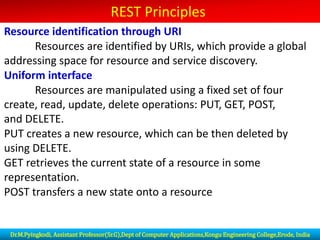
REST Principles
Resource identification through URI
Resources are identified by URIs, which provide a global
addressing space for resource and service discovery.
Uniform interface
Resources are manipulated using a fixed set of four
create, read, update, delete operations: PUT, GET, POST,
and DELETE.
PUT creates a new resource, which can be then deleted by
using DELETE.
GET retrieves the current state of a resource in some
representation.
POST transfers a new state onto a resource
Dr.M.Pyingkodi, Assistant Professor(Sr.G),Dept of Computer Applications,Kongu Engineering College,Erode, India
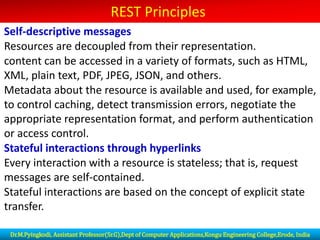
REST Principles
Self-descriptive messages
Resources are decoupled from their representation.
content can be accessed in a variety of formats, such as HTML,
XML, plain text, PDF, JPEG, JSON, and others.
Metadata about the resource is available and used, for example,
to control caching, detect transmission errors, negotiate the
appropriate representation format, and perform authentication
or access control.
Stateful interactions through hyperlinks
Every interaction with a resource is stateless; that is, request
messages are self-contained.
Stateful interactions are based on the concept of explicit state
transfer.
Dr.M.Pyingkodi, Assistant Professor(Sr.G),Dept of Computer Applications,Kongu Engineering College,Erode, India
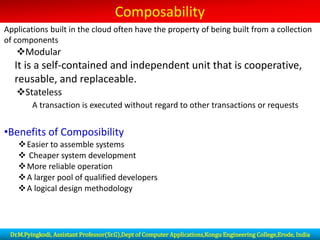
Composability
Applications built in the cloud often have the property of being built from a collection
of components
❖Modular
It is a self-contained and independent unit that is cooperative,
reusable, and replaceable.
❖Stateless
A transaction is executed without regard to other transactions or requests
•Benefits of Composibility
❖Easier to assemble systems
❖ Cheaper system development
❖More reliable operation
❖A larger pool of qualified developers
❖A logical design methodology
Dr.M.Pyingkodi, Assistant Professor(Sr.G),Dept of Computer Applications,Kongu Engineering College,Erode, India
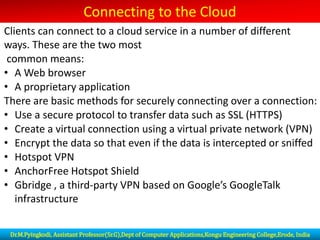
Connecting to the Cloud
Clients can connect to a cloud service in a number of different
ways. These are the two most
common means:
• A Web browser
• A proprietary application
There are basic methods for securely connecting over a connection:
• Use a secure protocol to transfer data such as SSL (HTTPS)
• Create a virtual connection using a virtual private network (VPN)
• Encrypt the data so that even if the data is intercepted or sniffed
• Hotspot VPN
• AnchorFree Hotspot Shield
• Gbridge , a third-party VPN based on Google’s GoogleTalk
infrastructure
Dr.M.Pyingkodi, Assistant Professor(Sr.G),Dept of Computer Applications,Kongu Engineering College,Erode, India
Cloud Applications services
Gbridge
Gbridge provides a means for securely connecting one computer to another
using Gtalk.
The Jolicloud Netbook OS
Jolicloud concentrates on building a social platform with automatic software
updates and installs.
The application launcher is built in HTML 5 and comes preinstalled with
Gmail, Skype, Twitter,Firefox, and other applications.
Any HTML 5 browser can be used to work with the Jolicloud interface.
Jolicloud maintains a library or App Directory of over 700 applications as
part of an app
store.
When you click to select an application, the company both installs and
updates the applica_x0002_tion going forward, just as the iPhone manages
applications on that device
Dr.M.Pyingkodi, Assistant Professor(Sr.G),Dept of Computer Applications,Kongu Engineering College,Erode, India
Chromium OS
•The Browser as an Operating System
•The Google Chrome OS is a Linux open-source operating system
designed to be a robust cloud client.
•The Chrome OS has been described as a hardened operating
system because it incorporates a sand_x0002_box architecture for
running applications and also performs automatic updates.
•Also included in the system is a version of remote desktop
connection software that creates an encrypted connection like
Microsoft’s RDP, Citrix’s ICA, or a VNC client.
•The Chrome OS hardware specification includes a Trusted Platform
Module, which provides for a “trusted bootpath” along with a
hard_x0002_ware switch that can be used to boot the system into a
developer model.
•In that mode, some of the security features are turned off,
allowing the user to reset the system.
Dr.M.Pyingkodi, Assistant Professor(Sr.G),Dept of Computer Applications,Kongu Engineering College,Erode, India
Milestones of Cloud
❖Mainframe Computing
❖Cluster Computing
❖Grid Computing
❖Cloud Computing
Dr.M.Pyingkodi, Assistant Professor(Sr.G),Dept of Computer Applications,Kongu Engineering College,Erode, India
Vision of Cloud Computing
• To grow my infrastructure, but don’t know for how long
• Cann’t invest infra myself
• Want to focus on appl logic, not maintenance & scalability
issues
• Access & edit my doc & photos from everywhere
• Have lot of infra, I want to rent
• Have infra & middleware & I can host appl
• Have infra to provide appl services
Dr.M.Pyingkodi, Assistant Professor(Sr.G),Dept of Computer Applications,Kongu Engineering College,Erode, India
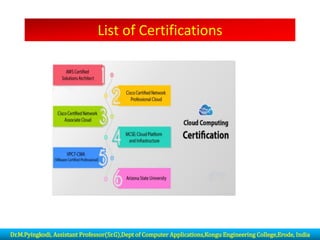
List of Certifications
Dr.M.Pyingkodi, Assistant Professor(Sr.G),Dept of Computer Applications,Kongu Engineering College,Erode, India

Cloud Computing Introduction

  • 1.
    Cloud Computing -Unit - I Dr.M.Pyingkodi Dept of Computer Applications Kongu Engineering College Erode, India
  • 2.
    Virtualization allows to sharesingle physical instance of an application or resource among multiple organizations or tenants (customers). Cloud Computing Technologies Dr.M.Pyingkodi, Assistant Professor(Sr.G),Dept of Computer Applications,Kongu Engineering College,Erode, India
  • 3.
    To use applicationsas a service for other applications regardless the type of vendor, product or technology. Cloud Computing Technologies - Service-Oriented Architecture Dr.M.Pyingkodi, Assistant Professor(Sr.G),Dept of Computer Applications,Kongu Engineering College,Erode, India
  • 4.
    To distributed computing,in which a group of computers from multiple locations are connected with each other to achieve a common objective Cloud Computing Technologies - Grid Computing Dr.M.Pyingkodi, Assistant Professor(Sr.G),Dept of Computer Applications,Kongu Engineering College,Erode, India
  • 5.
    A model inwhich computing resources are provided to the customer based on specific demand. The service provider charges exactly for the services provided, instead of a flat rate. Based on Pay-per-use model. It offers computational resources on demand as a metered service. • Cloud computing, grid computing, and managed IT services are based on the concept of utility computing. The main benefits of Utility computing are: • Pay per use: Since a user pays for only usage, the cost of Utility computing is pay per use. ... • Easy to Scale: It is easier to scale up the operations in Utility computing. ... • Maintenance: In Utility computing maintenance of servers is done by cloud provider. Cloud Computing Technologies - Utility Computing Dr.M.Pyingkodi, Assistant Professor(Sr.G),Dept of Computer Applications,Kongu Engineering College,Erode, India
  • 6.
    Types of CloudServices • Infrastructure as a Service IaaS provides virtual machines, virtual storage, virtual infrastructure, and other hardware assets as resources that clients can provision. • Platform as a Service PaaS provides virtual machines, operating systems, applications, services, development frameworks, transactions, and control structures. • Software as a Service SaaS is a complete operating environment with applications, management, and the user interface. Dr.M.Pyingkodi, Assistant Professor(Sr.G),Dept of Computer Applications,Kongu Engineering College,Erode, India
  • 7.
    Types of CloudServices Types of Cloud Services Dr.M.Pyingkodi, Assistant Professor(Sr.G),Dept of Computer Applications,Kongu Engineering College,Erode, India
  • 8.
    Essential Concepts Abstraction CC abstractsthe details of system implantation from the users Applications runs on physical systems that aren’t specified Data is stored in locations that are unknown Virtualization CC virtualizes systems by pooling and sharing resources Systems and storage can be provisioned as needed from a centralized infrastructure Costs are assessed on a metered basis, multi tendency is enabled and resources are scalable with agility Dr.M.Pyingkodi, Assistant Professor(Sr.G),Dept of Computer Applications,Kongu Engineering College,Erode, India
  • 9.
    NIST Dr.M.Pyingkodi, Assistant Professor(Sr.G),Deptof Computer Applications,Kongu Engineering College,Erode, India
  • 10.
    Cloud Types Deployment Models Tothe Location and management of the cloud’s infrastructure Public Private Hybrid Community Services Models IaaS (infrastructure as a Services) Paas ( Platform as a Services) Saas (Software as a Services) Dr.M.Pyingkodi, Assistant Professor(Sr.G),Dept of Computer Applications,Kongu Engineering College,Erode, India
  • 11.
    Cloud Cube Model Dr.M.Pyingkodi,Assistant Professor(Sr.G),Dept of Computer Applications,Kongu Engineering College,Erode, India
  • 12.
    Cloud Reference Model Dr.M.Pyingkodi,Assistant Professor(Sr.G),Dept of Computer Applications,Kongu Engineering College,Erode, India
  • 13.
    IaaS Service Provider ❖AmazonElastic Compute Cloud(EC2) ❖Eucalyptus ❖GoGrid ❖FlexiScale ❖RackSpace Cloud ❖Linode ❖Terremark All these vendors offer direct access to hardware resources A client would provision a computer in the form of a virtual machine image, provision storage, and then go on to install the operating system and applications onto that virtual system. Dr.M.Pyingkodi, Assistant Professor(Sr.G),Dept of Computer Applications,Kongu Engineering College,Erode, India
  • 14.
    PaaS • A PaaSservice adds integration features, middleware, and other orchestration and choreography services to the IaaS model. Examples of PaaS services are ❖Force.com ❖GoGrid CloudCenter ❖Google AppEngine ❖Windows Azure Platform Dr.M.Pyingkodi, Assistant Professor(Sr.G),Dept of Computer Applications,Kongu Engineering College,Erode, India
  • 15.
    SaaS • When acloud computing vendor offers software running in the cloud with use of the application on a pay-as-you-go model, it is referred to as SaaS. • With SaaS, the customer uses the application as needed and is not responsible for the installation of the application, its maintenance, or its upkeep. • A good example of an SaaS offering is an online accounting package ❖GoogleApps ❖Oracle On Demand ❖SalesForce.com ❖SQL Azure Dr.M.Pyingkodi, Assistant Professor(Sr.G),Dept of Computer Applications,Kongu Engineering College,Erode, India
  • 16.
    Top five cloudapplications • Collaboration applications • Web applications/Web serving • Cloud backup • Business applications • Personal productivity applications Dr.M.Pyingkodi, Assistant Professor(Sr.G),Dept of Computer Applications,Kongu Engineering College,Erode, India
  • 17.
    Benefits of Cloud •On-demand self-service: A client can provision computer resources without the need for interaction with cloud service provider personnel. • Broad network access: Access to resources in the cloud is available over the network using standard methods in a manner that provides platform-independent access to clients of all types. This includes a mixture of heterogeneous operating systems, and thick and thin platforms such as laptops, mobile phones, and PDA. • Resource pooling: A cloud service provider creates resources that are pooled together in a system that supports multi-tenant usage Dr.M.Pyingkodi, Assistant Professor(Sr.G),Dept of Computer Applications,Kongu Engineering College,Erode, India
  • 18.
    Benefits of Cloud •Rapid elasticity Resources can be rapidly and elastically provisioned. The system can add resources by either scaling up systems (more powerful computers) or scaling out systems (more computers of the same kind), and scaling may be automatic or manual. • Measured service: The use of cloud system resources is measured, audited, and reported to the customer based on a metered system. Dr.M.Pyingkodi, Assistant Professor(Sr.G),Dept of Computer Applications,Kongu Engineering College,Erode, India
  • 19.
    Benefits of Cloud •Lower costs: Because cloud networks operate at higher efficiencies and with greater utilization, significant cost reductions are often encountered. • Ease of utilization: Depending upon the type of service being offered, you may find that you do not require hardware or software licenses to implement your service. • Quality of Service: The Quality of Service (QoS) is something that you can obtain under contract from your vendor. • Reliability The scale of cloud computing networks and their ability to provide load balancing and failover makes them highly reliable, often much more reliable than what you can achieve in a single organization. Dr.M.Pyingkodi, Assistant Professor(Sr.G),Dept of Computer Applications,Kongu Engineering College,Erode, India
  • 20.
    • Outsourced ITmanagement A cloud computing deployment lets someone else manage your computing infrastructure while you manage your business. • Simplified maintenance and upgrade: Because the system is centralized, you can easily apply patches and upgrades. This means your users always have access to the latest software versions. • Low Barrier to Entry: In particular, upfront capital expenditures are dramatically reduced. In cloud computing, anyone can be a giant at any time. Dr.M.Pyingkodi, Assistant Professor(Sr.G),Dept of Computer Applications,Kongu Engineering College,Erode, India
  • 21.
    Disadvantages of Cloud •if your application needs large amounts of data transfer, cloud computing may not be the best model for you. • cloud computing is a stateless system, That lack of state allows messages to travel over different routes and for data to arrive out of sequence • additional overhead in the form of service brokers, transaction managers, and other middleware must be added to the system • When your data travels over and rests on systems that are no longer underyour control, you have increased risk due to the interception and malfeasance of others. • You can’t count on a cloud provider maintaining your privacy in the face of government actions. Dr.M.Pyingkodi, Assistant Professor(Sr.G),Dept of Computer Applications,Kongu Engineering College,Erode, India
  • 22.
    Virtual Appliances Applications suchas a Web server or database server that can run on a virtual machine image A virtual appliance is software that installs as middleware onto a virtual machine Dr.M.Pyingkodi, Assistant Professor(Sr.G),Dept of Computer Applications,Kongu Engineering College,Erode, India
  • 23.
    Virtual Appliances • Virtualappliances are software installed on virtual servers—application modules that are meant to run a particular machine instance or image type. • A virtual appliance is a platform instance. • user can run across virtual appliances in IaaS systems such as Amazon’s Elastic Compute Cloud (EC2) Amazon Machine Images are a collection of virtual appliances that you can install on their Xen hypervisor servers • Bagvapp (http://bagside.com/bagvapp/) offers virtual appliances, including ones based on Windows, all of which run on VMware Player. Dr.M.Pyingkodi, Assistant Professor(Sr.G),Dept of Computer Applications,Kongu Engineering College,Erode, India
  • 24.
    Virtual Appliances HelpdeskLive (http://helpdesklive.info/download/VirtualBox%20 VDI%20free%20images.html) offersvarious Linux distributions upon which you can build a virtual machine. Jcinacio (http://www.jcinacio.com/) has Ubuntu appliances VirtualBox (http://www.virtualbox.org/) is a virtual machine technology now owned by Oracle that can run various operating systems and serves as a host for a variety of virtual appliances. Vmachines (http://www.vmachines.net/) is a site with desktop, server, and security_x0002_related operating systems that run on VMware. Dr.M.Pyingkodi, Assistant Professor(Sr.G),Dept of Computer Applications,Kongu Engineering College,Erode, India
  • 25.
    Open Virtualization Format •Converting a virtual appliance from one platform to another file formats is the Open Virtualization Format (OVF), the work of the Distributed Management Task Force (DMTF) group. • Nearly all major virtualization platform vendors support OVF, notably VMware, Microsoft, Oracle, and Citrix. • open-source standard for packaging and distributing software applications for virtual machines (VM). • An OVF package contains multiple files in a single directory. The directory always contains an Extensible Markup Language (XML) file called the OVF descriptor with the name, hardware requirements, and references to other files in the package. Dr.M.Pyingkodi, Assistant Professor(Sr.G),Dept of Computer Applications,Kongu Engineering College,Erode, India
  • 26.
    Communication Protocols • HTTPand HTTPS transfer protocols. • interprocess communication (IPC) • DCOM, Java RMI, and CORBA attempt to solve the problem of engaging services and managing transactions over what is essentially a stateless network. • Web-centric RPC technologies was XML-RPC, which uses platform_x0002_independent XML data to encode program calls that are transported over HTTP, the networking transport to which nearly everyone is connected. • message-passing standard at the moment is the Simple Object Access Protocol (SOAP) • In WSDL, a service is a container that per_x0002_forms a set of functions that are exposed to Web protocols. Taken together, the protocol and port are a binding to which messages are passed and operations are performed. Dr.M.Pyingkodi, Assistant Professor(Sr.G),Dept of Computer Applications,Kongu Engineering College,Erode, India
  • 27.
    WS-* specifications A numberof WS-* extensions are in common use • WS-Addressing • WS-Discovery • WS-Eventing • WS-Federation • WS-MakeConnection • WS-Messaging • WS-MetadataExchange • WS-Notification • WS-Policy • WS-ResourceFramework • WS-Security • WS-Transfer • WS-Trust Dr.M.Pyingkodi, Assistant Professor(Sr.G),Dept of Computer Applications,Kongu Engineering College,Erode, India
  • 28.
    REST REST stands forREpresentational State Transfer. REST is web standards based architecture and uses HTTP Protocol. It revolves around resource where every component is a resource and a resource is accessed by a common interface using HTTP standard methods. It specifies constraints, such as the uniform interface, that if applied to a web service induce desirable properties, such as performance, scalability, and modifiability, that enable services to work best on the Web. Dr.M.Pyingkodi, Assistant Professor(Sr.G),Dept of Computer Applications,Kongu Engineering College,Erode, India
  • 29.
    REST Principles Resource identificationthrough URI Resources are identified by URIs, which provide a global addressing space for resource and service discovery. Uniform interface Resources are manipulated using a fixed set of four create, read, update, delete operations: PUT, GET, POST, and DELETE. PUT creates a new resource, which can be then deleted by using DELETE. GET retrieves the current state of a resource in some representation. POST transfers a new state onto a resource Dr.M.Pyingkodi, Assistant Professor(Sr.G),Dept of Computer Applications,Kongu Engineering College,Erode, India
  • 30.
    REST Principles Self-descriptive messages Resourcesare decoupled from their representation. content can be accessed in a variety of formats, such as HTML, XML, plain text, PDF, JPEG, JSON, and others. Metadata about the resource is available and used, for example, to control caching, detect transmission errors, negotiate the appropriate representation format, and perform authentication or access control. Stateful interactions through hyperlinks Every interaction with a resource is stateless; that is, request messages are self-contained. Stateful interactions are based on the concept of explicit state transfer. Dr.M.Pyingkodi, Assistant Professor(Sr.G),Dept of Computer Applications,Kongu Engineering College,Erode, India
  • 31.
    Composability Applications built inthe cloud often have the property of being built from a collection of components ❖Modular It is a self-contained and independent unit that is cooperative, reusable, and replaceable. ❖Stateless A transaction is executed without regard to other transactions or requests •Benefits of Composibility ❖Easier to assemble systems ❖ Cheaper system development ❖More reliable operation ❖A larger pool of qualified developers ❖A logical design methodology Dr.M.Pyingkodi, Assistant Professor(Sr.G),Dept of Computer Applications,Kongu Engineering College,Erode, India
  • 32.
    Connecting to theCloud Clients can connect to a cloud service in a number of different ways. These are the two most common means: • A Web browser • A proprietary application There are basic methods for securely connecting over a connection: • Use a secure protocol to transfer data such as SSL (HTTPS) • Create a virtual connection using a virtual private network (VPN) • Encrypt the data so that even if the data is intercepted or sniffed • Hotspot VPN • AnchorFree Hotspot Shield • Gbridge , a third-party VPN based on Google’s GoogleTalk infrastructure Dr.M.Pyingkodi, Assistant Professor(Sr.G),Dept of Computer Applications,Kongu Engineering College,Erode, India
  • 33.
    Cloud Applications services Gbridge Gbridgeprovides a means for securely connecting one computer to another using Gtalk. The Jolicloud Netbook OS Jolicloud concentrates on building a social platform with automatic software updates and installs. The application launcher is built in HTML 5 and comes preinstalled with Gmail, Skype, Twitter,Firefox, and other applications. Any HTML 5 browser can be used to work with the Jolicloud interface. Jolicloud maintains a library or App Directory of over 700 applications as part of an app store. When you click to select an application, the company both installs and updates the applica_x0002_tion going forward, just as the iPhone manages applications on that device Dr.M.Pyingkodi, Assistant Professor(Sr.G),Dept of Computer Applications,Kongu Engineering College,Erode, India
  • 34.
    Chromium OS •The Browseras an Operating System •The Google Chrome OS is a Linux open-source operating system designed to be a robust cloud client. •The Chrome OS has been described as a hardened operating system because it incorporates a sand_x0002_box architecture for running applications and also performs automatic updates. •Also included in the system is a version of remote desktop connection software that creates an encrypted connection like Microsoft’s RDP, Citrix’s ICA, or a VNC client. •The Chrome OS hardware specification includes a Trusted Platform Module, which provides for a “trusted bootpath” along with a hard_x0002_ware switch that can be used to boot the system into a developer model. •In that mode, some of the security features are turned off, allowing the user to reset the system. Dr.M.Pyingkodi, Assistant Professor(Sr.G),Dept of Computer Applications,Kongu Engineering College,Erode, India
  • 35.
    Milestones of Cloud ❖MainframeComputing ❖Cluster Computing ❖Grid Computing ❖Cloud Computing Dr.M.Pyingkodi, Assistant Professor(Sr.G),Dept of Computer Applications,Kongu Engineering College,Erode, India
  • 36.
    Vision of CloudComputing • To grow my infrastructure, but don’t know for how long • Cann’t invest infra myself • Want to focus on appl logic, not maintenance & scalability issues • Access & edit my doc & photos from everywhere • Have lot of infra, I want to rent • Have infra & middleware & I can host appl • Have infra to provide appl services Dr.M.Pyingkodi, Assistant Professor(Sr.G),Dept of Computer Applications,Kongu Engineering College,Erode, India
  • 37.
    List of Certifications Dr.M.Pyingkodi,Assistant Professor(Sr.G),Dept of Computer Applications,Kongu Engineering College,Erode, India