Mary Ainsworth 
Shaquita Gates 
Dawlyn Dieudonne 
Gerara Ford
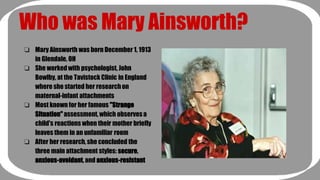
Who was Mary Ainsworth? 
❏ Mary Ainsworth was born December 1, 1913 
in Glendale, OH 
❏ She worked with psychologist, John 
Bowlby, at the Tavistock Clinic in England 
where she started her research on 
maternal-infant attachments 
❏ Most known for her famous "Strange 
Situation" assessment, which observes a 
child's reactions when their mother briefly 
leaves them in an unfamiliar room 
❏ After her research, she concluded the 
three main attachment styles: secure, 
anxious-avoidant, and anxious-resistant
Attachment Theory 
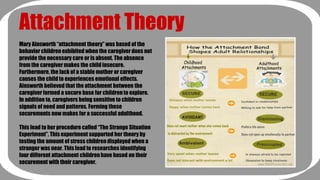
Mary Ainsworth “attachment theory” was based of the 
behavior children exhibited when the caregiver does not 
provide the necessary care or is absent. The absence 
from the caregiver makes the child insecure. 
Furthermore, the lack of a stable mother or caregiver 
causes the child to experiences emotional effects. 
Ainsworth believed that the attachment between the 
caregiver formed a secure base for children to explore. 
In addition to, caregivers being sensitive to children 
signals of need and patterns. Forming these 
securements now makes for a successful adulthood. 
This lead to her procedure called “The Strange Situation 
Experiment”. This experiment supported her theory by 
testing the amount of stress children displayed when a 
stranger was near. This lead to researches identifying 
four different attachment children have based on their 
securement with their caregiver.
Attachment Theory cont’d 
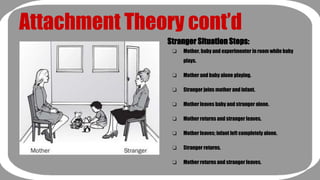
Stranger Situation Steps: 
❏ Mother, baby and experimenter in room while baby 
plays. 
❏ Mother and baby alone playing. 
❏ Stranger joins mother and infant. 
❏ Mother leaves baby and stranger alone. 
❏ Mother returns and stranger leaves. 
❏ Mother leaves; infant left completely alone. 
❏ Stranger returns. 
❏ Mother returns and stranger leaves.
Types of Attachment 
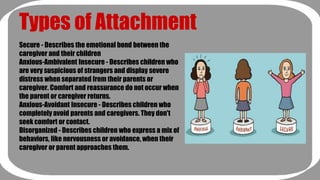
Secure - Describes the emotional bond between the 
caregiver and their children 
Anxious-Ambivalent Insecure - Describes children who 
are very suspicious of strangers and display severe 
distress when separated from their parents or 
caregiver. Comfort and reassurance do not occur when 
the parent or caregiver returns. 
Anxious-Avoidant Insecure - Describes children who 
completely avoid parents and caregivers. They don't 
seek comfort or contact. 
Disorganized - Describes children who express a mix of 
behaviors, like nervousness or avoidance, when their 
caregiver or parent approaches them.
Resources 
Cherry, K. (n.d.). Why Mary Ainsworth Is Important in Child Psychology. Retrieved October 8, 2014, 
from http://psychology.about.com/od/profilesal/p/ainsworth.htm 
McLeod, S. (2008, January 1). Mary Ainsworth | Attachment Styles | Simply Psychology. Retrieved 
December 15, 2014, from http://www.simplypsychology.org/mary-ainsworth.html 
Images retrieved from Google

Mary Ainsworth

  • 1.
    Mary Ainsworth ShaquitaGates Dawlyn Dieudonne Gerara Ford
  • 2.
    Who was MaryAinsworth? ❏ Mary Ainsworth was born December 1, 1913 in Glendale, OH ❏ She worked with psychologist, John Bowlby, at the Tavistock Clinic in England where she started her research on maternal-infant attachments ❏ Most known for her famous "Strange Situation" assessment, which observes a child's reactions when their mother briefly leaves them in an unfamiliar room ❏ After her research, she concluded the three main attachment styles: secure, anxious-avoidant, and anxious-resistant
  • 3.
    Attachment Theory MaryAinsworth “attachment theory” was based of the behavior children exhibited when the caregiver does not provide the necessary care or is absent. The absence from the caregiver makes the child insecure. Furthermore, the lack of a stable mother or caregiver causes the child to experiences emotional effects. Ainsworth believed that the attachment between the caregiver formed a secure base for children to explore. In addition to, caregivers being sensitive to children signals of need and patterns. Forming these securements now makes for a successful adulthood. This lead to her procedure called “The Strange Situation Experiment”. This experiment supported her theory by testing the amount of stress children displayed when a stranger was near. This lead to researches identifying four different attachment children have based on their securement with their caregiver.
  • 4.
    Attachment Theory cont’d Stranger Situation Steps: ❏ Mother, baby and experimenter in room while baby plays. ❏ Mother and baby alone playing. ❏ Stranger joins mother and infant. ❏ Mother leaves baby and stranger alone. ❏ Mother returns and stranger leaves. ❏ Mother leaves; infant left completely alone. ❏ Stranger returns. ❏ Mother returns and stranger leaves.
  • 5.
    Types of Attachment Secure - Describes the emotional bond between the caregiver and their children Anxious-Ambivalent Insecure - Describes children who are very suspicious of strangers and display severe distress when separated from their parents or caregiver. Comfort and reassurance do not occur when the parent or caregiver returns. Anxious-Avoidant Insecure - Describes children who completely avoid parents and caregivers. They don't seek comfort or contact. Disorganized - Describes children who express a mix of behaviors, like nervousness or avoidance, when their caregiver or parent approaches them.
  • 6.
    Resources Cherry, K.(n.d.). Why Mary Ainsworth Is Important in Child Psychology. Retrieved October 8, 2014, from http://psychology.about.com/od/profilesal/p/ainsworth.htm McLeod, S. (2008, January 1). Mary Ainsworth | Attachment Styles | Simply Psychology. Retrieved December 15, 2014, from http://www.simplypsychology.org/mary-ainsworth.html Images retrieved from Google