Download free for 30 days
Sign in
Upload
Language (EN)
Support
Business
Mobile
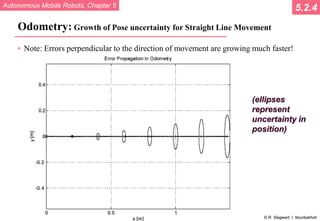
Social Media
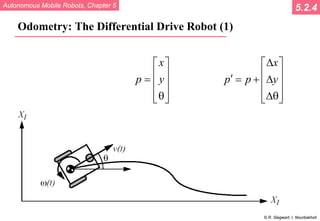
Marketing
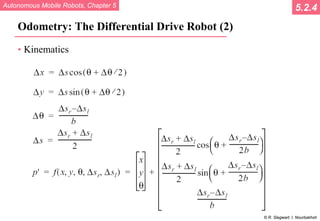
Technology
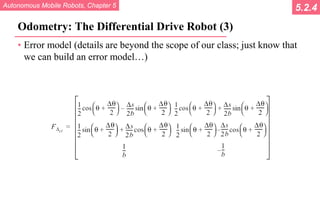
Art & Photos
Career
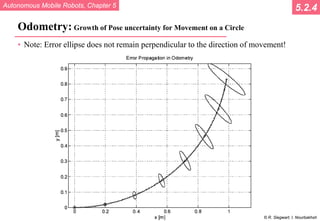
Design
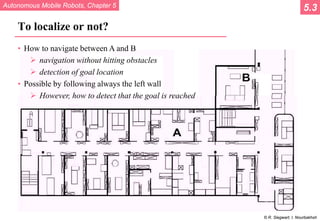
Education
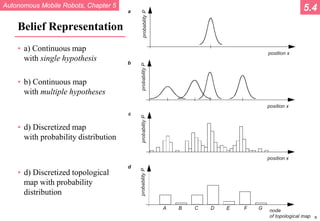
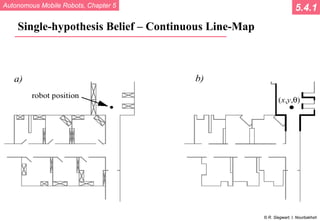
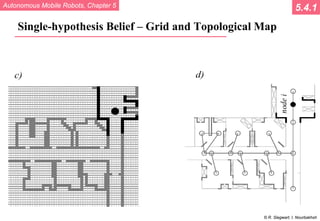
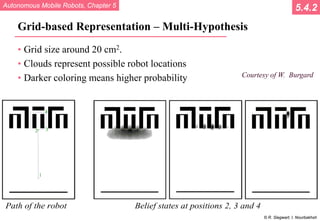
Presentations & Public Speaking
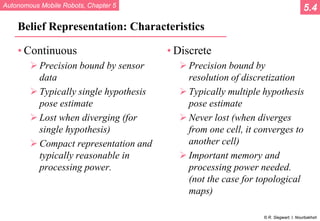
Government & Nonprofit
Healthcare
Internet
Law
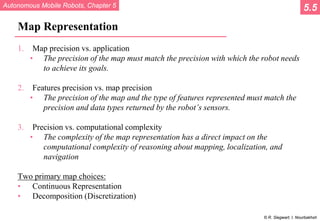
Leadership & Management
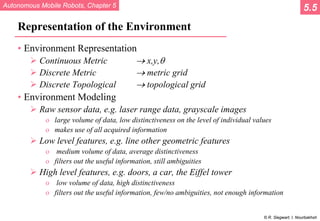
Automotive
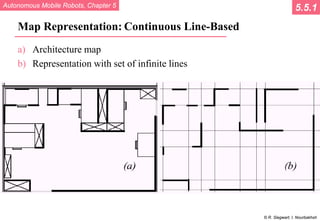
Engineering
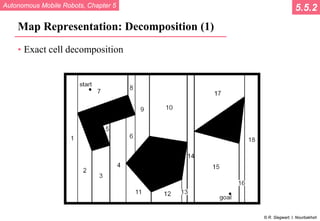
Software
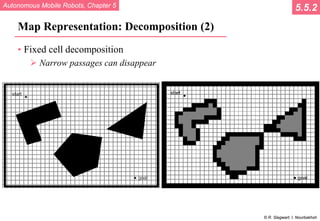
Recruiting & HR
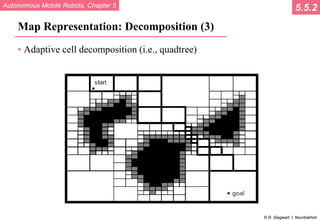
Retail
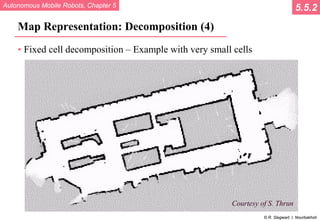
Sales
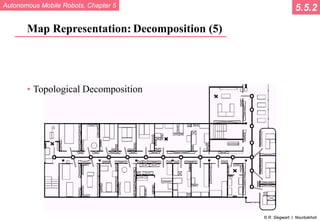
Services
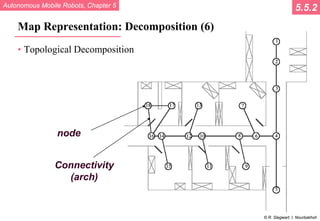
Science
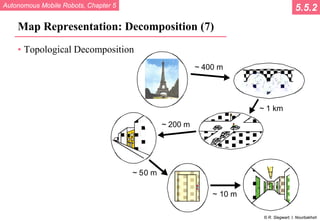
Small Business & Entrepreneurship
Food
Environment
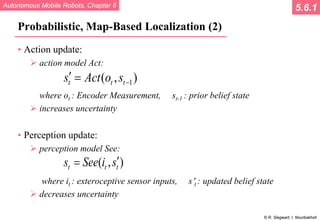
Economy & Finance
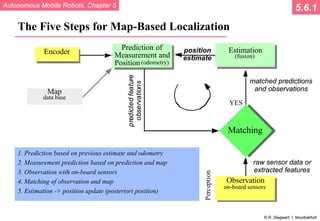
Data & Analytics
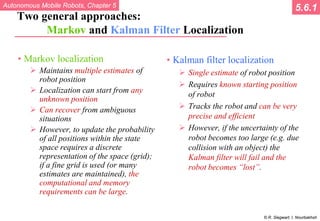
Investor Relations
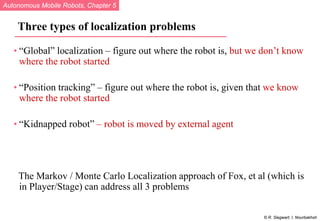
Sports
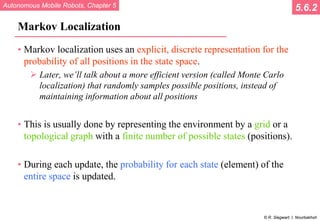
Spiritual
News & Politics
Travel
Self Improvement
Real Estate
Entertainment & Humor
Health & Medicine
Devices & Hardware
Lifestyle
Change Language
Language
English
Español
Português
Français
Deutsche
Cancel
Save
EN
JR
Uploaded by
Jenitha Rajadurai
PDF, PPTX
10 views
mobile robot localization techniques and methods
mobile robot localization
Engineering
◦
Read more
0
Save
Share
Embed
Embed presentation
Download
Download as PDF, PPTX
1
/ 58
2
/ 58
3
/ 58
4
/ 58
5
/ 58
6
/ 58
7
/ 58
8
/ 58
9
/ 58
10
/ 58
11
/ 58
12
/ 58
13
/ 58
14
/ 58
15
/ 58
16
/ 58
17
/ 58
18
/ 58
19
/ 58
20
/ 58
21
/ 58
22
/ 58
23
/ 58
24
/ 58
25
/ 58
26
/ 58
27
/ 58
28
/ 58
29
/ 58
30
/ 58
31
/ 58
32
/ 58
33
/ 58
34
/ 58
35
/ 58
36
/ 58
37
/ 58
38
/ 58
39
/ 58
40
/ 58
41
/ 58
42
/ 58
43
/ 58
44
/ 58
45
/ 58
46
/ 58
47
/ 58
48
/ 58
49
/ 58
50
/ 58
51
/ 58
52
/ 58
53
/ 58
54
/ 58
55
/ 58
56
/ 58
57
/ 58
58
/ 58
More Related Content
PDF
Robotics Navigation
by
cairo university
PPTX
Muhammad rizwan aqeel rlp.ppt
by
M Rizwan Aqeel
PDF
A Simple Integrative Solution For Simultaneous Localization And Mapping
by
Waqas Tariq
PDF
Self-Flying Drones: On a Mission to Navigate Dark, Dangerous and Unknown Worlds
by
Tahoe Silicon Mountain
PPTX
Autonomous_Mobile_Robots_Presentation.pptx
by
justiceck2000
PDF
Robotics Localization
by
cairo university
DOCX
Survey 1 (project overview)
by
Ahmed Abd El-Fattah
PPTX
Lecture 07: Localization and Mapping I
by
University of Colorado at Boulder
Robotics Navigation
by
cairo university
Muhammad rizwan aqeel rlp.ppt
by
M Rizwan Aqeel
A Simple Integrative Solution For Simultaneous Localization And Mapping
by
Waqas Tariq
Self-Flying Drones: On a Mission to Navigate Dark, Dangerous and Unknown Worlds
by
Tahoe Silicon Mountain
Autonomous_Mobile_Robots_Presentation.pptx
by
justiceck2000
Robotics Localization
by
cairo university
Survey 1 (project overview)
by
Ahmed Abd El-Fattah
Lecture 07: Localization and Mapping I
by
University of Colorado at Boulder
Similar to mobile robot localization techniques and methods
PPTX
slide introduction to Autonomous Robot.pptx
by
ayin4661
PDF
A one decade survey of autonomous mobile robot systems
by
IJECEIAES
PPT
Introduction to robotics
by
akhil_n12
PDF
Robotics for Path Planning
by
Hitesh Mohapatra
ODP
robotlocalization_02
by
Peter Borkuti
PPTX
Final Presentation COMPRESSED
by
Sujai Nair
PPT
AI Robotics
by
Yasir Khan
PDF
SLAM Constructor Framework for ROS
by
OSLL
PPTX
SLAM tools and Techniques VSLAM and SLAM.pptx
by
DrManojKumarShukla
PPTX
Intelligent mobile Robotics & Perception SystemsIntelligent mobile Robotics ...
by
Gouasmia Zakaria
PDF
20AD701 - AI in Robotics - ALL UNITs PPT
by
GeethaRRaj
PDF
Sensor Classification, Characterizing Sensor Performance.pdf
by
AnoopKrishnanS
PPT
Path Planning And Navigation
by
guest90654fd
PPT
Path Planning And Navigation
by
guest90654fd
PPT
Robotics
by
9896432164
PDF
Graph-based SLAM
by
Pranav Srinivas Kumar
PDF
On 2D SLAM for Large Indoor Spaces: A Polygon-Based Solution
by
Noury Bouraqadi
PDF
Robot navigation in unknown environment with obstacle recognition using laser...
by
IJECEIAES
PDF
A Real-Time Algorithm for Mobile Robot Mapping With Applications to.pdf
by
ssusera00b371
PDF
ROS and Unity.pdf
by
FauziAbdurrohim
slide introduction to Autonomous Robot.pptx
by
ayin4661
A one decade survey of autonomous mobile robot systems
by
IJECEIAES
Introduction to robotics
by
akhil_n12
Robotics for Path Planning
by
Hitesh Mohapatra
robotlocalization_02
by
Peter Borkuti
Final Presentation COMPRESSED
by
Sujai Nair
AI Robotics
by
Yasir Khan
SLAM Constructor Framework for ROS
by
OSLL
SLAM tools and Techniques VSLAM and SLAM.pptx
by
DrManojKumarShukla
Intelligent mobile Robotics & Perception SystemsIntelligent mobile Robotics ...
by
Gouasmia Zakaria
20AD701 - AI in Robotics - ALL UNITs PPT
by
GeethaRRaj
Sensor Classification, Characterizing Sensor Performance.pdf
by
AnoopKrishnanS
Path Planning And Navigation
by
guest90654fd
Path Planning And Navigation
by
guest90654fd
Robotics
by
9896432164
Graph-based SLAM
by
Pranav Srinivas Kumar
On 2D SLAM for Large Indoor Spaces: A Polygon-Based Solution
by
Noury Bouraqadi
Robot navigation in unknown environment with obstacle recognition using laser...
by
IJECEIAES
A Real-Time Algorithm for Mobile Robot Mapping With Applications to.pdf
by
ssusera00b371
ROS and Unity.pdf
by
FauziAbdurrohim
More from Jenitha Rajadurai
PPTX
counter design logic devices for sequential circuit
by
Jenitha Rajadurai
PDF
L2-Locomotion Systems.mobile robotics ppt
by
Jenitha Rajadurai
PDF
Planning and Navigation in mobile robotics
by
Jenitha Rajadurai
PPTX
sensors utilized in agro meteorology sdes
by
Jenitha Rajadurai
PPTX
microprocessor in agriculture processese
by
Jenitha Rajadurai
PPT
scada_classification based power point presentation
by
Jenitha Rajadurai
PPTX
Agrielectronics related ppt slide for study purpose
by
Jenitha Rajadurai
PPTX
datalogger-171219094658 used for agriculture
by
Jenitha Rajadurai
PPTX
MCQ for agriculture electronics for engineers
by
Jenitha Rajadurai
PPTX
Moses vaadhaigal suday school power point presentation
by
Jenitha Rajadurai
PPT
programming logic controller and programming
by
Jenitha Rajadurai
PPT
PP.SinglePhase.01.ppt variable frequency drive
by
Jenitha Rajadurai
PPTX
switches-210802065050.pptx switches and types
by
Jenitha Rajadurai
PPTX
Thermal sensors_thermal mapping_unit iv.pptx
by
Jenitha Rajadurai
PPTX
display technology used in agriculture automation
by
Jenitha Rajadurai
PPTX
final ppt soil moisture transducer use in agriculture
by
Jenitha Rajadurai
PPTX
programmable logic controller functions of plc
by
Jenitha Rajadurai
PPT
the basis of photosynthesis and their steps
by
Jenitha Rajadurai
PPTX
Chapter-5-Photosynthesis stages and growth
by
Jenitha Rajadurai
PPTX
programmable logic controller and automation
by
Jenitha Rajadurai
counter design logic devices for sequential circuit
by
Jenitha Rajadurai
L2-Locomotion Systems.mobile robotics ppt
by
Jenitha Rajadurai
Planning and Navigation in mobile robotics
by
Jenitha Rajadurai
sensors utilized in agro meteorology sdes
by
Jenitha Rajadurai
microprocessor in agriculture processese
by
Jenitha Rajadurai
scada_classification based power point presentation
by
Jenitha Rajadurai
Agrielectronics related ppt slide for study purpose
by
Jenitha Rajadurai
datalogger-171219094658 used for agriculture
by
Jenitha Rajadurai
MCQ for agriculture electronics for engineers
by
Jenitha Rajadurai
Moses vaadhaigal suday school power point presentation
by
Jenitha Rajadurai
programming logic controller and programming
by
Jenitha Rajadurai
PP.SinglePhase.01.ppt variable frequency drive
by
Jenitha Rajadurai
switches-210802065050.pptx switches and types
by
Jenitha Rajadurai
Thermal sensors_thermal mapping_unit iv.pptx
by
Jenitha Rajadurai
display technology used in agriculture automation
by
Jenitha Rajadurai
final ppt soil moisture transducer use in agriculture
by
Jenitha Rajadurai
programmable logic controller functions of plc
by
Jenitha Rajadurai
the basis of photosynthesis and their steps
by
Jenitha Rajadurai
Chapter-5-Photosynthesis stages and growth
by
Jenitha Rajadurai
programmable logic controller and automation
by
Jenitha Rajadurai
Recently uploaded
PPTX
Optimum mesh size for various fishing gears by B2B.pptx
by
B. BHASKAR
PPTX
How Does LNG Regasification Work | INOXCVA
by
INOXCVA
PDF
Microeconomics Theory and Market Structure.pdf
by
MahmoodKhalid11
PPTX
INTEGRATED COMMUNICATION AND SENSING Presentation.pptx
by
NanaAgyeman13
PDF
Applications of AI in Civil Engineering - Dr. Rohan Dasgupta
by
Rohan Dasgupta
PPTX
DIFFERENT TYPES OF SRTUCTURAL SYSTEM ANALYSIS
by
noshin231202
PDF
DAA Lab Manual ssit -kavya r.pdf or Digital Design and Analysis of Algorithm ...
by
kavya R
PDF
Microcontroller Notes Final 2016 April june.pdf
by
pmuiruri768
PPTX
A professional presentation on Cosmos Bank Heist
by
ssuser7f0075
PDF
Weak Incentives (WINK): The Agent Definition Layer
by
Andrei Savu
PDF
Computer Network Lab Manual ssit -kavya r.pdf or Computer Network Lab Manual ...
by
kavya R
PPTX
Presentation-WPS Office.pptx afgouvhyhgfccf
by
EndaleTimerga
PPTX
ME3592 - Metrology and Measurements - Unit - 1 - Lecture Notes
by
pprakash21252
PPTX
[Deck] What's New in Spark-Iceberg Integration via DSV2.pptx
by
Szehon Ho
PPTX
unit v awp IN ANTENNA AND WAVE PROP IN JNTUH
by
TCEKPEDDAPALLI
PDF
Rajesh Prasad- Brief Profile with educational, professional highlights
by
Rajesh Prasad
PDF
Plasticity and Structure of Soil/Atterberg Limits.pdf
by
MahmoodKhalid11
PPTX
Fuel Injection Pump Test Bench – Precision Testing & Calibration for Diesel E...
by
Neometrix_Engineering_Pvt_Ltd
PDF
Shear Strength of Soil (Direct shear test).pdf
by
MahmoodKhalid11
PDF
Enhancing optical fiber communication systems using repetition coding for imp...
by
MouweffeqBouregaa
Optimum mesh size for various fishing gears by B2B.pptx
by
B. BHASKAR
How Does LNG Regasification Work | INOXCVA
by
INOXCVA
Microeconomics Theory and Market Structure.pdf
by
MahmoodKhalid11
INTEGRATED COMMUNICATION AND SENSING Presentation.pptx
by
NanaAgyeman13
Applications of AI in Civil Engineering - Dr. Rohan Dasgupta
by
Rohan Dasgupta
DIFFERENT TYPES OF SRTUCTURAL SYSTEM ANALYSIS
by
noshin231202
DAA Lab Manual ssit -kavya r.pdf or Digital Design and Analysis of Algorithm ...
by
kavya R
Microcontroller Notes Final 2016 April june.pdf
by
pmuiruri768
A professional presentation on Cosmos Bank Heist
by
ssuser7f0075
Weak Incentives (WINK): The Agent Definition Layer
by
Andrei Savu
Computer Network Lab Manual ssit -kavya r.pdf or Computer Network Lab Manual ...
by
kavya R
Presentation-WPS Office.pptx afgouvhyhgfccf
by
EndaleTimerga
ME3592 - Metrology and Measurements - Unit - 1 - Lecture Notes
by
pprakash21252
[Deck] What's New in Spark-Iceberg Integration via DSV2.pptx
by
Szehon Ho
unit v awp IN ANTENNA AND WAVE PROP IN JNTUH
by
TCEKPEDDAPALLI
Rajesh Prasad- Brief Profile with educational, professional highlights
by
Rajesh Prasad
Plasticity and Structure of Soil/Atterberg Limits.pdf
by
MahmoodKhalid11
Fuel Injection Pump Test Bench – Precision Testing & Calibration for Diesel E...
by
Neometrix_Engineering_Pvt_Ltd
Shear Strength of Soil (Direct shear test).pdf
by
MahmoodKhalid11
Enhancing optical fiber communication systems using repetition coding for imp...
by
MouweffeqBouregaa
mobile robot localization techniques and methods
1.
Autonomous Mobile Robots,
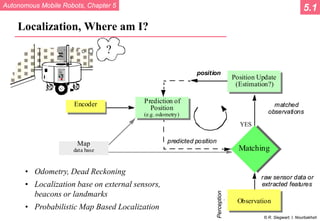
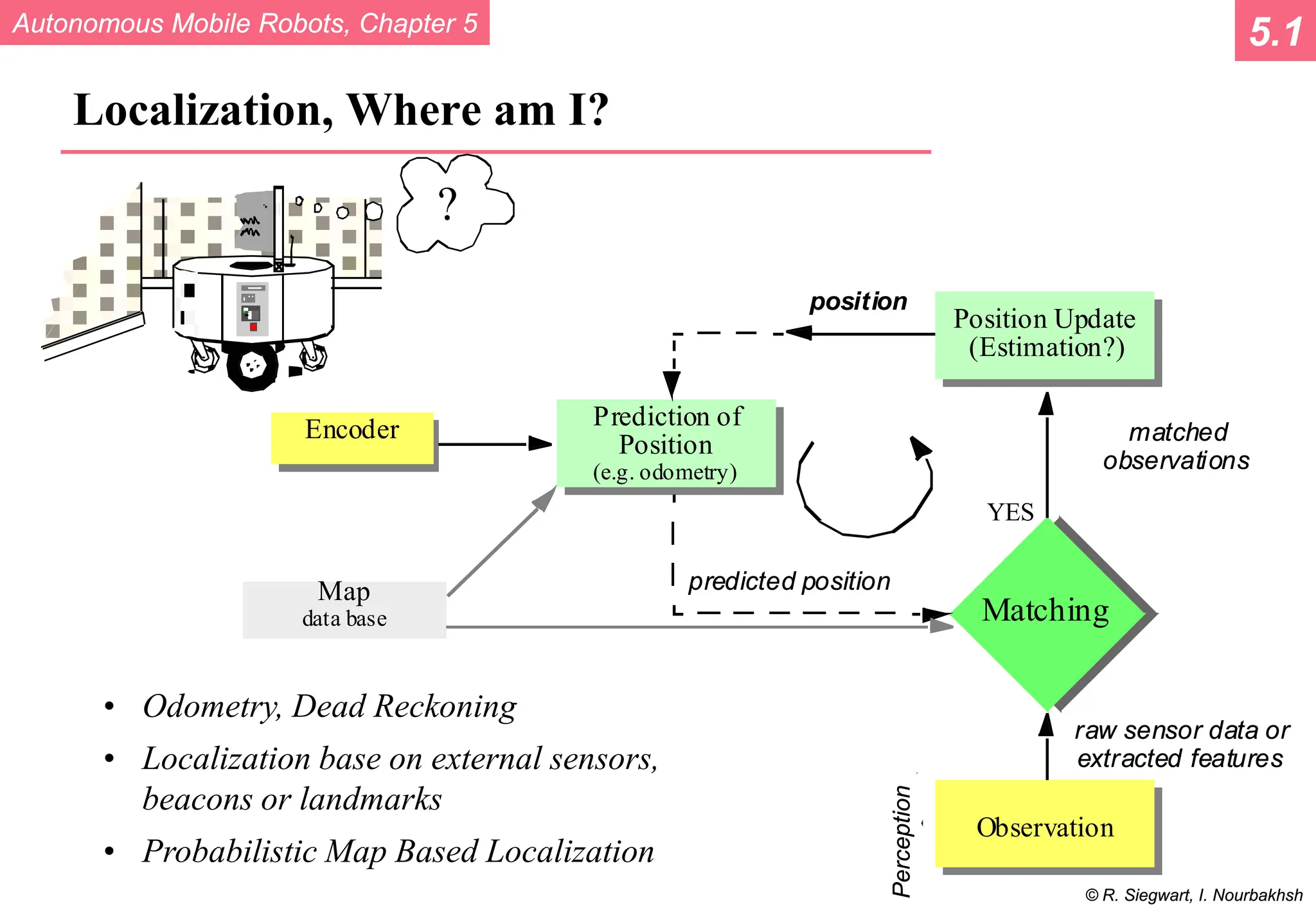
Chapter 5 © R. Siegwart, I. Nourbakhsh Localization, Where am I? ? • Odometry, Dead Reckoning • Localization base on external sensors, beacons or landmarks • Probabilistic Map Based Localization 5.1 Observation Map data base Prediction of Position (e.g. odometry) Perception Matching Position Update (Estimation?) raw sensor data or extracted features predicted position position matched observations YES Encoder Perception
2.
Autonomous Mobile Robots,
Chapter 5 © R. Siegwart, I. Nourbakhsh Challenges of Localization • Knowing the absolute position (e.g. GPS) is not sufficient • Localization in human-scale in relation with environment • Planning in the Cognition step requires more than only position as input • Perception and motion plays an important role Sensor noise Sensor aliasing Effector noise Odometric position estimation 5.2
3.
Autonomous Mobile Robots,
Chapter 5 © R. Siegwart, I. Nourbakhsh Sensor Noise • Sensor noise is mainly influenced by environment e.g. surface, illumination … • or by the measurement principle itself e.g. interference between ultrasonic sensors • Sensor noise drastically reduces the useful information of sensor readings. The solution is: to take multiple reading into account employ temporal and/or multi-sensor fusion 5.2.1
4.
Autonomous Mobile Robots,
Chapter 5 © R. Siegwart, I. Nourbakhsh Sensor Aliasing • In robots, non-uniqueness of sensors readings is the norm • Even with multiple sensors, there is a many-to-one mapping from environmental states to robot’s perceptual inputs • Therefore the amount of information perceived by the sensors is generally insufficient to identify the robot’s position from a single reading Robot’s localization is usually based on a series of readings Sufficient information is recovered by the robot over time 5.2.2
5.
Autonomous Mobile Robots,
Chapter 5 © R. Siegwart, I. Nourbakhsh Effector Noise: Odometry, Dead Reckoning • Odometry and dead reckoning: Position update is based on proprioceptive sensors Odometry: wheel sensors only Dead reckoning: also heading sensors • The movement of the robot, sensed with wheel encoders and/or heading sensors is integrated to the position. Pros: Straight forward, easy Cons: Errors are integrated -> unbounded • Using additional heading sensors (e.g. gyroscope) might help to reduce the accumulated errors, but the main problems remain the same. 5.2.3
6.
Autonomous Mobile Robots,
Chapter 5 © R. Siegwart, I. Nourbakhsh Odometry: Error sources deterministic non-deterministic (systematic) (non-systematic) deterministic errors can be eliminated by proper calibration of the system. non-deterministic errors have to be described by error models and will always lead to uncertain position estimate. • Major Error Sources: Limited resolution during integration (time increments, measurement resolution …) Misalignment of the wheels (deterministic) Unequal wheel diameter (deterministic) Variation in the contact point of the wheel Unequal floor contact (slipping, non-planar …) … 5.2.3
7.
Autonomous Mobile Robots,
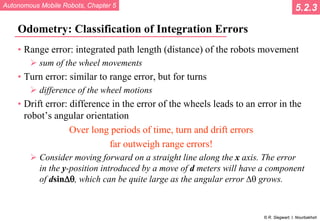
Chapter 5 © R. Siegwart, I. Nourbakhsh Odometry: Classification of Integration Errors • Range error: integrated path length (distance) of the robots movement sum of the wheel movements • Turn error: similar to range error, but for turns difference of the wheel motions • Drift error: difference in the error of the wheels leads to an error in the robot’s angular orientation Over long periods of time, turn and drift errors far outweigh range errors! Consider moving forward on a straight line along the x axis. The error in the y-position introduced by a move of d meters will have a component of dsin∆θ, which can be quite large as the angular error ∆θ grows. 5.2.3
8.
Autonomous Mobile Robots,
Chapter 5 © R. Siegwart, I. Nourbakhsh Odometry: The Differential Drive Robot (1) θ = y x p θ ∆ ∆ ∆ + = ′ y x p p 5.2.4
9.
Autonomous Mobile Robots,
Chapter 5 © R. Siegwart, I. Nourbakhsh Odometry: The Differential Drive Robot (2) • Kinematics 5.2.4
10.
Autonomous Mobile Robots,
Chapter 5 © R. Siegwart, I. Nourbakhsh Odometry: The Differential Drive Robot (3) • Error model (details are beyond the scope of our class; just know that we can build an error model…) 5.2.4
11.
Autonomous Mobile Robots,
Chapter 5 © R. Siegwart, I. Nourbakhsh Odometry: Growth of Pose uncertainty for Straight Line Movement • Note: Errors perpendicular to the direction of movement are growing much faster! 5.2.4 (ellipses represent uncertainty in position)
12.
Autonomous Mobile Robots,
Chapter 5 © R. Siegwart, I. Nourbakhsh Odometry: Growth of Pose uncertainty for Movement on a Circle • Note: Error ellipse does not remain perpendicular to the direction of movement! 5.2.4
13.
Autonomous Mobile Robots,
Chapter 5 © R. Siegwart, I. Nourbakhsh To localize or not? • How to navigate between A and B navigation without hitting obstacles detection of goal location • Possible by following always the left wall However, how to detect that the goal is reached 5.3
14.
Autonomous Mobile Robots,
Chapter 5 © R. Siegwart, I. Nourbakhsh Belief Representation • a) Continuous map with single hypothesis • b) Continuous map with multiple hypotheses • d) Discretized map with probability distribution • d) Discretized topological map with probability distribution 5.4
15.
Autonomous Mobile Robots,
Chapter 5 © R. Siegwart, I. Nourbakhsh Belief Representation: Characteristics • Continuous Precision bound by sensor data Typically single hypothesis pose estimate Lost when diverging (for single hypothesis) Compact representation and typically reasonable in processing power. • Discrete Precision bound by resolution of discretization Typically multiple hypothesis pose estimate Never lost (when diverges from one cell, it converges to another cell) Important memory and processing power needed. (not the case for topological maps) 5.4
16.
Autonomous Mobile Robots,
Chapter 5 © R. Siegwart, I. Nourbakhsh Single-hypothesis Belief – Continuous Line-Map 5.4.1
17.
Autonomous Mobile Robots,
Chapter 5 © R. Siegwart, I. Nourbakhsh Single-hypothesis Belief – Grid and Topological Map 5.4.1
18.
Autonomous Mobile Robots,
Chapter 5 © R. Siegwart, I. Nourbakhsh Grid-based Representation – Multi-Hypothesis • Grid size around 20 cm2. • Clouds represent possible robot locations • Darker coloring means higher probability 5.4.2 Courtesy of W. Burgard
19.
Autonomous Mobile Robots,
Chapter 5 © R. Siegwart, I. Nourbakhsh Map Representation 1. Map precision vs. application • The precision of the map must match the precision with which the robot needs to achieve its goals. 2. Features precision vs. map precision • The precision of the map and the type of features represented must match the precision and data types returned by the robot’s sensors. 3. Precision vs. computational complexity • The complexity of the map representation has a direct impact on the computational complexity of reasoning about mapping, localization, and navigation Two primary map choices: • Continuous Representation • Decomposition (Discretization) 5.5
20.
Autonomous Mobile Robots,
Chapter 5 © R. Siegwart, I. Nourbakhsh Representation of the Environment • Environment Representation Continuous Metric → x,y,θ Discrete Metric → metric grid Discrete Topological → topological grid • Environment Modeling Raw sensor data, e.g. laser range data, grayscale images o large volume of data, low distinctiveness on the level of individual values o makes use of all acquired information Low level features, e.g. line other geometric features o medium volume of data, average distinctiveness o filters out the useful information, still ambiguities High level features, e.g. doors, a car, the Eiffel tower o low volume of data, high distinctiveness o filters out the useful information, few/no ambiguities, not enough information 5.5
21.
Autonomous Mobile Robots,
Chapter 5 © R. Siegwart, I. Nourbakhsh Map Representation: Continuous Line-Based a) Architecture map b) Representation with set of infinite lines 5.5.1
22.
Autonomous Mobile Robots,
Chapter 5 © R. Siegwart, I. Nourbakhsh Map Representation: Decomposition (1) • Exact cell decomposition 5.5.2
23.
Autonomous Mobile Robots,
Chapter 5 © R. Siegwart, I. Nourbakhsh Map Representation: Decomposition (2) • Fixed cell decomposition Narrow passages can disappear 5.5.2
24.
Autonomous Mobile Robots,
Chapter 5 © R. Siegwart, I. Nourbakhsh Map Representation: Decomposition (3) • Adaptive cell decomposition (i.e., quadtree) 5.5.2
25.
Autonomous Mobile Robots,
Chapter 5 © R. Siegwart, I. Nourbakhsh Map Representation: Decomposition (4) • Fixed cell decomposition – Example with very small cells 5.5.2 Courtesy of S. Thrun
26.
Autonomous Mobile Robots,
Chapter 5 © R. Siegwart, I. Nourbakhsh Map Representation: Decomposition (5) • Topological Decomposition 5.5.2
27.
Autonomous Mobile Robots,
Chapter 5 © R. Siegwart, I. Nourbakhsh Map Representation: Decomposition (6) • Topological Decomposition node Connectivity (arch) 5.5.2
28.
Autonomous Mobile Robots,
Chapter 5 © R. Siegwart, I. Nourbakhsh Map Representation: Decomposition (7) • Topological Decomposition ~ 400 m ~ 1 km ~ 200 m ~ 50 m ~ 10 m 5.5.2
29.
Autonomous Mobile Robots,
Chapter 5 © R. Siegwart, I. Nourbakhsh State-of-the-Art: Current Challenges in Map Representation • Real world is dynamic • Perception is still a major challenge Error prone Extraction of useful information difficult • Traversal of open space • How to build up topology (boundaries of nodes) • Sensor fusion • … 5.5.3
30.
Autonomous Mobile Robots,
Chapter 5 © R. Siegwart, I. Nourbakhsh Probabilistic, Map-Based Localization (1) • Consider a mobile robot moving in a known environment. • As it starts to move, say from a precisely known location, it might keep track of its location using odometry. • However, after a certain movement the robot will get very uncertain about its position. update using an observation of its environment. • Odometric information leads to an estimate of the robot’s position, which can then be fused with the sensor observations to get the best possible update of the robot’s actual position. 5.6.1
31.
Autonomous Mobile Robots,
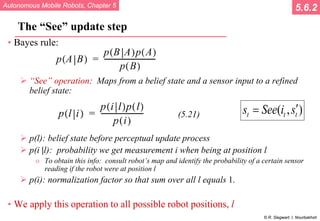
Chapter 5 © R. Siegwart, I. Nourbakhsh Probabilistic, Map-Based Localization (2) • Action update: action model Act: where ot : Encoder Measurement, st-1 : prior belief state increases uncertainty • Perception update: perception model See: where it : exteroceptive sensor inputs, s′t : updated belief state decreases uncertainty 5.6.1 1 ( , ) t t t s Act o s − ′ = ( , ) t t t s See i s′ =
32.
Autonomous Mobile Robots,
Chapter 5 © R. Siegwart, I. Nourbakhsh The Five Steps for Map-Based Localization Observation on-board sensors Map data base Prediction of Measurement and Position(odometry) P e r c e p t i o n Matching Estimation (fusion) raw sensor data or extracted features p r e d i c t e d f e a t u r e o b s e r v a t i o n s position estimate matched predictions and observations YES Encoder 1. Prediction based on previous estimate and odometry 2. Measurement prediction based on prediction and map 3. Observation with on-board sensors 4. Matching of observation and map 5. Estimation -> position update (posteriori position) 5.6.1
33.
Autonomous Mobile Robots,
Chapter 5 © R. Siegwart, I. Nourbakhsh Two general approaches: Markov and Kalman Filter Localization • Markov localization Maintains multiple estimates of robot position Localization can start from any unknown position Can recover from ambiguous situations However, to update the probability of all positions within the state space requires a discrete representation of the space (grid); if a fine grid is used (or many estimates are maintained), the computational and memory requirements can be large. • Kalman filter localization Single estimate of robot position Requires known starting position of robot Tracks the robot and can be very precise and efficient However, if the uncertainty of the robot becomes too large (e.g. due collision with an object) the Kalman filter will fail and the robot becomes “lost”. 5.6.1
34.
Autonomous Mobile Robots,
Chapter 5 © R. Siegwart, I. Nourbakhsh Three types of localization problems • “Global” localization – figure out where the robot is, but we don’t know where the robot started • “Position tracking” – figure out where the robot is, given that we know where the robot started • “Kidnapped robot” – robot is moved by external agent The Markov / Monte Carlo Localization approach of Fox, et al (which is in Player/Stage) can address all 3 problems
35.
Autonomous Mobile Robots,
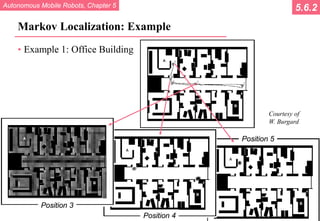
Chapter 5 © R. Siegwart, I. Nourbakhsh Markov Localization • Markov localization uses an explicit, discrete representation for the probability of all positions in the state space. Later, we’ll talk about a more efficient version (called Monte Carlo localization) that randomly samples possible positions, instead of maintaining information about all positions • This is usually done by representing the environment by a grid or a topological graph with a finite number of possible states (positions). • During each update, the probability for each state (element) of the entire space is updated. 5.6.2
36.
Autonomous Mobile Robots,
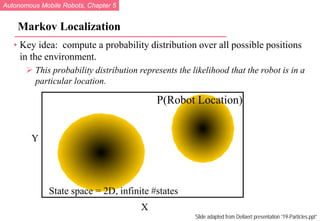
Chapter 5 © R. Siegwart, I. Nourbakhsh Markov Localization • Key idea: compute a probability distribution over all possible positions in the environment. This probability distribution represents the likelihood that the robot is in a particular location. P(Robot Location) X Y State space = 2D, infinite #states Slide adapted from Dellaert presentation “19-Particles.ppt”
37.
Autonomous Mobile Robots,
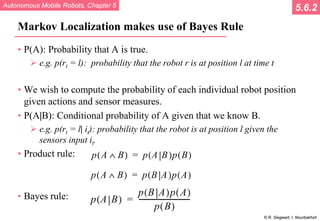
Chapter 5 © R. Siegwart, I. Nourbakhsh Markov Localization makes use of Bayes Rule • P(A): Probability that A is true. e.g. p(rt = l): probability that the robot r is at position l at time t • We wish to compute the probability of each individual robot position given actions and sensor measures. • P(A|B): Conditional probability of A given that we know B. e.g. p(rt = l| it): probability that the robot is at position l given the sensors input it. • Product rule: • Bayes rule: 5.6.2
38.
Autonomous Mobile Robots,
Chapter 5 © R. Siegwart, I. Nourbakhsh The “See” update step • Bayes rule: “See” operation: Maps from a belief state and a sensor input to a refined belief state: (5.21) p(l): belief state before perceptual update process p(i |l): probability we get measurement i when being at position l o To obtain this info: consult robot’s map and identify the probability of a certain sensor reading if the robot were at position l p(i): normalization factor so that sum over all l equals 1. • We apply this operation to all possible robot positions, l 5.6.2 ( , ) t t t s See i s′ =
39.
Autonomous Mobile Robots,
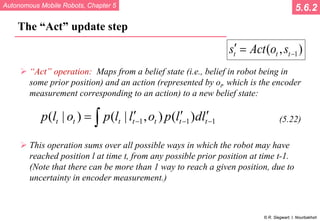
Chapter 5 © R. Siegwart, I. Nourbakhsh The “Act” update step “Act” operation: Maps from a belief state (i.e., belief in robot being in some prior position) and an action (represented by ot, which is the encoder measurement corresponding to an action) to a new belief state: (5.22) This operation sums over all possible ways in which the robot may have reached position l at time t, from any possible prior position at time t-1. (Note that there can be more than 1 way to reach a given position, due to uncertainty in encoder measurement.) 5.6.2 1 ( , ) t t t s Act o s − ′ = 1 1 1 ( | ) ( | , ) ( ) t t t t t t t p l o p l l o p l dl − − − ′ ′ ′ = ∫
40.
Autonomous Mobile Robots,
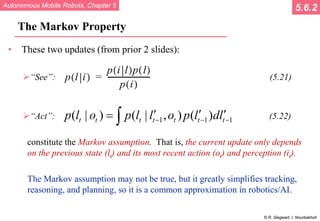
Chapter 5 © R. Siegwart, I. Nourbakhsh The Markov Property • These two updates (from prior 2 slides): “See”: (5.21) “Act”: (5.22) constitute the Markov assumption. That is, the current update only depends on the previous state (lt) and its most recent action (ot) and perception (it). The Markov assumption may not be true, but it greatly simplifies tracking, reasoning, and planning, so it is a common approximation in robotics/AI. 5.6.2 1 1 1 ( | ) ( | , ) ( ) t t t t t t t p l o p l l o p l dl − − − ′ ′ ′ = ∫
41.
Autonomous Mobile Robots,
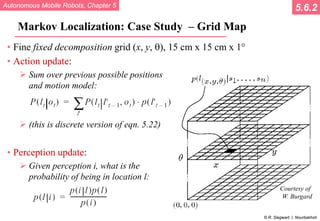
Chapter 5 © R. Siegwart, I. Nourbakhsh Markov Localization: Case Study – Grid Map • Fine fixed decomposition grid (x, y, θ), 15 cm x 15 cm x 1° • Action update: Sum over previous possible positions and motion model: (this is discrete version of eqn. 5.22) • Perception update: Given perception i, what is the probability of being in location l: 5.6.2 Courtesy of W. Burgard
42.
Autonomous Mobile Robots,
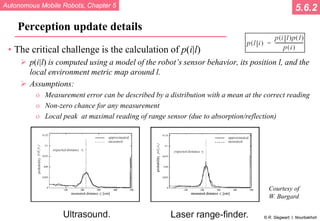
Chapter 5 © R. Siegwart, I. Nourbakhsh Perception update details • The critical challenge is the calculation of p(i|l) p(i|l) is computed using a model of the robot’s sensor behavior, its position l, and the local environment metric map around l. Assumptions: o Measurement error can be described by a distribution with a mean at the correct reading o Non-zero chance for any measurement o Local peak at maximal reading of range sensor (due to absorption/reflection) 5.6.2 Courtesy of W. Burgard
43.
Autonomous Mobile Robots,
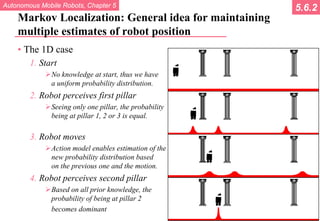
Chapter 5 © R. Siegwart, I. Nourbakhsh Markov Localization: General idea for maintaining multiple estimates of robot position • The 1D case 1. Start No knowledge at start, thus we have a uniform probability distribution. 2. Robot perceives first pillar Seeing only one pillar, the probability being at pillar 1, 2 or 3 is equal. 3. Robot moves Action model enables estimation of the new probability distribution based on the previous one and the motion. 4. Robot perceives second pillar Based on all prior knowledge, the probability of being at pillar 2 becomes dominant 5.6.2
44.
Autonomous Mobile Robots,
Chapter 5 © R. Siegwart, I. Nourbakhsh Markov Localization: Example • Example 1: Office Building 5.6.2 Position 3 Position 4 Position 5 Courtesy of W. Burgard
45.
Autonomous Mobile Robots,
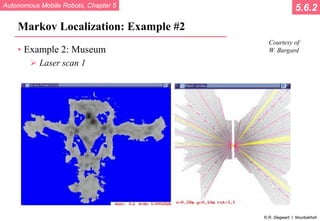
Chapter 5 © R. Siegwart, I. Nourbakhsh Markov Localization: Example #2 • Example 2: Museum Laser scan 1 5.6.2 Courtesy of W. Burgard
46.
Autonomous Mobile Robots,
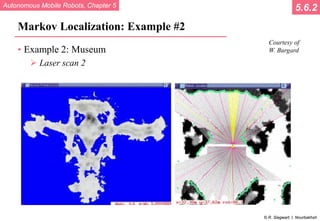
Chapter 5 © R. Siegwart, I. Nourbakhsh Markov Localization: Example #2 • Example 2: Museum Laser scan 2 5.6.2 Courtesy of W. Burgard
47.
Autonomous Mobile Robots,
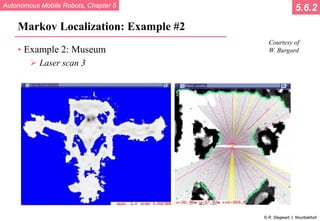
Chapter 5 © R. Siegwart, I. Nourbakhsh Markov Localization: Example #2 • Example 2: Museum Laser scan 3 5.6.2 Courtesy of W. Burgard
48.
Autonomous Mobile Robots,
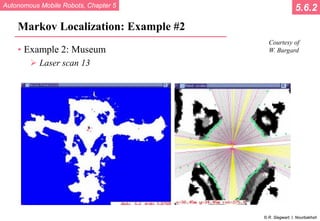
Chapter 5 © R. Siegwart, I. Nourbakhsh Markov Localization: Example #2 • Example 2: Museum Laser scan 13 5.6.2 Courtesy of W. Burgard
49.
Autonomous Mobile Robots,
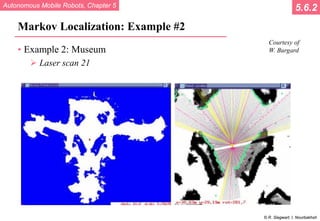
Chapter 5 © R. Siegwart, I. Nourbakhsh Markov Localization: Example #2 • Example 2: Museum Laser scan 21 5.6.2 Courtesy of W. Burgard
50.
Autonomous Mobile Robots,
Chapter 5 © R. Siegwart, I. Nourbakhsh Markov Localization: Using Randomized Sampling to Reduce Complexity “Particle filters”, “Monte Carlo algorithms” • Fine fixed decomposition grid results in a huge state space • Reducing complexity: The main goal is to reduce the number of states that are updated in each step • Randomized Sampling / Particle Filters Approximated belief state by representing only a ‘representative’ subset of all states (possible locations) E.g., update only 10% of all possible locations The sampling process is typically weighted, e.g., put more samples around the local peaks in the probability density function However, you have to ensure some less likely locations are still tracked, otherwise the robot might get lost 5.6.2
51.
Autonomous Mobile Robots,
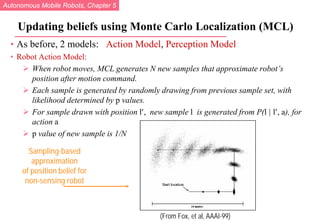
Chapter 5 © R. Siegwart, I. Nourbakhsh Updating beliefs using Monte Carlo Localization (MCL) • As before, 2 models: Action Model, Perception Model • Robot Action Model: When robot moves, MCL generates N new samples that approximate robot’s position after motion command. Each sample is generated by randomly drawing from previous sample set, with likelihood determined by p values. For sample drawn with position l′, new sample l is generated from P(l | l′, a), for action a p value of new sample is 1/N (From Fox, et al, AAAI-99) Sampling-based approximation of position belief for non-sensing robot
52.
Autonomous Mobile Robots,
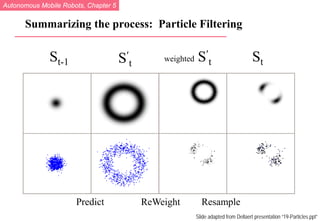
Chapter 5 © R. Siegwart, I. Nourbakhsh • Robot Perception Model: Re-weight sample set according to the likelihood that robot’s current sensors match what would be seen at a given location • After applying Motion model and Perception model: Resample, according to latest weights Add a few uniformly distributed, random samples o Very helpful in case robot completely loses track of its location Go to next iteration Updating beliefs using Monte Carlo Localization (MCL), con’t.
53.
Autonomous Mobile Robots,
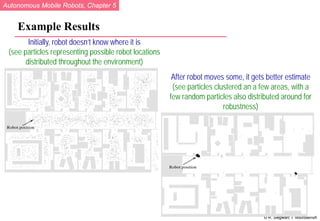
Chapter 5 © R. Siegwart, I. Nourbakhsh Example Results Initially, robot doesn’t know where it is (see particles representing possible robot locations distributed throughout the environment) After robot moves some, it gets better estimate (see particles clustered an a few areas, with a few random particles also distributed around for robustness)
54.
Autonomous Mobile Robots,
Chapter 5 © R. Siegwart, I. Nourbakhsh Adapting the Size of the Sample Set • Number of samples needed to achieve a desired level of accuracy varies dramatically depending on the situation During global localization: robot is ignorant of where it is need lots of samples During position tracking: robot’s uncertainty is small don’t need as many samples • MCL determines sample size “on the fly” Compare P(l) and P(l | s) (i.e., belief before and after sensing) to determine sample size The more divergence, the more samples that are kept
55.
Autonomous Mobile Robots,
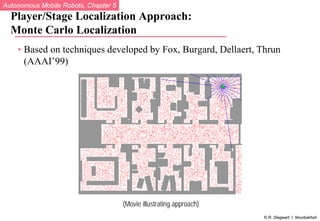
Chapter 5 © R. Siegwart, I. Nourbakhsh Player/Stage Localization Approach: Monte Carlo Localization • Based on techniques developed by Fox, Burgard, Dellaert, Thrun (AAAI’99) (Movie illustrating approach)
56.
Autonomous Mobile Robots,
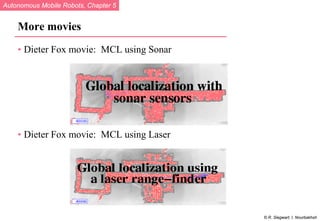
Chapter 5 © R. Siegwart, I. Nourbakhsh More movies • Dieter Fox movie: MCL using Sonar • Dieter Fox movie: MCL using Laser
57.
Autonomous Mobile Robots,
Chapter 5 © R. Siegwart, I. Nourbakhsh Summarizing the process: Particle Filtering weighted S′ t St S′ t St-1 Predict ReWeight Resample Slide adapted from Dellaert presentation “19-Particles.ppt”
58.
Autonomous Mobile Robots,
Chapter 5 © R. Siegwart, I. Nourbakhsh What sensor to use for localization? • Can work with: Sonar Laser Vision Radio signal strength
Download


![[Deck] What's New in Spark-Iceberg Integration via DSV2.pptx](https://cdn.slidesharecdn.com/ss_thumbnails/deckwhatsnewinspark-icebergintegrationviadsv2-260210005337-25955b12-thumbnail.jpg?width=640&height=640&fit=bounds)


