Handled by,
Dr.R.Jenitha
Assistant Professor, Dept of ECE
oxu5e3
5
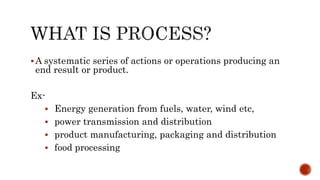
A systematic series of actions or operations producing an
end result or product.
Ex-
 Energy generation from fuels, water, wind etc,
 power transmission and distribution
 product manufacturing, packaging and distribution
 food processing
Sensors and
Transducers
Measurement and
instrumentation
Machines Control system
Actuator Process
Sensor
Controller
Set point
Input Output
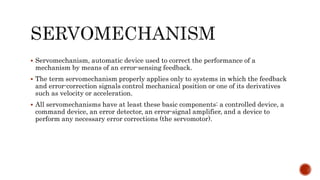
 Servomechanism, automatic device used to correct the performance of a
mechanism by means of an error-sensing feedback.
 The term servomechanism properly applies only to systems in which the feedback
and error-correction signals control mechanical position or one of its derivatives
such as velocity or acceleration.
 All servomechanisms have at least these basic components: a controlled device, a
command device, an error detector, an error-signal amplifier, and a device to
perform any necessary error corrections (the servomotor).
 For example, an automotive power window control is not a servomechanism, as
there is no automatic feedback that controls position,the operator does this by
observation. By contrast the car's cruise control uses closed loop feedback,which
classifies it as a servomechanism.
 The Boeing 777 is the first heavy jet plane engineered to fly with all major flight-
control functions managed by servomechanisms. The design of this revolutionary
plane is based on the so-called “fly-by-wire” system. In normal flight a digital
signal communicates the pilot’s instructions electrically to control
servomechanisms that position the plane’s control surfaces as needed.
 In this system, an input is applied
and an output obtained. Figure
shows an example; assume an
aircraft rudder controlled by an open
loop system.
 The demand, made by the pilot on
the rudder bar, is picked up by the
transducer which converts it to an
electrical signal i.e. the demand
signal. This signal is amplified and
fed to the motor, which responds by
moving the load i.e. the rudder.
There is no positional feedback and
the pilot does not know if the rudder
has adopted the position requested.
INPUT
TRANSDUCER
MOTOR LOAD
DEMAND
RESPONSE
DEMAND
SIGNAL
AMP
 In the closed loop system, the
demand is made in the same way.
In a basic system, positional
feedback would be given to the pilot
who would make adjustments
accordingly but this is not practical
with systems such as aircraft flying
controls.
 Figure shows closed lo system
INPUT
TRANSDUCER
SERVO
MOTOR
LOAD
OUTPUT
POSITION
TRANSDUCER
ERROR
DETECTOR
POSITION
FEEDBACK
ERROR
SIGNAL
AMP
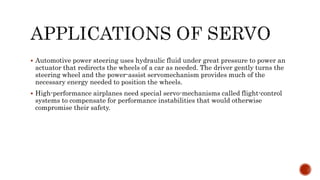
 Automotive power steering uses hydraulic fluid under great pressure to power an
actuator that redirects the wheels of a car as needed. The driver gently turns the
steering wheel and the power-assist servomechanism provides much of the
necessary energy needed to position the wheels.
 High-performance airplanes need special servo-mechanisms called flight-control
systems to compensate for performance instabilities that would otherwise
compromise their safety.

programmable logic controller and automation

  • 1.
  • 2.
  • 4.
    A systematic seriesof actions or operations producing an end result or product. Ex-  Energy generation from fuels, water, wind etc,  power transmission and distribution  product manufacturing, packaging and distribution  food processing
  • 5.
  • 6.
  • 18.
     Servomechanism, automaticdevice used to correct the performance of a mechanism by means of an error-sensing feedback.  The term servomechanism properly applies only to systems in which the feedback and error-correction signals control mechanical position or one of its derivatives such as velocity or acceleration.  All servomechanisms have at least these basic components: a controlled device, a command device, an error detector, an error-signal amplifier, and a device to perform any necessary error corrections (the servomotor).
  • 19.
     For example,an automotive power window control is not a servomechanism, as there is no automatic feedback that controls position,the operator does this by observation. By contrast the car's cruise control uses closed loop feedback,which classifies it as a servomechanism.  The Boeing 777 is the first heavy jet plane engineered to fly with all major flight- control functions managed by servomechanisms. The design of this revolutionary plane is based on the so-called “fly-by-wire” system. In normal flight a digital signal communicates the pilot’s instructions electrically to control servomechanisms that position the plane’s control surfaces as needed.
  • 20.
     In thissystem, an input is applied and an output obtained. Figure shows an example; assume an aircraft rudder controlled by an open loop system.  The demand, made by the pilot on the rudder bar, is picked up by the transducer which converts it to an electrical signal i.e. the demand signal. This signal is amplified and fed to the motor, which responds by moving the load i.e. the rudder. There is no positional feedback and the pilot does not know if the rudder has adopted the position requested. INPUT TRANSDUCER MOTOR LOAD DEMAND RESPONSE DEMAND SIGNAL AMP
  • 21.
     In theclosed loop system, the demand is made in the same way. In a basic system, positional feedback would be given to the pilot who would make adjustments accordingly but this is not practical with systems such as aircraft flying controls.  Figure shows closed lo system INPUT TRANSDUCER SERVO MOTOR LOAD OUTPUT POSITION TRANSDUCER ERROR DETECTOR POSITION FEEDBACK ERROR SIGNAL AMP
  • 22.
     Automotive powersteering uses hydraulic fluid under great pressure to power an actuator that redirects the wheels of a car as needed. The driver gently turns the steering wheel and the power-assist servomechanism provides much of the necessary energy needed to position the wheels.  High-performance airplanes need special servo-mechanisms called flight-control systems to compensate for performance instabilities that would otherwise compromise their safety.