GROUP 3:
Name: Reg#:
Paschal, Privatus 2011-04-05855
Richard, Evarist S 2011-04-00142
Nyakia,Thomas 2011-04-02271
Mchwampaka Davies 2011-04-03213
Urassa Richard E 2011-04-00697
Reuben, Elisha 2011-04-05998
05/22/15 TE412 : GROUP 3, CORDLESS SYSTEM 1
CORDLESS means lacking a cord
so cordless of an electrical/electronic appliance means that appliance
requiring no wire leading to an external electricity source because
of a self contained power supply i.e. powered by an internal
battery
 E.g cordless telephone
Cordless telephone is a telephone with a wireless handset that
communicates via radio waves with a base station connected to a
fixed telephone line, usually within a limited range of its base
station (which has the handset cradle).
There are various generations of cordless system
CT0,CT1,CT2,CT3,DECT,PHP.,PACS,PCS and PWTS
05/22/15 TE412 : GROUP 3, CORDLESS SYSTEM 2
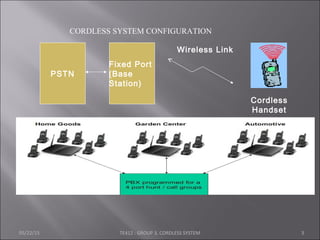
PSTN
Fixed Port
(Base
Station)
Wireless Link
Cordless
Handset
CORDLESS SYSTEM CONFIGURATION
05/22/15 TE412 : GROUP 3, CORDLESS SYSTEM 3
• An early standard for
analog cordless
telephony developed in
Europe. Originally CT0
Features;
 Operates in the 916MHz and
960MHz bands over paired
channels 25 kHz wide and
employs Frequency modulation
(FM).
 FDMA and FDD are used to
derive two separate channels,
one downstream and one
upstream each of which is 12.5
kHz wide.
05/22/15 TE412 : GROUP 3, CORDLESS SYSTEM 4
•Limited in range to approximately
150m.
•It lacks security
•CT1+ was intended as the basis for
public wireless service along lines of
telepoint which operates in the 887MHz
and 932MHz bands over 80 channels 25
kHz wide with one channel per carrier.
•CT1+ employs FDMA and FDD
• It employs TDMA and TDD
• It was originally supporting only
outgoing calls,
• Contemporary CT2
implementations support two
way calling
• Does not support handoff, so the
user must remain within the
range of the antenna used to set
up the call
• 10 mW maximum power output
• It uses Gaussian filtered GMSK
• Up to 100 meter (300 ft) range
• CT2 operates in the 864-868MHz
• CT2+, this is an improvement of
CT2 supporting two way calling
and call hand-off which uses
8MHz in the rang 944MHz to
952MHz.
05/22/15 TE412 : GROUP 3, CORDLESS SYSTEM 5
•A proprietary digital cordless telephone
system developed by Ericsson in 1990 as
a wireless office telecommunication
system (WOTS) for application in high-
density office environments that also
bases on TDMA and TDD at
approximately 8MHz bandwidth starting
from 944MHz.
CT-2 CT-3
• Typical CT users were sold a handset and base
station which they could connect to their own
home telephone system. Calls via the home base
station would be routed via the home telephone
line and in this configuration, the system was
identical to a standard cordless phone. When in
range, the user could receive incoming calls.
• E.g In CT-2, when in range user could receive
incoming calls and once out of range, the CT2 user
could find signs indicating a network base station
in the area, and make outgoing calls (but not
receive calls) using the network base station.
05/22/15 TE412 : GROUP 3, CORDLESS SYSTEM 6
 Japanese air interface
standard developed by
the Research and
Development Centre for
Radio Systems (RCR). The
PHS network interface
was specified by the
Telecommunications
Technical Committee of
Japan.
 It offers two –way
communications, data
services and Internet
services.05/22/15 TE412 : GROUP 3, CORDLESS SYSTEM 7
•PHS cells are small with
transmission power of base
station a maximum of 500 mW
and coverage about 2km in
LOS
•Uses TDMA/TDD for its radio
channel access method,
•Pi/4 DQPSK modulation at a
channel rate of 384kbps is
used on both forward and
backward links.
• Has capability to handover from one cell to another.
This makes PHS suitable for dense urban areas, but
impractical for rural areas, and the small cell size also
makes it difficult if not impossible to make calls from
rapidly moving vehicles.
• It supports seventy-seven radio channels, each 300 kHz
wide. Forty of the channels are designated for public
systems, and the other thirty-seven are used for home
or office use.
• It has low-cost base stations, and it supports "Dynamic
Cell Assignment" system,
• Modern PHS phone support many value-added
services such as high speed wireless data/ Internet
connection (64 kbit/s and higher), WWW access, e-
mailing, text messaging and even color image transfer.
05/22/15 TE412 : GROUP 3, CORDLESS SYSTEM 8
• Were published in 1992. The name has been
replaced by Digital Enhanced Coreless
Telephone .
• DECT is also based on TDMA/TDD.
• DECT is typically implemented as a wireless-
PBX connected to the PSTN.
• it is free wireless operates around 100 meters
outdoor and much less indoor around 50
meters
• Offers both speech and relatively high data rate
transmission capability (<300 kb/s).
05/22/15 TE412 : GROUP 3, CORDLESS SYSTEM 9
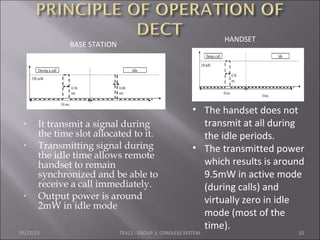
• It transmit a signal during
the time slot allocated to it.
• Transmitting signal during
the idle time allows remote
handset to remain
synchronized and be able to
receive a call immediately.
• Output power is around
2mW in idle mode
05/22/15 TE412 : GROUP 3, CORDLESS SYSTEM 10
• The handset does not
transmit at all during
the idle periods.
• The transmitted power
which results is around
9.5mW in active mode
(during calls) and
virtually zero in idle
mode (most of the
time).
BASE STATION
HANDSET
05/22/15 TE412 : GROUP 3, CORDLESS SYSTEM 11
• Residential- one base station can be used to
provide in house voice and data transfer
• Office
small office can be serviced by one base station.
Multiple base stations can be configured to
support large office.
• Tele-point also set up for the public places like
in airports
05/22/15 TE412 : GROUP 3, CORDLESS SYSTEM 12
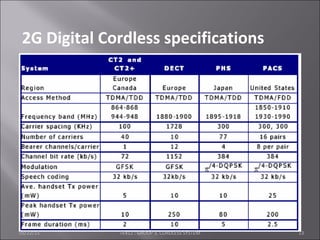
2G Digital Cordless specifications
05/22/15 TE412 : GROUP 3, CORDLESS SYSTEM 13
 There are very few homes in Tanzania that use
CT2 system due to decline (poor infrastructure)
of landline trunks.
 DECT is much used in many offices like Bank,
Industries and companies.
 PHS Declined due to decreasing costs of full
cellular service.
05/22/15 TE412 : GROUP 3, CORDLESS SYSTEM 14
05/22/15 TE412 : GROUP 3, CORDLESS SYSTEM 15

CORDLESS SYSTEMS

  • 1.
    GROUP 3: Name: Reg#: Paschal,Privatus 2011-04-05855 Richard, Evarist S 2011-04-00142 Nyakia,Thomas 2011-04-02271 Mchwampaka Davies 2011-04-03213 Urassa Richard E 2011-04-00697 Reuben, Elisha 2011-04-05998 05/22/15 TE412 : GROUP 3, CORDLESS SYSTEM 1
  • 2.
    CORDLESS means lackinga cord so cordless of an electrical/electronic appliance means that appliance requiring no wire leading to an external electricity source because of a self contained power supply i.e. powered by an internal battery  E.g cordless telephone Cordless telephone is a telephone with a wireless handset that communicates via radio waves with a base station connected to a fixed telephone line, usually within a limited range of its base station (which has the handset cradle). There are various generations of cordless system CT0,CT1,CT2,CT3,DECT,PHP.,PACS,PCS and PWTS 05/22/15 TE412 : GROUP 3, CORDLESS SYSTEM 2
  • 3.
    PSTN Fixed Port (Base Station) Wireless Link Cordless Handset CORDLESSSYSTEM CONFIGURATION 05/22/15 TE412 : GROUP 3, CORDLESS SYSTEM 3
  • 4.
    • An earlystandard for analog cordless telephony developed in Europe. Originally CT0 Features;  Operates in the 916MHz and 960MHz bands over paired channels 25 kHz wide and employs Frequency modulation (FM).  FDMA and FDD are used to derive two separate channels, one downstream and one upstream each of which is 12.5 kHz wide. 05/22/15 TE412 : GROUP 3, CORDLESS SYSTEM 4 •Limited in range to approximately 150m. •It lacks security •CT1+ was intended as the basis for public wireless service along lines of telepoint which operates in the 887MHz and 932MHz bands over 80 channels 25 kHz wide with one channel per carrier. •CT1+ employs FDMA and FDD
  • 5.
    • It employsTDMA and TDD • It was originally supporting only outgoing calls, • Contemporary CT2 implementations support two way calling • Does not support handoff, so the user must remain within the range of the antenna used to set up the call • 10 mW maximum power output • It uses Gaussian filtered GMSK • Up to 100 meter (300 ft) range • CT2 operates in the 864-868MHz • CT2+, this is an improvement of CT2 supporting two way calling and call hand-off which uses 8MHz in the rang 944MHz to 952MHz. 05/22/15 TE412 : GROUP 3, CORDLESS SYSTEM 5 •A proprietary digital cordless telephone system developed by Ericsson in 1990 as a wireless office telecommunication system (WOTS) for application in high- density office environments that also bases on TDMA and TDD at approximately 8MHz bandwidth starting from 944MHz. CT-2 CT-3
  • 6.
    • Typical CTusers were sold a handset and base station which they could connect to their own home telephone system. Calls via the home base station would be routed via the home telephone line and in this configuration, the system was identical to a standard cordless phone. When in range, the user could receive incoming calls. • E.g In CT-2, when in range user could receive incoming calls and once out of range, the CT2 user could find signs indicating a network base station in the area, and make outgoing calls (but not receive calls) using the network base station. 05/22/15 TE412 : GROUP 3, CORDLESS SYSTEM 6
  • 7.
     Japanese airinterface standard developed by the Research and Development Centre for Radio Systems (RCR). The PHS network interface was specified by the Telecommunications Technical Committee of Japan.  It offers two –way communications, data services and Internet services.05/22/15 TE412 : GROUP 3, CORDLESS SYSTEM 7 •PHS cells are small with transmission power of base station a maximum of 500 mW and coverage about 2km in LOS •Uses TDMA/TDD for its radio channel access method, •Pi/4 DQPSK modulation at a channel rate of 384kbps is used on both forward and backward links.
  • 8.
    • Has capabilityto handover from one cell to another. This makes PHS suitable for dense urban areas, but impractical for rural areas, and the small cell size also makes it difficult if not impossible to make calls from rapidly moving vehicles. • It supports seventy-seven radio channels, each 300 kHz wide. Forty of the channels are designated for public systems, and the other thirty-seven are used for home or office use. • It has low-cost base stations, and it supports "Dynamic Cell Assignment" system, • Modern PHS phone support many value-added services such as high speed wireless data/ Internet connection (64 kbit/s and higher), WWW access, e- mailing, text messaging and even color image transfer. 05/22/15 TE412 : GROUP 3, CORDLESS SYSTEM 8
  • 9.
    • Were publishedin 1992. The name has been replaced by Digital Enhanced Coreless Telephone . • DECT is also based on TDMA/TDD. • DECT is typically implemented as a wireless- PBX connected to the PSTN. • it is free wireless operates around 100 meters outdoor and much less indoor around 50 meters • Offers both speech and relatively high data rate transmission capability (<300 kb/s). 05/22/15 TE412 : GROUP 3, CORDLESS SYSTEM 9
  • 10.
    • It transmita signal during the time slot allocated to it. • Transmitting signal during the idle time allows remote handset to remain synchronized and be able to receive a call immediately. • Output power is around 2mW in idle mode 05/22/15 TE412 : GROUP 3, CORDLESS SYSTEM 10 • The handset does not transmit at all during the idle periods. • The transmitted power which results is around 9.5mW in active mode (during calls) and virtually zero in idle mode (most of the time). BASE STATION HANDSET
  • 11.
    05/22/15 TE412 :GROUP 3, CORDLESS SYSTEM 11
  • 12.
    • Residential- onebase station can be used to provide in house voice and data transfer • Office small office can be serviced by one base station. Multiple base stations can be configured to support large office. • Tele-point also set up for the public places like in airports 05/22/15 TE412 : GROUP 3, CORDLESS SYSTEM 12
  • 13.
    2G Digital Cordlessspecifications 05/22/15 TE412 : GROUP 3, CORDLESS SYSTEM 13
  • 14.
     There arevery few homes in Tanzania that use CT2 system due to decline (poor infrastructure) of landline trunks.  DECT is much used in many offices like Bank, Industries and companies.  PHS Declined due to decreasing costs of full cellular service. 05/22/15 TE412 : GROUP 3, CORDLESS SYSTEM 14
  • 15.
    05/22/15 TE412 :GROUP 3, CORDLESS SYSTEM 15