AT&T Views on 5G Architecture Evolution:
Early Phase 1 To Mature Phase 2 Deployment
Source: AT&T
R3-161772
© 2016 AT&T and the AT&T logo are trademarks of AT&T Intellectual Property.
Background
In light of the agreements on the Accelerated Phase 1 and the delineation of the various architectures to be developed, it is
important to consider the work approach and philosophy in 3GPP on several of the preferred architectures and to understand how
these architectures might be deployed and transitioned over time and across the 5G Phase 1 and Phase 2.
AT&T has the view that Option 7 would be the preferred first step in the path of initial 5G followed by Options 2 and/or Option 4.
(see Options listed in RP-161266)
However, recognizing the many factors that are in play the more practical approach may well be to pursue a migration from Option 3
to Option 7 to Option 2 and/or 4 evolution path. AT&T is of the view that a likely deployment and/or transition flow of the 3GPP 5G
Architecture options, based on 3GPP development timing and releases, would be:
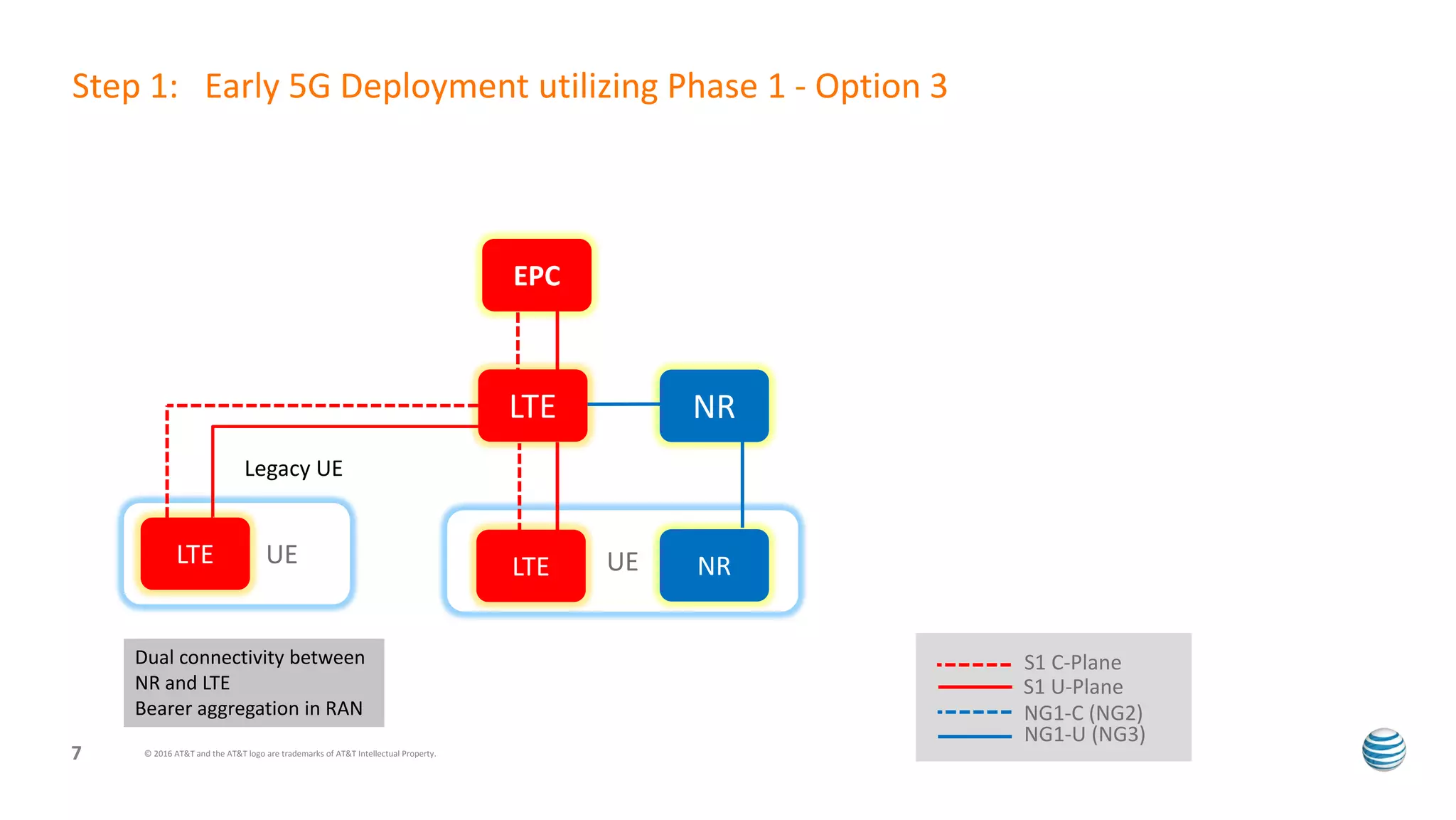
Step 1: Early 5G Deployment utilizing Phase 1 Option 3
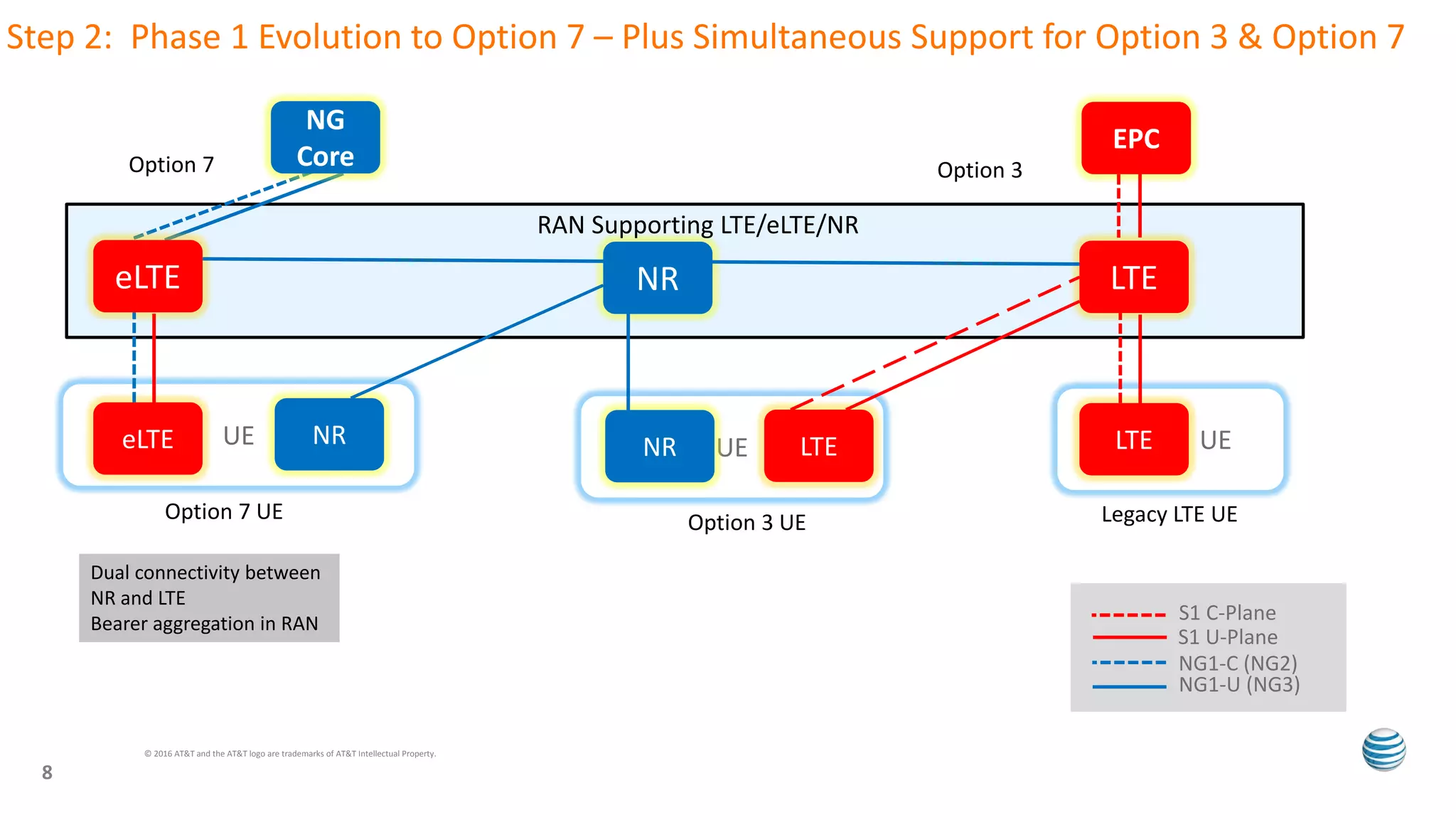
Step 2: Phase 1 Evolution to Option 7 – Plus Simultaneous Support for Option 3 & Option 7
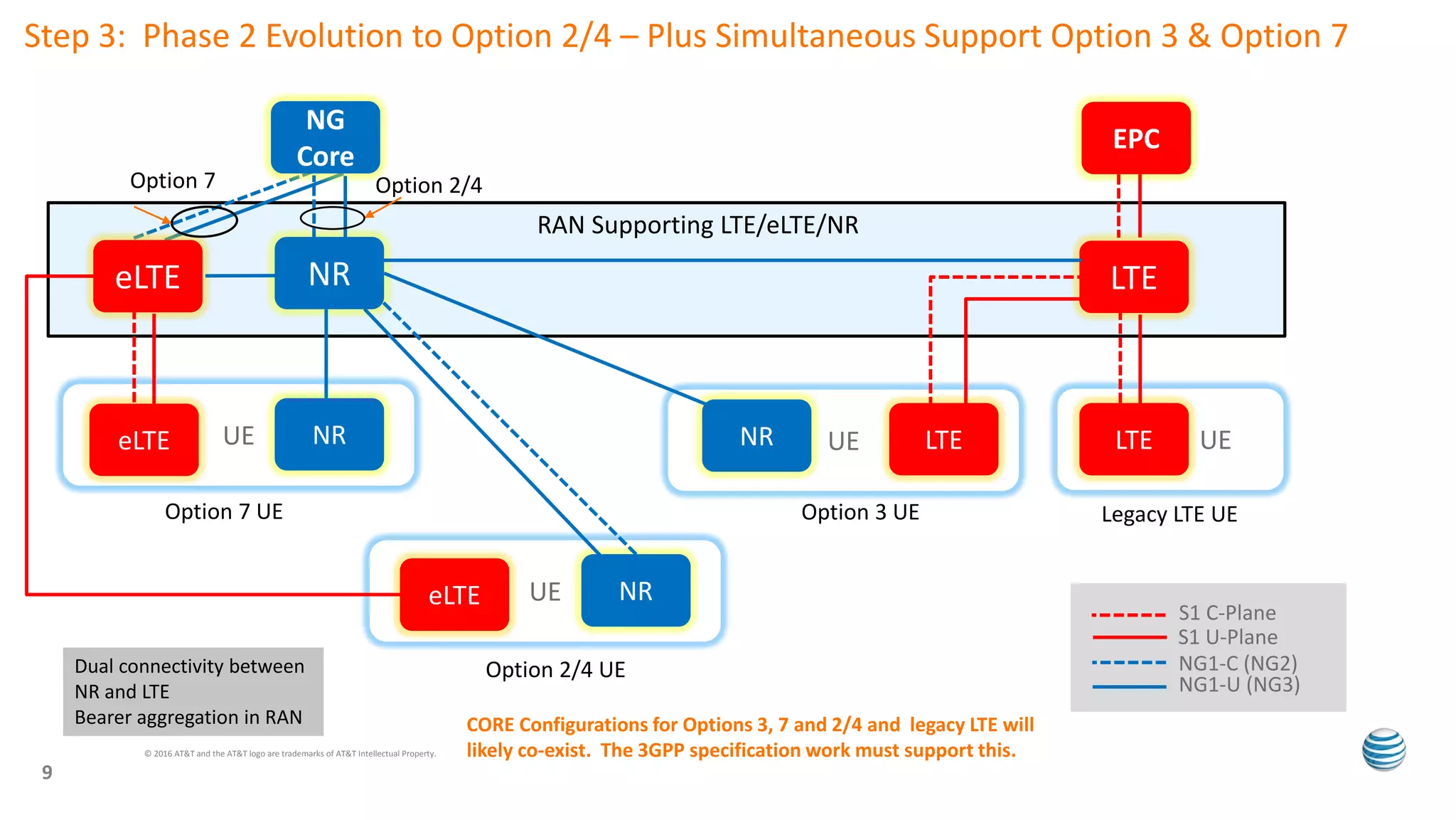
Step 3: Phase 2 Evolution to Option 2/4 – Plus Simultaneous Support Option 3 & Option 7
However, any alternative combinations or sequence of deployment and/or transition flows involving options 3, 7, 2/4 would similarly
need to be supported; e.g. Option 3 to Option 2/4, Option 7 to Option 2/4 +Option 3; etc.
© 2016 AT&T and the AT&T logo are trademarks of AT&T Intellectual Property.2
AT&T Views on 5G Architecture Evolution – Early Phase 1 To Mature Phase 2 Deployment
In order to support a variety of deployment needs by operators, AT&T proposes that the following
principles 1 - 6 be included as a text proposal in the relevant TRs in both the RAN2/3 and SA2 WGs.
© 2016 AT&T and the AT&T logo are trademarks of AT&T Intellectual Property.3
Proposal and TEXT Proposal
1. Option 7 should be progressed in parallel with Option 3 work
2. Option 3 development and specifications must be defined in a manner so as to facilitate transition to
deploying and utilizing Option 7, taking due note of the RAN, CORE and device impacts. Some
examples are:
a) The ability of the network to support both Option 3 or Option 7 UEs simultaneously on different frequency bands
such as MM wave and below 6 GHz
b) The ability to support LTE <---> NR handover scenarios
c) A UE operating on Option 7 when on a MM wave band and another UE using Option 3 in the same serving NR
node on the same MM wave band should be simultaneously supported for connectivity towards NG Core or EPC
respectively (supports 5G backward compatibility for initially deployed Option 3 UE)
d) A UE operating on Option 7 when on an LTE band and another UE using Option 3 in the same serving eNB on the
same LTE band should be simultaneously supported for connectivity towards NG Core or EPC respectively (supports
5G backward compatibility for initially deployed Option 3 UE)
3. Option 3 development and specifications should NOT preclude or hamper the transition to using
Option 7 and should be a software only upgrade
© 2016 AT&T and the AT&T logo are trademarks of AT&T Intellectual Property.
Slide 4
Principles on 5G Architecture Evolution
4. Option 7 development and specifications should NOT preclude or hamper the transition to using Option 2/4,
taking due note of the RAN, CORE and device impacts, and should be a software only upgrade
5. The industry movement to deployment of virtualized networks lends itself well to multiple architecture
Options being implemented simultaneously in deployed systems; i.e. the COREs for Options 3, 7 and 2/4 plus
legacy LTE are likely to coexist at the same time. The 3GPP specification work must support this.
a) Such a capability provides forward/backward compatibility and enhances transition with 5G
deployments over time from early deployments in Phase 1 through to Phase 2.
b) It also facilitates the support of different variants of UEs in same or differing bands utilizing different
control planes. Ultimately there would be transition to a single deployed architecture.
6. 3GPP needs to understand how much of Items 2 and 3 above are addressed in the standards specifications
and how much would fall under product design and deployment regimes while keeping in mind factors such as
roaming, migration aspects, as well as other pertinent aspects.
Figures relating to the proposals in the contribution are enclosed in the subsequent slides to aid in appreciating the
viewpoints.
© 2016 AT&T and the AT&T logo are trademarks of AT&T Intellectual Property.5
Principles on 5G Architecture Evolution (cont’d)
6 © 2016 AT&T and the AT&T logo are trademarks of AT&T Intellectual Property.
Deployment & Evolution of 5G Architectures
Over Time
© 2016 AT&T and the AT&T logo are trademarks of AT&T Intellectual Property.7
Step 1: Early 5G Deployment utilizing Phase 1 - Option 3
UE
LTE NR
EPC
LTE NR
Dual connectivity between
NR and LTE
Bearer aggregation in RAN
S1 C-Plane
S1 U-Plane
NG1-C (NG2)
NG1-U (NG3)
UELTE
Legacy UE
8
Step 2: Phase 1 Evolution to Option 7 – Plus Simultaneous Support for Option 3 & Option 7
UE
eLTE NR
NG
Core
eLTE NR
Dual connectivity between
NR and LTE
Bearer aggregation in RAN S1 C-Plane
S1 U-Plane
NG1-C (NG2)
NG1-U (NG3)
UE
LTE
EPC
LTEUE LTENR
Legacy LTE UEOption 3 UE
Option 7
Option 7 UE
Option 3
RAN Supporting LTE/eLTE/NR
© 2016 AT&T and the AT&T logo are trademarks of AT&T Intellectual Property.
9
Step 3: Phase 2 Evolution to Option 2/4 – Plus Simultaneous Support Option 3 & Option 7
UE
eLTE NR
NG
Core
eLTE NR
Dual connectivity between
NR and LTE
Bearer aggregation in RAN
S1 C-Plane
S1 U-Plane
NG1-C (NG2)
NG1-U (NG3)
UE
LTE
EPC
LTEUE LTENR
Legacy LTE UEOption 3 UE
Option 2/4 UE
Option 7 Option 2/4
UEeLTE NR
Option 7 UE
CORE Configurations for Options 3, 7 and 2/4 and legacy LTE will
likely co-exist. The 3GPP specification work must support this.
RAN Supporting LTE/eLTE/NR
© 2016 AT&T and the AT&T logo are trademarks of AT&T Intellectual Property.
Backup Slide - 3GPP Reference Documents
RP-161253
RP-161266
RP-161269
SP-160465
© 2016 AT&T and the AT&T logo are trademarks of AT&T Intellectual Property.10

AT&T View on LTE to 5G Network Migration

  • 1.
    AT&T Views on5G Architecture Evolution: Early Phase 1 To Mature Phase 2 Deployment Source: AT&T R3-161772 © 2016 AT&T and the AT&T logo are trademarks of AT&T Intellectual Property.
  • 2.
    Background In light ofthe agreements on the Accelerated Phase 1 and the delineation of the various architectures to be developed, it is important to consider the work approach and philosophy in 3GPP on several of the preferred architectures and to understand how these architectures might be deployed and transitioned over time and across the 5G Phase 1 and Phase 2. AT&T has the view that Option 7 would be the preferred first step in the path of initial 5G followed by Options 2 and/or Option 4. (see Options listed in RP-161266) However, recognizing the many factors that are in play the more practical approach may well be to pursue a migration from Option 3 to Option 7 to Option 2 and/or 4 evolution path. AT&T is of the view that a likely deployment and/or transition flow of the 3GPP 5G Architecture options, based on 3GPP development timing and releases, would be: Step 1: Early 5G Deployment utilizing Phase 1 Option 3 Step 2: Phase 1 Evolution to Option 7 – Plus Simultaneous Support for Option 3 & Option 7 Step 3: Phase 2 Evolution to Option 2/4 – Plus Simultaneous Support Option 3 & Option 7 However, any alternative combinations or sequence of deployment and/or transition flows involving options 3, 7, 2/4 would similarly need to be supported; e.g. Option 3 to Option 2/4, Option 7 to Option 2/4 +Option 3; etc. © 2016 AT&T and the AT&T logo are trademarks of AT&T Intellectual Property.2 AT&T Views on 5G Architecture Evolution – Early Phase 1 To Mature Phase 2 Deployment
  • 3.
    In order tosupport a variety of deployment needs by operators, AT&T proposes that the following principles 1 - 6 be included as a text proposal in the relevant TRs in both the RAN2/3 and SA2 WGs. © 2016 AT&T and the AT&T logo are trademarks of AT&T Intellectual Property.3 Proposal and TEXT Proposal
  • 4.
    1. Option 7should be progressed in parallel with Option 3 work 2. Option 3 development and specifications must be defined in a manner so as to facilitate transition to deploying and utilizing Option 7, taking due note of the RAN, CORE and device impacts. Some examples are: a) The ability of the network to support both Option 3 or Option 7 UEs simultaneously on different frequency bands such as MM wave and below 6 GHz b) The ability to support LTE <---> NR handover scenarios c) A UE operating on Option 7 when on a MM wave band and another UE using Option 3 in the same serving NR node on the same MM wave band should be simultaneously supported for connectivity towards NG Core or EPC respectively (supports 5G backward compatibility for initially deployed Option 3 UE) d) A UE operating on Option 7 when on an LTE band and another UE using Option 3 in the same serving eNB on the same LTE band should be simultaneously supported for connectivity towards NG Core or EPC respectively (supports 5G backward compatibility for initially deployed Option 3 UE) 3. Option 3 development and specifications should NOT preclude or hamper the transition to using Option 7 and should be a software only upgrade © 2016 AT&T and the AT&T logo are trademarks of AT&T Intellectual Property. Slide 4 Principles on 5G Architecture Evolution
  • 5.
    4. Option 7development and specifications should NOT preclude or hamper the transition to using Option 2/4, taking due note of the RAN, CORE and device impacts, and should be a software only upgrade 5. The industry movement to deployment of virtualized networks lends itself well to multiple architecture Options being implemented simultaneously in deployed systems; i.e. the COREs for Options 3, 7 and 2/4 plus legacy LTE are likely to coexist at the same time. The 3GPP specification work must support this. a) Such a capability provides forward/backward compatibility and enhances transition with 5G deployments over time from early deployments in Phase 1 through to Phase 2. b) It also facilitates the support of different variants of UEs in same or differing bands utilizing different control planes. Ultimately there would be transition to a single deployed architecture. 6. 3GPP needs to understand how much of Items 2 and 3 above are addressed in the standards specifications and how much would fall under product design and deployment regimes while keeping in mind factors such as roaming, migration aspects, as well as other pertinent aspects. Figures relating to the proposals in the contribution are enclosed in the subsequent slides to aid in appreciating the viewpoints. © 2016 AT&T and the AT&T logo are trademarks of AT&T Intellectual Property.5 Principles on 5G Architecture Evolution (cont’d)
  • 6.
    6 © 2016AT&T and the AT&T logo are trademarks of AT&T Intellectual Property. Deployment & Evolution of 5G Architectures Over Time
  • 7.
    © 2016 AT&Tand the AT&T logo are trademarks of AT&T Intellectual Property.7 Step 1: Early 5G Deployment utilizing Phase 1 - Option 3 UE LTE NR EPC LTE NR Dual connectivity between NR and LTE Bearer aggregation in RAN S1 C-Plane S1 U-Plane NG1-C (NG2) NG1-U (NG3) UELTE Legacy UE
  • 8.
    8 Step 2: Phase1 Evolution to Option 7 – Plus Simultaneous Support for Option 3 & Option 7 UE eLTE NR NG Core eLTE NR Dual connectivity between NR and LTE Bearer aggregation in RAN S1 C-Plane S1 U-Plane NG1-C (NG2) NG1-U (NG3) UE LTE EPC LTEUE LTENR Legacy LTE UEOption 3 UE Option 7 Option 7 UE Option 3 RAN Supporting LTE/eLTE/NR © 2016 AT&T and the AT&T logo are trademarks of AT&T Intellectual Property.
  • 9.
    9 Step 3: Phase2 Evolution to Option 2/4 – Plus Simultaneous Support Option 3 & Option 7 UE eLTE NR NG Core eLTE NR Dual connectivity between NR and LTE Bearer aggregation in RAN S1 C-Plane S1 U-Plane NG1-C (NG2) NG1-U (NG3) UE LTE EPC LTEUE LTENR Legacy LTE UEOption 3 UE Option 2/4 UE Option 7 Option 2/4 UEeLTE NR Option 7 UE CORE Configurations for Options 3, 7 and 2/4 and legacy LTE will likely co-exist. The 3GPP specification work must support this. RAN Supporting LTE/eLTE/NR © 2016 AT&T and the AT&T logo are trademarks of AT&T Intellectual Property.
  • 10.
    Backup Slide -3GPP Reference Documents RP-161253 RP-161266 RP-161269 SP-160465 © 2016 AT&T and the AT&T logo are trademarks of AT&T Intellectual Property.10