Copyright © 2005 Thomson Business & Professional Publishing.
All rights reserved.
ROBERT L. MATHIS
JOHN H. JACKSON
PowerPoint Presentation by Charlie Cook
The University of West Alabama
Training Human ResourcesTraining Human Resources
Chapter 9Chapter 9
SECTION 3SECTION 3
Training and DevelopingTraining and Developing
Human ResourcesHuman Resources
Copyright © 2005 Thomson Business & Professional 9–2
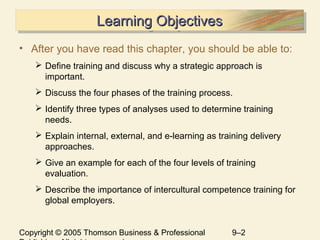
Learning ObjectivesLearning ObjectivesLearning ObjectivesLearning Objectives
• After you have read this chapter, you should be able to:
 Define training and discuss why a strategic approach is
important.
 Discuss the four phases of the training process.
 Identify three types of analyses used to determine training
needs.
 Explain internal, external, and e-learning as training delivery
approaches.
 Give an example for each of the four levels of training
evaluation.
 Describe the importance of intercultural competence training for
global employers.
Copyright © 2005 Thomson Business & Professional 9–3
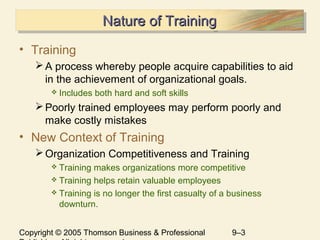
Nature of TrainingNature of TrainingNature of TrainingNature of Training
• Training
A process whereby people acquire capabilities to aid
in the achievement of organizational goals.
 Includes both hard and soft skills
Poorly trained employees may perform poorly and
make costly mistakes
• New Context of Training
Organization Competitiveness and Training
 Training makes organizations more competitive
 Training helps retain valuable employees
 Training is no longer the first casualty of a business
downturn.
Copyright © 2005 Thomson Business & Professional 9–4
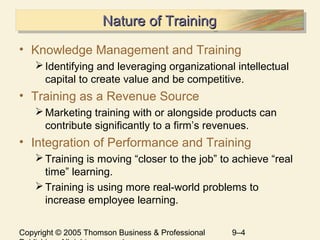
Nature of TrainingNature of TrainingNature of TrainingNature of Training
• Knowledge Management and Training
Identifying and leveraging organizational intellectual
capital to create value and be competitive.
• Training as a Revenue Source
Marketing training with or alongside products can
contribute significantly to a firm’s revenues.
• Integration of Performance and Training
Training is moving “closer to the job” to achieve “real
time” learning.
Training is using more real-world problems to
increase employee learning.
Copyright © 2005 Thomson Business & Professional 9–5
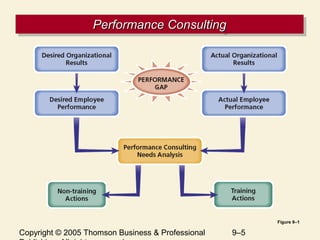
Performance ConsultingPerformance ConsultingPerformance ConsultingPerformance Consulting
Figure 9–1
Copyright © 2005 Thomson Business & Professional 9–6
Performance ConsultingPerformance ConsultingPerformance ConsultingPerformance Consulting
• Performance Consulting
A process in which a trainer and the organizational
client work together (“bundled solution”) to determine
what needs to be done to improve results
Performance consulting approach:
 Focusing on identifying and addressing root causes of
performance problems.
 Recognizing that the interaction of individual and
organizational factors influences employee performance.
 Documenting the actions and accomplishments of high
performers and comparing them with actions of more typical
performers.
Copyright © 2005 Thomson Business & Professional 9–7
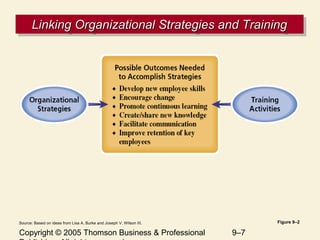
Linking Organizational Strategies and TrainingLinking Organizational Strategies and TrainingLinking Organizational Strategies and TrainingLinking Organizational Strategies and Training
Figure 9–2Source: Based on ideas from Lisa A. Burke and Joseph V. Wilson III.
Copyright © 2005 Thomson Business & Professional 9–8
Benefits of Strategic TrainingBenefits of Strategic TrainingBenefits of Strategic TrainingBenefits of Strategic Training
• HR and Training Professionals
Are more likely to get involved with the business,
partner with operating managers to help solve
problems, and to make significant contributions to
organizational results.
Are less likely to chase fads or the hottest or latest
type of training gimmick.
Are less likely to think that training alone can solve
most employee or organizational performance
problems.
Copyright © 2005 Thomson Business & Professional 9–9
Training and Global StrategiesTraining and Global StrategiesTraining and Global StrategiesTraining and Global Strategies
• Successful development of global strategies is
inhibited primarily by training deficits such as:
Workforces with disparate competencies
A declining pool of U.S. employees willing to go
overseas
Slow, expensive, and inflexible “on campus” training
options
Copyright © 2005 Thomson Business & Professional 9–10
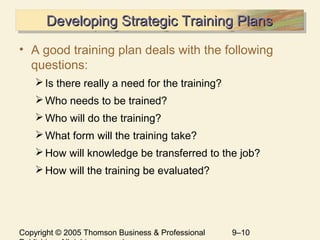
Developing Strategic Training PlansDeveloping Strategic Training PlansDeveloping Strategic Training PlansDeveloping Strategic Training Plans
• A good training plan deals with the following
questions:
Is there really a need for the training?
Who needs to be trained?
Who will do the training?
What form will the training take?
How will knowledge be transferred to the job?
How will the training be evaluated?
Copyright © 2005 Thomson Business & Professional 9–11
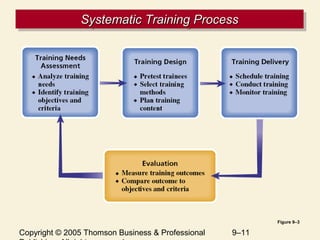
Systematic Training ProcessSystematic Training ProcessSystematic Training ProcessSystematic Training Process
Figure 9–3
Copyright © 2005 Thomson Business & Professional 9–12
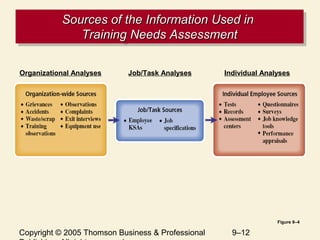
Sources of the Information Used inSources of the Information Used in
Training Needs AssessmentTraining Needs Assessment
Sources of the Information Used inSources of the Information Used in
Training Needs AssessmentTraining Needs Assessment
Figure 9–4
Organizational Analyses Job/Task Analyses Individual Analyses
Copyright © 2005 Thomson Business & Professional 9–13
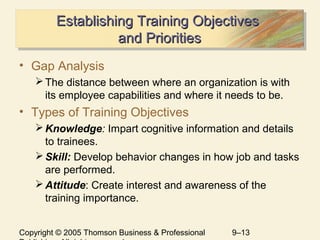
Establishing Training ObjectivesEstablishing Training Objectives
and Prioritiesand Priorities
Establishing Training ObjectivesEstablishing Training Objectives
and Prioritiesand Priorities
• Gap Analysis
The distance between where an organization is with
its employee capabilities and where it needs to be.
• Types of Training Objectives
Knowledge: Impart cognitive information and details
to trainees.
Skill: Develop behavior changes in how job and tasks
are performed.
Attitude: Create interest and awareness of the
training importance.
Copyright © 2005 Thomson Business & Professional 9–14
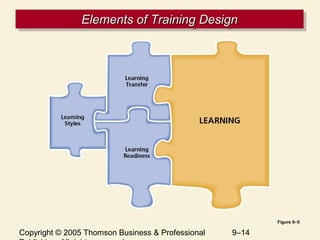
Elements of Training DesignElements of Training DesignElements of Training DesignElements of Training Design
Figure 9–5
Copyright © 2005 Thomson Business & Professional 9–15
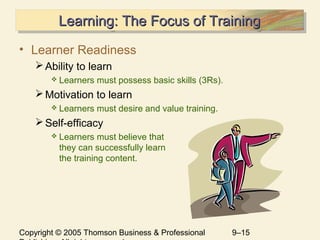
Learning: The Focus of TrainingLearning: The Focus of TrainingLearning: The Focus of TrainingLearning: The Focus of Training
• Learner Readiness
Ability to learn
 Learners must possess basic skills (3Rs).
Motivation to learn
 Learners must desire and value training.
Self-efficacy
 Learners must believe that
they can successfully learn
the training content.
Copyright © 2005 Thomson Business & Professional 9–16
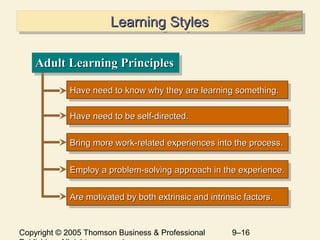
Learning StylesLearning StylesLearning StylesLearning Styles
Adult Learning PrinciplesAdult Learning PrinciplesAdult Learning PrinciplesAdult Learning Principles
Have need to know why they are learning something.Have need to know why they are learning something.Have need to know why they are learning something.Have need to know why they are learning something.
Have need to be self-directed.Have need to be self-directed.Have need to be self-directed.Have need to be self-directed.
Bring more work-related experiences into the process.Bring more work-related experiences into the process.Bring more work-related experiences into the process.Bring more work-related experiences into the process.
Employ a problem-solving approach in the experience.Employ a problem-solving approach in the experience.Employ a problem-solving approach in the experience.Employ a problem-solving approach in the experience.
Are motivated by both extrinsic and intrinsic factors.Are motivated by both extrinsic and intrinsic factors.Are motivated by both extrinsic and intrinsic factors.Are motivated by both extrinsic and intrinsic factors.
Copyright © 2005 Thomson Business & Professional 9–17
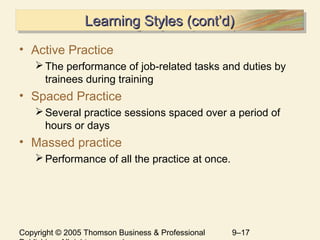
Learning Styles (cont’d)Learning Styles (cont’d)Learning Styles (cont’d)Learning Styles (cont’d)
• Active Practice
The performance of job-related tasks and duties by
trainees during training
• Spaced Practice
Several practice sessions spaced over a period of
hours or days
• Massed practice
Performance of all the practice at once.
Copyright © 2005 Thomson Business & Professional 9–18
Learning Styles (cont’d)Learning Styles (cont’d)Learning Styles (cont’d)Learning Styles (cont’d)
• Behavior Modeling
Copying someone else’s behavior by observing how
another person deals with a problem.
• Reinforcement
Law of effect states that people tend to repeat
behaviors that are rewarded and avoid behaviors that
are punished.
• Immediate Confirmation
Reinforcement and feedback are most effective when
given as soon as possible after training.
Copyright © 2005 Thomson Business & Professional 9–19
Learning Styles (cont’d)Learning Styles (cont’d)Learning Styles (cont’d)Learning Styles (cont’d)
• Transfer of Training
Effective transfer occurs when trainees actually use
on the job what they learned in training.
 Trainees take what was learned in training and apply it to the
job context in which they work.
 Employees maintain use of the learned material over time.
Increasing the transfer of training
 Offering trainees an overview of training content and process
before the actual training helps with both short-term and
longer-term training transfer.
 Ensuring that the training mirrors the job context as much as
possible.
Copyright © 2005 Thomson Business & Professional 9–20
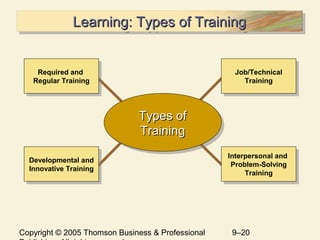
Learning: Types of TrainingLearning: Types of TrainingLearning: Types of TrainingLearning: Types of Training
Developmental and
Innovative Training
Developmental and
Innovative Training
Required and
Regular Training
Required and
Regular Training
Job/Technical
Training
Job/Technical
Training
Interpersonal and
Problem-Solving
Training
Interpersonal and
Problem-Solving
Training
Types ofTypes of
TrainingTraining
Types ofTypes of
TrainingTraining
Copyright © 2005 Thomson Business & Professional 9–21
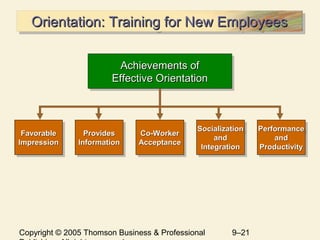
Orientation: Training for New EmployeesOrientation: Training for New EmployeesOrientation: Training for New EmployeesOrientation: Training for New Employees
Achievements ofAchievements of
Effective OrientationEffective Orientation
Achievements ofAchievements of
Effective OrientationEffective Orientation
Co-WorkerCo-Worker
AcceptanceAcceptance
Co-WorkerCo-Worker
AcceptanceAcceptance
FavorableFavorable
ImpressionImpression
FavorableFavorable
ImpressionImpression
ProvidesProvides
InformationInformation
ProvidesProvides
InformationInformation
SocializationSocialization
andand
IntegrationIntegration
SocializationSocialization
andand
IntegrationIntegration
PerformancePerformance
andand
ProductivityProductivity
PerformancePerformance
andand
ProductivityProductivity
Copyright © 2005 Thomson Business & Professional 9–22
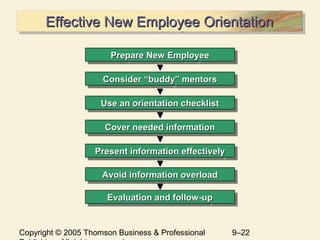
Effective New Employee OrientationEffective New Employee OrientationEffective New Employee OrientationEffective New Employee Orientation
Prepare New EmployeePrepare New EmployeePrepare New EmployeePrepare New Employee
Consider “buddy” mentorsConsider “buddy” mentorsConsider “buddy” mentorsConsider “buddy” mentors
Use an orientation checklistUse an orientation checklistUse an orientation checklistUse an orientation checklist
Cover needed informationCover needed informationCover needed informationCover needed information
Present information effectivelyPresent information effectivelyPresent information effectivelyPresent information effectively
Avoid information overloadAvoid information overloadAvoid information overloadAvoid information overload
Evaluation and follow-upEvaluation and follow-upEvaluation and follow-upEvaluation and follow-up
Copyright © 2005 Thomson Business & Professional 9–23
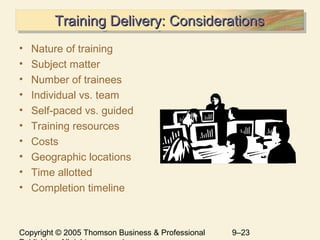
Training Delivery: ConsiderationsTraining Delivery: ConsiderationsTraining Delivery: ConsiderationsTraining Delivery: Considerations
• Nature of training
• Subject matter
• Number of trainees
• Individual vs. team
• Self-paced vs. guided
• Training resources
• Costs
• Geographic locations
• Time allotted
• Completion timeline
Copyright © 2005 Thomson Business & Professional 9–24
Internal TrainingInternal TrainingInternal TrainingInternal Training
• Informal Training
Training that occurs through interactions and
feedback among employees.
• On-the-Job Training (OJT)
Based on a guided form of training known as job
instruction training (JIT)
Problems with OJT
 Poorly-qualified or indifferent trainers
 Disruption of regular work
 Bad or incorrect habits are passed on
Copyright © 2005 Thomson Business & Professional 9–25
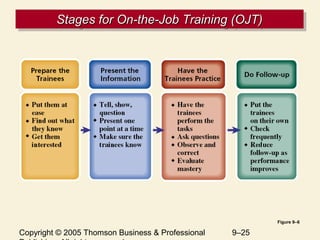
Stages for On-the-Job Training (OJT)Stages for On-the-Job Training (OJT)Stages for On-the-Job Training (OJT)Stages for On-the-Job Training (OJT)
Figure 9–6
Copyright © 2005 Thomson Business & Professional 9–26
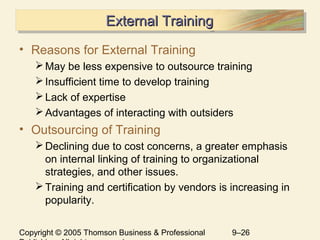
External TrainingExternal TrainingExternal TrainingExternal Training
• Reasons for External Training
May be less expensive to outsource training
Insufficient time to develop training
Lack of expertise
Advantages of interacting with outsiders
• Outsourcing of Training
Declining due to cost concerns, a greater emphasis
on internal linking of training to organizational
strategies, and other issues.
Training and certification by vendors is increasing in
popularity.
Copyright © 2005 Thomson Business & Professional 9–27
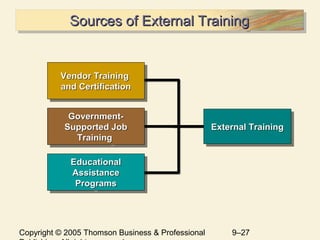
Sources of External TrainingSources of External TrainingSources of External TrainingSources of External Training
Vendor TrainingVendor Training
and Certificationand Certification
Vendor TrainingVendor Training
and Certificationand Certification
Government-Government-
Supported JobSupported Job
TrainingTraining
Government-Government-
Supported JobSupported Job
TrainingTraining
EducationalEducational
AssistanceAssistance
ProgramsPrograms
EducationalEducational
AssistanceAssistance
ProgramsPrograms
External TrainingExternal TrainingExternal TrainingExternal Training
Copyright © 2005 Thomson Business & Professional 9–28
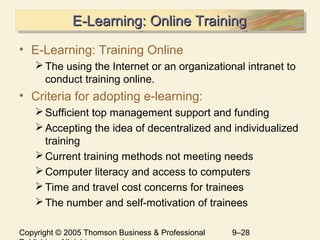
E-Learning: Online TrainingE-Learning: Online TrainingE-Learning: Online TrainingE-Learning: Online Training
• E-Learning: Training Online
The using the Internet or an organizational intranet to
conduct training online.
• Criteria for adopting e-learning:
Sufficient top management support and funding
Accepting the idea of decentralized and individualized
training
Current training methods not meeting needs
Computer literacy and access to computers
Time and travel cost concerns for trainees
The number and self-motivation of trainees
Copyright © 2005 Thomson Business & Professional 9–29
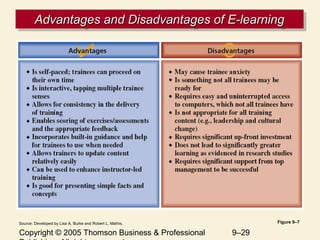
Advantages and Disadvantages of E-learningAdvantages and Disadvantages of E-learningAdvantages and Disadvantages of E-learningAdvantages and Disadvantages of E-learning
Figure 9–7Source: Developed by Lisa A. Burke and Robert L. Mathis.
Copyright © 2005 Thomson Business & Professional 9–30
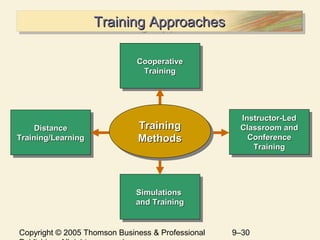
Training ApproachesTraining ApproachesTraining ApproachesTraining Approaches
DistanceDistance
Training/LearningTraining/Learning
DistanceDistance
Training/LearningTraining/Learning
CooperativeCooperative
TrainingTraining
CooperativeCooperative
TrainingTraining
Instructor-LedInstructor-Led
Classroom andClassroom and
ConferenceConference
TrainingTraining
Instructor-LedInstructor-Led
Classroom andClassroom and
ConferenceConference
TrainingTraining
SimulationsSimulations
and Trainingand Training
SimulationsSimulations
and Trainingand Training
TrainingTraining
MethodsMethods
TrainingTraining
MethodsMethods
Copyright © 2005 Thomson Business & Professional 9–31
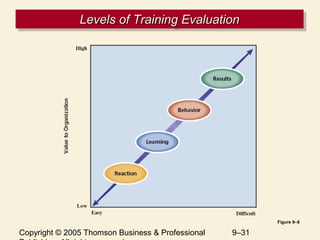
Levels of Training EvaluationLevels of Training EvaluationLevels of Training EvaluationLevels of Training Evaluation
Figure 9–8
Copyright © 2005 Thomson Business & Professional 9–32
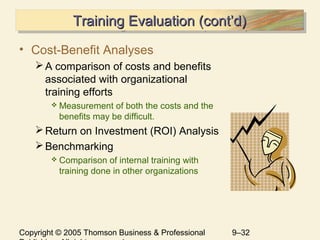
Training Evaluation (cont’d)Training Evaluation (cont’d)Training Evaluation (cont’d)Training Evaluation (cont’d)
• Cost-Benefit Analyses
A comparison of costs and benefits
associated with organizational
training efforts
 Measurement of both the costs and the
benefits may be difficult.
Return on Investment (ROI) Analysis
Benchmarking
 Comparison of internal training with
training done in other organizations
Copyright © 2005 Thomson Business & Professional 9–33
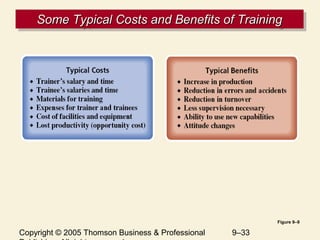
Some Typical Costs and Benefits of TrainingSome Typical Costs and Benefits of TrainingSome Typical Costs and Benefits of TrainingSome Typical Costs and Benefits of Training
Figure 9–9
Copyright © 2005 Thomson Business & Professional 9–34
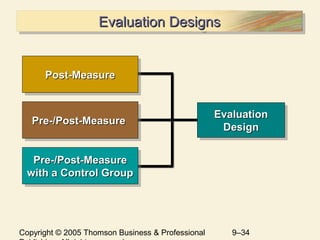
Evaluation DesignsEvaluation DesignsEvaluation DesignsEvaluation Designs
Post-MeasurePost-MeasurePost-MeasurePost-Measure
Pre-/Post-MeasurePre-/Post-MeasurePre-/Post-MeasurePre-/Post-Measure
Pre-/Post-MeasurePre-/Post-Measure
with a Control Groupwith a Control Group
Pre-/Post-MeasurePre-/Post-Measure
with a Control Groupwith a Control Group
EvaluationEvaluation
DesignDesign
EvaluationEvaluation
DesignDesign
Copyright © 2005 Thomson Business & Professional 9–35
Training for Global AssignmentsTraining for Global Assignments
• Only 50%–60% of global employers provide
formal training programs for expatriates and their
families.
Topics covered in pre-departure training:
 Daily living conditions, cultural customs, business issues,
country history, climate, and transportation and
communication systems.
Foreign firms operating in the United States conduct
training programs to prepare their employees for the
food, customs, labor and HR practices, and other
facets of working and living in the U.S.
Copyright © 2005 Thomson Business & Professional 9–36
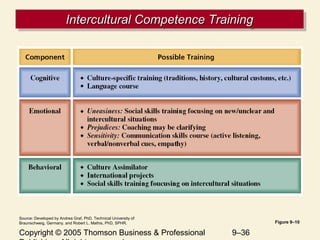
Intercultural Competence TrainingIntercultural Competence TrainingIntercultural Competence TrainingIntercultural Competence Training
Figure 9–10
Source: Developed by Andrea Graf, PhD, Technical University of
Braunschweig, Germany, and Robert L. Mathis, PhD, SPHR.

Chapter 9 Selecting Human Resources

  • 1.
    Copyright © 2005Thomson Business & Professional Publishing. All rights reserved. ROBERT L. MATHIS JOHN H. JACKSON PowerPoint Presentation by Charlie Cook The University of West Alabama Training Human ResourcesTraining Human Resources Chapter 9Chapter 9 SECTION 3SECTION 3 Training and DevelopingTraining and Developing Human ResourcesHuman Resources
  • 2.
    Copyright © 2005Thomson Business & Professional 9–2 Learning ObjectivesLearning ObjectivesLearning ObjectivesLearning Objectives • After you have read this chapter, you should be able to:  Define training and discuss why a strategic approach is important.  Discuss the four phases of the training process.  Identify three types of analyses used to determine training needs.  Explain internal, external, and e-learning as training delivery approaches.  Give an example for each of the four levels of training evaluation.  Describe the importance of intercultural competence training for global employers.
  • 3.
    Copyright © 2005Thomson Business & Professional 9–3 Nature of TrainingNature of TrainingNature of TrainingNature of Training • Training A process whereby people acquire capabilities to aid in the achievement of organizational goals.  Includes both hard and soft skills Poorly trained employees may perform poorly and make costly mistakes • New Context of Training Organization Competitiveness and Training  Training makes organizations more competitive  Training helps retain valuable employees  Training is no longer the first casualty of a business downturn.
  • 4.
    Copyright © 2005Thomson Business & Professional 9–4 Nature of TrainingNature of TrainingNature of TrainingNature of Training • Knowledge Management and Training Identifying and leveraging organizational intellectual capital to create value and be competitive. • Training as a Revenue Source Marketing training with or alongside products can contribute significantly to a firm’s revenues. • Integration of Performance and Training Training is moving “closer to the job” to achieve “real time” learning. Training is using more real-world problems to increase employee learning.
  • 5.
    Copyright © 2005Thomson Business & Professional 9–5 Performance ConsultingPerformance ConsultingPerformance ConsultingPerformance Consulting Figure 9–1
  • 6.
    Copyright © 2005Thomson Business & Professional 9–6 Performance ConsultingPerformance ConsultingPerformance ConsultingPerformance Consulting • Performance Consulting A process in which a trainer and the organizational client work together (“bundled solution”) to determine what needs to be done to improve results Performance consulting approach:  Focusing on identifying and addressing root causes of performance problems.  Recognizing that the interaction of individual and organizational factors influences employee performance.  Documenting the actions and accomplishments of high performers and comparing them with actions of more typical performers.
  • 7.
    Copyright © 2005Thomson Business & Professional 9–7 Linking Organizational Strategies and TrainingLinking Organizational Strategies and TrainingLinking Organizational Strategies and TrainingLinking Organizational Strategies and Training Figure 9–2Source: Based on ideas from Lisa A. Burke and Joseph V. Wilson III.
  • 8.
    Copyright © 2005Thomson Business & Professional 9–8 Benefits of Strategic TrainingBenefits of Strategic TrainingBenefits of Strategic TrainingBenefits of Strategic Training • HR and Training Professionals Are more likely to get involved with the business, partner with operating managers to help solve problems, and to make significant contributions to organizational results. Are less likely to chase fads or the hottest or latest type of training gimmick. Are less likely to think that training alone can solve most employee or organizational performance problems.
  • 9.
    Copyright © 2005Thomson Business & Professional 9–9 Training and Global StrategiesTraining and Global StrategiesTraining and Global StrategiesTraining and Global Strategies • Successful development of global strategies is inhibited primarily by training deficits such as: Workforces with disparate competencies A declining pool of U.S. employees willing to go overseas Slow, expensive, and inflexible “on campus” training options
  • 10.
    Copyright © 2005Thomson Business & Professional 9–10 Developing Strategic Training PlansDeveloping Strategic Training PlansDeveloping Strategic Training PlansDeveloping Strategic Training Plans • A good training plan deals with the following questions: Is there really a need for the training? Who needs to be trained? Who will do the training? What form will the training take? How will knowledge be transferred to the job? How will the training be evaluated?
  • 11.
    Copyright © 2005Thomson Business & Professional 9–11 Systematic Training ProcessSystematic Training ProcessSystematic Training ProcessSystematic Training Process Figure 9–3
  • 12.
    Copyright © 2005Thomson Business & Professional 9–12 Sources of the Information Used inSources of the Information Used in Training Needs AssessmentTraining Needs Assessment Sources of the Information Used inSources of the Information Used in Training Needs AssessmentTraining Needs Assessment Figure 9–4 Organizational Analyses Job/Task Analyses Individual Analyses
  • 13.
    Copyright © 2005Thomson Business & Professional 9–13 Establishing Training ObjectivesEstablishing Training Objectives and Prioritiesand Priorities Establishing Training ObjectivesEstablishing Training Objectives and Prioritiesand Priorities • Gap Analysis The distance between where an organization is with its employee capabilities and where it needs to be. • Types of Training Objectives Knowledge: Impart cognitive information and details to trainees. Skill: Develop behavior changes in how job and tasks are performed. Attitude: Create interest and awareness of the training importance.
  • 14.
    Copyright © 2005Thomson Business & Professional 9–14 Elements of Training DesignElements of Training DesignElements of Training DesignElements of Training Design Figure 9–5
  • 15.
    Copyright © 2005Thomson Business & Professional 9–15 Learning: The Focus of TrainingLearning: The Focus of TrainingLearning: The Focus of TrainingLearning: The Focus of Training • Learner Readiness Ability to learn  Learners must possess basic skills (3Rs). Motivation to learn  Learners must desire and value training. Self-efficacy  Learners must believe that they can successfully learn the training content.
  • 16.
    Copyright © 2005Thomson Business & Professional 9–16 Learning StylesLearning StylesLearning StylesLearning Styles Adult Learning PrinciplesAdult Learning PrinciplesAdult Learning PrinciplesAdult Learning Principles Have need to know why they are learning something.Have need to know why they are learning something.Have need to know why they are learning something.Have need to know why they are learning something. Have need to be self-directed.Have need to be self-directed.Have need to be self-directed.Have need to be self-directed. Bring more work-related experiences into the process.Bring more work-related experiences into the process.Bring more work-related experiences into the process.Bring more work-related experiences into the process. Employ a problem-solving approach in the experience.Employ a problem-solving approach in the experience.Employ a problem-solving approach in the experience.Employ a problem-solving approach in the experience. Are motivated by both extrinsic and intrinsic factors.Are motivated by both extrinsic and intrinsic factors.Are motivated by both extrinsic and intrinsic factors.Are motivated by both extrinsic and intrinsic factors.
  • 17.
    Copyright © 2005Thomson Business & Professional 9–17 Learning Styles (cont’d)Learning Styles (cont’d)Learning Styles (cont’d)Learning Styles (cont’d) • Active Practice The performance of job-related tasks and duties by trainees during training • Spaced Practice Several practice sessions spaced over a period of hours or days • Massed practice Performance of all the practice at once.
  • 18.
    Copyright © 2005Thomson Business & Professional 9–18 Learning Styles (cont’d)Learning Styles (cont’d)Learning Styles (cont’d)Learning Styles (cont’d) • Behavior Modeling Copying someone else’s behavior by observing how another person deals with a problem. • Reinforcement Law of effect states that people tend to repeat behaviors that are rewarded and avoid behaviors that are punished. • Immediate Confirmation Reinforcement and feedback are most effective when given as soon as possible after training.
  • 19.
    Copyright © 2005Thomson Business & Professional 9–19 Learning Styles (cont’d)Learning Styles (cont’d)Learning Styles (cont’d)Learning Styles (cont’d) • Transfer of Training Effective transfer occurs when trainees actually use on the job what they learned in training.  Trainees take what was learned in training and apply it to the job context in which they work.  Employees maintain use of the learned material over time. Increasing the transfer of training  Offering trainees an overview of training content and process before the actual training helps with both short-term and longer-term training transfer.  Ensuring that the training mirrors the job context as much as possible.
  • 20.
    Copyright © 2005Thomson Business & Professional 9–20 Learning: Types of TrainingLearning: Types of TrainingLearning: Types of TrainingLearning: Types of Training Developmental and Innovative Training Developmental and Innovative Training Required and Regular Training Required and Regular Training Job/Technical Training Job/Technical Training Interpersonal and Problem-Solving Training Interpersonal and Problem-Solving Training Types ofTypes of TrainingTraining Types ofTypes of TrainingTraining
  • 21.
    Copyright © 2005Thomson Business & Professional 9–21 Orientation: Training for New EmployeesOrientation: Training for New EmployeesOrientation: Training for New EmployeesOrientation: Training for New Employees Achievements ofAchievements of Effective OrientationEffective Orientation Achievements ofAchievements of Effective OrientationEffective Orientation Co-WorkerCo-Worker AcceptanceAcceptance Co-WorkerCo-Worker AcceptanceAcceptance FavorableFavorable ImpressionImpression FavorableFavorable ImpressionImpression ProvidesProvides InformationInformation ProvidesProvides InformationInformation SocializationSocialization andand IntegrationIntegration SocializationSocialization andand IntegrationIntegration PerformancePerformance andand ProductivityProductivity PerformancePerformance andand ProductivityProductivity
  • 22.
    Copyright © 2005Thomson Business & Professional 9–22 Effective New Employee OrientationEffective New Employee OrientationEffective New Employee OrientationEffective New Employee Orientation Prepare New EmployeePrepare New EmployeePrepare New EmployeePrepare New Employee Consider “buddy” mentorsConsider “buddy” mentorsConsider “buddy” mentorsConsider “buddy” mentors Use an orientation checklistUse an orientation checklistUse an orientation checklistUse an orientation checklist Cover needed informationCover needed informationCover needed informationCover needed information Present information effectivelyPresent information effectivelyPresent information effectivelyPresent information effectively Avoid information overloadAvoid information overloadAvoid information overloadAvoid information overload Evaluation and follow-upEvaluation and follow-upEvaluation and follow-upEvaluation and follow-up
  • 23.
    Copyright © 2005Thomson Business & Professional 9–23 Training Delivery: ConsiderationsTraining Delivery: ConsiderationsTraining Delivery: ConsiderationsTraining Delivery: Considerations • Nature of training • Subject matter • Number of trainees • Individual vs. team • Self-paced vs. guided • Training resources • Costs • Geographic locations • Time allotted • Completion timeline
  • 24.
    Copyright © 2005Thomson Business & Professional 9–24 Internal TrainingInternal TrainingInternal TrainingInternal Training • Informal Training Training that occurs through interactions and feedback among employees. • On-the-Job Training (OJT) Based on a guided form of training known as job instruction training (JIT) Problems with OJT  Poorly-qualified or indifferent trainers  Disruption of regular work  Bad or incorrect habits are passed on
  • 25.
    Copyright © 2005Thomson Business & Professional 9–25 Stages for On-the-Job Training (OJT)Stages for On-the-Job Training (OJT)Stages for On-the-Job Training (OJT)Stages for On-the-Job Training (OJT) Figure 9–6
  • 26.
    Copyright © 2005Thomson Business & Professional 9–26 External TrainingExternal TrainingExternal TrainingExternal Training • Reasons for External Training May be less expensive to outsource training Insufficient time to develop training Lack of expertise Advantages of interacting with outsiders • Outsourcing of Training Declining due to cost concerns, a greater emphasis on internal linking of training to organizational strategies, and other issues. Training and certification by vendors is increasing in popularity.
  • 27.
    Copyright © 2005Thomson Business & Professional 9–27 Sources of External TrainingSources of External TrainingSources of External TrainingSources of External Training Vendor TrainingVendor Training and Certificationand Certification Vendor TrainingVendor Training and Certificationand Certification Government-Government- Supported JobSupported Job TrainingTraining Government-Government- Supported JobSupported Job TrainingTraining EducationalEducational AssistanceAssistance ProgramsPrograms EducationalEducational AssistanceAssistance ProgramsPrograms External TrainingExternal TrainingExternal TrainingExternal Training
  • 28.
    Copyright © 2005Thomson Business & Professional 9–28 E-Learning: Online TrainingE-Learning: Online TrainingE-Learning: Online TrainingE-Learning: Online Training • E-Learning: Training Online The using the Internet or an organizational intranet to conduct training online. • Criteria for adopting e-learning: Sufficient top management support and funding Accepting the idea of decentralized and individualized training Current training methods not meeting needs Computer literacy and access to computers Time and travel cost concerns for trainees The number and self-motivation of trainees
  • 29.
    Copyright © 2005Thomson Business & Professional 9–29 Advantages and Disadvantages of E-learningAdvantages and Disadvantages of E-learningAdvantages and Disadvantages of E-learningAdvantages and Disadvantages of E-learning Figure 9–7Source: Developed by Lisa A. Burke and Robert L. Mathis.
  • 30.
    Copyright © 2005Thomson Business & Professional 9–30 Training ApproachesTraining ApproachesTraining ApproachesTraining Approaches DistanceDistance Training/LearningTraining/Learning DistanceDistance Training/LearningTraining/Learning CooperativeCooperative TrainingTraining CooperativeCooperative TrainingTraining Instructor-LedInstructor-Led Classroom andClassroom and ConferenceConference TrainingTraining Instructor-LedInstructor-Led Classroom andClassroom and ConferenceConference TrainingTraining SimulationsSimulations and Trainingand Training SimulationsSimulations and Trainingand Training TrainingTraining MethodsMethods TrainingTraining MethodsMethods
  • 31.
    Copyright © 2005Thomson Business & Professional 9–31 Levels of Training EvaluationLevels of Training EvaluationLevels of Training EvaluationLevels of Training Evaluation Figure 9–8
  • 32.
    Copyright © 2005Thomson Business & Professional 9–32 Training Evaluation (cont’d)Training Evaluation (cont’d)Training Evaluation (cont’d)Training Evaluation (cont’d) • Cost-Benefit Analyses A comparison of costs and benefits associated with organizational training efforts  Measurement of both the costs and the benefits may be difficult. Return on Investment (ROI) Analysis Benchmarking  Comparison of internal training with training done in other organizations
  • 33.
    Copyright © 2005Thomson Business & Professional 9–33 Some Typical Costs and Benefits of TrainingSome Typical Costs and Benefits of TrainingSome Typical Costs and Benefits of TrainingSome Typical Costs and Benefits of Training Figure 9–9
  • 34.
    Copyright © 2005Thomson Business & Professional 9–34 Evaluation DesignsEvaluation DesignsEvaluation DesignsEvaluation Designs Post-MeasurePost-MeasurePost-MeasurePost-Measure Pre-/Post-MeasurePre-/Post-MeasurePre-/Post-MeasurePre-/Post-Measure Pre-/Post-MeasurePre-/Post-Measure with a Control Groupwith a Control Group Pre-/Post-MeasurePre-/Post-Measure with a Control Groupwith a Control Group EvaluationEvaluation DesignDesign EvaluationEvaluation DesignDesign
  • 35.
    Copyright © 2005Thomson Business & Professional 9–35 Training for Global AssignmentsTraining for Global Assignments • Only 50%–60% of global employers provide formal training programs for expatriates and their families. Topics covered in pre-departure training:  Daily living conditions, cultural customs, business issues, country history, climate, and transportation and communication systems. Foreign firms operating in the United States conduct training programs to prepare their employees for the food, customs, labor and HR practices, and other facets of working and living in the U.S.
  • 36.
    Copyright © 2005Thomson Business & Professional 9–36 Intercultural Competence TrainingIntercultural Competence TrainingIntercultural Competence TrainingIntercultural Competence Training Figure 9–10 Source: Developed by Andrea Graf, PhD, Technical University of Braunschweig, Germany, and Robert L. Mathis, PhD, SPHR.