1-1
McGraw-Hill/Irwin ©2008 The McGraw-Hill Companies, All Rights Reserved
C
h
a
p
t
e
r
1
Introduction to
Employee
Training and
Development
1-2
Introduction (1 of 2)
Boston Pizza (Vancouver) has172 restaurants
– Most managers understood the Boston Pizza concept BUT lack
the soft skills needed to be good managers
– This led to the advent of Boston Pizza College
– Managers are trained on skills like team work, coaching etc.
– This has led to increase in the turnover by 300%
Competitiveness – a company’s ability to maintain and
gain market share in an industry
1-3
Introduction (2 of 2)
Boston Pizza has introduced training practices that have helped it gain a
competitive advantage in their markets
The training practices have helped Boston Pizza International, :
– grow the business, and
– improve customer service, by
– providing employees with the knowledge and skills they need to be successful
Issues affecting companies and influencing training practices:
– customer service
– employee retention and growth
– doing more with less
– quality and productivity
1-4
Human Resource Management
Policies, practices, and systems that influence
employees’:
– behavior
– attitudes
– Performance
HRM practices play a key role in attracting, motivating,
rewarding, and retaining employees
1-5
What is Training?
Training – a planned effort by a company to facilitate employees’
learning of job-related competencies
– Competencies – knowledge, skills or behavior critical for successful job
performance
The goal of training is for employees to:
– master the knowledge, skill, and behaviors emphasized in training
programs, and
– apply them to their day-to-day activities
Linked to strategic goals and objectives
Uses an instructional design process to ensure that training is effective
Compares or benchmarks the company’s training programs against
training programs in other companies
Creates working conditions that encourage continuous learning
High-Leverage Training
1-6
Continuous Learning
Requires employees to understand the entire work system
including the relationships among:
– their jobs
– their work units
– the entire company
Employees are expected to:
– acquire new skills and knowledge
– apply them on the job
– share this information with other employees
Managers take an active role:
– in identifying training needs
– helping to ensure that employees use training in their work
1-7
Training and Performance
Emphasis on high-leverage training has been
accompanied by a movement to link training to
performance improvement
Training is used to improve employee performance
This leads to improved business results
1-8
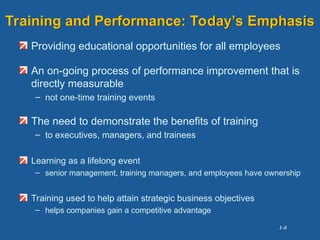
Training and Performance: Today’s Emphasis
Providing educational opportunities for all employees
An on-going process of performance improvement that is
directly measurable
– not one-time training events
The need to demonstrate the benefits of training
– to executives, managers, and trainees
Learning as a lifelong event
– senior management, training managers, and employees have ownership
Training used to help attain strategic business objectives
– helps companies gain a competitive advantage
1-9
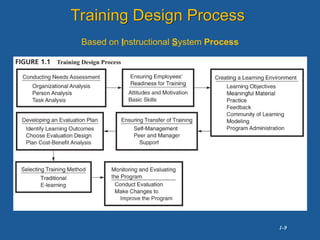
Training Design Process
Based on Instructional System Process
1-10
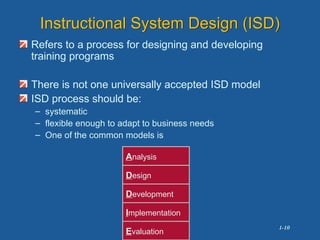
Instructional System Design (ISD)
Refers to a process for designing and developing
training programs
There is not one universally accepted ISD model
ISD process should be:
– systematic
– flexible enough to adapt to business needs
– One of the common models is
Analysis
Design
Development
Implementation
Evaluation
1-11
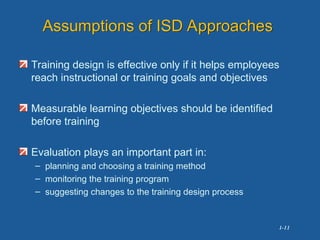
Assumptions of ISD Approaches
Training design is effective only if it helps employees
reach instructional or training goals and objectives
Measurable learning objectives should be identified
before training
Evaluation plays an important part in:
– planning and choosing a training method
– monitoring the training program
– suggesting changes to the training design process
1-12
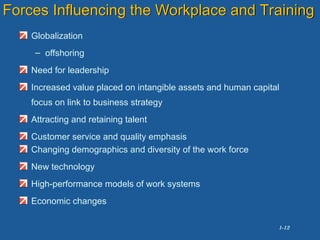
Forces Influencing the Workplace and Training
Globalization
– offshoring
Need for leadership
Increased value placed on intangible assets and human capital
focus on link to business strategy
Attracting and retaining talent
Customer service and quality emphasis
Changing demographics and diversity of the work force
New technology
High-performance models of work systems
Economic changes
1-13
Intangible Assets
Intangible Assets
Cannot be touched and are nonmonetary,
however equally as valuable as financial and
physical assets. They include:
– human capital
– customer capital
– social capital
– intellectual capital
1-14
Increasing Intangible Assets
Increase human capital by focusing on attracting,
developing, and retaining knowledge workers
A management style of developing and empowering
employees
Capability to adapt to change
– Learning organization – embraces a culture of lifelong
learning, enabling all employees to continually acquire and
share knowledge
1-15
Focus on Link to Business Strategy
Design and development of learning activities that helps
companies:
– successfully implement strategy
– reach business goals
Leadership and management development training programs:
– classroom instruction
– e-learning
1-16
Core Values of Total Quality
Management (TQM)
Methods and processes are designed to meet the needs of internal
and external customers
Every employee in the company receives training in quality
Quality is designed into a product or service so that errors are
prevented from occurring, rather than being detected and corrected
The company promotes cooperation with vendors, suppliers, and
customers to improve quality and hold down costs
Managers measure progress with feedback based on data
1-17
Categories and Point Values for the Malcolm
Baldrige National Quality Award Examination
Leadership 120 points
Measurement Analysis and Knowledge Management 90 points
Strategic Planning 85 points
Human Resource Focus 85 points
Process Management 85 points
Business Results 450 points
Customer and Market Focus 85 points
Total Points 1,000 points
1-18
Skills Needed to Manage a Diverse
Work Force
Communicating effectively with employees from a wide
variety of backgrounds
Coaching, training and developing employees of different
ages, educational backgrounds, ethnicities, physical abilities,
and races
Providing performance feedback that is free of values and
stereotypes based on gender, ethnicity, or physical handicap
Creating a work environment that allows employees of all
backgrounds to be creative and innovative
1-19
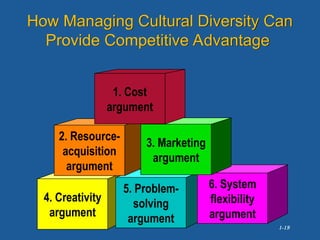
How Managing Cultural Diversity Can
Provide Competitive Advantage
4. Creativity
argument
5. Problem-
solving
argument
6. System
flexibility
argument
2. Resource-
acquisition
argument
3. Marketing
argument
1. Cost
argument
1-20
New Technology
Internet has created a new business model:
– e-commerce
Advantages of technology:
– reduced travel costs
– greater accessibility to training
– consistent delivery
– ability to access experts
– share learning
– creating a learning environment
– greater use of a contingent work force
1-21
High-Performance Models of
Work Systems
Work teams – involve employees with various skills who
interact to assemble a product or provide a service
Cross training – training employees in a wide range of
skills so they can fill any of the roles needed to be
performed on the team
Virtual teams – separated teams relying almost
exclusively on technology to interact and complete their
projects
1-22
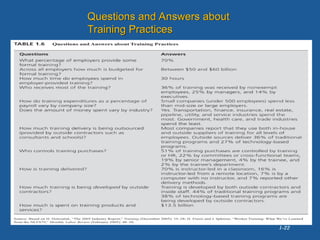
Questions and Answers about
Training Practices
1-23
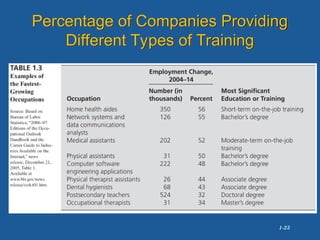
Percentage of Companies Providing
Different Types of Training
1-24
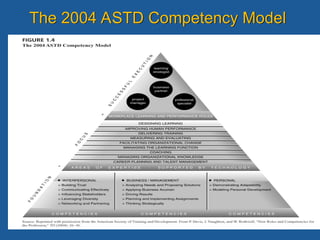
The 2004 ASTD Competency Model

Employee Training & Development - Chapter 1.ppt

  • 1.
    1-1 McGraw-Hill/Irwin ©2008 TheMcGraw-Hill Companies, All Rights Reserved C h a p t e r 1 Introduction to Employee Training and Development
  • 2.
    1-2 Introduction (1 of2) Boston Pizza (Vancouver) has172 restaurants – Most managers understood the Boston Pizza concept BUT lack the soft skills needed to be good managers – This led to the advent of Boston Pizza College – Managers are trained on skills like team work, coaching etc. – This has led to increase in the turnover by 300% Competitiveness – a company’s ability to maintain and gain market share in an industry
  • 3.
    1-3 Introduction (2 of2) Boston Pizza has introduced training practices that have helped it gain a competitive advantage in their markets The training practices have helped Boston Pizza International, : – grow the business, and – improve customer service, by – providing employees with the knowledge and skills they need to be successful Issues affecting companies and influencing training practices: – customer service – employee retention and growth – doing more with less – quality and productivity
  • 4.
    1-4 Human Resource Management Policies,practices, and systems that influence employees’: – behavior – attitudes – Performance HRM practices play a key role in attracting, motivating, rewarding, and retaining employees
  • 5.
    1-5 What is Training? Training– a planned effort by a company to facilitate employees’ learning of job-related competencies – Competencies – knowledge, skills or behavior critical for successful job performance The goal of training is for employees to: – master the knowledge, skill, and behaviors emphasized in training programs, and – apply them to their day-to-day activities Linked to strategic goals and objectives Uses an instructional design process to ensure that training is effective Compares or benchmarks the company’s training programs against training programs in other companies Creates working conditions that encourage continuous learning High-Leverage Training
  • 6.
    1-6 Continuous Learning Requires employeesto understand the entire work system including the relationships among: – their jobs – their work units – the entire company Employees are expected to: – acquire new skills and knowledge – apply them on the job – share this information with other employees Managers take an active role: – in identifying training needs – helping to ensure that employees use training in their work
  • 7.
    1-7 Training and Performance Emphasison high-leverage training has been accompanied by a movement to link training to performance improvement Training is used to improve employee performance This leads to improved business results
  • 8.
    1-8 Training and Performance:Today’s Emphasis Providing educational opportunities for all employees An on-going process of performance improvement that is directly measurable – not one-time training events The need to demonstrate the benefits of training – to executives, managers, and trainees Learning as a lifelong event – senior management, training managers, and employees have ownership Training used to help attain strategic business objectives – helps companies gain a competitive advantage
  • 9.
    1-9 Training Design Process Basedon Instructional System Process
  • 10.
    1-10 Instructional System Design(ISD) Refers to a process for designing and developing training programs There is not one universally accepted ISD model ISD process should be: – systematic – flexible enough to adapt to business needs – One of the common models is Analysis Design Development Implementation Evaluation
  • 11.
    1-11 Assumptions of ISDApproaches Training design is effective only if it helps employees reach instructional or training goals and objectives Measurable learning objectives should be identified before training Evaluation plays an important part in: – planning and choosing a training method – monitoring the training program – suggesting changes to the training design process
  • 12.
    1-12 Forces Influencing theWorkplace and Training Globalization – offshoring Need for leadership Increased value placed on intangible assets and human capital focus on link to business strategy Attracting and retaining talent Customer service and quality emphasis Changing demographics and diversity of the work force New technology High-performance models of work systems Economic changes
  • 13.
    1-13 Intangible Assets Intangible Assets Cannotbe touched and are nonmonetary, however equally as valuable as financial and physical assets. They include: – human capital – customer capital – social capital – intellectual capital
  • 14.
    1-14 Increasing Intangible Assets Increasehuman capital by focusing on attracting, developing, and retaining knowledge workers A management style of developing and empowering employees Capability to adapt to change – Learning organization – embraces a culture of lifelong learning, enabling all employees to continually acquire and share knowledge
  • 15.
    1-15 Focus on Linkto Business Strategy Design and development of learning activities that helps companies: – successfully implement strategy – reach business goals Leadership and management development training programs: – classroom instruction – e-learning
  • 16.
    1-16 Core Values ofTotal Quality Management (TQM) Methods and processes are designed to meet the needs of internal and external customers Every employee in the company receives training in quality Quality is designed into a product or service so that errors are prevented from occurring, rather than being detected and corrected The company promotes cooperation with vendors, suppliers, and customers to improve quality and hold down costs Managers measure progress with feedback based on data
  • 17.
    1-17 Categories and PointValues for the Malcolm Baldrige National Quality Award Examination Leadership 120 points Measurement Analysis and Knowledge Management 90 points Strategic Planning 85 points Human Resource Focus 85 points Process Management 85 points Business Results 450 points Customer and Market Focus 85 points Total Points 1,000 points
  • 18.
    1-18 Skills Needed toManage a Diverse Work Force Communicating effectively with employees from a wide variety of backgrounds Coaching, training and developing employees of different ages, educational backgrounds, ethnicities, physical abilities, and races Providing performance feedback that is free of values and stereotypes based on gender, ethnicity, or physical handicap Creating a work environment that allows employees of all backgrounds to be creative and innovative
  • 19.
    1-19 How Managing CulturalDiversity Can Provide Competitive Advantage 4. Creativity argument 5. Problem- solving argument 6. System flexibility argument 2. Resource- acquisition argument 3. Marketing argument 1. Cost argument
  • 20.
    1-20 New Technology Internet hascreated a new business model: – e-commerce Advantages of technology: – reduced travel costs – greater accessibility to training – consistent delivery – ability to access experts – share learning – creating a learning environment – greater use of a contingent work force
  • 21.
    1-21 High-Performance Models of WorkSystems Work teams – involve employees with various skills who interact to assemble a product or provide a service Cross training – training employees in a wide range of skills so they can fill any of the roles needed to be performed on the team Virtual teams – separated teams relying almost exclusively on technology to interact and complete their projects
  • 22.
    1-22 Questions and Answersabout Training Practices
  • 23.
    1-23 Percentage of CompaniesProviding Different Types of Training
  • 24.
    1-24 The 2004 ASTDCompetency Model