Chapter 1Understanding Ethics1-1McGraw-Hill
“Ethics is about how we meet the challenge of doing the right thing when that will cost more than we want to pay”The Josephson Institute of Ethics1-2
What is Ethics?How people try to live their lives according to a standard of “right” or “wrong” behaviors -- in both how we think and behave toward others and how we would like them to think and behave toward us.1-3
Understanding Right and WrongDeveloping your own ‘Moral Compass’How Should I live?The Value of a Value Intrinsic – a value is a good thing in itself and is pursued for its own sakeInstrumental – the pursuit of one value is a good way to reach another valueValue Conflicts – gray area makes the study of ethics complexDoing The Right ThingSimple truth – doing the right thing (right or wrong or good or bad)Personal integrityRules of appropriate individual behaviorRules of appropriate behavior for a community or societyThe Golden Rule – Do unto others as you would have them do unto you1-4
Ethical TheoriesVirtue Ethics – living your life according to a commitment to the achievement of a clear idealUtilitarianism - ethics for the greater goodUniversal Ethics – actions that are taken out of duty and obligation to a purely moral ideal rather than based on the needs of the situation1-5
Ethical Relativism	Where the traditions of your society, your personal opinions, and the circumstances of the present moment define your ethical principles.1-6
Applied EthicsThe study of how ethical theories are put into practice1-7
Ethical Dilemmas	Where the decision you must make requires you to make a ‘right’ choice knowing full well that you are:Leaving an equally ‘right’ choice undone.Likely to suffer something bad as a result of that choice.Contradicting a personal ethical principle in making that choice.Abandoning an ethical value of your community or society in making that choice.1-8
Resolving Ethical Dilemmas - IStep One: Analyze the consequences. Step Two: Analyze the actions. Step Three: Make a decision.1-9
Resolving Ethical Dilemmas Arthur DobrinWhat are the facts?What can you guess about the facts you don’t know?What do the facts mean?What does the problem look like through the eyes of the people involved?What will happen if you choose one thing rather than another?What do your feelings tell you?What will you think of yourself if you decide one thing or another?Can you explain and justify your decision to others?1-10
Ethical Reasoning1-11
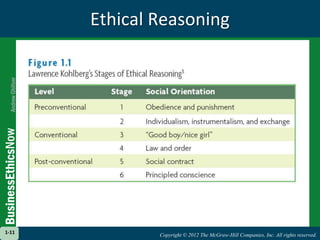
Ethical ReasoningKohlberg’s Stages of Moral Development:Level 1: Pre-Conventional:Stage 1: Punishment & Obedience Orientation – focused on avoidance of punishment and deference to power and authorityStage 2: Individualism, Instrumentalism, & Exchange – focused on satisfying one’s needs1-12
Ethical ReasoningKohlberg’s Stages of Moral Development:Level 2: Conventional:Stage 3: “Good Boy-Nice Girl” Orientation – focused on meeting the expectation of family membersStage 4:  Law & Order Orientation – increasingly aware of his or her membership in a society and the existence of codes of behavior (legal, religious, or social behavior dictate something is right or wrong)1-13
Ethical ReasoningKohlberg’s Stages of Moral Development:Level 3: Post-Conventional:Stage 5: Social-Contract Legalistic Orientation – focused on individual rights and the development of standards based on critical examination (something is right or wrong because it has withstood scrutiny by which the society in which the principle is accepted)Stage 6: Universal Ethical Principle Orientation – focused on self-chosen ethical principles that are found to be comprehensive and consistent (reflects the person’s individual value system and the conscious choices he or she makes in life)1-14

Chapter 1 review

  • 1.
  • 2.
    “Ethics is abouthow we meet the challenge of doing the right thing when that will cost more than we want to pay”The Josephson Institute of Ethics1-2
  • 3.
    What is Ethics?Howpeople try to live their lives according to a standard of “right” or “wrong” behaviors -- in both how we think and behave toward others and how we would like them to think and behave toward us.1-3
  • 4.
    Understanding Right andWrongDeveloping your own ‘Moral Compass’How Should I live?The Value of a Value Intrinsic – a value is a good thing in itself and is pursued for its own sakeInstrumental – the pursuit of one value is a good way to reach another valueValue Conflicts – gray area makes the study of ethics complexDoing The Right ThingSimple truth – doing the right thing (right or wrong or good or bad)Personal integrityRules of appropriate individual behaviorRules of appropriate behavior for a community or societyThe Golden Rule – Do unto others as you would have them do unto you1-4
  • 5.
    Ethical TheoriesVirtue Ethics– living your life according to a commitment to the achievement of a clear idealUtilitarianism - ethics for the greater goodUniversal Ethics – actions that are taken out of duty and obligation to a purely moral ideal rather than based on the needs of the situation1-5
  • 6.
    Ethical Relativism Where thetraditions of your society, your personal opinions, and the circumstances of the present moment define your ethical principles.1-6
  • 7.
    Applied EthicsThe studyof how ethical theories are put into practice1-7
  • 8.
    Ethical Dilemmas Where thedecision you must make requires you to make a ‘right’ choice knowing full well that you are:Leaving an equally ‘right’ choice undone.Likely to suffer something bad as a result of that choice.Contradicting a personal ethical principle in making that choice.Abandoning an ethical value of your community or society in making that choice.1-8
  • 9.
    Resolving Ethical Dilemmas- IStep One: Analyze the consequences. Step Two: Analyze the actions. Step Three: Make a decision.1-9
  • 10.
    Resolving Ethical DilemmasArthur DobrinWhat are the facts?What can you guess about the facts you don’t know?What do the facts mean?What does the problem look like through the eyes of the people involved?What will happen if you choose one thing rather than another?What do your feelings tell you?What will you think of yourself if you decide one thing or another?Can you explain and justify your decision to others?1-10
  • 11.
  • 12.
    Ethical ReasoningKohlberg’s Stagesof Moral Development:Level 1: Pre-Conventional:Stage 1: Punishment & Obedience Orientation – focused on avoidance of punishment and deference to power and authorityStage 2: Individualism, Instrumentalism, & Exchange – focused on satisfying one’s needs1-12
  • 13.
    Ethical ReasoningKohlberg’s Stagesof Moral Development:Level 2: Conventional:Stage 3: “Good Boy-Nice Girl” Orientation – focused on meeting the expectation of family membersStage 4: Law & Order Orientation – increasingly aware of his or her membership in a society and the existence of codes of behavior (legal, religious, or social behavior dictate something is right or wrong)1-13
  • 14.
    Ethical ReasoningKohlberg’s Stagesof Moral Development:Level 3: Post-Conventional:Stage 5: Social-Contract Legalistic Orientation – focused on individual rights and the development of standards based on critical examination (something is right or wrong because it has withstood scrutiny by which the society in which the principle is accepted)Stage 6: Universal Ethical Principle Orientation – focused on self-chosen ethical principles that are found to be comprehensive and consistent (reflects the person’s individual value system and the conscious choices he or she makes in life)1-14