Developing HR Competency Framework:A Special Reference to the National HR Competency ModelApril 9, 2010HR Competency Workshop, New Delhi Geetam Kapoor1
Environmental changes are transforming the way organizations create value and conduct business, compelling HR departments to accelerate their capacity for change.On one hand, HR serves as an employee advocate, on the other hand, it needs to be a business partner in formulating strategy and achieving goals to push the whole organization forward.It is a difficult but requisite challenge to balance these two potentially conflicting positions skillfully.Imperative for ChangeApril 9, 2010HR Competency Workshop, New Delhi Geetam Kapoor2
Become better at being both a more active contributor to the business team and a more innovative protector and developer of employees.This dual mandate requires activities ranging from business strategy development to process re-engineering, from generating newer staffing models to developing innovative R&R strategies, and the likeWhat changes should HR make?April 9, 2010HR Competency Workshop, New Delhi Geetam Kapoor3
Functional Guiding Principles:develop a compelling vision and value proposition for the whole organization
align the focus of HR efforts on more strategic outcomes
re-negotiate HR role & responsibilities with operational leaders within organization
commit to major & immediate competency development for HR professionalsHow to create the HR function of the future?April 9, 2010HR Competency Workshop, New Delhi Geetam Kapoor4
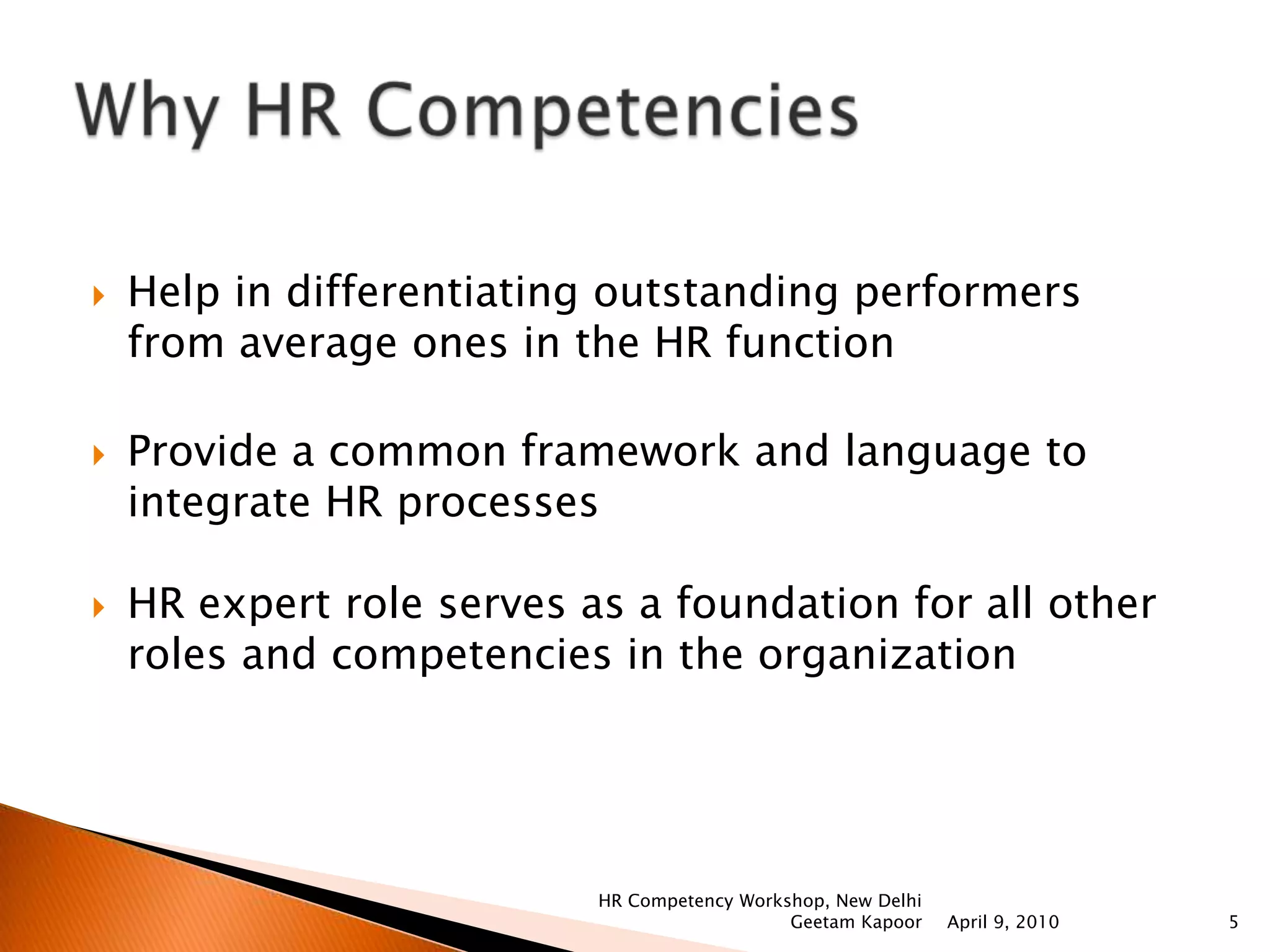
Help in differentiating outstanding performers from average ones in the HR functionProvide a common framework and language to integrate HR processesHR expert role serves as a foundation for all other roles and competencies in the organizationWhy HR CompetenciesApril 9, 2010HR Competency Workshop, New Delhi Geetam Kapoor5
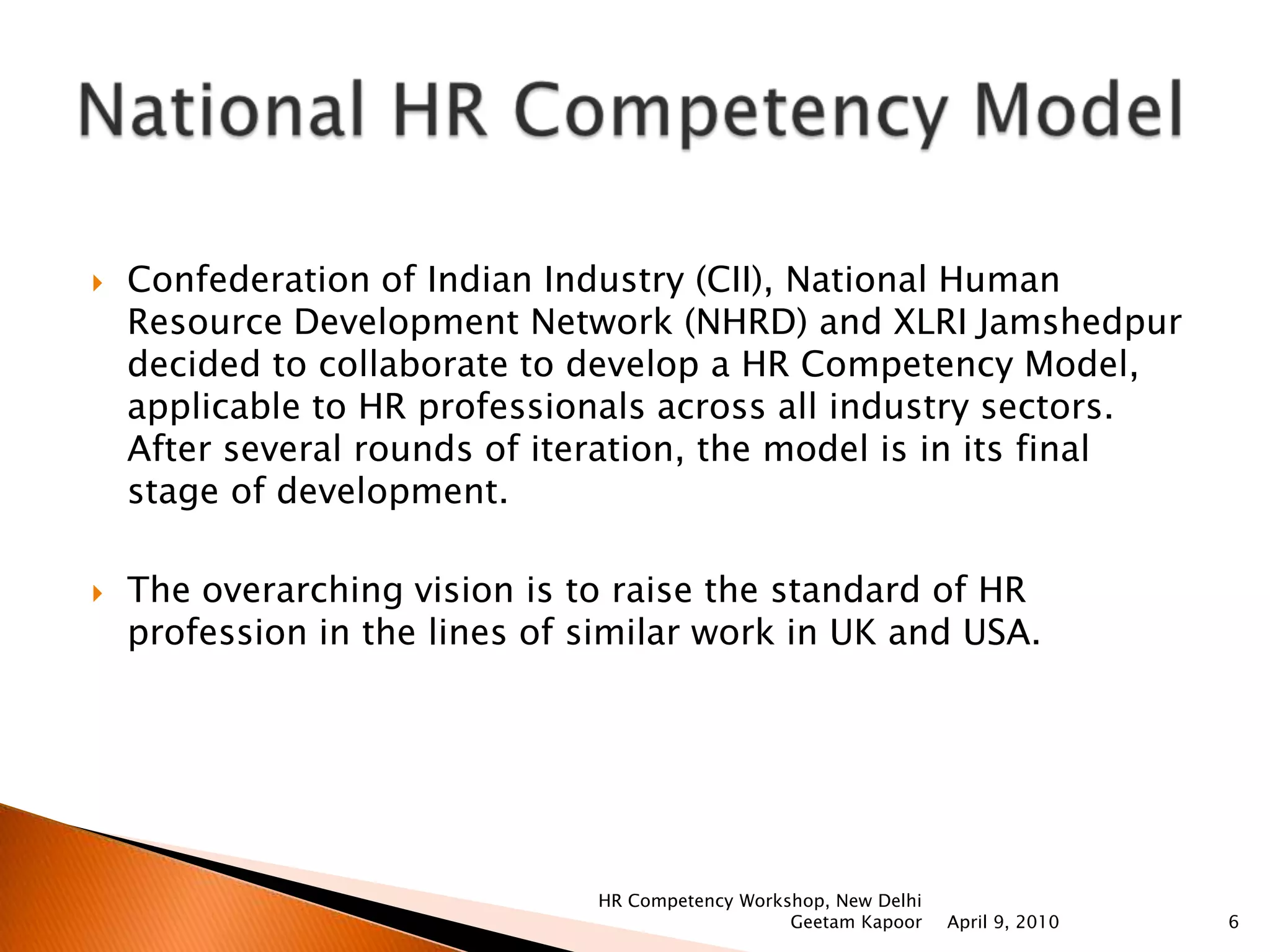
Confederation of Indian Industry (CII), National Human Resource Development Network (NHRD) and XLRI Jamshedpur decided to collaborate to develop a HR Competency Model, applicable to HR professionals across all industry sectors. After several rounds of iteration, the model is in its final stage of development.The overarching vision is to raise the standard of HR profession in the lines of similar work in UK and USA.National HR Competency ModelApril 9, 2010HR Competency Workshop, New Delhi Geetam Kapoor6
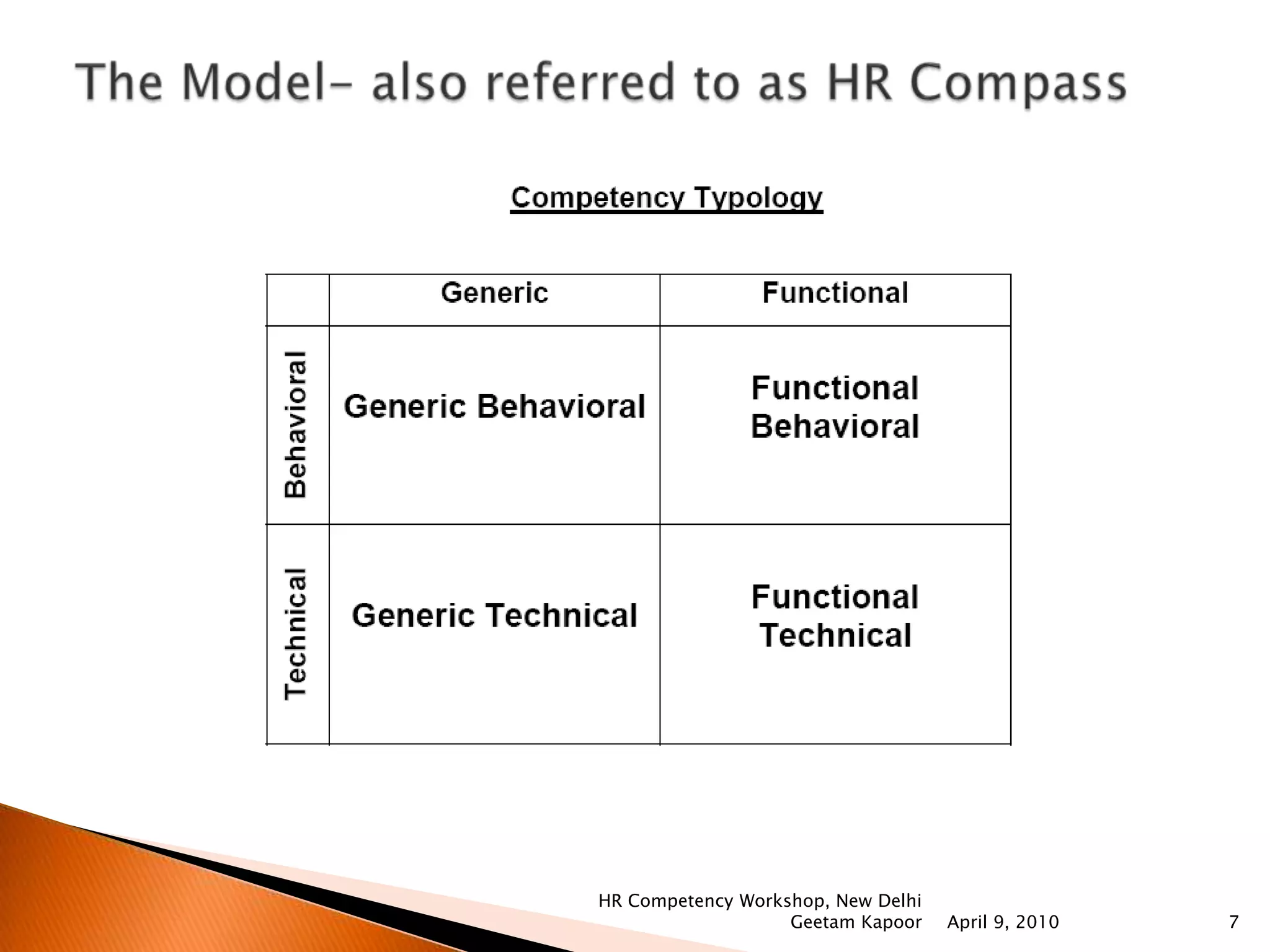
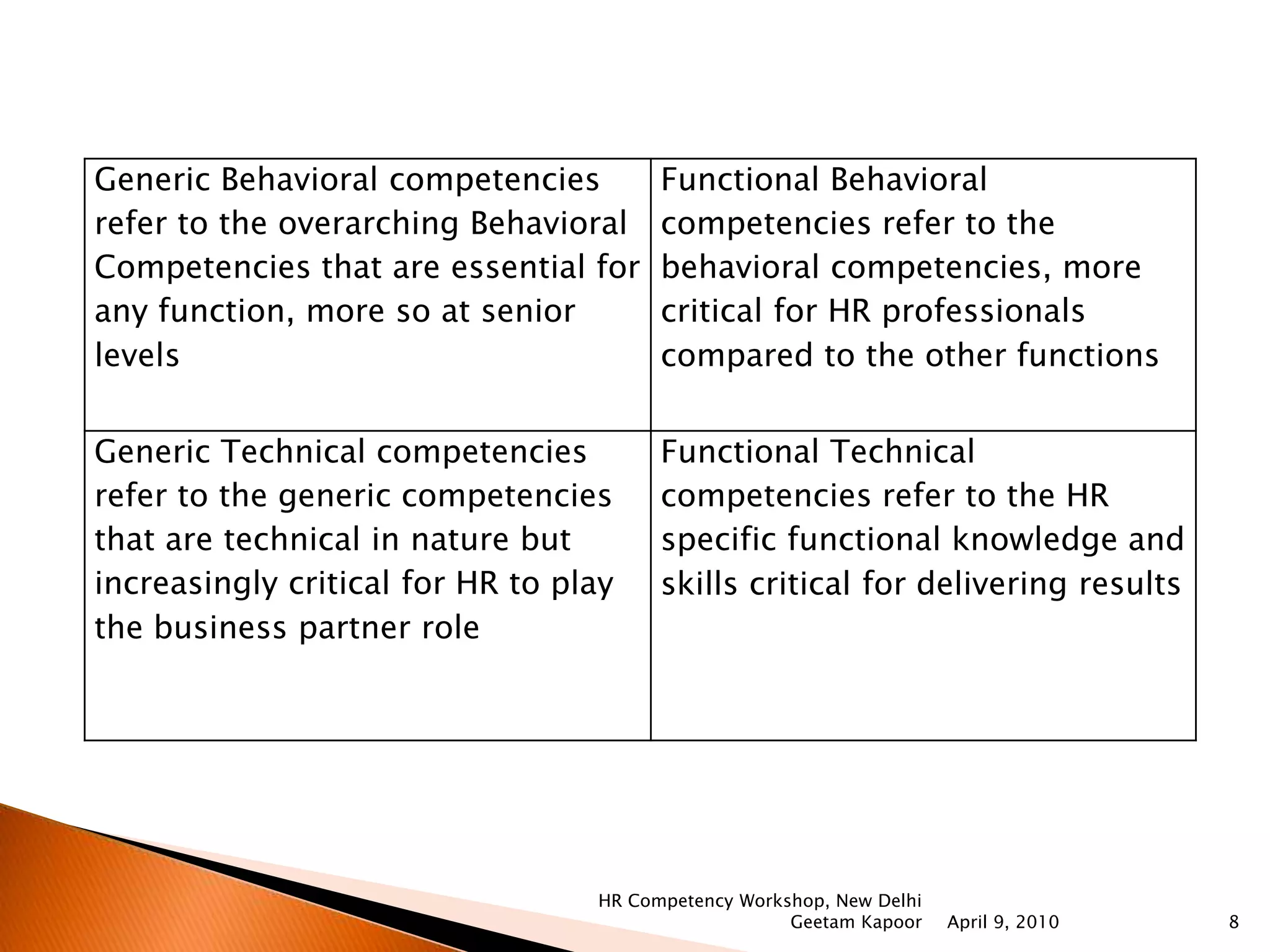
The Model- also referred to as HR CompassCompetency TypologyGeneric FunctionalBehavioralGeneric BehavioralFunctionalBehavioralTechnicalGeneric TechnicalFunctionalTechnicalApril 9, 2010HR Competency Workshop, New Delhi Geetam Kapoor7
April 9, 2010HR Competency Workshop, New Delhi Geetam Kapoor8
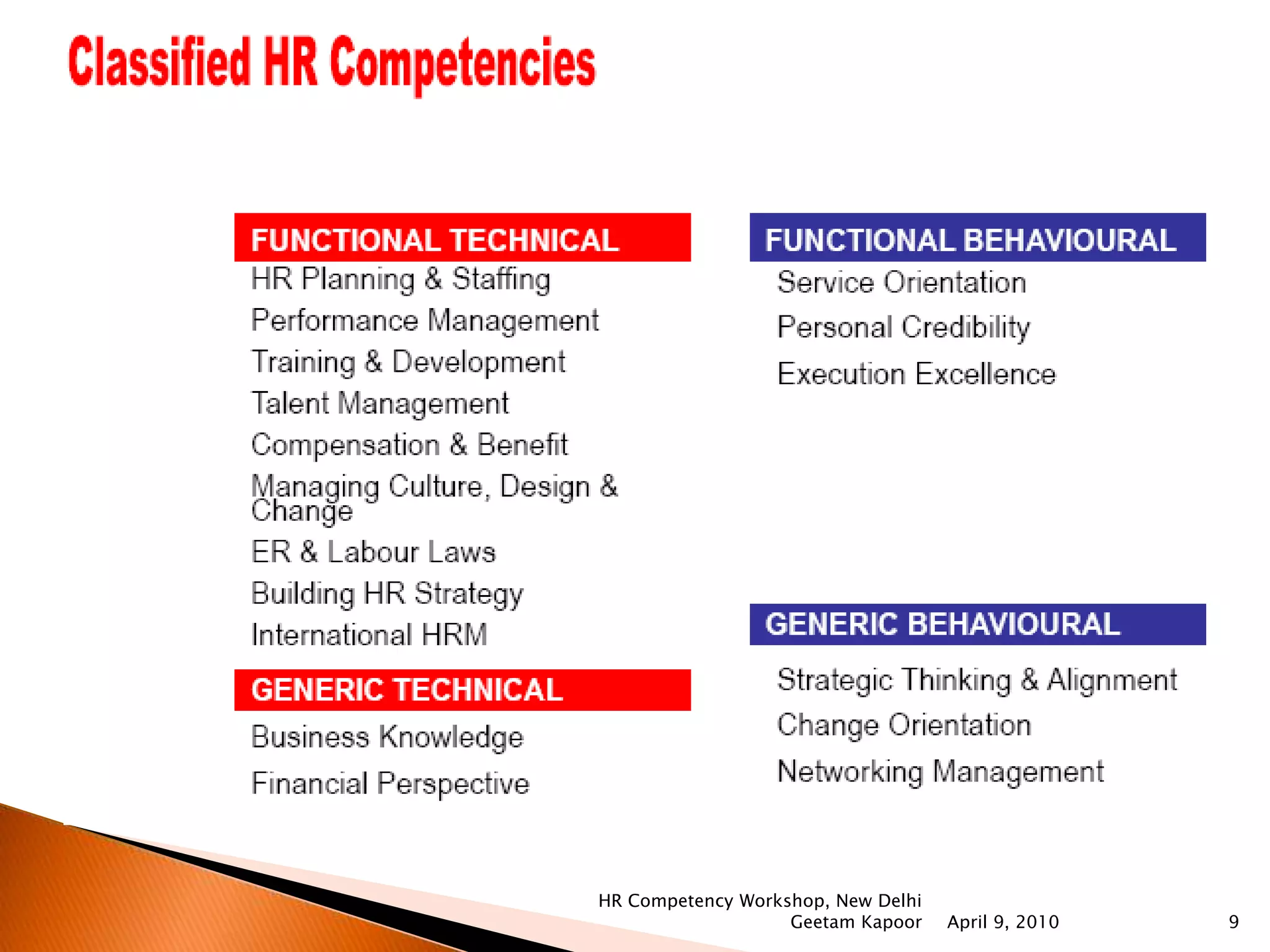
April 9, 2010HR Competency Workshop, New Delhi Geetam Kapoor9
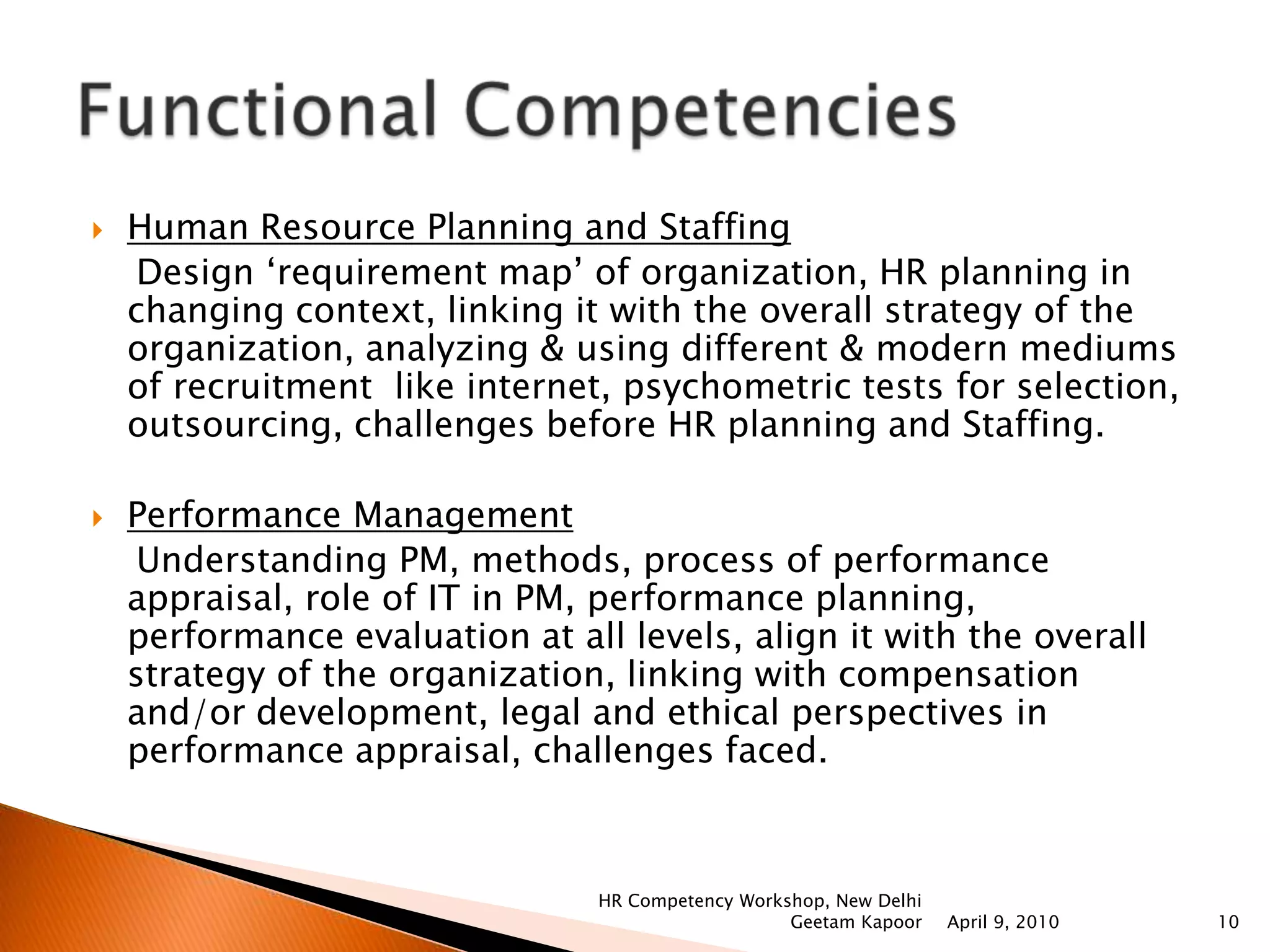
Human Resource Planning and Staffing    Design ‘requirement map’ of organization, HR planning in changing context, linking it with the overall strategy of the organization, analyzing & using different & modern mediums  of recruitment  like internet, psychometric tests for selection, outsourcing, challenges before HR planning and Staffing.Performance Management   Understanding PM, methods, process of performance appraisal, role of IT in PM, performance planning, performance evaluation at all levels, align it with the overall strategy of the organization, linking with compensation and/or development, legal and ethical perspectives in performance appraisal, challenges faced.Functional CompetenciesApril 9, 2010HR Competency Workshop, New Delhi Geetam Kapoor10
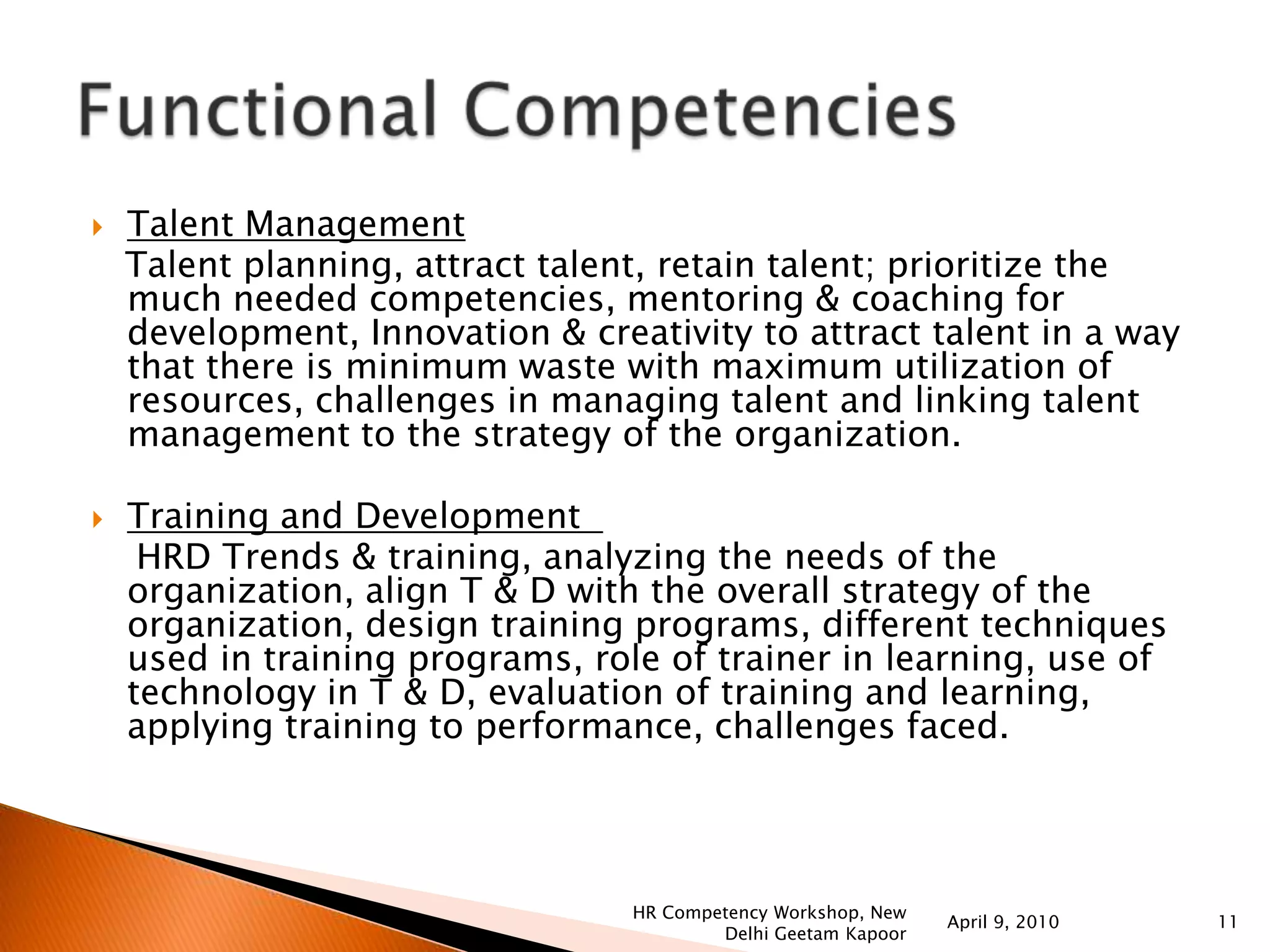
Talent Management   Talent planning, attract talent, retain talent; prioritize the much needed competencies, mentoring & coaching for development, Innovation & creativity to attract talent in a way that there is minimum waste with maximum utilization of resources, challenges in managing talent and linking talent management to the strategy of the organization.Training and Development       HRD Trends & training, analyzing the needs of the organization, align T & D with the overall strategy of the organization, design training programs, different techniques used in training programs, role of trainer in learning, use of technology in T & D, evaluation of training and learning, applying training to performance, challenges faced. April 9, 2010HR Competency Workshop, New Delhi Geetam Kapoor11Functional Competencies
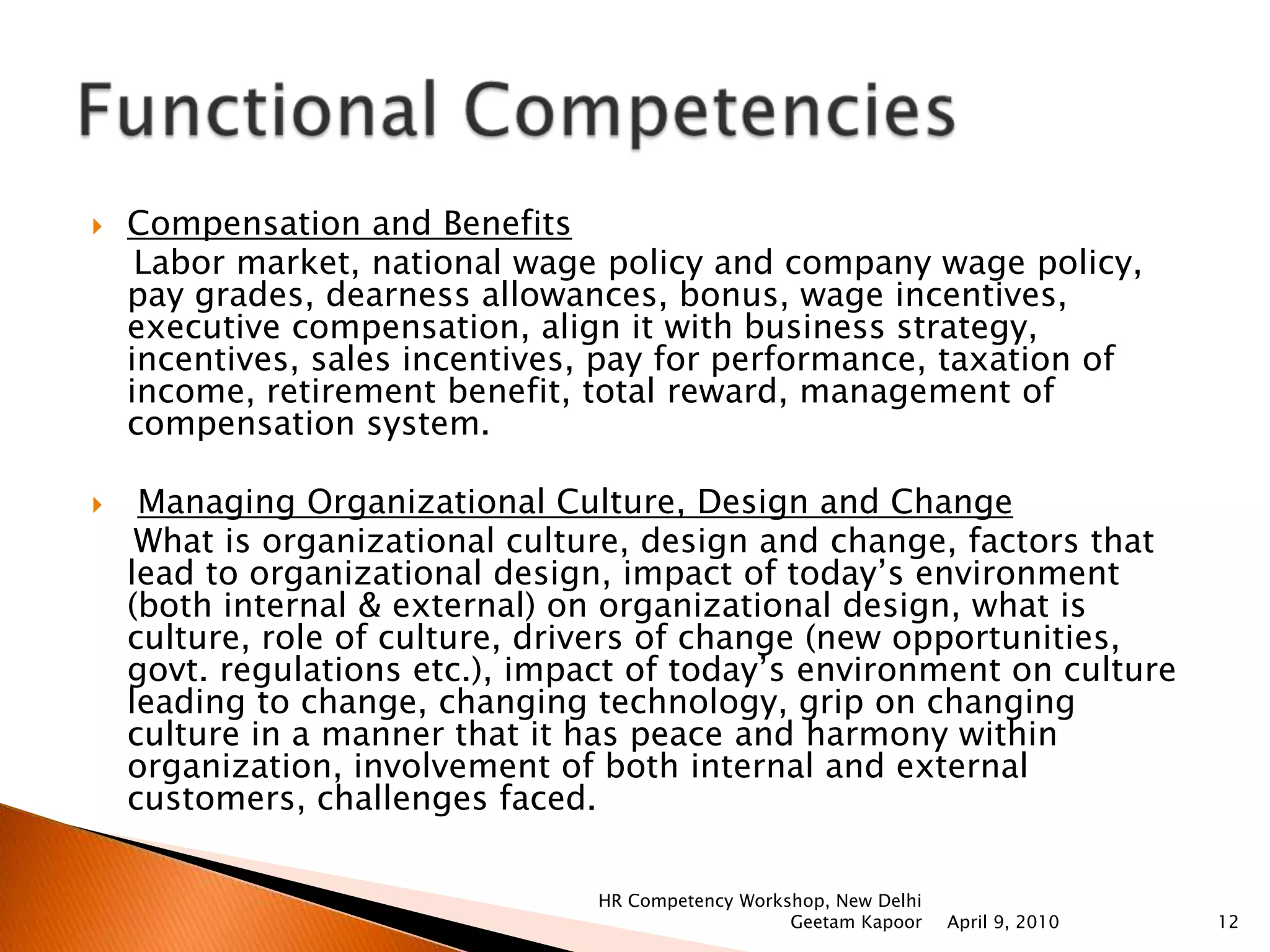
Compensation and Benefits    Labor market, national wage policy and company wage policy, pay grades, dearness allowances, bonus, wage incentives, executive compensation, align it with business strategy, incentives, sales incentives, pay for performance, taxation of income, retirement benefit, total reward, management of compensation system. Managing Organizational Culture, Design and Change    What is organizational culture, design and change, factors that lead to organizational design, impact of today’s environment (both internal & external) on organizational design, what is culture, role of culture, drivers of change (new opportunities, govt. regulations etc.), impact of today’s environment on culture leading to change, changing technology, grip on changing culture in a manner that it has peace and harmony within organization, involvement of both internal and external customers, challenges faced.April 9, 2010HR Competency Workshop, New Delhi Geetam Kapoor12Functional Competencies
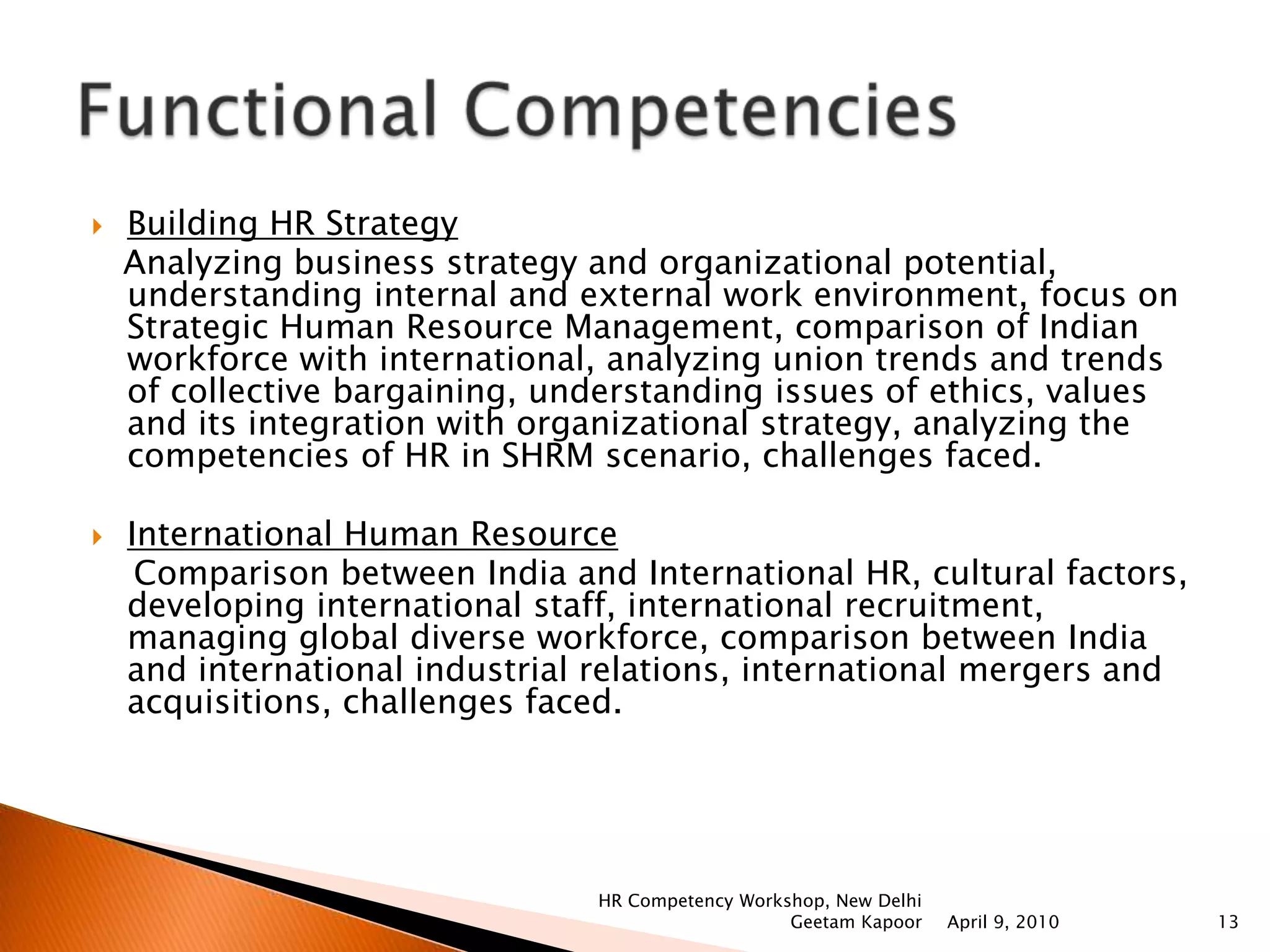
Building HR Strategy   Analyzing business strategy and organizational potential, understanding internal and external work environment, focus on Strategic Human Resource Management, comparison of Indian workforce with international, analyzing union trends and trends of collective bargaining, understanding issues of ethics, values and its integration with organizational strategy, analyzing the competencies of HR in SHRM scenario, challenges faced.International Human Resource    Comparison between India and International HR, cultural factors, developing international staff, international recruitment, managing global diverse workforce, comparison between India and international industrial relations, international mergers and acquisitions, challenges faced.April 9, 2010HR Competency Workshop, New Delhi Geetam Kapoor13Functional Competencies
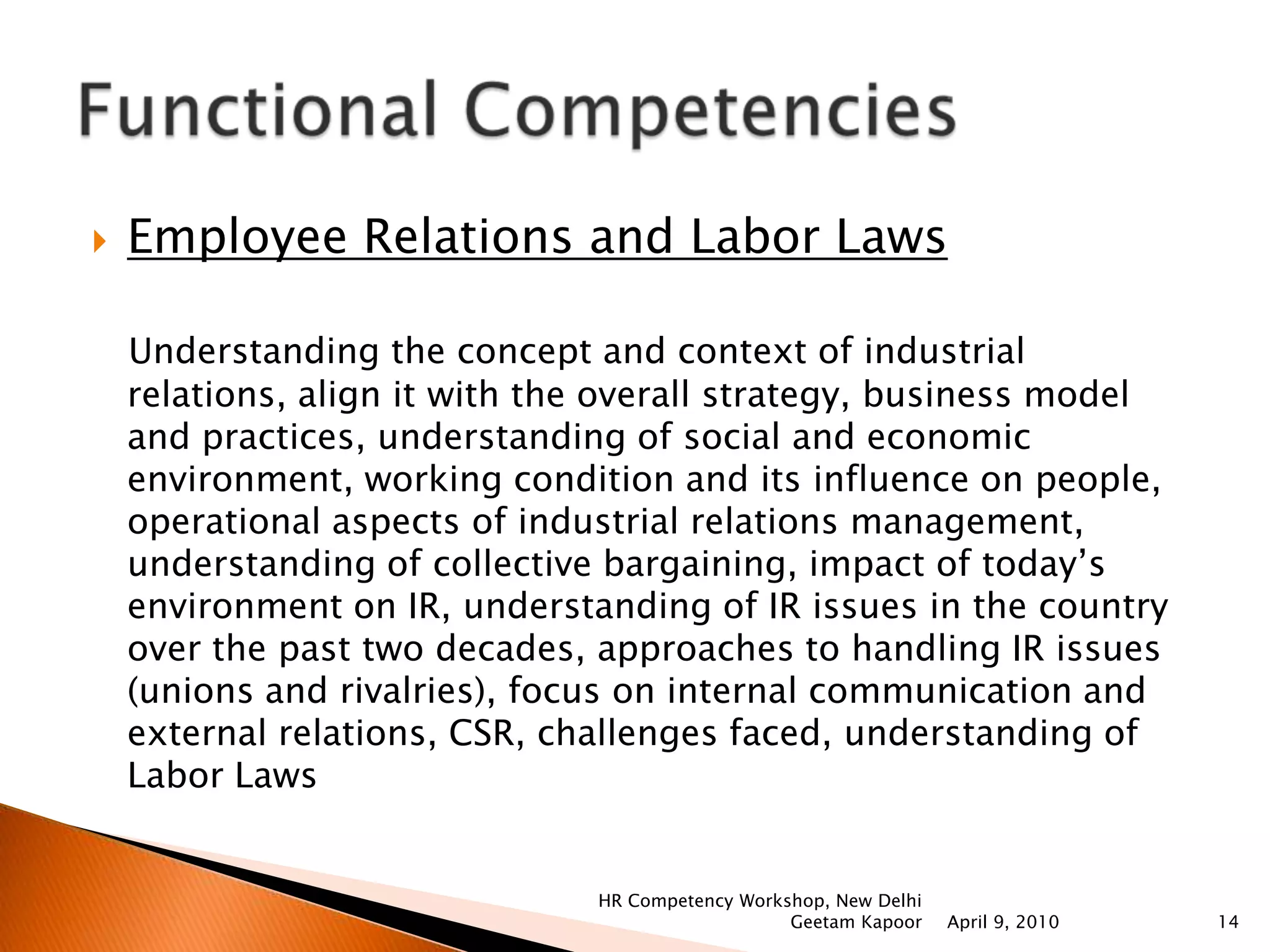
Employee Relations and Labor LawsUnderstanding the concept and context of industrial relations, align it with the overall strategy, business model and practices, understanding of social and economic environment, working condition and its influence on people, operational aspects of industrial relations management, understanding of collective bargaining, impact of today’s environment on IR, understanding of IR issues in the country over the past two decades, approaches to handling IR issues (unions and rivalries), focus on internal communication and external relations, CSR, challenges faced, understanding of Labor LawsApril 9, 2010HR Competency Workshop, New Delhi Geetam Kapoor14Functional Competencies
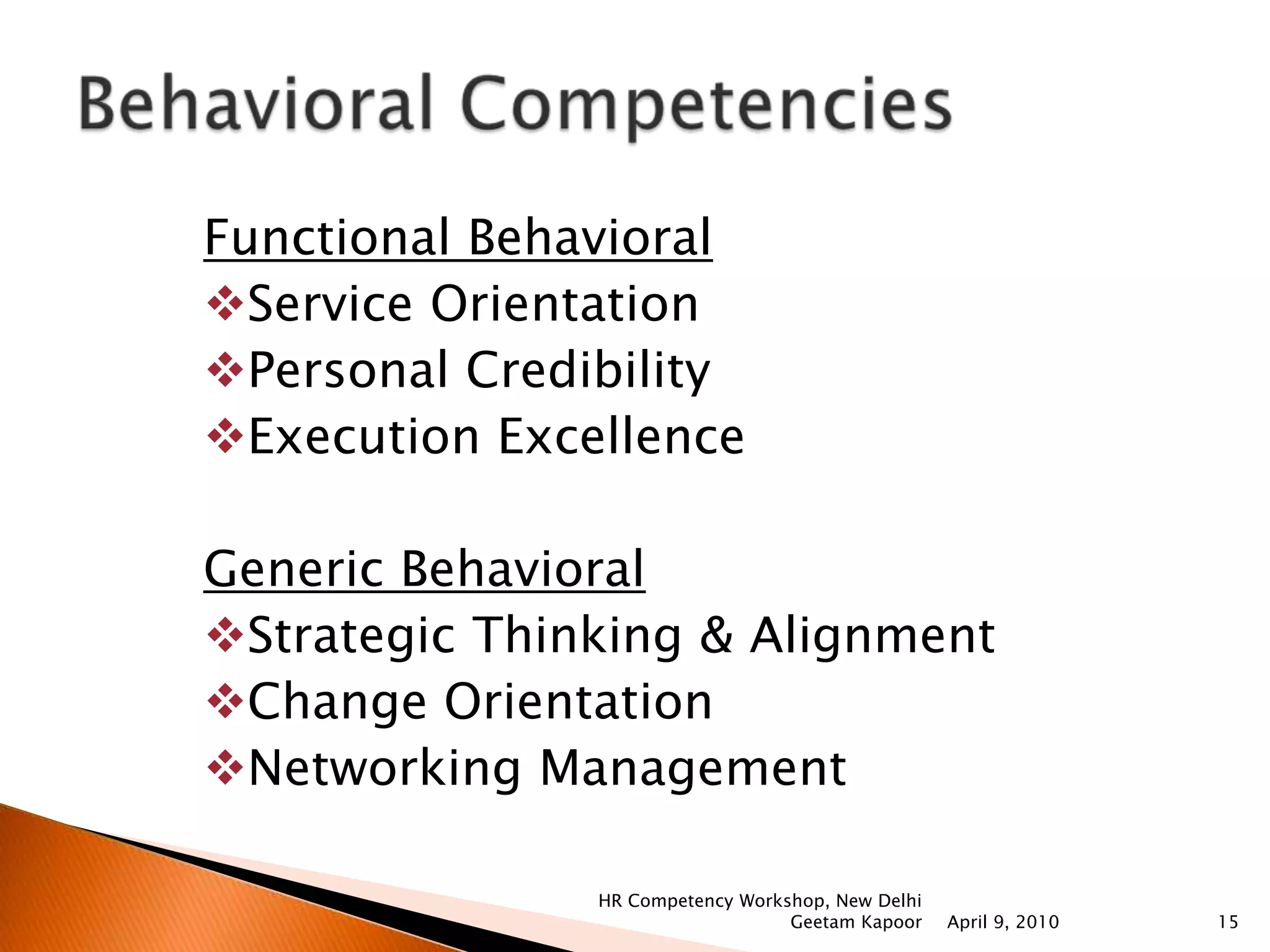
Functional BehavioralService Orientation
Personal Credibility

Developing hr competency framework

  • 1.
    Developing HR CompetencyFramework:A Special Reference to the National HR Competency ModelApril 9, 2010HR Competency Workshop, New Delhi Geetam Kapoor1
  • 2.
    Environmental changes aretransforming the way organizations create value and conduct business, compelling HR departments to accelerate their capacity for change.On one hand, HR serves as an employee advocate, on the other hand, it needs to be a business partner in formulating strategy and achieving goals to push the whole organization forward.It is a difficult but requisite challenge to balance these two potentially conflicting positions skillfully.Imperative for ChangeApril 9, 2010HR Competency Workshop, New Delhi Geetam Kapoor2
  • 3.
    Become better atbeing both a more active contributor to the business team and a more innovative protector and developer of employees.This dual mandate requires activities ranging from business strategy development to process re-engineering, from generating newer staffing models to developing innovative R&R strategies, and the likeWhat changes should HR make?April 9, 2010HR Competency Workshop, New Delhi Geetam Kapoor3
  • 4.
    Functional Guiding Principles:developa compelling vision and value proposition for the whole organization
  • 5.
    align the focusof HR efforts on more strategic outcomes
  • 6.
    re-negotiate HR role& responsibilities with operational leaders within organization
  • 7.
    commit to major& immediate competency development for HR professionalsHow to create the HR function of the future?April 9, 2010HR Competency Workshop, New Delhi Geetam Kapoor4
  • 8.
    Help in differentiatingoutstanding performers from average ones in the HR functionProvide a common framework and language to integrate HR processesHR expert role serves as a foundation for all other roles and competencies in the organizationWhy HR CompetenciesApril 9, 2010HR Competency Workshop, New Delhi Geetam Kapoor5
  • 9.
    Confederation of IndianIndustry (CII), National Human Resource Development Network (NHRD) and XLRI Jamshedpur decided to collaborate to develop a HR Competency Model, applicable to HR professionals across all industry sectors. After several rounds of iteration, the model is in its final stage of development.The overarching vision is to raise the standard of HR profession in the lines of similar work in UK and USA.National HR Competency ModelApril 9, 2010HR Competency Workshop, New Delhi Geetam Kapoor6
  • 10.
    The Model- alsoreferred to as HR CompassCompetency TypologyGeneric FunctionalBehavioralGeneric BehavioralFunctionalBehavioralTechnicalGeneric TechnicalFunctionalTechnicalApril 9, 2010HR Competency Workshop, New Delhi Geetam Kapoor7
  • 11.
    April 9, 2010HRCompetency Workshop, New Delhi Geetam Kapoor8
  • 12.
    April 9, 2010HRCompetency Workshop, New Delhi Geetam Kapoor9
  • 13.
    Human Resource Planningand Staffing Design ‘requirement map’ of organization, HR planning in changing context, linking it with the overall strategy of the organization, analyzing & using different & modern mediums of recruitment like internet, psychometric tests for selection, outsourcing, challenges before HR planning and Staffing.Performance Management Understanding PM, methods, process of performance appraisal, role of IT in PM, performance planning, performance evaluation at all levels, align it with the overall strategy of the organization, linking with compensation and/or development, legal and ethical perspectives in performance appraisal, challenges faced.Functional CompetenciesApril 9, 2010HR Competency Workshop, New Delhi Geetam Kapoor10
  • 14.
    Talent Management Talent planning, attract talent, retain talent; prioritize the much needed competencies, mentoring & coaching for development, Innovation & creativity to attract talent in a way that there is minimum waste with maximum utilization of resources, challenges in managing talent and linking talent management to the strategy of the organization.Training and Development   HRD Trends & training, analyzing the needs of the organization, align T & D with the overall strategy of the organization, design training programs, different techniques used in training programs, role of trainer in learning, use of technology in T & D, evaluation of training and learning, applying training to performance, challenges faced. April 9, 2010HR Competency Workshop, New Delhi Geetam Kapoor11Functional Competencies
  • 15.
    Compensation and Benefits Labor market, national wage policy and company wage policy, pay grades, dearness allowances, bonus, wage incentives, executive compensation, align it with business strategy, incentives, sales incentives, pay for performance, taxation of income, retirement benefit, total reward, management of compensation system. Managing Organizational Culture, Design and Change What is organizational culture, design and change, factors that lead to organizational design, impact of today’s environment (both internal & external) on organizational design, what is culture, role of culture, drivers of change (new opportunities, govt. regulations etc.), impact of today’s environment on culture leading to change, changing technology, grip on changing culture in a manner that it has peace and harmony within organization, involvement of both internal and external customers, challenges faced.April 9, 2010HR Competency Workshop, New Delhi Geetam Kapoor12Functional Competencies
  • 16.
    Building HR Strategy Analyzing business strategy and organizational potential, understanding internal and external work environment, focus on Strategic Human Resource Management, comparison of Indian workforce with international, analyzing union trends and trends of collective bargaining, understanding issues of ethics, values and its integration with organizational strategy, analyzing the competencies of HR in SHRM scenario, challenges faced.International Human Resource Comparison between India and International HR, cultural factors, developing international staff, international recruitment, managing global diverse workforce, comparison between India and international industrial relations, international mergers and acquisitions, challenges faced.April 9, 2010HR Competency Workshop, New Delhi Geetam Kapoor13Functional Competencies
  • 17.
    Employee Relations andLabor LawsUnderstanding the concept and context of industrial relations, align it with the overall strategy, business model and practices, understanding of social and economic environment, working condition and its influence on people, operational aspects of industrial relations management, understanding of collective bargaining, impact of today’s environment on IR, understanding of IR issues in the country over the past two decades, approaches to handling IR issues (unions and rivalries), focus on internal communication and external relations, CSR, challenges faced, understanding of Labor LawsApril 9, 2010HR Competency Workshop, New Delhi Geetam Kapoor14Functional Competencies
  • 18.
  • 19.
  • 20.
  • 21.
  • 22.
    Networking ManagementApril 9,2010Behavioral CompetenciesHR Competency Workshop, New Delhi Geetam Kapoor15
  • 23.
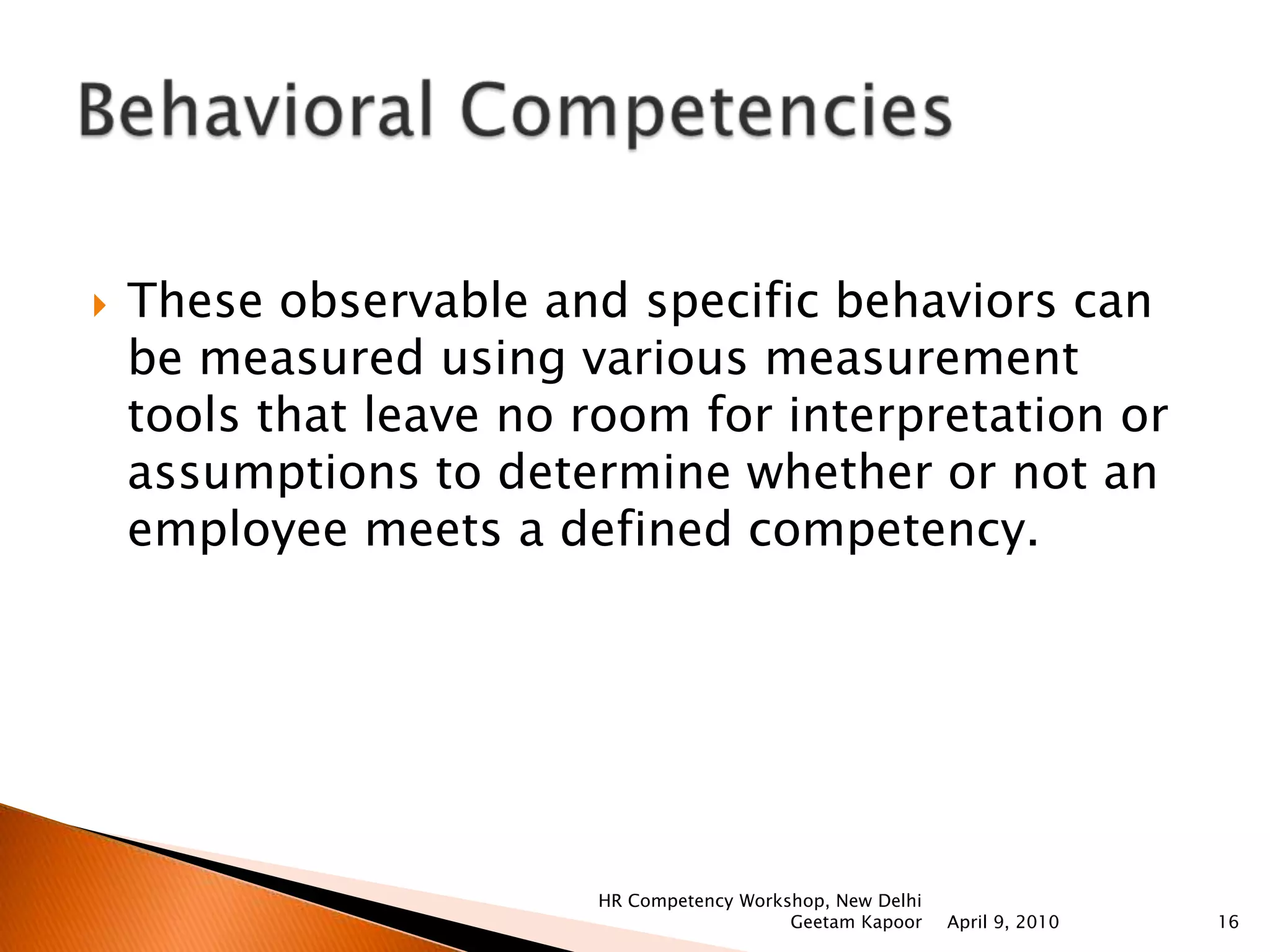
    These observable andspecific behaviors can be measured using various measurement tools that leave no room for interpretation or assumptions to determine whether or not an employee meets a defined competency.April 9, 2010HR Competency Workshop, New Delhi Geetam Kapoor16Behavioral Competencies
  • 24.
    These HR competencieswill be assessed at three proficiency levels which have been determined in terms of hierarchy and scope of activities of HR professionals functioning at different levels with commensurate responsibilities:Basic (at Operational level)
  • 25.
  • 26.
    Expert (at Senior/Corporatelevel)April 9, 2010HR Competency Workshop, New Delhi Geetam Kapoor17Proficiency Levels
  • 27.
    A comprehensive mechanismhas been evolved to assess these competencies. It is imperative for both the HR professionals as well as the organization that they are part of, to know where they stand in terms of the necessary HR competencies required for organizational effectiveness. These will be compared to the requisite competencies against the respective proficiency levels.Adequate measurement tools have been developed and efforts have been made to develop a pool of qualified assessors from across the four regions of the country to conduct assessment. At a broader, more macro level, this would also involve building capabilities among the Management Institutes to tailor the HR curriculum keeping in mind the competency requirements.April 9, 2010HR Competency Workshop, New Delhi Geetam Kapoor18Next Step in HR Compass
  • 28.
    April 9, 2010ThankYou!HR Competency Workshop, New Delhi Geetam Kapoor19

Editor's Notes

  • #5 Different organizations design various structures and roles to meet their diverse needs. HR functions need to become better at being both a more active contributor to the business team and a more innovative protector and developer of employees.This dual mandate requires activities ranging from business strategy development to process-re-engineering, from generating newer staffing models to developing innovative R&R strategies, from capturing and distributing expert knowledge to applying technology to leverage human assets.
  • #8 The ModelAs stated, the model captures the range of competencies required to play themultiple roles of HR. These have been organized in terms of Technical vsBehavioral and Functional Vs Generic classification. Thus we get a 2x2 matrix torepresent the competency typology as shown below
  • #14 The objective of this functional competence module is to give a comprehensive understanding of the relationships between business strategy, organization, and human resources, with a focus on how to create a high performance workplace.