Copyright © 2005 Thomson Business & Professional Publishing.
All rights reserved.
ROBERT L. MATHIS
JOHN H. JACKSON
PowerPoint Presentation by Charlie Cook
The University of West Alabama
Jobs and Job AnalysisJobs and Job Analysis
Chapter 6Chapter 6
SECTION 2SECTION 2
Staffing theStaffing the
OrganizationOrganization
Copyright © 2005 Thomson Business & Professional 6–2
Learning ObjectivesLearning ObjectivesLearning ObjectivesLearning Objectives
• After you have read this chapter, you should be able to:
 Discuss workflow analysis and business process re-engineering
as approaches to organizational work.
 Define job design and identify five design characteristics for jobs.
 Explain how work schedules and telework are affecting jobs and
work.
 Describe job analysis, and the stages in and methods used in
the job analysis process.
 Indicate how job analysis has both behavioral and legal aspects.
 Identify the components of job descriptions.
Copyright © 2005 Thomson Business & Professional 6–3
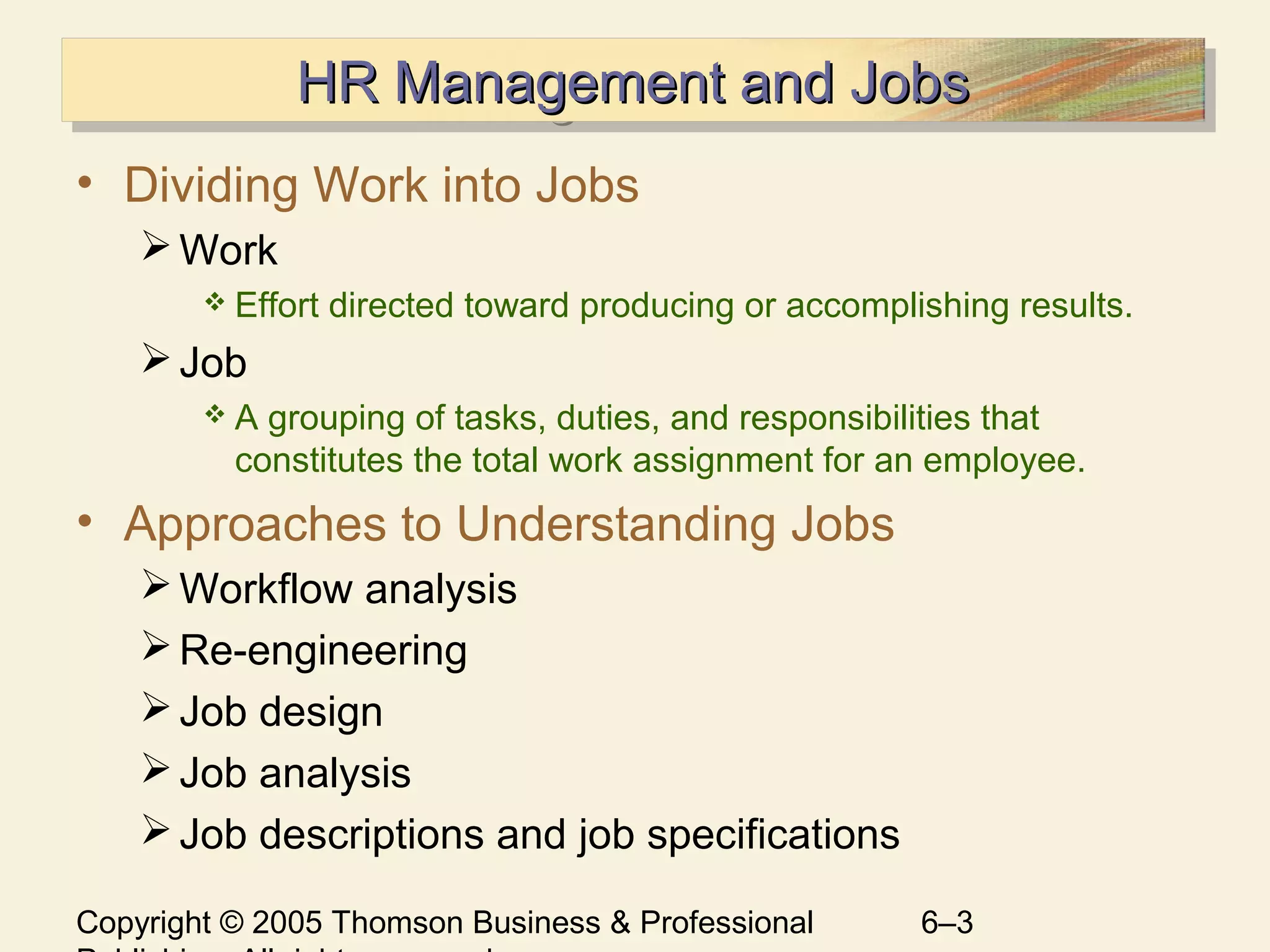
HR Management and JobsHR Management and JobsHR Management and JobsHR Management and Jobs
• Dividing Work into Jobs
Work
 Effort directed toward producing or accomplishing results.
Job
 A grouping of tasks, duties, and responsibilities that
constitutes the total work assignment for an employee.
• Approaches to Understanding Jobs
Workflow analysis
Re-engineering
Job design
Job analysis
Job descriptions and job specifications
Copyright © 2005 Thomson Business & Professional 6–4
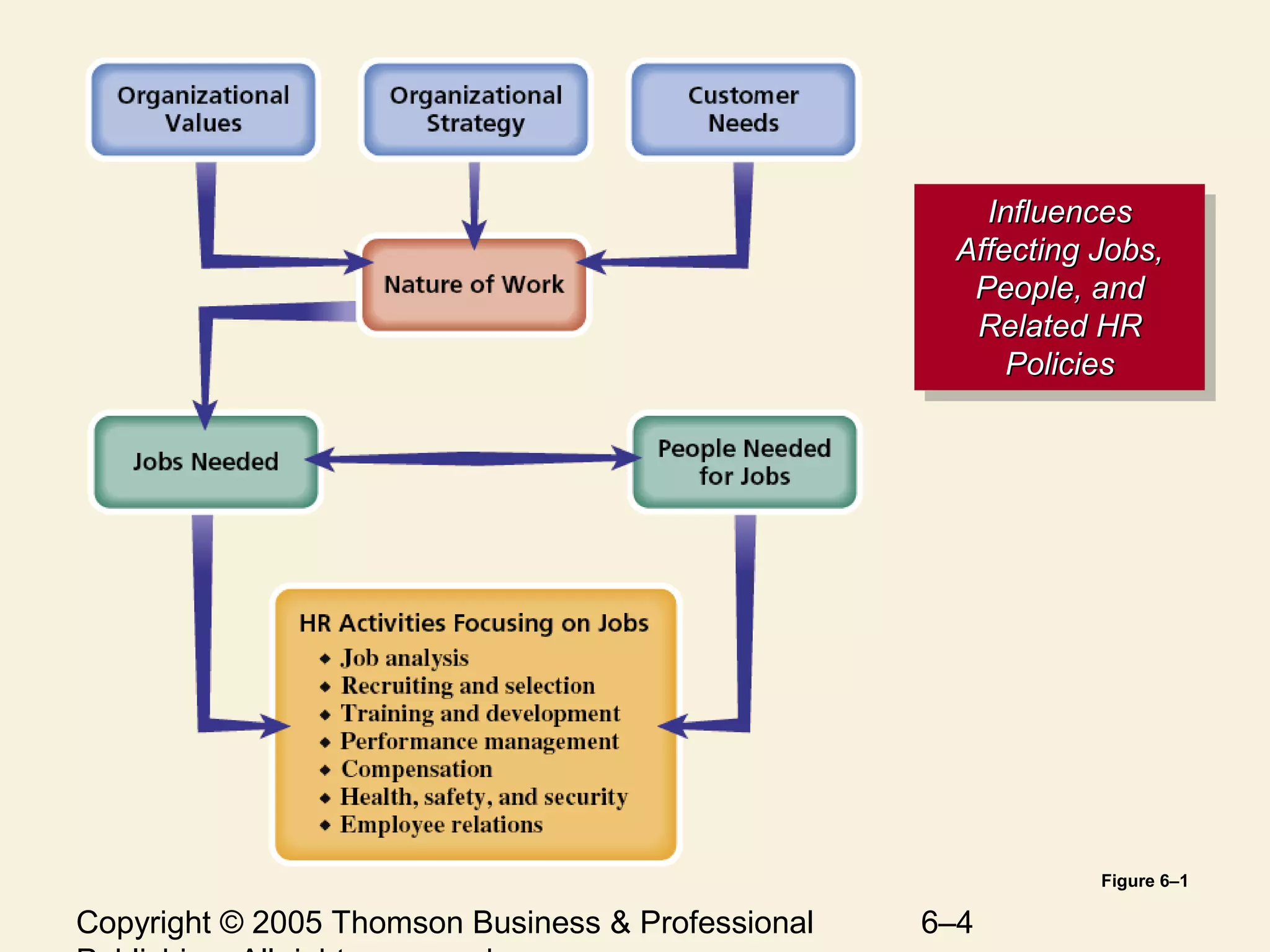
InfluencesInfluences
Affecting Jobs,Affecting Jobs,
People, andPeople, and
Related HRRelated HR
PoliciesPolicies
InfluencesInfluences
Affecting Jobs,Affecting Jobs,
People, andPeople, and
Related HRRelated HR
PoliciesPolicies
Figure 6–1
Copyright © 2005 Thomson Business & Professional 6–5
Workflow AnalysisWorkflow AnalysisWorkflow AnalysisWorkflow Analysis
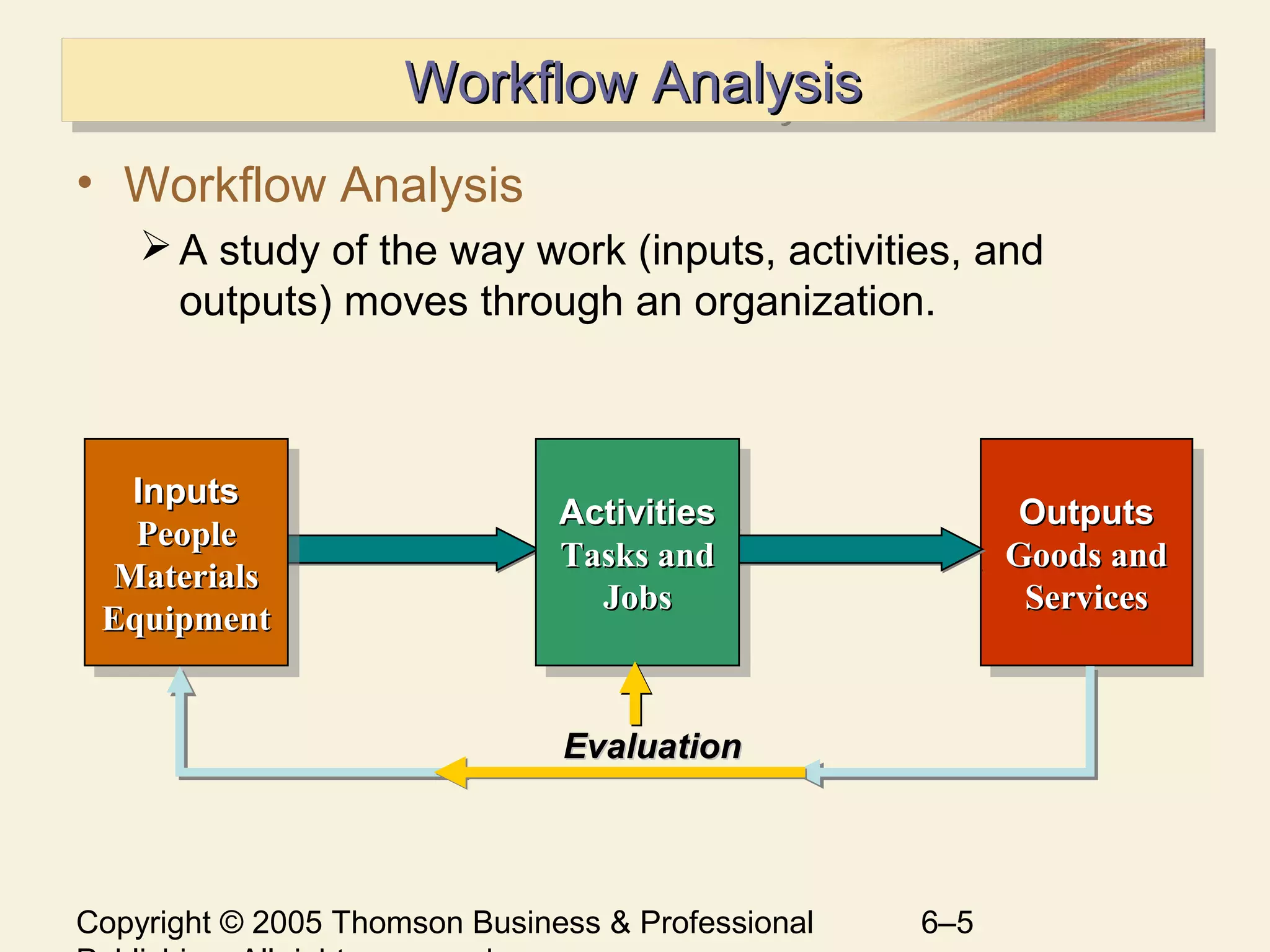
• Workflow Analysis
A study of the way work (inputs, activities, and
outputs) moves through an organization.
InputsInputs
PeoplePeople
MaterialsMaterials
EquipmentEquipment
InputsInputs
PeoplePeople
MaterialsMaterials
EquipmentEquipment
ActivitiesActivities
Tasks andTasks and
JobsJobs
ActivitiesActivities
Tasks andTasks and
JobsJobs
OutputsOutputs
Goods andGoods and
ServicesServices
OutputsOutputs
Goods andGoods and
ServicesServices
EvaluationEvaluation
Copyright © 2005 Thomson Business & Professional 6–6
Business Process Re-engineeringBusiness Process Re-engineeringBusiness Process Re-engineeringBusiness Process Re-engineering
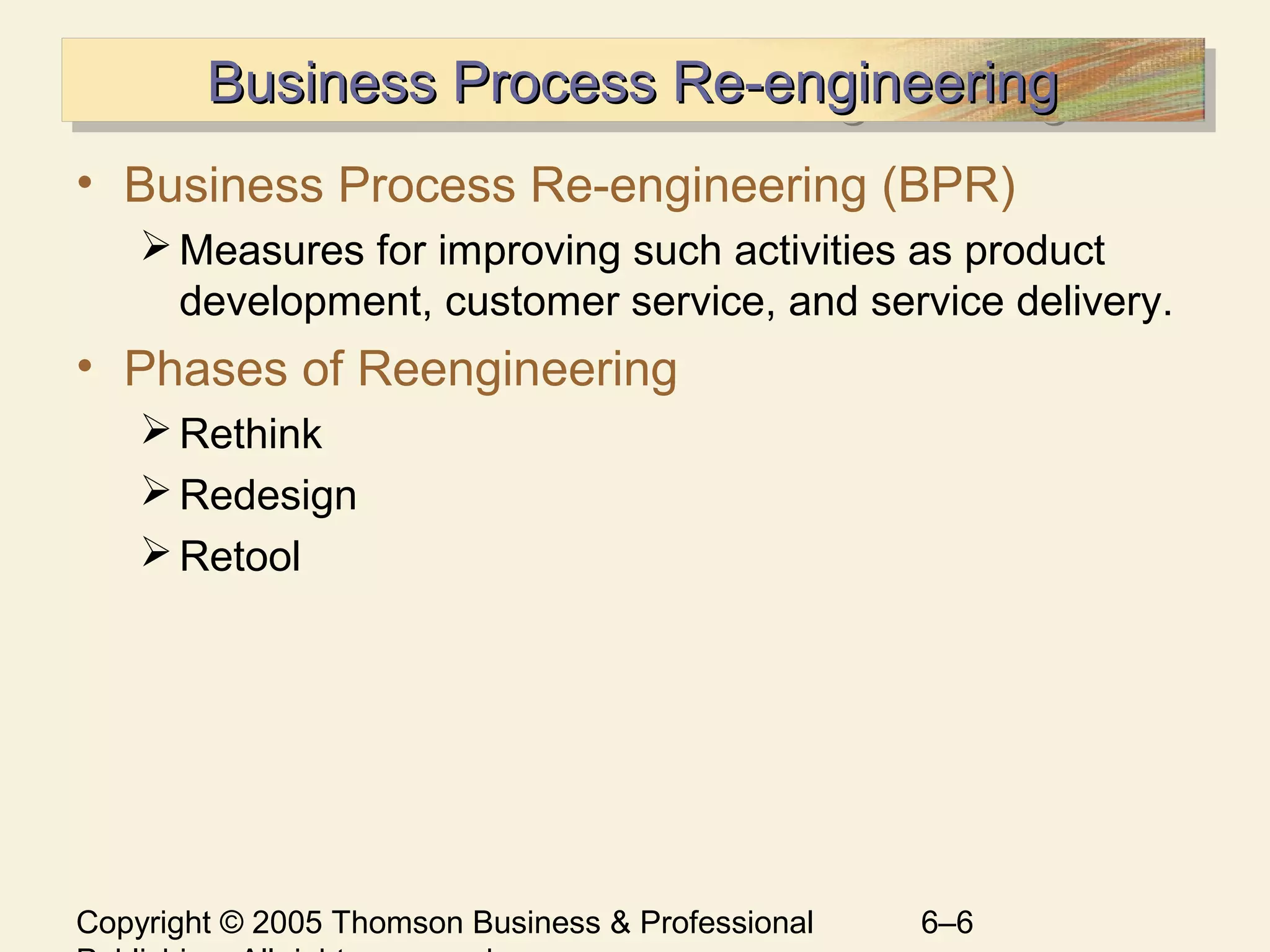
• Business Process Re-engineering (BPR)
Measures for improving such activities as product
development, customer service, and service delivery.
• Phases of Reengineering
Rethink
Redesign
Retool
Copyright © 2005 Thomson Business & Professional 6–7
Importance Of Job DesignImportance Of Job DesignImportance Of Job DesignImportance Of Job Design
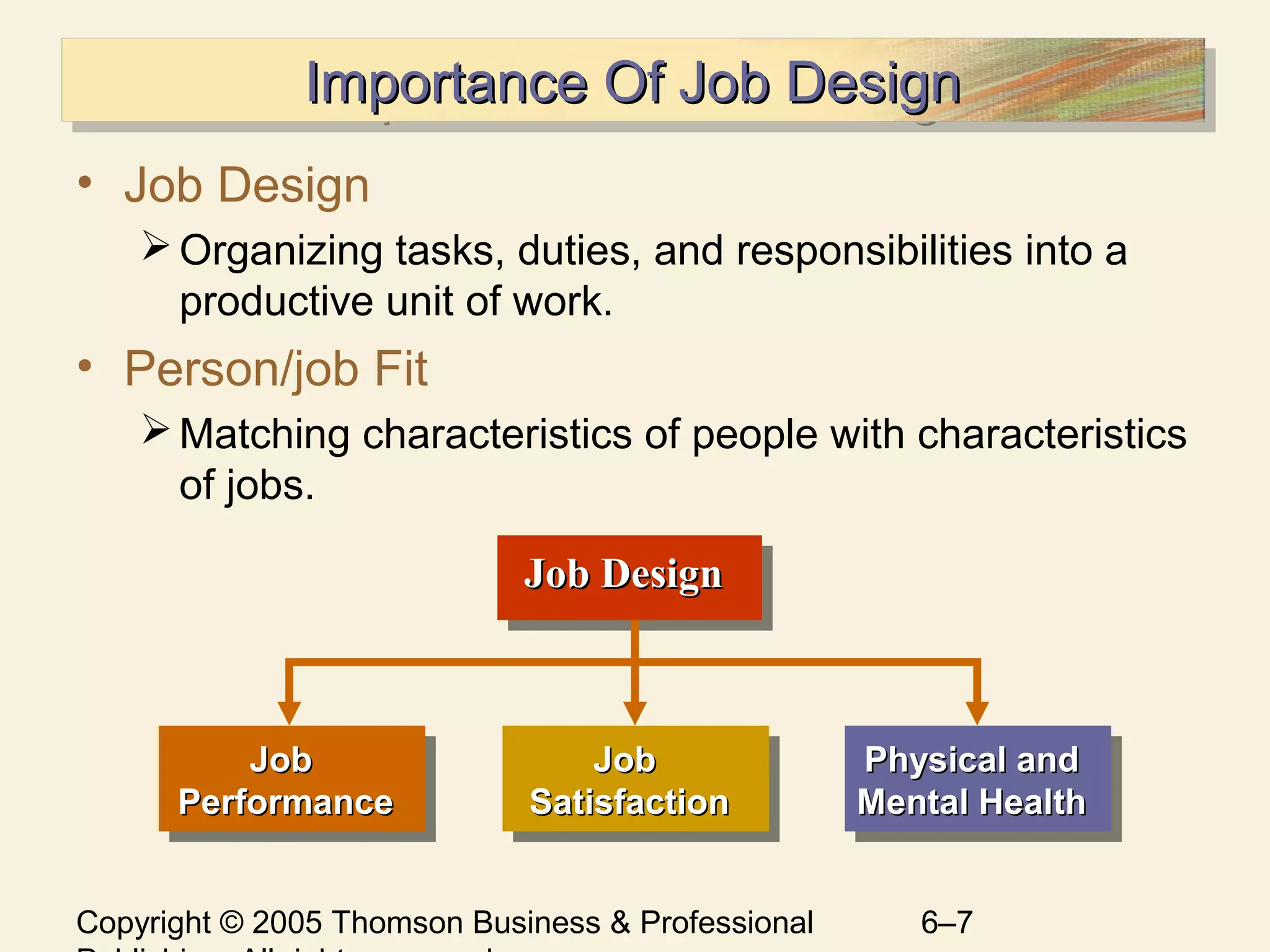
• Job Design
Organizing tasks, duties, and responsibilities into a
productive unit of work.
• Person/job Fit
Matching characteristics of people with characteristics
of jobs.
Job DesignJob DesignJob DesignJob Design
JobJob
SatisfactionSatisfaction
JobJob
SatisfactionSatisfaction
JobJob
PerformancePerformance
JobJob
PerformancePerformance
Physical andPhysical and
Mental HealthMental Health
Physical andPhysical and
Mental HealthMental Health
Copyright © 2005 Thomson Business & Professional 6–8
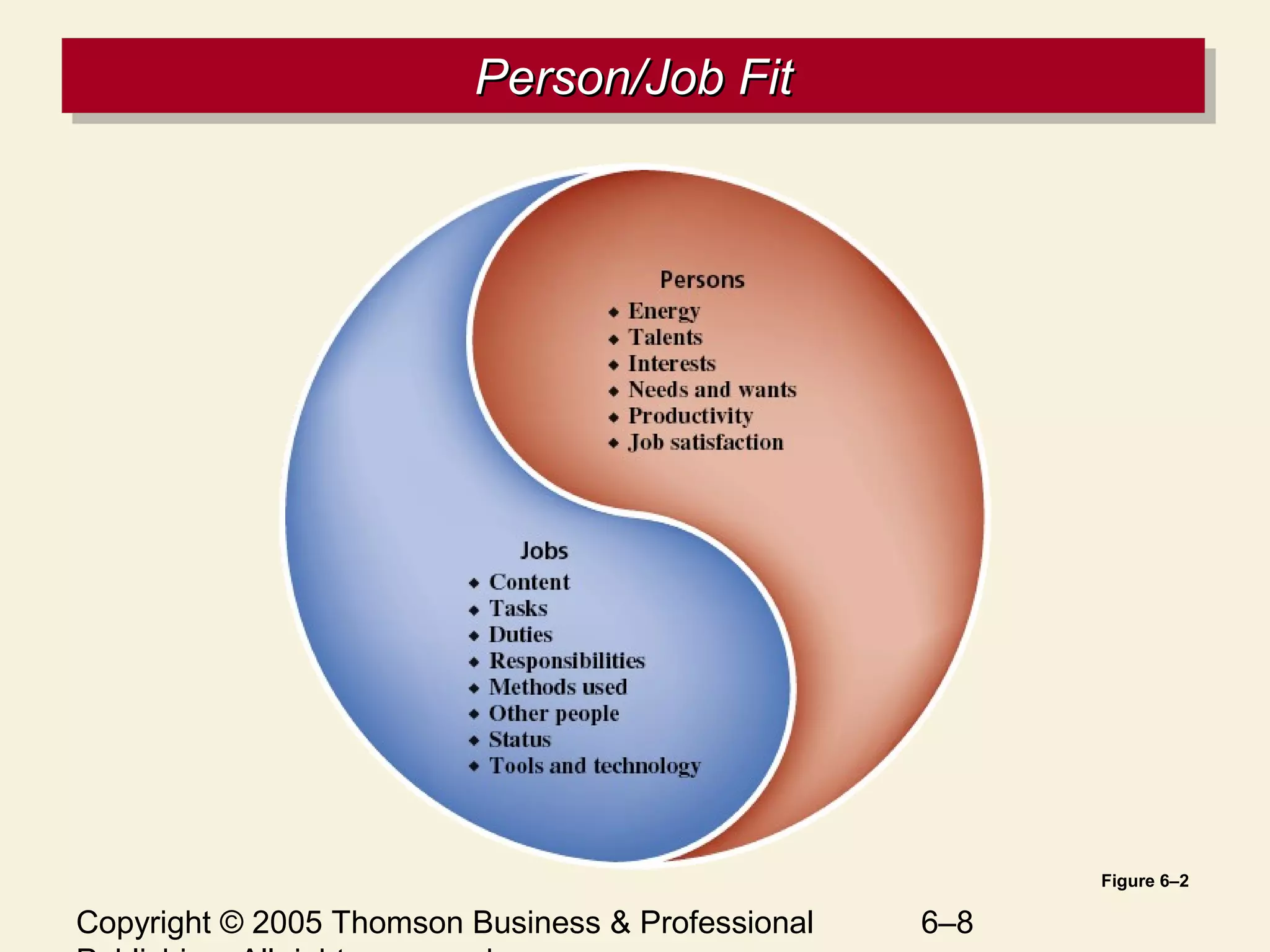
Person/Job FitPerson/Job FitPerson/Job FitPerson/Job Fit
Figure 6–2
Copyright © 2005 Thomson Business & Professional 6–9
Nature of Job DesignNature of Job DesignNature of Job DesignNature of Job Design
• Job Enlargement
Broadening the scope of a job by expanding the
number of different tasks to be performed.
• Job Enrichment
Increasing the depth of a job by adding the
responsibility for planning, organizing , controlling,
and evaluating the job.
• Job Rotation
The process of shifting a person from job to job.
Copyright © 2005 Thomson Business & Professional 6–10
Characteristics of JobsCharacteristics of JobsCharacteristics of JobsCharacteristics of Jobs
• Skill Variety
The extent to which the work requires several
different activities for successful completion.
• Task Identity
The extent to which the job includes a “whole”
identifiable unit of work that is carried out from start to
finish and that results in a visible outcome.
• Task Significance
The impact the job has on other people.
Copyright © 2005 Thomson Business & Professional 6–11
Characteristics of JobsCharacteristics of JobsCharacteristics of JobsCharacteristics of Jobs
• Autonomy
The extent of individual freedom and discretion in the
work and its scheduling.
• Feedback
Amount of information employees receive about how
well or how poorly they have performed.
Copyright © 2005 Thomson Business & Professional 6–12
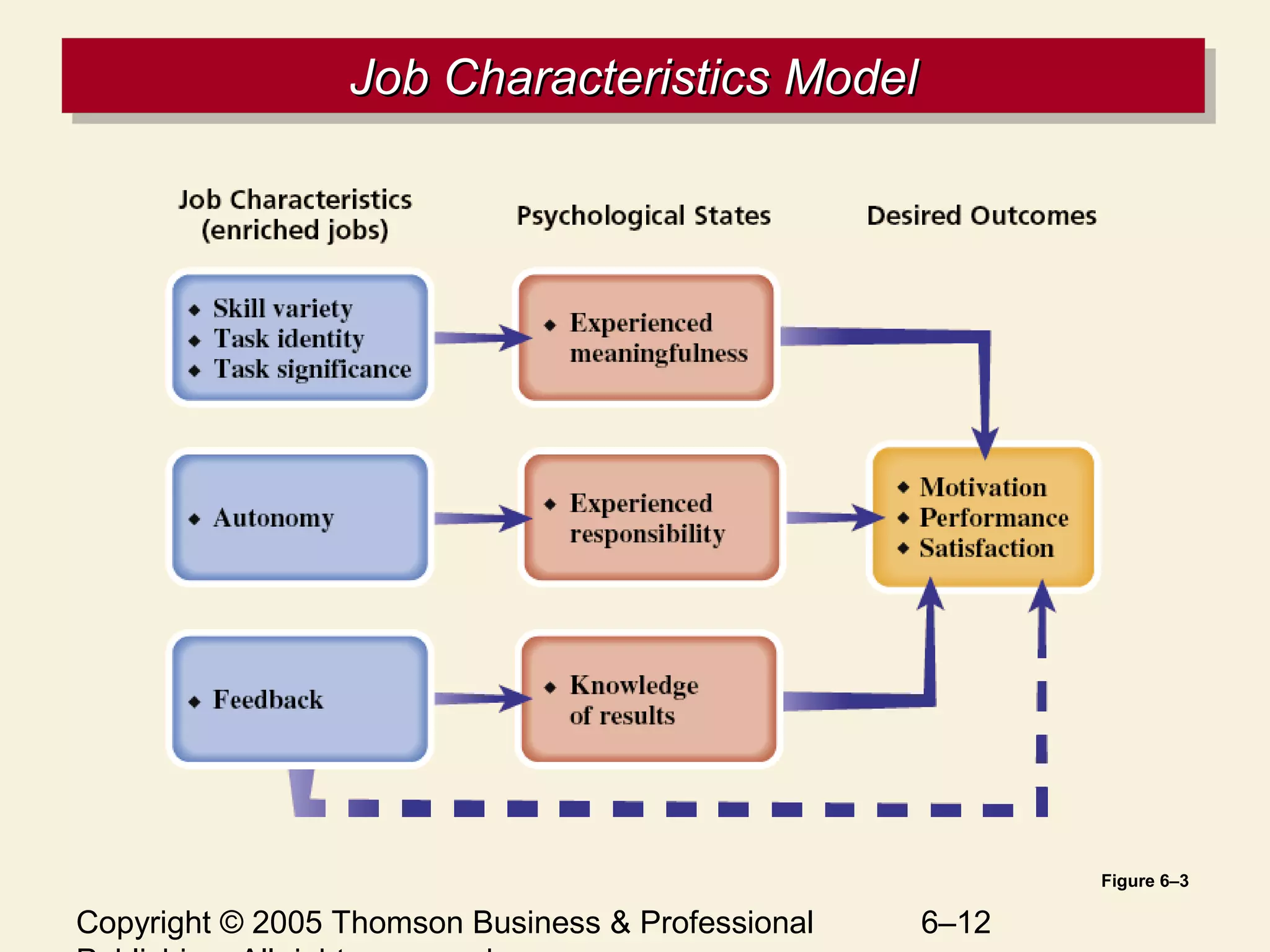
Job Characteristics ModelJob Characteristics ModelJob Characteristics ModelJob Characteristics Model
Figure 6–3
Copyright © 2005 Thomson Business & Professional 6–13
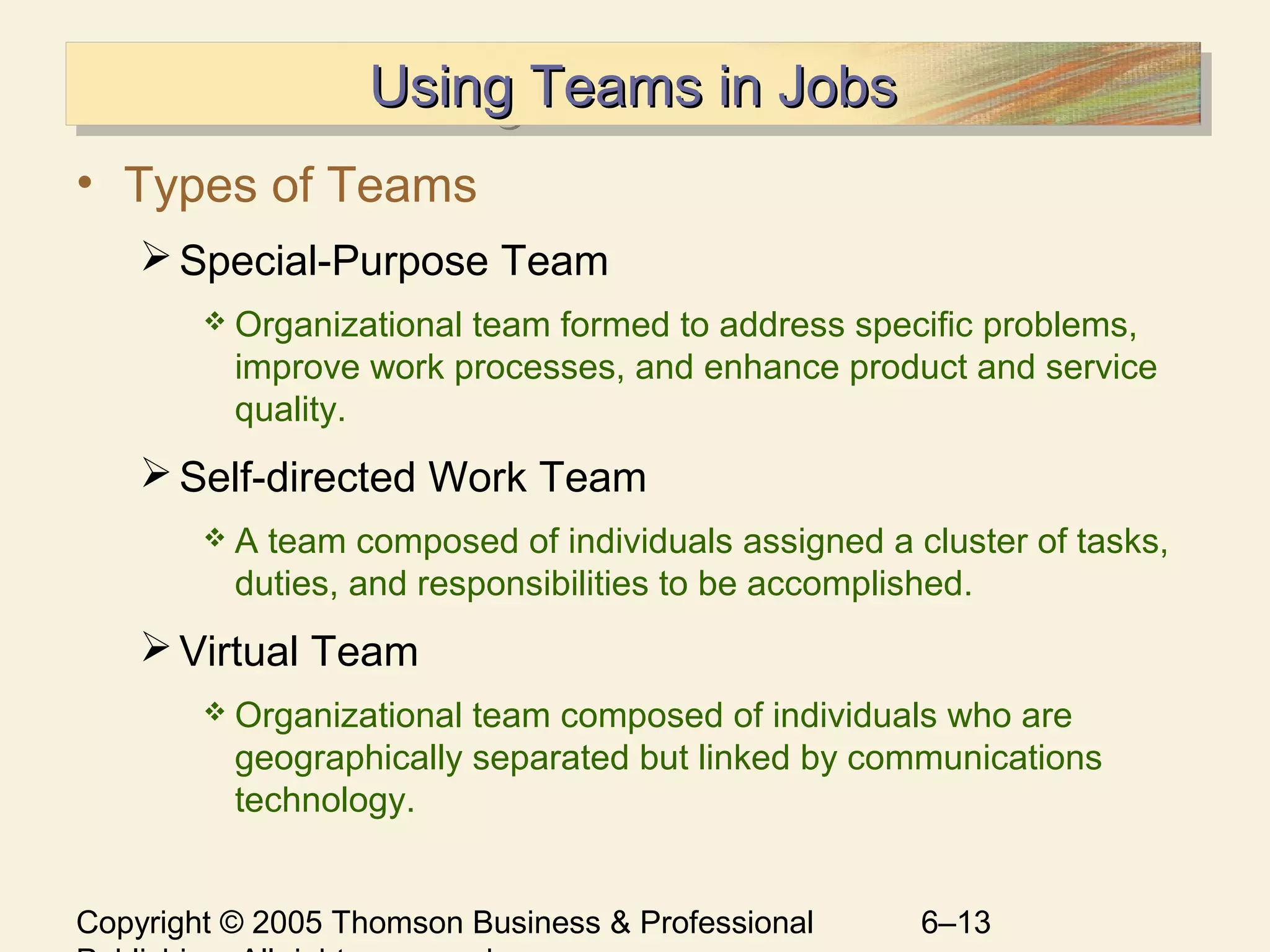
Using Teams in JobsUsing Teams in JobsUsing Teams in JobsUsing Teams in Jobs
• Types of Teams
Special-Purpose Team
 Organizational team formed to address specific problems,
improve work processes, and enhance product and service
quality.
Self-directed Work Team
 A team composed of individuals assigned a cluster of tasks,
duties, and responsibilities to be accomplished.
Virtual Team
 Organizational team composed of individuals who are
geographically separated but linked by communications
technology.
Copyright © 2005 Thomson Business & Professional 6–14
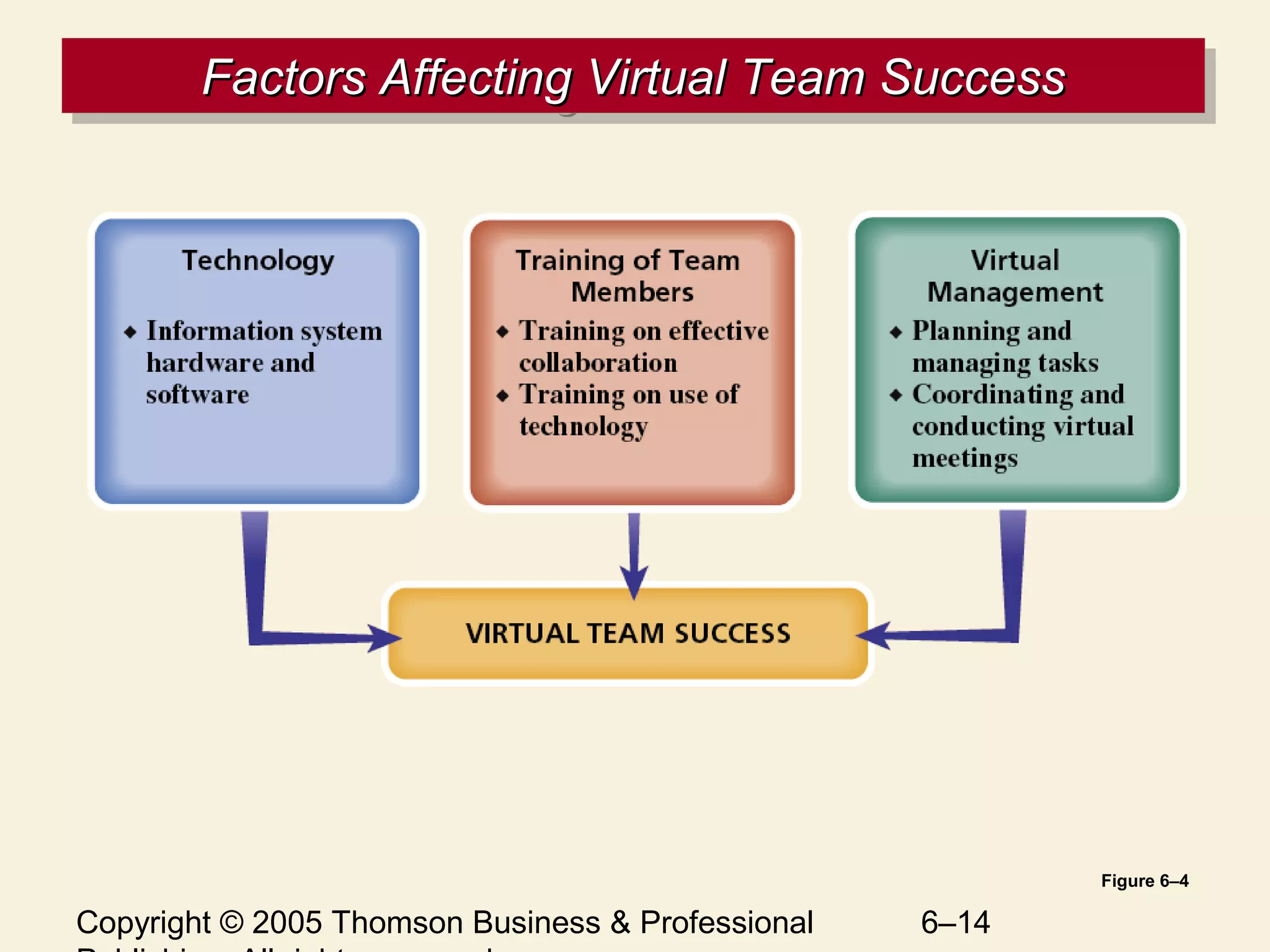
Factors Affecting Virtual Team SuccessFactors Affecting Virtual Team SuccessFactors Affecting Virtual Team SuccessFactors Affecting Virtual Team Success
Figure 6–4
Copyright © 2005 Thomson Business & Professional 6–15
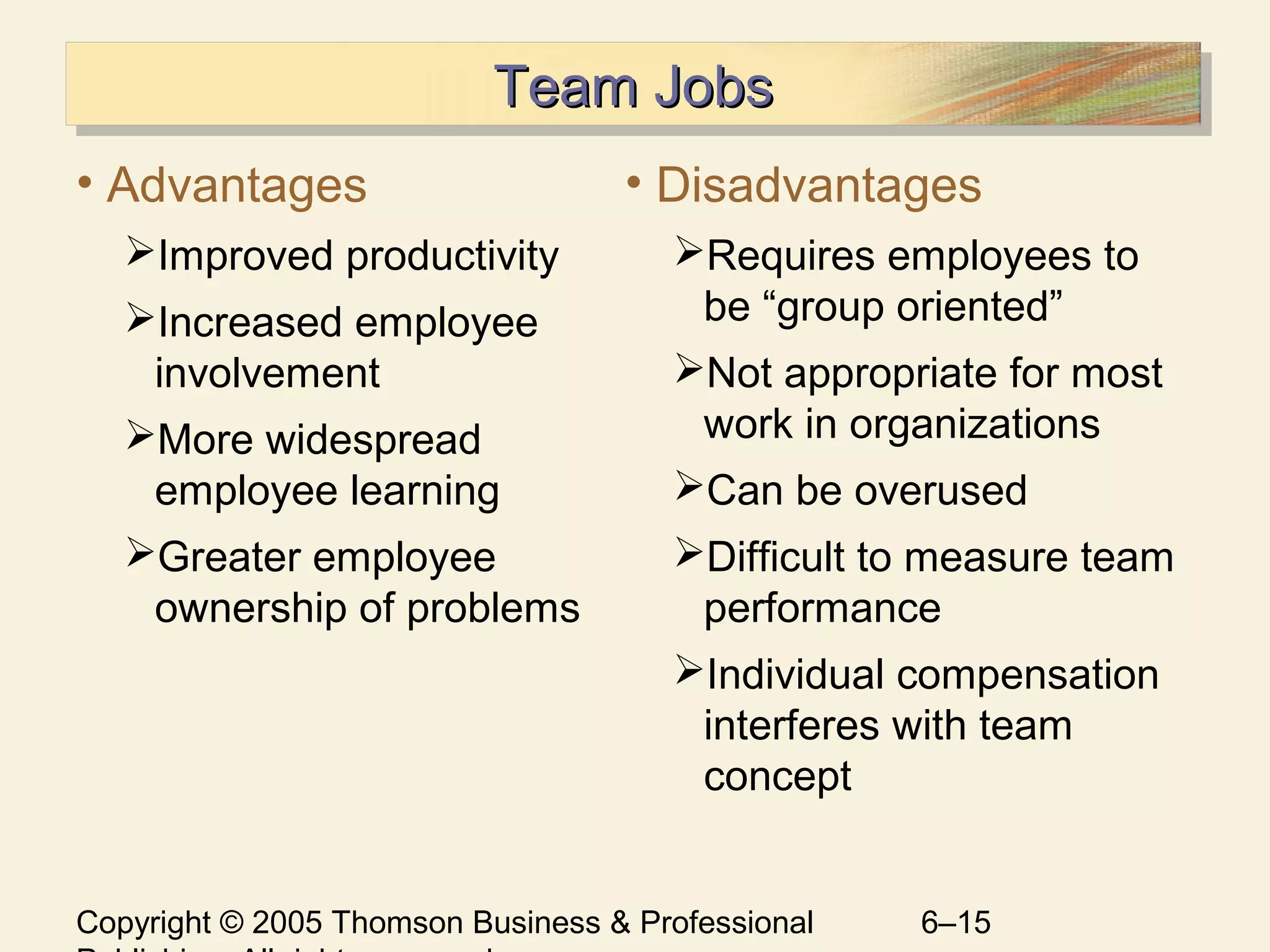
Team JobsTeam JobsTeam JobsTeam Jobs
• Advantages
Improved productivity
Increased employee
involvement
More widespread
employee learning
Greater employee
ownership of problems
• Disadvantages
Requires employees to
be “group oriented”
Not appropriate for most
work in organizations
Can be overused
Difficult to measure team
performance
Individual compensation
interferes with team
concept
Copyright © 2005 Thomson Business & Professional 6–16
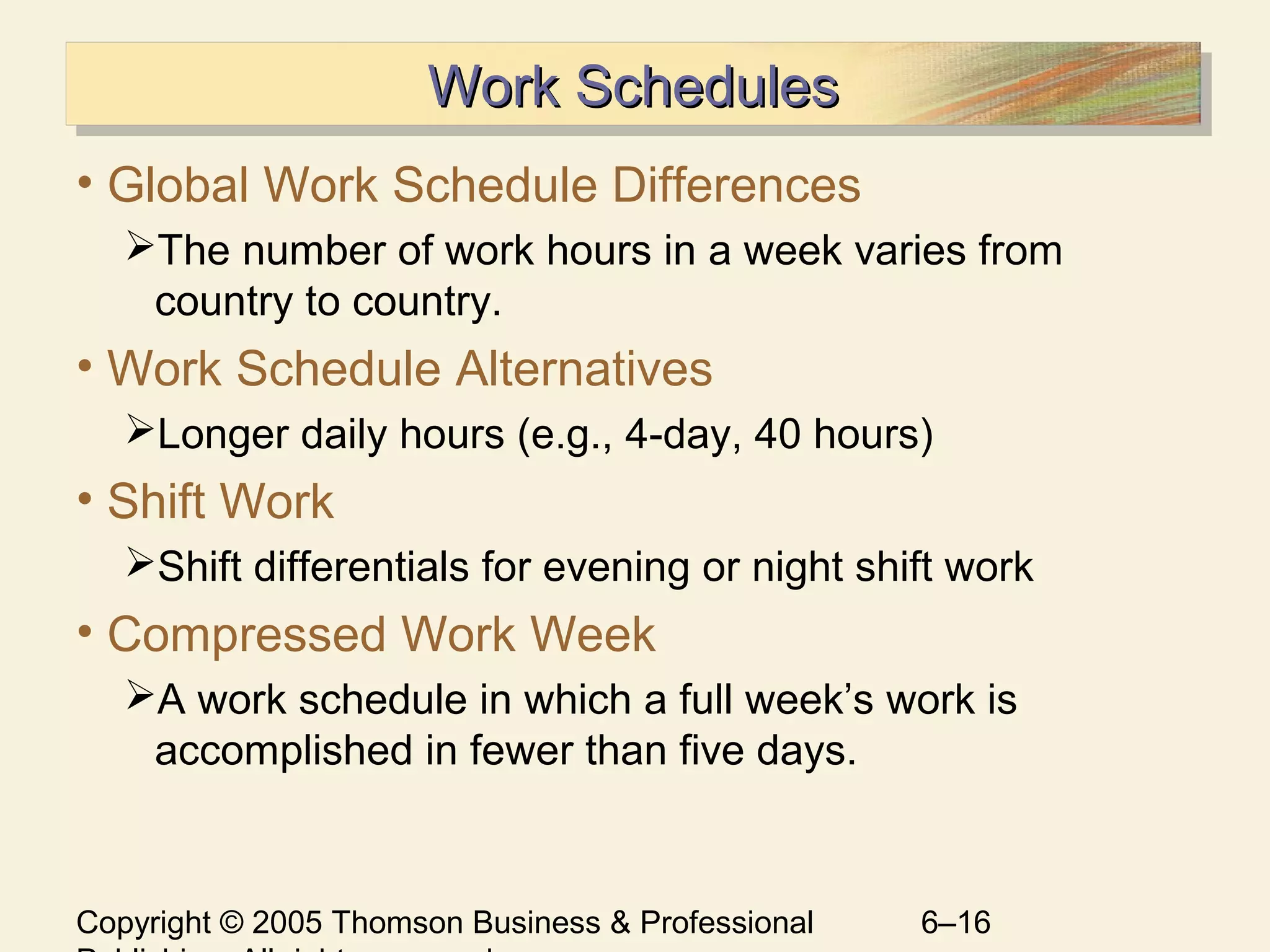
Work SchedulesWork SchedulesWork SchedulesWork Schedules
• Global Work Schedule Differences
The number of work hours in a week varies from
country to country.
• Work Schedule Alternatives
Longer daily hours (e.g., 4-day, 40 hours)
• Shift Work
Shift differentials for evening or night shift work
• Compressed Work Week
A work schedule in which a full week’s work is
accomplished in fewer than five days.
Copyright © 2005 Thomson Business & Professional 6–17
Work SchedulesWork SchedulesWork SchedulesWork Schedules
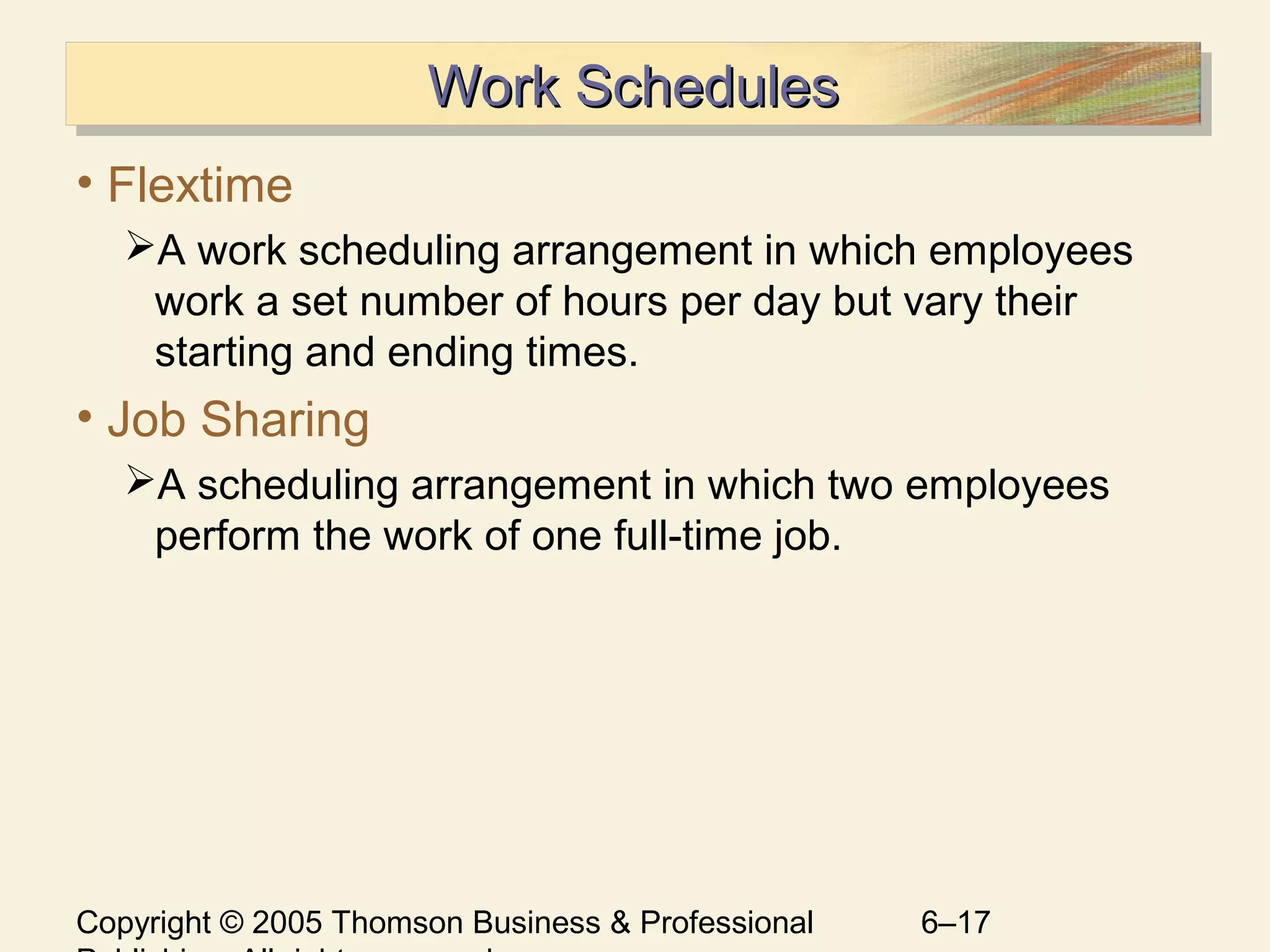
• Flextime
A work scheduling arrangement in which employees
work a set number of hours per day but vary their
starting and ending times.
• Job Sharing
A scheduling arrangement in which two employees
perform the work of one full-time job.
Copyright © 2005 Thomson Business & Professional 6–18
Alternative Work LocationsAlternative Work LocationsAlternative Work LocationsAlternative Work Locations
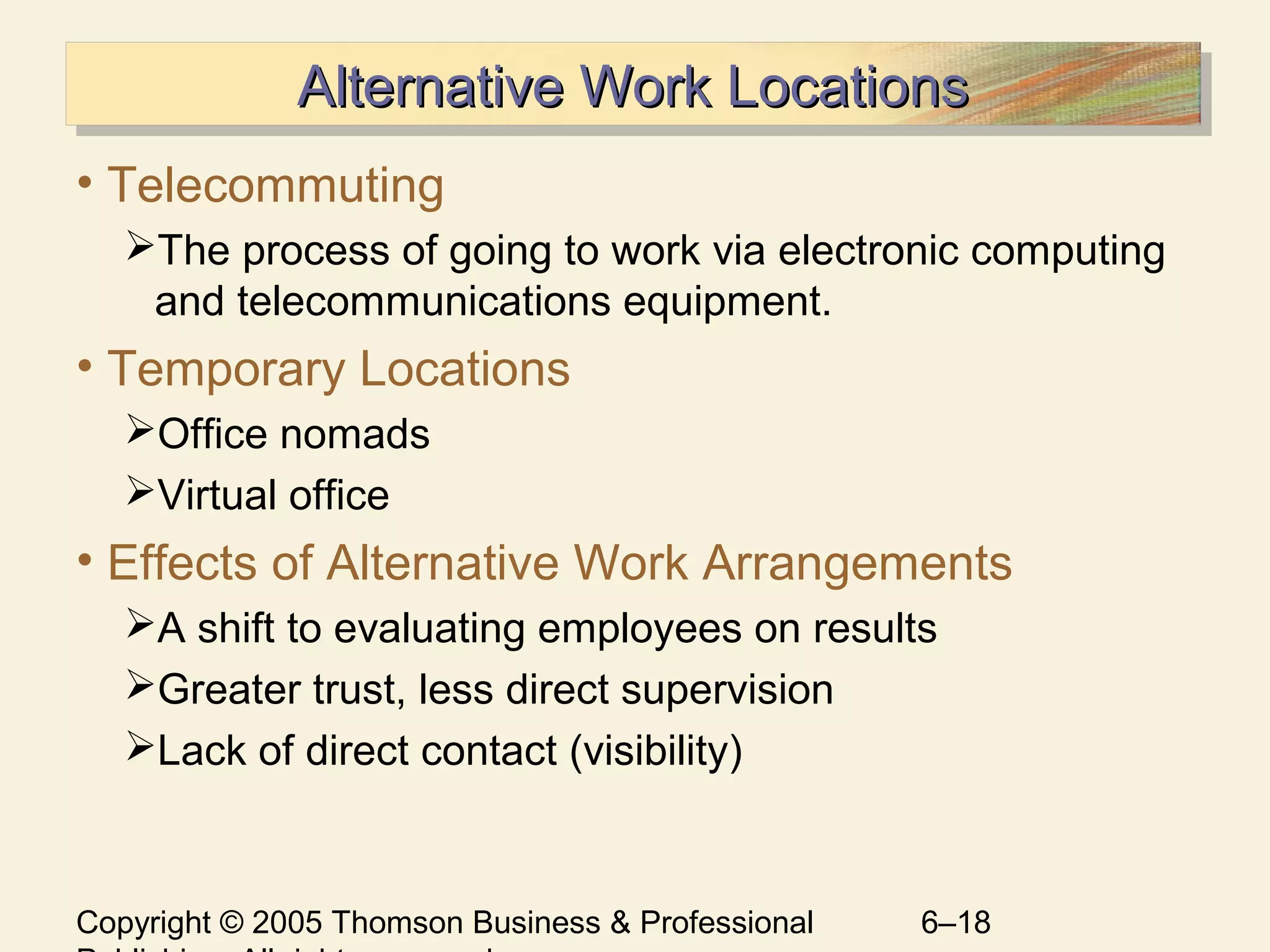
• Telecommuting
The process of going to work via electronic computing
and telecommunications equipment.
• Temporary Locations
Office nomads
Virtual office
• Effects of Alternative Work Arrangements
A shift to evaluating employees on results
Greater trust, less direct supervision
Lack of direct contact (visibility)
Copyright © 2005 Thomson Business & Professional 6–19
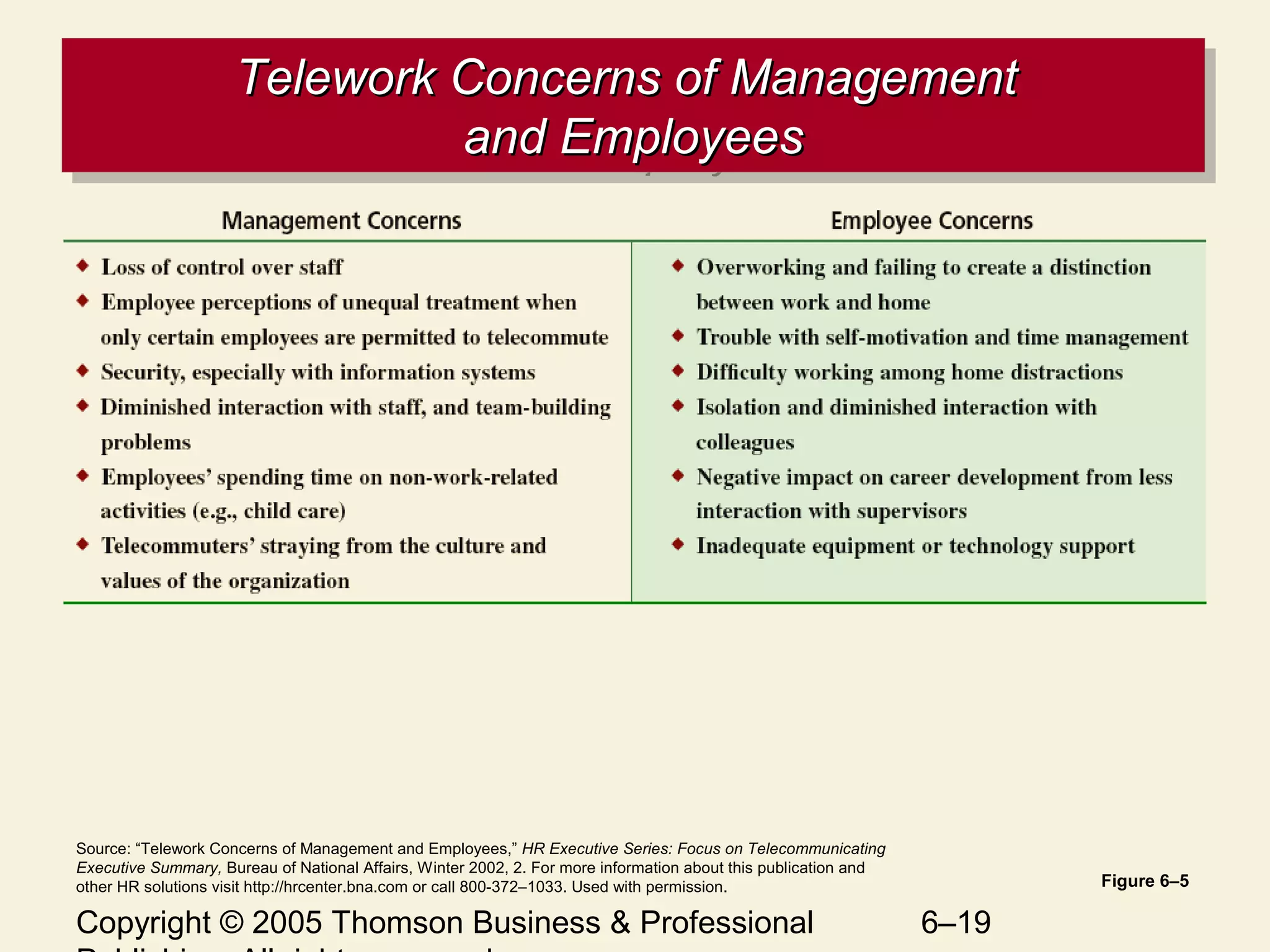
Telework Concerns of ManagementTelework Concerns of Management
and Employeesand Employees
Telework Concerns of ManagementTelework Concerns of Management
and Employeesand Employees
Figure 6–5
Source: “Telework Concerns of Management and Employees,” HR Executive Series: Focus on Telecommunicating
Executive Summary, Bureau of National Affairs, Winter 2002, 2. For more information about this publication and
other HR solutions visit http://hrcenter.bna.com or call 800-372–1033. Used with permission.
Copyright © 2005 Thomson Business & Professional 6–20
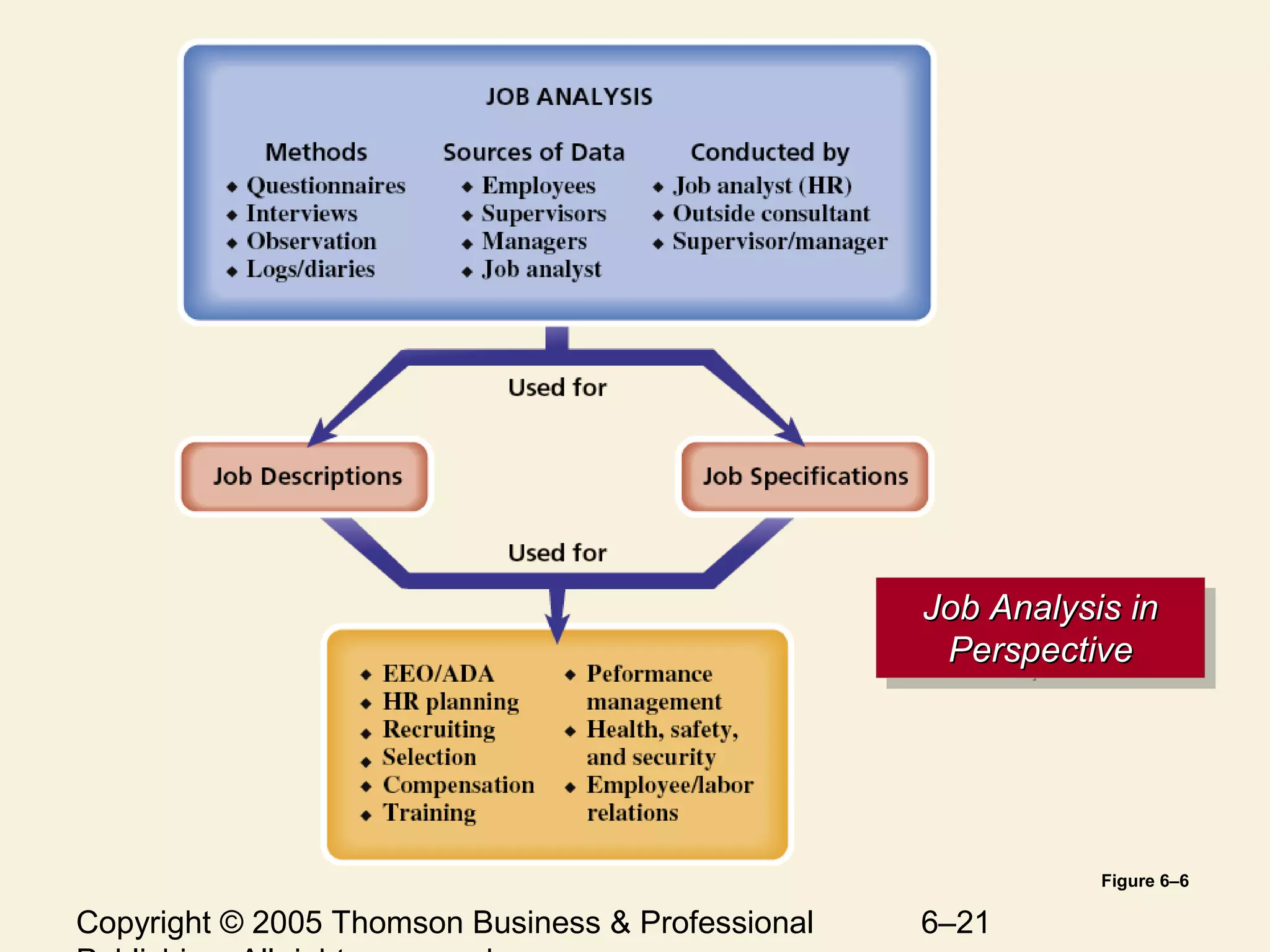
The Nature of Job AnalysisThe Nature of Job AnalysisThe Nature of Job AnalysisThe Nature of Job Analysis
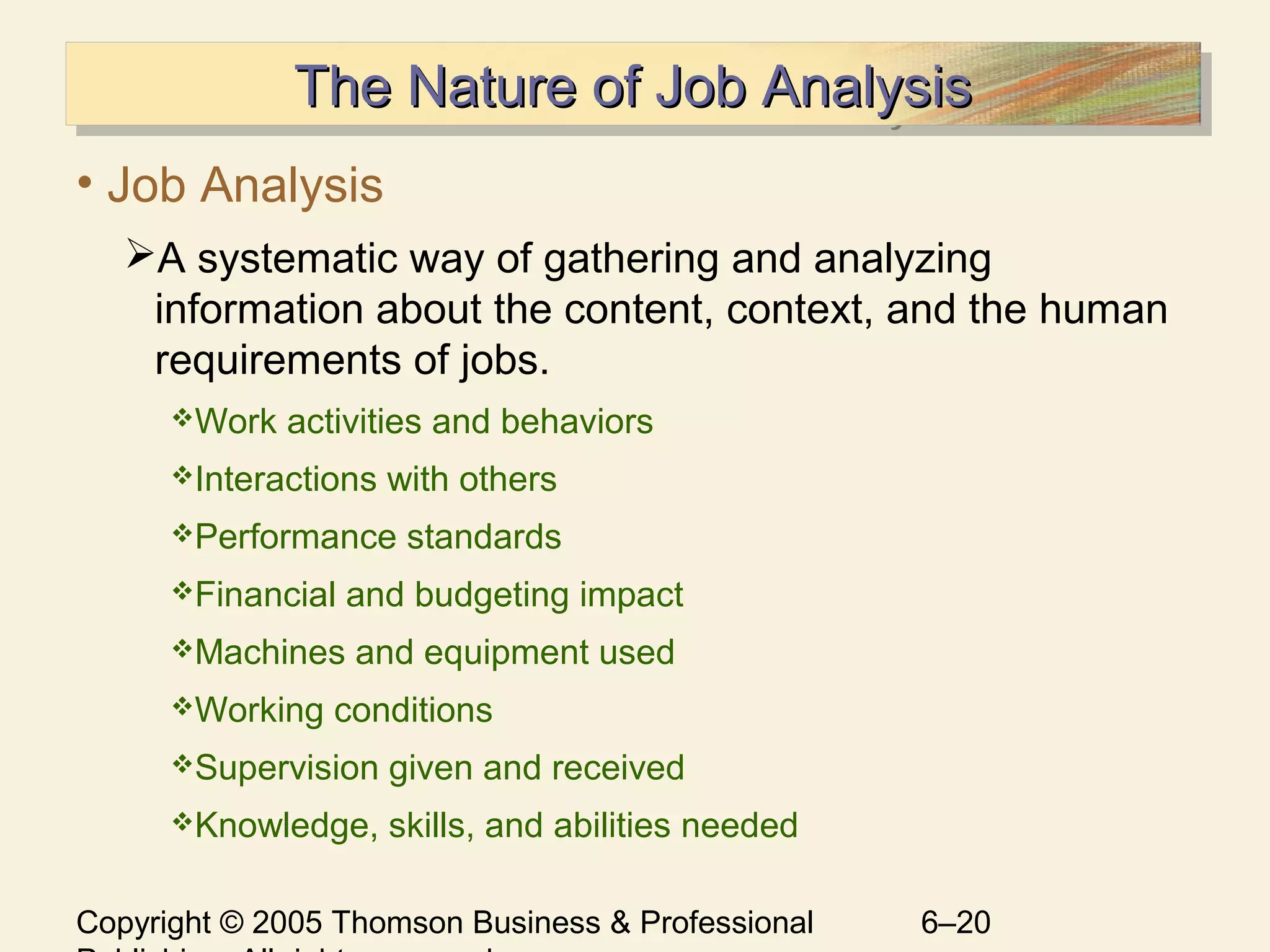
• Job Analysis
A systematic way of gathering and analyzing
information about the content, context, and the human
requirements of jobs.
Work activities and behaviors
Interactions with others
Performance standards
Financial and budgeting impact
Machines and equipment used
Working conditions
Supervision given and received
Knowledge, skills, and abilities needed
Copyright © 2005 Thomson Business & Professional 6–21
Job Analysis inJob Analysis in
PerspectivePerspective
Job Analysis inJob Analysis in
PerspectivePerspective
Figure 6–6
Copyright © 2005 Thomson Business & Professional 6–22
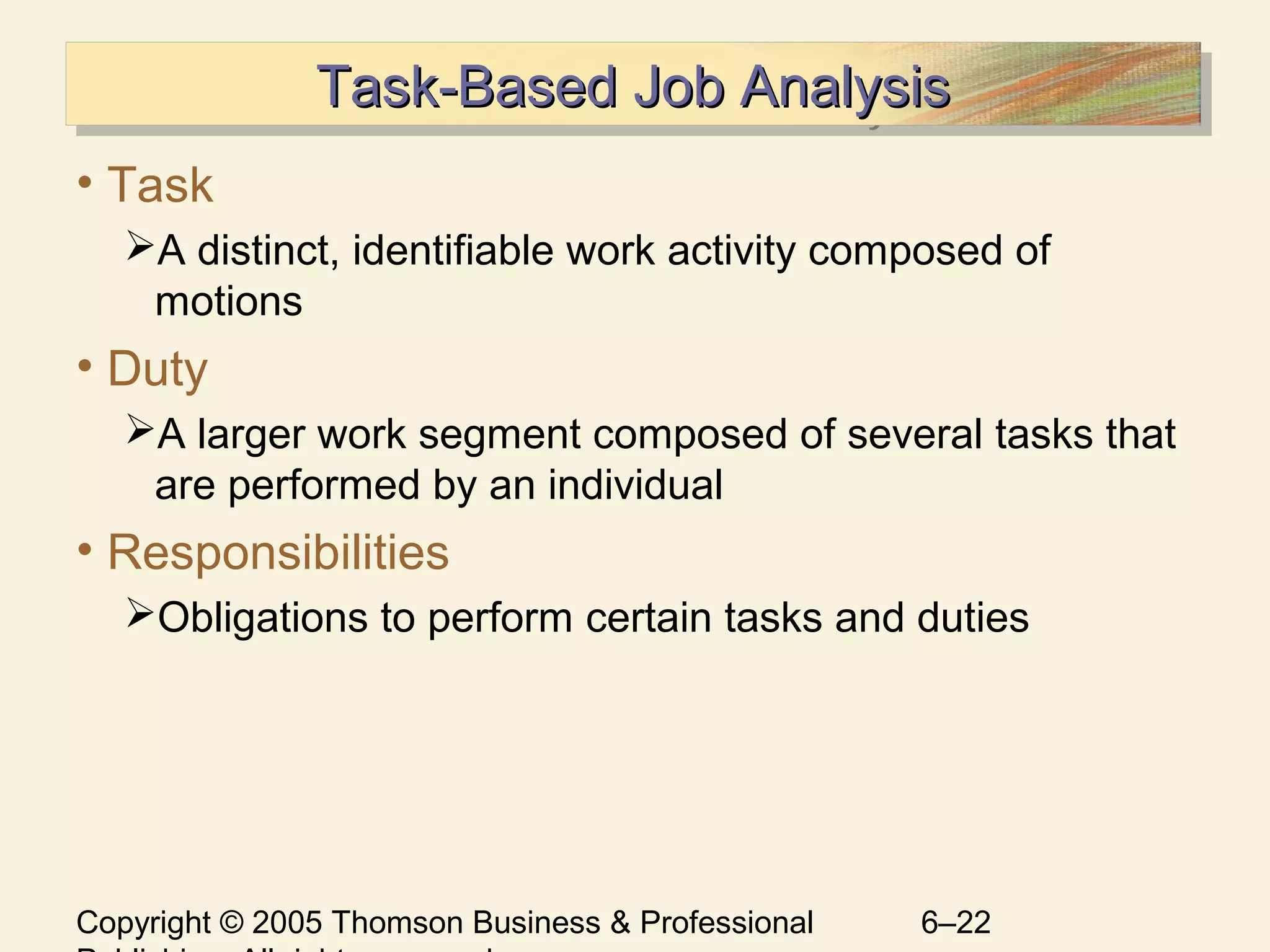
Task-Based Job AnalysisTask-Based Job AnalysisTask-Based Job AnalysisTask-Based Job Analysis
• Task
A distinct, identifiable work activity composed of
motions
• Duty
A larger work segment composed of several tasks that
are performed by an individual
• Responsibilities
Obligations to perform certain tasks and duties
Copyright © 2005 Thomson Business & Professional 6–23
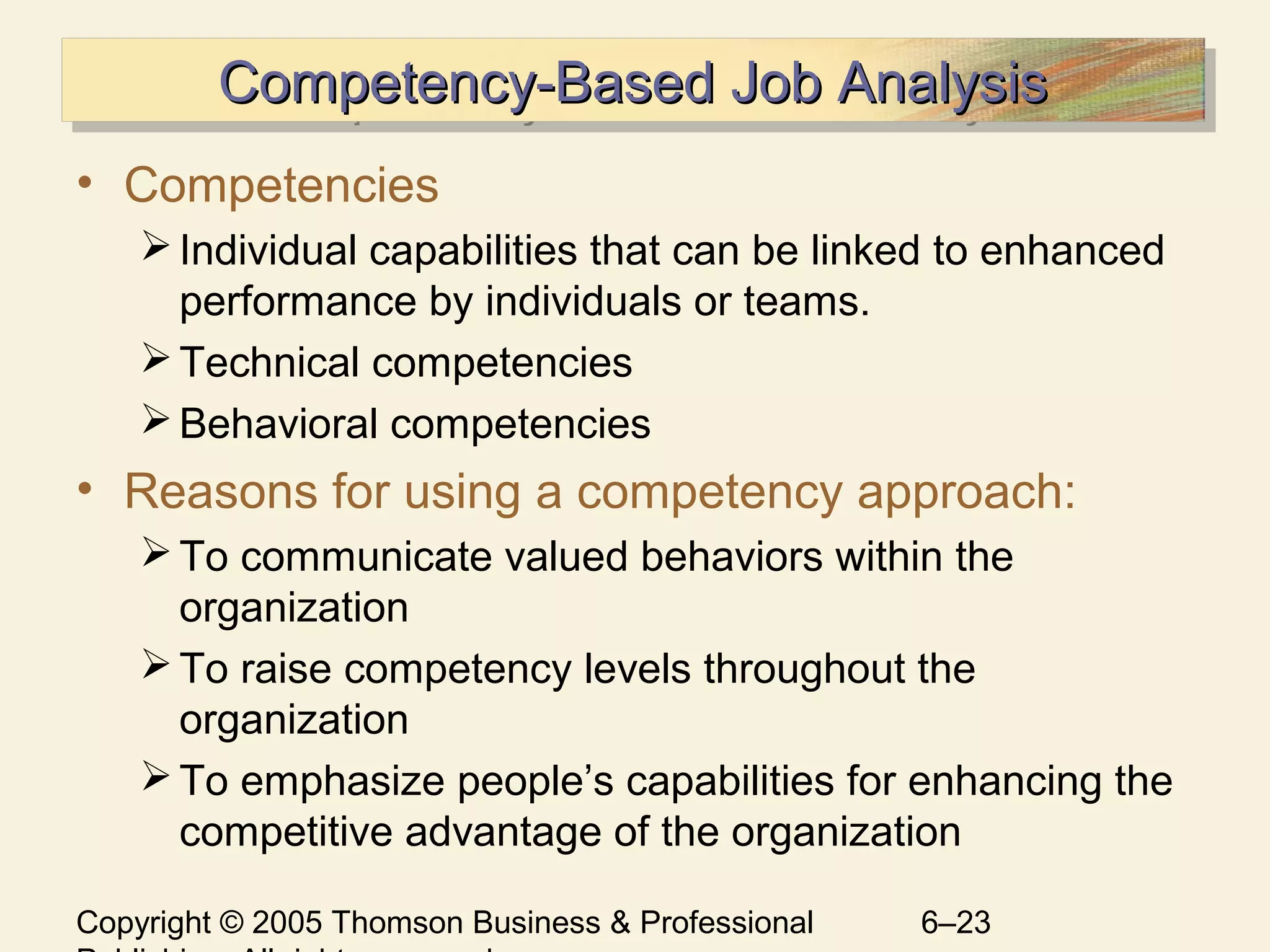
Competency-Based Job AnalysisCompetency-Based Job AnalysisCompetency-Based Job AnalysisCompetency-Based Job Analysis
• Competencies
Individual capabilities that can be linked to enhanced
performance by individuals or teams.
Technical competencies
Behavioral competencies
• Reasons for using a competency approach:
To communicate valued behaviors within the
organization
To raise competency levels throughout the
organization
To emphasize people’s capabilities for enhancing the
competitive advantage of the organization
Copyright © 2005 Thomson Business & Professional 6–24
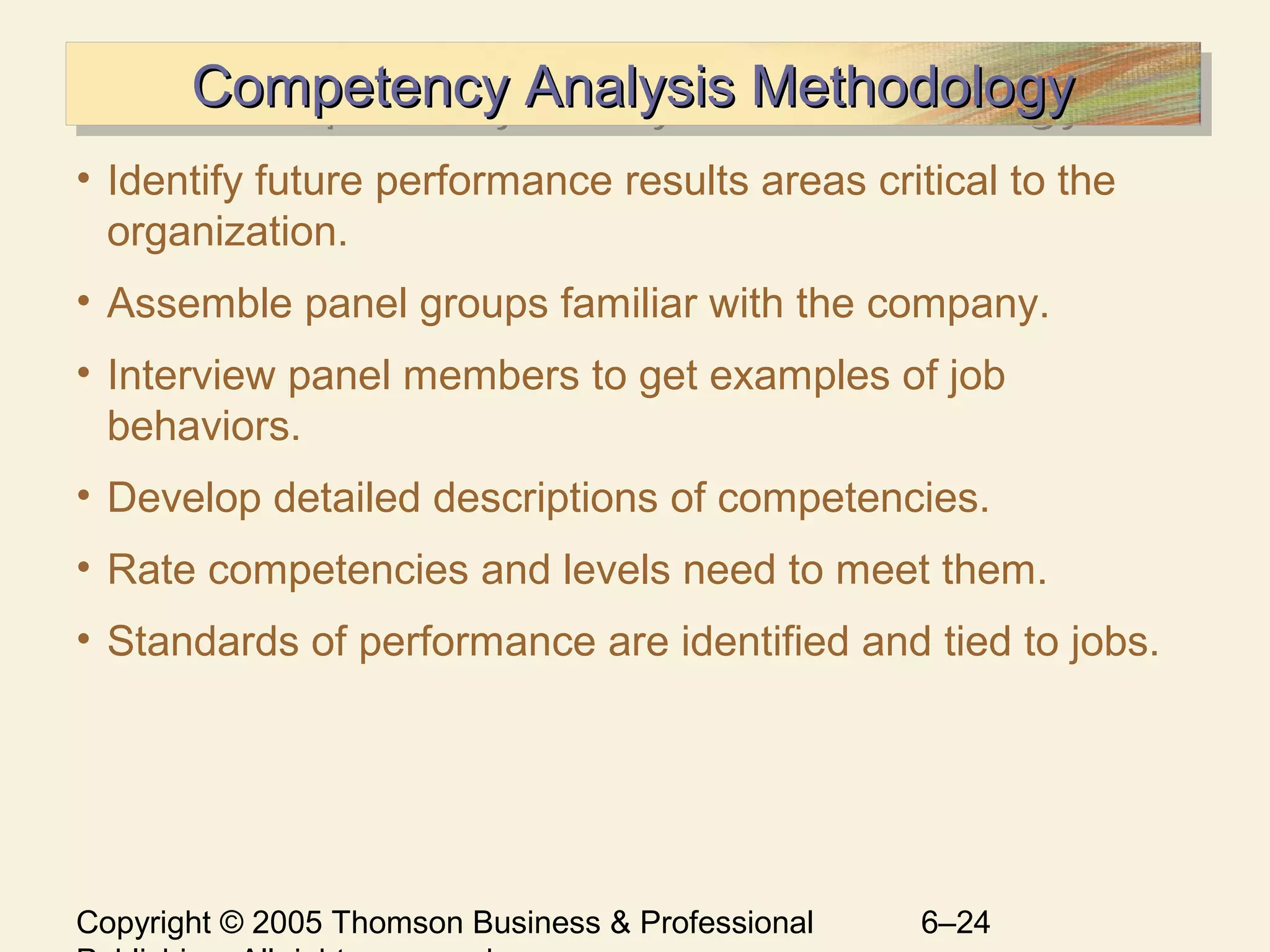
Competency Analysis MethodologyCompetency Analysis MethodologyCompetency Analysis MethodologyCompetency Analysis Methodology
• Identify future performance results areas critical to the
organization.
• Assemble panel groups familiar with the company.
• Interview panel members to get examples of job
behaviors.
• Develop detailed descriptions of competencies.
• Rate competencies and levels need to meet them.
• Standards of performance are identified and tied to jobs.
Copyright © 2005 Thomson Business & Professional 6–25
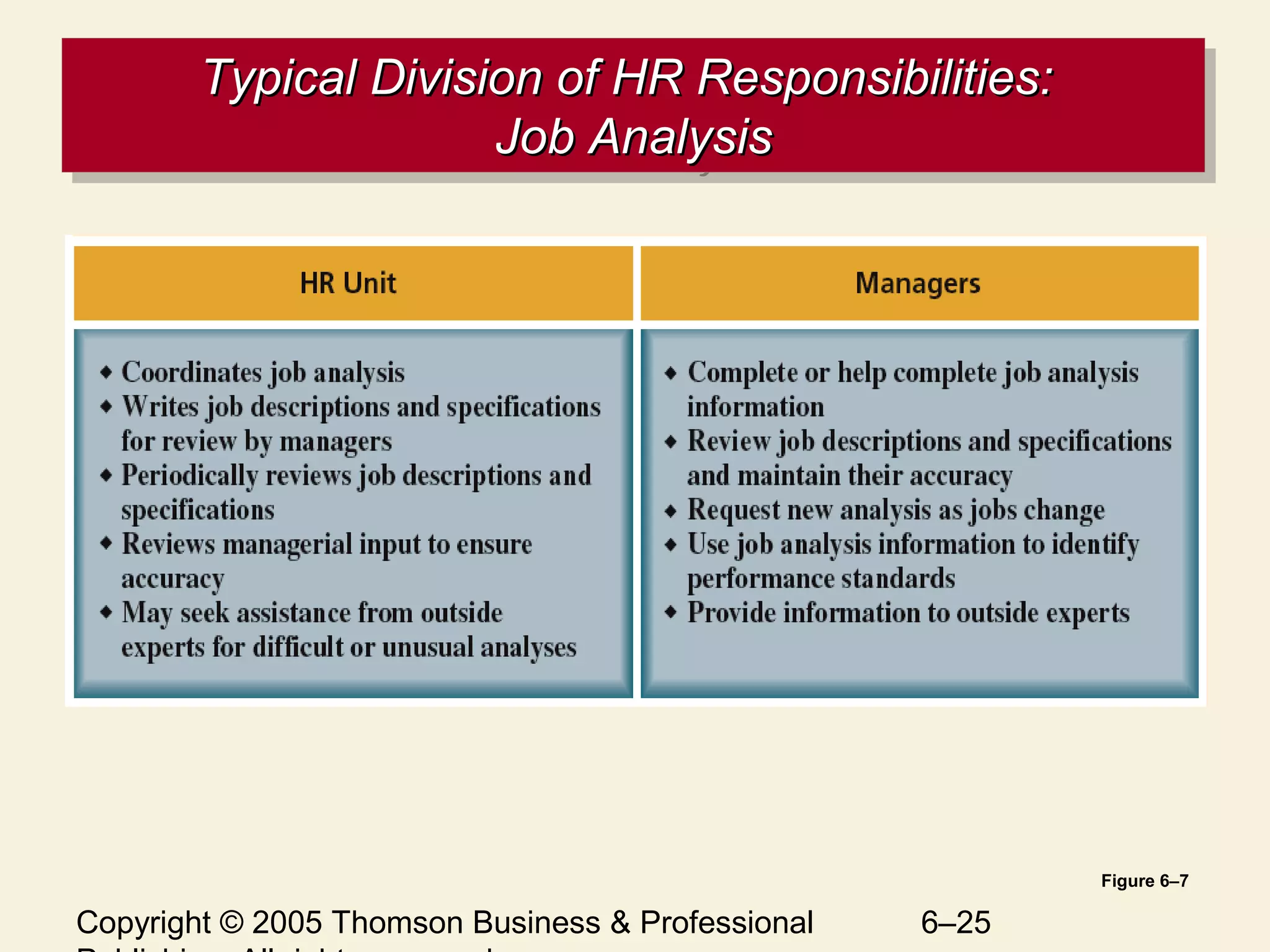
Typical Division of HR Responsibilities:Typical Division of HR Responsibilities:
Job AnalysisJob Analysis
Typical Division of HR Responsibilities:Typical Division of HR Responsibilities:
Job AnalysisJob Analysis
Figure 6–7
Copyright © 2005 Thomson Business & Professional 6–26
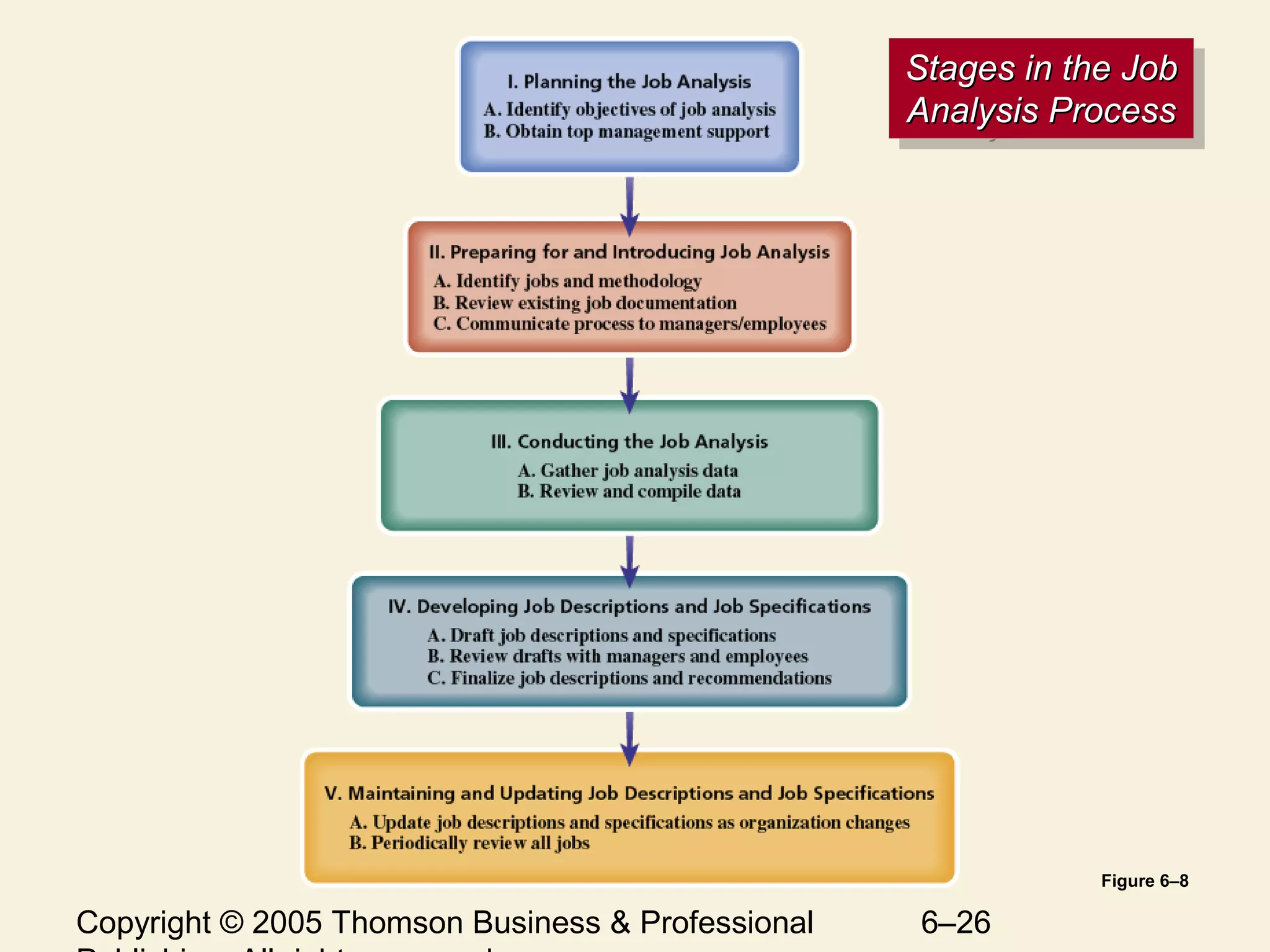
Stages in the JobStages in the Job
Analysis ProcessAnalysis Process
Stages in the JobStages in the Job
Analysis ProcessAnalysis Process
Figure 6–8
Copyright © 2005 Thomson Business & Professional 6–27
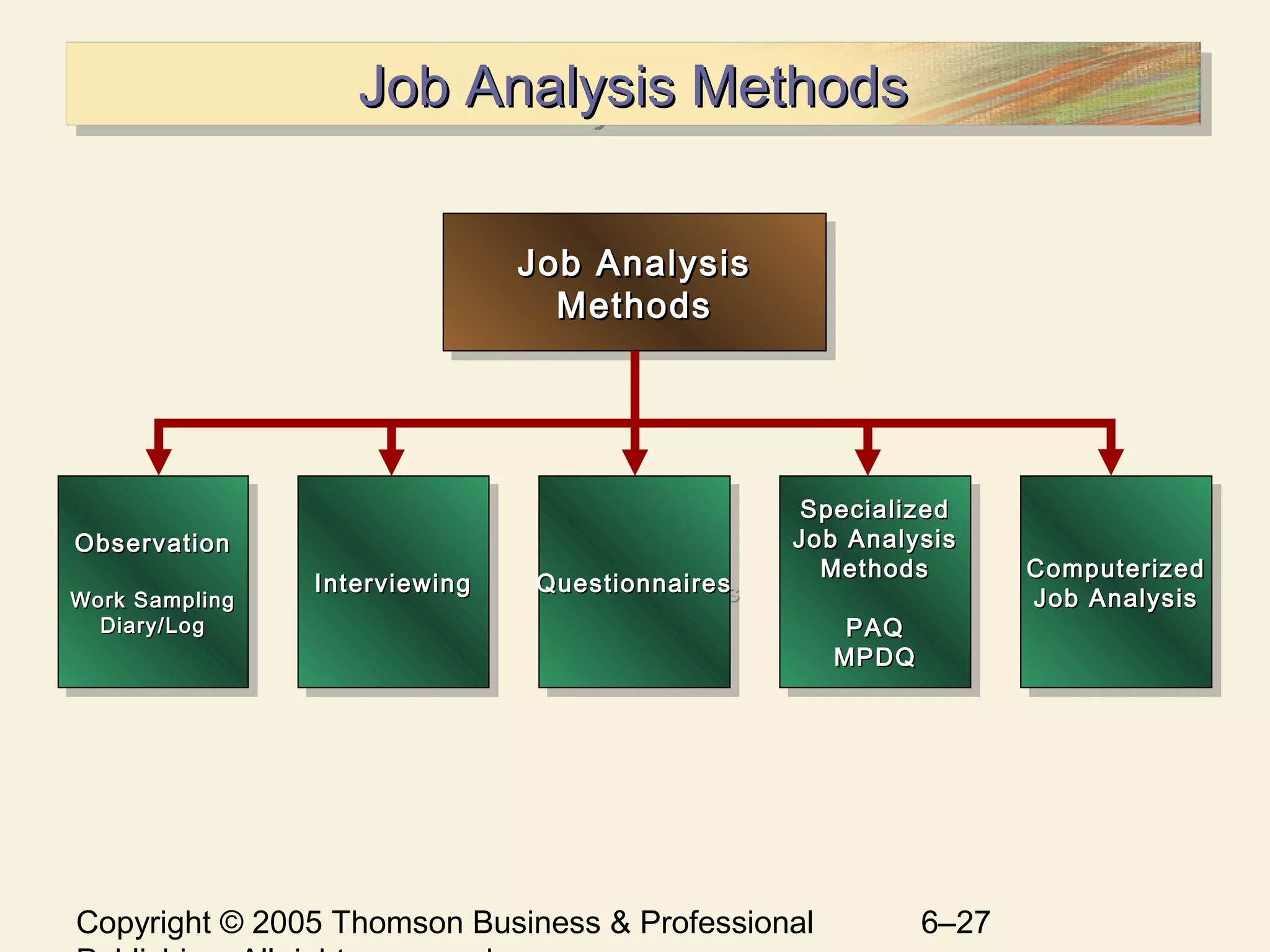
Job Analysis MethodsJob Analysis MethodsJob Analysis MethodsJob Analysis Methods
Job AnalysisJob Analysis
MethodsMethods
Job AnalysisJob Analysis
MethodsMethods
QuestionnairesQuestionnairesQuestionnairesQuestionnaires
ObservationObservation
Work SamplingWork Sampling
Diary/LogDiary/Log
ObservationObservation
Work SamplingWork Sampling
Diary/LogDiary/Log
InterviewingInterviewingInterviewingInterviewing
SpecializedSpecialized
Job AnalysisJob Analysis
MethodsMethods
PAQPAQ
MPDQMPDQ
SpecializedSpecialized
Job AnalysisJob Analysis
MethodsMethods
PAQPAQ
MPDQMPDQ
ComputerizedComputerized
Job AnalysisJob Analysis
ComputerizedComputerized
Job AnalysisJob Analysis
Copyright © 2005 Thomson Business & Professional 6–28
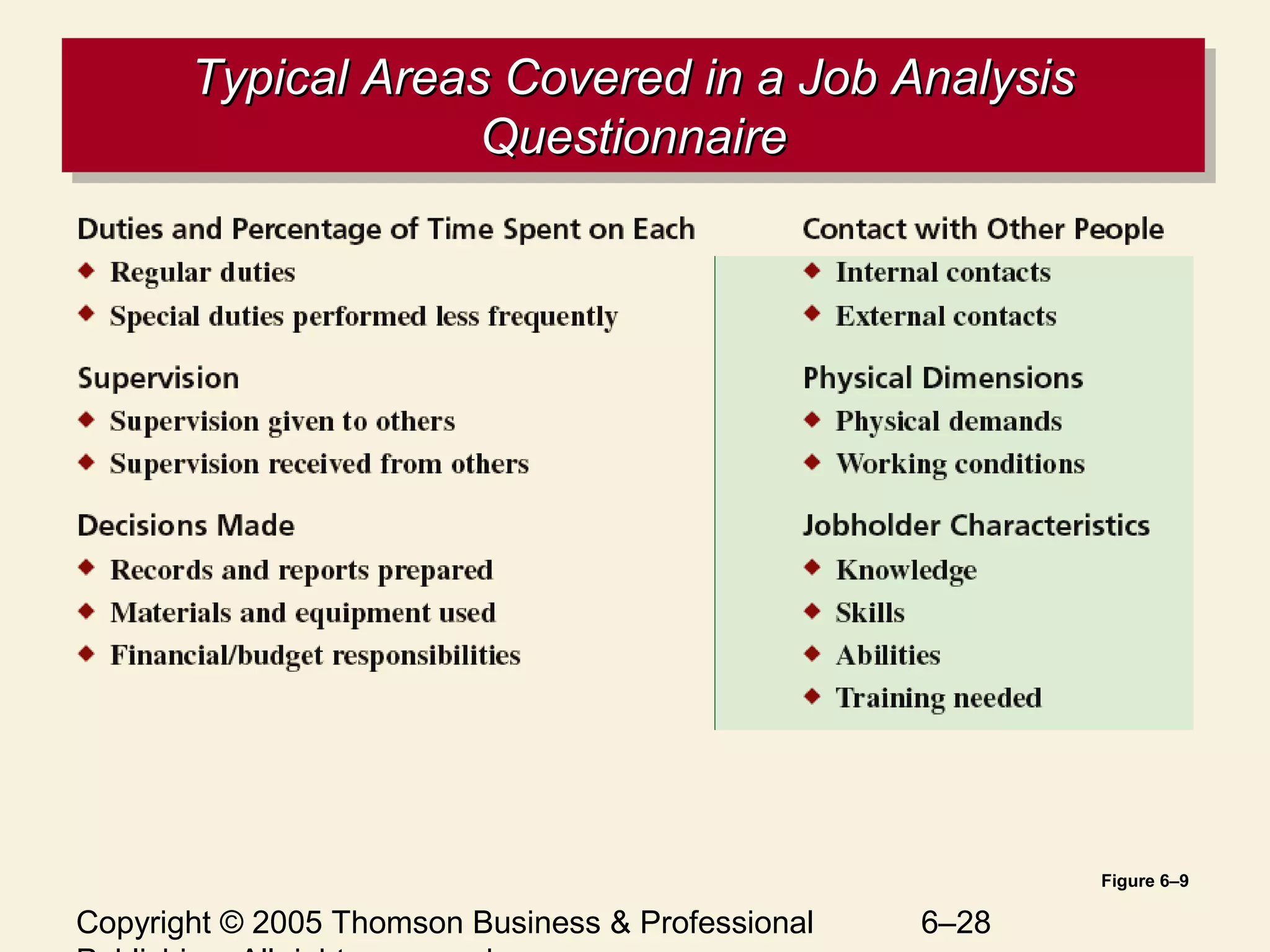
Typical Areas Covered in a Job AnalysisTypical Areas Covered in a Job Analysis
QuestionnaireQuestionnaire
Typical Areas Covered in a Job AnalysisTypical Areas Covered in a Job Analysis
QuestionnaireQuestionnaire
Figure 6–9
Copyright © 2005 Thomson Business & Professional 6–29
Job Analysis andJob Analysis and
the U.S. Department of Laborthe U.S. Department of Labor
Job Analysis andJob Analysis and
the U.S. Department of Laborthe U.S. Department of Labor
• Functional Job Analysis (FJA)
Goals of the organization
What workers do to achieve goals
Level and orientation of what workers do
Performance standards
Training content
• O*Net Online
Online information on skills, abilities, knowledge, work
activities, and interests associated with a wide range of
jobs and occupations from DOL job research.
Copyright © 2005 Thomson Business & Professional 6–30
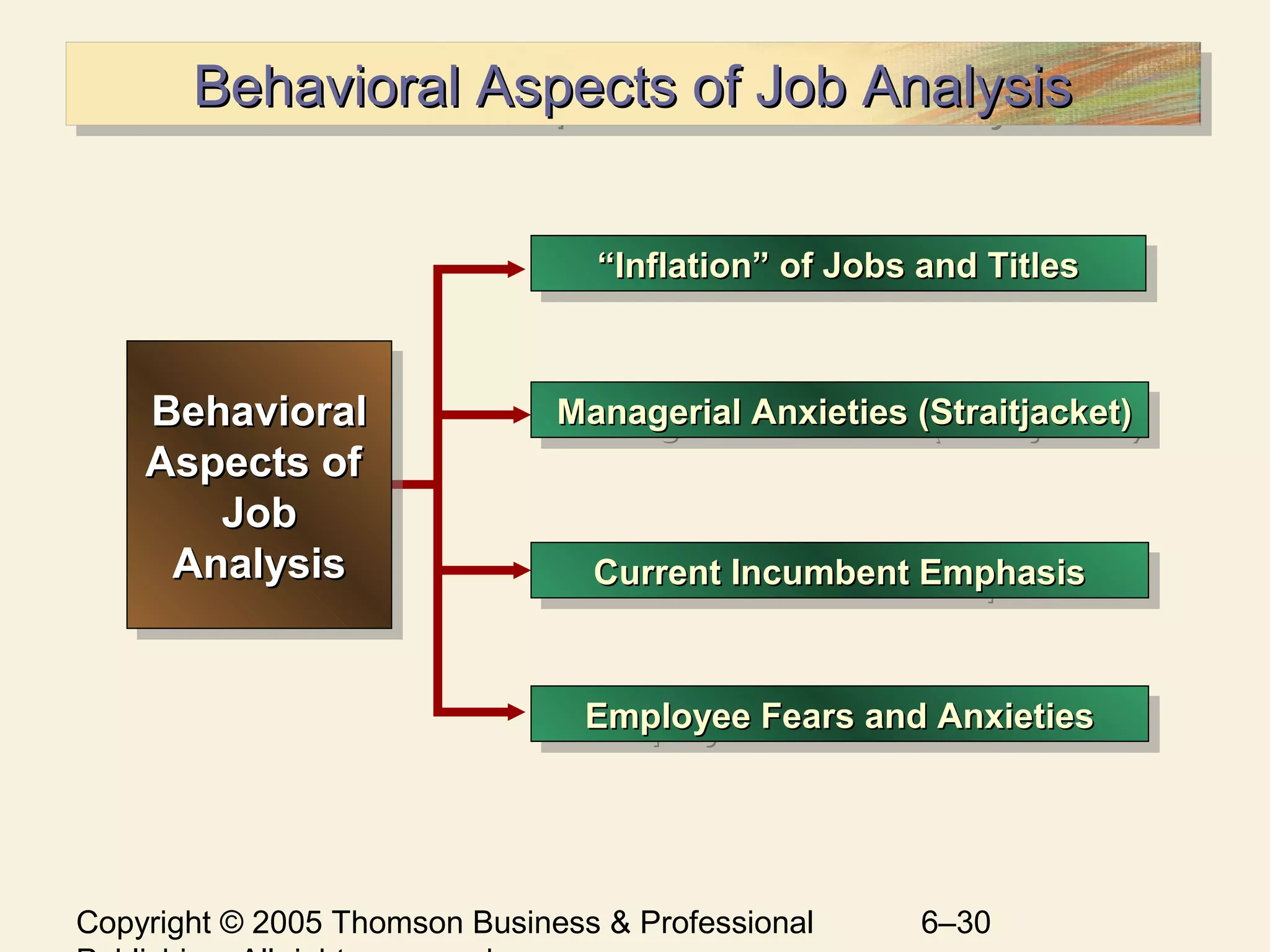
Behavioral Aspects of Job AnalysisBehavioral Aspects of Job AnalysisBehavioral Aspects of Job AnalysisBehavioral Aspects of Job Analysis
Employee Fears and AnxietiesEmployee Fears and AnxietiesEmployee Fears and AnxietiesEmployee Fears and Anxieties
““Inflation” of Jobs and TitlesInflation” of Jobs and Titles““Inflation” of Jobs and TitlesInflation” of Jobs and Titles
Managerial Anxieties (Straitjacket)Managerial Anxieties (Straitjacket)Managerial Anxieties (Straitjacket)Managerial Anxieties (Straitjacket)
Current Incumbent EmphasisCurrent Incumbent EmphasisCurrent Incumbent EmphasisCurrent Incumbent Emphasis
BehavioralBehavioral
Aspects ofAspects of
JobJob
AnalysisAnalysis
BehavioralBehavioral
Aspects ofAspects of
JobJob
AnalysisAnalysis
Copyright © 2005 Thomson Business & Professional 6–31
Legal Aspects of Job AnalysisLegal Aspects of Job AnalysisLegal Aspects of Job AnalysisLegal Aspects of Job Analysis
• Job Analysis and the Americans with Disabilities
Act (ADA)
Essential job functions—fundamental duties of the
job that are performed regularly, require significant
amounts of time, cannot be easily assigned to another
employee, and are necessary to accomplish the job.
Marginal job functions—duties that are part of the job
but are incidental or ancillary to the purpose and nature
of the job.
Copyright © 2005 Thomson Business & Professional 6–32
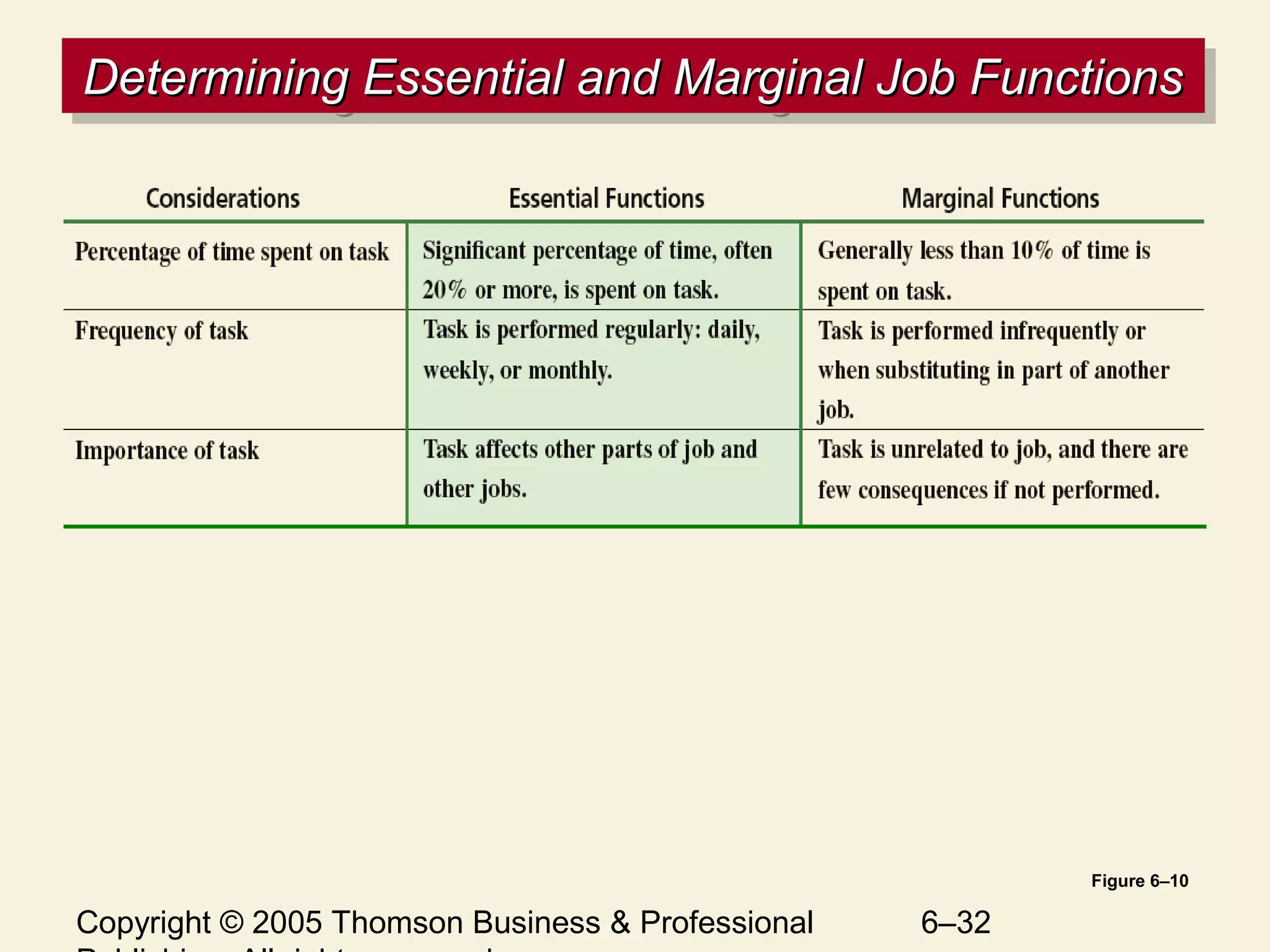
Determining Essential and Marginal Job FunctionsDetermining Essential and Marginal Job FunctionsDetermining Essential and Marginal Job FunctionsDetermining Essential and Marginal Job Functions
Figure 6–10
Copyright © 2005 Thomson Business & Professional 6–33
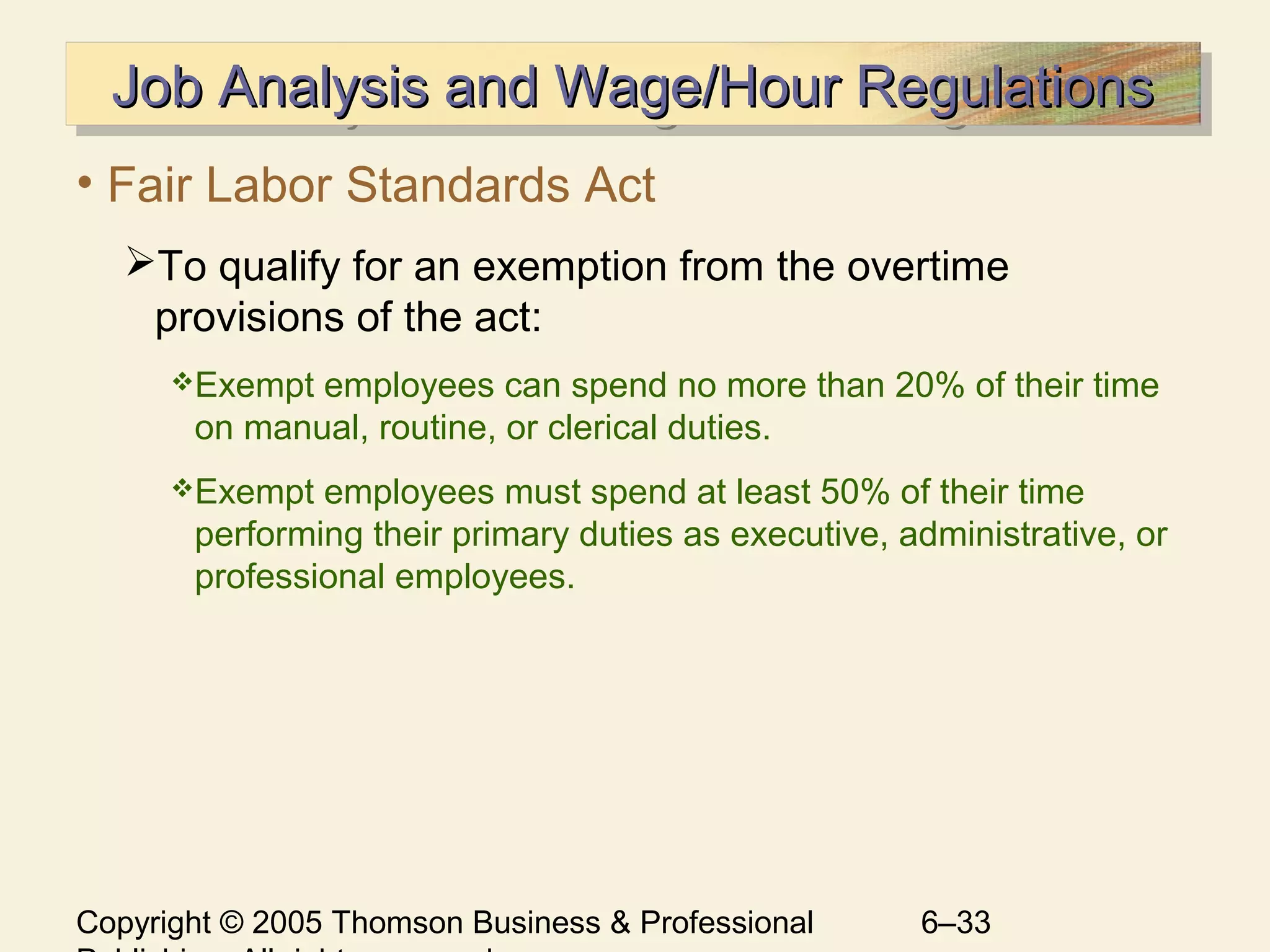
Job Analysis and Wage/Hour RegulationsJob Analysis and Wage/Hour RegulationsJob Analysis and Wage/Hour RegulationsJob Analysis and Wage/Hour Regulations
• Fair Labor Standards Act
To qualify for an exemption from the overtime
provisions of the act:
Exempt employees can spend no more than 20% of their time
on manual, routine, or clerical duties.
Exempt employees must spend at least 50% of their time
performing their primary duties as executive, administrative, or
professional employees.
Copyright © 2005 Thomson Business & Professional 6–34
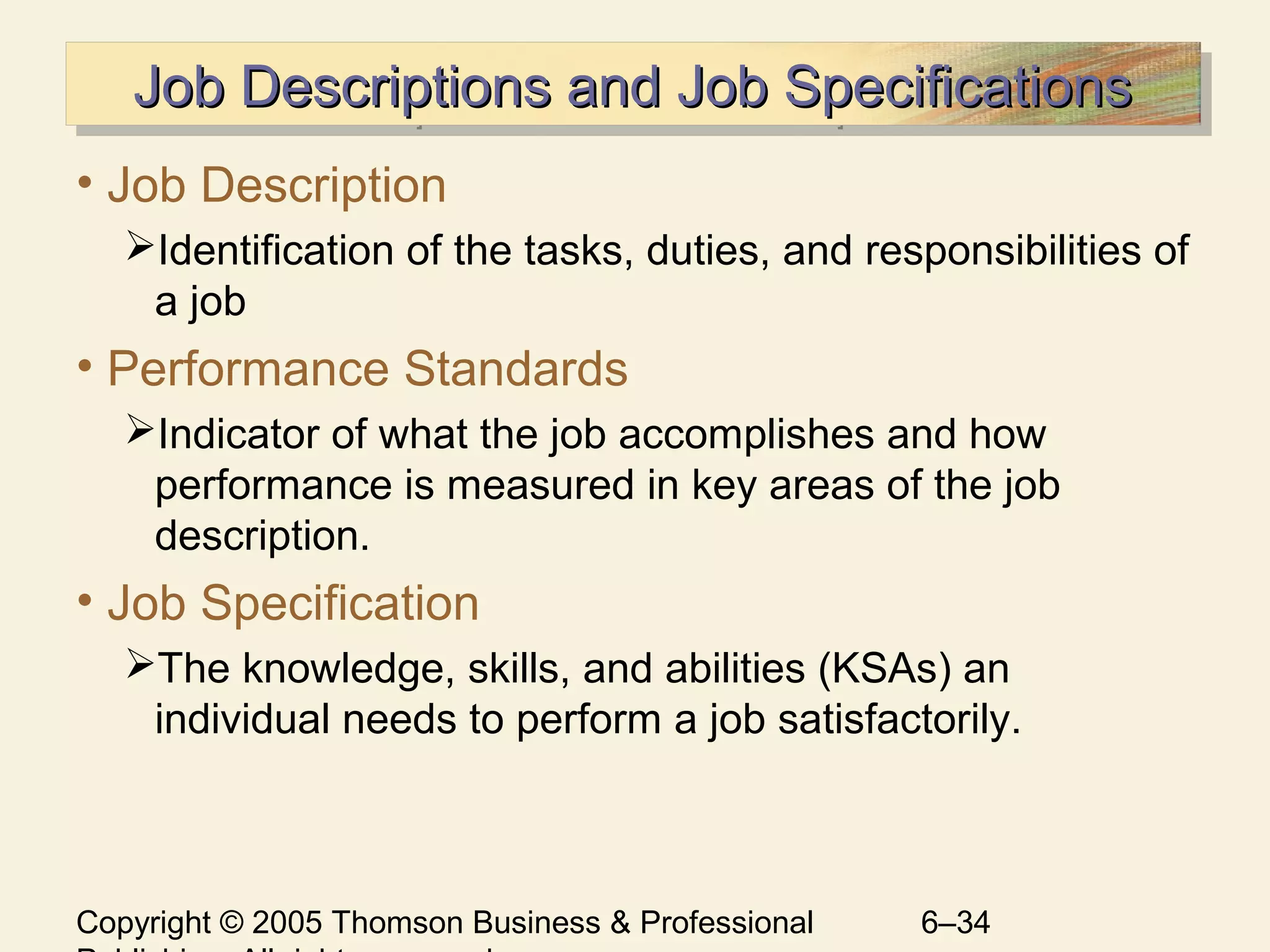
Job Descriptions and Job SpecificationsJob Descriptions and Job SpecificationsJob Descriptions and Job SpecificationsJob Descriptions and Job Specifications
• Job Description
Identification of the tasks, duties, and responsibilities of
a job
• Performance Standards
Indicator of what the job accomplishes and how
performance is measured in key areas of the job
description.
• Job Specification
The knowledge, skills, and abilities (KSAs) an
individual needs to perform a job satisfactorily.
Copyright © 2005 Thomson Business & Professional 6–35
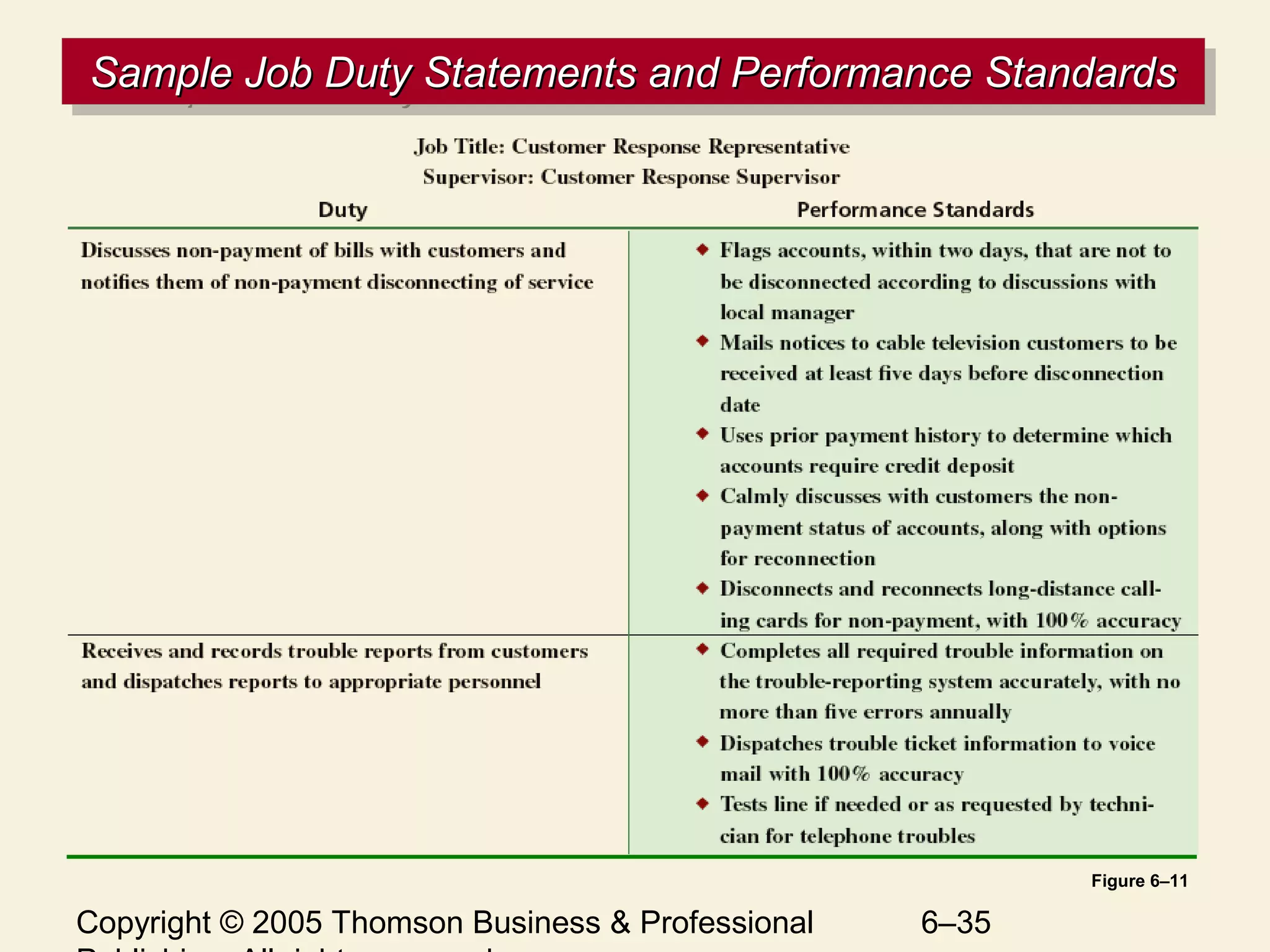
Sample Job Duty Statements and Performance StandardsSample Job Duty Statements and Performance StandardsSample Job Duty Statements and Performance StandardsSample Job Duty Statements and Performance Standards
Figure 6–11
Copyright © 2005 Thomson Business & Professional 6–36
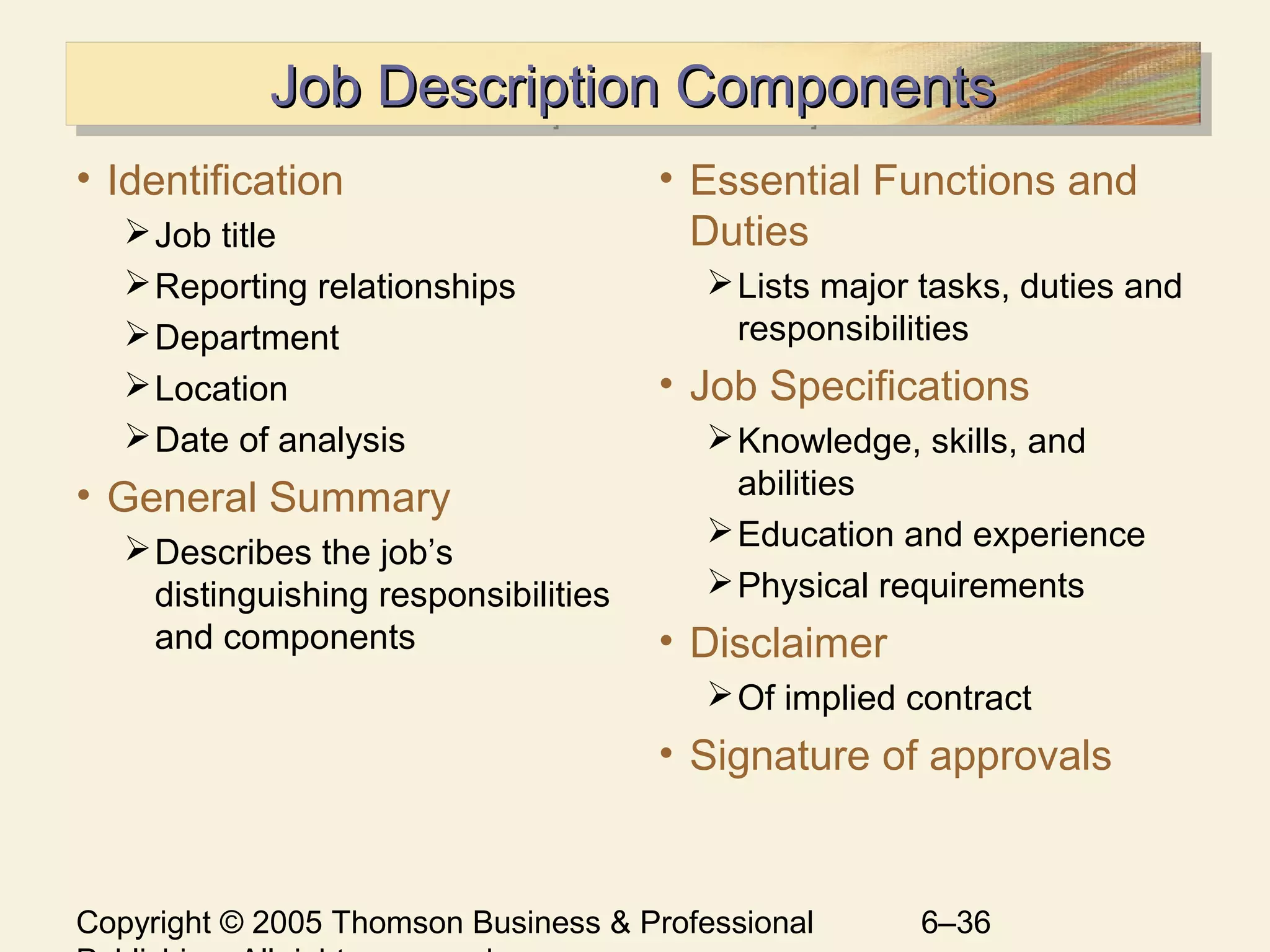
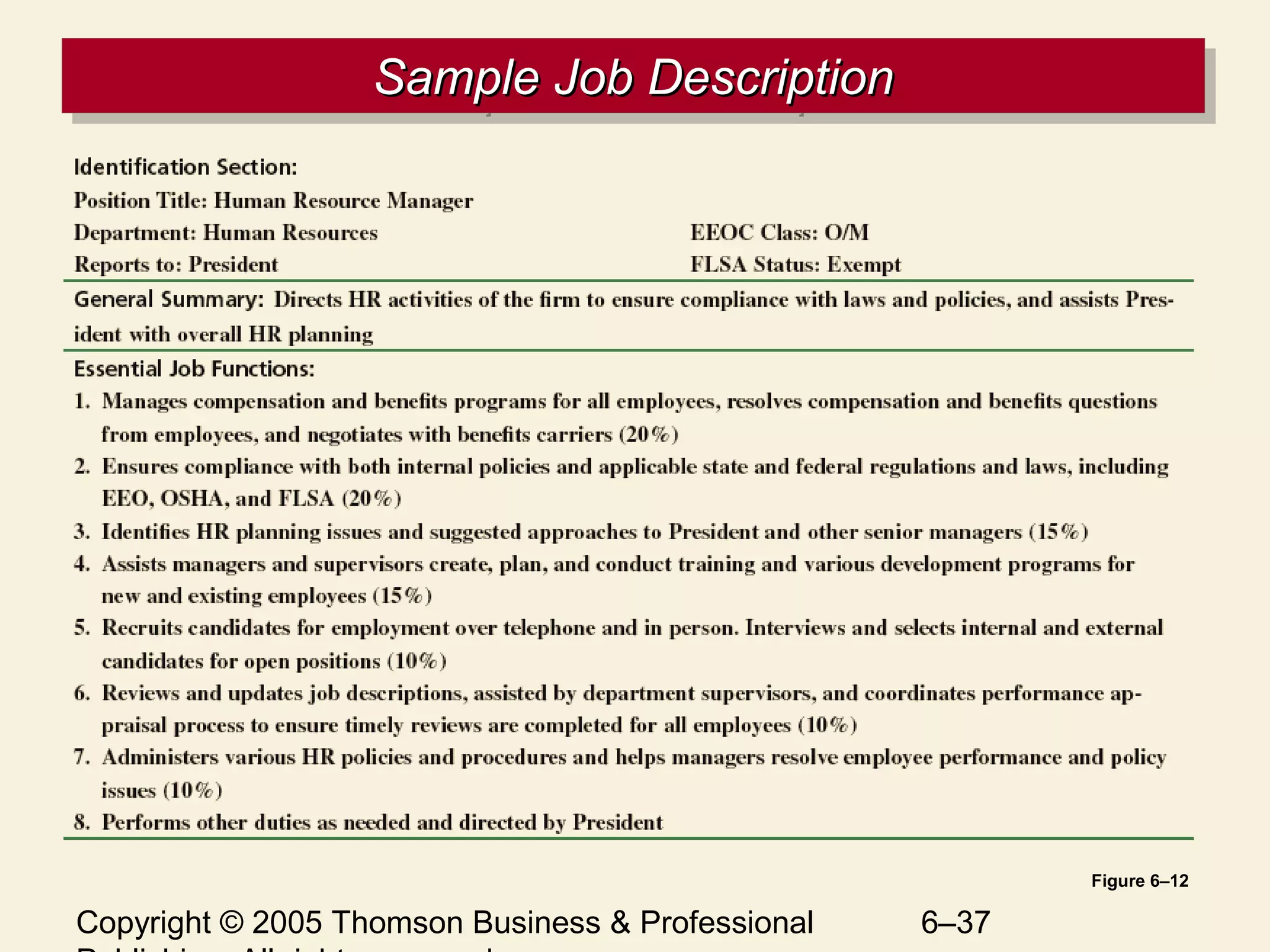
Job Description ComponentsJob Description ComponentsJob Description ComponentsJob Description Components
• Identification
Job title
Reporting relationships
Department
Location
Date of analysis
• General Summary
Describes the job’s
distinguishing responsibilities
and components
• Essential Functions and
Duties
Lists major tasks, duties and
responsibilities
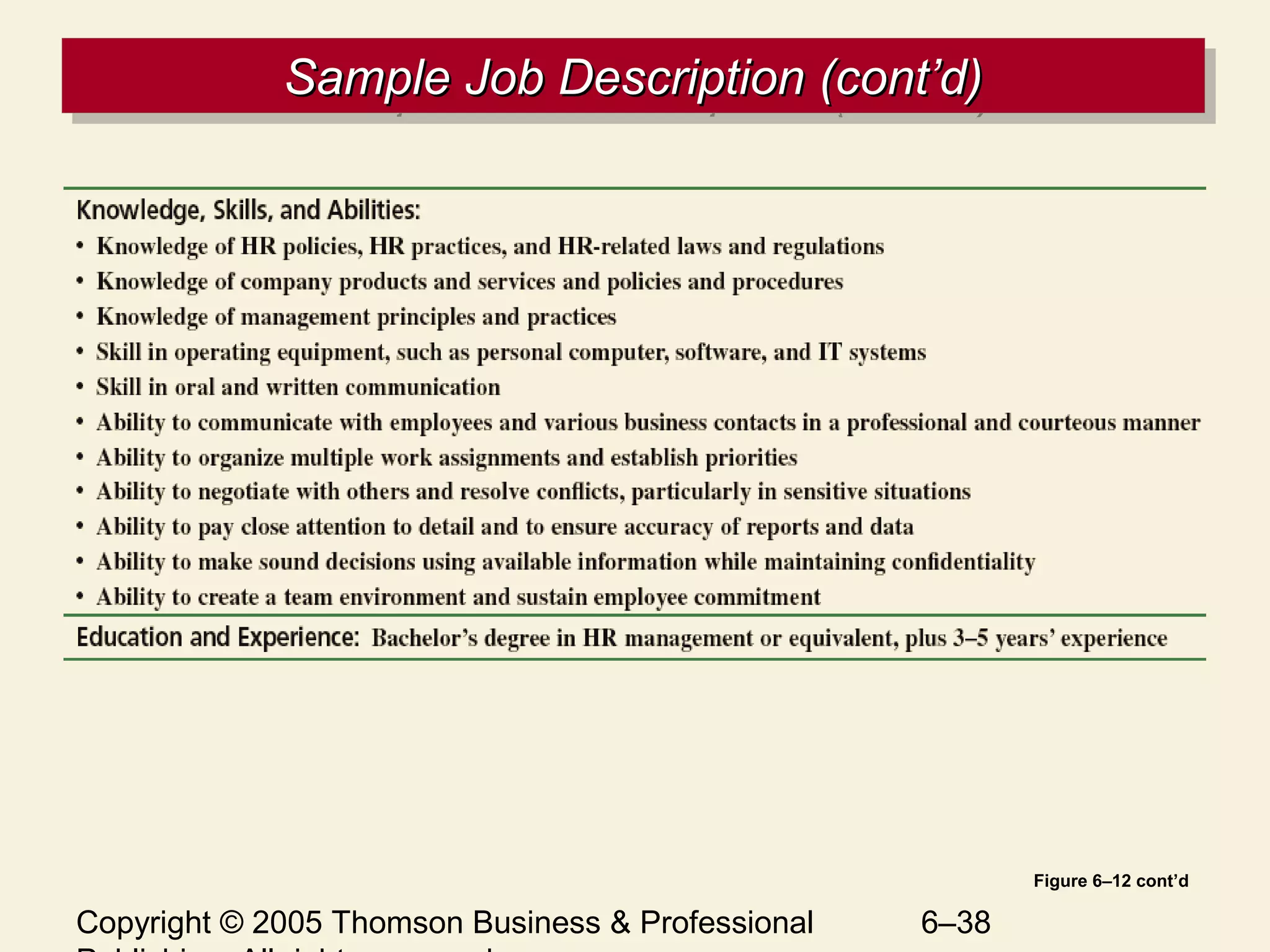
• Job Specifications
Knowledge, skills, and
abilities
Education and experience
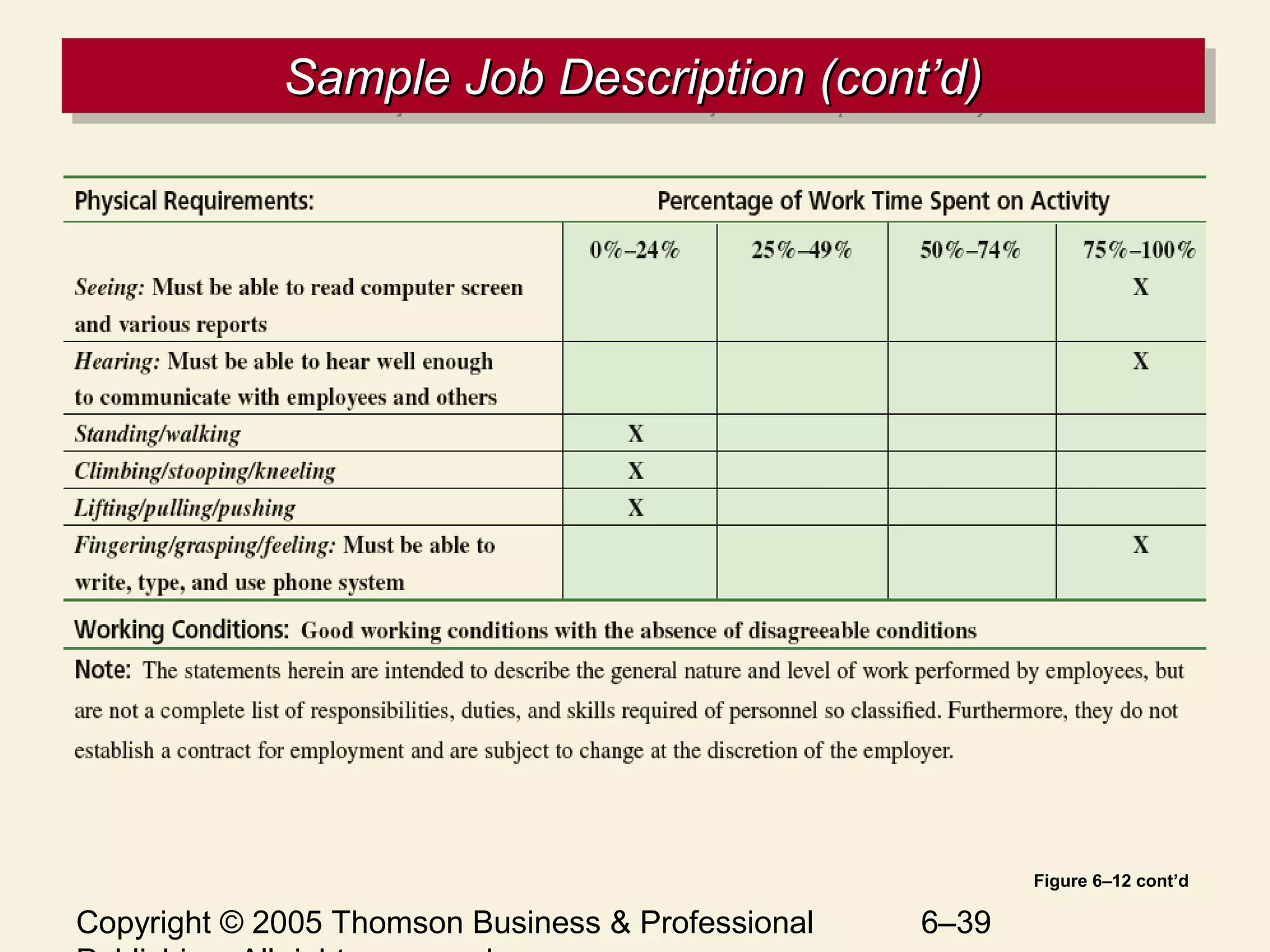
Physical requirements
• Disclaimer
Of implied contract
• Signature of approvals
Copyright © 2005 Thomson Business & Professional 6–37
Sample Job DescriptionSample Job DescriptionSample Job DescriptionSample Job Description
Figure 6–12
Copyright © 2005 Thomson Business & Professional 6–38
Sample Job Description (cont’d)Sample Job Description (cont’d)Sample Job Description (cont’d)Sample Job Description (cont’d)
Figure 6–12 cont’d
Copyright © 2005 Thomson Business & Professional 6–39
Sample Job Description (cont’d)Sample Job Description (cont’d)Sample Job Description (cont’d)Sample Job Description (cont’d)
Figure 6–12 cont’d

Chapter 6 Jobs and Job Analysis

  • 1.
    Copyright © 2005Thomson Business & Professional Publishing. All rights reserved. ROBERT L. MATHIS JOHN H. JACKSON PowerPoint Presentation by Charlie Cook The University of West Alabama Jobs and Job AnalysisJobs and Job Analysis Chapter 6Chapter 6 SECTION 2SECTION 2 Staffing theStaffing the OrganizationOrganization
  • 2.
    Copyright © 2005Thomson Business & Professional 6–2 Learning ObjectivesLearning ObjectivesLearning ObjectivesLearning Objectives • After you have read this chapter, you should be able to:  Discuss workflow analysis and business process re-engineering as approaches to organizational work.  Define job design and identify five design characteristics for jobs.  Explain how work schedules and telework are affecting jobs and work.  Describe job analysis, and the stages in and methods used in the job analysis process.  Indicate how job analysis has both behavioral and legal aspects.  Identify the components of job descriptions.
  • 3.
    Copyright © 2005Thomson Business & Professional 6–3 HR Management and JobsHR Management and JobsHR Management and JobsHR Management and Jobs • Dividing Work into Jobs Work  Effort directed toward producing or accomplishing results. Job  A grouping of tasks, duties, and responsibilities that constitutes the total work assignment for an employee. • Approaches to Understanding Jobs Workflow analysis Re-engineering Job design Job analysis Job descriptions and job specifications
  • 4.
    Copyright © 2005Thomson Business & Professional 6–4 InfluencesInfluences Affecting Jobs,Affecting Jobs, People, andPeople, and Related HRRelated HR PoliciesPolicies InfluencesInfluences Affecting Jobs,Affecting Jobs, People, andPeople, and Related HRRelated HR PoliciesPolicies Figure 6–1
  • 5.
    Copyright © 2005Thomson Business & Professional 6–5 Workflow AnalysisWorkflow AnalysisWorkflow AnalysisWorkflow Analysis • Workflow Analysis A study of the way work (inputs, activities, and outputs) moves through an organization. InputsInputs PeoplePeople MaterialsMaterials EquipmentEquipment InputsInputs PeoplePeople MaterialsMaterials EquipmentEquipment ActivitiesActivities Tasks andTasks and JobsJobs ActivitiesActivities Tasks andTasks and JobsJobs OutputsOutputs Goods andGoods and ServicesServices OutputsOutputs Goods andGoods and ServicesServices EvaluationEvaluation
  • 6.
    Copyright © 2005Thomson Business & Professional 6–6 Business Process Re-engineeringBusiness Process Re-engineeringBusiness Process Re-engineeringBusiness Process Re-engineering • Business Process Re-engineering (BPR) Measures for improving such activities as product development, customer service, and service delivery. • Phases of Reengineering Rethink Redesign Retool
  • 7.
    Copyright © 2005Thomson Business & Professional 6–7 Importance Of Job DesignImportance Of Job DesignImportance Of Job DesignImportance Of Job Design • Job Design Organizing tasks, duties, and responsibilities into a productive unit of work. • Person/job Fit Matching characteristics of people with characteristics of jobs. Job DesignJob DesignJob DesignJob Design JobJob SatisfactionSatisfaction JobJob SatisfactionSatisfaction JobJob PerformancePerformance JobJob PerformancePerformance Physical andPhysical and Mental HealthMental Health Physical andPhysical and Mental HealthMental Health
  • 8.
    Copyright © 2005Thomson Business & Professional 6–8 Person/Job FitPerson/Job FitPerson/Job FitPerson/Job Fit Figure 6–2
  • 9.
    Copyright © 2005Thomson Business & Professional 6–9 Nature of Job DesignNature of Job DesignNature of Job DesignNature of Job Design • Job Enlargement Broadening the scope of a job by expanding the number of different tasks to be performed. • Job Enrichment Increasing the depth of a job by adding the responsibility for planning, organizing , controlling, and evaluating the job. • Job Rotation The process of shifting a person from job to job.
  • 10.
    Copyright © 2005Thomson Business & Professional 6–10 Characteristics of JobsCharacteristics of JobsCharacteristics of JobsCharacteristics of Jobs • Skill Variety The extent to which the work requires several different activities for successful completion. • Task Identity The extent to which the job includes a “whole” identifiable unit of work that is carried out from start to finish and that results in a visible outcome. • Task Significance The impact the job has on other people.
  • 11.
    Copyright © 2005Thomson Business & Professional 6–11 Characteristics of JobsCharacteristics of JobsCharacteristics of JobsCharacteristics of Jobs • Autonomy The extent of individual freedom and discretion in the work and its scheduling. • Feedback Amount of information employees receive about how well or how poorly they have performed.
  • 12.
    Copyright © 2005Thomson Business & Professional 6–12 Job Characteristics ModelJob Characteristics ModelJob Characteristics ModelJob Characteristics Model Figure 6–3
  • 13.
    Copyright © 2005Thomson Business & Professional 6–13 Using Teams in JobsUsing Teams in JobsUsing Teams in JobsUsing Teams in Jobs • Types of Teams Special-Purpose Team  Organizational team formed to address specific problems, improve work processes, and enhance product and service quality. Self-directed Work Team  A team composed of individuals assigned a cluster of tasks, duties, and responsibilities to be accomplished. Virtual Team  Organizational team composed of individuals who are geographically separated but linked by communications technology.
  • 14.
    Copyright © 2005Thomson Business & Professional 6–14 Factors Affecting Virtual Team SuccessFactors Affecting Virtual Team SuccessFactors Affecting Virtual Team SuccessFactors Affecting Virtual Team Success Figure 6–4
  • 15.
    Copyright © 2005Thomson Business & Professional 6–15 Team JobsTeam JobsTeam JobsTeam Jobs • Advantages Improved productivity Increased employee involvement More widespread employee learning Greater employee ownership of problems • Disadvantages Requires employees to be “group oriented” Not appropriate for most work in organizations Can be overused Difficult to measure team performance Individual compensation interferes with team concept
  • 16.
    Copyright © 2005Thomson Business & Professional 6–16 Work SchedulesWork SchedulesWork SchedulesWork Schedules • Global Work Schedule Differences The number of work hours in a week varies from country to country. • Work Schedule Alternatives Longer daily hours (e.g., 4-day, 40 hours) • Shift Work Shift differentials for evening or night shift work • Compressed Work Week A work schedule in which a full week’s work is accomplished in fewer than five days.
  • 17.
    Copyright © 2005Thomson Business & Professional 6–17 Work SchedulesWork SchedulesWork SchedulesWork Schedules • Flextime A work scheduling arrangement in which employees work a set number of hours per day but vary their starting and ending times. • Job Sharing A scheduling arrangement in which two employees perform the work of one full-time job.
  • 18.
    Copyright © 2005Thomson Business & Professional 6–18 Alternative Work LocationsAlternative Work LocationsAlternative Work LocationsAlternative Work Locations • Telecommuting The process of going to work via electronic computing and telecommunications equipment. • Temporary Locations Office nomads Virtual office • Effects of Alternative Work Arrangements A shift to evaluating employees on results Greater trust, less direct supervision Lack of direct contact (visibility)
  • 19.
    Copyright © 2005Thomson Business & Professional 6–19 Telework Concerns of ManagementTelework Concerns of Management and Employeesand Employees Telework Concerns of ManagementTelework Concerns of Management and Employeesand Employees Figure 6–5 Source: “Telework Concerns of Management and Employees,” HR Executive Series: Focus on Telecommunicating Executive Summary, Bureau of National Affairs, Winter 2002, 2. For more information about this publication and other HR solutions visit http://hrcenter.bna.com or call 800-372–1033. Used with permission.
  • 20.
    Copyright © 2005Thomson Business & Professional 6–20 The Nature of Job AnalysisThe Nature of Job AnalysisThe Nature of Job AnalysisThe Nature of Job Analysis • Job Analysis A systematic way of gathering and analyzing information about the content, context, and the human requirements of jobs. Work activities and behaviors Interactions with others Performance standards Financial and budgeting impact Machines and equipment used Working conditions Supervision given and received Knowledge, skills, and abilities needed
  • 21.
    Copyright © 2005Thomson Business & Professional 6–21 Job Analysis inJob Analysis in PerspectivePerspective Job Analysis inJob Analysis in PerspectivePerspective Figure 6–6
  • 22.
    Copyright © 2005Thomson Business & Professional 6–22 Task-Based Job AnalysisTask-Based Job AnalysisTask-Based Job AnalysisTask-Based Job Analysis • Task A distinct, identifiable work activity composed of motions • Duty A larger work segment composed of several tasks that are performed by an individual • Responsibilities Obligations to perform certain tasks and duties
  • 23.
    Copyright © 2005Thomson Business & Professional 6–23 Competency-Based Job AnalysisCompetency-Based Job AnalysisCompetency-Based Job AnalysisCompetency-Based Job Analysis • Competencies Individual capabilities that can be linked to enhanced performance by individuals or teams. Technical competencies Behavioral competencies • Reasons for using a competency approach: To communicate valued behaviors within the organization To raise competency levels throughout the organization To emphasize people’s capabilities for enhancing the competitive advantage of the organization
  • 24.
    Copyright © 2005Thomson Business & Professional 6–24 Competency Analysis MethodologyCompetency Analysis MethodologyCompetency Analysis MethodologyCompetency Analysis Methodology • Identify future performance results areas critical to the organization. • Assemble panel groups familiar with the company. • Interview panel members to get examples of job behaviors. • Develop detailed descriptions of competencies. • Rate competencies and levels need to meet them. • Standards of performance are identified and tied to jobs.
  • 25.
    Copyright © 2005Thomson Business & Professional 6–25 Typical Division of HR Responsibilities:Typical Division of HR Responsibilities: Job AnalysisJob Analysis Typical Division of HR Responsibilities:Typical Division of HR Responsibilities: Job AnalysisJob Analysis Figure 6–7
  • 26.
    Copyright © 2005Thomson Business & Professional 6–26 Stages in the JobStages in the Job Analysis ProcessAnalysis Process Stages in the JobStages in the Job Analysis ProcessAnalysis Process Figure 6–8
  • 27.
    Copyright © 2005Thomson Business & Professional 6–27 Job Analysis MethodsJob Analysis MethodsJob Analysis MethodsJob Analysis Methods Job AnalysisJob Analysis MethodsMethods Job AnalysisJob Analysis MethodsMethods QuestionnairesQuestionnairesQuestionnairesQuestionnaires ObservationObservation Work SamplingWork Sampling Diary/LogDiary/Log ObservationObservation Work SamplingWork Sampling Diary/LogDiary/Log InterviewingInterviewingInterviewingInterviewing SpecializedSpecialized Job AnalysisJob Analysis MethodsMethods PAQPAQ MPDQMPDQ SpecializedSpecialized Job AnalysisJob Analysis MethodsMethods PAQPAQ MPDQMPDQ ComputerizedComputerized Job AnalysisJob Analysis ComputerizedComputerized Job AnalysisJob Analysis
  • 28.
    Copyright © 2005Thomson Business & Professional 6–28 Typical Areas Covered in a Job AnalysisTypical Areas Covered in a Job Analysis QuestionnaireQuestionnaire Typical Areas Covered in a Job AnalysisTypical Areas Covered in a Job Analysis QuestionnaireQuestionnaire Figure 6–9
  • 29.
    Copyright © 2005Thomson Business & Professional 6–29 Job Analysis andJob Analysis and the U.S. Department of Laborthe U.S. Department of Labor Job Analysis andJob Analysis and the U.S. Department of Laborthe U.S. Department of Labor • Functional Job Analysis (FJA) Goals of the organization What workers do to achieve goals Level and orientation of what workers do Performance standards Training content • O*Net Online Online information on skills, abilities, knowledge, work activities, and interests associated with a wide range of jobs and occupations from DOL job research.
  • 30.
    Copyright © 2005Thomson Business & Professional 6–30 Behavioral Aspects of Job AnalysisBehavioral Aspects of Job AnalysisBehavioral Aspects of Job AnalysisBehavioral Aspects of Job Analysis Employee Fears and AnxietiesEmployee Fears and AnxietiesEmployee Fears and AnxietiesEmployee Fears and Anxieties ““Inflation” of Jobs and TitlesInflation” of Jobs and Titles““Inflation” of Jobs and TitlesInflation” of Jobs and Titles Managerial Anxieties (Straitjacket)Managerial Anxieties (Straitjacket)Managerial Anxieties (Straitjacket)Managerial Anxieties (Straitjacket) Current Incumbent EmphasisCurrent Incumbent EmphasisCurrent Incumbent EmphasisCurrent Incumbent Emphasis BehavioralBehavioral Aspects ofAspects of JobJob AnalysisAnalysis BehavioralBehavioral Aspects ofAspects of JobJob AnalysisAnalysis
  • 31.
    Copyright © 2005Thomson Business & Professional 6–31 Legal Aspects of Job AnalysisLegal Aspects of Job AnalysisLegal Aspects of Job AnalysisLegal Aspects of Job Analysis • Job Analysis and the Americans with Disabilities Act (ADA) Essential job functions—fundamental duties of the job that are performed regularly, require significant amounts of time, cannot be easily assigned to another employee, and are necessary to accomplish the job. Marginal job functions—duties that are part of the job but are incidental or ancillary to the purpose and nature of the job.
  • 32.
    Copyright © 2005Thomson Business & Professional 6–32 Determining Essential and Marginal Job FunctionsDetermining Essential and Marginal Job FunctionsDetermining Essential and Marginal Job FunctionsDetermining Essential and Marginal Job Functions Figure 6–10
  • 33.
    Copyright © 2005Thomson Business & Professional 6–33 Job Analysis and Wage/Hour RegulationsJob Analysis and Wage/Hour RegulationsJob Analysis and Wage/Hour RegulationsJob Analysis and Wage/Hour Regulations • Fair Labor Standards Act To qualify for an exemption from the overtime provisions of the act: Exempt employees can spend no more than 20% of their time on manual, routine, or clerical duties. Exempt employees must spend at least 50% of their time performing their primary duties as executive, administrative, or professional employees.
  • 34.
    Copyright © 2005Thomson Business & Professional 6–34 Job Descriptions and Job SpecificationsJob Descriptions and Job SpecificationsJob Descriptions and Job SpecificationsJob Descriptions and Job Specifications • Job Description Identification of the tasks, duties, and responsibilities of a job • Performance Standards Indicator of what the job accomplishes and how performance is measured in key areas of the job description. • Job Specification The knowledge, skills, and abilities (KSAs) an individual needs to perform a job satisfactorily.
  • 35.
    Copyright © 2005Thomson Business & Professional 6–35 Sample Job Duty Statements and Performance StandardsSample Job Duty Statements and Performance StandardsSample Job Duty Statements and Performance StandardsSample Job Duty Statements and Performance Standards Figure 6–11
  • 36.
    Copyright © 2005Thomson Business & Professional 6–36 Job Description ComponentsJob Description ComponentsJob Description ComponentsJob Description Components • Identification Job title Reporting relationships Department Location Date of analysis • General Summary Describes the job’s distinguishing responsibilities and components • Essential Functions and Duties Lists major tasks, duties and responsibilities • Job Specifications Knowledge, skills, and abilities Education and experience Physical requirements • Disclaimer Of implied contract • Signature of approvals
  • 37.
    Copyright © 2005Thomson Business & Professional 6–37 Sample Job DescriptionSample Job DescriptionSample Job DescriptionSample Job Description Figure 6–12
  • 38.
    Copyright © 2005Thomson Business & Professional 6–38 Sample Job Description (cont’d)Sample Job Description (cont’d)Sample Job Description (cont’d)Sample Job Description (cont’d) Figure 6–12 cont’d
  • 39.
    Copyright © 2005Thomson Business & Professional 6–39 Sample Job Description (cont’d)Sample Job Description (cont’d)Sample Job Description (cont’d)Sample Job Description (cont’d) Figure 6–12 cont’d