New Topic: States of Matter All matter is one of three states: solid, liquid or gas. Please load this image yourself. I can't put it here because I don't have a license for it. http://falconsscience.files.wordpress.com/2008/08/state.gif
Solids Solids have strong bonds between particles.
Solids have a fixed shape and volume. http://commons.wikimedia.org/wiki/File:LateriteBricks.jpg http://commons.wikimedia.org/wiki/File:Solid.png
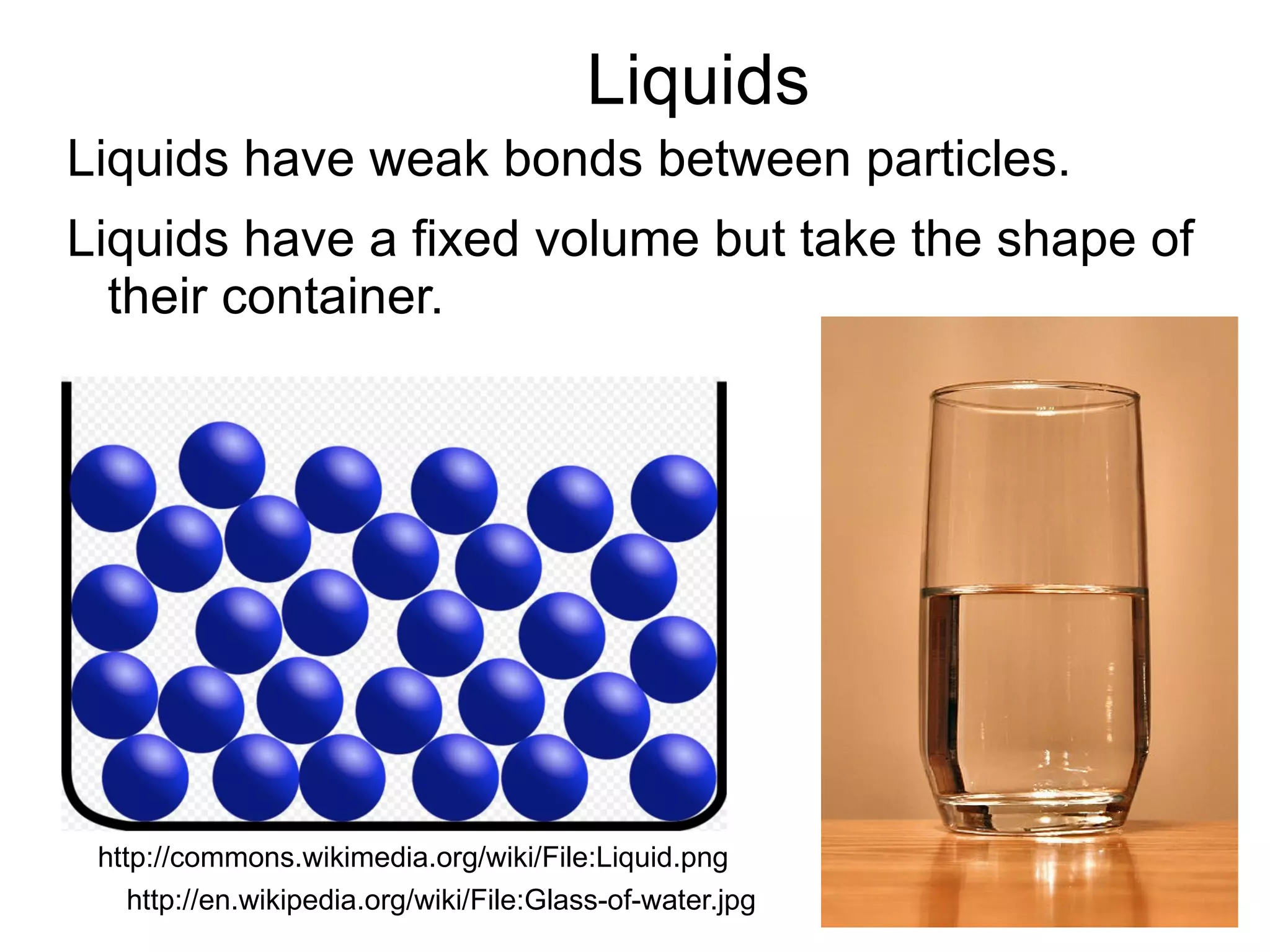
Liquids Liquids have weak bonds between particles.
Liquids have a fixed volume but take the shape of their container. http://en.wikipedia.org/wiki/File:Glass-of-water.jpg http://commons.wikimedia.org/wiki/File:Liquid.png
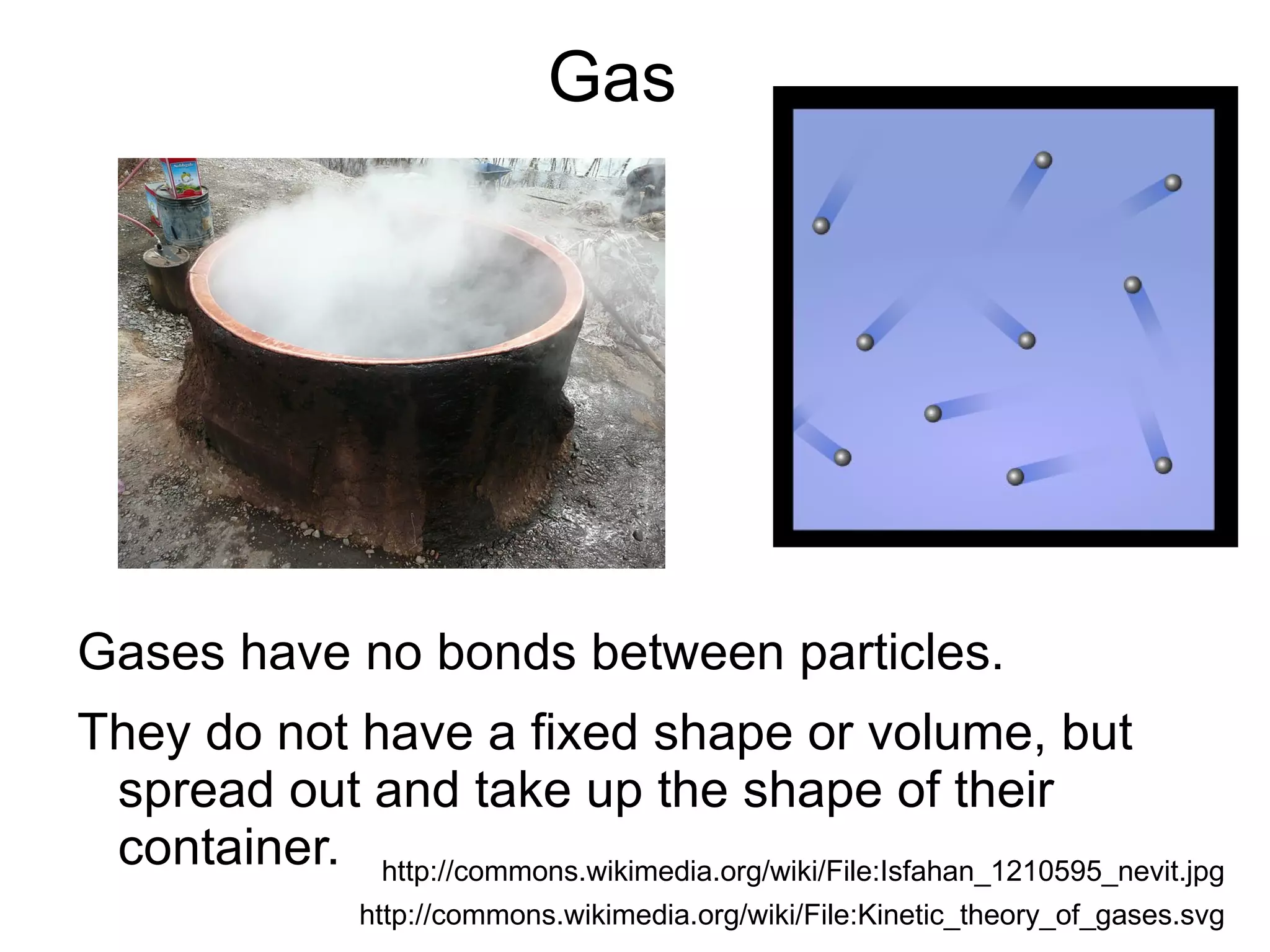
Gas Gases have no bonds between particles.
They do not have a fixed shape or volume, but spread out and take up the shape of their container. http://commons.wikimedia.org/wiki/File:Kinetic_theory_of_gases.svg http://commons.wikimedia.org/wiki/File:Isfahan_1210595_nevit.jpg
Bookwork Read 20-24
Questions page 24
Read 25-29
Questions page 29 except question 2
Read pages 30-34
Questions page 35

Grade 6 states of matter

  • 1.
    New Topic: Statesof Matter All matter is one of three states: solid, liquid or gas. Please load this image yourself. I can't put it here because I don't have a license for it. http://falconsscience.files.wordpress.com/2008/08/state.gif
  • 2.
    Solids Solids havestrong bonds between particles.
  • 3.
    Solids have afixed shape and volume. http://commons.wikimedia.org/wiki/File:LateriteBricks.jpg http://commons.wikimedia.org/wiki/File:Solid.png
  • 4.
    Liquids Liquids haveweak bonds between particles.
  • 5.
    Liquids have afixed volume but take the shape of their container. http://en.wikipedia.org/wiki/File:Glass-of-water.jpg http://commons.wikimedia.org/wiki/File:Liquid.png
  • 6.
    Gas Gases haveno bonds between particles.
  • 7.
    They do nothave a fixed shape or volume, but spread out and take up the shape of their container. http://commons.wikimedia.org/wiki/File:Kinetic_theory_of_gases.svg http://commons.wikimedia.org/wiki/File:Isfahan_1210595_nevit.jpg
  • 8.
  • 9.
  • 10.
  • 11.
    Questions page 29except question 2
  • 12.
  • 13.
  • 14.
    Diffusion (Notes) Particlesin a liquid and a gas move around very quickly in r________ directions.
  • 15.
    If particles areconcentrated in one area in a gas, they will spread out and take up the entire space. As they do, their concentration d___________.
  • 16.
    This is whygases appear to disappear when we open the window.
  • 17.
    Particles spreading outby wind is not diffusion.
  • 18.
  • 19.
    To investigate therelationship between the rate of diffusion and temperature.
  • 20.
    Hypothesis The potassiumpermanganate will spread out faster in the ________ water because ______ _____________________________________.
  • 21.
  • 22.
  • 23.
  • 24.
    Predict Observe ExplainPOE is a short version of an experiment. It does not use the aim, hypothesis etc. 1. Mix 100mL of water and 100mL of alcohol. 2. Measure the total volume. Hypothesis 50mL of water mixed with 50mL of alcohol will make __________ mL of water-alcohol mixture because ______________________________. Explanation Go online and do some research. Then explain what we saw.
  • 25.
    Mixing Alcohol andWater Alcohol and water have different sized particles.
  • 26.
    The smaller alcoholparticles fit into the spaces between the water particles.
  • 27.
    The same thinghappens when we mix salt and water.
  • 28.
    When salt isadded to water, the mass increases, the volume does not increase much, therefore the density ______________.
  • 29.
    Flotation If somethinghas a lower density than water, it floats. If the density is higher than water, it sinks.
  • 30.
    If salt isadded to the water, the salt takes up some of the space in between the atoms, so the density becomes heavier.
  • 31.
    Challenge: Fill thecontainers with the right amount of sand so that its density is higher than water but lower than salt water. How will you tell?
  • 32.
    Matter and ParticlesEverything is made of small particles (a_______ or m_________).
  • 33.
    In solids, theyare 'stuck' together in a special shape called a l__________.
  • 34.
    In a liquid,the particles move in fast, random directions.
  • 35.
    There is e_________s_________ between the particles.
  • 36.
    In a liquid,there are weak bonds keeping the particles together.
  • 37.
    In a gas,there are no bonds holding the particles together. The particles move ________ than in a liquid.
  • 38.
    When matter isheated, the particles move f_________ so they take up more space. This is called t___________ e___________.
  • 39.
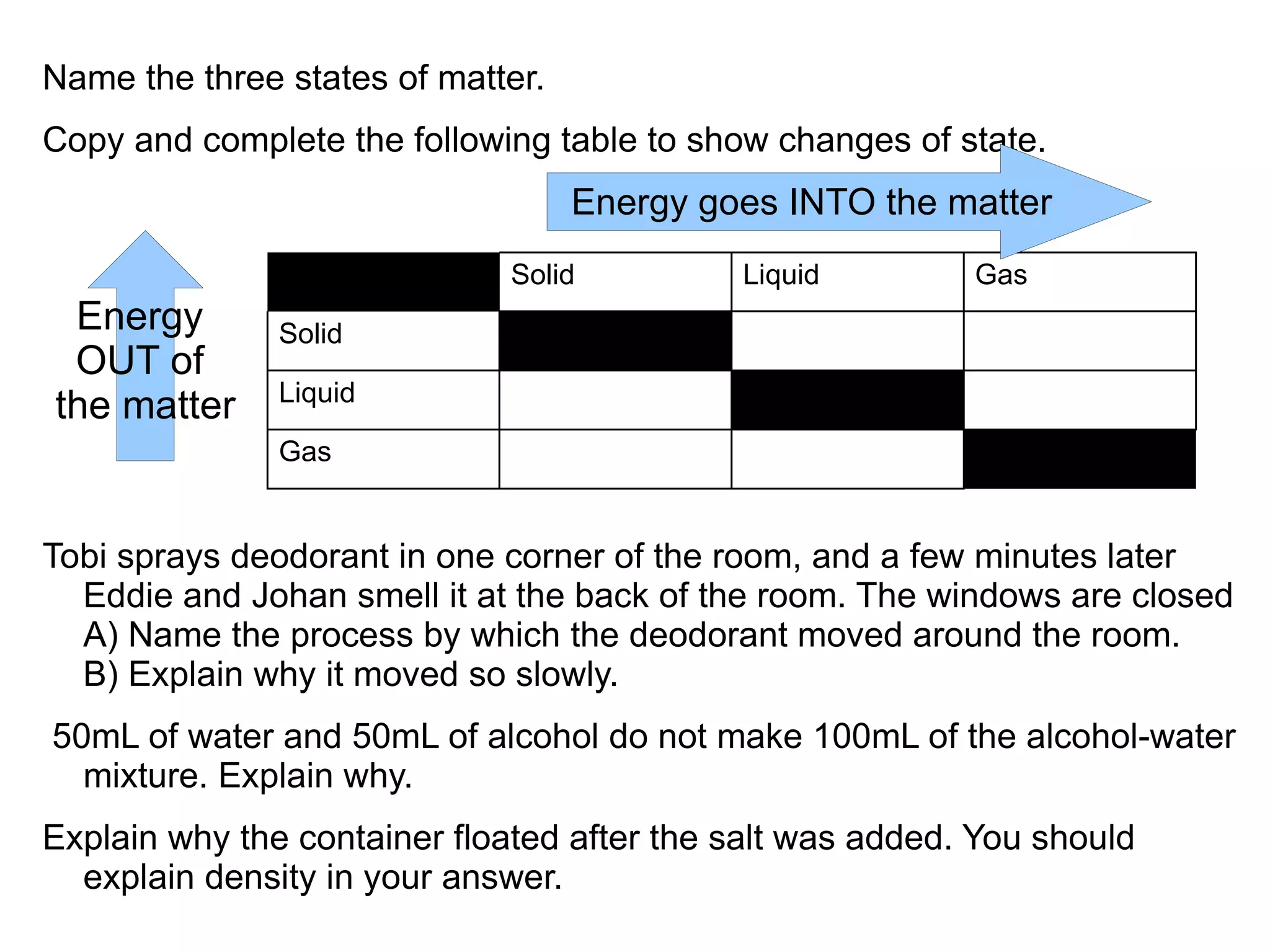
    Name the threestates of matter.
  • 40.
    Copy and completethe following table to show changes of state.
  • 41.
    Tobi sprays deodorantin one corner of the room, and a few minutes later Eddie and Johan smell it at the back of the room. The windows are closed A) Name the process by which the deodorant moved around the room. B) Explain why it moved so slowly.
  • 42.
    50mL of waterand 50mL of alcohol do not make 100mL of the alcohol-water mixture. Explain why.
  • 43.
    Explain why thecontainer floated after the salt was added. You should explain density in your answer. Solid Liquid Gas Solid Liquid Gas Energy OUT of the matter Energy goes INTO the matter
  • 44.
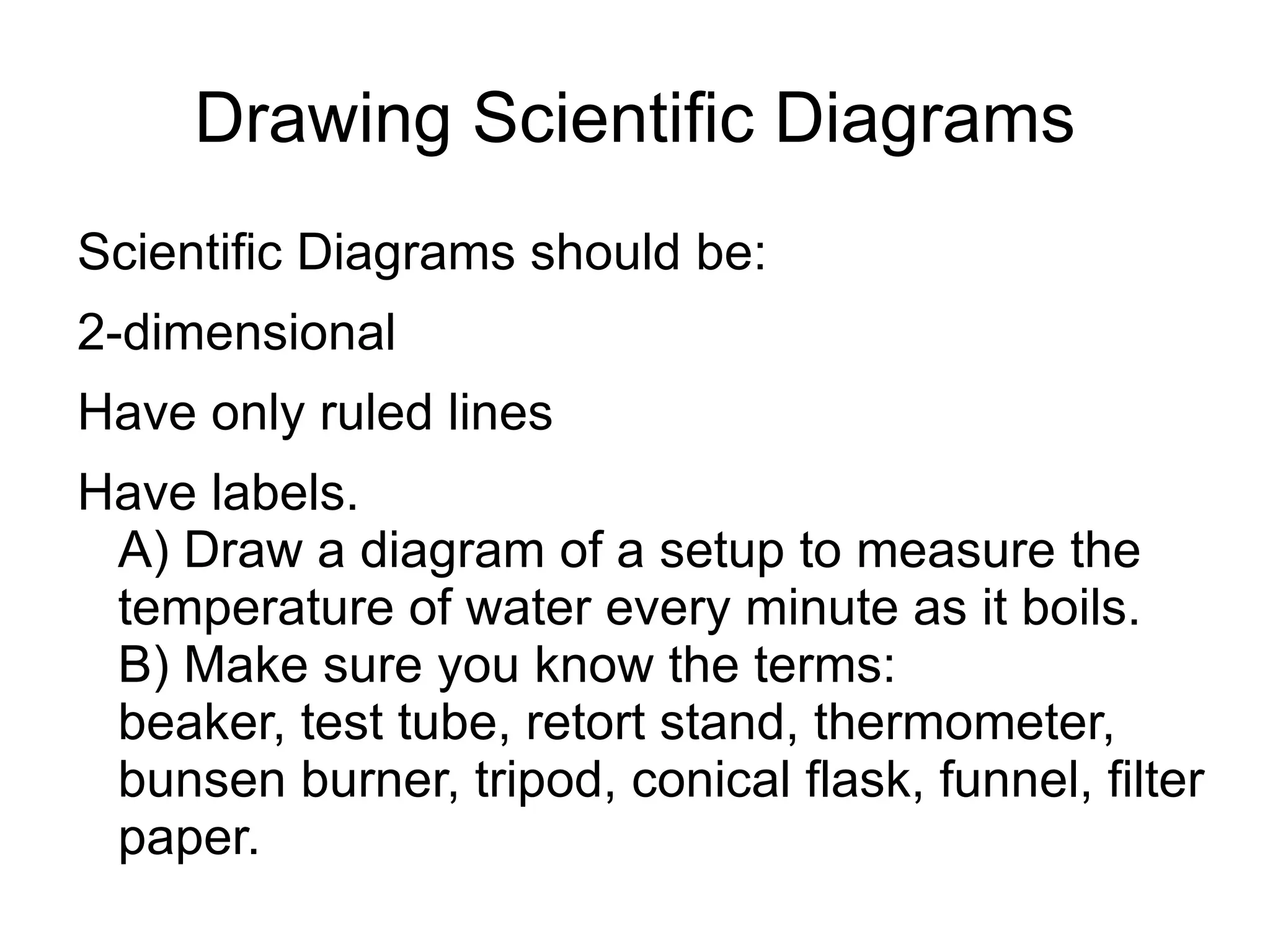
    Drawing Scientific DiagramsScientific Diagrams should be: 2-dimensional
  • 45.
  • 46.
    Have labels. A)Draw a diagram of a setup to measure the temperature of water every minute as it boils. B) Make sure you know the terms: beaker, test tube, retort stand, thermometer, bunsen burner, tripod, conical flask, funnel, filter paper.