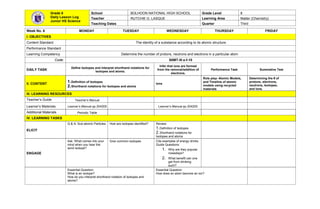
Week No. 1 MONDAY TUESDAY WEDNESDAY THURSDAY FRIDAY
I. OBJECTIVES
Content Standard
The Learners demonstrate an understanding of: the particle nature of matter as basis for explaining properties, physical changes, and structure of
substances and mixtures
Performance Standard
The Learners shall be able to: present how water behaves in its
different states within the water cycle
Learning Competency
The Learners should be able to:
explain the properties of solids, liquids, and gases based on the particle nature of matter;
Code: S8MT-IIIa-b-8
DAILY TASK Diagnostic (module 1) Distinguish Matter from non-matter Explain that matter is made up of tiny particles
II. CONTENT DIAGNOSTIC TEST Common properties of matter Composition of Matter
III.LEARNING RESOURCES
Teacher’s Guide
Learner’s Materials
Learners’ Module pp
172173
Learners’ Module pp
172173
Learners’ Module pp.
174177
Learners’ Module pp.
174177
Additional Materials www.factmonster.com
IV. LEARNING TASKS
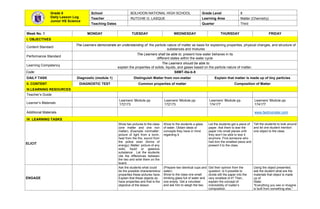
ELICIT
Show two pictures to the class
(one matter and one non
matter). (Example: nonmatter:
picture of light from a torch,
heat from the fire, sound from
the police siren (forms of
energy); Matter: picture of any
solid, liquid or gaseous
substance. Let the students
cite the differences between
the two and write them on the
board.
Show to the students a glass
of water. Obtain ideas or
concepts they have in mind
regarding it.
Let the students get a piece of
paper. Ask them to tear the
paper into small pieces until
they won’t be able to tear it
anymore. Find someone who
had torn the smallest piece and
present it to the class.
Tell the students to look around
and let one student mention
one object to the class.
ENGAGE
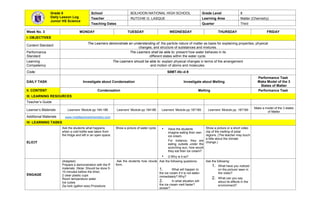
Ask the students what could
be the possible characteristics/
properties these pictures have.
Explain that these objects do
have properties and that is the
objective of the lesson.
(Prepare two identical cups and
water)
Show to the class one small
drinking glass full of water and
one empty. Get a volunteer
and ask him to weigh the two.
Get their opinion from the
question: Is it possible to
divide still the paper into the
very smallest of it? Then,
explain the concept of
indivisibility of matter’s
composition.
Using the object presented,
ask the student what are the
materials that object is made
up of.
State:
“Everything you see or imagine
is built from something else.”
Grade 8
Daily Lesson Log
Junior HS Science
School BOLHOON NATIONAL HIGH SCHOOL Grade Level 8
Teacher RUTCHIE G. LASQUE Learning Area Matter (Chemistry)
Teaching Dates Quarter Third
Ask the students on what they
observed with the two objects.
(Students must infer that water
has mass)
This concept will be further
discussed for today’s topic.
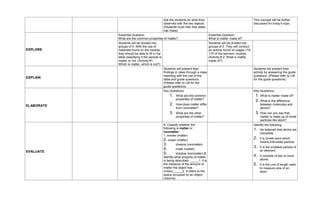
EXPLORE
Essential Question:
What are the common properties of matter?
Essential Question:
What is matter made of?
Students will be divided into
groups of 5. With the use of
materials found on the module,
they should be able to fill in the
table classifying if the sample is
matter or not. (Activity #1:
Which is matter, which is not?)
Students will be divided into
groups of 5. They will conduct
an activity found on pages 174-
175 of the learners’ module.
(Activity # 2: What is matter
made of?)
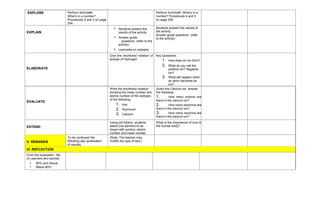
EXPLAIN
Students will present their
findings in class through a class
reporting with the use of the
table and guide questions.
(Please refer to LM for the
guide questions)
Students will present their
activity by answering the guide
questions. (Please refer to LM
for the guide questions)
ELABORATE
Key Questions:
1. What are the common
properties of matter?
2. How does matter differ
from nonmatter?
3. What are the other
properties of matter?
Key Questions:
1. What is matter made of?
2. What is the difference
between molecules and
atoms?
3. How can you say that
matter is made up of small
particles like atom?
EVALUATE
A. Classify whether the
following is matter or
nonmatter:
1. smoke (matter)
2. ocean (matter)
3. dreams (nonmatter)
4. chalk (matter)
5. shadow (nonmatter) B.
Identify what property of matter
is being described: _____1. It is
the measure of the amount of
matter the object has.
(mass) _____2. It refers to the
space occupied by an object.
(volume)
Identify the following
1. He believed that atoms are
indivisible.
2. It is Greek word which
means indivisible particle.
3. It is the smallest particle of
an element.
4. It consists of two or more
atoms.
5. It is the unit of length used
to measure size of an
atom.
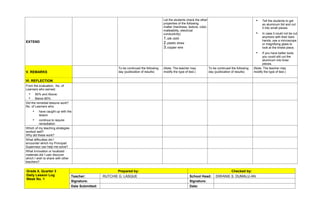
EXTEND
Let the students check the other
properties of the following
matter (hardness, texture, color,
malleability, electrical
conductivity)
1.silk cloth
2.plastic straw
3.copper wire
• Tell the students to get
an aluminum foil and cut
it into small pieces.
• In case it could not be cut
anymore with their bare
hands, use a microscope
or magnifying glass to
look at the tiniest piece.
• If you have better tools,
you could still cut the
aluminum into tinier
pieces.
V. REMARKS
To be continued the following
day (publication of results)
(Note: The teacher may
modify the type of test.)
To be continued the following
day (publication of results)
(Note: The teacher may
modify the type of test.)
VI. REFLECTION
From the evaluation, No. of
Learners who earned:
• 80% and Above:
• Below 80%:
Did the remedial lessons work?
No. of Learners who:
• have caught up with the
lesson
• continue to require
remediation
Which of my teaching strategies
worked well?
Why did these work?
What difficulties did I
encounter which my Principal/
Supervisor can help me solve?
What innovation or localized
materials did I use/ discover
which I wish to share with other
teachers?
Grade 8, Quarter 3
Daily Lesson Log
Week No. 1
Prepared by: Checked by:
Teacher: RUTCHIE G. LASQUE School Head: DIWANIE S. DUMALU-AN
Signature: Signature:
Date Submitted: Date:
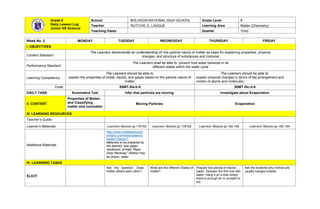
Week No. 2 MONDAY TUESDAY WEDNESDAY THURSDAY FRIDAY
I. OBJECTIVES
Content Standard
The Learners demonstrate an understanding of: the particle nature of matter as basis for explaining properties, physical
changes, and structure of substances and mixtures
Performance Standard
The Learners shall be able to: present how water behaves in its
different states within the water cycle
Learning Competency
The Learners should be able to:
explain the properties of solids, liquids, and gases based on the particle nature of
matter;
The Learners should be able to:
explain physical changes in terms of the arrangement and
motion of atoms and molecules;
Code: S8MT-IIIa-b-8 S8MT-IIIc-d-9
DAILY TASK Summative Test Infer that particles are moving Investigate about Evaporation
II. CONTENT
Properties of Matter,
and Classifying
matter and nonmatter
Moving Particles Evaporation
III. LEARNING RESOURCES
Teacher’s Guide
Learner’s Materials Learners’ Module pp 178182 Learners’ Module pp 178182 Learners’ Module pp 182-184 Learners’ Module pp 182-184
Additional Materials
http://www.middleschoolch
emistry.com/lessonplans/c
hapter1/lesson1
Materials to be prepared by
the teacher: wax paper,
cardboard, printed “Race
Drop Raceway” sheets/ may
be drawn, water
IV. LEARNING TASKS
ELICIT
Ask the question: Does
matter attract each other?
What are the different States of
matter?
Prepare two pieces of manila
paper. Dampen the first one with
water. Hang it on a side where
there is enough air or sunlight to
dry.
Ask the students why clothes are
usually hanged outside.
Grade 8
Daily Lesson Log
Junior HS Science
School BOLHOON NATIONAL HIGH SCHOOL Grade Level 8
Teacher RUTCHIE G. LASQUE Learning Area Matter (Chemistry)
Teaching Dates Quarter Third
ENGAGE
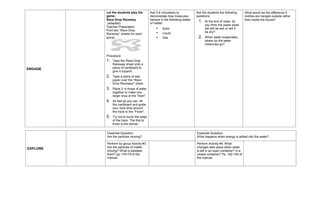
Let the students play the
game:
Race Drop Raceway
(adapted)
Teacher Preparation
Print two “Race Drop
Raceway” sheets for each
group.
Procedure
1. Tape the Race Drop
Raceway sheet onto a
piece of cardboard to
give it support.
2. Tape a piece of wax
paper over the “Race
Drop Raceway!” sheet.
3. Place 2–4 drops of water
together to make one
larger drop at the “Start”.
4. As fast as you can, tilt
the cardboard and guide
your race drop around
the track to the “Finish”.
5. Try not to touch the edge
of the track. The first to
finish is the winner.
Ask 5-6 volunteers to
demonstrate how molecules
behave in the following states
of matter:
• Solid
• Liquid
• Gas
Ask the students the following
questions:
1. At the end of class, do
you think the paper towel
will still be wet or will it
be dry?
2. When water evaporates,
where do the water
molecules go?
What would be the difference if
clothes are hanged outside rather
than inside the house?
EXPLORE
Essential Question:
Are the particles moving?
Essential Question:
What happens when energy is added into the water?
Perform by group Activity #3:
Are the particles of matter
moving? What is between
them? pp 178179 of the
manual.
Perform Activity #4: What
changes take place when water
is left in an open container? In a
closed container? Pp. 182-183 of
the manual.
EXPLAIN
Students will present their
findings in class through a
class reporting with the use of
the table and guide questions.
(Please refer to LM for the
guide questions)
Students will present their findings
in class through a class reporting
with the use of the table and guide
questions. (Please refer to LM for
the guide questions)
ELABORATE
Key Questions:
1. What is matter made of?
2. What can you say about
its movement?
3. Describe the
arrangement of
particles of solid, liquid
and gas.
Key Questions:
1. What do you think may be
the biggest factor which contributed
to the evaporation process?
2. What happened to the
kinetic energy of particles from
liquid to gas/vapor?
3. How does evaporation take
place?
EVALUATE
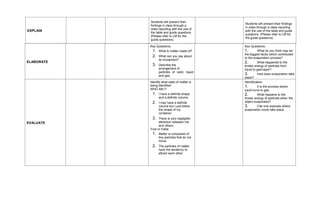
Identify what state of matter is
being identified:
WHO AM I?
1. I have a definite shape
and a definite volume.
2. I may have a definite
volume but I just follow
the shape of my
container.
3. There is very negligible
attraction between me
and others.
True or False
1. Matter is composed of
tiny particles that do not
move.
2. The particles of matter
have the tendency to
attract each other.
Identification:
1. It is the process where
liquid turns to gas.
2. What happens to the
kinetic energy of particles when the
object evaporates?
3. Cite one example where
evaporation could take place.
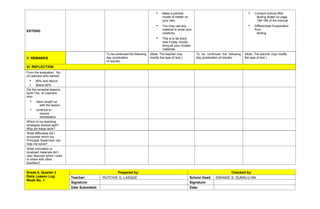
EXTEND
• Make a particle
model of matter on
your own.
• You may use any
material to show your
creativity.
• This is to be done
next Friday. Kindly
bring all your chosen
materials.
• Conduct Activity #5A:
Boiling Water on page
184-185 of the manual.
• Differentiate Evaporation
from
Boiling
V. REMARKS
To be continued the following
day (publication
of results)
(Note: The teacher may
modify the type of test.)
To be continued the following
day (publication of results)
(Note: The teacher may modify
the type of test.)
VI. REFLECTION
From the evaluation, No.
of Learners who earned:
• 80% and Above:
• Below 80%:
Did the remedial lessons
work? No. of Learners
who:
• have caught up
with the lesson
• continue to
require
remediation
Which of my teaching
strategies worked well?
Why did these work?
What difficulties did I
encounter which my
Principal/ Supervisor can
help me solve?
What innovation or
localized materials did I
use/ discover which I wish
to share with other
teachers?
Grade 8, Quarter 3
Daily Lesson Log
Week No. 1
Prepared by: Checked by:
Teacher: RUTCHIE G. LASQUE School Head: DIWANIE S. DUMALU-AN
Signature: Signature:
Date Submitted: Date:
Week No. 3 MONDAY TUESDAY WEDNESDAY THURSDAY FRIDAY
I. OBJECTIVES
Content Standard
The Learners demonstrate an understanding of: the particle nature of matter as basis for explaining properties, physical
changes, and structure of substances and mixtures.
Performance
Standard
The Learners shall be able to: present how water behaves in its
different states within the water cycle.
Learning
Competency
The Learners should be able to: explain physical changes in terms of the arrangement
and motion of atoms and molecules.
Code: S8MT-IIIc-d-9
DAILY TASK Investigate about Condensation Investigate about Melting
Performance Task
Make Model of the 3
States of Matter
II. CONTENT Condensation Melting Performance Task
III. LEARNING RESOURCES
Teacher’s Guide
Learner’s Materials Learners’ Module pp 184-186 Learners’ Module pp 184186 Learners’ Module pp 187189 Learners’ Module pp. 187189
Make a model of the 3 states
of Matter
Additional Materials www.middleschoolchemistry.com
IV. LEARNING TASKS
ELICIT
Ask the students what happens
when a cold bottle was taken from
the fridge and left in an open space.
Show a picture of water cycle. • Have the students
imagine eating their own
ice cream.
For instance, they are
eating outside under the
scorching sun, how would
they eat their ice cream?
• Why is it so?
Show a picture or a short video
clip of the melting of polar
regions. (The teacher may touch
a little about the climate
change.)
ENGAGE
(Adapted)
Prepare a demonstration with the ff
materials: (Note: Should be done 5-
10 minutes before the time)
2 clear plastic cups
Room temperature water
Ice cubes
Zip lock (gallon size) Procedure:
Ask the students how clouds
form.
Ask the following questions:
1. What will happen to
the ice cream if it is not eaten
immediately? Why?
2. In what situation will
the ice cream melt faster?
slower?
Ask the following:
1. What have you noticed
on the picture/ seen in
the video?
2. What can you say
about its effects in the
environment?
Grade 8
Daily Lesson Log
Junior HS Science
School BOLHOON NATIONAL HIGH SCHOOL Grade Level 8
Teacher RUTCHIE G. LASQUE Learning Area Matter (Chemistry)
Teaching Dates Quarter Third
1. Place water and ice cubes
into two identical cups.
2. Immediately place one of
the cups in a zip lock bag and get as
much air out of the bag as possible.
Close the bag securely.
3. Allow the cups to sit
undisturbed for about 5-10 minutes.
Ask the students:
Why do you think the cup that is
exposed to more air has more water
on the outside of it?
3. What might be the
factors involved in the process?
3. How did this happen?
(Introduce the melting process)
EXPLORE
Essential Question:
What happens when particles lose their energy and drop their
temperature?
Essential Question:
What happens to the kinetic energy of the molecules when
temperature increases/decreases and heat transfer continues?
Essential Question: How will
you demonstrate the three
states of matter?
• Perform activity #5 Part B:
Cooling Water page 186.
• Answer guide questions #6-
9
• Perform Activity #6:
What changes take
place when ice turns
into liquid water?
• Answer the guide
questions found on
pages 187-188.
The teacher may opt to use the
following:
a. Illustration/Drawing
b. Model
c. Multimedia
Presentation
d. Others. With their
chosen materials, students will
create their own particle
model of the following
scenario:
a.solid-liquid
b.gas-liquid
c.liquid-gas
d.liquid-solid
EXPLAIN
Students will present their
findings in class through a
class reporting with the use of
the table and guide questions.
(Please refer to
LM for the guide questions)
Students will present their
findings in class through a class
reporting with the use of the
table and guide questions.
(Please refer to LM for the guide
questions)
ELABORATE
Key Questions:
1. What happens to water
when it is cooled?
2. How does the
process of condensation take
place?
Key Questions:
1. What do you think may be
the biggest factor which
contributed to the
melting/freezing process? 2.
What happened to the kinetic
Why do droplets form at the
surface of a covered hot
container?
energy of particles from solid to
liquid?
3. What happened to the kinetic
energy of particles from liquid to
solid?
3. How does melting take
place?
How does freezing take place?
EVALUATE
TRUE or FALSE
Write True if the statement is
correct and False if it is not.
1. As the temperature
increases, the kinetic energy
increases as well.
(True)
2. When particles lose
their energy, they return to
their original state. (True) 3.
Condensation is a process
when liquid turns to its
gaseous state.
(False)
4. The gaseous state of water
is called water vapor. (True)
Identification:
1. It is the process
where liquid turns to solid.
2. What happens to the
kinetic energy of particles
when the object melts? 3. If
the temperature surrounding
the object is greater, what
process will take place?
4. It is the process where
solid turns to liquid.
5. When heat is
decreased, the object
melts/freezes?
Criteria:
40% Accuracy
35% Creativity
15% Resourcefulness
10% Neatness
Total: 100%
EXTEND
Cite other practical examples
or situations where you could
observe
the process of condensation.
Explain to students that there
are cases that some substances
can change directly from solid to
gas.
This process is called
SUBLIMATION. The
opposite of which is called the
DEPOSITION.
V. REMARKS
To be continued the following day
(publication of results)
(Note: The teacher may
modify the type of test.)
To be continued the following
day (publication of results)
(Note: The teacher may
modify the type of test.)
VI. REFLECTION
From the evaluation,
No. of Learners who
earned:
• 80% and
Above:
• Below 80%:
Did the remedial
lessons work? No. of
Learners who:
• have caught
up with the
lesson
• continue to
require
remediation
Which of my teaching
strategies worked well?
Why did these work?
What difficulties did I
encounter which my
Principal/ Supervisor
can help me solve?
What innovation or
localized materials did I
use/ discover which I
wish to share with other
teachers?
Grade 8, Quarter 3
Daily Lesson Log
Week No. 1
Prepared by: Checked by:
Teacher: RUTCHIE G. LASQUE School Head: DIWANIE S. DUMALU-AN
Signature: Signature:
Date Submitted: Date:
Week No. 4 MONDAY TUESDAY WEDNESDAY THURSDAY FRIDAY
I. OBJECTIVES
Content Standard The identity of a substance according to its atomic structure.
Performance Standard
Learning Competency Determine the number of protons, neutrons and electrons in a particular atom.
Code: S8MT-III e-f-10
DAILY TASK Summative Test Determine the charges of subatomic particles Compare the masses of the subatomic particles.
II. CONTENT
Coverage:
Phase Changes Charges of subatomic particles Masses of the subatomic particles.
III. LEARNING RESOURCES
Teacher’s Guide
Learner’s Materials Learner’s Module pp 193 Learner’s Module pp 195-197
Additional Materials Plastic-covered notebook
Plastic straw, tissue paper, aluminum
foil
Atomic Models Pictures
IV. LEARNING TASKS
ELICIT
Reflect on the line “Like
poles repel, unlike poles
attract”.
What are atoms made of? What
structures compose an atom?
Enumerate some
properties of the three
subatomic particles. (refer
to table 2 in LM p195.
Present the Table #2: Some
properties of the three main
subatomic particles on page
195
ENGAGE
Rub a plastic covered
notebook vigorously against
a hard object and placed it
over the head.
What happens?
If you rub a plastic straw with tissue
paper and place it near an
aluminum foil, what will happen?
Give one property of
subatomic particle. Which
among them contributes the
most to the overall mass of
an atom?
Ask which among the three has
the highest value of mass.
Explain the concept of
Scientific notation.
EXPLORE
Essential Question: Do
objects attract or repel each
other/carry positive and
negative charges?
Essential Question:
Do objects attract or repel each
other/carry positive and negative
charges?
Essential Question:
Compare the masses of
the subatomic particles.
Essential Question:
Compare the masses of the
subatomic particles.
Perform Activity 1: “Charge”
it to experience! in LM
p193.
Perform Activity 2: The big
difference in LM pp195-196.
EXPLAIN
Students present the results of the
activity.
Answer guide questions. (refer to the
activity)
Students present the results of
the activity. Comparison of the
masses of the three subatomic
particles using the bar graph,
Grade 8
Daily Lesson Log
Junior HS Science
School BOLHOON NATIONAL HIGH SCHOOL Grade Level 8
Teacher RUTCHIE G. LASQUE Learning Area Matter (Chemistry)
Teaching Dates Quarter Third
pie chart and a seesaw can.
Answer guide questions. (refer
to the activity).
ELABORATE
• Ask students what makes up
an atom?
• Give the charges of the three
subatomic particles.
Which subatomic particle/s
make/s up most of the mass of
the atom?
EVALUATE
Complete the table.
Subatomic
Particle
Charge Location
1. positive 4.
electron 2. 5.
3. neutral 6.
Refer to the masses in table 2.
Answer the following
questions.
1.Which subatomic particle is
the lightest?
2.Which subatomic particle is
the heaviest?
3. Which subatomic particle
has almost the same mass? 4-
5. Which subatomic particles
make up most of the mass of
the atom.
EXTEND
Present Table 2. Some Properties of
the three subatomic particles.
pp195
Research on Thomson’s and
Rutherford model of the atom.
V. REMARKS
To be continued the
following day (publication
of results)
(Note: The teacher may modify the
type of test.)
To be continued the following
day (publication of results)
(Note: The teacher may modify
the type of test.)
VI. REFLECTION
From the evaluation, No.
of Learners who earned:
• 80% and Above:
• Below 80%:
Did the remedial lessons
work? No. of Learners who:
• have caught up
with the less
• continue to
require
remediation
Which of my teaching
strategies worked well?
Why did these work?
What difficulties did I
encounter which my
Principal/ Supervisor can
help me solve?
What innovation or
localized materials did I
use/ discover which I wish
to share with other
teachers?
Grade 8, Quarter 3
Daily Lesson Log
Week No. 1
Prepared by: Checked by:
Teacher: RUTCHIE G. LASQUE School Head: DIWANIE S. DUMALU-AN
Signature: Signature:
Date Submitted: Date:
Week No. 5 MONDAY TUESDAY WEDNESDAY THURSDAY FRIDAY
I. OBJECTIVES
Content Standard The identity of a substance according to its atomic structure.
Performance Standard
Learning Competency Determine the number of protons, neutrons and electrons in a particular atom
Code: S8MT-III e-f-10
DAILY TASK Describe Thomson’s model
Describe Rutherford’s
model.
Summative Test Determine the number of neutrons from the mass number.
II. CONTENT Thomson’s model Rutherford’s model.
Subatomic Particles and
Molecular Models
Determining the number of neutrons from the mass number.
III. LEARNING RESOURCES
Teacher’s Guide Teacher’s Manual Teacher’s Manual
Learner’s Materials Learner’s Manual pp 198-203
Learner’s Manual pp 198-203
pp 193
Learner’s Manual pp 203-205
Learner’s Manual pp 203-205 pp
195-197
Additional Materials
Exemplar Lesson Plan
pp138-140
Exemplar Lesson Plan,
Periodic Table ,pen/pencil
Exemplar Lesson Plan,
Periodic Table ,pen/pencil
IV. LEARNING TASKS
ELICIT
What is an atom? What
are the different subatomic
particles of an atom?
Review: Thomson’s atomic
model.
Show a periodic Table. Ask
students about the salient
features of the Periodic
Table.
What makes up the mass of an
atom?
ENGAGE
Show to the class a real raisin
bread.
Guide Questions:
1. What is the name of
this bread?
2. What is in this bread
that is not found in
other breads?
(The teacher may opt to use a
picture instead.)
Teacher
demonstration:
Activity #3 Part A
• Look for a volunteer.
• Ask few questions.
GAME:
Group the students and
ask a representative to
answer the question by
writing the answer on the
board.
• The teacher gives the
name of the element.
• Students write its symbol,
atomic number and mass
number.
Ask one student to draw an atom
having three subatomic particles.
Grade 8
Daily Lesson Log
Junior HS Science
School BOLHOON NATIONAL HIGH SCHOOL Grade Level 8
Teacher RUTCHIE G. LASQUE Learning Area Matter (Chemistry)
Teaching Dates Quarter Third
EXPLORE
Essential Question:
How did Thomson
discover the electron?
Essential Question:
How do you describe
Rutherford’s model?
Essential Question:
How do you determine the number of neutrons, protons, electrons in a neutral
atom?
• Show Thomson’s
atomic model.
• Elicit ideas from the
students.
Perform Activity #3 Part B
and C: Small but terrible.
Perform Activity #4:
What’s in a number?,
procedure 1 in LM p. 204.
EXPLAIN
Lecturette:
Discuss the details of his
discovery.
Students present the results
of the activity. Answer guide
questions. (refer to the
activity)
Students present the results of the activity.
Answer guide questions. (refer to the activity)
ELABORATE
Key Questions:
1. What was the
experiment
conducted by J.J.
Thomson?
2. How was he able
to prove the
existence of
electrons?
3. Describe
Thomson’s
discovery.
Key Questions:
1. What was the
experiment
conducted by
Rutherford?
2. How was he able to
prove the existence
of the nucleus?
3. Describe
Rutherford’s
discovery.
Key Questions:
1. Differentiate
atomic
number
from mass
number.
2. How do you
determine
the number
of neutrons
given the
mass number and atomic number?
EVALUATE
Draw and describe J.J.
Thomson’s model.
Draw and describe
Rutherford’s model.
Data completion: Fill in the missing data in
the table.
Element
Mass
#
Atomic
#
p+
e-
n0
Na 23 1
C 6 1 6
Rn 222 86
Au 7 11
EXTEND Identify the uses of
Thomson’s experiment.
(e.g. television-picture tube)
Cite the flaws of
Rutherford’s discovery.
Define Isotopes and its uses.
V. REMARKS
To be continued the
following day (publication of
results)
(Note: The teacher may
modify the type of test.)
VI. REFLECTIONS
From the evaluation, No.
of Learners who earned:
• 80% and Above:
• Below 80%:
Did the remedial lessons
work? No. of Learners who:
• have caught up with
the lesson
• continue to require
remediation
Which of my teaching
strategies worked well?
Why did these work?
What difficulties did I
encounter which my
Principal/ Supervisor can help
me solve?
What innovation or localized
materials did I use/ discover
which I wish to share with
other teachers?
Grade 8, Quarter 3
Daily Lesson Log
Week No. 1
Prepared by: Checked by:
Teacher: RUTCHIE G. LASQUE School Head: DIWANIE S. DUMALU-AN
Signature: Signature:
Date Submitted: Date:
Week No. 6 MONDAY TUESDAY WEDNESDAY THURSDAY FRIDAY
I. OBJECTIVES
Content Standard The identity of a substance according to its atomic structure.
Performance Standard
Learning Competency Determine the number of protons, neutrons and electrons in a particular atom
Code: S8MT-III e-f-10
DAILY TASK
Define Isotopes and interpret shorthand notations for
isotopes and atoms.
Infer that ions are formed
from the removal/addition of
electrons.
Performance Task Summative Test
II. CONTENT
1.Definition of Isotopes
2.Shorthand notations for Isotopes and atoms
Ions
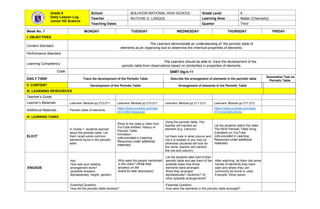
Role play- Atomic Models,
and Timeline of atomic
models using recycled
materials
Determining the # of
protons, electrons,
neutrons, Isotopes,
and Ions.
III. LEARNING RESOURCES
Teacher’s Guide Teacher’s Manual
Learner’s Materials Learner’s Manual pp 204205 Learner’s Manual pp 204205
Additional Materials Periodic Table
IV. LEARNING TASKS
ELICIT
Q & A: Sub-atomic Particles How are isotopes identified? Review:
1.Definition of Isotopes
2.Shorthand notations for
Isotopes and atoms
ENGAGE
Ask: What comes into your
mind when you hear the
word isotope?
Give common isotopes. Cite examples of energy drinks.
Guide Questions:
1. Why are they popular
nowadays?
2. What benefit can one
get from drinking
such?
Essential Question:
What is an isotope?
How do you interpret shorthand notation of isotopes and
atoms?
Essential Question:
How does an atom become an ion?
Grade 8
Daily Lesson Log
Junior HS Science
School BOLHOON NATIONAL HIGH SCHOOL Grade Level 8
Teacher RUTCHIE G. LASQUE Learning Area Matter (Chemistry)
Teaching Dates Quarter Third
EXPLORE Perform Activity#4:
What’s in a number?
Procedures 2 and 3 on page
204.
Perform Activity#4: What’s in a
number? Procedures 4 and 5
on page 205.
EXPLAIN
• Students present the
results of the activity.
• Answer guide
questions. (refer to the
activity)
• Lecturette on isotopes
Students present the results of
the activity.
Answer guide questions. (refer
to the activity)
ELABORATE
Give the shorthand notation of
isotope of Hydrogen.
Key Questions:
1. How does an ion form?
2. What do you call the
positive ion? Negative
ion?
3. What will happen when
an atom becomes an
ion?
EVALUATE
Write the shorthand notation
showing the mass number and
atomic number of the isotopes
of the following:
1. Iron
2. Aluminum
3. Calcium
Given the Calcium ion, answer
the following:
1. How many protons are
there in the calcium ion?
2. How many electrons are
there in the calcium ion?
3. How many neutrons are
there in the calcium ion?
EXTEND
Using old folders, students
select one element to be
drawn with symbol, atomic
number and mass number.
What is the importance of ions in
the human body?
V. REMARKS
To be continued the
following day (publication
of results)
(Note: The teacher may
modify the type of test.)
VI. REFLECTION
From the evaluation, No.
of Learners who earned:
• 80% and Above:
• Below 80%:
Did the remedial lessons
work? No. of Learners who:
• have caught up
with the lesson
• continue to require
remediation
Which of my teaching
strategies worked well?
Why did these work?
What difficulties did I
encounter which my
Principal/ Supervisor can
help me solve?
What innovation or
localized materials did I
use/ discover which I wish
to share with other
teachers?
Grade 8, Quarter 3
Daily Lesson Log
Week No. 1
Prepared by: Checked by:
Teacher: RUTCHIE G. LASQUE School Head: DIWANIE S. DUMALU-AN
Signature: Signature:
Date Submitted: Date:
Week No. 7 MONDAY TUESDAY WEDNESDAY THURSDAY FRIDAY
I. OBJECTIVES
Content Standard
The Learners demonstrate an understanding of: the periodic table of
elements as an organizing tool to determine the chemical properties of elements.
Performance Standard
Learning Competency
The Learners should be able to: trace the development of the
periodic table from observations based on similarities in properties of elements.
Code: S8MT-IIIg-h-11
DAILY TASK Trace the development of the Periodic Table Describe the arrangement of elements in the periodic table
Summative Test on
Periodic Table
II. CONTENT Development of the Periodic Table Arrangement of elements in the Periodic Table
III. LEARNING RESOURCES
Teacher’s Guide
Learner’s Materials Learners’ Module pp 210-211 Learners’ Module pp 210-211 Learners’ Module pp 211-213 Learners’ Module pp 211-213
Additional Materials Periodic table of elements
https://www.youtube.com/wat
ch?v=I5H1SeepnaU
https://www.youtube.com/watc
h?v=VgVQKCcfwnU
IV. LEARNING TASKS
ELICIT
In Grade 7, students learned
about the periodic table. Let
them recall some common
elements found in the periodic
table.
Show to the class a video from
YouTube entitled: History of
Periodic Table
Animation
(cite provided in Learning
Resources under additional
materials)
Using the periodic table, The
teacher will mention an
element (e.g. Calcium).
Let them look in what column and
row it is located or you may do
otherwise (students will look for
the name, teacher will mention
the row and column)
Let the students watch the video
The NEW Periodic Table Song
(Updated) on YouTube.
(cite provided in Learning
Resources under additional
materials)
ENGAGE
Ask:
How was your seating
arrangement done?
(possible answers:
alphabetically, height, gender)
Who were the people mentioned
in the video? (Write their
answers on the
board for later discussion)
Let the students take hold of their
periodic table and ask them of the
possible ways how those
elements were arranged.
Were they arranged
alphabetically? randomly? Or
other possible arrangements?
After watching, let them cite some
names of elements they have
seen and where they can
commonly be found or used.
Example: Silver-spoon
Essential Question:
How did the periodic table develop?
Essential Question:
How were the elements in the periodic table arranged?
Grade 8
Daily Lesson Log
Junior HS Science
School BOLHOON NATIONAL HIGH SCHOOL Grade Level 8
Teacher RUTCHIE G. LASQUE Learning Area Matter (Chemistry)
Teaching Dates Quarter Third
EXPLORE
Perform Activity #1 part A:
Tracking the path and
constructing the Periodic Table
on pages 210-211 of their
textbook.
Continue Activity #1 Part B.
Tracking the path and
constructing the Periodic Table on
page 211 of the learner’s manual.
EXPLAIN
With the use of the guide
questions, students will report
their answers in front.
(Questions #1-4)
With the use of the guide
questions, students will report
their answers in front. (Questions
#5-10)
ELABORATE
Key Questions:
1. Who were the people
behind the history of periodic
table? And what was their
respective concept?
2. What bases did the
following chemists use to explain
their arrangement of elements?
a. Dobereiner
b. Newlands
c. Meyer
d. Mendeleev
e. Moseley
Key Questions:
1. What is periodic law?
2. Differentiate groups from periods.
3. What are the different family
names of groups found in the
periodic table?
EVALUATE
Identification
1. He is a German chemist
who grouped elements in three
with similar properties.
2. This arrangement was
proposed by Newlands.
3. How did Mendeleev
arrange the elements in the
periodic table?
I. Identify in what period and
group does the following element
belong:
1. Boron
2. Calcium
3. Neon
4. Hydrogen
5. Potassium
II. Identify and label the parts of
the periodic table.
EXTEND
Trace the development of the
Periodic Table by making a
timeline. Write it in a short sized
bond paper.
For the next session, tell the
students to bring the following
materials for their
Performance output:
a. Bond paper (long sized)
b. Coloring materials
c. Designing materials
d. Ruler
e. Glue
• Assign this activity by
pair.
• Ask the students to do
some research about
the following information
of the assigned element:
a. Name of element and
how it got its name.
b. Symbol, Atomic
Number and Atomic
Mass
c. Where is it found and in
what form
d. Physical facts
(melting point, boiling
point, density)
e. Uses (with pictures)
f. Source of information
V. REMARKS
To be continued the following
day (publication of results)
(Note: The teacher may
modify the type of test.)
To be continued the following day
(publication of results)
(Note: The teacher may
modify the type of test.)
VI. REFLECTION
From the evaluation, No. of
Learners who earned:
• 80% and Above:
• Below 80%:
Did the remedial lessons
work? No. of Learners who:
• have caught up
with the lesson
• continue to require
remediation
Which of my teaching
strategies worked well?
Why did these work?
What difficulties did I
encounter which my
Principal/ Supervisor can
help me solve?
What innovation or localized
materials did I use/ discover
which I wish to share with
other teachers?
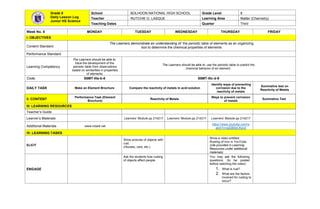
Week No. 8 MONDAY TUESDAY WEDNESDAY THURSDAY FRIDAY
I. OBJECTIVES
Content Standard
The Learners demonstrate an understanding of: the periodic table of elements as an organizing
tool to determine the chemical properties of elements
Performance Standard
Learning Competency
The Learners should be able to:
trace the development of the
periodic table from observations
based on similarities in properties
of elements
The Learners should be able to: use the periodic table to predict the
chemical behavior of an element.
Code: S8MT-IIIa-b-8 S8MT-IIIc-d-9
DAILY TASK Make an Element Brochure Compare the reactivity of metals in acid solution
Identify ways of preventing
corrosion due to the
reactivity of metals
Summative test on
Reactivity of Metals
II. CONTENT
Performance Task (Element
Brochure)
Reactivity of Metals
Ways to prevent corrosion
of metals
Summative Test
III. LEARNING RESOURCES
Teacher’s Guide
Learner’s Materials Learners’ Module pp 214217 Learners’ Module pp 214217 Learners’ Module pp 214217
Additional Materials www.nclark.net
https://www.youtube.com/w
atch?v=qd2B9yCKzc0
IV. LEARNING TASKS
ELICIT
Show pictures of objects with
rust.
(Houses, cars, etc.)
Show a video entitled:
Rusting of Iron in YouTube.
(cite provided in Learning
Resources under additional
materials)
ENGAGE
Ask the students how rusting
of objects affect people.
You may ask the following
questions: (to be posted
before watching the video)
1. What is rust?
2. What are the factors
involved for rusting to
occur?
Grade 8
Daily Lesson Log
Junior HS Science
School BOLHOON NATIONAL HIGH SCHOOL Grade Level 8
Teacher RUTCHIE G. LASQUE Learning Area Matter (Chemistry)
Teaching Dates Quarter Third
3. When does rusting
happen?
4. In what condition
does rusting process
is hastened?
5. What did the boy do
to solve the problem?
EXPLORE
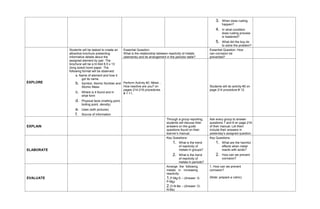
Students will be tasked to create an
attractive brochure presenting
informative details about the
assigned element by pair. The
brochure will be a tri-fold 8.5 x 13
(long sized) bond paper. The
following format will be observed:
a. Name of element and how it
got its name.
b. Symbol, Atomic Number and
Atomic Mass
c. Where is it found and in
what form
d. Physical facts (melting point,
boiling point, density)
e. Uses (with pictures)
f. Source of information
Essential Question:
What is the relationship between reactivity of metals
(elements) and its arrangement in the periodic table?
Essential Question: How
can corrosion be
prevented?
Perform Activity #2: Metal…
How reactive are you? on
pages 214-216 procedures
# 1-11.
Students will do activity #2 on
page 214 procedure # 12.
EXPLAIN
Through a group reporting,
students will discuss their
answers on the guide
questions found on their
learner’s manual.
Ask every group to answer
questions 7 and 8 on page 216
of their manual. Let them
include their answers in
yesterday’s assigned question.
ELABORATE
Key Questions:
1. What is the trend
of reactivity of
metals in groups?
2. What is the trend
of reactivity of
metals in periods?
Key Questions:
1. What are the harmful
effects when metal
reacts with acids?
2. How can we prevent
corrosion?
EVALUATE
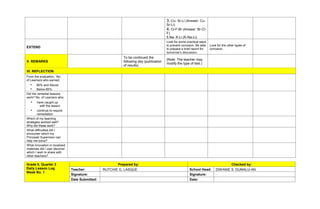
Arrange the following
metals in increasing
reactivity:
1.P-Mg-S – (Answer: S-
P-Mg)
2.O-N-Be – (Answer: O-
N-Be)
1. How can we prevent
corrosion?
(Note: prepare a rubric)
3. Cu- Sr-Li (Answer: Cu-
Sr-Li)
4. Cl-F-Br (Answer: Br-Cl-
F)
5.Na- K-Li (K-Na-Li)
EXTEND
Look for some practical ways
to prevent corrosion. Be able
to prepare a brief report for
tomorrow’s discussion.
Look for the other types of
corrosion.
V. REMARKS
To be continued the
following day (publication
of results)
(Note: The teacher may
modify the type of test.)
VI. REFLECTION
From the evaluation, No.
of Learners who earned:
• 80% and Above:
• Below 80%:
Did the remedial lessons
work? No. of Learners who:
• have caught up
with the lesson
• continue to require
remediation
Which of my teaching
strategies worked well?
Why did these work?
What difficulties did I
encounter which my
Principal/ Supervisor can
help me solve?
What innovation or localized
materials did I use/ discover
which I wish to share with
other teachers?
Grade 8, Quarter 3
Daily Lesson Log
Week No. 1
Prepared by: Checked by:
Teacher: RUTCHIE G. LASQUE School Head: DIWANIE S. DUMALU-AN
Signature: Signature:
Date Submitted: Date:

Science 8_3rd Q_DLL.docx

  • 1.
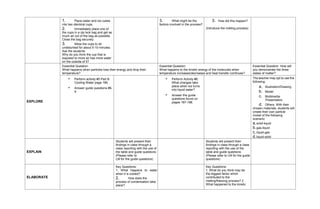
    Week No. 1MONDAY TUESDAY WEDNESDAY THURSDAY FRIDAY I. OBJECTIVES Content Standard The Learners demonstrate an understanding of: the particle nature of matter as basis for explaining properties, physical changes, and structure of substances and mixtures Performance Standard The Learners shall be able to: present how water behaves in its different states within the water cycle Learning Competency The Learners should be able to: explain the properties of solids, liquids, and gases based on the particle nature of matter; Code: S8MT-IIIa-b-8 DAILY TASK Diagnostic (module 1) Distinguish Matter from non-matter Explain that matter is made up of tiny particles II. CONTENT DIAGNOSTIC TEST Common properties of matter Composition of Matter III.LEARNING RESOURCES Teacher’s Guide Learner’s Materials Learners’ Module pp 172173 Learners’ Module pp 172173 Learners’ Module pp. 174177 Learners’ Module pp. 174177 Additional Materials www.factmonster.com IV. LEARNING TASKS ELICIT Show two pictures to the class (one matter and one non matter). (Example: nonmatter: picture of light from a torch, heat from the fire, sound from the police siren (forms of energy); Matter: picture of any solid, liquid or gaseous substance. Let the students cite the differences between the two and write them on the board. Show to the students a glass of water. Obtain ideas or concepts they have in mind regarding it. Let the students get a piece of paper. Ask them to tear the paper into small pieces until they won’t be able to tear it anymore. Find someone who had torn the smallest piece and present it to the class. Tell the students to look around and let one student mention one object to the class. ENGAGE Ask the students what could be the possible characteristics/ properties these pictures have. Explain that these objects do have properties and that is the objective of the lesson. (Prepare two identical cups and water) Show to the class one small drinking glass full of water and one empty. Get a volunteer and ask him to weigh the two. Get their opinion from the question: Is it possible to divide still the paper into the very smallest of it? Then, explain the concept of indivisibility of matter’s composition. Using the object presented, ask the student what are the materials that object is made up of. State: “Everything you see or imagine is built from something else.” Grade 8 Daily Lesson Log Junior HS Science School BOLHOON NATIONAL HIGH SCHOOL Grade Level 8 Teacher RUTCHIE G. LASQUE Learning Area Matter (Chemistry) Teaching Dates Quarter Third
  • 2.
    Ask the studentson what they observed with the two objects. (Students must infer that water has mass) This concept will be further discussed for today’s topic. EXPLORE Essential Question: What are the common properties of matter? Essential Question: What is matter made of? Students will be divided into groups of 5. With the use of materials found on the module, they should be able to fill in the table classifying if the sample is matter or not. (Activity #1: Which is matter, which is not?) Students will be divided into groups of 5. They will conduct an activity found on pages 174- 175 of the learners’ module. (Activity # 2: What is matter made of?) EXPLAIN Students will present their findings in class through a class reporting with the use of the table and guide questions. (Please refer to LM for the guide questions) Students will present their activity by answering the guide questions. (Please refer to LM for the guide questions) ELABORATE Key Questions: 1. What are the common properties of matter? 2. How does matter differ from nonmatter? 3. What are the other properties of matter? Key Questions: 1. What is matter made of? 2. What is the difference between molecules and atoms? 3. How can you say that matter is made up of small particles like atom? EVALUATE A. Classify whether the following is matter or nonmatter: 1. smoke (matter) 2. ocean (matter) 3. dreams (nonmatter) 4. chalk (matter) 5. shadow (nonmatter) B. Identify what property of matter is being described: _____1. It is the measure of the amount of matter the object has. (mass) _____2. It refers to the space occupied by an object. (volume) Identify the following 1. He believed that atoms are indivisible. 2. It is Greek word which means indivisible particle. 3. It is the smallest particle of an element. 4. It consists of two or more atoms. 5. It is the unit of length used to measure size of an atom.
  • 3.
    EXTEND Let the studentscheck the other properties of the following matter (hardness, texture, color, malleability, electrical conductivity) 1.silk cloth 2.plastic straw 3.copper wire • Tell the students to get an aluminum foil and cut it into small pieces. • In case it could not be cut anymore with their bare hands, use a microscope or magnifying glass to look at the tiniest piece. • If you have better tools, you could still cut the aluminum into tinier pieces. V. REMARKS To be continued the following day (publication of results) (Note: The teacher may modify the type of test.) To be continued the following day (publication of results) (Note: The teacher may modify the type of test.) VI. REFLECTION From the evaluation, No. of Learners who earned: • 80% and Above: • Below 80%: Did the remedial lessons work? No. of Learners who: • have caught up with the lesson • continue to require remediation Which of my teaching strategies worked well? Why did these work? What difficulties did I encounter which my Principal/ Supervisor can help me solve? What innovation or localized materials did I use/ discover which I wish to share with other teachers? Grade 8, Quarter 3 Daily Lesson Log Week No. 1 Prepared by: Checked by: Teacher: RUTCHIE G. LASQUE School Head: DIWANIE S. DUMALU-AN Signature: Signature: Date Submitted: Date:
  • 4.
    Week No. 2MONDAY TUESDAY WEDNESDAY THURSDAY FRIDAY I. OBJECTIVES Content Standard The Learners demonstrate an understanding of: the particle nature of matter as basis for explaining properties, physical changes, and structure of substances and mixtures Performance Standard The Learners shall be able to: present how water behaves in its different states within the water cycle Learning Competency The Learners should be able to: explain the properties of solids, liquids, and gases based on the particle nature of matter; The Learners should be able to: explain physical changes in terms of the arrangement and motion of atoms and molecules; Code: S8MT-IIIa-b-8 S8MT-IIIc-d-9 DAILY TASK Summative Test Infer that particles are moving Investigate about Evaporation II. CONTENT Properties of Matter, and Classifying matter and nonmatter Moving Particles Evaporation III. LEARNING RESOURCES Teacher’s Guide Learner’s Materials Learners’ Module pp 178182 Learners’ Module pp 178182 Learners’ Module pp 182-184 Learners’ Module pp 182-184 Additional Materials http://www.middleschoolch emistry.com/lessonplans/c hapter1/lesson1 Materials to be prepared by the teacher: wax paper, cardboard, printed “Race Drop Raceway” sheets/ may be drawn, water IV. LEARNING TASKS ELICIT Ask the question: Does matter attract each other? What are the different States of matter? Prepare two pieces of manila paper. Dampen the first one with water. Hang it on a side where there is enough air or sunlight to dry. Ask the students why clothes are usually hanged outside. Grade 8 Daily Lesson Log Junior HS Science School BOLHOON NATIONAL HIGH SCHOOL Grade Level 8 Teacher RUTCHIE G. LASQUE Learning Area Matter (Chemistry) Teaching Dates Quarter Third
  • 5.
    ENGAGE Let the studentsplay the game: Race Drop Raceway (adapted) Teacher Preparation Print two “Race Drop Raceway” sheets for each group. Procedure 1. Tape the Race Drop Raceway sheet onto a piece of cardboard to give it support. 2. Tape a piece of wax paper over the “Race Drop Raceway!” sheet. 3. Place 2–4 drops of water together to make one larger drop at the “Start”. 4. As fast as you can, tilt the cardboard and guide your race drop around the track to the “Finish”. 5. Try not to touch the edge of the track. The first to finish is the winner. Ask 5-6 volunteers to demonstrate how molecules behave in the following states of matter: • Solid • Liquid • Gas Ask the students the following questions: 1. At the end of class, do you think the paper towel will still be wet or will it be dry? 2. When water evaporates, where do the water molecules go? What would be the difference if clothes are hanged outside rather than inside the house? EXPLORE Essential Question: Are the particles moving? Essential Question: What happens when energy is added into the water? Perform by group Activity #3: Are the particles of matter moving? What is between them? pp 178179 of the manual. Perform Activity #4: What changes take place when water is left in an open container? In a closed container? Pp. 182-183 of the manual.
  • 6.
    EXPLAIN Students will presenttheir findings in class through a class reporting with the use of the table and guide questions. (Please refer to LM for the guide questions) Students will present their findings in class through a class reporting with the use of the table and guide questions. (Please refer to LM for the guide questions) ELABORATE Key Questions: 1. What is matter made of? 2. What can you say about its movement? 3. Describe the arrangement of particles of solid, liquid and gas. Key Questions: 1. What do you think may be the biggest factor which contributed to the evaporation process? 2. What happened to the kinetic energy of particles from liquid to gas/vapor? 3. How does evaporation take place? EVALUATE Identify what state of matter is being identified: WHO AM I? 1. I have a definite shape and a definite volume. 2. I may have a definite volume but I just follow the shape of my container. 3. There is very negligible attraction between me and others. True or False 1. Matter is composed of tiny particles that do not move. 2. The particles of matter have the tendency to attract each other. Identification: 1. It is the process where liquid turns to gas. 2. What happens to the kinetic energy of particles when the object evaporates? 3. Cite one example where evaporation could take place.
  • 7.
    EXTEND • Make aparticle model of matter on your own. • You may use any material to show your creativity. • This is to be done next Friday. Kindly bring all your chosen materials. • Conduct Activity #5A: Boiling Water on page 184-185 of the manual. • Differentiate Evaporation from Boiling V. REMARKS To be continued the following day (publication of results) (Note: The teacher may modify the type of test.) To be continued the following day (publication of results) (Note: The teacher may modify the type of test.) VI. REFLECTION From the evaluation, No. of Learners who earned: • 80% and Above: • Below 80%: Did the remedial lessons work? No. of Learners who: • have caught up with the lesson • continue to require remediation Which of my teaching strategies worked well? Why did these work? What difficulties did I encounter which my Principal/ Supervisor can help me solve? What innovation or localized materials did I use/ discover which I wish to share with other teachers? Grade 8, Quarter 3 Daily Lesson Log Week No. 1 Prepared by: Checked by: Teacher: RUTCHIE G. LASQUE School Head: DIWANIE S. DUMALU-AN Signature: Signature: Date Submitted: Date:
  • 8.
    Week No. 3MONDAY TUESDAY WEDNESDAY THURSDAY FRIDAY I. OBJECTIVES Content Standard The Learners demonstrate an understanding of: the particle nature of matter as basis for explaining properties, physical changes, and structure of substances and mixtures. Performance Standard The Learners shall be able to: present how water behaves in its different states within the water cycle. Learning Competency The Learners should be able to: explain physical changes in terms of the arrangement and motion of atoms and molecules. Code: S8MT-IIIc-d-9 DAILY TASK Investigate about Condensation Investigate about Melting Performance Task Make Model of the 3 States of Matter II. CONTENT Condensation Melting Performance Task III. LEARNING RESOURCES Teacher’s Guide Learner’s Materials Learners’ Module pp 184-186 Learners’ Module pp 184186 Learners’ Module pp 187189 Learners’ Module pp. 187189 Make a model of the 3 states of Matter Additional Materials www.middleschoolchemistry.com IV. LEARNING TASKS ELICIT Ask the students what happens when a cold bottle was taken from the fridge and left in an open space. Show a picture of water cycle. • Have the students imagine eating their own ice cream. For instance, they are eating outside under the scorching sun, how would they eat their ice cream? • Why is it so? Show a picture or a short video clip of the melting of polar regions. (The teacher may touch a little about the climate change.) ENGAGE (Adapted) Prepare a demonstration with the ff materials: (Note: Should be done 5- 10 minutes before the time) 2 clear plastic cups Room temperature water Ice cubes Zip lock (gallon size) Procedure: Ask the students how clouds form. Ask the following questions: 1. What will happen to the ice cream if it is not eaten immediately? Why? 2. In what situation will the ice cream melt faster? slower? Ask the following: 1. What have you noticed on the picture/ seen in the video? 2. What can you say about its effects in the environment? Grade 8 Daily Lesson Log Junior HS Science School BOLHOON NATIONAL HIGH SCHOOL Grade Level 8 Teacher RUTCHIE G. LASQUE Learning Area Matter (Chemistry) Teaching Dates Quarter Third
  • 9.
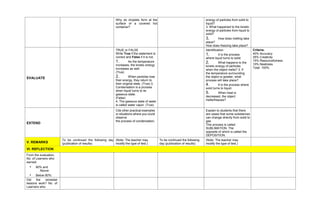
    1. Place waterand ice cubes into two identical cups. 2. Immediately place one of the cups in a zip lock bag and get as much air out of the bag as possible. Close the bag securely. 3. Allow the cups to sit undisturbed for about 5-10 minutes. Ask the students: Why do you think the cup that is exposed to more air has more water on the outside of it? 3. What might be the factors involved in the process? 3. How did this happen? (Introduce the melting process) EXPLORE Essential Question: What happens when particles lose their energy and drop their temperature? Essential Question: What happens to the kinetic energy of the molecules when temperature increases/decreases and heat transfer continues? Essential Question: How will you demonstrate the three states of matter? • Perform activity #5 Part B: Cooling Water page 186. • Answer guide questions #6- 9 • Perform Activity #6: What changes take place when ice turns into liquid water? • Answer the guide questions found on pages 187-188. The teacher may opt to use the following: a. Illustration/Drawing b. Model c. Multimedia Presentation d. Others. With their chosen materials, students will create their own particle model of the following scenario: a.solid-liquid b.gas-liquid c.liquid-gas d.liquid-solid EXPLAIN Students will present their findings in class through a class reporting with the use of the table and guide questions. (Please refer to LM for the guide questions) Students will present their findings in class through a class reporting with the use of the table and guide questions. (Please refer to LM for the guide questions) ELABORATE Key Questions: 1. What happens to water when it is cooled? 2. How does the process of condensation take place? Key Questions: 1. What do you think may be the biggest factor which contributed to the melting/freezing process? 2. What happened to the kinetic
  • 10.
    Why do dropletsform at the surface of a covered hot container? energy of particles from solid to liquid? 3. What happened to the kinetic energy of particles from liquid to solid? 3. How does melting take place? How does freezing take place? EVALUATE TRUE or FALSE Write True if the statement is correct and False if it is not. 1. As the temperature increases, the kinetic energy increases as well. (True) 2. When particles lose their energy, they return to their original state. (True) 3. Condensation is a process when liquid turns to its gaseous state. (False) 4. The gaseous state of water is called water vapor. (True) Identification: 1. It is the process where liquid turns to solid. 2. What happens to the kinetic energy of particles when the object melts? 3. If the temperature surrounding the object is greater, what process will take place? 4. It is the process where solid turns to liquid. 5. When heat is decreased, the object melts/freezes? Criteria: 40% Accuracy 35% Creativity 15% Resourcefulness 10% Neatness Total: 100% EXTEND Cite other practical examples or situations where you could observe the process of condensation. Explain to students that there are cases that some substances can change directly from solid to gas. This process is called SUBLIMATION. The opposite of which is called the DEPOSITION. V. REMARKS To be continued the following day (publication of results) (Note: The teacher may modify the type of test.) To be continued the following day (publication of results) (Note: The teacher may modify the type of test.) VI. REFLECTION From the evaluation, No. of Learners who earned: • 80% and Above: • Below 80%: Did the remedial lessons work? No. of Learners who:
  • 11.
    • have caught upwith the lesson • continue to require remediation Which of my teaching strategies worked well? Why did these work? What difficulties did I encounter which my Principal/ Supervisor can help me solve? What innovation or localized materials did I use/ discover which I wish to share with other teachers? Grade 8, Quarter 3 Daily Lesson Log Week No. 1 Prepared by: Checked by: Teacher: RUTCHIE G. LASQUE School Head: DIWANIE S. DUMALU-AN Signature: Signature: Date Submitted: Date:
  • 12.
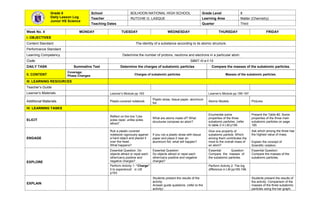
    Week No. 4MONDAY TUESDAY WEDNESDAY THURSDAY FRIDAY I. OBJECTIVES Content Standard The identity of a substance according to its atomic structure. Performance Standard Learning Competency Determine the number of protons, neutrons and electrons in a particular atom. Code: S8MT-III e-f-10 DAILY TASK Summative Test Determine the charges of subatomic particles Compare the masses of the subatomic particles. II. CONTENT Coverage: Phase Changes Charges of subatomic particles Masses of the subatomic particles. III. LEARNING RESOURCES Teacher’s Guide Learner’s Materials Learner’s Module pp 193 Learner’s Module pp 195-197 Additional Materials Plastic-covered notebook Plastic straw, tissue paper, aluminum foil Atomic Models Pictures IV. LEARNING TASKS ELICIT Reflect on the line “Like poles repel, unlike poles attract”. What are atoms made of? What structures compose an atom? Enumerate some properties of the three subatomic particles. (refer to table 2 in LM p195. Present the Table #2: Some properties of the three main subatomic particles on page 195 ENGAGE Rub a plastic covered notebook vigorously against a hard object and placed it over the head. What happens? If you rub a plastic straw with tissue paper and place it near an aluminum foil, what will happen? Give one property of subatomic particle. Which among them contributes the most to the overall mass of an atom? Ask which among the three has the highest value of mass. Explain the concept of Scientific notation. EXPLORE Essential Question: Do objects attract or repel each other/carry positive and negative charges? Essential Question: Do objects attract or repel each other/carry positive and negative charges? Essential Question: Compare the masses of the subatomic particles. Essential Question: Compare the masses of the subatomic particles. Perform Activity 1: “Charge” it to experience! in LM p193. Perform Activity 2: The big difference in LM pp195-196. EXPLAIN Students present the results of the activity. Answer guide questions. (refer to the activity) Students present the results of the activity. Comparison of the masses of the three subatomic particles using the bar graph, Grade 8 Daily Lesson Log Junior HS Science School BOLHOON NATIONAL HIGH SCHOOL Grade Level 8 Teacher RUTCHIE G. LASQUE Learning Area Matter (Chemistry) Teaching Dates Quarter Third
  • 13.
    pie chart anda seesaw can. Answer guide questions. (refer to the activity). ELABORATE • Ask students what makes up an atom? • Give the charges of the three subatomic particles. Which subatomic particle/s make/s up most of the mass of the atom? EVALUATE Complete the table. Subatomic Particle Charge Location 1. positive 4. electron 2. 5. 3. neutral 6. Refer to the masses in table 2. Answer the following questions. 1.Which subatomic particle is the lightest? 2.Which subatomic particle is the heaviest? 3. Which subatomic particle has almost the same mass? 4- 5. Which subatomic particles make up most of the mass of the atom. EXTEND Present Table 2. Some Properties of the three subatomic particles. pp195 Research on Thomson’s and Rutherford model of the atom. V. REMARKS To be continued the following day (publication of results) (Note: The teacher may modify the type of test.) To be continued the following day (publication of results) (Note: The teacher may modify the type of test.) VI. REFLECTION From the evaluation, No. of Learners who earned: • 80% and Above: • Below 80%: Did the remedial lessons work? No. of Learners who: • have caught up with the less • continue to require remediation Which of my teaching strategies worked well? Why did these work?
  • 14.
    What difficulties didI encounter which my Principal/ Supervisor can help me solve? What innovation or localized materials did I use/ discover which I wish to share with other teachers? Grade 8, Quarter 3 Daily Lesson Log Week No. 1 Prepared by: Checked by: Teacher: RUTCHIE G. LASQUE School Head: DIWANIE S. DUMALU-AN Signature: Signature: Date Submitted: Date:
  • 15.
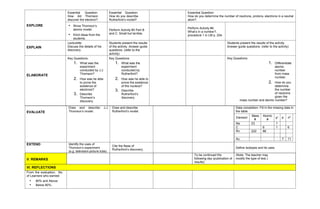
    Week No. 5MONDAY TUESDAY WEDNESDAY THURSDAY FRIDAY I. OBJECTIVES Content Standard The identity of a substance according to its atomic structure. Performance Standard Learning Competency Determine the number of protons, neutrons and electrons in a particular atom Code: S8MT-III e-f-10 DAILY TASK Describe Thomson’s model Describe Rutherford’s model. Summative Test Determine the number of neutrons from the mass number. II. CONTENT Thomson’s model Rutherford’s model. Subatomic Particles and Molecular Models Determining the number of neutrons from the mass number. III. LEARNING RESOURCES Teacher’s Guide Teacher’s Manual Teacher’s Manual Learner’s Materials Learner’s Manual pp 198-203 Learner’s Manual pp 198-203 pp 193 Learner’s Manual pp 203-205 Learner’s Manual pp 203-205 pp 195-197 Additional Materials Exemplar Lesson Plan pp138-140 Exemplar Lesson Plan, Periodic Table ,pen/pencil Exemplar Lesson Plan, Periodic Table ,pen/pencil IV. LEARNING TASKS ELICIT What is an atom? What are the different subatomic particles of an atom? Review: Thomson’s atomic model. Show a periodic Table. Ask students about the salient features of the Periodic Table. What makes up the mass of an atom? ENGAGE Show to the class a real raisin bread. Guide Questions: 1. What is the name of this bread? 2. What is in this bread that is not found in other breads? (The teacher may opt to use a picture instead.) Teacher demonstration: Activity #3 Part A • Look for a volunteer. • Ask few questions. GAME: Group the students and ask a representative to answer the question by writing the answer on the board. • The teacher gives the name of the element. • Students write its symbol, atomic number and mass number. Ask one student to draw an atom having three subatomic particles. Grade 8 Daily Lesson Log Junior HS Science School BOLHOON NATIONAL HIGH SCHOOL Grade Level 8 Teacher RUTCHIE G. LASQUE Learning Area Matter (Chemistry) Teaching Dates Quarter Third
  • 16.
    EXPLORE Essential Question: How didThomson discover the electron? Essential Question: How do you describe Rutherford’s model? Essential Question: How do you determine the number of neutrons, protons, electrons in a neutral atom? • Show Thomson’s atomic model. • Elicit ideas from the students. Perform Activity #3 Part B and C: Small but terrible. Perform Activity #4: What’s in a number?, procedure 1 in LM p. 204. EXPLAIN Lecturette: Discuss the details of his discovery. Students present the results of the activity. Answer guide questions. (refer to the activity) Students present the results of the activity. Answer guide questions. (refer to the activity) ELABORATE Key Questions: 1. What was the experiment conducted by J.J. Thomson? 2. How was he able to prove the existence of electrons? 3. Describe Thomson’s discovery. Key Questions: 1. What was the experiment conducted by Rutherford? 2. How was he able to prove the existence of the nucleus? 3. Describe Rutherford’s discovery. Key Questions: 1. Differentiate atomic number from mass number. 2. How do you determine the number of neutrons given the mass number and atomic number? EVALUATE Draw and describe J.J. Thomson’s model. Draw and describe Rutherford’s model. Data completion: Fill in the missing data in the table. Element Mass # Atomic # p+ e- n0 Na 23 1 C 6 1 6 Rn 222 86 Au 7 11 EXTEND Identify the uses of Thomson’s experiment. (e.g. television-picture tube) Cite the flaws of Rutherford’s discovery. Define Isotopes and its uses. V. REMARKS To be continued the following day (publication of results) (Note: The teacher may modify the type of test.) VI. REFLECTIONS From the evaluation, No. of Learners who earned: • 80% and Above: • Below 80%:
  • 17.
    Did the remediallessons work? No. of Learners who: • have caught up with the lesson • continue to require remediation Which of my teaching strategies worked well? Why did these work? What difficulties did I encounter which my Principal/ Supervisor can help me solve? What innovation or localized materials did I use/ discover which I wish to share with other teachers? Grade 8, Quarter 3 Daily Lesson Log Week No. 1 Prepared by: Checked by: Teacher: RUTCHIE G. LASQUE School Head: DIWANIE S. DUMALU-AN Signature: Signature: Date Submitted: Date:
  • 18.
    Week No. 6MONDAY TUESDAY WEDNESDAY THURSDAY FRIDAY I. OBJECTIVES Content Standard The identity of a substance according to its atomic structure. Performance Standard Learning Competency Determine the number of protons, neutrons and electrons in a particular atom Code: S8MT-III e-f-10 DAILY TASK Define Isotopes and interpret shorthand notations for isotopes and atoms. Infer that ions are formed from the removal/addition of electrons. Performance Task Summative Test II. CONTENT 1.Definition of Isotopes 2.Shorthand notations for Isotopes and atoms Ions Role play- Atomic Models, and Timeline of atomic models using recycled materials Determining the # of protons, electrons, neutrons, Isotopes, and Ions. III. LEARNING RESOURCES Teacher’s Guide Teacher’s Manual Learner’s Materials Learner’s Manual pp 204205 Learner’s Manual pp 204205 Additional Materials Periodic Table IV. LEARNING TASKS ELICIT Q & A: Sub-atomic Particles How are isotopes identified? Review: 1.Definition of Isotopes 2.Shorthand notations for Isotopes and atoms ENGAGE Ask: What comes into your mind when you hear the word isotope? Give common isotopes. Cite examples of energy drinks. Guide Questions: 1. Why are they popular nowadays? 2. What benefit can one get from drinking such? Essential Question: What is an isotope? How do you interpret shorthand notation of isotopes and atoms? Essential Question: How does an atom become an ion? Grade 8 Daily Lesson Log Junior HS Science School BOLHOON NATIONAL HIGH SCHOOL Grade Level 8 Teacher RUTCHIE G. LASQUE Learning Area Matter (Chemistry) Teaching Dates Quarter Third
  • 19.
    EXPLORE Perform Activity#4: What’sin a number? Procedures 2 and 3 on page 204. Perform Activity#4: What’s in a number? Procedures 4 and 5 on page 205. EXPLAIN • Students present the results of the activity. • Answer guide questions. (refer to the activity) • Lecturette on isotopes Students present the results of the activity. Answer guide questions. (refer to the activity) ELABORATE Give the shorthand notation of isotope of Hydrogen. Key Questions: 1. How does an ion form? 2. What do you call the positive ion? Negative ion? 3. What will happen when an atom becomes an ion? EVALUATE Write the shorthand notation showing the mass number and atomic number of the isotopes of the following: 1. Iron 2. Aluminum 3. Calcium Given the Calcium ion, answer the following: 1. How many protons are there in the calcium ion? 2. How many electrons are there in the calcium ion? 3. How many neutrons are there in the calcium ion? EXTEND Using old folders, students select one element to be drawn with symbol, atomic number and mass number. What is the importance of ions in the human body? V. REMARKS To be continued the following day (publication of results) (Note: The teacher may modify the type of test.) VI. REFLECTION From the evaluation, No. of Learners who earned: • 80% and Above: • Below 80%:
  • 20.
    Did the remediallessons work? No. of Learners who: • have caught up with the lesson • continue to require remediation Which of my teaching strategies worked well? Why did these work? What difficulties did I encounter which my Principal/ Supervisor can help me solve? What innovation or localized materials did I use/ discover which I wish to share with other teachers? Grade 8, Quarter 3 Daily Lesson Log Week No. 1 Prepared by: Checked by: Teacher: RUTCHIE G. LASQUE School Head: DIWANIE S. DUMALU-AN Signature: Signature: Date Submitted: Date:
  • 21.
    Week No. 7MONDAY TUESDAY WEDNESDAY THURSDAY FRIDAY I. OBJECTIVES Content Standard The Learners demonstrate an understanding of: the periodic table of elements as an organizing tool to determine the chemical properties of elements. Performance Standard Learning Competency The Learners should be able to: trace the development of the periodic table from observations based on similarities in properties of elements. Code: S8MT-IIIg-h-11 DAILY TASK Trace the development of the Periodic Table Describe the arrangement of elements in the periodic table Summative Test on Periodic Table II. CONTENT Development of the Periodic Table Arrangement of elements in the Periodic Table III. LEARNING RESOURCES Teacher’s Guide Learner’s Materials Learners’ Module pp 210-211 Learners’ Module pp 210-211 Learners’ Module pp 211-213 Learners’ Module pp 211-213 Additional Materials Periodic table of elements https://www.youtube.com/wat ch?v=I5H1SeepnaU https://www.youtube.com/watc h?v=VgVQKCcfwnU IV. LEARNING TASKS ELICIT In Grade 7, students learned about the periodic table. Let them recall some common elements found in the periodic table. Show to the class a video from YouTube entitled: History of Periodic Table Animation (cite provided in Learning Resources under additional materials) Using the periodic table, The teacher will mention an element (e.g. Calcium). Let them look in what column and row it is located or you may do otherwise (students will look for the name, teacher will mention the row and column) Let the students watch the video The NEW Periodic Table Song (Updated) on YouTube. (cite provided in Learning Resources under additional materials) ENGAGE Ask: How was your seating arrangement done? (possible answers: alphabetically, height, gender) Who were the people mentioned in the video? (Write their answers on the board for later discussion) Let the students take hold of their periodic table and ask them of the possible ways how those elements were arranged. Were they arranged alphabetically? randomly? Or other possible arrangements? After watching, let them cite some names of elements they have seen and where they can commonly be found or used. Example: Silver-spoon Essential Question: How did the periodic table develop? Essential Question: How were the elements in the periodic table arranged? Grade 8 Daily Lesson Log Junior HS Science School BOLHOON NATIONAL HIGH SCHOOL Grade Level 8 Teacher RUTCHIE G. LASQUE Learning Area Matter (Chemistry) Teaching Dates Quarter Third
  • 22.
    EXPLORE Perform Activity #1part A: Tracking the path and constructing the Periodic Table on pages 210-211 of their textbook. Continue Activity #1 Part B. Tracking the path and constructing the Periodic Table on page 211 of the learner’s manual. EXPLAIN With the use of the guide questions, students will report their answers in front. (Questions #1-4) With the use of the guide questions, students will report their answers in front. (Questions #5-10) ELABORATE Key Questions: 1. Who were the people behind the history of periodic table? And what was their respective concept? 2. What bases did the following chemists use to explain their arrangement of elements? a. Dobereiner b. Newlands c. Meyer d. Mendeleev e. Moseley Key Questions: 1. What is periodic law? 2. Differentiate groups from periods. 3. What are the different family names of groups found in the periodic table? EVALUATE Identification 1. He is a German chemist who grouped elements in three with similar properties. 2. This arrangement was proposed by Newlands. 3. How did Mendeleev arrange the elements in the periodic table? I. Identify in what period and group does the following element belong: 1. Boron 2. Calcium 3. Neon 4. Hydrogen 5. Potassium II. Identify and label the parts of the periodic table. EXTEND Trace the development of the Periodic Table by making a timeline. Write it in a short sized bond paper. For the next session, tell the students to bring the following materials for their Performance output: a. Bond paper (long sized) b. Coloring materials c. Designing materials d. Ruler e. Glue
  • 23.
    • Assign thisactivity by pair. • Ask the students to do some research about the following information of the assigned element: a. Name of element and how it got its name. b. Symbol, Atomic Number and Atomic Mass c. Where is it found and in what form d. Physical facts (melting point, boiling point, density) e. Uses (with pictures) f. Source of information V. REMARKS To be continued the following day (publication of results) (Note: The teacher may modify the type of test.) To be continued the following day (publication of results) (Note: The teacher may modify the type of test.) VI. REFLECTION From the evaluation, No. of Learners who earned: • 80% and Above: • Below 80%: Did the remedial lessons work? No. of Learners who: • have caught up with the lesson • continue to require remediation Which of my teaching strategies worked well? Why did these work? What difficulties did I encounter which my Principal/ Supervisor can help me solve? What innovation or localized materials did I use/ discover which I wish to share with other teachers?
  • 24.
    Week No. 8MONDAY TUESDAY WEDNESDAY THURSDAY FRIDAY I. OBJECTIVES Content Standard The Learners demonstrate an understanding of: the periodic table of elements as an organizing tool to determine the chemical properties of elements Performance Standard Learning Competency The Learners should be able to: trace the development of the periodic table from observations based on similarities in properties of elements The Learners should be able to: use the periodic table to predict the chemical behavior of an element. Code: S8MT-IIIa-b-8 S8MT-IIIc-d-9 DAILY TASK Make an Element Brochure Compare the reactivity of metals in acid solution Identify ways of preventing corrosion due to the reactivity of metals Summative test on Reactivity of Metals II. CONTENT Performance Task (Element Brochure) Reactivity of Metals Ways to prevent corrosion of metals Summative Test III. LEARNING RESOURCES Teacher’s Guide Learner’s Materials Learners’ Module pp 214217 Learners’ Module pp 214217 Learners’ Module pp 214217 Additional Materials www.nclark.net https://www.youtube.com/w atch?v=qd2B9yCKzc0 IV. LEARNING TASKS ELICIT Show pictures of objects with rust. (Houses, cars, etc.) Show a video entitled: Rusting of Iron in YouTube. (cite provided in Learning Resources under additional materials) ENGAGE Ask the students how rusting of objects affect people. You may ask the following questions: (to be posted before watching the video) 1. What is rust? 2. What are the factors involved for rusting to occur? Grade 8 Daily Lesson Log Junior HS Science School BOLHOON NATIONAL HIGH SCHOOL Grade Level 8 Teacher RUTCHIE G. LASQUE Learning Area Matter (Chemistry) Teaching Dates Quarter Third
  • 25.
    3. When doesrusting happen? 4. In what condition does rusting process is hastened? 5. What did the boy do to solve the problem? EXPLORE Students will be tasked to create an attractive brochure presenting informative details about the assigned element by pair. The brochure will be a tri-fold 8.5 x 13 (long sized) bond paper. The following format will be observed: a. Name of element and how it got its name. b. Symbol, Atomic Number and Atomic Mass c. Where is it found and in what form d. Physical facts (melting point, boiling point, density) e. Uses (with pictures) f. Source of information Essential Question: What is the relationship between reactivity of metals (elements) and its arrangement in the periodic table? Essential Question: How can corrosion be prevented? Perform Activity #2: Metal… How reactive are you? on pages 214-216 procedures # 1-11. Students will do activity #2 on page 214 procedure # 12. EXPLAIN Through a group reporting, students will discuss their answers on the guide questions found on their learner’s manual. Ask every group to answer questions 7 and 8 on page 216 of their manual. Let them include their answers in yesterday’s assigned question. ELABORATE Key Questions: 1. What is the trend of reactivity of metals in groups? 2. What is the trend of reactivity of metals in periods? Key Questions: 1. What are the harmful effects when metal reacts with acids? 2. How can we prevent corrosion? EVALUATE Arrange the following metals in increasing reactivity: 1.P-Mg-S – (Answer: S- P-Mg) 2.O-N-Be – (Answer: O- N-Be) 1. How can we prevent corrosion? (Note: prepare a rubric)
  • 26.
    3. Cu- Sr-Li(Answer: Cu- Sr-Li) 4. Cl-F-Br (Answer: Br-Cl- F) 5.Na- K-Li (K-Na-Li) EXTEND Look for some practical ways to prevent corrosion. Be able to prepare a brief report for tomorrow’s discussion. Look for the other types of corrosion. V. REMARKS To be continued the following day (publication of results) (Note: The teacher may modify the type of test.) VI. REFLECTION From the evaluation, No. of Learners who earned: • 80% and Above: • Below 80%: Did the remedial lessons work? No. of Learners who: • have caught up with the lesson • continue to require remediation Which of my teaching strategies worked well? Why did these work? What difficulties did I encounter which my Principal/ Supervisor can help me solve? What innovation or localized materials did I use/ discover which I wish to share with other teachers? Grade 8, Quarter 3 Daily Lesson Log Week No. 1 Prepared by: Checked by: Teacher: RUTCHIE G. LASQUE School Head: DIWANIE S. DUMALU-AN Signature: Signature: Date Submitted: Date: