Mixed Methods
Research Design
by
Siti Nabilah Abu Hurairah
2017577527
What is mixed methods and why?
 A procedure for collecting, analysing, and “mixing” both quantitative and qualitative
methods in a single study or a series of studies to understand a research problem
(Creswell & Plano Clark, 2011).
 Used MMR when:
a. When we have both qualitative & quantitative data.
b. When one type of research design is not sufficient to answer or explain the RQs.
c. When you need qualitative research to help explain quantitative findings.
d. When you want to obtain more detailed, specific information than can be gained
from the results of statistical tests.
e. When you want to provide an alternative perspective in a study.
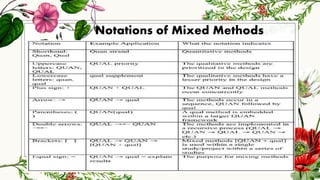
Notations of Mixed Methods
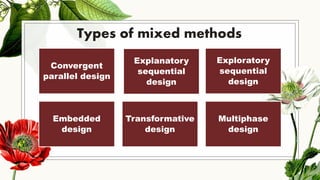
Types of mixed methods
Convergent
parallel design
Explanatory
sequential
design
Exploratory
sequential
design
Embedded
design
Transformative
design
Multiphase
design
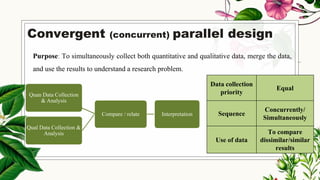
Purpose: To simultaneously collect both quantitative and qualitative data, merge the data,
and use the results to understand a research problem.
Convergent (concurrent) parallel design
Quan Data Collection
& Analysis
Qual Data Collection &
Analysis
Compare / relate Interpretation
Data collection
priority
Equal
Sequence
Concurrently/
Simultaneously
Use of data
To compare
dissimilar/similar
results
The Explanatory Sequential Design
(two phase model)
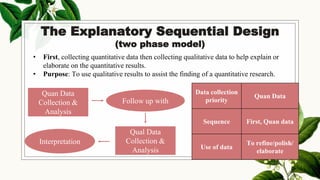
• First, collecting quantitative data then collecting qualitative data to help explain or
elaborate on the quantitative results.
• Purpose: To use qualitative results to assist the finding of a quantitative research.
Quan Data
Collection &
Analysis
Qual Data
Collection &
Analysis
Follow up with
Interpretation
Data collection
priority
Quan Data
Sequence First, Quan data
Use of data
To refine/polish/
elaborate
The Exploratory Sequential Design
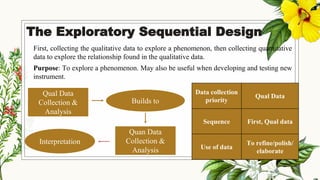
First, collecting the qualitative data to explore a phenomenon, then collecting quantitative
data to explore the relationship found in the qualitative data.
Purpose: To explore a phenomenon. May also be useful when developing and testing new
instrument.
Qual Data
Collection &
Analysis
Quan Data
Collection &
Analysis
Builds to
Interpretation
Data collection
priority
Qual Data
Sequence First, Qual data
Use of data
To refine/polish/
elaborate
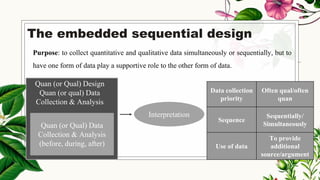
Purpose: to collect quantitative and qualitative data simultaneously or sequentially, but to
have one form of data play a supportive role to the other form of data.
The embedded sequential design
Data collection
priority
Often qual/often
quan
Sequence
Sequentially/
Simultaneously
Use of data
To provide
additional
source/argument
Quan (or Qual) Data
Collection & Analysis
(before, during, after)
Quan (or Qual) Design
Quan (or qual) Data
Collection & Analysis
Interpretation
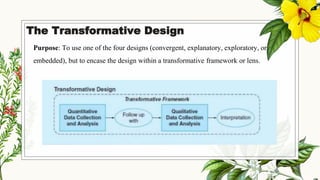
The Transformative Design
Purpose: To use one of the four designs (convergent, explanatory, exploratory, or
embedded), but to encase the design within a transformative framework or lens.
The Multiphase Design
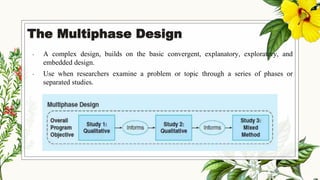
• A complex design, builds on the basic convergent, explanatory, exploratory, and
embedded design.
• Use when researchers examine a problem or topic through a series of phases or
separated studies.
Basic characteristics of MM
• Provide the rationale for the design.
• Include collecting qualitative and quantitative data.
• Consider priority.
• Consider sequence.
• Match the data analysis to a design.
• Diagram the procedures.
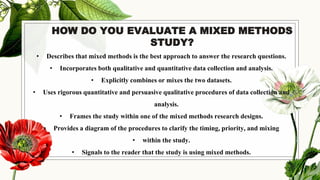
HOW DO YOU EVALUATE A MIXED METHODS
STUDY?
• Describes that mixed methods is the best approach to answer the research questions.
• Incorporates both qualitative and quantitative data collection and analysis.
• Explicitly combines or mixes the two datasets.
• Uses rigorous quantitative and persuasive qualitative procedures of data collection and
analysis.
• Frames the study within one of the mixed methods research designs.
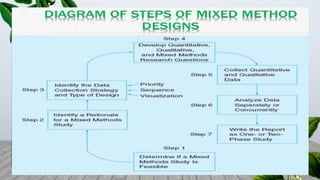
• Provides a diagram of the procedures to clarify the timing, priority, and mixing
• within the study.
• Signals to the reader that the study is using mixed methods.
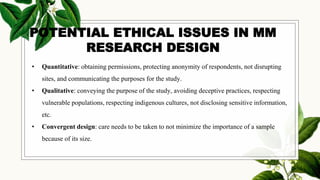
POTENTIAL ETHICAL ISSUES IN MM
RESEARCH DESIGN
• Quantitative: obtaining permissions, protecting anonymity of respondents, not disrupting
sites, and communicating the purposes for the study.
• Qualitative: conveying the purpose of the study, avoiding deceptive practices, respecting
vulnerable populations, respecting indigenous cultures, not disclosing sensitive information,
etc.
• Convergent design: care needs to be taken to not minimize the importance of a sample
because of its size.
• Explanatory design: in order to follow up on those individuals with qualitative interviews,
there needs to be an identifier linked to the quantitative database; do not use names with
permission.
• Embedded design: do not use the initial interview data to place participants into a control
group where they do not receive a beneficial treatment.

Mixed Methods Research Design

  • 1.
    Mixed Methods Research Design by SitiNabilah Abu Hurairah 2017577527
  • 2.
    What is mixedmethods and why?  A procedure for collecting, analysing, and “mixing” both quantitative and qualitative methods in a single study or a series of studies to understand a research problem (Creswell & Plano Clark, 2011).  Used MMR when: a. When we have both qualitative & quantitative data. b. When one type of research design is not sufficient to answer or explain the RQs. c. When you need qualitative research to help explain quantitative findings. d. When you want to obtain more detailed, specific information than can be gained from the results of statistical tests. e. When you want to provide an alternative perspective in a study.
  • 3.
  • 4.
    Types of mixedmethods Convergent parallel design Explanatory sequential design Exploratory sequential design Embedded design Transformative design Multiphase design
  • 5.
    Purpose: To simultaneouslycollect both quantitative and qualitative data, merge the data, and use the results to understand a research problem. Convergent (concurrent) parallel design Quan Data Collection & Analysis Qual Data Collection & Analysis Compare / relate Interpretation Data collection priority Equal Sequence Concurrently/ Simultaneously Use of data To compare dissimilar/similar results
  • 6.
    The Explanatory SequentialDesign (two phase model) • First, collecting quantitative data then collecting qualitative data to help explain or elaborate on the quantitative results. • Purpose: To use qualitative results to assist the finding of a quantitative research. Quan Data Collection & Analysis Qual Data Collection & Analysis Follow up with Interpretation Data collection priority Quan Data Sequence First, Quan data Use of data To refine/polish/ elaborate
  • 7.
    The Exploratory SequentialDesign First, collecting the qualitative data to explore a phenomenon, then collecting quantitative data to explore the relationship found in the qualitative data. Purpose: To explore a phenomenon. May also be useful when developing and testing new instrument. Qual Data Collection & Analysis Quan Data Collection & Analysis Builds to Interpretation Data collection priority Qual Data Sequence First, Qual data Use of data To refine/polish/ elaborate
  • 8.
    Purpose: to collectquantitative and qualitative data simultaneously or sequentially, but to have one form of data play a supportive role to the other form of data. The embedded sequential design Data collection priority Often qual/often quan Sequence Sequentially/ Simultaneously Use of data To provide additional source/argument Quan (or Qual) Data Collection & Analysis (before, during, after) Quan (or Qual) Design Quan (or qual) Data Collection & Analysis Interpretation
  • 9.
    The Transformative Design Purpose:To use one of the four designs (convergent, explanatory, exploratory, or embedded), but to encase the design within a transformative framework or lens.
  • 10.
    The Multiphase Design •A complex design, builds on the basic convergent, explanatory, exploratory, and embedded design. • Use when researchers examine a problem or topic through a series of phases or separated studies.
  • 11.
    Basic characteristics ofMM • Provide the rationale for the design. • Include collecting qualitative and quantitative data. • Consider priority. • Consider sequence. • Match the data analysis to a design. • Diagram the procedures.
  • 13.
    HOW DO YOUEVALUATE A MIXED METHODS STUDY? • Describes that mixed methods is the best approach to answer the research questions. • Incorporates both qualitative and quantitative data collection and analysis. • Explicitly combines or mixes the two datasets. • Uses rigorous quantitative and persuasive qualitative procedures of data collection and analysis. • Frames the study within one of the mixed methods research designs. • Provides a diagram of the procedures to clarify the timing, priority, and mixing • within the study. • Signals to the reader that the study is using mixed methods.
  • 14.
    POTENTIAL ETHICAL ISSUESIN MM RESEARCH DESIGN • Quantitative: obtaining permissions, protecting anonymity of respondents, not disrupting sites, and communicating the purposes for the study. • Qualitative: conveying the purpose of the study, avoiding deceptive practices, respecting vulnerable populations, respecting indigenous cultures, not disclosing sensitive information, etc. • Convergent design: care needs to be taken to not minimize the importance of a sample because of its size.
  • 15.
    • Explanatory design:in order to follow up on those individuals with qualitative interviews, there needs to be an identifier linked to the quantitative database; do not use names with permission. • Embedded design: do not use the initial interview data to place participants into a control group where they do not receive a beneficial treatment.