PROBABILISTIC &
NONPROBABILISTIC
(PURPOSEFUL)
SAMPLING
SITI MARDHIAH BINTI AZMIR
2017987099
Outlines
• Sample definition
• Types of sampling in quantitative researches
• Types of sampling in qualitative researches
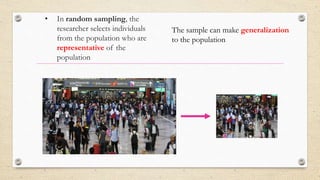
• In random sampling, the
researcher selects individuals
from the population who are
representative of the
population
The sample can make generalization
to the population
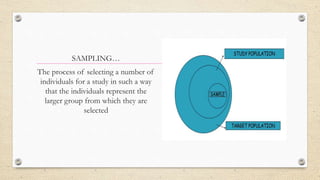
SAMPLING…
The process of selecting a number of
individuals for a study in such a way
that the individuals represent the
larger group from which they are
selected
Quantitative Sampling
• Purpose – to identify participants from whom to seek some information
• Issues
- Nature of the sample (random samples)
- Size of the sample
- Method of selecting the sample
Quantitative Sampling
Important Issues
 Representation – the extent to which the sample is representative of the population
 Generalization – the extent to which the results of the study can be reasonably
extended from the sample to the population
 Sampling error
The chance occurrence that a randomly selected sample is not representative of
the population due to errors inherent in the sampling technique.
• Sampling bias
Selecting Random Samples
• Known as probability sampling
• Best method to achieve a representative sample
• Four technique
1. Random Sampling
2. Systematic Sampling
3. Stratified Random Sampling
4. Cluster Sampling
1. Simple Random Sampling
• Selecting subjects so that all members of a population have an equal and
independent chance of being selected
Advantages
1. Easy to conduct
2 High probability of achieving a representative sample
3 Meets assumptions of many statistical procedures
Disadvantages
1. Identification of all members of the population can be difficult
2. Contacting all members of the sample can be difficult
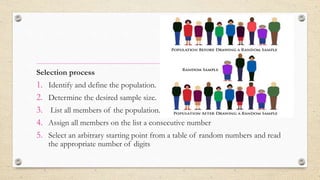
Selection process
1. Identify and define the population.
2. Determine the desired sample size.
3. List all members of the population.
4. Assign all members on the list a consecutive number
5. Select an arbitrary starting point from a table of random numbers and read
the appropriate number of digits
2. Systematic Sampling
• Researcher choose every nth
individual in the population until
reached the desired sample size.
• May not be as precise but more
convenient as the people do not
have to be numbered and does
not require a random number
tables.
Advantage
-Very easily done
Disadvantages
- subgroups
- some members of the
population don’t have an equal
chance of being included
Cont..
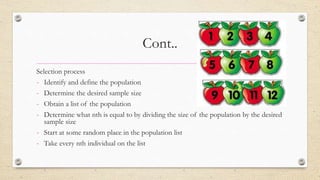
Selection process
- Identify and define the population
- Determine the desired sample size
- Obtain a list of the population
- Determine what nth is equal to by dividing the size of the population by the desired
sample size
- Start at some random place in the population list
- Take every nth individual on the list
3. Stratified Sampling
• The population is divided into two
or more groups called strata,
according to some criterion, such as
geographic location, grade level, age,
or income, and subsamples are
randomly selected from each strata.
Advantages
- More accurate sample
- Can be used for both proportional and
nonproportional samples
- Representation of subgroups in the
sample
Disadvantages
- Identification of all members of the
population can be difficult
- Identifying members of all subgroups
can be difficult
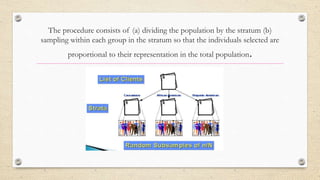
The procedure consists of (a) dividing the population by the stratum (b)
sampling within each group in the stratum so that the individuals selected are
proportional to their representation in the total population.
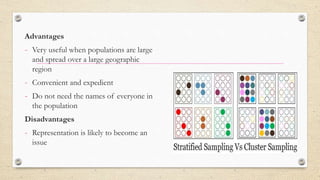
4. Cluster Sampling
• The process of randomly selecting intact groups, not individuals, within the
defined population sharing similar characteristics
- Clusters are locations within which an intact group of members of the
population can be found
- Examples : Neighbourhood, School districts, Schools, Classrooms
Advantages
- Very useful when populations are large
and spread over a large geographic
region
- Convenient and expedient
- Do not need the names of everyone in
the population
Disadvantages
- Representation is likely to become an
issue
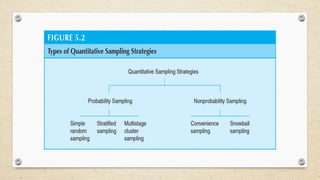
Non-probability Samples
• Researcher selects individuals because they are available, convenient, and
represent some characteristics the investigator seeks to study.
1. Convenience Sampling
2. Snowball Sampling
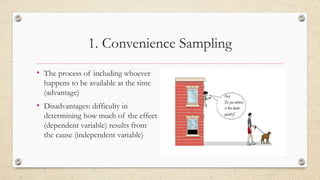
1. Convenience Sampling
• The process of including whoever
happens to be available at the time
(advantage)
• Disadvantages: difficulty in
determining how much of the effect
(dependent variable) results from
the cause (independent variable)
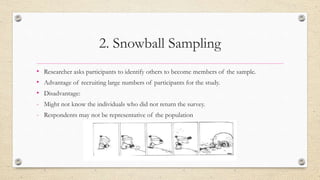
2. Snowball Sampling
• Researcher asks participants to identify others to become members of the sample.
• Advantage of recruiting large numbers of participants for the study.
• Disadvantage:
- Might not know the individuals who did not return the survey.
- Respondents may not be representative of the population
SAMPLING IN QUALITATIVE RESEARCH
• Researchers in qualitative research select their participants according to their :
• 1) characteristics
• 2) knowledge
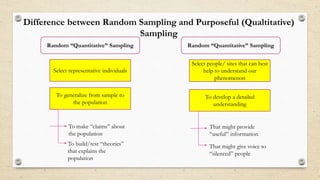
Difference between Random Sampling and Purposeful (Qualtitative)
Sampling
Select representative individuals
To generalize from sample to
the population
Random “Quantitative” Sampling
To make “claims” about
the population
To build/test “theories”
that explains the
population
Random “Quantitative” Sampling
Select people/ sites that can best
help to understand our
phenomenon
To develop a detailed
understanding
That might provide
“useful” information
That might give voice to
“silenced” people
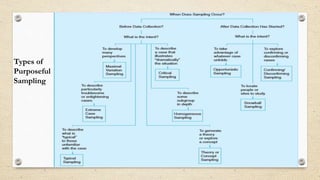
Types of
Purposeful
Sampling
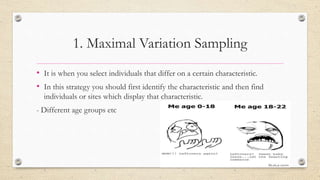
1. Maximal Variation Sampling
• It is when you select individuals that differ on a certain characteristic.
• In this strategy you should first identify the characteristic and then find
individuals or sites which display that characteristic.
- Different age groups etc
2. Typical Sampling
• It is when you study a person or a site that is “typical” to those unfamiliar
with the situation.
• You can select a typical sample by collecting demographic data or survey data
about all cases.
• Eg: teachers working form 15 years in the
same school
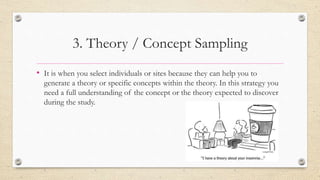
3. Theory / Concept Sampling
• It is when you select individuals or sites because they can help you to
generate a theory or specific concepts within the theory. In this strategy you
need a full understanding of the concept or the theory expected to discover
during the study.
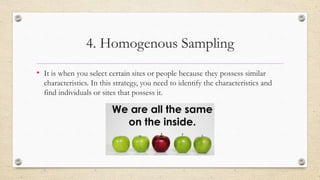
4. Homogenous Sampling
• It is when you select certain sites or people because they possess similar
characteristics. In this strategy, you need to identify the characteristics and
find individuals or sites that possess it.
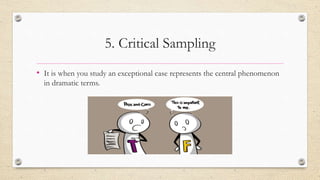
5. Critical Sampling
• It is when you study an exceptional case represents the central phenomenon
in dramatic terms.
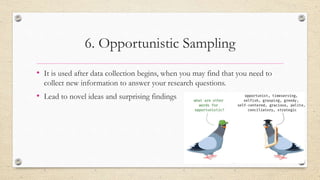
6. Opportunistic Sampling
• It is used after data collection begins, when you may find that you need to
collect new information to answer your research questions.
• Lead to novel ideas and surprising findings
References
• Creswell, J., W. (2012) Educational research: Planning, Conducting, and
Evaluating Quantitative and Qualitative Research, 4th ed.
• Patton, M.Q. (2002). Qualitative Research and Evaluation Methods.
Thousand Oaks, CA: Sage.
PROBABILISTIC AND NONPROBABILISTIC SAMPLING

PROBABILISTIC AND NONPROBABILISTIC SAMPLING

  • 1.
  • 2.
    Outlines • Sample definition •Types of sampling in quantitative researches • Types of sampling in qualitative researches
  • 3.
    • In randomsampling, the researcher selects individuals from the population who are representative of the population The sample can make generalization to the population
  • 4.
    SAMPLING… The process ofselecting a number of individuals for a study in such a way that the individuals represent the larger group from which they are selected
  • 5.
    Quantitative Sampling • Purpose– to identify participants from whom to seek some information • Issues - Nature of the sample (random samples) - Size of the sample - Method of selecting the sample
  • 6.
    Quantitative Sampling Important Issues Representation – the extent to which the sample is representative of the population  Generalization – the extent to which the results of the study can be reasonably extended from the sample to the population  Sampling error The chance occurrence that a randomly selected sample is not representative of the population due to errors inherent in the sampling technique. • Sampling bias
  • 8.
    Selecting Random Samples •Known as probability sampling • Best method to achieve a representative sample • Four technique 1. Random Sampling 2. Systematic Sampling 3. Stratified Random Sampling 4. Cluster Sampling
  • 9.
    1. Simple RandomSampling • Selecting subjects so that all members of a population have an equal and independent chance of being selected Advantages 1. Easy to conduct 2 High probability of achieving a representative sample 3 Meets assumptions of many statistical procedures Disadvantages 1. Identification of all members of the population can be difficult 2. Contacting all members of the sample can be difficult
  • 10.
    Selection process 1. Identifyand define the population. 2. Determine the desired sample size. 3. List all members of the population. 4. Assign all members on the list a consecutive number 5. Select an arbitrary starting point from a table of random numbers and read the appropriate number of digits
  • 11.
    2. Systematic Sampling •Researcher choose every nth individual in the population until reached the desired sample size. • May not be as precise but more convenient as the people do not have to be numbered and does not require a random number tables. Advantage -Very easily done Disadvantages - subgroups - some members of the population don’t have an equal chance of being included
  • 12.
    Cont.. Selection process - Identifyand define the population - Determine the desired sample size - Obtain a list of the population - Determine what nth is equal to by dividing the size of the population by the desired sample size - Start at some random place in the population list - Take every nth individual on the list
  • 13.
    3. Stratified Sampling •The population is divided into two or more groups called strata, according to some criterion, such as geographic location, grade level, age, or income, and subsamples are randomly selected from each strata. Advantages - More accurate sample - Can be used for both proportional and nonproportional samples - Representation of subgroups in the sample Disadvantages - Identification of all members of the population can be difficult - Identifying members of all subgroups can be difficult
  • 14.
    The procedure consistsof (a) dividing the population by the stratum (b) sampling within each group in the stratum so that the individuals selected are proportional to their representation in the total population.
  • 15.
    4. Cluster Sampling •The process of randomly selecting intact groups, not individuals, within the defined population sharing similar characteristics - Clusters are locations within which an intact group of members of the population can be found - Examples : Neighbourhood, School districts, Schools, Classrooms
  • 16.
    Advantages - Very usefulwhen populations are large and spread over a large geographic region - Convenient and expedient - Do not need the names of everyone in the population Disadvantages - Representation is likely to become an issue
  • 17.
    Non-probability Samples • Researcherselects individuals because they are available, convenient, and represent some characteristics the investigator seeks to study. 1. Convenience Sampling 2. Snowball Sampling
  • 18.
    1. Convenience Sampling •The process of including whoever happens to be available at the time (advantage) • Disadvantages: difficulty in determining how much of the effect (dependent variable) results from the cause (independent variable)
  • 19.
    2. Snowball Sampling •Researcher asks participants to identify others to become members of the sample. • Advantage of recruiting large numbers of participants for the study. • Disadvantage: - Might not know the individuals who did not return the survey. - Respondents may not be representative of the population
  • 20.
    SAMPLING IN QUALITATIVERESEARCH • Researchers in qualitative research select their participants according to their : • 1) characteristics • 2) knowledge
  • 21.
    Difference between RandomSampling and Purposeful (Qualtitative) Sampling Select representative individuals To generalize from sample to the population Random “Quantitative” Sampling To make “claims” about the population To build/test “theories” that explains the population Random “Quantitative” Sampling Select people/ sites that can best help to understand our phenomenon To develop a detailed understanding That might provide “useful” information That might give voice to “silenced” people
  • 22.
  • 23.
    1. Maximal VariationSampling • It is when you select individuals that differ on a certain characteristic. • In this strategy you should first identify the characteristic and then find individuals or sites which display that characteristic. - Different age groups etc
  • 24.
    2. Typical Sampling •It is when you study a person or a site that is “typical” to those unfamiliar with the situation. • You can select a typical sample by collecting demographic data or survey data about all cases. • Eg: teachers working form 15 years in the same school
  • 25.
    3. Theory /Concept Sampling • It is when you select individuals or sites because they can help you to generate a theory or specific concepts within the theory. In this strategy you need a full understanding of the concept or the theory expected to discover during the study.
  • 26.
    4. Homogenous Sampling •It is when you select certain sites or people because they possess similar characteristics. In this strategy, you need to identify the characteristics and find individuals or sites that possess it.
  • 27.
    5. Critical Sampling •It is when you study an exceptional case represents the central phenomenon in dramatic terms.
  • 28.
    6. Opportunistic Sampling •It is used after data collection begins, when you may find that you need to collect new information to answer your research questions. • Lead to novel ideas and surprising findings
  • 29.
    References • Creswell, J.,W. (2012) Educational research: Planning, Conducting, and Evaluating Quantitative and Qualitative Research, 4th ed. • Patton, M.Q. (2002). Qualitative Research and Evaluation Methods. Thousand Oaks, CA: Sage.