Fever with altered sensorium
Shilanjan Roy
Dept Of Medicine
Burdwan Medical College
Introduction
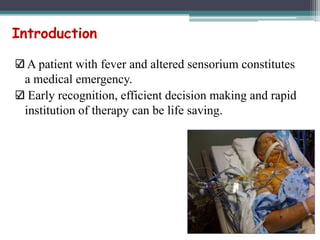
A patient with fever and altered sensorium constitutes
a medical emergency.
Early recognition, efficient decision making and rapid
institution of therapy can be life saving.
Levels of consciousness:
Alert: Fully conscious
Lethargic: Appear somnolent, but may be able to
maintain arousal.

Obtunded: Requires touch or voice to maintain arousal.
Stuporous: Unresponsiveness from which the individual
can be aroused only by painful stimulus.
Comatose: State in which patient is unable to arouse or
respond to noxious stimuli and is completely unaware
of self and surroundings.
Fever with altered sensorium-- causes
A. INFECTIONS
•
•
•
•

Encephalitis
Meningitis
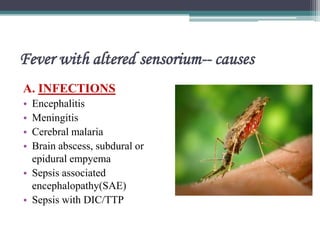
Cerebral malaria
Brain abscess, subdural or
epidural empyema
• Sepsis associated
encephalopathy(SAE)
• Sepsis with DIC/TTP
Causes contd..
B. NON INFECTIOUS CAUSES OF FEVER
a. OVERPRODUCTION OF HEAT :
1. Neuroleptic malignant syndrome
2. Malignant Hyperthermia.
3.Serotonin Syndrome
4.Cocaine, Amphetamine, ecstasy toxicity
5.Salicylate poisoning.
6.Thyrotoxic encephalopathy.
7.Convulsive status epilepticus.
8.Catatonic schizophrenia
b. IMPAIRED HEAT DISSIPATION
1.Anticholinergic toxicity e.g amitriptyline
2.Heat Stroke.
c. STRUCTURAL LESIONS( IMPAIRED
THERMOREGULATORY MECHANISM)
1.Hypothalamic lesion.
2.Brainstem lesion( stroke)
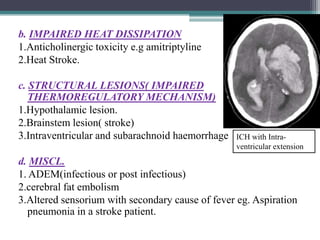
3.Intraventricular and subarachnoid haemorrhage

ICH with Intraventricular extension

d. MISCL.
1. ADEM(infectious or post infectious)
2.cerebral fat embolism
3.Altered sensorium with secondary cause of fever eg. Aspiration
pneumonia in a stroke patient.
Important points:
Presence of fever alone is not sufficient to make a diagnosis of
an infectious etiology( e.g Meningitis or encephalitis)
Encephalopathy may be precipitated by systemic infections or
sepsis without cerebral inflammation (septic encephalopathy)
Sepsis can lead to altered sensorium secondary to metabolic
alterations like hypoglycaemia
, hyperpyrexia, hypovolemia, hepatic or renal failure.
Even in absence of infection there can be high rise of temp due
to mechanisms such as overproduction or impaired dissipation
of heat, non infectious CNS diseases, hypothalamic lesion.
Patients of NMS may have fever, neck stiffness, delirium,
generalised rigidity, even after the offending drug has been
withdrawn.

WORLDWIDE , infection of the CNS is the
commonest cause of Fever with altered sensorium.
In a study from India among children < 18 yrs of age,
commonest cause of acute febrile encephalopathy was
VIRAL MENINGITIS, accounting for 40% of the cases.
Among non viral, bacterial ( 34%), tubercular meningitis
(7.9%) and cerebral malaria (5.2%) were most common.
Causes of infectious meningoencephalitis:
A. VIRAL:
a. DNA virus:
1. Herpes viruses: herpes simplex (HSV1,HSV2)
other herpes viruses (HHV6, EBV, VZV, CMV)
2. Adenovirus.
b. RNA viruses:
Influenza, Polio, Entero,
Measles, Rubella, Mumps,
Rabies, Arbo, Reo, & Retrovirus
B. BACTERIAL:
1. Pyogenic meningitis
2. Mycobacterium tuberculosis
3. Mycoplasma pneumoniae
4. Listeria monocytogenes
5. Borrelia burgdorferri.
6. Tropheryma whippeli
7. Leptospira,
8. Brucella,
9. Legionella
10. Salmonella typhi.
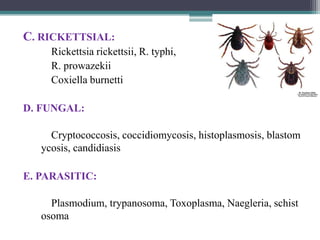
C. RICKETTSIAL:
Rickettsia rickettsii, R. typhi,
R. prowazekii
Coxiella burnetti
D. FUNGAL:
Cryptococcosis, coccidiomycosis, histoplasmosis, blastom
ycosis, candidiasis
E. PARASITIC:
Plasmodium, trypanosoma, Toxoplasma, Naegleria, schist
osoma
APPROACH TO THE PATIENT
HISTORY:
 Most important
 Sometimes only clue to correct
diagnosis.
 Careful and systematic clinical
assessment is key to management of
a patient of febrile encephalopathy.
 Imp to differentiate infective vs non
infective causes.
 Temporal course is also imp –
whether fever preceded or followed
altered sensorium or simultaneous.
 Classical triad of CNS inf – fever,
neck rigidity, altered mental status.
(present in majority of patients)
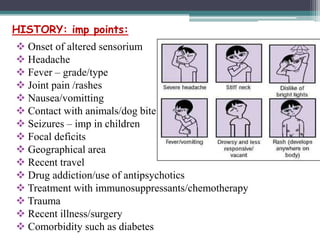
HISTORY: imp points:
 Onset of altered sensorium
 Headache
 Fever – grade/type
 Joint pain /rashes
 Nausea/vomitting
 Contact with animals/dog bite
 Seizures – imp in children
 Focal deficits
 Geographical area
 Recent travel
 Drug addiction/use of antipsychotics
 Treatment with immunosuppressants/chemotherapy
 Trauma
 Recent illness/surgery
 Comorbidity such as diabetes
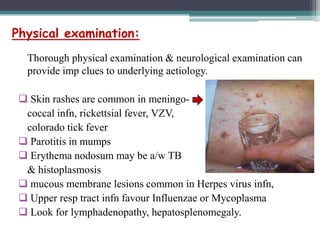
Physical examination:
Thorough physical examination & neurological examination can
provide imp clues to underlying aetiology.
 Skin rashes are common in meningococcal infn, rickettsial fever, VZV,
colorado tick fever
 Parotitis in mumps
 Erythema nodosum may be a/w TB
& histoplasmosis
 mucous membrane lesions common in Herpes virus infn,
 Upper resp tract infn favour Influenzae or Mycoplasma
 Look for lymphadenopathy, hepatosplenomegaly.
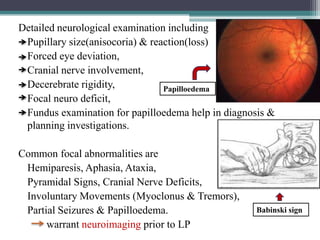
Detailed neurological examination including
Pupillary size(anisocoria) & reaction(loss)
Forced eye deviation,
Cranial nerve involvement,
Decerebrate rigidity,
Papilloedema
Focal neuro deficit,
Fundus examination for papilloedema help in diagnosis &
planning investigations.
Common focal abnormalities are
Hemiparesis, Aphasia, Ataxia,
Pyramidal Signs, Cranial Nerve Deficits,
Involuntary Movements (Myoclonus & Tremors),
Partial Seizures & Papilloedema.
warrant neuroimaging prior to LP

Babinski sign
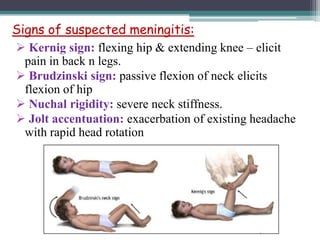
Signs of suspected meningitis:
 Kernig sign: flexing hip & extending knee – elicit
pain in back n legs.
 Brudzinski sign: passive flexion of neck elicits
flexion of hip
 Nuchal rigidity: severe neck stiffness.
 Jolt accentuation: exacerbation of existing headache
with rapid head rotation
After getting clues from History and
examination,
investigations are tailored as per
provisional diagnosis.
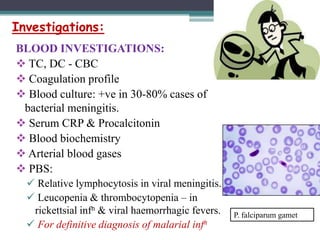
Investigations:
BLOOD INVESTIGATIONS:
 TC, DC - CBC
 Coagulation profile
 Blood culture: +ve in 30-80% cases of
bacterial meningitis.
 Serum CRP & Procalcitonin
 Blood biochemistry
 Arterial blood gases
 PBS:
 Relative lymphocytosis in viral meningitis.
 Leucopenia & thrombocytopenia – in
rickettsial infn & viral haemorrhagic fevers.
 For definitive diagnosis of malarial infn

P. falciparum gamet
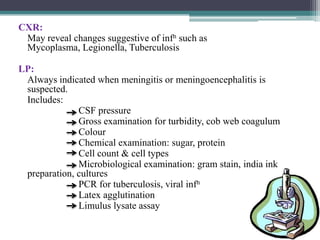
CXR:
May reveal changes suggestive of infn such as
Mycoplasma, Legionella, Tuberculosis
LP:
Always indicated when meningitis or meningoencephalitis is
suspected.
Includes:
CSF pressure
Gross examination for turbidity, cob web coagulum
Colour
Chemical examination: sugar, protein
Cell count & cell types
Microbiological examination: gram stain, india ink
preparation, cultures
PCR for tuberculosis, viral infn
Latex agglutination
Limulus lysate assay
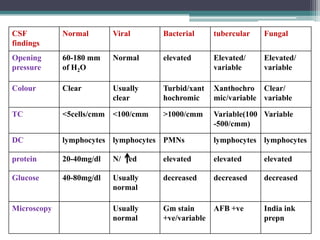
CSF
findings

Normal

Viral

Bacterial

tubercular

Fungal

Opening
pressure

60-180 mm
of H2O

Normal

elevated

Elevated/
variable

Elevated/
variable

Colour

Clear

Usually
clear

Turbid/xant
hochromic

Xanthochro Clear/
mic/variable variable

TC

<5cells/cmm

<100/cmm

>1000/cmm

Variable(100 Variable
-500/cmm)

DC

lymphocytes lymphocytes PMNs

lymphocytes lymphocytes

protein

20-40mg/dl

N/ ed

elevated

elevated

elevated

Glucose

40-80mg/dl

Usually
normal

decreased

decreased

decreased

Usually
normal

Gm stain
+ve/variable

AFB +ve

India ink
prepn

Microscopy
Neuroimaging:
MRI
CT scan

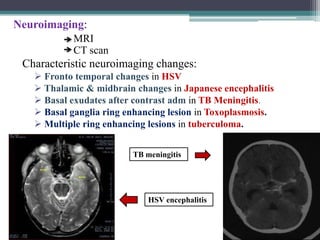
Characteristic neuroimaging changes:
 Fronto temporal changes in HSV
 Thalamic & midbrain changes in Japanese encephalitis
 Basal exudates after contrast adm in TB Meningitis.
 Basal ganglia ring enhancing lesion in Toxoplasmosis.
 Multiple ring enhancing lesions in tuberculoma.
TB meningitis

HSV encephalitis
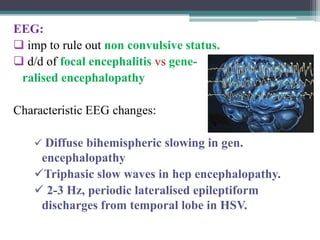
EEG:
 imp to rule out non convulsive status.
 d/d of focal encephalitis vs generalised encephalopathy
Characteristic EEG changes:
 Diffuse bihemispheric slowing in gen.

encephalopathy
Triphasic slow waves in hep encephalopathy.
 2-3 Hz, periodic lateralised epileptiform
discharges from temporal lobe in HSV.
Others:
Thyroid function test
Drug levels
Urine toxicology screen
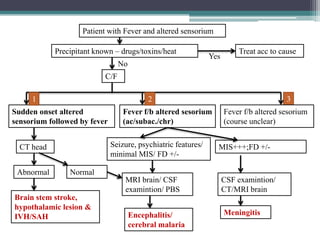
Patient with Fever and altered sensorium

Precipitant known – drugs/toxins/heat

Yes

Treat acc to cause

No

C/F
1

2

Sudden onset altered
sensorium followed by fever

Seizure, psychiatric features/
minimal MIS/ FD +/-

CT head
Abnormal

Fever f/b altered sesorium
(ac/subac./chr)

3
Fever f/b altered sesorium
(course unclear)
MIS+++;FD +/-

Normal

MRI brain/ CSF
examintion/ PBS
Brain stem stroke,
hypothalamic lesion &
IVH/SAH

Encephalitis/
cerebral malaria

CSF examintion/
CT/MRI brain
Meningitis
3

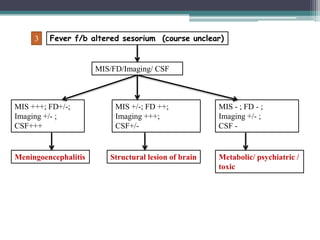
Fever f/b altered sesorium (course unclear)

MIS/FD/Imaging/ CSF

MIS +++; FD+/-;
Imaging +/- ;
CSF+++

Meningoencephalitis

MIS +/-; FD ++;
Imaging +++;
CSF+/-

Structural lesion of brain

MIS - ; FD - ;
Imaging +/- ;
CSF -

Metabolic/ psychiatric /
toxic
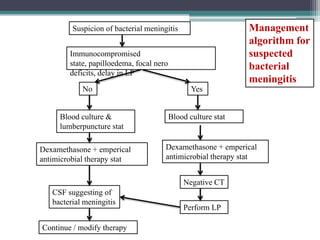
Management
algorithm for
suspected
bacterial
meningitis

Suspicion of bacterial meningitis
Immunocompromised
state, papilloedema, focal nero
deficits, delay in LP
No

Blood culture &
lumberpuncture stat
Dexamethasone + emperical
antimicrobial therapy stat

Yes

Blood culture stat

Dexamethasone + emperical
antimicrobial therapy stat
Negative CT

CSF suggesting of
bacterial meningitis
Continue / modify therapy

Perform LP
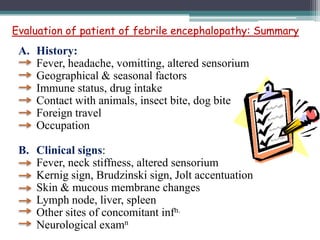
Evaluation of patient of febrile encephalopathy: Summary

A. History:
Fever, headache, vomitting, altered sensorium
Geographical & seasonal factors
Immune status, drug intake
Contact with animals, insect bite, dog bite
Foreign travel
Occupation
B. Clinical signs:
Fever, neck stiffness, altered sensorium
Kernig sign, Brudzinski sign, Jolt accentuation
Skin & mucous membrane changes
Lymph node, liver, spleen
Other sites of concomitant infn.
Neurological examn
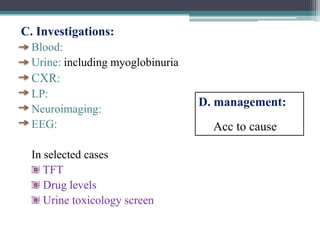
C. Investigations:
Blood:
Urine: including myoglobinuria
CXR:
LP:
Neuroimaging:
EEG:
In selected cases
TFT
Drug levels
Urine toxicology screen

D. management:

Acc to cause
Approach to a case of Fever with altered sensorium

Approach to a case of Fever with altered sensorium

  • 1.
    Fever with alteredsensorium Shilanjan Roy Dept Of Medicine Burdwan Medical College
  • 2.
    Introduction A patient withfever and altered sensorium constitutes a medical emergency. Early recognition, efficient decision making and rapid institution of therapy can be life saving.
  • 3.
    Levels of consciousness: Alert:Fully conscious Lethargic: Appear somnolent, but may be able to maintain arousal. Obtunded: Requires touch or voice to maintain arousal. Stuporous: Unresponsiveness from which the individual can be aroused only by painful stimulus. Comatose: State in which patient is unable to arouse or respond to noxious stimuli and is completely unaware of self and surroundings.
  • 4.
    Fever with alteredsensorium-- causes A. INFECTIONS • • • • Encephalitis Meningitis Cerebral malaria Brain abscess, subdural or epidural empyema • Sepsis associated encephalopathy(SAE) • Sepsis with DIC/TTP
  • 5.
    Causes contd.. B. NONINFECTIOUS CAUSES OF FEVER a. OVERPRODUCTION OF HEAT : 1. Neuroleptic malignant syndrome 2. Malignant Hyperthermia. 3.Serotonin Syndrome 4.Cocaine, Amphetamine, ecstasy toxicity 5.Salicylate poisoning. 6.Thyrotoxic encephalopathy. 7.Convulsive status epilepticus. 8.Catatonic schizophrenia
  • 6.
    b. IMPAIRED HEATDISSIPATION 1.Anticholinergic toxicity e.g amitriptyline 2.Heat Stroke. c. STRUCTURAL LESIONS( IMPAIRED THERMOREGULATORY MECHANISM) 1.Hypothalamic lesion. 2.Brainstem lesion( stroke) 3.Intraventricular and subarachnoid haemorrhage ICH with Intraventricular extension d. MISCL. 1. ADEM(infectious or post infectious) 2.cerebral fat embolism 3.Altered sensorium with secondary cause of fever eg. Aspiration pneumonia in a stroke patient.
  • 7.
    Important points: Presence offever alone is not sufficient to make a diagnosis of an infectious etiology( e.g Meningitis or encephalitis) Encephalopathy may be precipitated by systemic infections or sepsis without cerebral inflammation (septic encephalopathy) Sepsis can lead to altered sensorium secondary to metabolic alterations like hypoglycaemia , hyperpyrexia, hypovolemia, hepatic or renal failure. Even in absence of infection there can be high rise of temp due to mechanisms such as overproduction or impaired dissipation of heat, non infectious CNS diseases, hypothalamic lesion.
  • 8.
    Patients of NMSmay have fever, neck stiffness, delirium, generalised rigidity, even after the offending drug has been withdrawn. WORLDWIDE , infection of the CNS is the commonest cause of Fever with altered sensorium. In a study from India among children < 18 yrs of age, commonest cause of acute febrile encephalopathy was VIRAL MENINGITIS, accounting for 40% of the cases. Among non viral, bacterial ( 34%), tubercular meningitis (7.9%) and cerebral malaria (5.2%) were most common.
  • 9.
    Causes of infectiousmeningoencephalitis: A. VIRAL: a. DNA virus: 1. Herpes viruses: herpes simplex (HSV1,HSV2) other herpes viruses (HHV6, EBV, VZV, CMV) 2. Adenovirus. b. RNA viruses: Influenza, Polio, Entero, Measles, Rubella, Mumps, Rabies, Arbo, Reo, & Retrovirus
  • 10.
    B. BACTERIAL: 1. Pyogenicmeningitis 2. Mycobacterium tuberculosis 3. Mycoplasma pneumoniae 4. Listeria monocytogenes 5. Borrelia burgdorferri. 6. Tropheryma whippeli 7. Leptospira, 8. Brucella, 9. Legionella 10. Salmonella typhi.
  • 11.
    C. RICKETTSIAL: Rickettsia rickettsii,R. typhi, R. prowazekii Coxiella burnetti D. FUNGAL: Cryptococcosis, coccidiomycosis, histoplasmosis, blastom ycosis, candidiasis E. PARASITIC: Plasmodium, trypanosoma, Toxoplasma, Naegleria, schist osoma
  • 12.
    APPROACH TO THEPATIENT HISTORY:  Most important  Sometimes only clue to correct diagnosis.  Careful and systematic clinical assessment is key to management of a patient of febrile encephalopathy.  Imp to differentiate infective vs non infective causes.  Temporal course is also imp – whether fever preceded or followed altered sensorium or simultaneous.  Classical triad of CNS inf – fever, neck rigidity, altered mental status. (present in majority of patients)
  • 13.
    HISTORY: imp points: Onset of altered sensorium  Headache  Fever – grade/type  Joint pain /rashes  Nausea/vomitting  Contact with animals/dog bite  Seizures – imp in children  Focal deficits  Geographical area  Recent travel  Drug addiction/use of antipsychotics  Treatment with immunosuppressants/chemotherapy  Trauma  Recent illness/surgery  Comorbidity such as diabetes
  • 14.
    Physical examination: Thorough physicalexamination & neurological examination can provide imp clues to underlying aetiology.  Skin rashes are common in meningococcal infn, rickettsial fever, VZV, colorado tick fever  Parotitis in mumps  Erythema nodosum may be a/w TB & histoplasmosis  mucous membrane lesions common in Herpes virus infn,  Upper resp tract infn favour Influenzae or Mycoplasma  Look for lymphadenopathy, hepatosplenomegaly.
  • 15.
    Detailed neurological examinationincluding Pupillary size(anisocoria) & reaction(loss) Forced eye deviation, Cranial nerve involvement, Decerebrate rigidity, Papilloedema Focal neuro deficit, Fundus examination for papilloedema help in diagnosis & planning investigations. Common focal abnormalities are Hemiparesis, Aphasia, Ataxia, Pyramidal Signs, Cranial Nerve Deficits, Involuntary Movements (Myoclonus & Tremors), Partial Seizures & Papilloedema. warrant neuroimaging prior to LP Babinski sign
  • 16.
    Signs of suspectedmeningitis:  Kernig sign: flexing hip & extending knee – elicit pain in back n legs.  Brudzinski sign: passive flexion of neck elicits flexion of hip  Nuchal rigidity: severe neck stiffness.  Jolt accentuation: exacerbation of existing headache with rapid head rotation
  • 17.
    After getting cluesfrom History and examination, investigations are tailored as per provisional diagnosis.
  • 18.
    Investigations: BLOOD INVESTIGATIONS:  TC,DC - CBC  Coagulation profile  Blood culture: +ve in 30-80% cases of bacterial meningitis.  Serum CRP & Procalcitonin  Blood biochemistry  Arterial blood gases  PBS:  Relative lymphocytosis in viral meningitis.  Leucopenia & thrombocytopenia – in rickettsial infn & viral haemorrhagic fevers.  For definitive diagnosis of malarial infn P. falciparum gamet
  • 19.
    CXR: May reveal changessuggestive of infn such as Mycoplasma, Legionella, Tuberculosis LP: Always indicated when meningitis or meningoencephalitis is suspected. Includes: CSF pressure Gross examination for turbidity, cob web coagulum Colour Chemical examination: sugar, protein Cell count & cell types Microbiological examination: gram stain, india ink preparation, cultures PCR for tuberculosis, viral infn Latex agglutination Limulus lysate assay
  • 20.
    CSF findings Normal Viral Bacterial tubercular Fungal Opening pressure 60-180 mm of H2O Normal elevated Elevated/ variable Elevated/ variable Colour Clear Usually clear Turbid/xant hochromic XanthochroClear/ mic/variable variable TC <5cells/cmm <100/cmm >1000/cmm Variable(100 Variable -500/cmm) DC lymphocytes lymphocytes PMNs lymphocytes lymphocytes protein 20-40mg/dl N/ ed elevated elevated elevated Glucose 40-80mg/dl Usually normal decreased decreased decreased Usually normal Gm stain +ve/variable AFB +ve India ink prepn Microscopy
  • 21.
    Neuroimaging: MRI CT scan Characteristic neuroimagingchanges:  Fronto temporal changes in HSV  Thalamic & midbrain changes in Japanese encephalitis  Basal exudates after contrast adm in TB Meningitis.  Basal ganglia ring enhancing lesion in Toxoplasmosis.  Multiple ring enhancing lesions in tuberculoma. TB meningitis HSV encephalitis
  • 22.
    EEG:  imp torule out non convulsive status.  d/d of focal encephalitis vs generalised encephalopathy Characteristic EEG changes:  Diffuse bihemispheric slowing in gen. encephalopathy Triphasic slow waves in hep encephalopathy.  2-3 Hz, periodic lateralised epileptiform discharges from temporal lobe in HSV.
  • 23.
    Others: Thyroid function test Druglevels Urine toxicology screen
  • 24.
    Patient with Feverand altered sensorium Precipitant known – drugs/toxins/heat Yes Treat acc to cause No C/F 1 2 Sudden onset altered sensorium followed by fever Seizure, psychiatric features/ minimal MIS/ FD +/- CT head Abnormal Fever f/b altered sesorium (ac/subac./chr) 3 Fever f/b altered sesorium (course unclear) MIS+++;FD +/- Normal MRI brain/ CSF examintion/ PBS Brain stem stroke, hypothalamic lesion & IVH/SAH Encephalitis/ cerebral malaria CSF examintion/ CT/MRI brain Meningitis
  • 25.
    3 Fever f/b alteredsesorium (course unclear) MIS/FD/Imaging/ CSF MIS +++; FD+/-; Imaging +/- ; CSF+++ Meningoencephalitis MIS +/-; FD ++; Imaging +++; CSF+/- Structural lesion of brain MIS - ; FD - ; Imaging +/- ; CSF - Metabolic/ psychiatric / toxic
  • 26.
    Management algorithm for suspected bacterial meningitis Suspicion ofbacterial meningitis Immunocompromised state, papilloedema, focal nero deficits, delay in LP No Blood culture & lumberpuncture stat Dexamethasone + emperical antimicrobial therapy stat Yes Blood culture stat Dexamethasone + emperical antimicrobial therapy stat Negative CT CSF suggesting of bacterial meningitis Continue / modify therapy Perform LP
  • 27.
    Evaluation of patientof febrile encephalopathy: Summary A. History: Fever, headache, vomitting, altered sensorium Geographical & seasonal factors Immune status, drug intake Contact with animals, insect bite, dog bite Foreign travel Occupation B. Clinical signs: Fever, neck stiffness, altered sensorium Kernig sign, Brudzinski sign, Jolt accentuation Skin & mucous membrane changes Lymph node, liver, spleen Other sites of concomitant infn. Neurological examn
  • 28.
    C. Investigations: Blood: Urine: includingmyoglobinuria CXR: LP: Neuroimaging: EEG: In selected cases TFT Drug levels Urine toxicology screen D. management: Acc to cause

Editor's Notes

  • #25 MIS – meningeal irritation signsFD- focal deficitsIVH/SAH – intraventricularhaemorrhage/subarachnoid haemorrhage