MITOSIS  & MEIOSIS + terms exercise
Role of Mitosis Formation of a multicellular organism.  Asexual reproduction e.g. Amoeba, yeast and vegetative reproduction of plant.  Cell replacement and regeneration.  Gamete formation in the flowering plant.  Faithful copying of genes and their transfer to the next generation of nuclei or cells.  Maintains the correct chromosome number of somatic cells.
 
http://highered.mcgraw-hill.com/sites/0073031216/student_view0/exercise13/mitosis_movie.html Movie from mc graw hill about mitosis
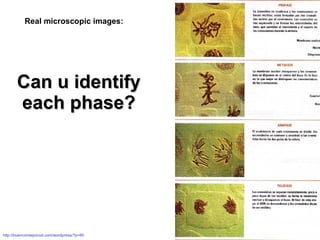
Can u identify  each phase? http://buenconsejoicod.com/wordpress/?p=60 Real microscopic images:
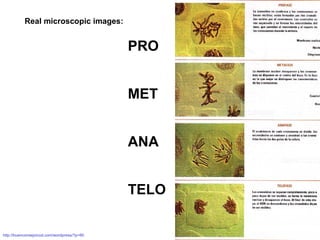
PRO MET ANA TELO http://buenconsejoicod.com/wordpress/?p=60 Real microscopic images:
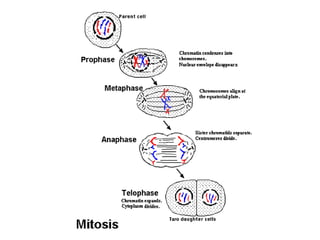
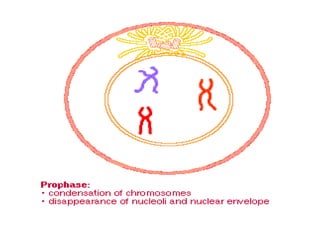
? phase chromatin condenses forming chromosomes each chromosome composed of two identical sister chromatids connected at the centromere spindle fibres forming nuclear membrane breaks down towards the end of prophase  Draw the phase Texts from: http://www.skoool.ie/skoool/examcentre_sc.asp?id=2848
? phase chromosomes placed individually along the equatorial plane of the cell each chromosome is connected to both sides of the cell by spindle fibres attached to the centromeres  Draw the phase Texts from: http://www.skoool.ie/skoool/examcentre_sc.asp?id=2848
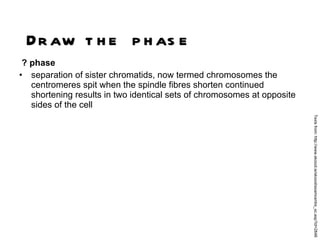
? phase separation of sister chromatids, now termed chromosomes the centromeres spit when the spindle fibres shorten continued shortening results in two identical sets of chromosomes at opposite sides of the cell  Draw the phase Texts from: http://www.skoool.ie/skoool/examcentre_sc.asp?id=2848
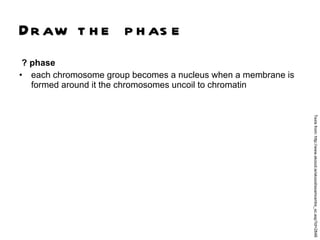
Draw the phase ? phase each chromosome group becomes a nucleus when a membrane is formed around it the chromosomes uncoil to chromatin Texts from: http://www.skoool.ie/skoool/examcentre_sc.asp?id=2848
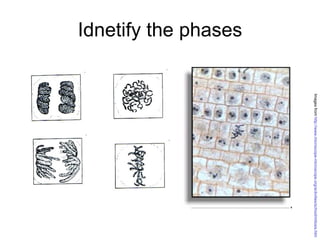
Idnetify the phases Images from  http://www.microscope-microscope.org/activities/school/mitosis.htm
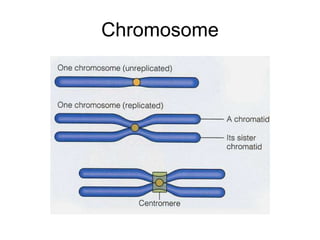
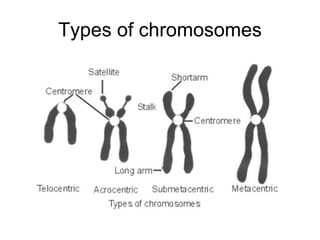
Chromosome
Types of chromosomes
Cell Division  Mitosis  is the process of cell division in which one cell becomes two identical daughter cells. It is required for  development  renewal  regeneration
 
 
MEIOSIS
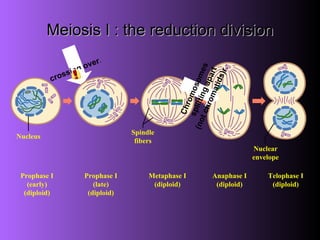
Meiosis Specialized form of cell division with  two successive rounds (MEIOSIS I + MEIOSIS II)  of cell division  without  DNA replication in between . Produces  haploid  cells  (n)
Meiosis Start with 46 double stranded chromosomes (2n) After 1st division  - 23 double stranded chromosomes (n)  After 2nd division - 23 single stranded chromosomes (n) Occurs in our germ cells   cells that produce our gametes egg and sperm
MEIOSIS = MEIOSIS I + MEIOSIS II Meiosis I : the reduction division Meiosis II : the equational division
Meiosis I : the reduction division crossing over .  Chromosomes  splitting apart (not chromatids)r .  Prophase I (early) (diploid) Prophase I (late) (diploid) Metaphase I (diploid) Anaphase I (diploid) Telophase I (diploid) Nucleus Spindle fibers Nuclear envelope
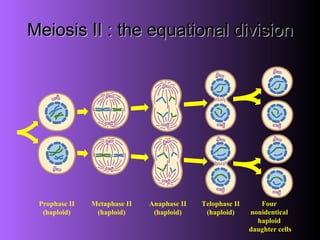
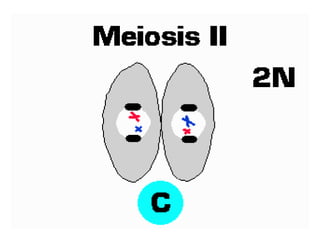
Meiosis II : the equational division Prophase II (haploid) Metaphase II (haploid) Anaphase II (haploid) Telophase II (haploid) Four  nonidentical  haploid  daughter cells
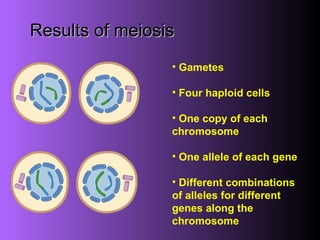
Results of meiosis Gametes Four haploid cells One copy of each chromosome  One allele of each gene Different combinations of alleles for different genes along the chromosome
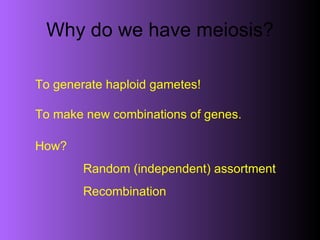
Why do we have meiosis? To generate haploid gametes! To make new combinations of genes. How? Random (independent) assortment Recombination
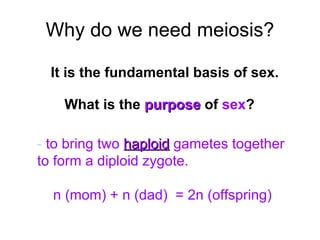
Why do we need meiosis? -  to bring two  haploid  gametes together to form a diploid zygote. n (mom) + n (dad)  = 2n (offspring) It is the fundamental basis of sex. What is the  purpose  of  sex ?
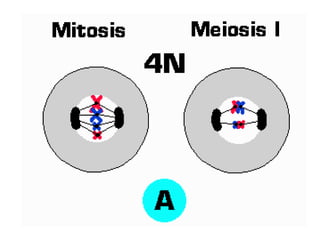
MEIOSIS Difference between  mitosis  and  meiosis I
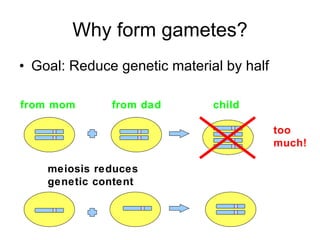
Why form gametes? Goal: Reduce genetic material by half from mom from dad child meiosis reduces genetic content too much!
 
 
Make  a  table  with the  differences Meioisis  vs.  Mitosis http:// dobsomnimedia.blogspot.com /
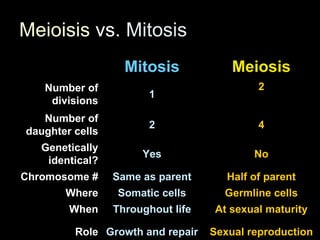
Meioisis   vs . Mitosis Mitosis Meiosis Number of divisions 1 2 Number of daughter cells 2 4 Genetically identical? Yes No Chromosome # Same as parent Half of parent Where Somatic cells Germline cells When Throughout life At sexual maturity Role Growth and repair Sexual reproduction
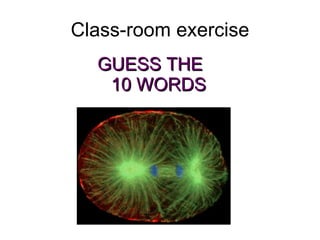
Class-room exercise GUESS THE  10 WORDS
The  cell   genetically   identical   to another. 1
A  network  of  filaments  that collectively form a  mitotic   spindle  (in  mitosis ) and  meiotic   spindle  (in  meiosis ). It is chiefly involved in moving and segregating the  chromosomes  during nuclear division. 2
The constricted  region  joining the two  sister   chromatids  that make up an X-shaped  chromosome .  3
A  structure  within the  cell  that bears the  genetic  material  as a threadlike linear  strand  of  DNA  bonded to various  proteins  in the  nucleus  of  eukaryotic   cells . 4
They are the products of the division of the parent cell. 5
A form of  cell   division  happening in sexually reproducing  organisms  by which two consecutive nuclear divisions occur without the chromosomal  replication  in between, leading to the production of four  haploid   gametes  ( sex  cells )  6
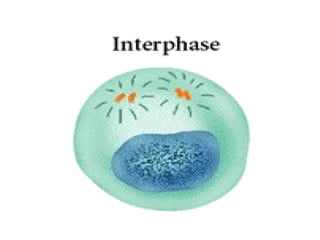
The  stage  of the  cell  or  nucleus  when it is not in  mitosis , hence comprising most of the  cell   cycle . 7
The final  stage  of mitosis, when  chromosome   separation  is completed.   8
Body cells are called  ................  ............... 9
It is the process that our body uses to grow and replace cells. 10
ANSWERS
Clone The  cell   genetically   identical   to another. 1
Spindle fibres A  network  of  filaments  that collectively form a  mitotic   spindle  (in  mitosis ) and  meiotic   spindle  (in  meiosis ). It is chiefly involved in moving and segregating the  chromosomes  during nuclear division. 2
Centromere The constricted  region  joining the two  sister   chromatids  that make up an X-shaped  chromosome .  3
Chromosome A  structure  within the  cell  that bears the  genetic  material  as a threadlike linear  strand  of  DNA  bonded to various  proteins  in the  nucleus  of  eukaryotic   cells . 4
Daughter cells They are the products of the division of the parent cell. 5
Meiosis A form of  cell   division  happening in sexually reproducing  organisms  by which two consecutive nuclear divisions occur without the chromosomal  replication  in between, leading to the production of four  haploid   gametes  ( sex  cells )  6
Interphase The  stage  of the  cell  or  nucleus  when it is not in  mitosis , hence comprising most of the  cell   cycle . 7
Telophase The final  stage  of mitosis, when  chromosome   separation  is completed.   8
Somatic cells Body cells are called  ................  ............... 9
Mitosis It is the process that our body uses to grow and replace cells. 10
http :// www.biology - online.org / dictionary / Some definitions were taken from http://www.goboxy.com/vector_stock/vector-cool-design/
http://www.webdesignhot.com/free-vector-graphics/free-vector-colorful-dots-background/ Some graphics were taken from
Thanks for your attention http://www.designbyhumans.com

Mitosis meiosis-fernando biodeluna2011

  • 1.
    MITOSIS &MEIOSIS + terms exercise
  • 2.
    Role of MitosisFormation of a multicellular organism. Asexual reproduction e.g. Amoeba, yeast and vegetative reproduction of plant. Cell replacement and regeneration. Gamete formation in the flowering plant. Faithful copying of genes and their transfer to the next generation of nuclei or cells. Maintains the correct chromosome number of somatic cells.
  • 3.
  • 4.
  • 5.
    Can u identify each phase? http://buenconsejoicod.com/wordpress/?p=60 Real microscopic images:
  • 6.
    PRO MET ANATELO http://buenconsejoicod.com/wordpress/?p=60 Real microscopic images:
  • 7.
    ? phase chromatincondenses forming chromosomes each chromosome composed of two identical sister chromatids connected at the centromere spindle fibres forming nuclear membrane breaks down towards the end of prophase Draw the phase Texts from: http://www.skoool.ie/skoool/examcentre_sc.asp?id=2848
  • 8.
    ? phase chromosomesplaced individually along the equatorial plane of the cell each chromosome is connected to both sides of the cell by spindle fibres attached to the centromeres Draw the phase Texts from: http://www.skoool.ie/skoool/examcentre_sc.asp?id=2848
  • 9.
    ? phase separationof sister chromatids, now termed chromosomes the centromeres spit when the spindle fibres shorten continued shortening results in two identical sets of chromosomes at opposite sides of the cell Draw the phase Texts from: http://www.skoool.ie/skoool/examcentre_sc.asp?id=2848
  • 10.
    Draw the phase? phase each chromosome group becomes a nucleus when a membrane is formed around it the chromosomes uncoil to chromatin Texts from: http://www.skoool.ie/skoool/examcentre_sc.asp?id=2848
  • 11.
    Idnetify the phasesImages from http://www.microscope-microscope.org/activities/school/mitosis.htm
  • 12.
  • 13.
  • 14.
    Cell Division Mitosis is the process of cell division in which one cell becomes two identical daughter cells. It is required for development renewal regeneration
  • 15.
  • 16.
  • 17.
  • 18.
    Meiosis Specialized formof cell division with two successive rounds (MEIOSIS I + MEIOSIS II) of cell division without DNA replication in between . Produces haploid cells (n)
  • 19.
    Meiosis Start with46 double stranded chromosomes (2n) After 1st division - 23 double stranded chromosomes (n) After 2nd division - 23 single stranded chromosomes (n) Occurs in our germ cells cells that produce our gametes egg and sperm
  • 20.
    MEIOSIS = MEIOSISI + MEIOSIS II Meiosis I : the reduction division Meiosis II : the equational division
  • 21.
    Meiosis I :the reduction division crossing over . Chromosomes splitting apart (not chromatids)r . Prophase I (early) (diploid) Prophase I (late) (diploid) Metaphase I (diploid) Anaphase I (diploid) Telophase I (diploid) Nucleus Spindle fibers Nuclear envelope
  • 22.
    Meiosis II :the equational division Prophase II (haploid) Metaphase II (haploid) Anaphase II (haploid) Telophase II (haploid) Four nonidentical haploid daughter cells
  • 23.
    Results of meiosisGametes Four haploid cells One copy of each chromosome One allele of each gene Different combinations of alleles for different genes along the chromosome
  • 24.
    Why do wehave meiosis? To generate haploid gametes! To make new combinations of genes. How? Random (independent) assortment Recombination
  • 25.
    Why do weneed meiosis? - to bring two haploid gametes together to form a diploid zygote. n (mom) + n (dad) = 2n (offspring) It is the fundamental basis of sex. What is the purpose of sex ?
  • 26.
    MEIOSIS Difference between mitosis and meiosis I
  • 27.
    Why form gametes?Goal: Reduce genetic material by half from mom from dad child meiosis reduces genetic content too much!
  • 28.
  • 29.
  • 30.
    Make a table with the differences Meioisis vs. Mitosis http:// dobsomnimedia.blogspot.com /
  • 31.
    Meioisis vs . Mitosis Mitosis Meiosis Number of divisions 1 2 Number of daughter cells 2 4 Genetically identical? Yes No Chromosome # Same as parent Half of parent Where Somatic cells Germline cells When Throughout life At sexual maturity Role Growth and repair Sexual reproduction
  • 32.
  • 33.
    The cell genetically identical to another. 1
  • 34.
    A network of filaments that collectively form a mitotic spindle (in mitosis ) and meiotic spindle (in meiosis ). It is chiefly involved in moving and segregating the chromosomes during nuclear division. 2
  • 35.
    The constricted region joining the two sister chromatids that make up an X-shaped chromosome . 3
  • 36.
    A structure within the cell that bears the genetic material as a threadlike linear strand of DNA bonded to various proteins in the nucleus of eukaryotic cells . 4
  • 37.
    They are theproducts of the division of the parent cell. 5
  • 38.
    A form of cell division happening in sexually reproducing organisms by which two consecutive nuclear divisions occur without the chromosomal replication in between, leading to the production of four haploid gametes ( sex cells ) 6
  • 39.
    The stage of the cell or nucleus when it is not in mitosis , hence comprising most of the cell cycle . 7
  • 40.
    The final stage of mitosis, when chromosome separation is completed. 8
  • 41.
    Body cells arecalled ................ ............... 9
  • 42.
    It is theprocess that our body uses to grow and replace cells. 10
  • 43.
  • 44.
    Clone The cell genetically identical to another. 1
  • 45.
    Spindle fibres A network of filaments that collectively form a mitotic spindle (in mitosis ) and meiotic spindle (in meiosis ). It is chiefly involved in moving and segregating the chromosomes during nuclear division. 2
  • 46.
    Centromere The constricted region joining the two sister chromatids that make up an X-shaped chromosome . 3
  • 47.
    Chromosome A structure within the cell that bears the genetic material as a threadlike linear strand of DNA bonded to various proteins in the nucleus of eukaryotic cells . 4
  • 48.
    Daughter cells Theyare the products of the division of the parent cell. 5
  • 49.
    Meiosis A formof cell division happening in sexually reproducing organisms by which two consecutive nuclear divisions occur without the chromosomal replication in between, leading to the production of four haploid gametes ( sex cells ) 6
  • 50.
    Interphase The stage of the cell or nucleus when it is not in mitosis , hence comprising most of the cell cycle . 7
  • 51.
    Telophase The final stage of mitosis, when chromosome separation is completed. 8
  • 52.
    Somatic cells Bodycells are called ................ ............... 9
  • 53.
    Mitosis It isthe process that our body uses to grow and replace cells. 10
  • 54.
    http :// www.biology- online.org / dictionary / Some definitions were taken from http://www.goboxy.com/vector_stock/vector-cool-design/
  • 55.
  • 56.
    Thanks for yourattention http://www.designbyhumans.com