Mitosis
Meiosis
Cell Cycle
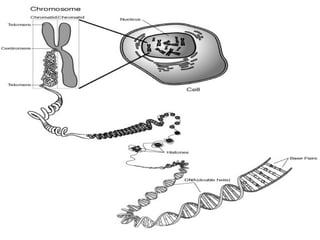
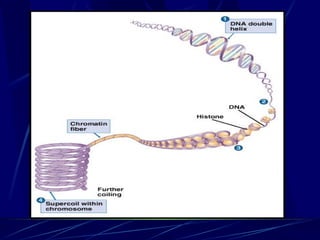
Eukaryotic chromosomes contain
DNA and protein
The chromosomes carry the genetic
information
 When a cell divides, chromatin fibers are
very highly folded, and become visible in
the light microscope as chromosomes.
 During interphase (between divisions),
chromatin is more extended, a form used
for expression genetic information.
• DNA is organized into informational
units called genes
• Chromosomes contain hundreds to
thousands of genes
Cell Cycle
The cell cycle is a sequence of cell
growth and division.
The cell cycle is the period from
the beginning of one division to the
beginning of the next.
The time it takes to complete one
cell cycle is the generation time.
Cells divide when they reach a certain size
NO (nerve, skeletal muscle and red blood cells)
Cell division involves mitosis and
cytokinesis.
Mitosis involves division of the
chromosomes.
Cytokinesis involves division of the
cytoplasm.
Mitosis without cytokinesis results in
multinucleate cells.
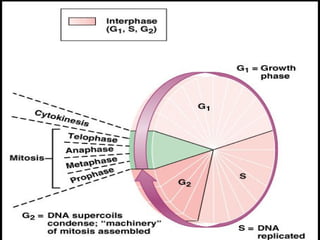
Eukaryotic cell cycle
 Beginning of one division to beginning of next
 Stages in eukaryotic cell cycle
 Interphase
 First gap phase
 Synthesis phase
 Second gap phase
 M phase
 Mitosis
 Cytokinesis
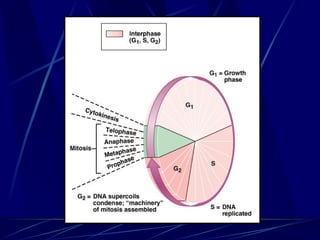
Chromosomes become duplicated
during interphase
Cells are very active during
interphase, synthesizing biological
molecules and growing the G1
(gap)
phase
The S (synthesis) phase is marked by
DNA replication
The G2
(gap) phase occurs between
the S phase and mitosis
Despite differences between
prokaryotes and eukaryotes, there are
several common features in their cell
division processes.
Replication of the DNA must occur.
 Segregation of the "original" and its
"replica" follow.
Cytokinesis ends the cell division process.
Whether the cell was eukaryotic or
prokaryotic, these basic events must
occur.
Hereditary material is passed on to
new cells by mitosis or meiosis
Cell division, growth, and reproduction
Interphase
Mitosis
Cytokinesis
Meiosis
Cell division
• Chromosomal packaging of DNA allows
efficient distribution of genetic material
during cell division
• Life cycle requires two distinct types of cell
division processes: mitosis and meiosis
• Cell division: one cell becomes two cells during
an organism’s life cycle
Mitosis
Mitosis is nuclear division plus cytokinesis, and
produces two identical daughter cells during the
following steps:
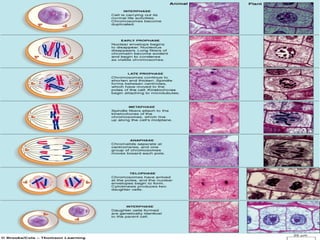
 Prophase
 Metaphase
 Anaphase
 Telophase.
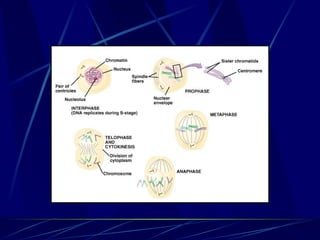
Interphase is often included in discussions of
mitosis, but interphase is technically not part of
mitosis, but rather encompasses stages G1, S, and
G2 of the cell cycle.
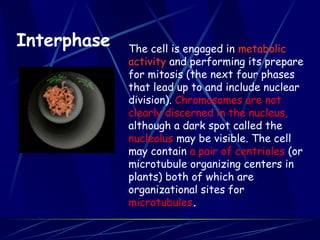
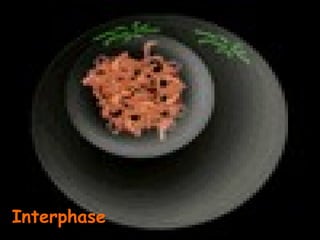
Interphase The cell is engaged in metabolic
activity and performing its prepare
for mitosis (the next four phases
that lead up to and include nuclear
division). Chromosomes are not
clearly discerned in the nucleus,
although a dark spot called the
nucleolus may be visible. The cell
may contain a pair of centrioles (or
microtubule organizing centers in
plants) both of which are
organizational sites for
microtubules.
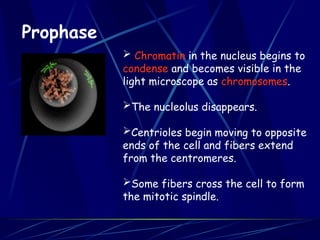
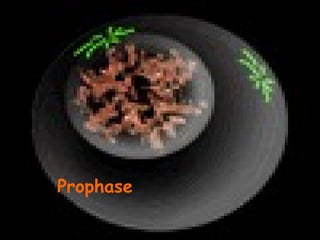
Prophase
 Chromatin in the nucleus begins to
condense and becomes visible in the
light microscope as chromosomes.
The nucleolus disappears.
Centrioles begin moving to opposite
ends of the cell and fibers extend
from the centromeres.
Some fibers cross the cell to form
the mitotic spindle.
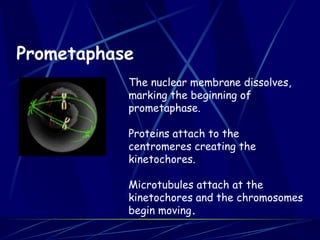
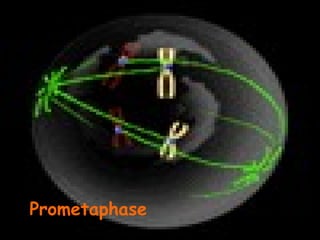
Prometaphase
The nuclear membrane dissolves,
marking the beginning of
prometaphase.
Proteins attach to the
centromeres creating the
kinetochores.
Microtubules attach at the
kinetochores and the chromosomes
begin moving.
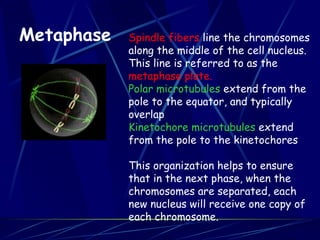
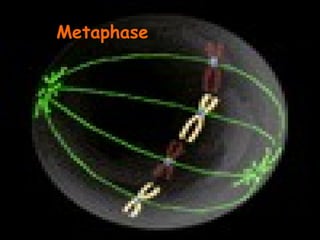
Metaphase Spindle fibers line the chromosomes
along the middle of the cell nucleus.
This line is referred to as the
metaphase plate.
Polar microtubules extend from the
pole to the equator, and typically
overlap
Kinetochore microtubules extend
from the pole to the kinetochores
This organization helps to ensure
that in the next phase, when the
chromosomes are separated, each
new nucleus will receive one copy of
each chromosome.
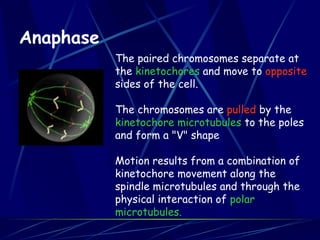
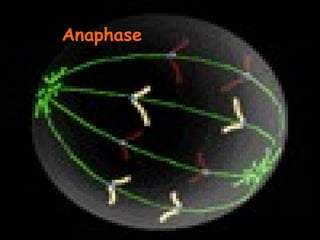
Anaphase
The paired chromosomes separate at
the kinetochores and move to opposite
sides of the cell.
The chromosomes are pulled by the
kinetochore microtubules to the poles
and form a "V" shape
Motion results from a combination of
kinetochore movement along the
spindle microtubules and through the
physical interaction of polar
microtubules.
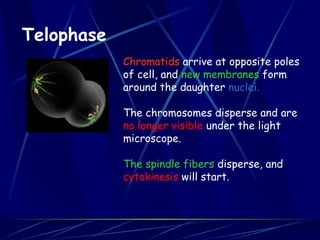
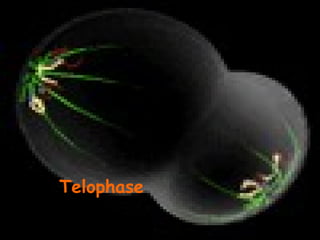
Telophase
Chromatids arrive at opposite poles
of cell, and new membranes form
around the daughter nuclei.
The chromosomes disperse and are
no longer visible under the light
microscope.
The spindle fibers disperse, and
cytokinesis will start.
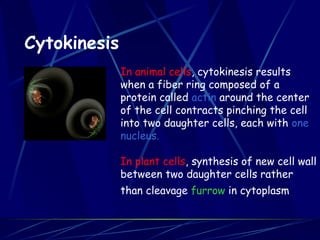
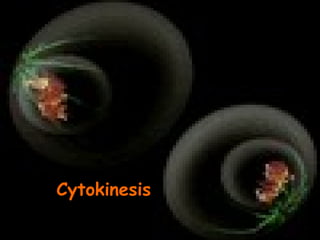
Cytokinesis
In animal cells, cytokinesis results
when a fiber ring composed of a
protein called actin around the center
of the cell contracts pinching the cell
into two daughter cells, each with one
nucleus.
In plant cells, synthesis of new cell wall
between two daughter cells rather
than cleavage furrow in cytoplasm
Interphase
Prophase
Prometaphase
Metaphase
Anaphase
Telophase
Cytokinesis
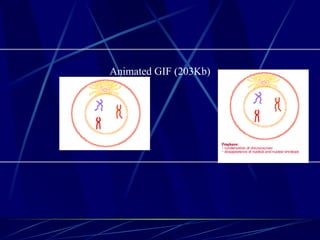
Animated GIF (203Kb)
Reproduction
Asexual reproduction
Sexual reproduction
Asexual Reproduction
A form of duplication using only mitosis.
Example, a new plant grows out of the root
or a shoot from an existing plant.
Produces only genetically identical
offspring since all divisions are by mitosis.
Sexual reproduction
Formation of new individual by a combination
of two haploid sex cells (gametes).
Fertilization- combination of genetic
information from two separate cells that
have one half the original genetic
information
Gametes for fertilization usually come from
separate parents
1. Female- produces an egg
2. Male produces sperm
Both gametes are haploid, with a single
set of chromosomes
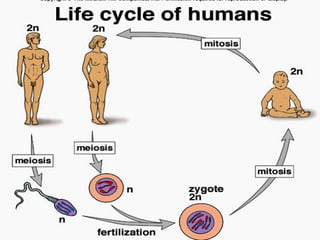
The new individual is called a zygote, with
two sets of chromosomes (diploid).
Meiosis is a process to convert a diploid
cell to a haploid gamete, and cause a
change in the genetic information to
increase diversity in the offspring.
Chromosomes in a Diploid Cell
Summary of chromosome characteristics
Diploid set for humans; 2n = 46
Autosomes; homologous chromosomes, one
from each parent (humans = 22 sets of 2)
Sex chromosomes (humans have 1 set)
1. Female-sex chromosomes are homologous
(XX)
2. Male-sex chromosomes are non-homologous
(XY)
Number of sets of
chromosomes in a cell
Haploid (n)-- one set chromosomes
Diploid (2n)-- two sets chromosomes
Most plant and animal adults are
diploid (2n)
Eggs and sperm are haploid (n)
Most cells in the human body are
produced by mitosis. These are the
somatic (or vegetative) line cells.
Cells that become gametes are referred
to as germ line cells. The vast majority
of cell divisions in the human body are
mitotic, with meiosis being restricted to
the gonads.
Diploid cells
Characteristic number of
chromosome pairs per cell
Homologous chromosomes
Similar in length, shape, other features,
and carry similar attributes
Haploid cells
Contain only one member of each
homologous chromosome pair
Meiosis
Diploid cells undergo meiosis to form
haploid cells
Meiosis potentially produces four
haploid cells
Meiosis involves two separate
divisions
Two successive nuclear divisions occur,
Meiosis I (Reduction) and Meiosis II
(Division).
Meiosis I reduces the ploidy level from 2n
to n (reduction) while Meiosis II divides
the remaining set of chromosomes in a
mitosis-like process (division).
In meiosis, homologous chromosomes
are separated into different daughter
cells
Meiosis I and meiosis II each include
prophase, metaphase, anaphase, and
telophase
The First Division
Meiosis I
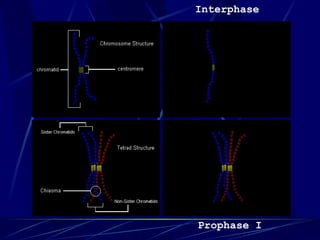
Prophase I is one of the most important
stages of meiosis.
During this stage, many crucial events
occur.
In prophase I,
The spindle appears.
Nuclear envelopes disappear.
The DNA of the chromosomes begin to twist and
condense, making the DNA visible to the
microscope.
Each chromosome actively seeks out its
homologous pair (which also has a sister
chromatid).
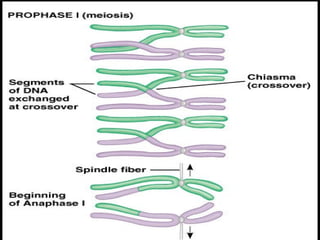
The two replicated homologous pairs find each
other and form a synapse. The structure formed
is referred to as a tetrad (four chromatids).
The point at which the two non-sister chromatids
intertwine is called a chiasma. Sometimes a
process known as crossing over occurs at this
point.
This is where two non-sister chromatids
exchange genetic material. This exchange does
not become evident, however, until the two
homologous pairs separate.
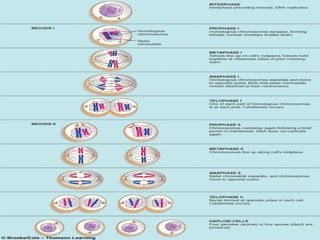
Prophase I includes synapsis and crossing over
Homologous chromosomes pair and undergo
synapsis
One member of a pair is the maternal
homologue, the other is the paternal homologue
Synapsis is the association of four chromatids
(two from each homologue)
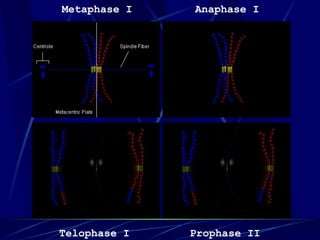
In metaphase I, the tetrads line up along the
equator.
Anaphase I results in the separation of
homologous pairs. Cells are haploid at this
point.
Telophase I results in a brief reappearance
of nuclear envelopes, and the spindle
disappears. The cell waits momentarily
during interkinesis.
Interkinesis separates meiosis I and II; no
DNA synthesis occurs
The Second Division
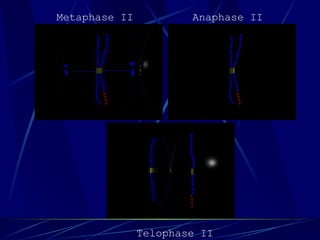
Meiosis II
In prophase II, the spindle reappears, and the
nuclear membrane fragments.
In metaphase II, the chromosomes align at
the equator.
In anaphase II, sister chromatids separate.
In telophase II, the nuclear envelopes
reappear, and four haploid cells are the
result.
Prophase I
Interphase
Prophase II
Telophase I
Anaphase I
Metaphase I
Metaphase II Anaphase II
Telophase II
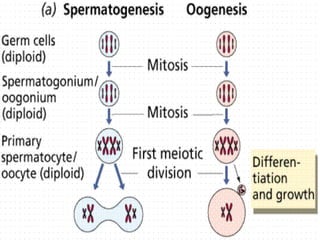
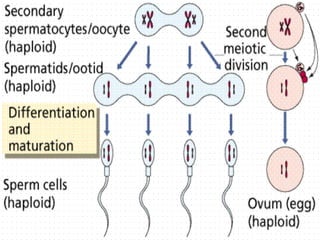
Germ line cells undergo gametogenesis
 Spermatogenesis produces sperm
 Oogenesis typically produces eggs, or a
single ovum and two or more polar bodies
lecture brief discussions for all students

lecture brief discussions for all students

  • 1.
  • 2.
    Eukaryotic chromosomes contain DNAand protein The chromosomes carry the genetic information
  • 6.
     When acell divides, chromatin fibers are very highly folded, and become visible in the light microscope as chromosomes.  During interphase (between divisions), chromatin is more extended, a form used for expression genetic information.
  • 7.
    • DNA isorganized into informational units called genes • Chromosomes contain hundreds to thousands of genes
  • 8.
    Cell Cycle The cellcycle is a sequence of cell growth and division. The cell cycle is the period from the beginning of one division to the beginning of the next. The time it takes to complete one cell cycle is the generation time.
  • 9.
    Cells divide whenthey reach a certain size NO (nerve, skeletal muscle and red blood cells) Cell division involves mitosis and cytokinesis. Mitosis involves division of the chromosomes. Cytokinesis involves division of the cytoplasm. Mitosis without cytokinesis results in multinucleate cells.
  • 10.
    Eukaryotic cell cycle Beginning of one division to beginning of next  Stages in eukaryotic cell cycle  Interphase  First gap phase  Synthesis phase  Second gap phase  M phase  Mitosis  Cytokinesis
  • 12.
    Chromosomes become duplicated duringinterphase Cells are very active during interphase, synthesizing biological molecules and growing the G1 (gap) phase The S (synthesis) phase is marked by DNA replication The G2 (gap) phase occurs between the S phase and mitosis
  • 13.
    Despite differences between prokaryotesand eukaryotes, there are several common features in their cell division processes. Replication of the DNA must occur.  Segregation of the "original" and its "replica" follow. Cytokinesis ends the cell division process. Whether the cell was eukaryotic or prokaryotic, these basic events must occur.
  • 14.
    Hereditary material ispassed on to new cells by mitosis or meiosis Cell division, growth, and reproduction Interphase Mitosis Cytokinesis Meiosis
  • 15.
    Cell division • Chromosomalpackaging of DNA allows efficient distribution of genetic material during cell division • Life cycle requires two distinct types of cell division processes: mitosis and meiosis • Cell division: one cell becomes two cells during an organism’s life cycle
  • 16.
    Mitosis Mitosis is nucleardivision plus cytokinesis, and produces two identical daughter cells during the following steps:  Prophase  Metaphase  Anaphase  Telophase. Interphase is often included in discussions of mitosis, but interphase is technically not part of mitosis, but rather encompasses stages G1, S, and G2 of the cell cycle.
  • 18.
    Interphase The cellis engaged in metabolic activity and performing its prepare for mitosis (the next four phases that lead up to and include nuclear division). Chromosomes are not clearly discerned in the nucleus, although a dark spot called the nucleolus may be visible. The cell may contain a pair of centrioles (or microtubule organizing centers in plants) both of which are organizational sites for microtubules.
  • 19.
    Prophase  Chromatin inthe nucleus begins to condense and becomes visible in the light microscope as chromosomes. The nucleolus disappears. Centrioles begin moving to opposite ends of the cell and fibers extend from the centromeres. Some fibers cross the cell to form the mitotic spindle.
  • 20.
    Prometaphase The nuclear membranedissolves, marking the beginning of prometaphase. Proteins attach to the centromeres creating the kinetochores. Microtubules attach at the kinetochores and the chromosomes begin moving.
  • 21.
    Metaphase Spindle fibersline the chromosomes along the middle of the cell nucleus. This line is referred to as the metaphase plate. Polar microtubules extend from the pole to the equator, and typically overlap Kinetochore microtubules extend from the pole to the kinetochores This organization helps to ensure that in the next phase, when the chromosomes are separated, each new nucleus will receive one copy of each chromosome.
  • 22.
    Anaphase The paired chromosomesseparate at the kinetochores and move to opposite sides of the cell. The chromosomes are pulled by the kinetochore microtubules to the poles and form a "V" shape Motion results from a combination of kinetochore movement along the spindle microtubules and through the physical interaction of polar microtubules.
  • 23.
    Telophase Chromatids arrive atopposite poles of cell, and new membranes form around the daughter nuclei. The chromosomes disperse and are no longer visible under the light microscope. The spindle fibers disperse, and cytokinesis will start.
  • 24.
    Cytokinesis In animal cells,cytokinesis results when a fiber ring composed of a protein called actin around the center of the cell contracts pinching the cell into two daughter cells, each with one nucleus. In plant cells, synthesis of new cell wall between two daughter cells rather than cleavage furrow in cytoplasm
  • 25.
  • 26.
  • 27.
  • 28.
  • 29.
  • 30.
  • 31.
  • 34.
  • 35.
  • 36.
    Asexual Reproduction A formof duplication using only mitosis. Example, a new plant grows out of the root or a shoot from an existing plant. Produces only genetically identical offspring since all divisions are by mitosis.
  • 37.
    Sexual reproduction Formation ofnew individual by a combination of two haploid sex cells (gametes). Fertilization- combination of genetic information from two separate cells that have one half the original genetic information Gametes for fertilization usually come from separate parents
  • 38.
    1. Female- producesan egg 2. Male produces sperm Both gametes are haploid, with a single set of chromosomes The new individual is called a zygote, with two sets of chromosomes (diploid). Meiosis is a process to convert a diploid cell to a haploid gamete, and cause a change in the genetic information to increase diversity in the offspring.
  • 39.
    Chromosomes in aDiploid Cell Summary of chromosome characteristics Diploid set for humans; 2n = 46 Autosomes; homologous chromosomes, one from each parent (humans = 22 sets of 2) Sex chromosomes (humans have 1 set) 1. Female-sex chromosomes are homologous (XX) 2. Male-sex chromosomes are non-homologous (XY)
  • 40.
    Number of setsof chromosomes in a cell Haploid (n)-- one set chromosomes Diploid (2n)-- two sets chromosomes Most plant and animal adults are diploid (2n) Eggs and sperm are haploid (n)
  • 41.
    Most cells inthe human body are produced by mitosis. These are the somatic (or vegetative) line cells. Cells that become gametes are referred to as germ line cells. The vast majority of cell divisions in the human body are mitotic, with meiosis being restricted to the gonads.
  • 42.
    Diploid cells Characteristic numberof chromosome pairs per cell Homologous chromosomes Similar in length, shape, other features, and carry similar attributes Haploid cells Contain only one member of each homologous chromosome pair
  • 44.
    Meiosis Diploid cells undergomeiosis to form haploid cells Meiosis potentially produces four haploid cells Meiosis involves two separate divisions
  • 45.
    Two successive nucleardivisions occur, Meiosis I (Reduction) and Meiosis II (Division). Meiosis I reduces the ploidy level from 2n to n (reduction) while Meiosis II divides the remaining set of chromosomes in a mitosis-like process (division).
  • 46.
    In meiosis, homologouschromosomes are separated into different daughter cells Meiosis I and meiosis II each include prophase, metaphase, anaphase, and telophase
  • 47.
    The First Division MeiosisI Prophase I is one of the most important stages of meiosis. During this stage, many crucial events occur.
  • 48.
    In prophase I, Thespindle appears. Nuclear envelopes disappear. The DNA of the chromosomes begin to twist and condense, making the DNA visible to the microscope. Each chromosome actively seeks out its homologous pair (which also has a sister chromatid).
  • 49.
    The two replicatedhomologous pairs find each other and form a synapse. The structure formed is referred to as a tetrad (four chromatids). The point at which the two non-sister chromatids intertwine is called a chiasma. Sometimes a process known as crossing over occurs at this point. This is where two non-sister chromatids exchange genetic material. This exchange does not become evident, however, until the two homologous pairs separate.
  • 51.
    Prophase I includessynapsis and crossing over Homologous chromosomes pair and undergo synapsis One member of a pair is the maternal homologue, the other is the paternal homologue Synapsis is the association of four chromatids (two from each homologue)
  • 52.
    In metaphase I,the tetrads line up along the equator. Anaphase I results in the separation of homologous pairs. Cells are haploid at this point. Telophase I results in a brief reappearance of nuclear envelopes, and the spindle disappears. The cell waits momentarily during interkinesis. Interkinesis separates meiosis I and II; no DNA synthesis occurs
  • 53.
    The Second Division MeiosisII In prophase II, the spindle reappears, and the nuclear membrane fragments. In metaphase II, the chromosomes align at the equator. In anaphase II, sister chromatids separate. In telophase II, the nuclear envelopes reappear, and four haploid cells are the result.
  • 55.
  • 56.
  • 57.
    Metaphase II AnaphaseII Telophase II
  • 58.
    Germ line cellsundergo gametogenesis  Spermatogenesis produces sperm  Oogenesis typically produces eggs, or a single ovum and two or more polar bodies