Chapter 17
Organizational Design
Learning Goals
• Describe how organizational design
  coordinates activities in an organization and
  gets information to decision makers
• Discuss the contingency factors of
  organizational design
• Distinguish between the organizational
  design effects of strategy, external
  environment, technical process, and size
Learning Goals (Cont.)
• Describe the design features of functional,
  divisional, hybrid, and matrix organization
  forms
• Explain the characteristics of several forms
  of organizations that are likely to evolve in
  the future
Chapter Overview
• Introduction
• The Contingency Factors of Organizational
  Design
• Forms of Organizational Design
• International Aspects of Organizational
  Design
• Ethical Issues in Organizational Design
Introduction
• Organizational design refers to the way
  managers structure their organization to
  reach the organization’s goals
• Structural elements include
  – Allocation of duties, tasks, and responsibilities
    between departments and individuals
  – Reporting relationships
  – Number of levels
Introduction (Cont.)
• Organizational charts show the formal
  design or structure. See text book Figure
  17.1
• An incomplete picture because of informal
  arrangements and underlying behavioral
  processes
• Two basic goals of organizational design
  – Get information to decision makers
  – Coordinate the interdependent parts of an
    organization
The Contingency Factors of
     Organizational Design
• Overview
  – External environment: Includes the
    organization’s competitors, customers,
    suppliers, government, . . .
  – Strategy: The plan for reaching the goals of
    the organization
  – Open systems character of organizations
    tightly couples these two factors
The Contingency Factors of
  Organizational Design (Cont.)
• Overview (cont.)
  – Technical process: The system an
    organization uses to produce its products or
    services
  – Size: The number of organization members
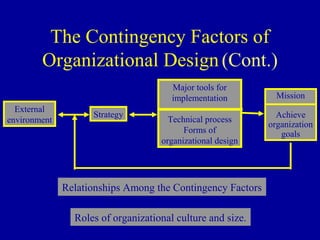
The Contingency Factors of
        Organizational Design (Cont.)
                                       Major tools for
                                       implementation         Mission
  External
                    Strategy                                  Achieve
environment                           Technical process
                                                            organization
                                          Forms of             goals
                                    organizational design


              Relationships Among the Contingency Factors

                Roles of organizational culture and size.
Strategy
• An organization’s strategy describes long-
  term goals and way of reaching the goals
• Describes resource allocation
• Plays a mediating role between the external
  environment and the tools of organizational
  design
  – Note the two headed arrows in the drawings
  – Example: Product innovation response
Strategy (Cont.)
• Strategy’s mediating role in organizational
  design
  – “Structure follows strategy”
  – “Strategy follows structure”
  – In both views, the design of the organization is
    a major tool for carrying out the strategy
Strategy (Cont.)
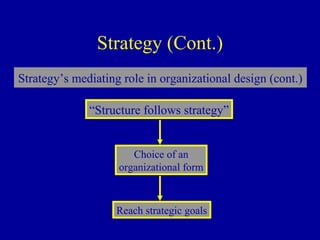
Strategy’s mediating role in organizational design (cont.)

              “Structure follows strategy”


                       Choice of an
                    organizational form


                    Reach strategic goals
Strategy (Cont.)
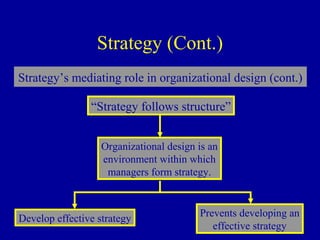
Strategy’s mediating role in organizational design (cont.)

                “Strategy follows structure”


                   Organizational design is an
                   environment within which
                    managers form strategy.


                                         Prevents developing an
Develop effective strategy
                                            effective strategy
External Environment
• Managers assess the uncertainty in the
  external environment when considering
  design decisions
• Can design the organization to increase
  information about the environment
• Or make the organization more flexible in
  its response to the environment
• Information plays a key role because it can
  reduce risk in a manager's predictions about
  the future
External Environment (Cont.)
• Two elements of environmental
  uncertainty
  – Complexity of the external environment.
    Ranges from simple to complex
     • Simple environment has a few similar elements
     • Complex environment has many different elements
External Environment (Cont.)
– Static to dynamic external environment
   • Static external environment is unchanging or slowly
     changing
   • Dynamic external environment is filled with quickly
     moving events that could conflict with each other
   • Degree of change creates uncertainty in predicting
     future states of the environment
External Environment (Cont.)
• Four possible states of the external
  environment
  – Simple-static: lowest uncertainty
  – Complex-dynamic: highest uncertainty
  – Simple-dynamic and complex-static
    environments are about midway between the
    other two
  – Example: Internet commerce has created a
    complex-dynamic environment for much of the
    retail industry
Technical Process
• Conversion of inputs to outputs
• Manufacturing, service, or mental processes
• Affects peoples’ behavior in many ways
  –   Work pace
  –   Worker control
  –   Degree of routine
  –   Predictability
  –   Interdependence within the process
• Various types of technical processes exist
Organization Size
• As size increases, organizations have
  – More formal written rules and procedures
  – More management levels, unless managers
    decentralize
  – More complex organizational forms
  – Higher coordination requirements because of
    complexity
  – Size and technical process: more strongly
    associated with organizational design in small
    organizations than in large organizations
Forms of
       Organizational Design
• Three major forms: functional, divisional,
  and matrix
• Combine functional and divisional designs
  to get a hybrid design
• Several variations of the divisional design
• Several evolving forms of organizational
  design
Organizational Design
           by Function
• Groups tasks of the organization according
  to the activities they perform
• Typically configured into departments such
  as manufacturing, engineering, accounting,
  marketing, . . .
• Functional configurations can vary from
  one organization to another depending on
  tasks and goals
Organizational Design
        by Function (Cont.)
• Strategy: Focused on a few products or
  services in well defined markets with few
  competitors
• External environment: stable, simple, little
  uncertainty
• Technical process: Routine with little
  interdependence with other parts of the
  organization
• Size: Small to medium
Organizational Design
        by Function (Cont.)
• See Figure 17.1 in the text book for an
  example
• Each major functional area helps align the
  company with each sector
• Marketing, for example, focuses on
  customers. It does not manufacture
  products. That is the job of the
  manufacturing function
Organizational Design
        by Function (Cont.)
• Line and staff
  – Line does the major operating tasks
  – Staff gives support and serve in advisory roles.
    Emphasizes technical skills within each
    function
• Individuals work with others who share
  common backgrounds and views
• Homogeneity can lead to narrow views of
  the function’s contribution to the
  organization
Organizational Design
        by Function (Cont.)
• Strengths
  – Specialization
  – Brings specialists together
  – Collegial relationships develop among
    specialists
  – Encourages development of specialized skills
    and information sharing
  – Clear career paths for specialists
Organizational Design
        by Function (Cont.)
• Weaknesses
  – Does not help managers respond quickly to
    external changes
  – Emphasis on specialization promotes a tunnel-
    vision view of the goal of the function
  – Functional design can produce a set of widely
    accepted behaviors and perceptions with the
    organization
Organizational Design
           by Division
• Uses decentralization
• Divisions formed around products, services,
  locations, customers, programs, or technical
  process
• Often evolves from a functional design
• As the external environment changes,
  managers may need to diversify its
  activities to stay competitive
• A common management reaction to large
  organization size
Organizational Design
        by Division (Cont.)
• Strategy: Focused on different products,
  services, customers, or operating locations
• External environment: Complex, fast
  changing, with moderate to high uncertainty
• Technical process: Nonroutine and
  interdependent with others parts of the
  organization
• Size: large
Organizational Design
        by Division (Cont.)
• Emphasizes decision-making autonomy
  throughout the organization
• Has high interpersonal skill demands
  because of extensive contacts with people
  throughout the organization
• Rewards behavior that goes toward the goal
  of decentralization: product, customer,
  service, or location
Organizational Design
        by Division (Cont.)
• Strengths
  – Easily adapts to differences in products,
    services, clients, location, and the like
  – For example, products and differ in how
    manufactured and marketed
  – Products, services, and customers are highly
    visible
  – Often appear in division names
Organizational Design
        by Division (Cont.)
• Weaknesses
  – Loses economies of scale because many
    functions such as accounting are duplicated
    within the divisions
  – Technical specialization is more diffuse
    compared to a functional design
  – Hard to get uniform application of policies and
    procedures across divisions
Hybrid
       Organizational Design
• Hybrid design uses both functions and
  divisions
• Managers use a hybrid design to get the
  benefits and reduce the weaknesses of the
  two configurations
• The divisions decentralize some functions,
  and the headquarters location centralizes
  others
• Centralized functions often are the costly
  ones
Hybrid
  Organizational Design (Cont.)
• People in different parts of the organization
  fulfill different requirements
• Functional areas reward technical expertise
• Functional specialists often support the
  divisions
• Divisions do the primary work of the
  organization
Hybrid
  Organizational Design (Cont.)
• Strategy: Focused on many products or
  services
• External environment: Fast changing,
  moderate to high uncertainty, complex
• Technical process: Both routine and
  nonroutine; high interdependence with
  functions and divisions
• Size: Large
Hybrid
  Organizational Design (Cont.)
• Strengths
  – Focuses on products, services, and customers
  – Adapts well to complex environments
  – Economies of scale: expensive shared
    resources are centralized and support all
    divisions
Hybrid
  Organizational Design (Cont.)
• Weaknesses
  – Focus on division goals can lose total
    organization view
  – Non-uniform application of organizational
    policies
  – Potential for high administrative overhead if
    staff expands without control
  – Potential conflict between division managers
    and corporate headquarters. Managers want
    autonomy; headquarters wants control
Matrix
       Organizational Design
• Used when two sectors of the external
  environment demand management attention
• Typically responding to the customer and
  technical parts of the environment
  – Customers have special needs
  – Technology changes fast
• Emerged during the 1950s within the U.S.
  aerospace industry
Matrix
  Organizational Design (Cont.)
• Rejects the unity of command principal
  described in Chapter 1 of the text book
• Uses multiple authority structures, so that
  many people report to two managers
• People from different functional areas work
  on various projects
Matrix
  Organizational Design (Cont.)
• Each person has at least two supervisors or
  managers. One supervisor is in the
  functional area and the other is in a project
• Mixture of people from the functional areas
  varies according the project needs
• Multiple reporting relationships are a basic
  feature of matrix organizations
       See text book Figure 17.3 for a simplified
             matrix organizational design.
Matrix
  Organizational Design (Cont.)
• Conditions under which an organization
  may choose a matrix design
  – Pressures from the external environment for a
    dual focus
  – High uncertainty within the multiple sectors
    of the external environment
  – Constraints on human and physical resources
Matrix
  Organizational Design (Cont.)
• High conflict potential because of multiple
  authority relationships
• Managers need well-developed conflict
  management skills
• Demand high levels of coordination,
  cooperation, and communication
• Requires high levels of interpersonal skill
Matrix
  Organizational Design (Cont.)
• Different matrix uses and forms
  – Within specific functional areas such as
    marketing. Managers responsible for a brand
    or group of brands bring all marketing skills
    together to focus on the products
  – Temporary forms for specific projects
  – Permanent forms for the organization’s on-
    going work
Matrix
  Organizational Design (Cont.)
• Strengths
  – Responsive, flexible, efficient use of costly
    resources
  – Potentially high levels of human motivation
    and involvement
  – Managers can respond fast to market changes
  – Shares scarce and expensive resources
  – People get information about a total project, not
    only about their specialty
Matrix
  Organizational Design (Cont.)
• Weaknesses
  – High levels of ambiguity because of multiple
    authority relationships
  – Ambiguity can encourage power struggles
    among managers
  – Multiple authority relationships can give
    opposing demands to people
  – High conflict potential can reach dysfunctional
    levels and act as significant stressors for people
    in matrix organizations
Evolving Forms of
       Organizational Design
• Several new forms of organizational design
  – Self-managing teams, a team-based approach
  – A process view of organizational design
    focuses on work processes
  – The virtual organization. This unusual form
    links widely scattered organizations into a
    network
Self-Managing Teams
• Customer focus and fast changing
  environments require decisions at lower
  levels in an organization
• Decentralizes decision authority in the
  teams
• Decision authority in these teams can focus
  on customers, processes, and product design
Self-Managing Teams (Cont.)
• Often cross-functional membership
• Helps flatten an organization by removing a
  layer of management
• Results in a nimble organization that can
  respond to fast changing customer needs
A Process View of
       Organizational Design
• Discards the view of packaging duties and
  tasks along functional or divisional lines
• The organization is a set of interconnected
  processes that weave across multiple
  functions
• Focuses on the results of a process not on
  people’s skills or functions
• People have responsibility for all or part of
  a process with decision authority over those
  parts
The Virtual Organization
• A temporary network of companies or
  people that focus on reaching a specific
  target
• Information technology links members into
  a network no matter where they are in the
  world
• Enter agreements to get needed skills or
  resources
• Little direct control over functions done by
  other members of the network
The Virtual Organization (Cont.)
• Features a need for high trust among
  members
• Need conflict management and negotiation
  skills
• Interdependent in reaching a mutually
  desired goal
International Aspects
     of Organizational Design
• The international context of organizations
  increases environmental complexity
• Varying cultural orientations and laws
  introduce high uncertainty in the external
  environment
• Functional and divisional designs are more
  congruent with cultures that want to avoid
  uncertainty and accept hierarchical
  relationships (Latin American countries and
  Japan)
International Aspects
of Organizational Design (Cont.)
• Matrix organizations do not work well in
  countries that avoid ambiguity (Belgium,
  France, and Italy)
• Self-managing teams work well in countries
  with socially oriented values (Sweden and
  Norway)
• Virtual organizations use communications
  and computer technology to span national
  boundaries
Ethical Issues and
       Organizational Design
• Lobbying activities can change an
  organization’s external environment. Both
  legal and ethical in the United States
• Bribing government officials is illegal
  under U.S. law
• Introducing new technologies can displace
  workers and cause stress among those who
  need to learn the technology
Ethical Issues and
  Organizational Design (Cont.)
• Ethical issues about reducing the size of an
  organization and increasing its efficiency.
  A utilitarian analysis looks at the net
  benefits of management’s actions
• High conflict and ambiguity of matrix
  organizations can act as a significant
  stressor
• Moving to the alternative forms is large-
  scale organizational change and stress for
  many people

Ch17

  • 1.
  • 2.
    Learning Goals • Describehow organizational design coordinates activities in an organization and gets information to decision makers • Discuss the contingency factors of organizational design • Distinguish between the organizational design effects of strategy, external environment, technical process, and size
  • 3.
    Learning Goals (Cont.) •Describe the design features of functional, divisional, hybrid, and matrix organization forms • Explain the characteristics of several forms of organizations that are likely to evolve in the future
  • 4.
    Chapter Overview • Introduction •The Contingency Factors of Organizational Design • Forms of Organizational Design • International Aspects of Organizational Design • Ethical Issues in Organizational Design
  • 5.
    Introduction • Organizational designrefers to the way managers structure their organization to reach the organization’s goals • Structural elements include – Allocation of duties, tasks, and responsibilities between departments and individuals – Reporting relationships – Number of levels
  • 6.
    Introduction (Cont.) • Organizationalcharts show the formal design or structure. See text book Figure 17.1 • An incomplete picture because of informal arrangements and underlying behavioral processes • Two basic goals of organizational design – Get information to decision makers – Coordinate the interdependent parts of an organization
  • 7.
    The Contingency Factorsof Organizational Design • Overview – External environment: Includes the organization’s competitors, customers, suppliers, government, . . . – Strategy: The plan for reaching the goals of the organization – Open systems character of organizations tightly couples these two factors
  • 8.
    The Contingency Factorsof Organizational Design (Cont.) • Overview (cont.) – Technical process: The system an organization uses to produce its products or services – Size: The number of organization members
  • 9.
    The Contingency Factorsof Organizational Design (Cont.) Major tools for implementation Mission External Strategy Achieve environment Technical process organization Forms of goals organizational design Relationships Among the Contingency Factors Roles of organizational culture and size.
  • 10.
    Strategy • An organization’sstrategy describes long- term goals and way of reaching the goals • Describes resource allocation • Plays a mediating role between the external environment and the tools of organizational design – Note the two headed arrows in the drawings – Example: Product innovation response
  • 11.
    Strategy (Cont.) • Strategy’smediating role in organizational design – “Structure follows strategy” – “Strategy follows structure” – In both views, the design of the organization is a major tool for carrying out the strategy
  • 12.
    Strategy (Cont.) Strategy’s mediatingrole in organizational design (cont.) “Structure follows strategy” Choice of an organizational form Reach strategic goals
  • 13.
    Strategy (Cont.) Strategy’s mediatingrole in organizational design (cont.) “Strategy follows structure” Organizational design is an environment within which managers form strategy. Prevents developing an Develop effective strategy effective strategy
  • 14.
    External Environment • Managersassess the uncertainty in the external environment when considering design decisions • Can design the organization to increase information about the environment • Or make the organization more flexible in its response to the environment • Information plays a key role because it can reduce risk in a manager's predictions about the future
  • 15.
    External Environment (Cont.) •Two elements of environmental uncertainty – Complexity of the external environment. Ranges from simple to complex • Simple environment has a few similar elements • Complex environment has many different elements
  • 16.
    External Environment (Cont.) –Static to dynamic external environment • Static external environment is unchanging or slowly changing • Dynamic external environment is filled with quickly moving events that could conflict with each other • Degree of change creates uncertainty in predicting future states of the environment
  • 17.
    External Environment (Cont.) •Four possible states of the external environment – Simple-static: lowest uncertainty – Complex-dynamic: highest uncertainty – Simple-dynamic and complex-static environments are about midway between the other two – Example: Internet commerce has created a complex-dynamic environment for much of the retail industry
  • 18.
    Technical Process • Conversionof inputs to outputs • Manufacturing, service, or mental processes • Affects peoples’ behavior in many ways – Work pace – Worker control – Degree of routine – Predictability – Interdependence within the process • Various types of technical processes exist
  • 19.
    Organization Size • Assize increases, organizations have – More formal written rules and procedures – More management levels, unless managers decentralize – More complex organizational forms – Higher coordination requirements because of complexity – Size and technical process: more strongly associated with organizational design in small organizations than in large organizations
  • 20.
    Forms of Organizational Design • Three major forms: functional, divisional, and matrix • Combine functional and divisional designs to get a hybrid design • Several variations of the divisional design • Several evolving forms of organizational design
  • 21.
    Organizational Design by Function • Groups tasks of the organization according to the activities they perform • Typically configured into departments such as manufacturing, engineering, accounting, marketing, . . . • Functional configurations can vary from one organization to another depending on tasks and goals
  • 22.
    Organizational Design by Function (Cont.) • Strategy: Focused on a few products or services in well defined markets with few competitors • External environment: stable, simple, little uncertainty • Technical process: Routine with little interdependence with other parts of the organization • Size: Small to medium
  • 23.
    Organizational Design by Function (Cont.) • See Figure 17.1 in the text book for an example • Each major functional area helps align the company with each sector • Marketing, for example, focuses on customers. It does not manufacture products. That is the job of the manufacturing function
  • 24.
    Organizational Design by Function (Cont.) • Line and staff – Line does the major operating tasks – Staff gives support and serve in advisory roles. Emphasizes technical skills within each function • Individuals work with others who share common backgrounds and views • Homogeneity can lead to narrow views of the function’s contribution to the organization
  • 25.
    Organizational Design by Function (Cont.) • Strengths – Specialization – Brings specialists together – Collegial relationships develop among specialists – Encourages development of specialized skills and information sharing – Clear career paths for specialists
  • 26.
    Organizational Design by Function (Cont.) • Weaknesses – Does not help managers respond quickly to external changes – Emphasis on specialization promotes a tunnel- vision view of the goal of the function – Functional design can produce a set of widely accepted behaviors and perceptions with the organization
  • 27.
    Organizational Design by Division • Uses decentralization • Divisions formed around products, services, locations, customers, programs, or technical process • Often evolves from a functional design • As the external environment changes, managers may need to diversify its activities to stay competitive • A common management reaction to large organization size
  • 28.
    Organizational Design by Division (Cont.) • Strategy: Focused on different products, services, customers, or operating locations • External environment: Complex, fast changing, with moderate to high uncertainty • Technical process: Nonroutine and interdependent with others parts of the organization • Size: large
  • 29.
    Organizational Design by Division (Cont.) • Emphasizes decision-making autonomy throughout the organization • Has high interpersonal skill demands because of extensive contacts with people throughout the organization • Rewards behavior that goes toward the goal of decentralization: product, customer, service, or location
  • 30.
    Organizational Design by Division (Cont.) • Strengths – Easily adapts to differences in products, services, clients, location, and the like – For example, products and differ in how manufactured and marketed – Products, services, and customers are highly visible – Often appear in division names
  • 31.
    Organizational Design by Division (Cont.) • Weaknesses – Loses economies of scale because many functions such as accounting are duplicated within the divisions – Technical specialization is more diffuse compared to a functional design – Hard to get uniform application of policies and procedures across divisions
  • 32.
    Hybrid Organizational Design • Hybrid design uses both functions and divisions • Managers use a hybrid design to get the benefits and reduce the weaknesses of the two configurations • The divisions decentralize some functions, and the headquarters location centralizes others • Centralized functions often are the costly ones
  • 33.
    Hybrid OrganizationalDesign (Cont.) • People in different parts of the organization fulfill different requirements • Functional areas reward technical expertise • Functional specialists often support the divisions • Divisions do the primary work of the organization
  • 34.
    Hybrid OrganizationalDesign (Cont.) • Strategy: Focused on many products or services • External environment: Fast changing, moderate to high uncertainty, complex • Technical process: Both routine and nonroutine; high interdependence with functions and divisions • Size: Large
  • 35.
    Hybrid OrganizationalDesign (Cont.) • Strengths – Focuses on products, services, and customers – Adapts well to complex environments – Economies of scale: expensive shared resources are centralized and support all divisions
  • 36.
    Hybrid OrganizationalDesign (Cont.) • Weaknesses – Focus on division goals can lose total organization view – Non-uniform application of organizational policies – Potential for high administrative overhead if staff expands without control – Potential conflict between division managers and corporate headquarters. Managers want autonomy; headquarters wants control
  • 37.
    Matrix Organizational Design • Used when two sectors of the external environment demand management attention • Typically responding to the customer and technical parts of the environment – Customers have special needs – Technology changes fast • Emerged during the 1950s within the U.S. aerospace industry
  • 38.
    Matrix OrganizationalDesign (Cont.) • Rejects the unity of command principal described in Chapter 1 of the text book • Uses multiple authority structures, so that many people report to two managers • People from different functional areas work on various projects
  • 39.
    Matrix OrganizationalDesign (Cont.) • Each person has at least two supervisors or managers. One supervisor is in the functional area and the other is in a project • Mixture of people from the functional areas varies according the project needs • Multiple reporting relationships are a basic feature of matrix organizations See text book Figure 17.3 for a simplified matrix organizational design.
  • 40.
    Matrix OrganizationalDesign (Cont.) • Conditions under which an organization may choose a matrix design – Pressures from the external environment for a dual focus – High uncertainty within the multiple sectors of the external environment – Constraints on human and physical resources
  • 41.
    Matrix OrganizationalDesign (Cont.) • High conflict potential because of multiple authority relationships • Managers need well-developed conflict management skills • Demand high levels of coordination, cooperation, and communication • Requires high levels of interpersonal skill
  • 42.
    Matrix OrganizationalDesign (Cont.) • Different matrix uses and forms – Within specific functional areas such as marketing. Managers responsible for a brand or group of brands bring all marketing skills together to focus on the products – Temporary forms for specific projects – Permanent forms for the organization’s on- going work
  • 43.
    Matrix OrganizationalDesign (Cont.) • Strengths – Responsive, flexible, efficient use of costly resources – Potentially high levels of human motivation and involvement – Managers can respond fast to market changes – Shares scarce and expensive resources – People get information about a total project, not only about their specialty
  • 44.
    Matrix OrganizationalDesign (Cont.) • Weaknesses – High levels of ambiguity because of multiple authority relationships – Ambiguity can encourage power struggles among managers – Multiple authority relationships can give opposing demands to people – High conflict potential can reach dysfunctional levels and act as significant stressors for people in matrix organizations
  • 45.
    Evolving Forms of Organizational Design • Several new forms of organizational design – Self-managing teams, a team-based approach – A process view of organizational design focuses on work processes – The virtual organization. This unusual form links widely scattered organizations into a network
  • 46.
    Self-Managing Teams • Customerfocus and fast changing environments require decisions at lower levels in an organization • Decentralizes decision authority in the teams • Decision authority in these teams can focus on customers, processes, and product design
  • 47.
    Self-Managing Teams (Cont.) •Often cross-functional membership • Helps flatten an organization by removing a layer of management • Results in a nimble organization that can respond to fast changing customer needs
  • 48.
    A Process Viewof Organizational Design • Discards the view of packaging duties and tasks along functional or divisional lines • The organization is a set of interconnected processes that weave across multiple functions • Focuses on the results of a process not on people’s skills or functions • People have responsibility for all or part of a process with decision authority over those parts
  • 49.
    The Virtual Organization •A temporary network of companies or people that focus on reaching a specific target • Information technology links members into a network no matter where they are in the world • Enter agreements to get needed skills or resources • Little direct control over functions done by other members of the network
  • 50.
    The Virtual Organization(Cont.) • Features a need for high trust among members • Need conflict management and negotiation skills • Interdependent in reaching a mutually desired goal
  • 51.
    International Aspects of Organizational Design • The international context of organizations increases environmental complexity • Varying cultural orientations and laws introduce high uncertainty in the external environment • Functional and divisional designs are more congruent with cultures that want to avoid uncertainty and accept hierarchical relationships (Latin American countries and Japan)
  • 52.
    International Aspects of OrganizationalDesign (Cont.) • Matrix organizations do not work well in countries that avoid ambiguity (Belgium, France, and Italy) • Self-managing teams work well in countries with socially oriented values (Sweden and Norway) • Virtual organizations use communications and computer technology to span national boundaries
  • 53.
    Ethical Issues and Organizational Design • Lobbying activities can change an organization’s external environment. Both legal and ethical in the United States • Bribing government officials is illegal under U.S. law • Introducing new technologies can displace workers and cause stress among those who need to learn the technology
  • 54.
    Ethical Issues and Organizational Design (Cont.) • Ethical issues about reducing the size of an organization and increasing its efficiency. A utilitarian analysis looks at the net benefits of management’s actions • High conflict and ambiguity of matrix organizations can act as a significant stressor • Moving to the alternative forms is large- scale organizational change and stress for many people

Editor's Notes

  • #2 24 April 1997 1 Chapter 17: Organizational Design: Contingency and Configuration Views