
(A Basic Approach)
Engr. Jed G. Concepcion
Business Development
Process Improvement
Engineering
Construction
Software Development
Computer Hardware
Communication
Other related field
Concerned with activities involved
in ensuring that project is delivered
on time and on schedule and in
accordance with the requirements
of the organisations.
Project management is needed
because project development is
always subject to budget and
schedule constraints that are set by
the organisation.
A systematic approach of a
project for the purpose of
smooth delivery of output.
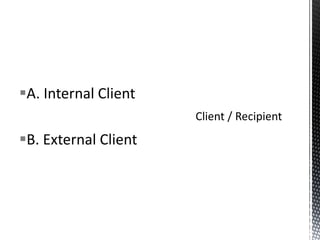
A. Internal Client
B. External Client
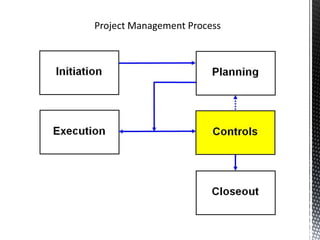
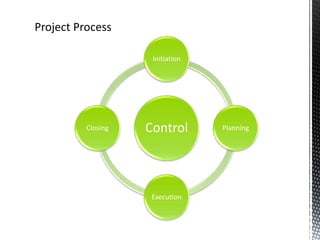
Control
Initiation
Planning
Execution
Closing
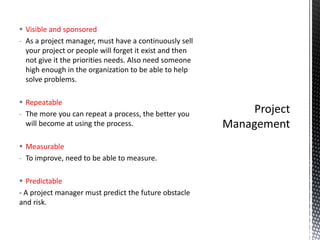
 Visible and sponsored
- As a project manager, must have a continuously sell
your project or people will forget it exist and then
not give it the priorities needs. Also need someone
high enough in the organization to be able to help
solve problems.
 Repeatable
- The more you can repeat a process, the better you
will become at using the process.
 Measurable
- To improve, need to be able to measure.
 Predictable
- A project manager must predict the future obstacle
and risk.
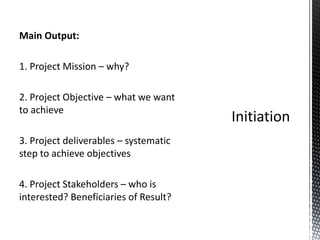
Main Output:
1. Project Mission – why?
2. Project Objective – what we want
to achieve
3. Project deliverables – systematic
step to achieve objectives
4. Project Stakeholders – who is
interested? Beneficiaries of Result?
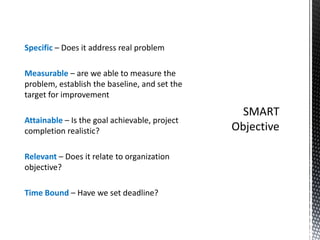
Specific – Does it address real problem
Measurable – are we able to measure the
problem, establish the baseline, and set the
target for improvement
Attainable – Is the goal achievable, project
completion realistic?
Relevant – Does it relate to organization
objective?
Time Bound – Have we set deadline?
Output:
Project Schedule
Project Path / Analysis
Work Breakdown
Resource Management
 Project Management Approach
 Work Breakdown Structure (to the level at
which control will be exercise)
 Budget
 Scheduled start and finish date
 Responsibility Chart / Assignment
 Change Control Plan / System
 Performance Measurement Baselines
 Major Milestone and their target dates
 Resources
 Risk Management Plan
 Open Issues
 Pending Decision
 Project Organization chart
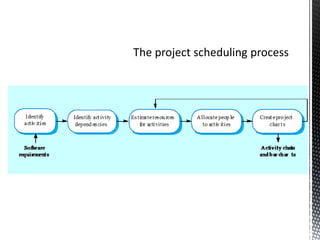
Probably the most time-consuming
project management activity.
Continuous activity from initial
concept through to system
delivery. Plans must be regularly
revised as new information
becomes available.
Various different types of plan may
be developed to support the main
project plan that is concerned with
schedule and budget.
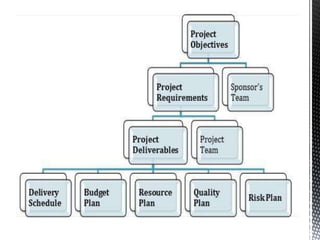
The project plan sets out:
The resources available to the
project;
The work breakdown;
A schedule for the work.
 May not be possible to appoint the
ideal people to work on a project
 Project budget may not allow for the
use of highly-paid staff;
 Staff with the appropriate experience
may not be available;
 An organisation may wish to develop
employee skills on a project.
 Managers have to work within these
constraints especially when there
are shortages of trained staff.
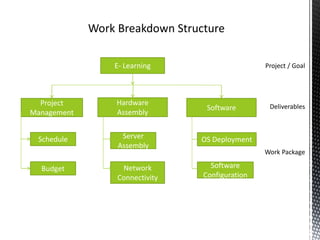
E- Learning
Project
Management
Hardware
Assembly
Software
Schedule
Budget
Server
Assembly
Network
Connectivity
OS Deployment
Software
Configuration
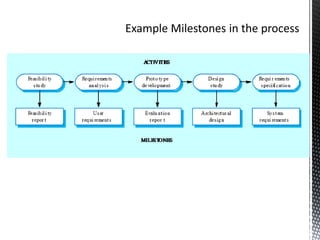
Activities in a project should be
organised to produce tangible
outputs for management to judge
progress.
Milestones are the end-point of a
process activity.
Deliverables are project results
delivered to customers.
The waterfall process allows for the
straightforward definition of
progress milestones.
Split project into tasks and estimate
time and resources required to
complete each task.
Organize tasks concurrently to make
optimal use of workforce.
Minimize task dependencies to
avoid delays caused by one task
waiting for another to complete.
Dependent on project managers
intuition and experience.
Estimating the difficulty of problems
and hence the cost of developing a
solution is hard.
Productivity is not proportional to the
number of people working on a task.
Adding people to a late project makes
it later because of communication
overheads.
The unexpected always happens.
Always allow contingency in planning
(plan B).
Graphical notations used to
illustrate the project schedule.
Show project breakdown into
tasks. Tasks should not be too
small. They should take about a
week or two.
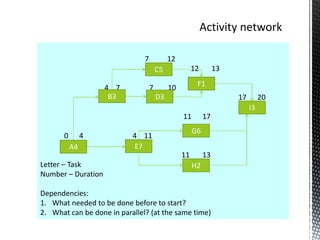
Activity charts show task
dependencies and the critical path.
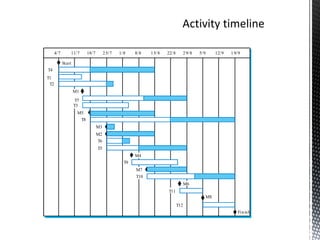
Bar charts show schedule against
calendar time.
7 12
12 13
4 7 7 10
17 20
11 17
0 4 4 11
11 13
Letter – Task
Number – Duration
Dependencies:
1. What needed to be done before to start?
2. What can be done in parallel? (at the same time)
A4
B3
E7
C5
D3
F1
G6
H2
I3
Two Success Factor
1. Critical Path – the path through the
network where the task have “ No
Float”. If any one of these tasks
even one day late, it will delay the
whole project. These are the “
Critical Task”
2. Float – those task that are NOT on
the critical path will more flexibility
in when you can start them.
4/7 11/7 18/7 25/7 1/8 8/8 15/8 22/8 29/8 5/9 12/9 19/9
T4
T1
T2
M1
T7
T3
M5
T8
M3
M2
T6
T5
M4
T9
M7
T10
M6
T11
M8
T12
Start
Finish
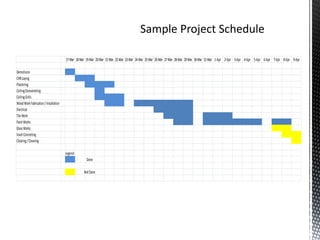
17-Mar 18-Mar 19-Mar 20-Mar 21-Mar 22-Mar 23-Mar 24-Mar 25-Mar 26-Mar 27-Mar 28-Mar 29-Mar 30-Mar 31-Mar 1-Apr 2-Apr 3-Apr 4-Apr 5-Apr 6-Apr 7-Apr 8-Apr 9-Apr
Demolision
CHBLaying
Plastering
CeilingDismanteling
CeilingGrills
WoodWorkFabrication/Installation
Electrical
TileWork
PaintWorks
GlassWorks
VaultConcreting
Clearing/Cleaning
Legend:
Done
NotDone
Risk management is concerned with
identifying risks and drawing up plans to
minimise their effect on a project.
A risk is a probability that some adverse
circumstance will occur
Project risks affect schedule or
resources;
Product risks affect the quality or
performance of project being
developed;
Business risks affect the organisation
developing or procuring.
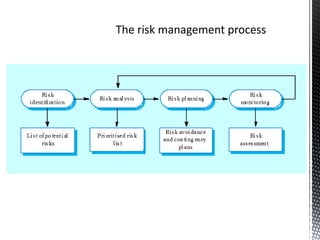
Risk identification
Identify project, product and
business risks;
Risk analysis
Assess the likelihood and
consequences of these risks;
Risk planning
Draw up plans to avoid or minimise
the effects of the risk;
Risk monitoring
Monitor the risks throughout the
project;
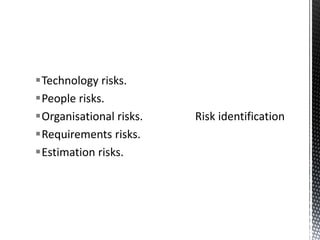
Technology risks.
People risks.
Organisational risks.
Requirements risks.
Estimation risks.
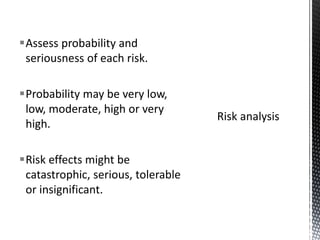
Assess probability and
seriousness of each risk.
Probability may be very low,
low, moderate, high or very
high.
Risk effects might be
catastrophic, serious, tolerable
or insignificant.
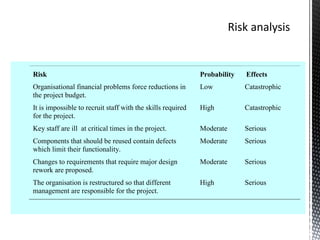
Risk Probability Effects
Organisational financial problems force reductions in
the project budget.
Low Catastrophic
It is impossible to recruit staff with the skills required
for the project.
High Catastrophic
Key staff are ill at critical times in the project. Moderate Serious
Components that should be reused contain defects
which limit their functionality.
Moderate Serious
Changes to requirements that require major design
rework are proposed.
Moderate Serious
The organisation is restructured so that different
management are responsible for the project.
High Serious
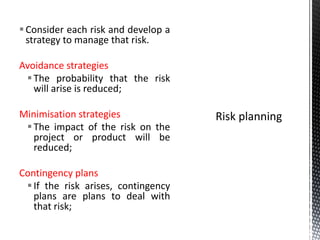
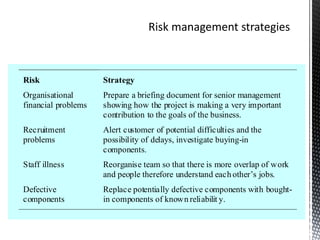
Consider each risk and develop a
strategy to manage that risk.
Avoidance strategies
The probability that the risk
will arise is reduced;
Minimisation strategies
The impact of the risk on the
project or product will be
reduced;
Contingency plans
If the risk arises, contingency
plans are plans to deal with
that risk;
Risk Strategy
Organisational
financial problems
Prepare a briefing document for senior management
showing how the project is making a very important
contribution to the goals of the business.
Recruitment
problems
Alert customer of potential difficulties and the
possibility of delays, investigate buying-in
components.
Staff illness Reorganise team so that there is more overlap of work
and people therefore understand each other’s jobs.
Defective
components
Replace potentially defective components with bought-
in components of known reliabilit y.
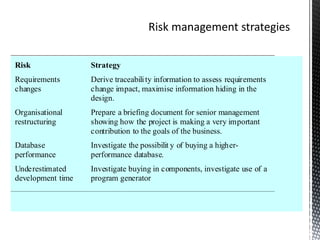
Risk Strategy
Requirements
changes
Derive traceability information to assess requirements
change impact, maximise information hiding in the
design.
Organisational
restructuring
Prepare a briefing document for senior management
showing how the project is making a very important
contribution to the goals of the business.
Database
performance
Investigate the possibilit y of buying a higher-
performance database.
Underestimated
development time
Investigate buying in components, investigate use of a
program generator
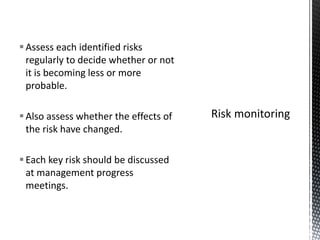
Assess each identified risks
regularly to decide whether or not
it is becoming less or more
probable.
Also assess whether the effects of
the risk have changed.
Each key risk should be discussed
at management progress
meetings.
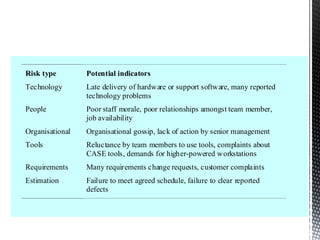
Risk type Potential indicators
Technology Late delivery of hardware or support software, many reported
technology problems
People Poor staff morale, poor relationships amongst team member,
job availability
Organisational Organisational gossip, lack of action by senior management
Tools Reluctance by team members to use tools, complaints about
CASE tools, demands for higher-powered workstations
Requirements Many requirements change requests, customer complaints
Estimation Failure to meet agreed schedule, failure to clear reported
defects
OUTPUT:
Confirmation of completion
(Delay or on time)
Rework / Change
Management
Means coordinating,
communicating, listening, checking
and confirming the following:
Quality
Risks
Issues
Cost
Schedule
What is in a good management progress
report?
 Task on critical path achieved this week
 Task on critical path that are late this
week
 Changes to the critical path
 Other task achieved this week
 Other tasks late this week
 Planned task for next week
 High Level issues and their resolution plan
 High level risk and their resolution plan
You only given 1 month and the
president of the company want
you to handle a small project that
will set-up the company network
and upgrade all workstations.
You are assigned as a project
manager to a million peso
project which will create a
enterprise data center to a
leading telephone company in
the Philippines. You have been
given a 5 months to turn over
the said data center.
 Good project management is
essential for project success.
 The intangible nature of software
causes problems for management.
 Managers have diverse roles but their
most significant activities are
planning, estimating and scheduling.
 Planning and estimating are iterative
processes which continue throughout
the course of a project.
A project milestone is a predictable
state where a formal report of
progress is presented to
management.
Project scheduling involves
preparing various graphical
representations showing project
activities, their durations and
staffing.
Risk management is concerned with
identifying risks which may affect the
project and planning to ensure that
these risks do not develop into
major threats.
Project management (A Basic Approach)

Project management (A Basic Approach)

  • 1.
    (A Basic Approach) Engr.Jed G. Concepcion
  • 2.
    Business Development Process Improvement Engineering Construction SoftwareDevelopment Computer Hardware Communication Other related field
  • 4.
    Concerned with activitiesinvolved in ensuring that project is delivered on time and on schedule and in accordance with the requirements of the organisations. Project management is needed because project development is always subject to budget and schedule constraints that are set by the organisation. A systematic approach of a project for the purpose of smooth delivery of output.
  • 5.
  • 8.
  • 9.
     Visible andsponsored - As a project manager, must have a continuously sell your project or people will forget it exist and then not give it the priorities needs. Also need someone high enough in the organization to be able to help solve problems.  Repeatable - The more you can repeat a process, the better you will become at using the process.  Measurable - To improve, need to be able to measure.  Predictable - A project manager must predict the future obstacle and risk.
  • 10.
    Main Output: 1. ProjectMission – why? 2. Project Objective – what we want to achieve 3. Project deliverables – systematic step to achieve objectives 4. Project Stakeholders – who is interested? Beneficiaries of Result?
  • 11.
    Specific – Doesit address real problem Measurable – are we able to measure the problem, establish the baseline, and set the target for improvement Attainable – Is the goal achievable, project completion realistic? Relevant – Does it relate to organization objective? Time Bound – Have we set deadline?
  • 12.
    Output: Project Schedule Project Path/ Analysis Work Breakdown Resource Management
  • 13.
     Project ManagementApproach  Work Breakdown Structure (to the level at which control will be exercise)  Budget  Scheduled start and finish date  Responsibility Chart / Assignment  Change Control Plan / System  Performance Measurement Baselines  Major Milestone and their target dates  Resources  Risk Management Plan  Open Issues  Pending Decision  Project Organization chart
  • 15.
    Probably the mosttime-consuming project management activity. Continuous activity from initial concept through to system delivery. Plans must be regularly revised as new information becomes available. Various different types of plan may be developed to support the main project plan that is concerned with schedule and budget.
  • 16.
    The project plansets out: The resources available to the project; The work breakdown; A schedule for the work.
  • 17.
     May notbe possible to appoint the ideal people to work on a project  Project budget may not allow for the use of highly-paid staff;  Staff with the appropriate experience may not be available;  An organisation may wish to develop employee skills on a project.  Managers have to work within these constraints especially when there are shortages of trained staff.
  • 18.
  • 19.
    Activities in aproject should be organised to produce tangible outputs for management to judge progress. Milestones are the end-point of a process activity. Deliverables are project results delivered to customers. The waterfall process allows for the straightforward definition of progress milestones.
  • 21.
    Split project intotasks and estimate time and resources required to complete each task. Organize tasks concurrently to make optimal use of workforce. Minimize task dependencies to avoid delays caused by one task waiting for another to complete. Dependent on project managers intuition and experience.
  • 23.
    Estimating the difficultyof problems and hence the cost of developing a solution is hard. Productivity is not proportional to the number of people working on a task. Adding people to a late project makes it later because of communication overheads. The unexpected always happens. Always allow contingency in planning (plan B).
  • 24.
    Graphical notations usedto illustrate the project schedule. Show project breakdown into tasks. Tasks should not be too small. They should take about a week or two. Activity charts show task dependencies and the critical path. Bar charts show schedule against calendar time.
  • 25.
    7 12 12 13 47 7 10 17 20 11 17 0 4 4 11 11 13 Letter – Task Number – Duration Dependencies: 1. What needed to be done before to start? 2. What can be done in parallel? (at the same time) A4 B3 E7 C5 D3 F1 G6 H2 I3
  • 26.
    Two Success Factor 1.Critical Path – the path through the network where the task have “ No Float”. If any one of these tasks even one day late, it will delay the whole project. These are the “ Critical Task” 2. Float – those task that are NOT on the critical path will more flexibility in when you can start them.
  • 27.
    4/7 11/7 18/725/7 1/8 8/8 15/8 22/8 29/8 5/9 12/9 19/9 T4 T1 T2 M1 T7 T3 M5 T8 M3 M2 T6 T5 M4 T9 M7 T10 M6 T11 M8 T12 Start Finish
  • 28.
    17-Mar 18-Mar 19-Mar20-Mar 21-Mar 22-Mar 23-Mar 24-Mar 25-Mar 26-Mar 27-Mar 28-Mar 29-Mar 30-Mar 31-Mar 1-Apr 2-Apr 3-Apr 4-Apr 5-Apr 6-Apr 7-Apr 8-Apr 9-Apr Demolision CHBLaying Plastering CeilingDismanteling CeilingGrills WoodWorkFabrication/Installation Electrical TileWork PaintWorks GlassWorks VaultConcreting Clearing/Cleaning Legend: Done NotDone
  • 29.
    Risk management isconcerned with identifying risks and drawing up plans to minimise their effect on a project. A risk is a probability that some adverse circumstance will occur Project risks affect schedule or resources; Product risks affect the quality or performance of project being developed; Business risks affect the organisation developing or procuring.
  • 30.
    Risk identification Identify project,product and business risks; Risk analysis Assess the likelihood and consequences of these risks; Risk planning Draw up plans to avoid or minimise the effects of the risk; Risk monitoring Monitor the risks throughout the project;
  • 32.
    Technology risks. People risks. Organisationalrisks. Requirements risks. Estimation risks.
  • 33.
    Assess probability and seriousnessof each risk. Probability may be very low, low, moderate, high or very high. Risk effects might be catastrophic, serious, tolerable or insignificant.
  • 34.
    Risk Probability Effects Organisationalfinancial problems force reductions in the project budget. Low Catastrophic It is impossible to recruit staff with the skills required for the project. High Catastrophic Key staff are ill at critical times in the project. Moderate Serious Components that should be reused contain defects which limit their functionality. Moderate Serious Changes to requirements that require major design rework are proposed. Moderate Serious The organisation is restructured so that different management are responsible for the project. High Serious
  • 35.
    Consider each riskand develop a strategy to manage that risk. Avoidance strategies The probability that the risk will arise is reduced; Minimisation strategies The impact of the risk on the project or product will be reduced; Contingency plans If the risk arises, contingency plans are plans to deal with that risk;
  • 36.
    Risk Strategy Organisational financial problems Preparea briefing document for senior management showing how the project is making a very important contribution to the goals of the business. Recruitment problems Alert customer of potential difficulties and the possibility of delays, investigate buying-in components. Staff illness Reorganise team so that there is more overlap of work and people therefore understand each other’s jobs. Defective components Replace potentially defective components with bought- in components of known reliabilit y.
  • 37.
    Risk Strategy Requirements changes Derive traceabilityinformation to assess requirements change impact, maximise information hiding in the design. Organisational restructuring Prepare a briefing document for senior management showing how the project is making a very important contribution to the goals of the business. Database performance Investigate the possibilit y of buying a higher- performance database. Underestimated development time Investigate buying in components, investigate use of a program generator
  • 38.
    Assess each identifiedrisks regularly to decide whether or not it is becoming less or more probable. Also assess whether the effects of the risk have changed. Each key risk should be discussed at management progress meetings.
  • 39.
    Risk type Potentialindicators Technology Late delivery of hardware or support software, many reported technology problems People Poor staff morale, poor relationships amongst team member, job availability Organisational Organisational gossip, lack of action by senior management Tools Reluctance by team members to use tools, complaints about CASE tools, demands for higher-powered workstations Requirements Many requirements change requests, customer complaints Estimation Failure to meet agreed schedule, failure to clear reported defects
  • 41.
    OUTPUT: Confirmation of completion (Delayor on time) Rework / Change Management
  • 42.
    Means coordinating, communicating, listening,checking and confirming the following: Quality Risks Issues Cost Schedule
  • 43.
    What is ina good management progress report?  Task on critical path achieved this week  Task on critical path that are late this week  Changes to the critical path  Other task achieved this week  Other tasks late this week  Planned task for next week  High Level issues and their resolution plan  High level risk and their resolution plan
  • 44.
    You only given1 month and the president of the company want you to handle a small project that will set-up the company network and upgrade all workstations.
  • 45.
    You are assignedas a project manager to a million peso project which will create a enterprise data center to a leading telephone company in the Philippines. You have been given a 5 months to turn over the said data center.
  • 46.
     Good projectmanagement is essential for project success.  The intangible nature of software causes problems for management.  Managers have diverse roles but their most significant activities are planning, estimating and scheduling.  Planning and estimating are iterative processes which continue throughout the course of a project.
  • 47.
    A project milestoneis a predictable state where a formal report of progress is presented to management. Project scheduling involves preparing various graphical representations showing project activities, their durations and staffing. Risk management is concerned with identifying risks which may affect the project and planning to ensure that these risks do not develop into major threats.