Principles of Information
Systems
Chapter 2
Information Systems in Organizations
Principles and Learning Objectives
• The use of information systems to add value to the
organization is strongly influenced by
organizational structure, culture, and change
– Identify the value-added processes in the supply
chain and describe the role of information systems
within them
– Provide a clear definition of the terms organizational
structure, culture, and change and discuss how they
affect the implementation of information systems
Principles and Learning Objectives
(continued)
• Because information systems are so important,
businesses need to be sure that improvements
or completely new systems help lower costs,
increase profits, improve service, or achieve a
competitive advantage
– Identify some of the strategies employed to lower
costs or improve service
– Define the term competitive advantage and
discuss how organizations are using information
systems to gain such an advantage
– Discuss how organizations justify the need for
information systems
Principles and Learning Objectives
(continued)
• Cooperation between business managers and IS
personnel is the key to unlocking the potential of
any new or modified system
– Define the types of roles, functions, and careers
available in information systems
Why Learn About Information Systems
in Organizations?
• Information systems (ISs) can cut costs and
increase profits
• Students in most fields need to know ISs
– Management major might be hired to design a
system to improve productivity
– Biochemistry major might be hired to conduct drug
research using computer techniques
Organizations and Information
Systems
• Organization: a formal collection of people and
other resources established to accomplish a set of
goals
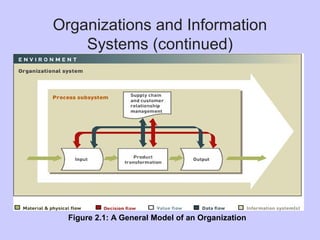
• An organization is a system - has inputs,
processing mechanisms, outputs, and feedback
– Inputs to the system: resources such as materials,
people, and money
– Outputs to the environment: goods or services
Organizations and Information
Systems (continued)
Figure 2.1: A General Model of an Organization
Organizations and Information
Systems (continued)
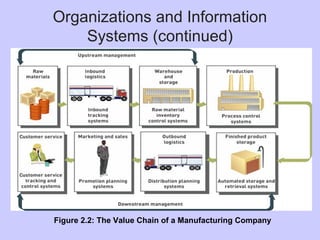
• Value chain: series (chain) of activities that
includes inbound logistics, warehouse and storage,
production, finished product storage, outbound
logistics, marketing and sales, and customer
service
• Upstream management: management of raw
materials, inbound logistics, and warehouse and
storage facilities
• Downstream management: management of
finished product storage, outbound logistics,
marketing and sales, and customer service
Organizations and Information
Systems (continued)
Figure 2.2: The Value Chain of a Manufacturing Company
Organizational Structures
• Organizational structure: organizational
subunits and the way they relate to the overall
organization
• Categories of organizational structure
– Traditional
– Project
– Team
– Virtual
Traditional Organizational Structure
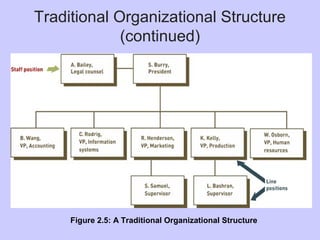
• A hierarchical structure
• Major department heads report to a president or
top-level manager
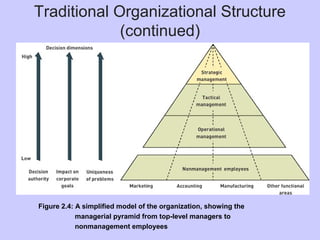
• Managerial pyramid shows the hierarchy of
decision making and authority
Traditional Organizational Structure
(continued)
Figure 2.4: A simplified model of the organization, showing the
managerial pyramid from top-level managers to
nonmanagement employees
Traditional Organizational Structure
(continued)
Figure 2.5: A Traditional Organizational Structure
Project and Team Organizational
Structures
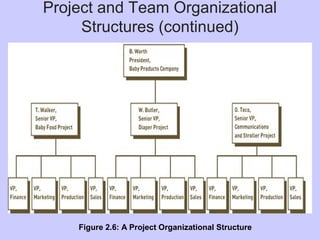
• Project organizational structure: centered on
major products or services
– Many project teams are temporary
• Team organizational structure: centered on
work teams or groups
– Team can be temporary or permanent,
depending on tasks
Project and Team Organizational
Structures (continued)
Figure 2.6: A Project Organizational Structure
Virtual Organizational Structure and
Collaborative Work
• Virtual organizational structure
– Employs business units in geographically dispersed
areas
– People may never meet face to face
– Allows collaborative work
• Managers and employees can effectively work in
groups, even those composed of members from
around the world
Organizational Culture and Change
• Organizational culture
– Major understandings and assumptions
– Influences information systems
• Organizational change
– How organizations plan for, implement, and handle
change
Reengineering and Continuous
Improvement
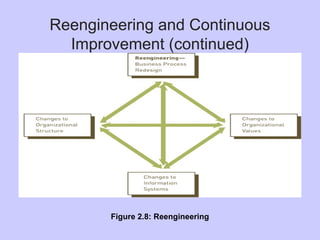
• Reengineering
– Process redesign
– Radical redesign of business processes,
organizational structures, information systems, and
values of the organization to achieve a breakthrough
in business results
Reengineering and Continuous
Improvement (continued)
Figure 2.8: Reengineering
Reengineering and Continuous
Improvement (continued)
• Continuous improvement
– Constantly seeking ways to improve business
processes
– Benefits
• Increased customer loyalty
• Reduction in customer dissatisfaction
• Reduced opportunity for competitive inroads
Reengineering and Continuous
Improvement (continued)
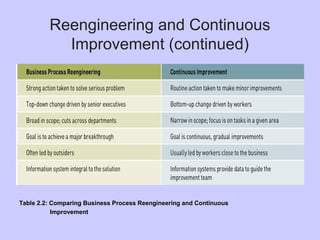
Table 2.2: Comparing Business Process Reengineering and Continuous
Improvement
Quality
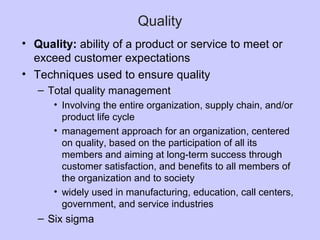
• Quality: ability of a product or service to meet or
exceed customer expectations
• Techniques used to ensure quality
– Total quality management
• Involving the entire organization, supply chain, and/or
product life cycle
• management approach for an organization, centered
on quality, based on the participation of all its
members and aiming at long-term success through
customer satisfaction, and benefits to all members of
the organization and to society
• widely used in manufacturing, education, call centers,
government, and service industries
– Six sigma
Quality
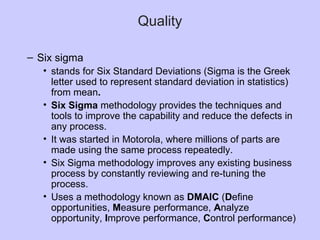
– Six sigma
• stands for Six Standard Deviations (Sigma is the Greek
letter used to represent standard deviation in statistics)
from mean.
• Six Sigma methodology provides the techniques and
tools to improve the capability and reduce the defects in
any process.
• It was started in Motorola, where millions of parts are
made using the same process repeatedly.
• Six Sigma methodology improves any existing business
process by constantly reviewing and re-tuning the
process.
• Uses a methodology known as DMAIC (Define
opportunities, Measure performance, Analyze
opportunity, Improve performance, Control performance)
Outsourcing, On-Demand Computing,
and Downsizing
• Outsourcing: contracting with outside professional
services
• On-demand computing: contracting for computer
resources to rapidly respond to an organization’s
varying workflow
• Downsizing: reducing number of employees
Competitive Advantage
• Significant and (ideally) long-term benefit to a
company over its competition
• Ability to establish and maintain competitive
advantage is vital to the company’s success
Factors That Lead Firms to Seek
Competitive Advantage
• Rivalry among existing competitors
• Threat of new entrants
• Threat of substitute products and services
• Bargaining power of customers and suppliers
Strategic Planning for Competitive
Advantage
• Cost leadership
• Differentiation
• Niche strategy
• Altering the industry structure
Strategic Planning for Competitive
Advantage (continued)
• Creating new products and services
• Improving existing product lines and service
• Other strategies
– Growth in sales
– First to market
– Customizing products and services
– Hiring the best people
Performance-Based Information Systems
(continued)
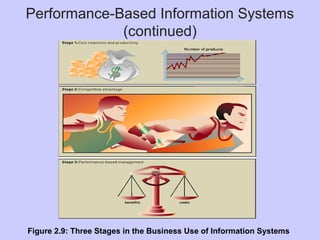
Figure 2.9: Three Stages in the Business Use of Information Systems
Productivity
• A measure of output achieved divided by input
required
• Higher level of output for a given level of input
means greater productivity
Return on Investment and the Value of
Information Systems
• Earnings growth
• Market share
• Customer awareness and satisfaction
• Total cost of ownership
Risk
• Managers must consider risks of designing,
developing, and implementing information systems
• Information system may be a failure
• Costs of development and implementation of a
system can be greater than the returns from it
Careers in Information Systems
• Degree programs
– Degrees in information systems
– Business degrees with a global or international
orientation
• Computer systems are making IS professionals’
work easier
• Opportunities in information systems are not
confined to single countries
Roles, Functions, and Careers in the
IS Department
• Primary responsibilities in information systems
– Operations: focuses on the efficiency of IS functions
– Systems development: focuses on specific
development projects and ongoing maintenance and
review
– Support: provides user assistance, data
administration, user training, and Web administration
Typical IS Titles and Functions
• Chief Information Officer (CIO)
– Employs the IS department’s equipment and
personnel to help the organization attain its goals
• LAN administrators
– Set up and manage the network hardware,
software, and security processes
Typical IS Titles and Functions
(continued)
• Internet careers
– Internet strategists and administrators
– Internet systems developers
– Internet programmers
– Internet or Web site operators
• Certification
– Examples: Microsoft Certified Systems Engineer,
Certified Information Systems Security Professional
(CISSP), and Oracle Certified Professional
37
Other IS Careers
• New and exciting careers have developed in
security and fraud detection and prevention
• Other IS career opportunities include being
employed by technology companies, such as:
– Microsoft (www.microsoft.com), Google
(www.google.com), Dell (www.dell.com), and many
others
Other IS Careers
• Information security
• Privacy
• Cybersecurity
• Online fraud-fighting
Other IS Careers (continued)
• Working from home
• Working for a consulting firm
• Working for a hardware or software vendor
developing or selling products
40
Finding a Job in IS
• Developing an online résumé can be critical to
finding a good job
• Job search approaches
– On campus visits
– Referrals from professors, friends, and family
members
– The Internet
• Online job sites
• Company Web sites
• Social networking sites
• Blogs
Summary
• An organization is a system - has inputs,
processing mechanisms, outputs, and feedback
• Categories of organizational structure: traditional,
project, team, and virtual
• Organizational culture: major understandings and
assumptions
• Reengineering: radical redesign of business
processes, organizational structures, information
systems, and values of the organization to achieve
a breakthrough in business results
• Continuous improvement: constantly seeking
ways to improve business processes
• Outsourcing: contracting with outside
professional services
• Downsizing: reducing number of employees
• Competitive advantage: significant, and (ideally)
long-term benefit to a company over its
competition
• Performance-based information systems:
consider both strategic advantage and costs
Summary (continued)
• Productivity: a measure of output achieved
divided by input required
• Primary responsibilities in information systems:
operations, systems development, and support
• Typical IS titles: Chief Information Officer (CIO),
LAN administrators, Internet strategists and
administrators, Internet systems developers,
Internet programmers, and Internet or Web site
operators
Summary (continued)

Week 3 & 4 ch02 c

  • 1.
    Principles of Information Systems Chapter2 Information Systems in Organizations
  • 2.
    Principles and LearningObjectives • The use of information systems to add value to the organization is strongly influenced by organizational structure, culture, and change – Identify the value-added processes in the supply chain and describe the role of information systems within them – Provide a clear definition of the terms organizational structure, culture, and change and discuss how they affect the implementation of information systems
  • 3.
    Principles and LearningObjectives (continued) • Because information systems are so important, businesses need to be sure that improvements or completely new systems help lower costs, increase profits, improve service, or achieve a competitive advantage – Identify some of the strategies employed to lower costs or improve service – Define the term competitive advantage and discuss how organizations are using information systems to gain such an advantage – Discuss how organizations justify the need for information systems
  • 4.
    Principles and LearningObjectives (continued) • Cooperation between business managers and IS personnel is the key to unlocking the potential of any new or modified system – Define the types of roles, functions, and careers available in information systems
  • 5.
    Why Learn AboutInformation Systems in Organizations? • Information systems (ISs) can cut costs and increase profits • Students in most fields need to know ISs – Management major might be hired to design a system to improve productivity – Biochemistry major might be hired to conduct drug research using computer techniques
  • 6.
    Organizations and Information Systems •Organization: a formal collection of people and other resources established to accomplish a set of goals • An organization is a system - has inputs, processing mechanisms, outputs, and feedback – Inputs to the system: resources such as materials, people, and money – Outputs to the environment: goods or services
  • 7.
    Organizations and Information Systems(continued) Figure 2.1: A General Model of an Organization
  • 8.
    Organizations and Information Systems(continued) • Value chain: series (chain) of activities that includes inbound logistics, warehouse and storage, production, finished product storage, outbound logistics, marketing and sales, and customer service • Upstream management: management of raw materials, inbound logistics, and warehouse and storage facilities • Downstream management: management of finished product storage, outbound logistics, marketing and sales, and customer service
  • 9.
    Organizations and Information Systems(continued) Figure 2.2: The Value Chain of a Manufacturing Company
  • 10.
    Organizational Structures • Organizationalstructure: organizational subunits and the way they relate to the overall organization • Categories of organizational structure – Traditional – Project – Team – Virtual
  • 11.
    Traditional Organizational Structure •A hierarchical structure • Major department heads report to a president or top-level manager • Managerial pyramid shows the hierarchy of decision making and authority
  • 12.
    Traditional Organizational Structure (continued) Figure2.4: A simplified model of the organization, showing the managerial pyramid from top-level managers to nonmanagement employees
  • 13.
    Traditional Organizational Structure (continued) Figure2.5: A Traditional Organizational Structure
  • 14.
    Project and TeamOrganizational Structures • Project organizational structure: centered on major products or services – Many project teams are temporary • Team organizational structure: centered on work teams or groups – Team can be temporary or permanent, depending on tasks
  • 15.
    Project and TeamOrganizational Structures (continued) Figure 2.6: A Project Organizational Structure
  • 16.
    Virtual Organizational Structureand Collaborative Work • Virtual organizational structure – Employs business units in geographically dispersed areas – People may never meet face to face – Allows collaborative work • Managers and employees can effectively work in groups, even those composed of members from around the world
  • 17.
    Organizational Culture andChange • Organizational culture – Major understandings and assumptions – Influences information systems • Organizational change – How organizations plan for, implement, and handle change
  • 18.
    Reengineering and Continuous Improvement •Reengineering – Process redesign – Radical redesign of business processes, organizational structures, information systems, and values of the organization to achieve a breakthrough in business results
  • 19.
    Reengineering and Continuous Improvement(continued) Figure 2.8: Reengineering
  • 20.
    Reengineering and Continuous Improvement(continued) • Continuous improvement – Constantly seeking ways to improve business processes – Benefits • Increased customer loyalty • Reduction in customer dissatisfaction • Reduced opportunity for competitive inroads
  • 21.
    Reengineering and Continuous Improvement(continued) Table 2.2: Comparing Business Process Reengineering and Continuous Improvement
  • 22.
    Quality • Quality: abilityof a product or service to meet or exceed customer expectations • Techniques used to ensure quality – Total quality management • Involving the entire organization, supply chain, and/or product life cycle • management approach for an organization, centered on quality, based on the participation of all its members and aiming at long-term success through customer satisfaction, and benefits to all members of the organization and to society • widely used in manufacturing, education, call centers, government, and service industries – Six sigma
  • 23.
    Quality – Six sigma •stands for Six Standard Deviations (Sigma is the Greek letter used to represent standard deviation in statistics) from mean. • Six Sigma methodology provides the techniques and tools to improve the capability and reduce the defects in any process. • It was started in Motorola, where millions of parts are made using the same process repeatedly. • Six Sigma methodology improves any existing business process by constantly reviewing and re-tuning the process. • Uses a methodology known as DMAIC (Define opportunities, Measure performance, Analyze opportunity, Improve performance, Control performance)
  • 24.
    Outsourcing, On-Demand Computing, andDownsizing • Outsourcing: contracting with outside professional services • On-demand computing: contracting for computer resources to rapidly respond to an organization’s varying workflow • Downsizing: reducing number of employees
  • 25.
    Competitive Advantage • Significantand (ideally) long-term benefit to a company over its competition • Ability to establish and maintain competitive advantage is vital to the company’s success
  • 26.
    Factors That LeadFirms to Seek Competitive Advantage • Rivalry among existing competitors • Threat of new entrants • Threat of substitute products and services • Bargaining power of customers and suppliers
  • 27.
    Strategic Planning forCompetitive Advantage • Cost leadership • Differentiation • Niche strategy • Altering the industry structure
  • 28.
    Strategic Planning forCompetitive Advantage (continued) • Creating new products and services • Improving existing product lines and service • Other strategies – Growth in sales – First to market – Customizing products and services – Hiring the best people
  • 29.
    Performance-Based Information Systems (continued) Figure2.9: Three Stages in the Business Use of Information Systems
  • 30.
    Productivity • A measureof output achieved divided by input required • Higher level of output for a given level of input means greater productivity
  • 31.
    Return on Investmentand the Value of Information Systems • Earnings growth • Market share • Customer awareness and satisfaction • Total cost of ownership
  • 32.
    Risk • Managers mustconsider risks of designing, developing, and implementing information systems • Information system may be a failure • Costs of development and implementation of a system can be greater than the returns from it
  • 33.
    Careers in InformationSystems • Degree programs – Degrees in information systems – Business degrees with a global or international orientation • Computer systems are making IS professionals’ work easier • Opportunities in information systems are not confined to single countries
  • 34.
    Roles, Functions, andCareers in the IS Department • Primary responsibilities in information systems – Operations: focuses on the efficiency of IS functions – Systems development: focuses on specific development projects and ongoing maintenance and review – Support: provides user assistance, data administration, user training, and Web administration
  • 35.
    Typical IS Titlesand Functions • Chief Information Officer (CIO) – Employs the IS department’s equipment and personnel to help the organization attain its goals • LAN administrators – Set up and manage the network hardware, software, and security processes
  • 36.
    Typical IS Titlesand Functions (continued) • Internet careers – Internet strategists and administrators – Internet systems developers – Internet programmers – Internet or Web site operators • Certification – Examples: Microsoft Certified Systems Engineer, Certified Information Systems Security Professional (CISSP), and Oracle Certified Professional
  • 37.
    37 Other IS Careers •New and exciting careers have developed in security and fraud detection and prevention • Other IS career opportunities include being employed by technology companies, such as: – Microsoft (www.microsoft.com), Google (www.google.com), Dell (www.dell.com), and many others
  • 38.
    Other IS Careers •Information security • Privacy • Cybersecurity • Online fraud-fighting
  • 39.
    Other IS Careers(continued) • Working from home • Working for a consulting firm • Working for a hardware or software vendor developing or selling products
  • 40.
    40 Finding a Jobin IS • Developing an online résumé can be critical to finding a good job • Job search approaches – On campus visits – Referrals from professors, friends, and family members – The Internet • Online job sites • Company Web sites • Social networking sites • Blogs
  • 41.
    Summary • An organizationis a system - has inputs, processing mechanisms, outputs, and feedback • Categories of organizational structure: traditional, project, team, and virtual • Organizational culture: major understandings and assumptions • Reengineering: radical redesign of business processes, organizational structures, information systems, and values of the organization to achieve a breakthrough in business results
  • 42.
    • Continuous improvement:constantly seeking ways to improve business processes • Outsourcing: contracting with outside professional services • Downsizing: reducing number of employees • Competitive advantage: significant, and (ideally) long-term benefit to a company over its competition • Performance-based information systems: consider both strategic advantage and costs Summary (continued)
  • 43.
    • Productivity: ameasure of output achieved divided by input required • Primary responsibilities in information systems: operations, systems development, and support • Typical IS titles: Chief Information Officer (CIO), LAN administrators, Internet strategists and administrators, Internet systems developers, Internet programmers, and Internet or Web site operators Summary (continued)

Editor's Notes

  • #3 <number>
  • #4 <number>
  • #18 <number>
  • #23 <number>
  • #24 <number>
  • #25 <number>
  • #27 <number>
  • #28 <number>
  • #29 <number>
  • #36 <number>