Project Management for Information
Systems
Tri Suci Handayani
SISTEM INFORMASI
SAINS DAN TEKNOLOGI
UNIVERSITAS ISLAM NEGERI SULTAN SYARIF KASIM RIAU
http://sif.uin-suska.ac.id/
http://fst.uin-suska.ac.id/
http://www.uin-suska.ac.id/
1
PROJECT MANAGEMENT
‘INTRODUCTION’
1
Introduction
“Projects, rather than repetitive tasks, are now the basis for most value-added in
business”
-Tom Peters
2
Why do we need to learn project
management?
 It is different from system analysis
 It will allow you to apply all the knowledge you have learned in IS, such as
programming, data management, and system analysis, into the practices
 But more – management
 Consider you get a programming job. In the first week in the company you are
asked:
 To work with someone to do some Java programming but you don’t know
what it is for;
 To join a project group for internal software resource sharing project but
you don’t know who are your colleagues before a meeting; or
 To look into the latest WiMax (IEEE 802.16e) technology to see the
potential application to your company’s business. You here of it but
wonder why
 To investigate the search engine market and write a proposal – it is a task
for a programmer?
 What should you do?
3
Objectives
1. To explain the main tasks undertaken by project managers
2. To introduce software project management and to describe its
typical characteristics
3. To discuss project planning and the planning process
4. To show how graphical schedule representations are used by
project management
5. To discuss the notion of risks and the risk management process
4
Advantages of Using Project Management
 Better control of financial, physical, and human resources
 Improved customer relations
 Shorter development times
 Lower costs
 Higher quality and increased reliability
 Higher profit margins
 Improved productivity
 Better internal coordination
 Higher worker morale
5
What is Project?
 A project Series of actions to achieve a result
 Single occurrence – a unique, non-repetitive assignment
 Time limitations – with a pre-defined date of delivery
 Clear purpose – specified from one or more goals (well defined,
measurable and realistic), do not mix project goals and effect
goals
 Unpredictable structure – it consists of a number of complex
activities with mutual interdependencies
 Own organization – e.g. Not in the original line of work
 A project is a temporary effort to create a unique product or
service.
 Projects usually include constraints and risks regarding cost,
schedule or performance outcome.
6
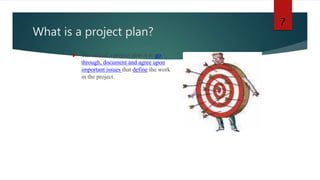
What is a project plan?
 The aim of a project plan is to go
through, document and agree upon
important issues that define the work
in the project.
7
What is Project Management?
 Project management is a set of principles, practices, and
techniques applied to lead project teams and control project
schedule, cost, and performance risks to result in delighted
customers.
8
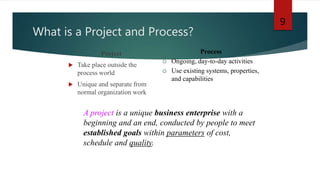
What is a Project and Process?
Project
 Take place outside the
process world
 Unique and separate from
normal organization work
9
Process
 Ongoing, day-to-day activities
 Use existing systems, properties,
and capabilities
A project is a unique business enterprise with a
beginning and an end, conducted by people to meet
established goals within parameters of cost,
schedule and quality.
Elements of Projects
 Complex, one-time processes
 Limited by budget, schedule, and resources
 Developed to resolve a clear goal or set of goals
 Customer-focused
10
General Project Characteristics
 Ad-hoc (informal) actions with a clear life cycle
 Building blocks in the design and execution of
organizational strategies
 Responsible for the newest and most improved products,
services, and organizational processes
 Provide a philosophy and strategy for the management of
change
11
General Project Characteristics (Cont.)
 Entail crossing functional and organization boundaries
 Traditional management functions of planning, organizing,
motivating, directing, and controlling apply
 Principal outcomes are the satisfaction of customer
requirements within technical, cost, and schedule constraints
 Terminated upon successful completion
12
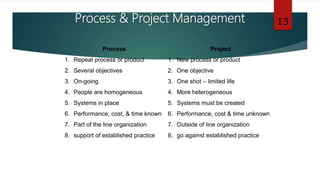
Process & Project Management 13
Process
1. Repeat process or product
2. Several objectives
3. On-going
4. People are homogeneous
5. Systems in place
6. Performance, cost, & time known
7. Part of the line organization
8. support of established practice
Project
1. New process or product
2. One objective
3. One shot – limited life
4. More heterogeneous
5. Systems must be created
6. Performance, cost & time unknown
7. Outside of line organization
8. go against established practice
Information Technology Project “Success”
 Software & hardware projects fail at a 65% rate
 Over ½ of all IT projects become runaways
 Up to 75% of all software projects are cancelled
 Average cost overrun is 45%; schedule overrun is
63%; with only 67% of originally contracted features
 47% of IT projects delivered but not used, 29% paid
for but not delivered; 19% abandoned
14
Why are Projects Important?
1. Reduced product life cycles
2. Narrow product begin windows
3. Increasingly complex and technical products
4. Appearance of global markets
5. Economic period marked by low inflation
15
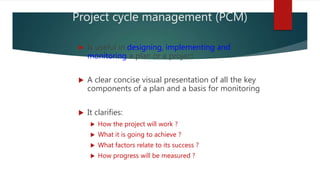
Project cycle management (PCM)
 Is useful in designing, implementing and
monitoring a plan or a project
 A clear concise visual presentation of all the key
components of a plan and a basis for monitoring
 It clarifies:
 How the project will work ?
 What it is going to achieve ?
 What factors relate to its success ?
 How progress will be measured ?
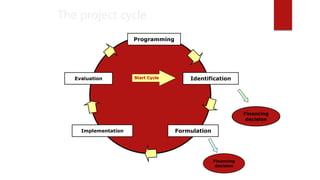
Programming
Implementation Formulation
Evaluation Identification
Financing
decision
Financing
decision
Start Cycle
The project cycle
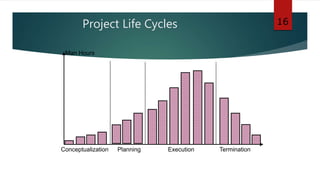
Project Life Cycles 16
Man Hours
Conceptualization Planning Execution Termination
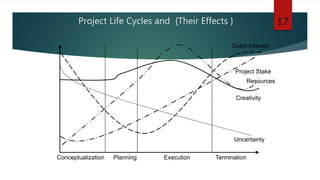
Project Life Cycles and {Their Effects } 17
Conceptualization Planning Execution Termination
Uncertainty
Client Interest
Project Stake
Creativity
Resources
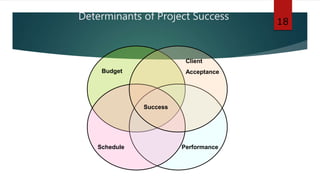
Determinants of Project Success 18
Success
Budget
Client
Acceptance
Schedule Performance
Six Criteria for IT Project Success
 System quality
 Information quality
 Use
 User satisfaction
 Individual Impact
 Organizational impact
19
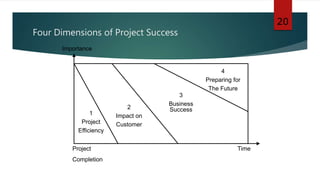
Four Dimensions of Project Success
20
Project
Completion
Time
Importance
1
Project
Efficiency
4
Preparing for
The Future
2
Impact on
Customer
3
Business
Success
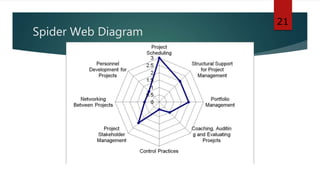
Spider Web Diagram
21
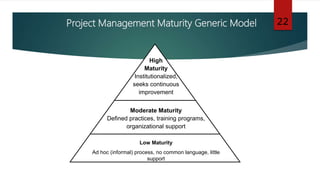
Project Management Maturity Generic Model 22
Low Maturity
Ad hoc (informal) process, no common language, little
support
Moderate Maturity
Defined practices, training programs,
organizational support
High
Maturity
Institutionalized,
seeks continuous
improvement
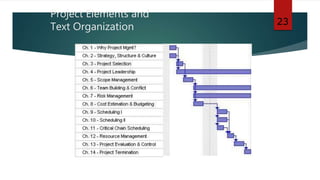
Project Elements and
Text Organization 23
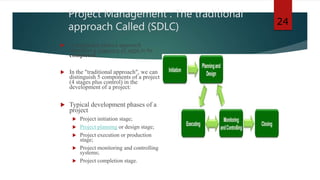
Project Management : The traditional
approach Called (SDLC)
 A traditional phased approach
identifies a sequence of steps to be
completed.
 In the "traditional approach", we can
distinguish 5 components of a project
(4 stages plus control) in the
development of a project:
 Typical development phases of a
project
 Project initiation stage;
 Project planning or design stage;
 Project execution or production
stage;
 Project monitoring and controlling
systems;
 Project completion stage.
24

Manpro ppt

  • 1.
    Project Management forInformation Systems Tri Suci Handayani SISTEM INFORMASI SAINS DAN TEKNOLOGI UNIVERSITAS ISLAM NEGERI SULTAN SYARIF KASIM RIAU http://sif.uin-suska.ac.id/ http://fst.uin-suska.ac.id/ http://www.uin-suska.ac.id/ 1
  • 2.
  • 3.
    Introduction “Projects, rather thanrepetitive tasks, are now the basis for most value-added in business” -Tom Peters 2
  • 4.
    Why do weneed to learn project management?  It is different from system analysis  It will allow you to apply all the knowledge you have learned in IS, such as programming, data management, and system analysis, into the practices  But more – management  Consider you get a programming job. In the first week in the company you are asked:  To work with someone to do some Java programming but you don’t know what it is for;  To join a project group for internal software resource sharing project but you don’t know who are your colleagues before a meeting; or  To look into the latest WiMax (IEEE 802.16e) technology to see the potential application to your company’s business. You here of it but wonder why  To investigate the search engine market and write a proposal – it is a task for a programmer?  What should you do? 3
  • 5.
    Objectives 1. To explainthe main tasks undertaken by project managers 2. To introduce software project management and to describe its typical characteristics 3. To discuss project planning and the planning process 4. To show how graphical schedule representations are used by project management 5. To discuss the notion of risks and the risk management process 4
  • 6.
    Advantages of UsingProject Management  Better control of financial, physical, and human resources  Improved customer relations  Shorter development times  Lower costs  Higher quality and increased reliability  Higher profit margins  Improved productivity  Better internal coordination  Higher worker morale 5
  • 7.
    What is Project? A project Series of actions to achieve a result  Single occurrence – a unique, non-repetitive assignment  Time limitations – with a pre-defined date of delivery  Clear purpose – specified from one or more goals (well defined, measurable and realistic), do not mix project goals and effect goals  Unpredictable structure – it consists of a number of complex activities with mutual interdependencies  Own organization – e.g. Not in the original line of work  A project is a temporary effort to create a unique product or service.  Projects usually include constraints and risks regarding cost, schedule or performance outcome. 6
  • 8.
    What is aproject plan?  The aim of a project plan is to go through, document and agree upon important issues that define the work in the project. 7
  • 9.
    What is ProjectManagement?  Project management is a set of principles, practices, and techniques applied to lead project teams and control project schedule, cost, and performance risks to result in delighted customers. 8
  • 10.
    What is aProject and Process? Project  Take place outside the process world  Unique and separate from normal organization work 9 Process  Ongoing, day-to-day activities  Use existing systems, properties, and capabilities A project is a unique business enterprise with a beginning and an end, conducted by people to meet established goals within parameters of cost, schedule and quality.
  • 11.
    Elements of Projects Complex, one-time processes  Limited by budget, schedule, and resources  Developed to resolve a clear goal or set of goals  Customer-focused 10
  • 12.
    General Project Characteristics Ad-hoc (informal) actions with a clear life cycle  Building blocks in the design and execution of organizational strategies  Responsible for the newest and most improved products, services, and organizational processes  Provide a philosophy and strategy for the management of change 11
  • 13.
    General Project Characteristics(Cont.)  Entail crossing functional and organization boundaries  Traditional management functions of planning, organizing, motivating, directing, and controlling apply  Principal outcomes are the satisfaction of customer requirements within technical, cost, and schedule constraints  Terminated upon successful completion 12
  • 14.
    Process & ProjectManagement 13 Process 1. Repeat process or product 2. Several objectives 3. On-going 4. People are homogeneous 5. Systems in place 6. Performance, cost, & time known 7. Part of the line organization 8. support of established practice Project 1. New process or product 2. One objective 3. One shot – limited life 4. More heterogeneous 5. Systems must be created 6. Performance, cost & time unknown 7. Outside of line organization 8. go against established practice
  • 15.
    Information Technology Project“Success”  Software & hardware projects fail at a 65% rate  Over ½ of all IT projects become runaways  Up to 75% of all software projects are cancelled  Average cost overrun is 45%; schedule overrun is 63%; with only 67% of originally contracted features  47% of IT projects delivered but not used, 29% paid for but not delivered; 19% abandoned 14
  • 16.
    Why are ProjectsImportant? 1. Reduced product life cycles 2. Narrow product begin windows 3. Increasingly complex and technical products 4. Appearance of global markets 5. Economic period marked by low inflation 15
  • 17.
    Project cycle management(PCM)  Is useful in designing, implementing and monitoring a plan or a project  A clear concise visual presentation of all the key components of a plan and a basis for monitoring  It clarifies:  How the project will work ?  What it is going to achieve ?  What factors relate to its success ?  How progress will be measured ?
  • 18.
  • 19.
    Project Life Cycles16 Man Hours Conceptualization Planning Execution Termination
  • 20.
    Project Life Cyclesand {Their Effects } 17 Conceptualization Planning Execution Termination Uncertainty Client Interest Project Stake Creativity Resources
  • 21.
    Determinants of ProjectSuccess 18 Success Budget Client Acceptance Schedule Performance
  • 22.
    Six Criteria forIT Project Success  System quality  Information quality  Use  User satisfaction  Individual Impact  Organizational impact 19
  • 23.
    Four Dimensions ofProject Success 20 Project Completion Time Importance 1 Project Efficiency 4 Preparing for The Future 2 Impact on Customer 3 Business Success
  • 24.
  • 25.
    Project Management MaturityGeneric Model 22 Low Maturity Ad hoc (informal) process, no common language, little support Moderate Maturity Defined practices, training programs, organizational support High Maturity Institutionalized, seeks continuous improvement
  • 26.
  • 27.
    Project Management :The traditional approach Called (SDLC)  A traditional phased approach identifies a sequence of steps to be completed.  In the "traditional approach", we can distinguish 5 components of a project (4 stages plus control) in the development of a project:  Typical development phases of a project  Project initiation stage;  Project planning or design stage;  Project execution or production stage;  Project monitoring and controlling systems;  Project completion stage. 24