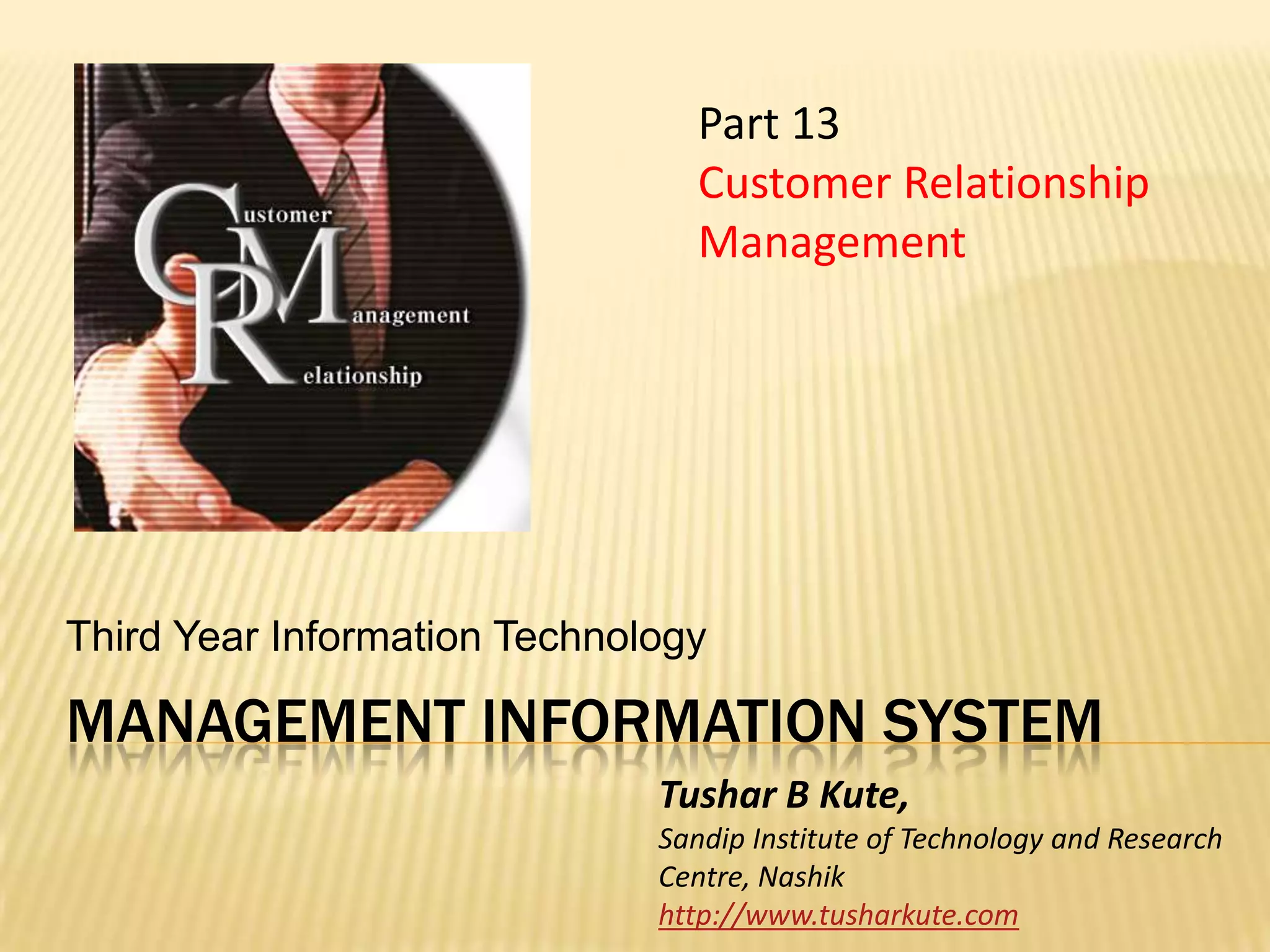
Management information systemThird Year Information TechnologyPart 13Customer Relationship Management Tushar B Kute,Sandip Institute of Technology and Research Centre, Nashikhttp://www.tusharkute.com
CRMOf the people, by the people, and for the people.
Three Eras in the History of MarketingProduction Era	“A good product will sell itself.”Sales Era“Creative advertising and selling will overcome consumer resistance and convince them to buy.”Marketing Era“The consumer is king! Find a need and fill it.”
Profitability of Long-Life Customers According to a study conducted by the American Management Association, 65 percent of the average company’s business comes from its present, satisfied customers Costs a company 6x’s more to sell a product to a new customer than it does to an existing one
Profitability of Long-Life CustomersA business that each day for one year loses one customer who customarily spends $50/week would suffer a sales decline of $1,000,000 the next year Reichheldfound that companies could boost profits by 100 percent by retaining just 5 percent more of their customers.
Relationship MarketingRelationship marketing involves long-term, value-added relationships developed over time with customers and suppliers.  Relationship marketing recognizes the critical importance of internal marketing to the success of external marketing plans.
Relationship MarketingMorgan and Hunt (1994) proposed the following definition of relationship marketing:  Relationship marketing refers to all marketing activities directed toward establishing, developing, and maintaining successful relationship exchanges
Customer Relationship Management“Process of creating and maintaining relationships with business customers or consumers”“A holistic process of identifying, attracting, differentiating, and retaining customers”“Integrating the firm’s value chain to create enhanced customer value at every step”“An integrated cross-functional focus on improving customer retention and profitability for the company.”“A view of the customer that asserts that he or she is a valuable asset to be managed.” –S. Thomas Foster.Deciding that “you want lifetime clients.”  -Richard Buckingham.
Customer Relationship ManagementBottom-line:	The use of information-enabled systems for enhancing individual customer relationships to ensure long-term customer loyalty and retention
Crm configurationFront office operationsMeetings, phone calls, emails, online services.Back office operationsBilling, maintenance, planning, marketing, advertising, finance, manufacturing.Business relationshipsInteraction with companies and partners, suppliers, vendors and retail outlets, distributors.
Complaint ResolutionFeedbackGuaranteesCorrective ActionFour tools
Complaint resolutionThree types of complaints:  Regulatory, Employee, CustomerCompensationEase of Resolution
feedbackCustomer DataCustomer BehaviorData-gatheringAnalyzing Data
guaranteesCustomer RightsGuarantee Design:UnconditionalMeaningfulCommunicablePainless to invoke
The way a firm reacts to a problem so that the problem never reoccurs.Corrective action
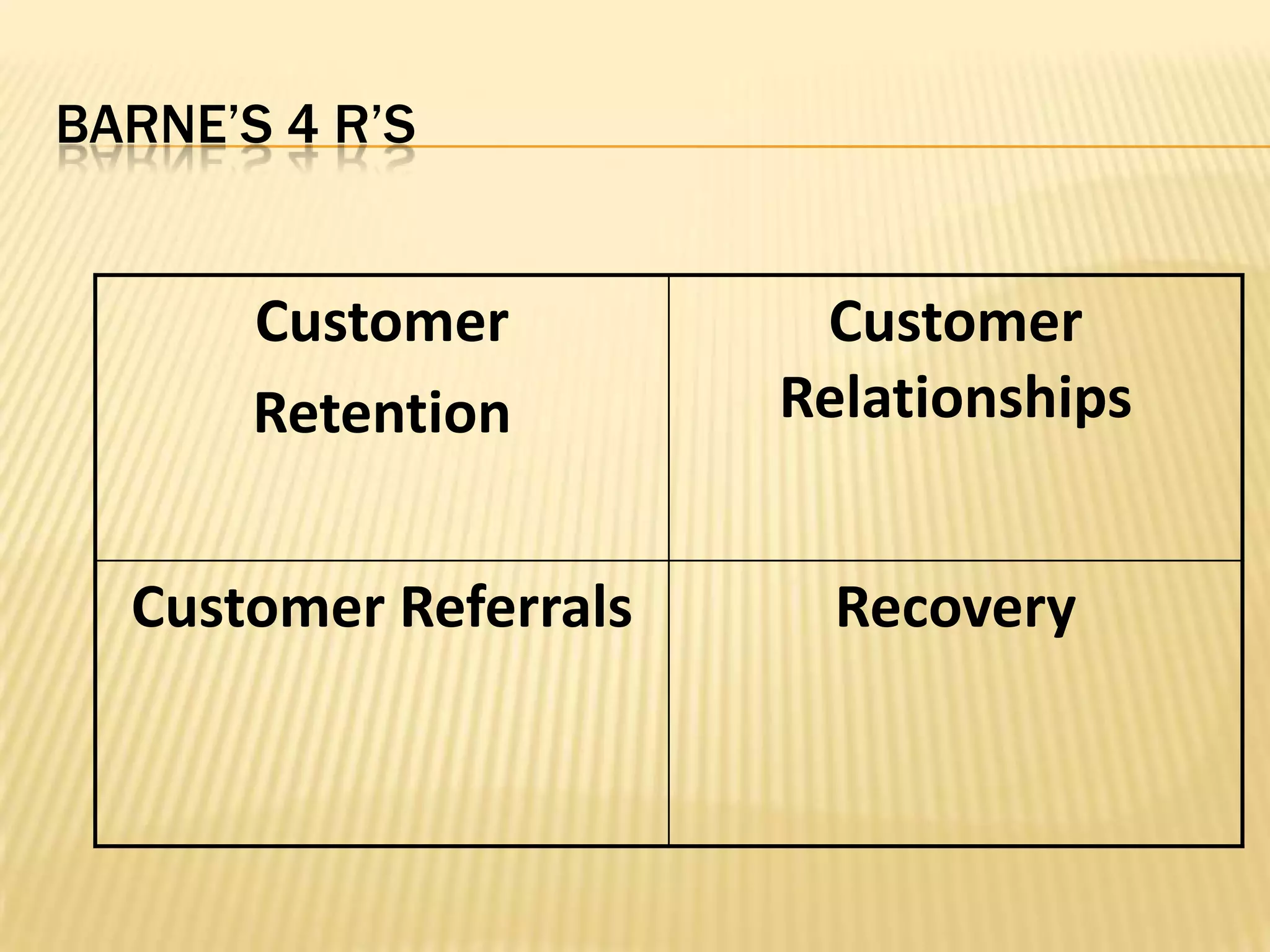
Barne’s 4 r’s
A low-cost way  to increase revenue.  Retention is cheaper than acquisition.  Must be voluntary.Must lead to long-term relationships.Customer retention
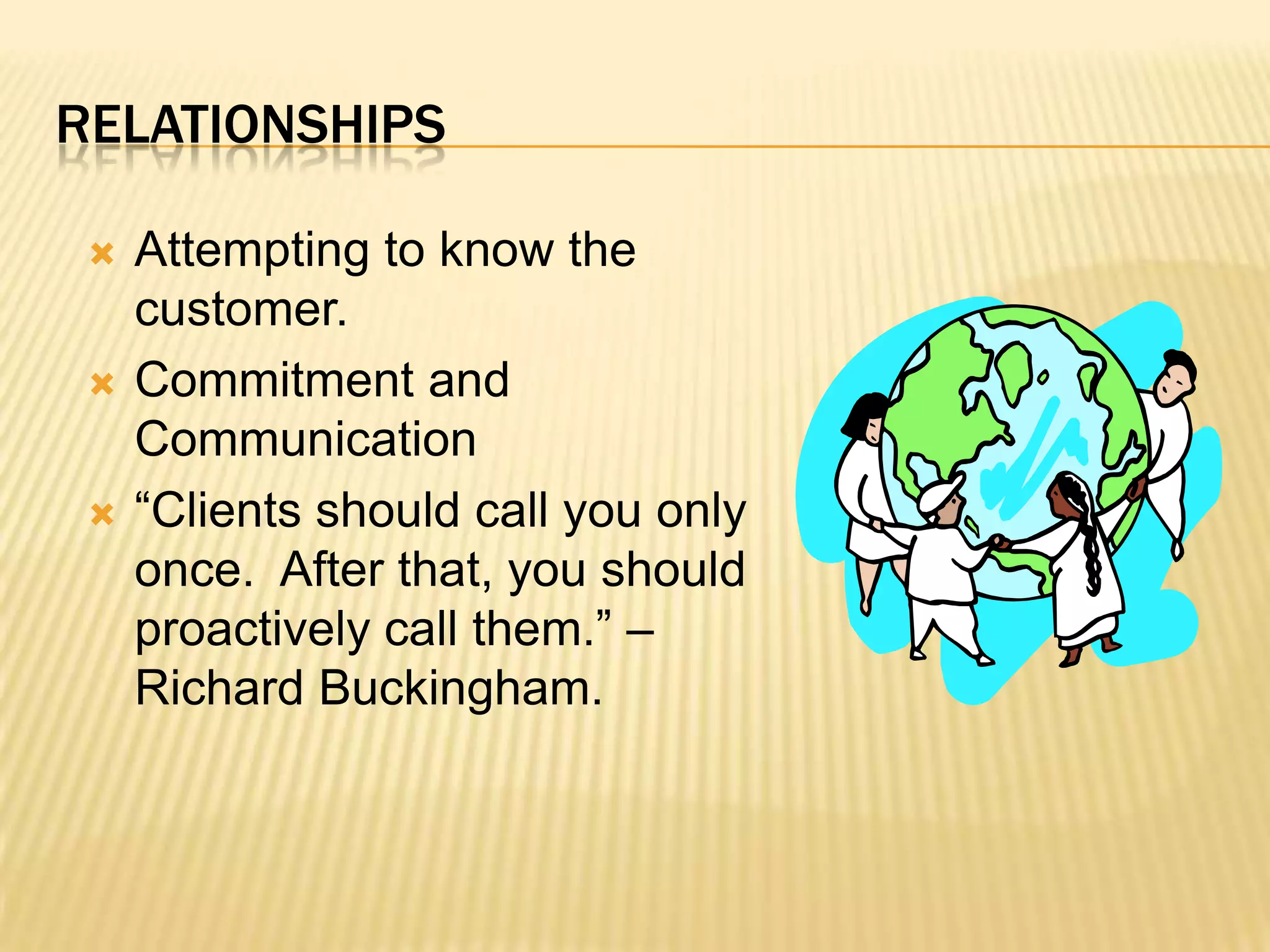
RelationshipsAttempting to know the customer.  Commitment and Communication “Clients should call you only once.  After that, you should proactively call them.” –Richard Buckingham.
Powerful tool that results from customer satisfaction or dissatisfaction.“Referral clients are already sold, before they even call you.” –Richard Buckinghamreferrals
Empower employees so that they may deal with mistakes as they occur.recovery
CUSTOMER RELATIONSHIP MANAGEMENTTime line of CRM evolutionFirst Generation(before 1990)started with such functions like maintaining prospects data, generating leads, creating sales quotations & placing sales orders  and other functions like after sales help desks, call centers etcSecond Generation (1990-1996) consolidation of various activities  into pre-sales through SFA transactions and post sales through CSS. Not much of an integration with back office operationsThird Generation( After 2002) integration of the customer facing front end systems with the back end systems as well as with partners& suppliers helped by the growth of the Internet technology.
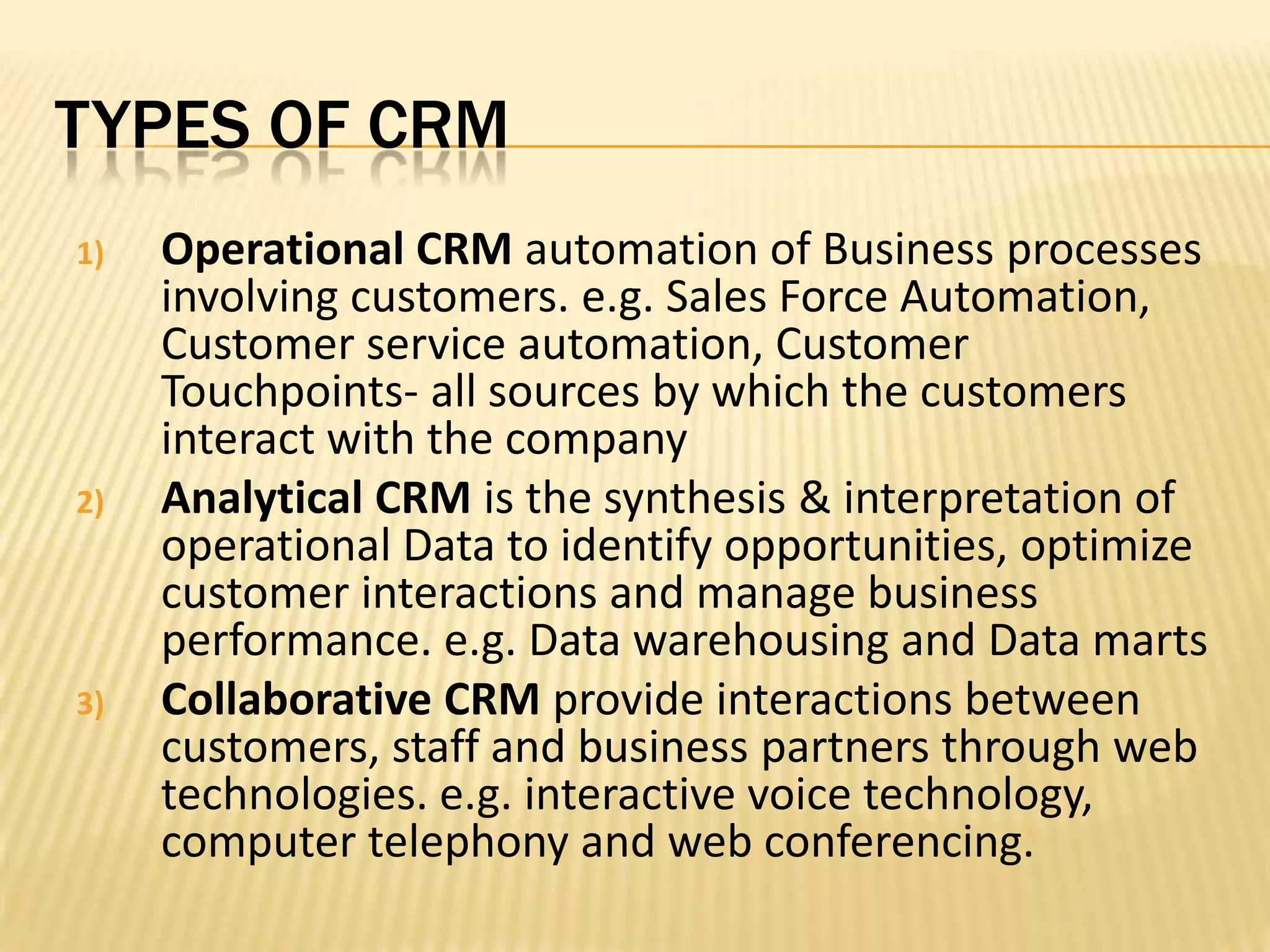
Types of CRMOperational CRM automation of Business processes involving customers. e.g. Sales Force Automation, Customer service automation, Customer Touchpoints- all sources by which the customers interact with the companyAnalytical CRM is the synthesis & interpretation of operational Data to identify opportunities, optimize customer interactions and manage business performance. e.g. Data warehousing and Data martsCollaborative CRM provide interactions between customers, staff and business partners through web technologies. e.g. interactive voice technology, computer telephony and web conferencing.
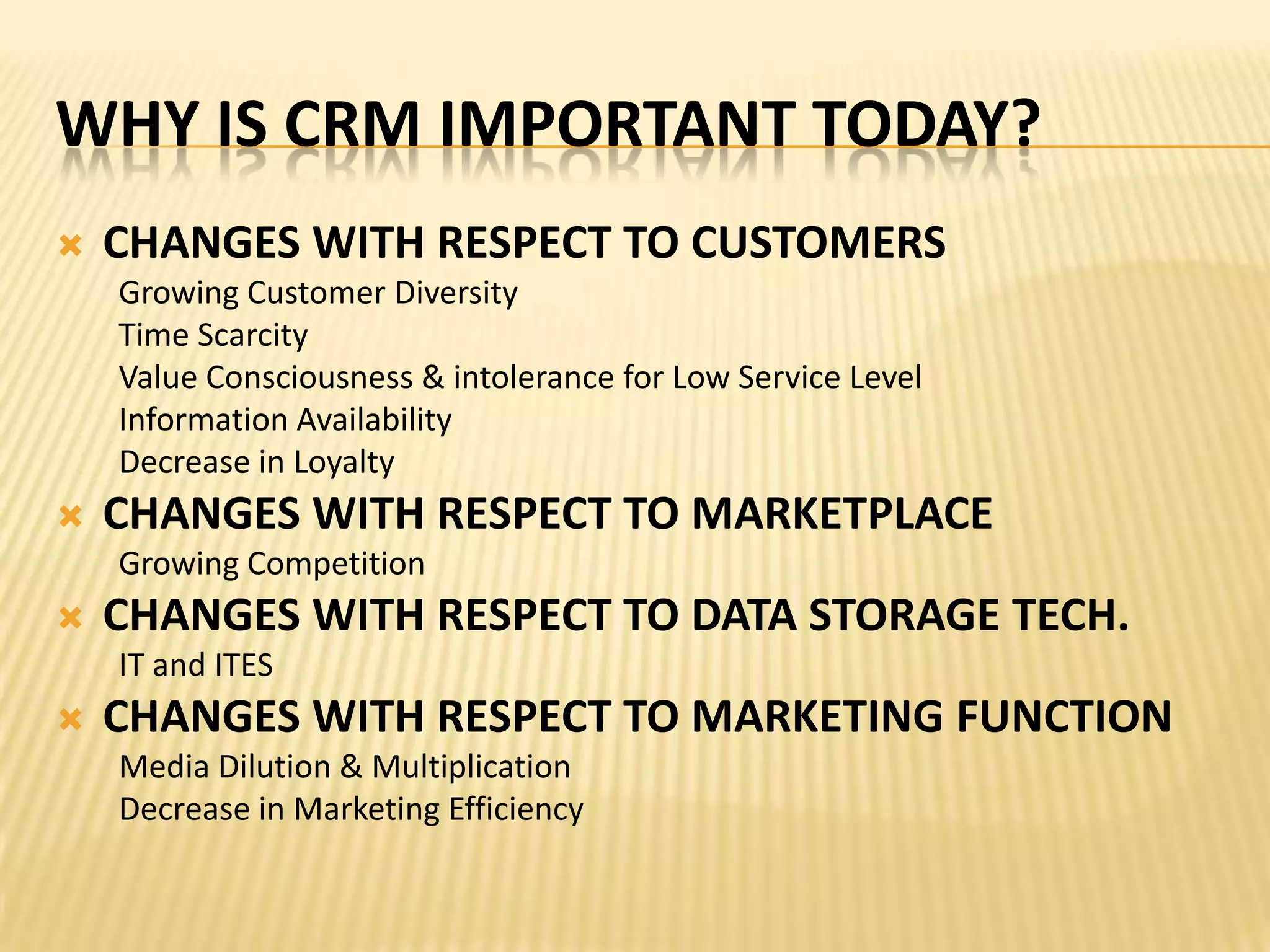
CHANGES WITH RESPECT TO CUSTOMERSGrowing Customer DiversityTime ScarcityValue Consciousness & intolerance for Low Service LevelInformation AvailabilityDecrease in LoyaltyCHANGES WITH RESPECT TO MARKETPLACEGrowing CompetitionCHANGES WITH RESPECT TO DATA STORAGE TECH.IT and ITESCHANGES WITH RESPECT TO MARKETING FUNCTIONMedia Dilution & MultiplicationDecrease in Marketing EfficiencyWHY IS CRM IMPORTANT TODAY?
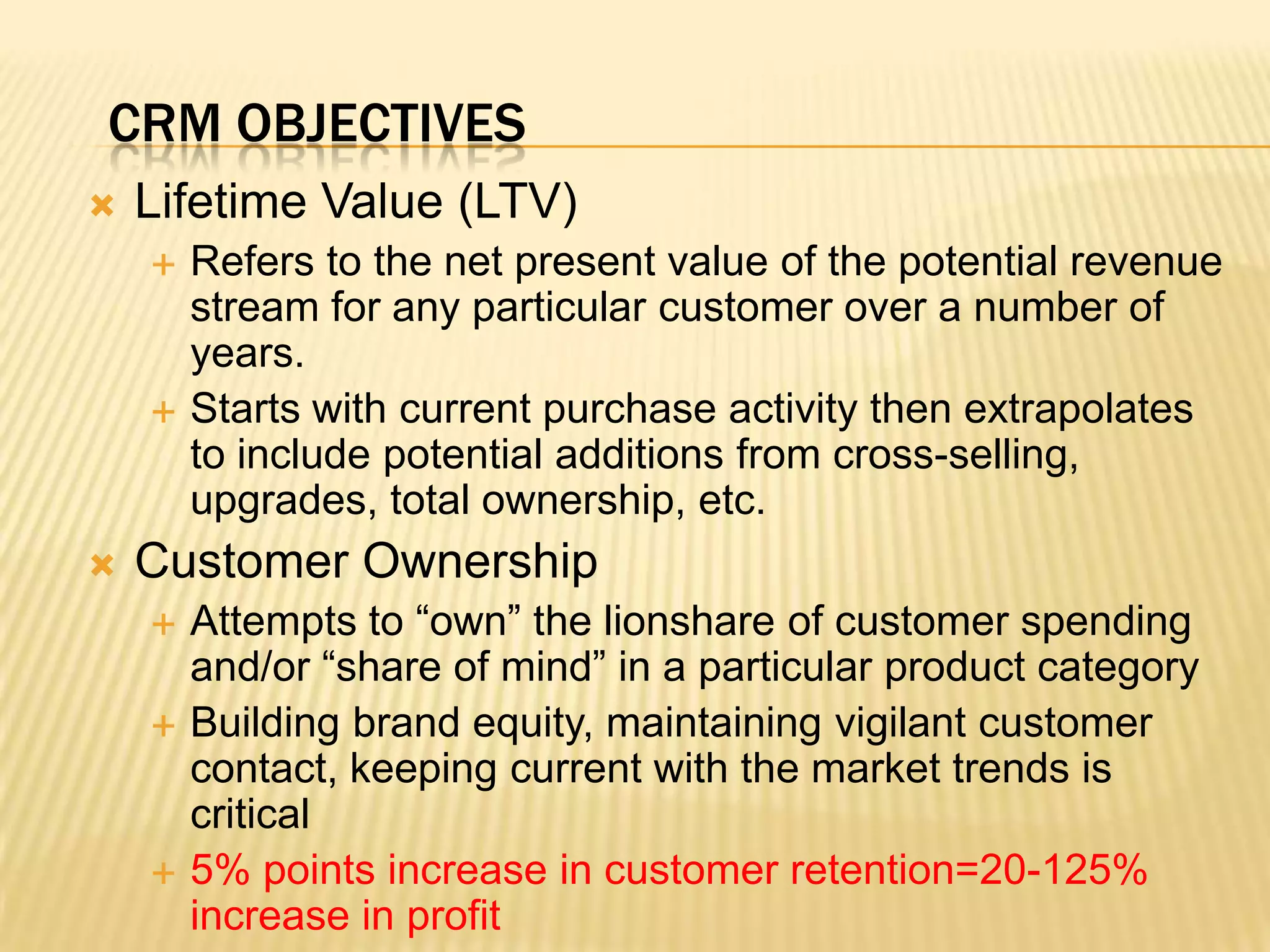
CRM ObjectivesLifetime Value (LTV)Refers to the net present value of the potential revenue stream for any particular customer over a number of years.Starts with current purchase activity then extrapolates to include potential additions from cross-selling, upgrades, total ownership, etc.Customer OwnershipAttempts to “own” the lionshare of customer spending and/or “share of mind” in a particular product categoryBuilding brand equity, maintaining vigilant customer contact, keeping current with the market trends is critical5% points increase in customer retention=20-125% increase in profit
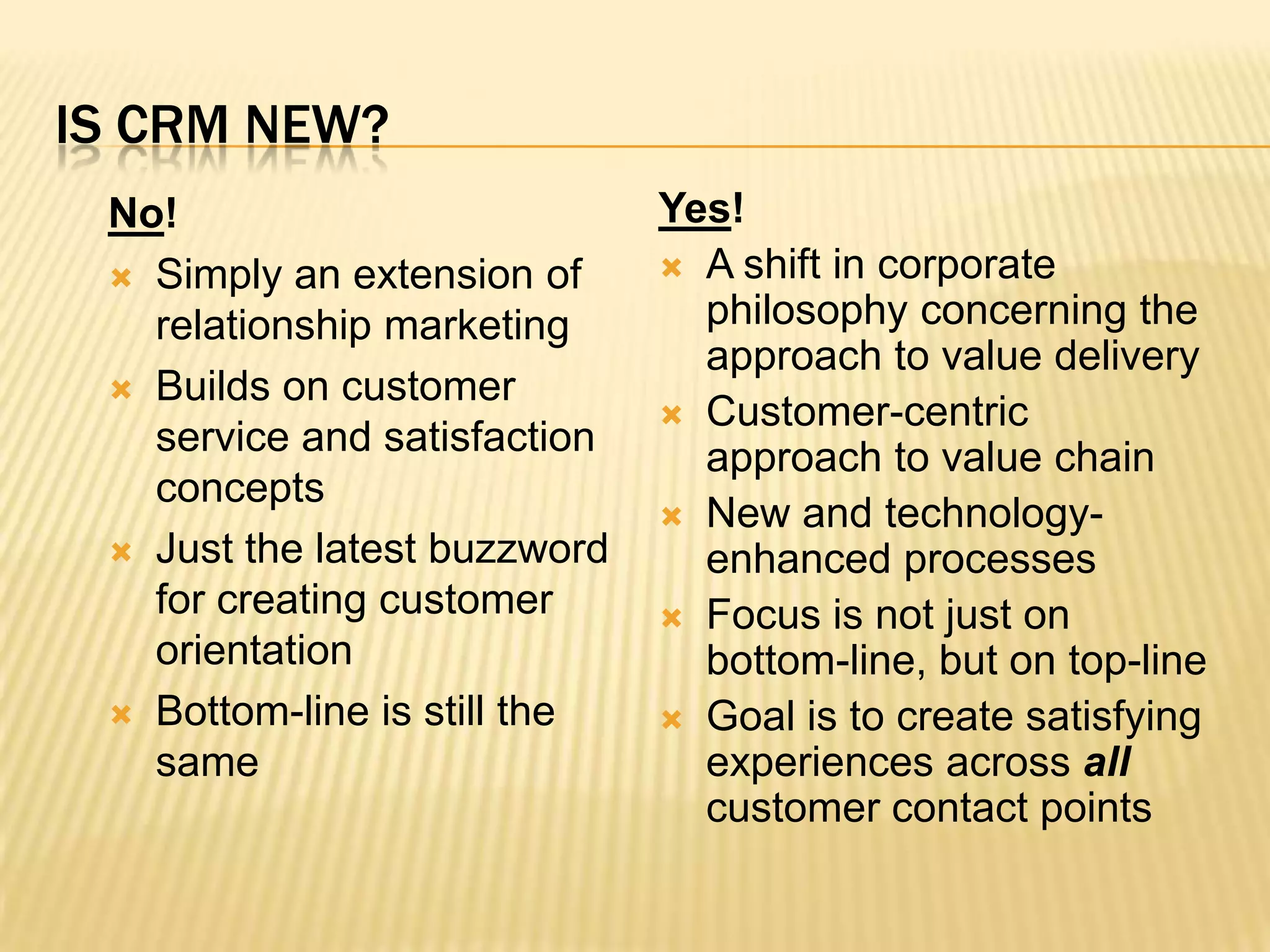
Is CRM New?No!Simply an extension of relationship marketingBuilds on customer service and satisfaction conceptsJust the latest buzzword for creating customer orientationBottom-line is still the sameYes!A shift in corporate philosophy concerning the approach to value deliveryCustomer-centric approach to value chainNew and technology-enhanced processesFocus is not just on bottom-line, but on top-lineGoal is to create satisfying experiences across all customer contact points
Approaches to crmData driven approach.Process driven approach.
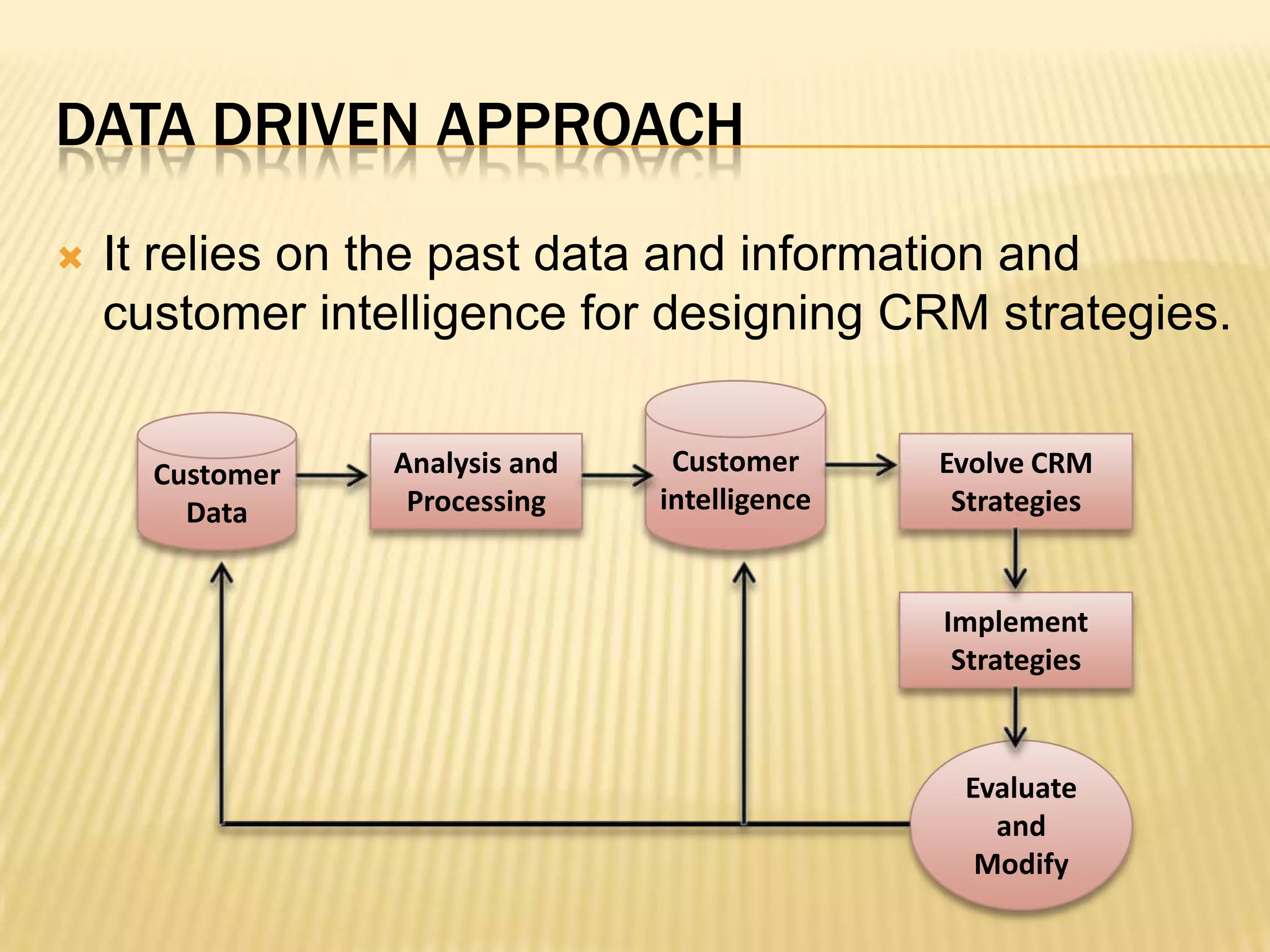
Data driven approachIt relies on the past data and information and customer intelligence for designing CRM strategies.CustomerintelligenceCustomerDataAnalysis and ProcessingEvolve CRM StrategiesImplementStrategiesEvaluate and Modify
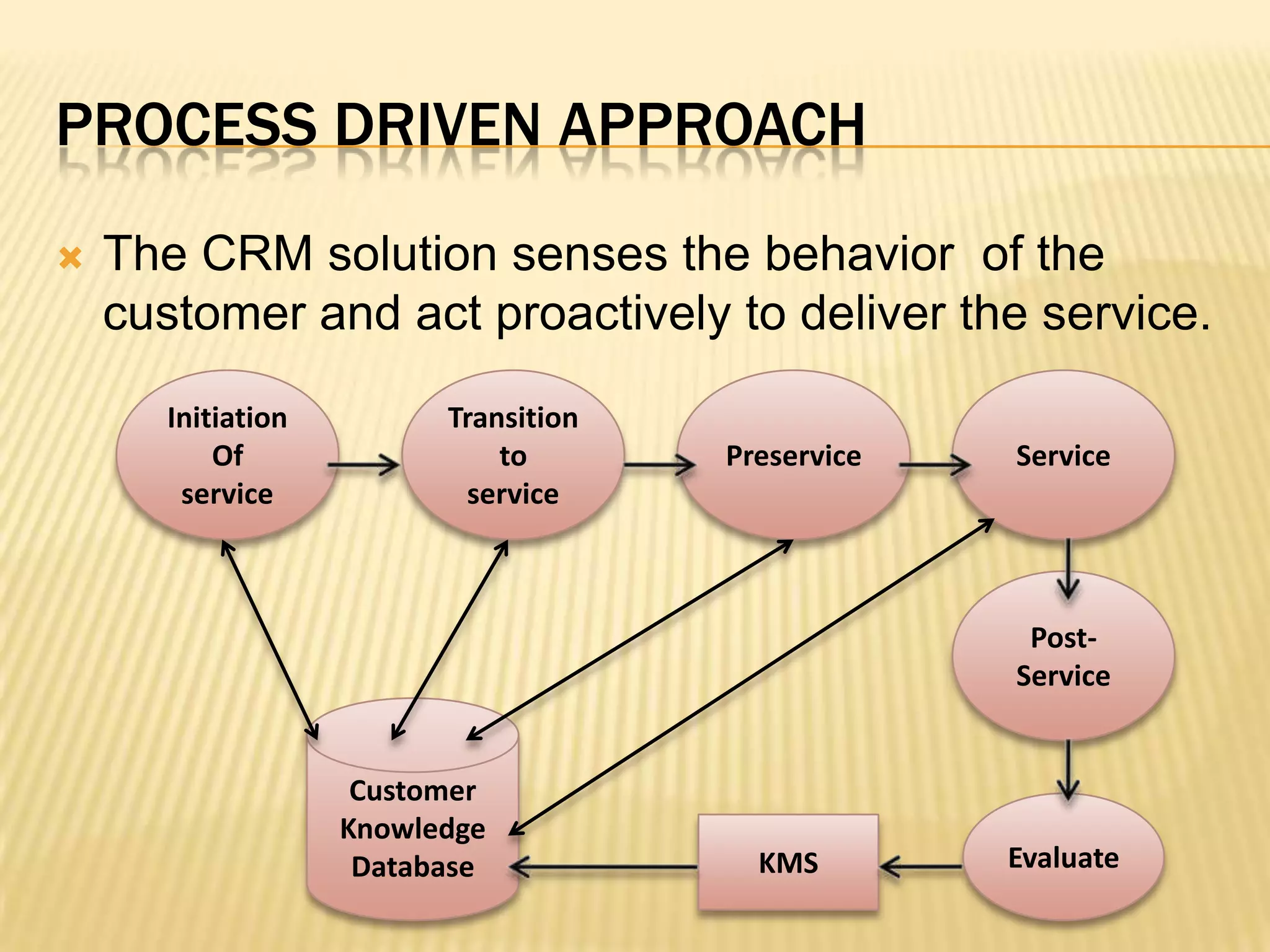
process driven approachThe CRM solution senses the behavior  of the customer and act proactively to deliver the service.Initiation OfserviceTransition toservicePreserviceServicePost-ServiceCustomerKnowledgeDatabaseEvaluateKMS
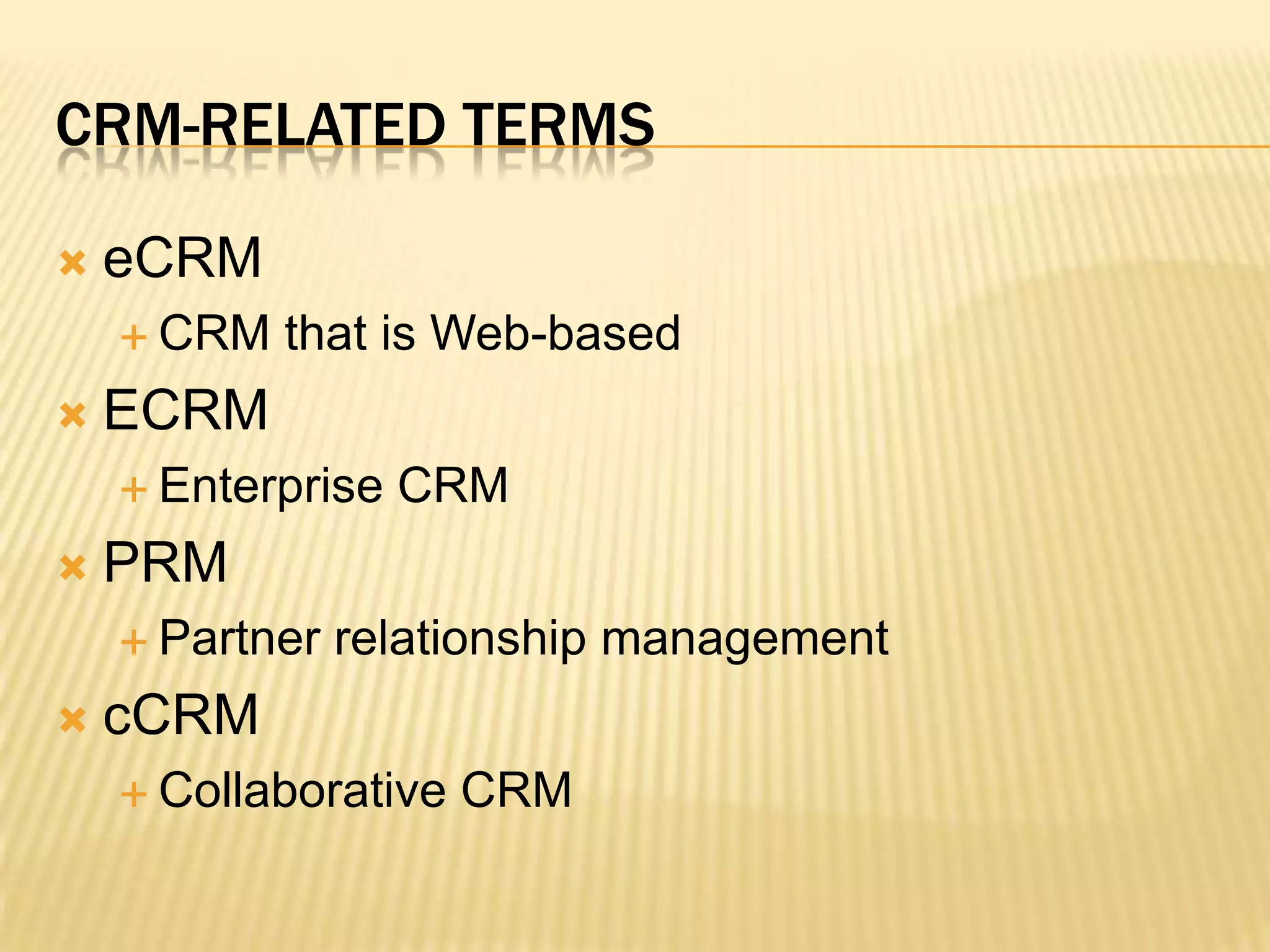
CRM-Related Terms	eCRMCRM that is Web-basedECRM	Enterprise CRMPRMPartner relationship managementcCRMCollaborative CRM
CRM-Related TermsSRMSupplier relationship managementmCRMMobile CRMxCRMMore hybrids to com
“You can learn a lot about our motorcycle company by understanding our customers.  By valuing and responding to our customers, we have become the leader in the heavyweight motorcycle market.” –Harley-Davidson website“The customers’ first choice in casual dining.” –Chili’s Visionquotes
referencesWamanJawadekar, "Management Information Systems” , 4th Edition, Tata McGraw-Hill Publishing Company Limited.Tushar B Kute,Sandip Institute of Technology and Research Centre, Nashikhttp://www.tusharkute.com

MIS 13 Customer Relationship Management

  • 1.
    Management information systemThirdYear Information TechnologyPart 13Customer Relationship Management Tushar B Kute,Sandip Institute of Technology and Research Centre, Nashikhttp://www.tusharkute.com
  • 2.
    CRMOf the people,by the people, and for the people.
  • 3.
    Three Eras inthe History of MarketingProduction Era “A good product will sell itself.”Sales Era“Creative advertising and selling will overcome consumer resistance and convince them to buy.”Marketing Era“The consumer is king! Find a need and fill it.”
  • 4.
    Profitability of Long-LifeCustomers According to a study conducted by the American Management Association, 65 percent of the average company’s business comes from its present, satisfied customers Costs a company 6x’s more to sell a product to a new customer than it does to an existing one
  • 5.
    Profitability of Long-LifeCustomersA business that each day for one year loses one customer who customarily spends $50/week would suffer a sales decline of $1,000,000 the next year Reichheldfound that companies could boost profits by 100 percent by retaining just 5 percent more of their customers.
  • 6.
    Relationship MarketingRelationship marketinginvolves long-term, value-added relationships developed over time with customers and suppliers. Relationship marketing recognizes the critical importance of internal marketing to the success of external marketing plans.
  • 7.
    Relationship MarketingMorgan andHunt (1994) proposed the following definition of relationship marketing: Relationship marketing refers to all marketing activities directed toward establishing, developing, and maintaining successful relationship exchanges
  • 8.
    Customer Relationship Management“Processof creating and maintaining relationships with business customers or consumers”“A holistic process of identifying, attracting, differentiating, and retaining customers”“Integrating the firm’s value chain to create enhanced customer value at every step”“An integrated cross-functional focus on improving customer retention and profitability for the company.”“A view of the customer that asserts that he or she is a valuable asset to be managed.” –S. Thomas Foster.Deciding that “you want lifetime clients.” -Richard Buckingham.
  • 9.
    Customer Relationship ManagementBottom-line: Theuse of information-enabled systems for enhancing individual customer relationships to ensure long-term customer loyalty and retention
  • 10.
    Crm configurationFront officeoperationsMeetings, phone calls, emails, online services.Back office operationsBilling, maintenance, planning, marketing, advertising, finance, manufacturing.Business relationshipsInteraction with companies and partners, suppliers, vendors and retail outlets, distributors.
  • 11.
  • 12.
    Complaint resolutionThree typesof complaints: Regulatory, Employee, CustomerCompensationEase of Resolution
  • 13.
  • 14.
  • 15.
    The way afirm reacts to a problem so that the problem never reoccurs.Corrective action
  • 16.
  • 17.
    A low-cost way to increase revenue. Retention is cheaper than acquisition. Must be voluntary.Must lead to long-term relationships.Customer retention
  • 18.
    RelationshipsAttempting to knowthe customer. Commitment and Communication “Clients should call you only once. After that, you should proactively call them.” –Richard Buckingham.
  • 19.
    Powerful tool thatresults from customer satisfaction or dissatisfaction.“Referral clients are already sold, before they even call you.” –Richard Buckinghamreferrals
  • 20.
    Empower employees sothat they may deal with mistakes as they occur.recovery
  • 21.
    CUSTOMER RELATIONSHIP MANAGEMENTTimeline of CRM evolutionFirst Generation(before 1990)started with such functions like maintaining prospects data, generating leads, creating sales quotations & placing sales orders and other functions like after sales help desks, call centers etcSecond Generation (1990-1996) consolidation of various activities into pre-sales through SFA transactions and post sales through CSS. Not much of an integration with back office operationsThird Generation( After 2002) integration of the customer facing front end systems with the back end systems as well as with partners& suppliers helped by the growth of the Internet technology.
  • 22.
    Types of CRMOperationalCRM automation of Business processes involving customers. e.g. Sales Force Automation, Customer service automation, Customer Touchpoints- all sources by which the customers interact with the companyAnalytical CRM is the synthesis & interpretation of operational Data to identify opportunities, optimize customer interactions and manage business performance. e.g. Data warehousing and Data martsCollaborative CRM provide interactions between customers, staff and business partners through web technologies. e.g. interactive voice technology, computer telephony and web conferencing.
  • 23.
    CHANGES WITH RESPECTTO CUSTOMERSGrowing Customer DiversityTime ScarcityValue Consciousness & intolerance for Low Service LevelInformation AvailabilityDecrease in LoyaltyCHANGES WITH RESPECT TO MARKETPLACEGrowing CompetitionCHANGES WITH RESPECT TO DATA STORAGE TECH.IT and ITESCHANGES WITH RESPECT TO MARKETING FUNCTIONMedia Dilution & MultiplicationDecrease in Marketing EfficiencyWHY IS CRM IMPORTANT TODAY?
  • 24.
    CRM ObjectivesLifetime Value(LTV)Refers to the net present value of the potential revenue stream for any particular customer over a number of years.Starts with current purchase activity then extrapolates to include potential additions from cross-selling, upgrades, total ownership, etc.Customer OwnershipAttempts to “own” the lionshare of customer spending and/or “share of mind” in a particular product categoryBuilding brand equity, maintaining vigilant customer contact, keeping current with the market trends is critical5% points increase in customer retention=20-125% increase in profit
  • 25.
    Is CRM New?No!Simplyan extension of relationship marketingBuilds on customer service and satisfaction conceptsJust the latest buzzword for creating customer orientationBottom-line is still the sameYes!A shift in corporate philosophy concerning the approach to value deliveryCustomer-centric approach to value chainNew and technology-enhanced processesFocus is not just on bottom-line, but on top-lineGoal is to create satisfying experiences across all customer contact points
  • 26.
    Approaches to crmDatadriven approach.Process driven approach.
  • 27.
    Data driven approachItrelies on the past data and information and customer intelligence for designing CRM strategies.CustomerintelligenceCustomerDataAnalysis and ProcessingEvolve CRM StrategiesImplementStrategiesEvaluate and Modify
  • 28.
    process driven approachTheCRM solution senses the behavior of the customer and act proactively to deliver the service.Initiation OfserviceTransition toservicePreserviceServicePost-ServiceCustomerKnowledgeDatabaseEvaluateKMS
  • 29.
    CRM-Related Terms eCRMCRM thatis Web-basedECRM Enterprise CRMPRMPartner relationship managementcCRMCollaborative CRM
  • 30.
    CRM-Related TermsSRMSupplier relationshipmanagementmCRMMobile CRMxCRMMore hybrids to com
  • 31.
    “You can learna lot about our motorcycle company by understanding our customers. By valuing and responding to our customers, we have become the leader in the heavyweight motorcycle market.” –Harley-Davidson website“The customers’ first choice in casual dining.” –Chili’s Visionquotes
  • 32.
    referencesWamanJawadekar, "Management InformationSystems” , 4th Edition, Tata McGraw-Hill Publishing Company Limited.Tushar B Kute,Sandip Institute of Technology and Research Centre, Nashikhttp://www.tusharkute.com