UNIT – IV
Customer Relationship Management
Course: MBA-II
Subject: EWIS
CUSTOMER RELATIONSHIP
MANAGMENT
A BRIEF HISTORY
1980s: Database Marketing
– Speak individually to countless customers
– The reality: It's too costly, too difficult, and doesn't pay out
on the bottom line
– The compromise: A little database marketing goes a long way,
maybe plus an iota of demographics
A BRIEF HISTORY
1990s: Relationship Marketing
– Major phenomenon: Loyalty programs.
– Major promise: Loyalty!
– Major result:
Companies such as airlines now have an enormous incremental
layer of expenses, without much to show for it
Early 2000's: Customer Relationship Management
– Major phenomenon: Great promise
– Major reality: Promise unattained.
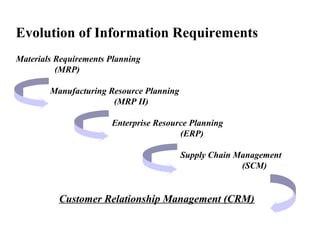
Evolution of Information Requirements
Materials Requirements Planning
(MRP)
Manufacturing Resource Planning
(MRP II)
Enterprise Resource Planning
(ERP)
Supply Chain Management
(SCM)
Customer Relationship Management (CRM)
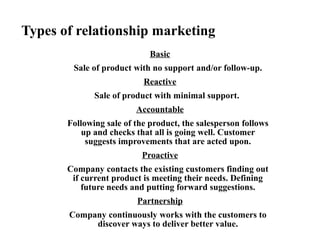
Types of relationship marketing
Basic
Sale of product with no support and/or follow-up.
Reactive
Sale of product with minimal support.
Accountable
Following sale of the product, the salesperson follows
up and checks that all is going well. Customer
suggests improvements that are acted upon.
Proactive
Company contacts the existing customers finding out
if current product is meeting their needs. Defining
future needs and putting forward suggestions.
Partnership
Company continuously works with the customers to
discover ways to deliver better value.
Establishing a relationship-marketing programme
Identify the key customers meriting relationship
management
Assign a skilled manager to each key customer
Develop a clear job description for relationship
management
Have each relationship manager develop annual and long
range customer relationship plans
Appoint an overall manager to supervise the relationship
managers
What is CRM
Craig Conway ,CEO – People Soft
Customer approaches a business with an expectation.
On company reactions they form an experience that shapes their
behavior.
The ability to recognize this process & to actively manage it forms
basis of CRM
Scott Fletcher , President - e pipeline
Set of business process/policies that are designed to acquire retain
and service customers.
Ronni Marshak –Seybolds group
Every company’s game plan includes
Goals – Profitability
Strategy – Establish L.T customer relationships
Plans – Invest in CRM technology
Objectives –Achieve 60 % customer retention
Tactics – Implement 24/7 call centre
Robert Thompson , President , Front Line Solutions
CRM is a business strategy to select and manage customers to optimize
long term value.
CRM requires customer centric business philosophy & culture to support
effective marketing , sales & Service processes
Brent Frei , CEO Onyx Software
CRM is a comprehensive set of processes and technologies for
managing the relationships with potential and current customers
across marketing sales and service functions
Peter Keen ,Chairman Keen Innovations
CRM is the commitment of the company to place the customer
experience at the centre of its priorities& to ensure that incentive
systems , processes and information resources leverage the
relationship by enhancing the experience
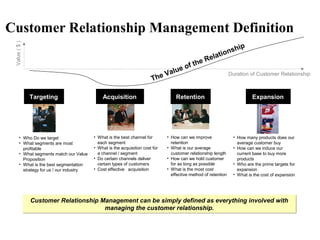
Targeting Acquisition Retention Expansion
Customer Relationship Management can be simply defined as everything involved with
managing the customer relationship.
Customer Relationship Management can be simply defined as everything involved with
managing the customer relationship.
The Value of the Relationship
• Who Do we target
• What segments are most
profitable
• What segments match our Value
Proposition
• What is the best segmentation
strategy for us / our industry
• What is the best channel for
each segment
• What is the acquisition cost for
a channel / segment
• Do certain channels deliver
certain types of customers
• Cost effective acquisition
• How can we improve
retention
• What is our average
customer relationship length
• How can we hold customer
for as long as possible
• What is the most cost
effective method of retention
• How many products does our
average customer buy
• How can we induce our
current base to buy more
products
• Who are the prime targets for
expansion
• What is the cost of expansion
Customer Relationship Management Definition
Duration of Customer Relationship
Value($)
Why CRM?
 It costs six times more to sell to new customer than to sell
to an existing one.
 A typical dissatisfied customer will tell 8-10 people
 By increasing the customer retention rate by 5%, profits
could increase by by 85%
 Odds of selling to new customers = 15%, as compared to
those for existing customers (50%)
 70% of the complaining customers will remain loyal if
problem is solved
 90% of companies do not have the sales and service
integration to support e-commerce
Goals of CRM?
* Provide better customer service
* Make call centres more efficient
* Cross sell products more effectively
* Helps sales team close deals faster
* Simplify marketing and sales process
* Discover new customers
* Increase customer revenues
Marketing Selling Servicing
Customer Management Process Threads
Broadcast
Mail
Field Personnel
Agents/Distributors
Call Center
Retail
Internet
Back Office Process/Systems
CustomerInteractionChannels
Are we making the right level
and type of marketing, sales,
and service investments in
each of our customer
segments?
Customer RelationshipCustomer Relationship
StrategiesStrategies
Are we taking a holistic
approach to our customers
across processes and
channels?
Customer RelationshipCustomer Relationship
StructureStructure
Have we implemented best
practices and technology in
process/channel?
Customer RelationshipCustomer Relationship
PerformancePerformance
ScopeScope DepthDepth
Importance of CRM[1]
Capture Customer
Data and Measure
Results
The Customer
Capture Customer
Data and Measure
Results
Take Action to
Enrich the Customer
Relationship Capture Customer
Data and Measure
Results
Build and Manage
Customer Value
Capture Customer
Data and Measure
Results
Capture Customer
Data and Measure
Results
Capture
Customer Data
and Measure
Results
Store Data, Mine
and Make
Information
Accessible
The CRMThe CRM
DynamicDynamic
Customer Relationship Management is a ongoing, dynamic learning process for an organizationCustomer Relationship Management is a ongoing, dynamic learning process for an organization
Customer Relationship Management Process[2]
 The building blocks of CRM allow an organization to manage this cycle and use the
knowledge on customers to enhance the Life Time value of the customer portfolio.
 No organization has perfect information on its customers. Knowledge of customers is
continuously enhanced through the CRM dynamic.
Implementing CRM must be approached from an
Integrated Perspective[3]
All areas must be implemented, to some degree, to effectively manage the customer
relationship. When pieces are implemented in isolation, the benefits are less than
overwhelming.
All areas must be implemented, to some degree, to effectively manage the customer
relationship. When pieces are implemented in isolation, the benefits are less than
overwhelming.
Capture Customer
Data and Measure
Results
The Customer
Capture Customer
Data and Measure
Results
Take Action to
Enrich the Customer
Relationship Capture Customer
Data and Measure
Results
Build and Manage
Customer Value
Capture Customer
Data and Measure
Results
Capture Customer
Data and Measure
Results
Capture
Customer Data
and Measure
Results
Store Data, Mine
and Make
information
Accessible
CRMCRM
without anwithout an
IntegratedIntegrated
ApproachApproach
A data warehouse full of data without
the tools to extract knowledge is
nothing more than expensive
inventory.
Sophisticated mining tools only
produce results only as good as the
data they mine.
Developing insights on how to improve the value of the
customer relationship without having the infrastructure to
take action has no impact on the bottom line. In addition,
there is no opportunity to test the ‘theoretical’ analysis.
Implementing new technologies without
the knowledge on how to enrich the
relationship is likely to yield a return below
the cost of the capital expenditure.
Taking action to improve the
relationship without measuring the
results provides no evidence of
success or failure and limits the
opportunity for learning.
Capturing gigabytes of customer data
in disparate operational systems that
are next to impossible to access may
render the data useless.
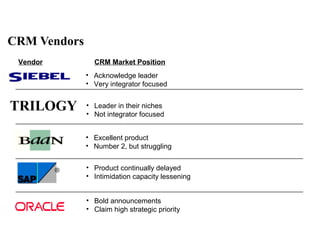
Vendor CRM Market Position
• Acknowledge leader
• Very integrator focused
• Leader in their niches
• Not integrator focused
• Excellent product
• Number 2, but struggling
• Product continually delayed
• Intimidation capacity lessening
• Bold announcements
• Claim high strategic priority
®
TRILOGY
CRM Vendors
E-CRM
Business Processes
Profiles &
Preferences
Business PartnerBusiness Partner
Business to CustomerBusiness to Customer
Business to BusinessBusiness to Business
The ValueThe Value
PropositionProposition
ofof
ElectronicElectronic
BusinessBusiness
SolutionsSolutions
Integrating
more directly
with the
business
processes of
customers and
partners
Tailoring
products and
services to
customers
needs and
values
Business
Processes
Extending key business
applications to clients and
business partners
Business PartnerBusiness Partner
e-Business is all about integrating the internal and external processes between business partners and
customers.
e-Business is all about integrating the internal and external processes between business partners and
customers.
e-Business – Definition[4]
Internet technology can improve the level of customer care, while reducing the cost of
maintaining the customer base.
Internet technology can improve the level of customer care, while reducing the cost of
maintaining the customer base.
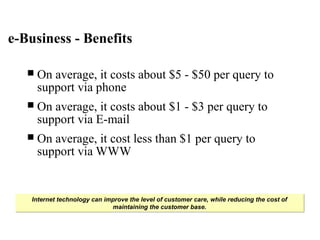
e-Business - Benefits
 On average, it costs about $5 - $50 per query to
support via phone
 On average, it costs about $1 - $3 per query to
support via E-mail
 On average, it cost less than $1 per query to
support via WWW
References
 The CRM Handbook by Jill Dyche
 Concepts in Enterprise Resource Planning by Brand, Monk and Wagner –
Thomson Learning
 http://www.block.si/block.php?
url=http://http://www.scribd.com/doc/37867210/CRM-PPT&category=401
 http://en.wikipedia.org/wiki/Customer Relationship Management
 www.Management Information System/management/Ebook/CRM.PDF
Images
1) http://en.wikipedia.org/wiki/Customer Relationship Management
2)www.Management Information System/management/Ebook/CRM.PDF
3) www.Management Information System/management/Ebook/CRM.PDF
4) www.Management Information System/management/Ebook/CRM.PDF
THANK YOU

Mba ii ewis u iv crm

  • 1.
    UNIT – IV CustomerRelationship Management Course: MBA-II Subject: EWIS
  • 2.
  • 3.
    A BRIEF HISTORY 1980s:Database Marketing – Speak individually to countless customers – The reality: It's too costly, too difficult, and doesn't pay out on the bottom line – The compromise: A little database marketing goes a long way, maybe plus an iota of demographics
  • 4.
    A BRIEF HISTORY 1990s:Relationship Marketing – Major phenomenon: Loyalty programs. – Major promise: Loyalty! – Major result: Companies such as airlines now have an enormous incremental layer of expenses, without much to show for it Early 2000's: Customer Relationship Management – Major phenomenon: Great promise – Major reality: Promise unattained.
  • 5.
    Evolution of InformationRequirements Materials Requirements Planning (MRP) Manufacturing Resource Planning (MRP II) Enterprise Resource Planning (ERP) Supply Chain Management (SCM) Customer Relationship Management (CRM)
  • 6.
    Types of relationshipmarketing Basic Sale of product with no support and/or follow-up. Reactive Sale of product with minimal support. Accountable Following sale of the product, the salesperson follows up and checks that all is going well. Customer suggests improvements that are acted upon. Proactive Company contacts the existing customers finding out if current product is meeting their needs. Defining future needs and putting forward suggestions. Partnership Company continuously works with the customers to discover ways to deliver better value.
  • 7.
    Establishing a relationship-marketingprogramme Identify the key customers meriting relationship management Assign a skilled manager to each key customer Develop a clear job description for relationship management Have each relationship manager develop annual and long range customer relationship plans Appoint an overall manager to supervise the relationship managers
  • 8.
    What is CRM CraigConway ,CEO – People Soft Customer approaches a business with an expectation. On company reactions they form an experience that shapes their behavior. The ability to recognize this process & to actively manage it forms basis of CRM Scott Fletcher , President - e pipeline Set of business process/policies that are designed to acquire retain and service customers.
  • 9.
    Ronni Marshak –Seyboldsgroup Every company’s game plan includes Goals – Profitability Strategy – Establish L.T customer relationships Plans – Invest in CRM technology Objectives –Achieve 60 % customer retention Tactics – Implement 24/7 call centre Robert Thompson , President , Front Line Solutions CRM is a business strategy to select and manage customers to optimize long term value. CRM requires customer centric business philosophy & culture to support effective marketing , sales & Service processes
  • 10.
    Brent Frei ,CEO Onyx Software CRM is a comprehensive set of processes and technologies for managing the relationships with potential and current customers across marketing sales and service functions Peter Keen ,Chairman Keen Innovations CRM is the commitment of the company to place the customer experience at the centre of its priorities& to ensure that incentive systems , processes and information resources leverage the relationship by enhancing the experience
  • 11.
    Targeting Acquisition RetentionExpansion Customer Relationship Management can be simply defined as everything involved with managing the customer relationship. Customer Relationship Management can be simply defined as everything involved with managing the customer relationship. The Value of the Relationship • Who Do we target • What segments are most profitable • What segments match our Value Proposition • What is the best segmentation strategy for us / our industry • What is the best channel for each segment • What is the acquisition cost for a channel / segment • Do certain channels deliver certain types of customers • Cost effective acquisition • How can we improve retention • What is our average customer relationship length • How can we hold customer for as long as possible • What is the most cost effective method of retention • How many products does our average customer buy • How can we induce our current base to buy more products • Who are the prime targets for expansion • What is the cost of expansion Customer Relationship Management Definition Duration of Customer Relationship Value($)
  • 12.
    Why CRM?  Itcosts six times more to sell to new customer than to sell to an existing one.  A typical dissatisfied customer will tell 8-10 people  By increasing the customer retention rate by 5%, profits could increase by by 85%  Odds of selling to new customers = 15%, as compared to those for existing customers (50%)  70% of the complaining customers will remain loyal if problem is solved  90% of companies do not have the sales and service integration to support e-commerce
  • 13.
    Goals of CRM? *Provide better customer service * Make call centres more efficient * Cross sell products more effectively * Helps sales team close deals faster * Simplify marketing and sales process * Discover new customers * Increase customer revenues
  • 14.
    Marketing Selling Servicing CustomerManagement Process Threads Broadcast Mail Field Personnel Agents/Distributors Call Center Retail Internet Back Office Process/Systems CustomerInteractionChannels Are we making the right level and type of marketing, sales, and service investments in each of our customer segments? Customer RelationshipCustomer Relationship StrategiesStrategies Are we taking a holistic approach to our customers across processes and channels? Customer RelationshipCustomer Relationship StructureStructure Have we implemented best practices and technology in process/channel? Customer RelationshipCustomer Relationship PerformancePerformance ScopeScope DepthDepth Importance of CRM[1]
  • 15.
    Capture Customer Data andMeasure Results The Customer Capture Customer Data and Measure Results Take Action to Enrich the Customer Relationship Capture Customer Data and Measure Results Build and Manage Customer Value Capture Customer Data and Measure Results Capture Customer Data and Measure Results Capture Customer Data and Measure Results Store Data, Mine and Make Information Accessible The CRMThe CRM DynamicDynamic Customer Relationship Management is a ongoing, dynamic learning process for an organizationCustomer Relationship Management is a ongoing, dynamic learning process for an organization Customer Relationship Management Process[2]  The building blocks of CRM allow an organization to manage this cycle and use the knowledge on customers to enhance the Life Time value of the customer portfolio.  No organization has perfect information on its customers. Knowledge of customers is continuously enhanced through the CRM dynamic.
  • 16.
    Implementing CRM mustbe approached from an Integrated Perspective[3] All areas must be implemented, to some degree, to effectively manage the customer relationship. When pieces are implemented in isolation, the benefits are less than overwhelming. All areas must be implemented, to some degree, to effectively manage the customer relationship. When pieces are implemented in isolation, the benefits are less than overwhelming. Capture Customer Data and Measure Results The Customer Capture Customer Data and Measure Results Take Action to Enrich the Customer Relationship Capture Customer Data and Measure Results Build and Manage Customer Value Capture Customer Data and Measure Results Capture Customer Data and Measure Results Capture Customer Data and Measure Results Store Data, Mine and Make information Accessible CRMCRM without anwithout an IntegratedIntegrated ApproachApproach A data warehouse full of data without the tools to extract knowledge is nothing more than expensive inventory. Sophisticated mining tools only produce results only as good as the data they mine. Developing insights on how to improve the value of the customer relationship without having the infrastructure to take action has no impact on the bottom line. In addition, there is no opportunity to test the ‘theoretical’ analysis. Implementing new technologies without the knowledge on how to enrich the relationship is likely to yield a return below the cost of the capital expenditure. Taking action to improve the relationship without measuring the results provides no evidence of success or failure and limits the opportunity for learning. Capturing gigabytes of customer data in disparate operational systems that are next to impossible to access may render the data useless.
  • 17.
    Vendor CRM MarketPosition • Acknowledge leader • Very integrator focused • Leader in their niches • Not integrator focused • Excellent product • Number 2, but struggling • Product continually delayed • Intimidation capacity lessening • Bold announcements • Claim high strategic priority ® TRILOGY CRM Vendors
  • 18.
  • 19.
    Business Processes Profiles & Preferences BusinessPartnerBusiness Partner Business to CustomerBusiness to Customer Business to BusinessBusiness to Business The ValueThe Value PropositionProposition ofof ElectronicElectronic BusinessBusiness SolutionsSolutions Integrating more directly with the business processes of customers and partners Tailoring products and services to customers needs and values Business Processes Extending key business applications to clients and business partners Business PartnerBusiness Partner e-Business is all about integrating the internal and external processes between business partners and customers. e-Business is all about integrating the internal and external processes between business partners and customers. e-Business – Definition[4]
  • 20.
    Internet technology canimprove the level of customer care, while reducing the cost of maintaining the customer base. Internet technology can improve the level of customer care, while reducing the cost of maintaining the customer base. e-Business - Benefits  On average, it costs about $5 - $50 per query to support via phone  On average, it costs about $1 - $3 per query to support via E-mail  On average, it cost less than $1 per query to support via WWW
  • 21.
    References  The CRMHandbook by Jill Dyche  Concepts in Enterprise Resource Planning by Brand, Monk and Wagner – Thomson Learning  http://www.block.si/block.php? url=http://http://www.scribd.com/doc/37867210/CRM-PPT&category=401  http://en.wikipedia.org/wiki/Customer Relationship Management  www.Management Information System/management/Ebook/CRM.PDF Images 1) http://en.wikipedia.org/wiki/Customer Relationship Management 2)www.Management Information System/management/Ebook/CRM.PDF 3) www.Management Information System/management/Ebook/CRM.PDF 4) www.Management Information System/management/Ebook/CRM.PDF
  • 22.