Minimum Spanning Tree
M.Balamurugan
Assistant Professor
Dept of Computer Science
Sri Kaliswari College
Sivakasi
TREE
B
A
FE
C
D
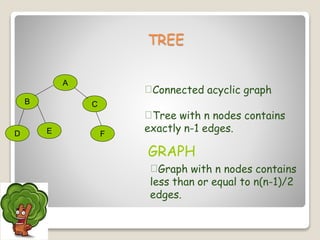
Connected acyclic graph
Tree with n nodes contains
exactly n-1 edges.
GRAPH
Graph with n nodes contains
less than or equal to n(n-1)/2
edges.
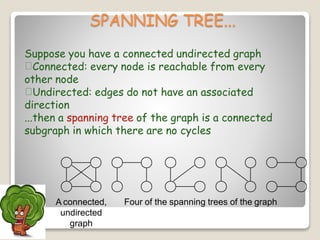
A connected,
undirected
graph
Four of the spanning trees of the graph
SPANNING TREE...
Suppose you have a connected undirected graph
Connected: every node is reachable from every
other node
Undirected: edges do not have an associated
direction
...then a spanning tree of the graph is a connected
subgraph in which there are no cycles
Minimizing costs
Applications:
electric power
water
telephone lines
MINIMUM SPANNING TREE
 Let G = (V, E) be a connected, undirected
graph where V is the set of nodes and E is
the set of edges. Each edge has a given
nonnegative length. The problem is to find
a subset T of the edges of G such that all
the nodes remain connected when only the
edges in T are used, and the sum of the
lengths of the edges in T is as small as
possible possible. Since G is connected, at
least one solution must exist.
Finding Spanning Trees
• There are two basic algorithms for finding minimum-cost
spanning trees, and both are greedy algorithms
• Kruskal’s algorithm:
Created in 1957 by Joseph Kruskal
• Prim’s algorithm
Created by Robert C. Prim
A
F
B
C
D
2
7
4
5
8 6
4
5
3
8
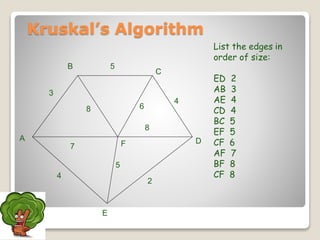
List the edges in
order of size:
ED 2
AB 3
AE 4
CD 4
BC 5
EF 5
CF 6
AF 7
BF 8
CF 8
Kruskal’s Algorithm
E
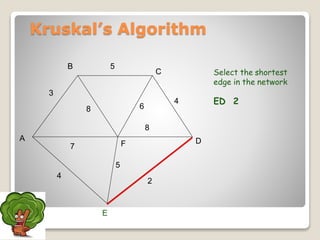
Select the shortest
edge in the network
ED 2
A
F
B
C
D
2
7
4
5
8 6
4
5
3
8
Kruskal’s Algorithm
E
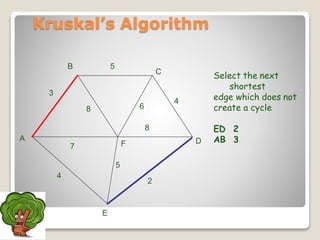
Select the next
shortest
edge which does not
create a cycle
ED 2
AB 3A
F
B
C
D
2
7
4
5
8 6
4
5
3
8
Kruskal’s Algorithm
E
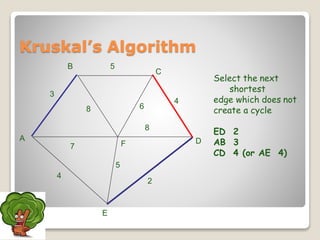
Select the next
shortest
edge which does not
create a cycle
ED 2
AB 3
CD 4 (or AE 4)
A
F
B
C
D
2
7
4
5
8 6
4
5
3
8
Kruskal’s Algorithm
E
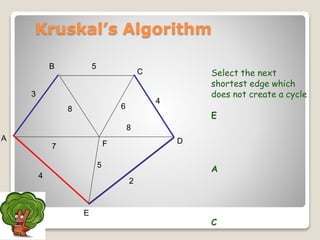
Select the next
shortest edge which
does not create a cycle
E
A
C
A
F
B
C
D
E
2
7
4
5
8 6
4
5
3
8
Kruskal’s Algorithm
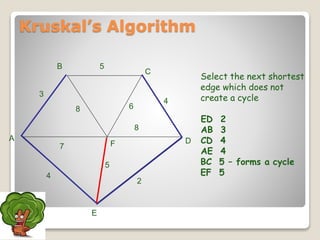
Select the next shortest
edge which does not
create a cycle
ED 2
AB 3
D CD 4
AE 4
BC 5 – forms a cycle
EF 5
A
F
B
C
E
2
7
4
5
8 6
4
5
3
8
Kruskal’s Algorithm
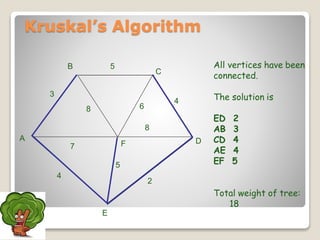
All vertices have been
connected.
The solution is
ED 2
AB 3
CD 4
AE 4
EF 5
Total weight of tree:
18
A
F
B
C
D
E
2
7
4
5
8 6
4
5
3
8
Kruskal’s Algorithm
Algorithm
Kruskal’s Algorithm:
complexity
Sorting loop:
Initialization of components:
Finding and merging:
O(a log n)
O(n)
O(a log n)
O(a log n)
A
F
B
C
D
2
7
4
5
8 6
4
5
3
8
Select any vertex
A
Select the shortest
edge connected to
that vertex
AB 3
Prim’s
Algorithm
E
A
F
B
C
D
2
7
4
5
8 6
4
5
3
8
Select the shortest
edge connected to
any vertex already
connected.
AE 4
Prim’s
Algorithm
E
Select the shortest
edge connected to
any vertex already
connected.
ED 2
A
F
B
C
D
2
7
4
5
8 6
4
5
3
8
Prim’s
Algorithm
E
Select the shortest
edge connected to
any vertex already
connected.
DC 4
A
F
B
C
D
2
7
4
5
8 6
4
5
3
8
Prim’s
Algorithm
E
Select the shortest
edge connected to
any vertex already
connected.
EF 5A
F
B
C
D
2
7
4
5
8 6
4
5
3
8
Prim’s
Algorithm
E
A
F
B
C
D
2
7
4
5
8 6
4
5
3
8
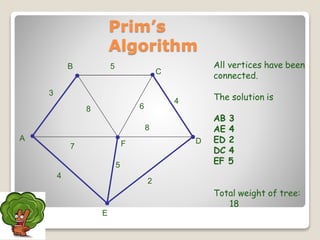
All vertices have been
connected.
The solution is
AB 3
AE 4
ED 2
DC 4
EF 5
Total weight of tree:
18
Prim’s
Algorithm
E
Prim’s
Algorithm
Complexity:
Outer loop: n-1 times
Inner loop: n times
O(n2)
Minimum Connector
Algorithms
Kruskal’s algorithm
1. Select the shortest edge
in a network
2. Select the next shortest
edge which does not create
a cycle
3. Repeat step 2 until
all vertices have
been connected
Prim’s algorithm
1. Select any vertex
2. Select the shortest edge
connected to that vertex
3. Select the shortest edge
connected to any vertex
already connected
4. Repeat step 3 until all
vertices have been
connected
Thank you!!

Minimum Spanning Tree