Best Practices  in  Panel Building  for  Minimizing Electrical Noise
Best Practices  in  Panel Building  for  Minimizing Electrical Noise The focus of this presentation is on how to minimize electrical noise in the control system and the techniques used in panel building to minimize electrical noise.
What is Grounding? According to NEC Connecting to the earth or to some conducting body that serves in place of the earth.
 
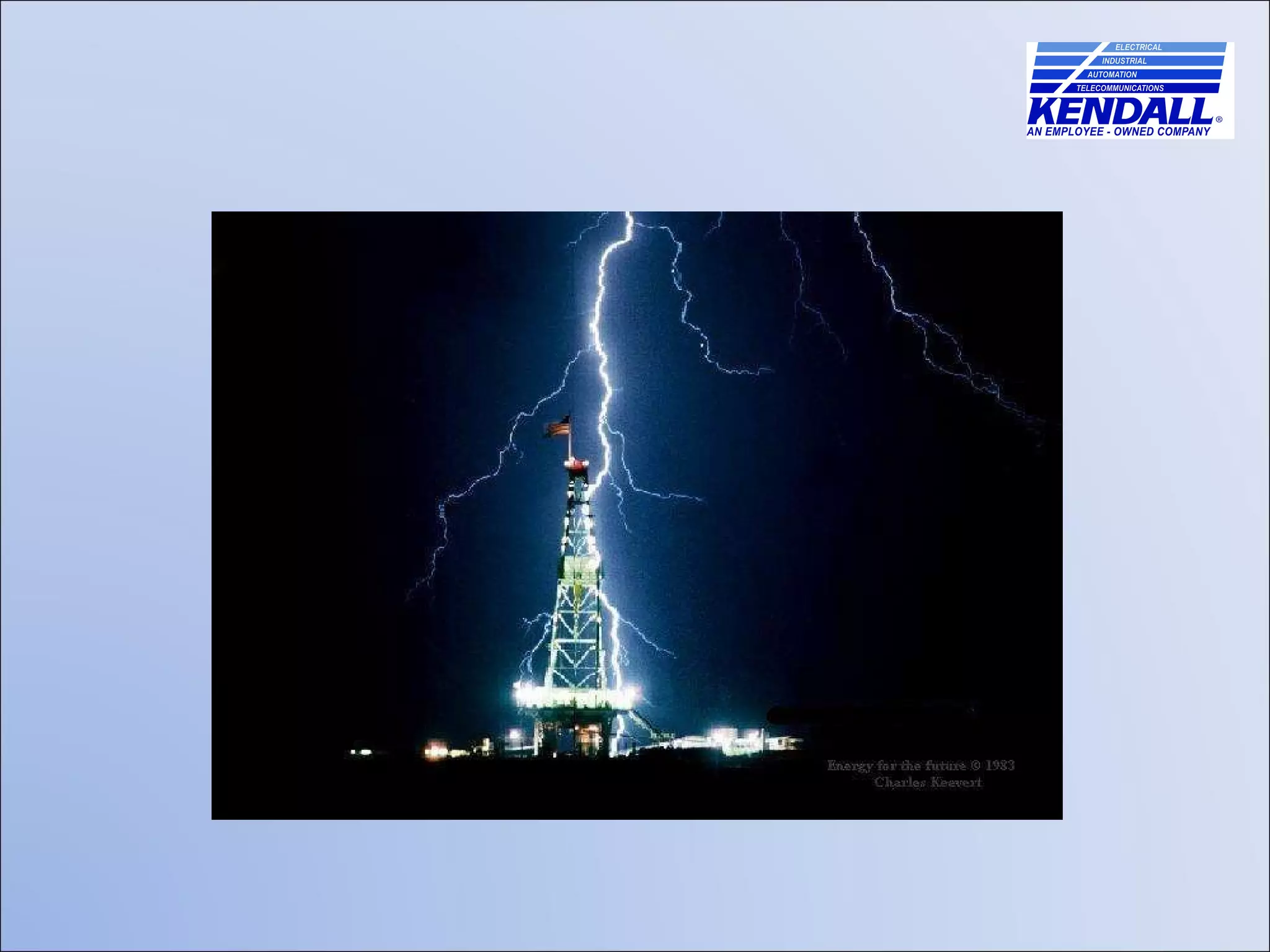
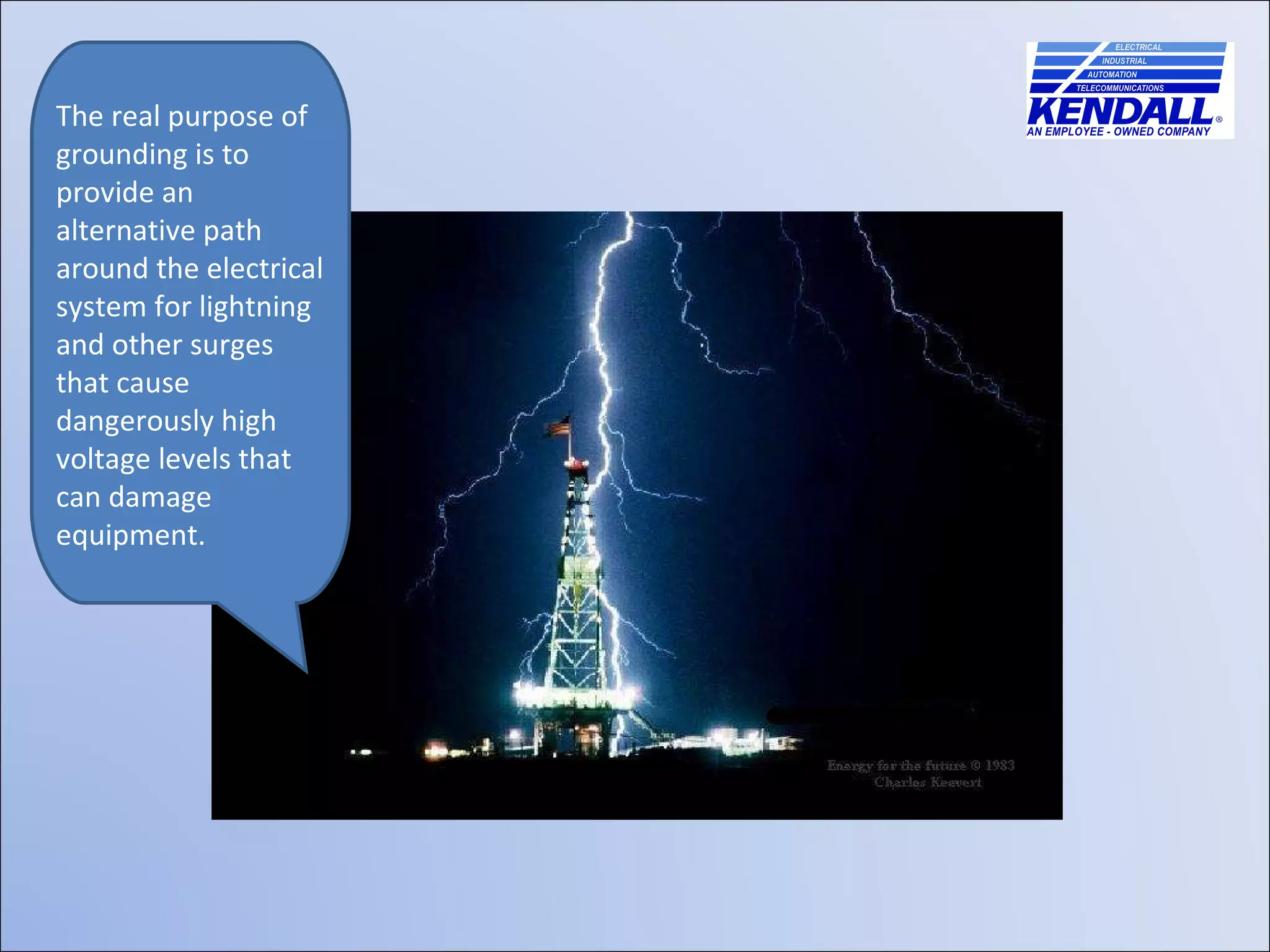
The real purpose of grounding is to provide an alternative path around the electrical system for lightning and other surges that cause dangerously high voltage levels that can damage equipment.
What is Bonding? According to NEC Connecting all metal parts together and to the system winding to provide a low-impedance path to the source to facilitate the opening of the circuit-protection device to remove dangerous voltages on metal parts.
 
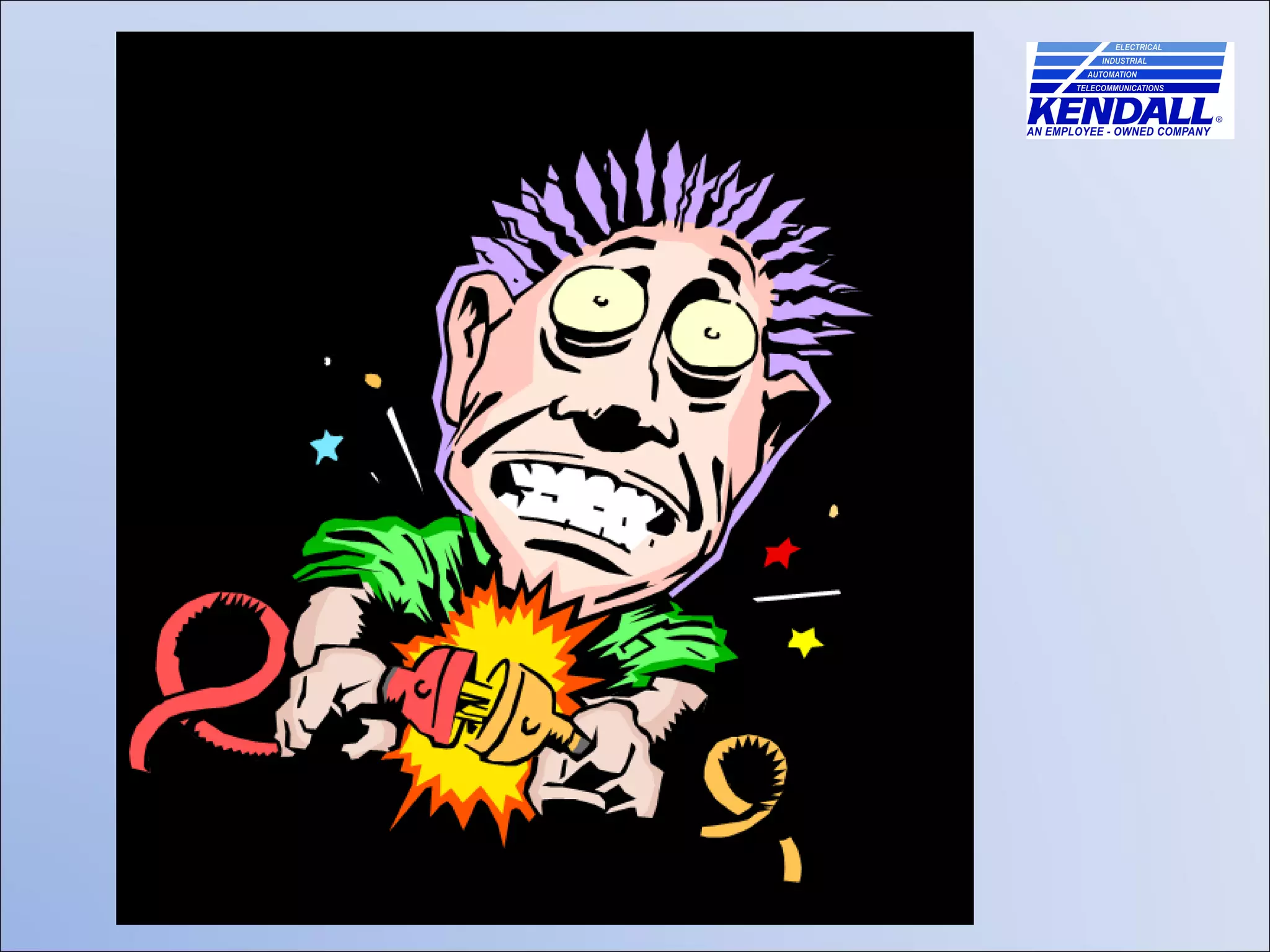
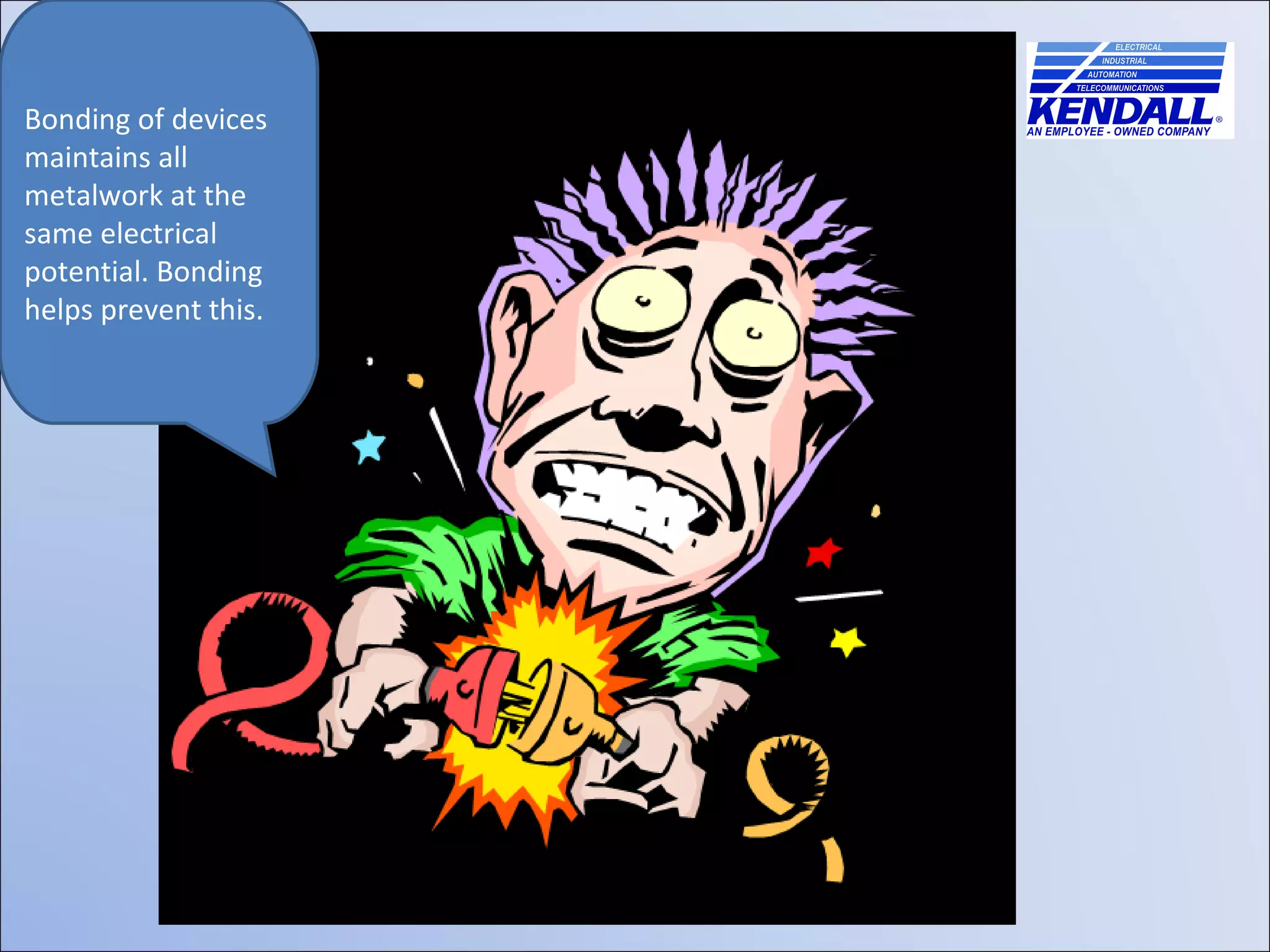
Bonding of devices maintains all metalwork at the same electrical potential. Bonding helps prevent this.
High Frequency Bonding Segregation Shielding Filtering Contact Suppression / Clamping These are the five considerations for reducing electrical noise in a panel.
High Frequency Bonding Segregation Shielding Filtering Contact Suppression / Clamping Maintaining all metalwork at the same electrical potential. If different potentials exist the voltage difference is seen as common-mode noise on all interconnect wiring internal and external to the cabinet.
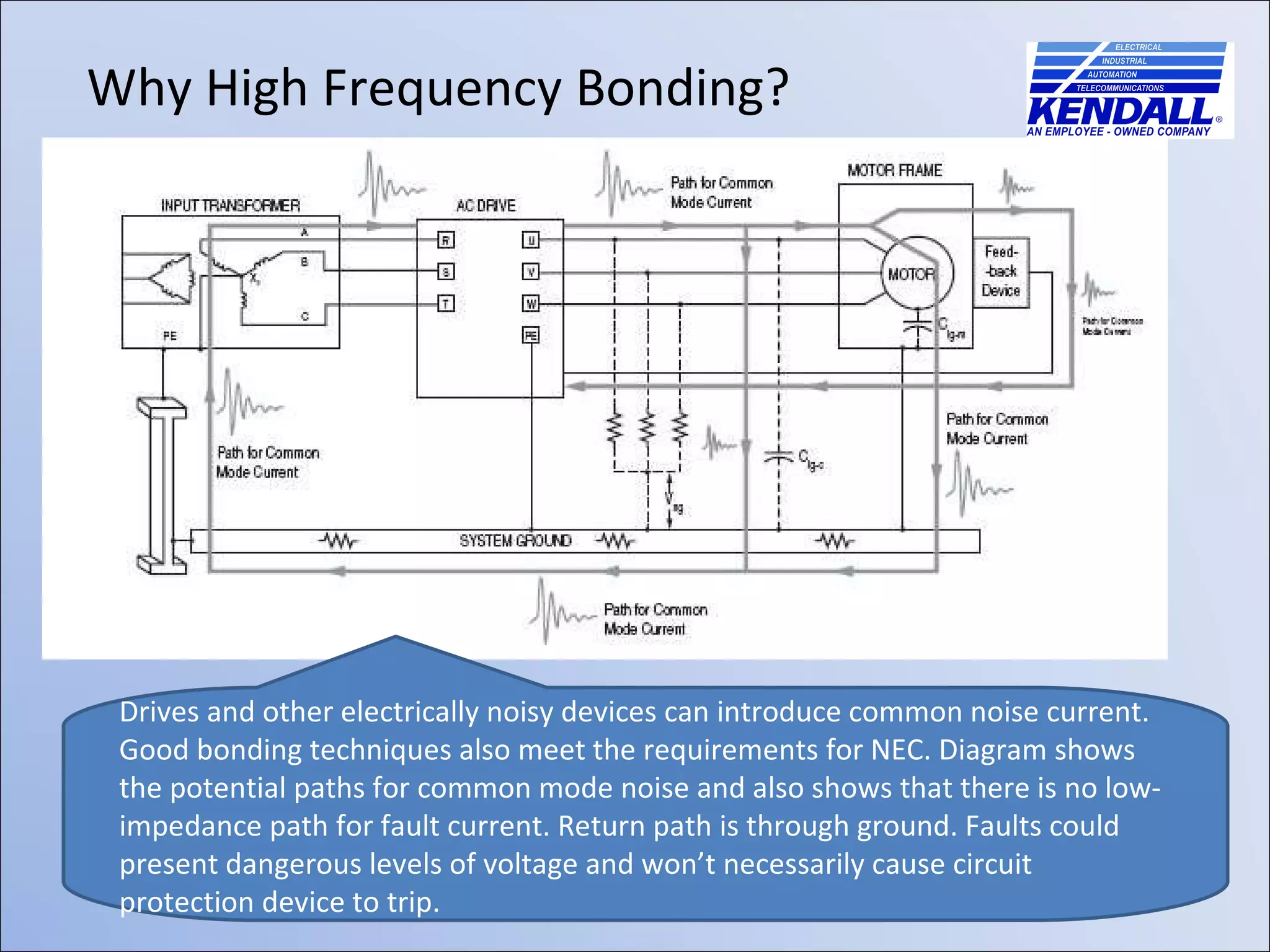
Why High Frequency Bonding? Drives and other electrically noisy devices can introduce common noise current. Good bonding techniques also meet the requirements for NEC. Diagram shows the potential paths for common mode noise and also shows that there is no low-impedance path for fault current. Return path is through ground. Faults could present dangerous levels of voltage and won’t necessarily cause circuit protection device to trip.
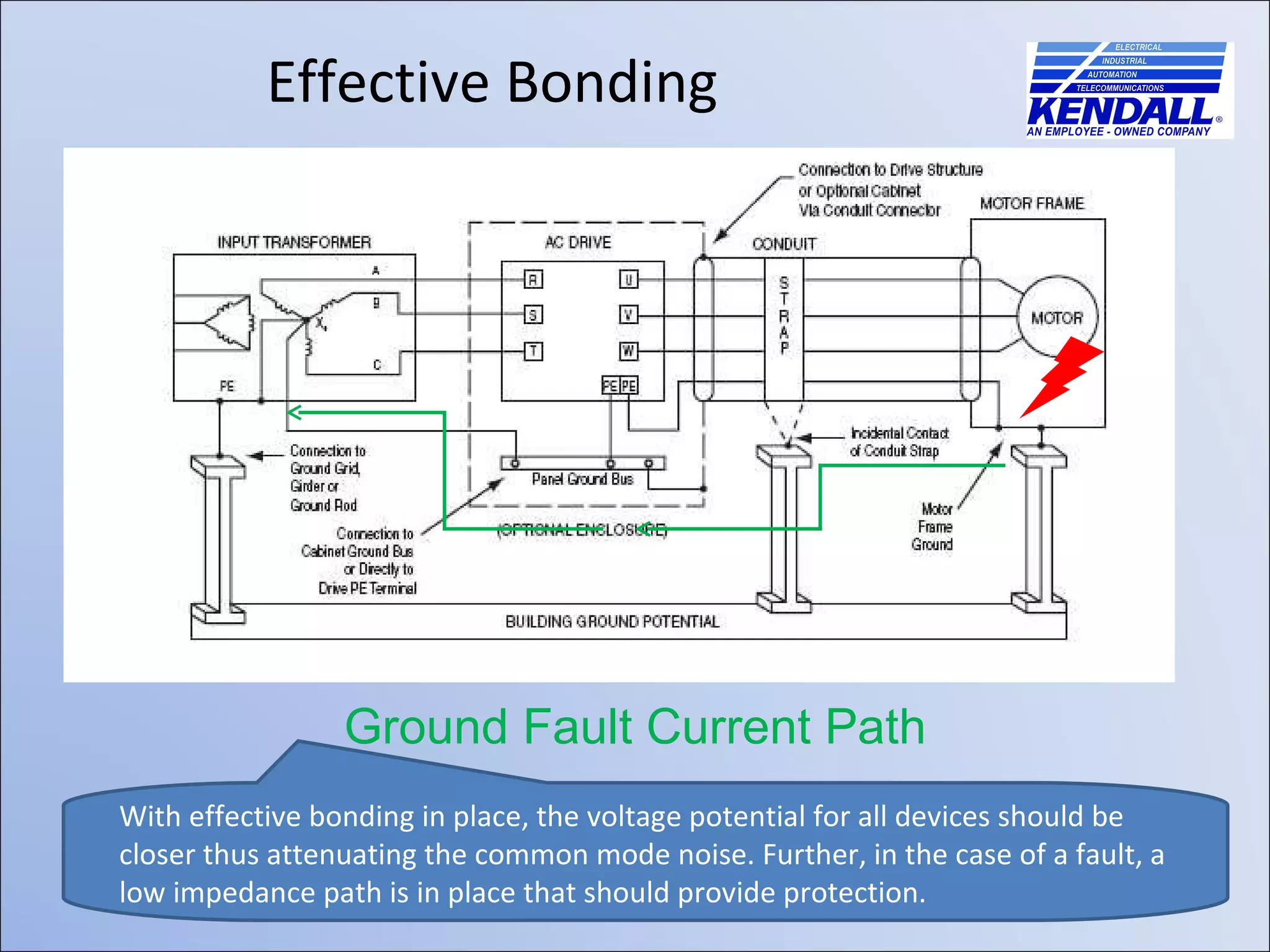
Ground Fault Current Path Effective Bonding With effective bonding in place, the voltage potential for all devices should be closer thus attenuating the common mode noise. Further, in the case of a fault, a low impedance path is in place that should provide protection.
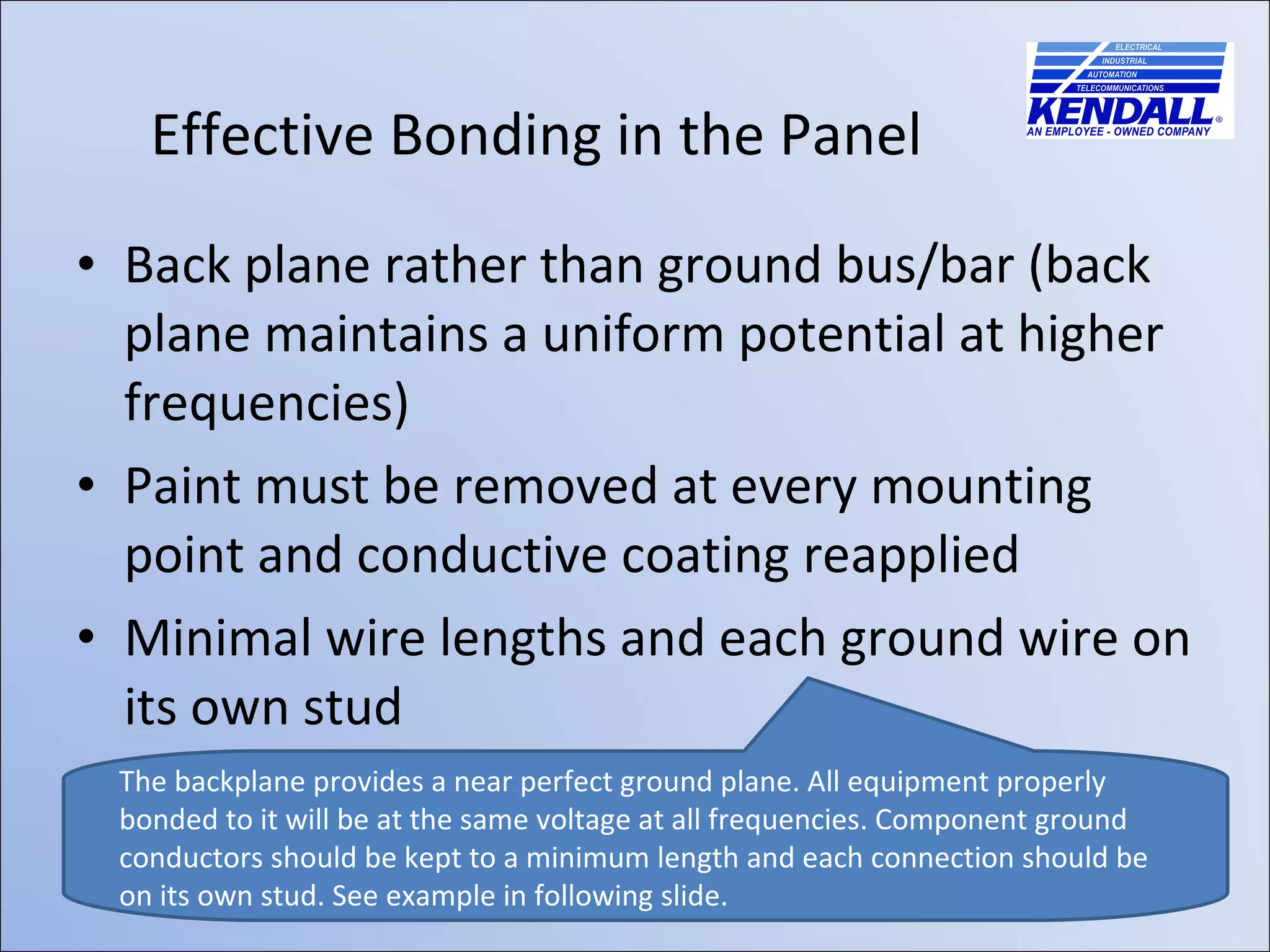
Back plane rather than ground bus/bar (back plane maintains a uniform potential at higher frequencies) Paint must be removed at every mounting point and conductive coating reapplied Minimal wire lengths and each ground wire on its own stud Effective Bonding in the Panel The backplane provides a near perfect ground plane. All equipment properly bonded to it will be at the same voltage at all frequencies. Component ground conductors should be kept to a minimum length and each connection should be on its own stud. See example in following slide.
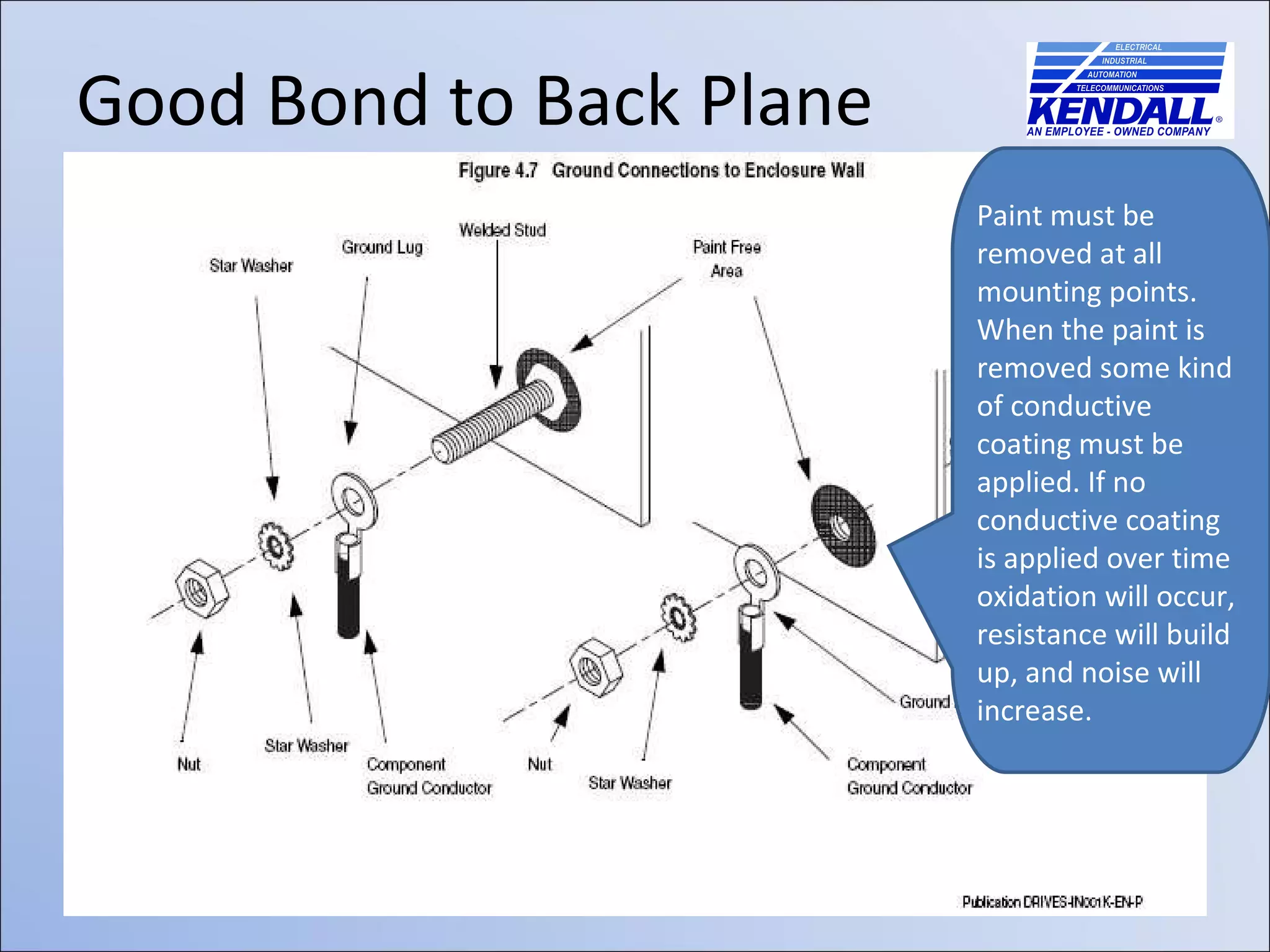
Good Bond to Back Plane Paint must be removed at all mounting points. When the paint is removed some kind of conductive coating must be applied. If no conductive coating is applied over time oxidation will occur, resistance will build up, and noise will increase.
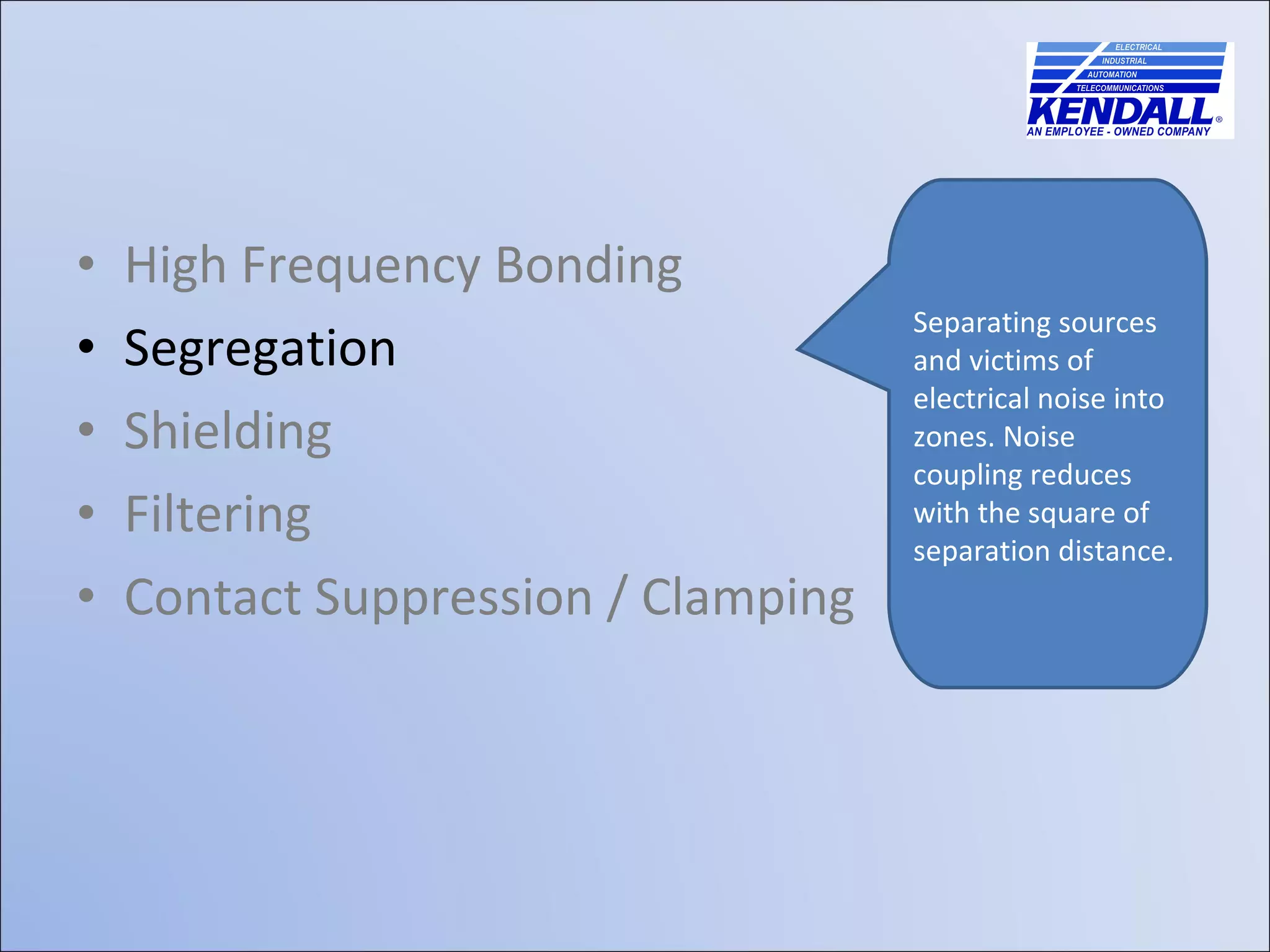
High Frequency Bonding Segregation Shielding Filtering Contact Suppression / Clamping Separating sources and victims of electrical noise into zones. Noise coupling reduces with the square of separation distance.
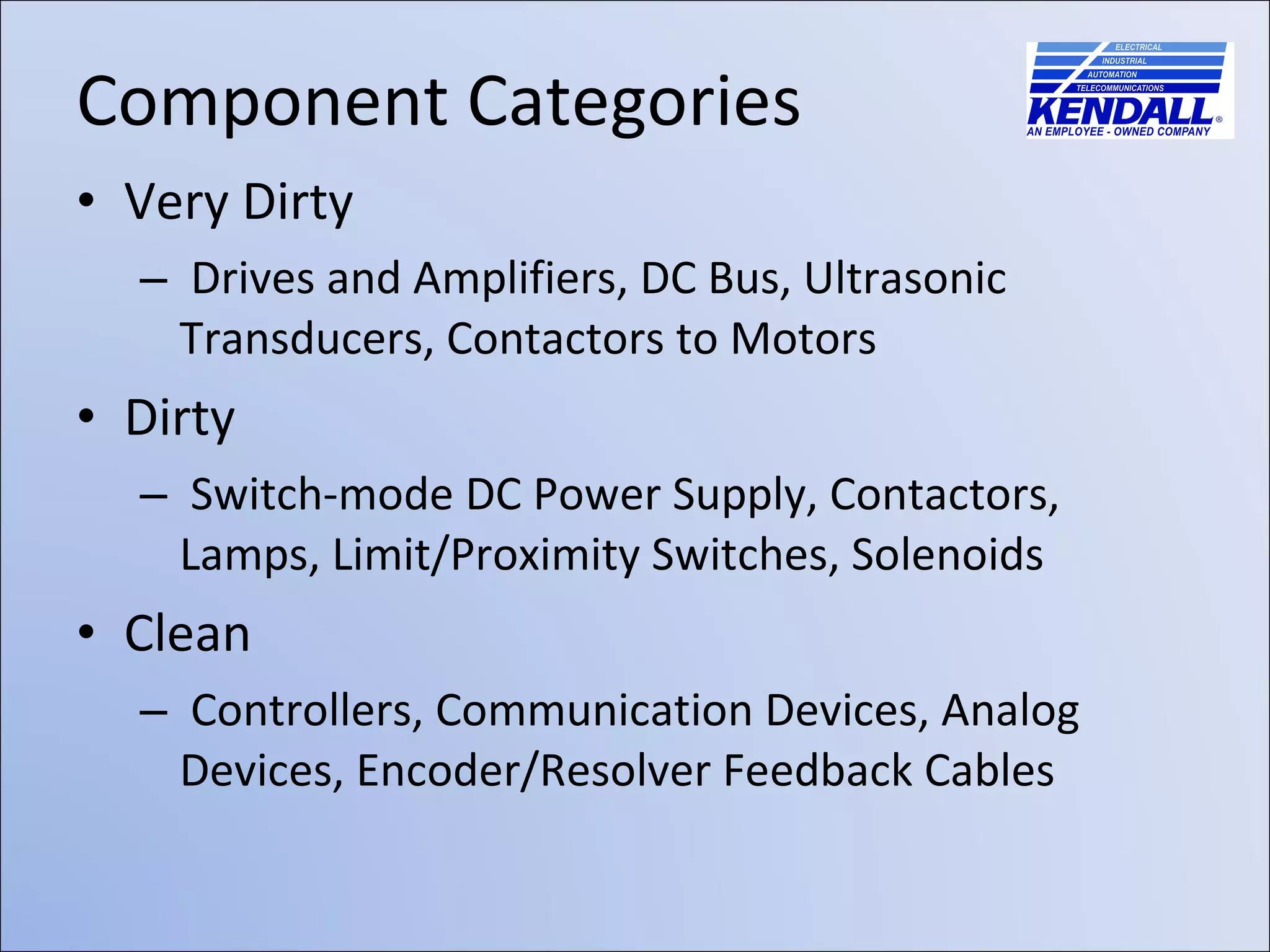
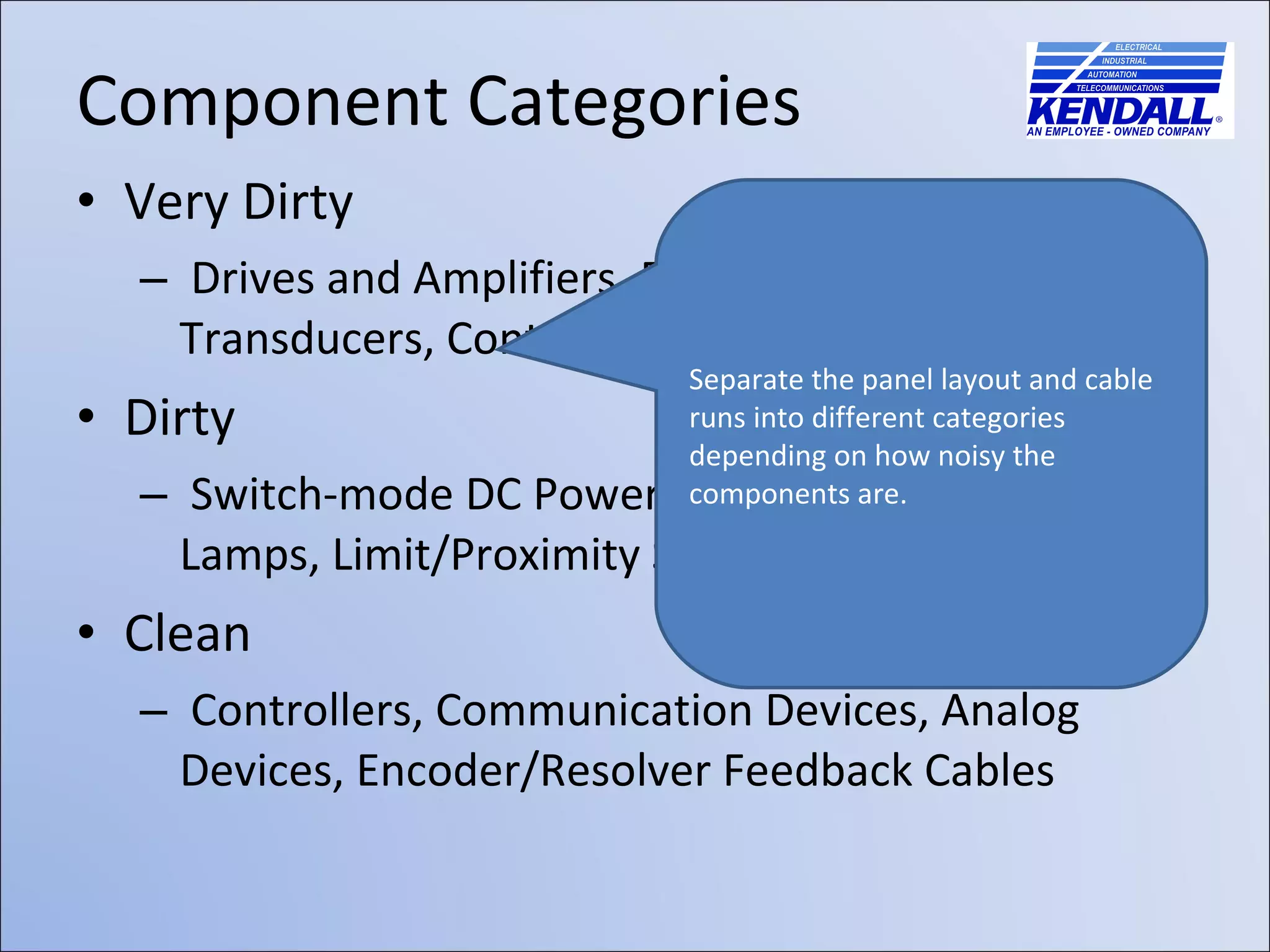
Very Dirty  Drives and Amplifiers, DC Bus, Ultrasonic Transducers, Contactors to Motors Dirty  Switch-mode DC Power Supply, Contactors, Lamps, Limit/Proximity Switches, Solenoids Clean  Controllers, Communication Devices, Analog Devices, Encoder/Resolver Feedback Cables Component Categories
Very Dirty  Drives and Amplifiers, DC Bus, Ultrasonic Transducers, Contactors to Motors Dirty  Switch-mode DC Power Supply, Contactors, Lamps, Limit/Proximity Switches, Solenoids Clean  Controllers, Communication Devices, Analog Devices, Encoder/Resolver Feedback Cables Component Categories Separate the panel layout and cable runs into different categories depending on how noisy the components are.
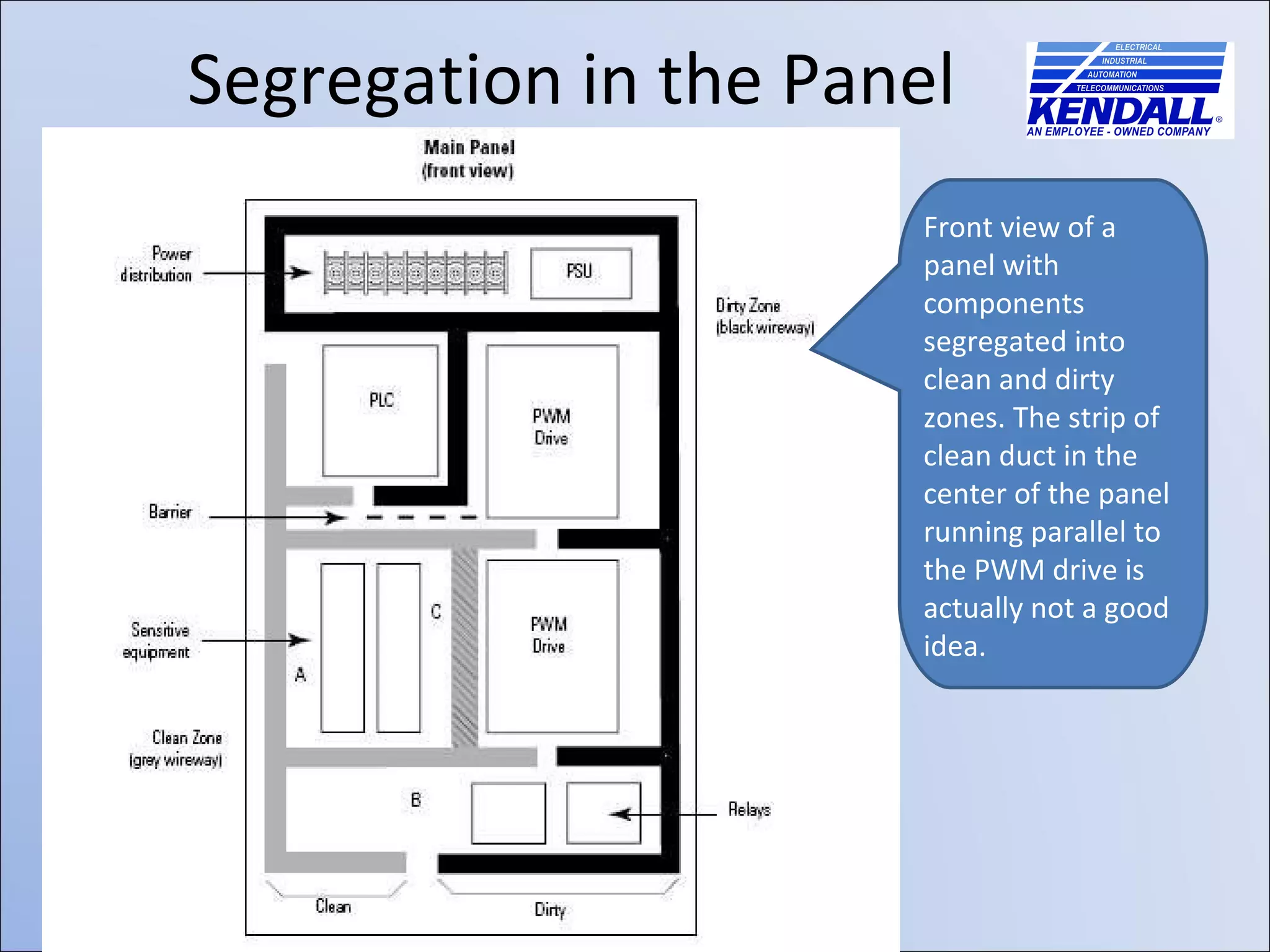
Segregation in the Panel Front view of a panel with components segregated into clean and dirty zones. The strip of clean duct in the center of the panel running parallel to the PWM drive is actually not a good idea.
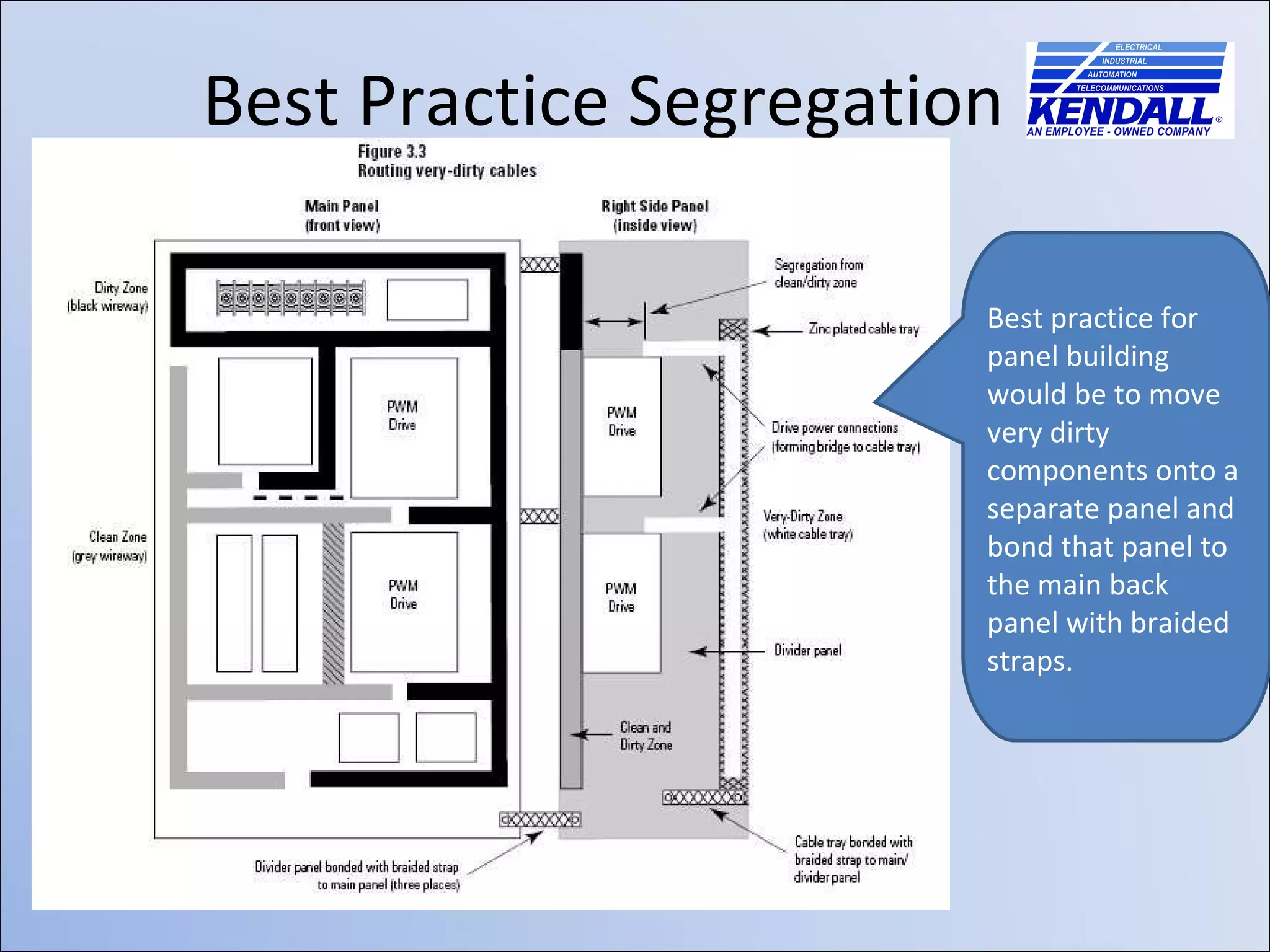
Best Practice Segregation Best practice for panel building would be to move very dirty components onto a separate panel and bond that panel to the main back panel with braided straps.
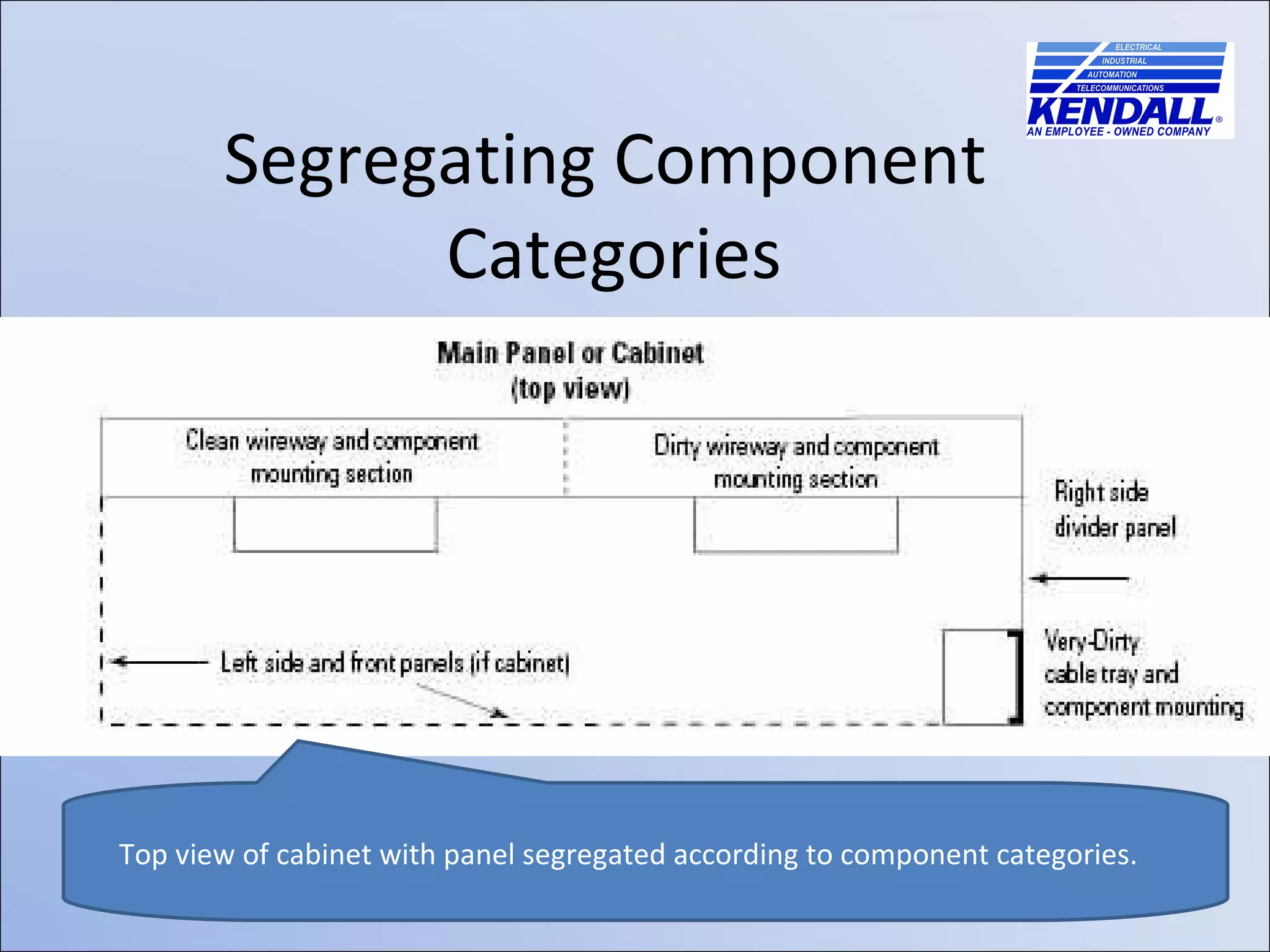
Segregating Component  Categories Top view of cabinet with panel segregated according to component categories.
High Frequency Bonding Segregation Shielding Filtering Contact Suppression / Clamping Using shielded cable and steel barriers to reduce electrical noise when possible and cost effective and when devices in the cabinet cannot be separated by a sufficient distance (~6 inches).
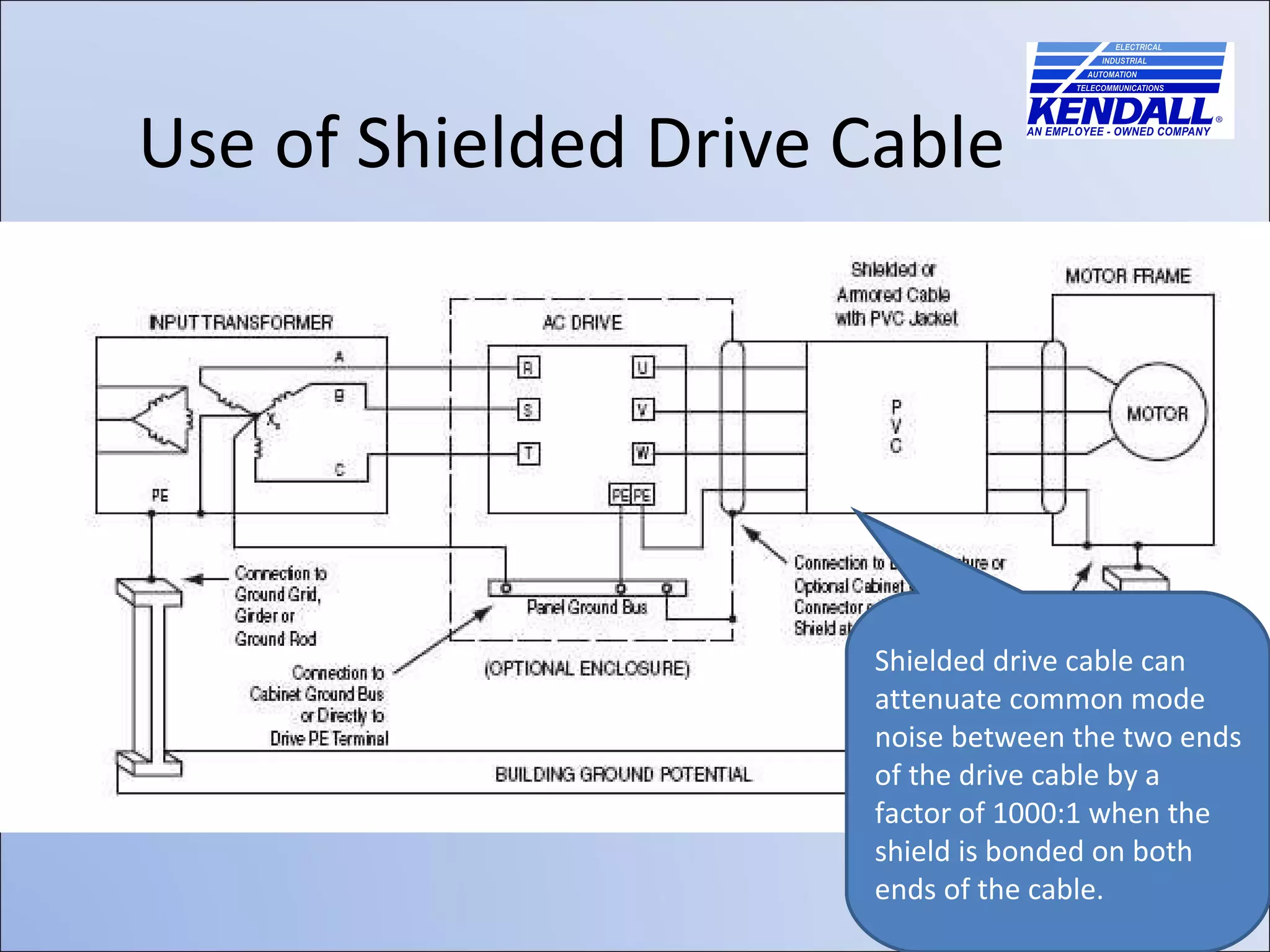
Use of Shielded Drive Cable Shielded drive cable can attenuate common mode noise between the two ends of the drive cable by a factor of 1000:1 when the shield is bonded on both ends of the cable.
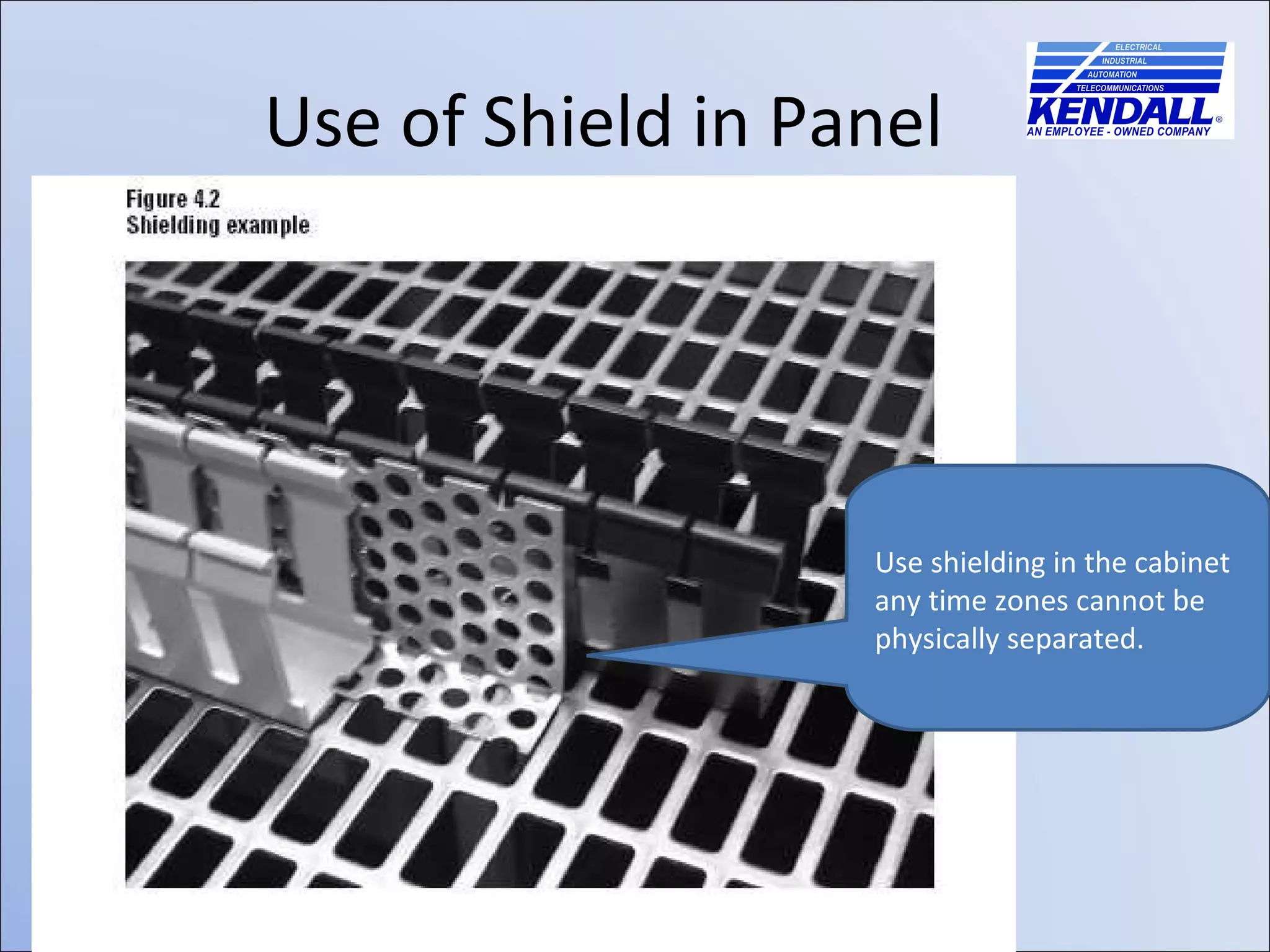
Use of Shield in Panel Use shielding in the cabinet any time zones cannot be physically separated.
High Frequency Bonding Segregation Shielding Filtering Contact Suppression / Clamping Use low-pass filters to attenuate RF noise on cable runs.
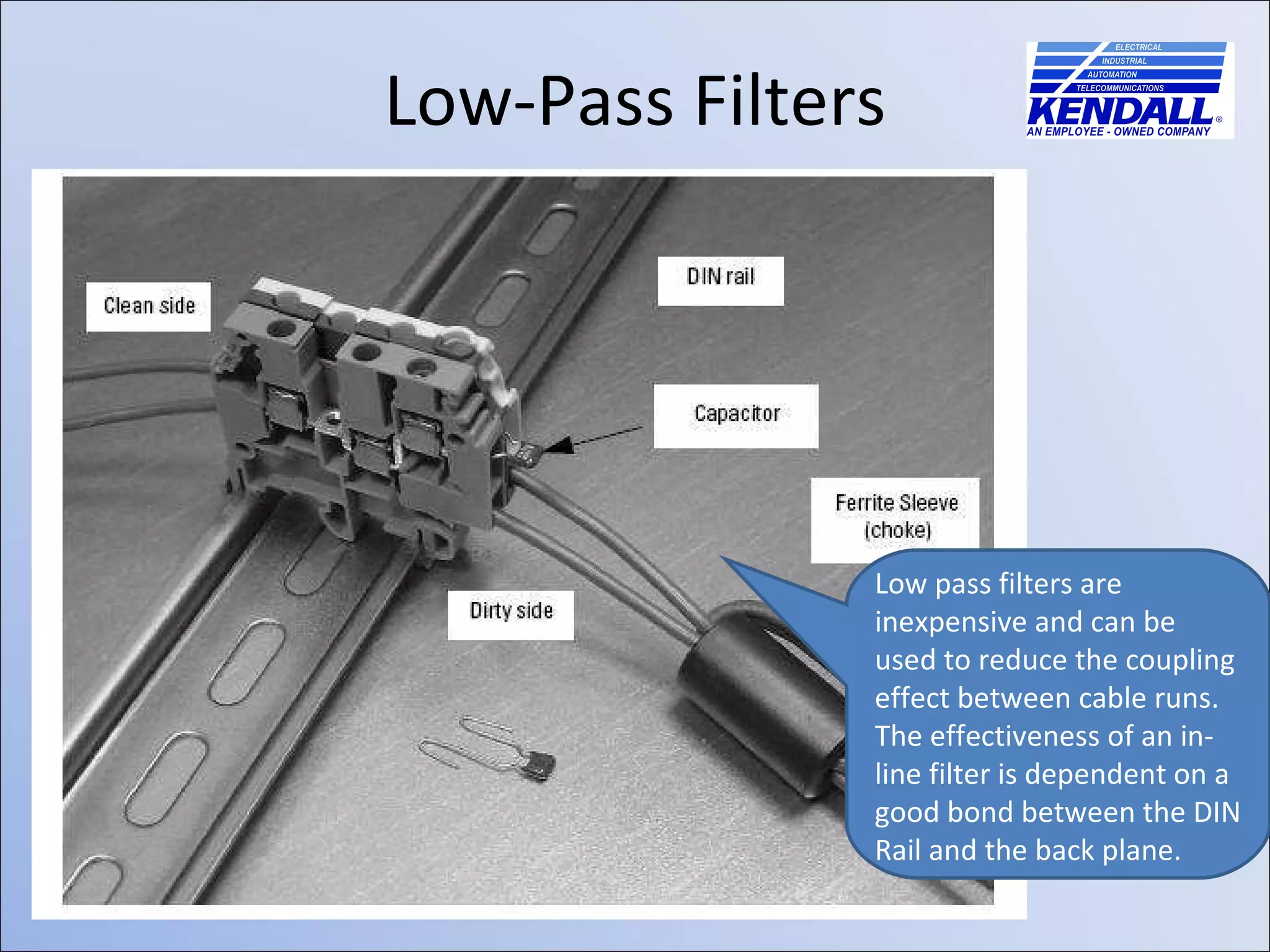
Low-Pass Filters Low pass filters are inexpensive and can be used to reduce the coupling effect between cable runs. The effectiveness of an in-line filter is dependent on a good bond between the DIN Rail and the back plane.
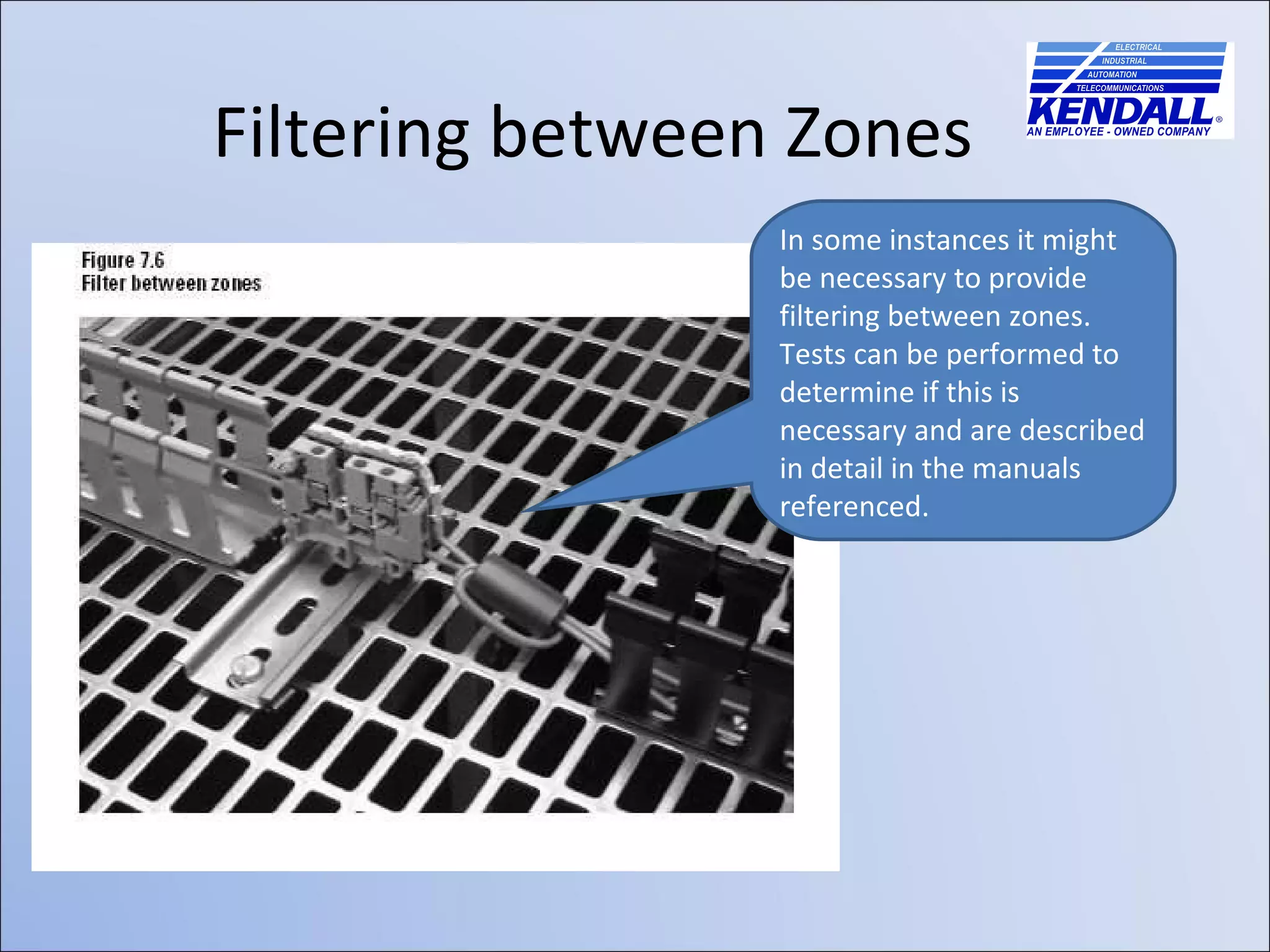
Filtering between Zones In some instances it might be necessary to provide filtering between zones. Tests can be performed to determine if this is necessary and are described in detail in the manuals referenced.
High Frequency Bonding Segregation Shielding Filtering Contact Suppression / Clamping Adding contact suppression to switches is an easy and inexpensive way to reduce noise and is recommended for all applications.
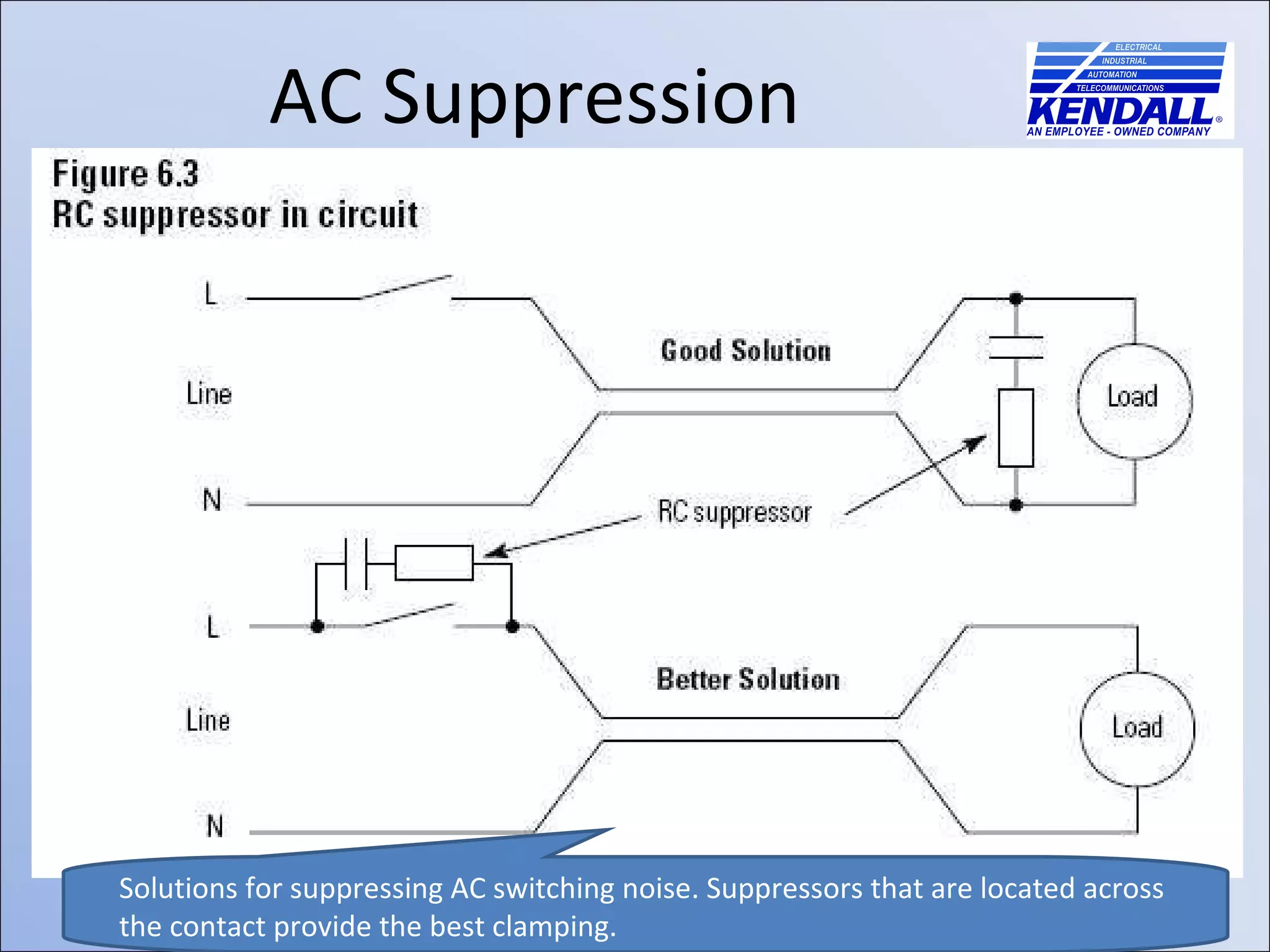
AC Suppression Solutions for suppressing AC switching noise. Suppressors that are located across the contact provide the best clamping.
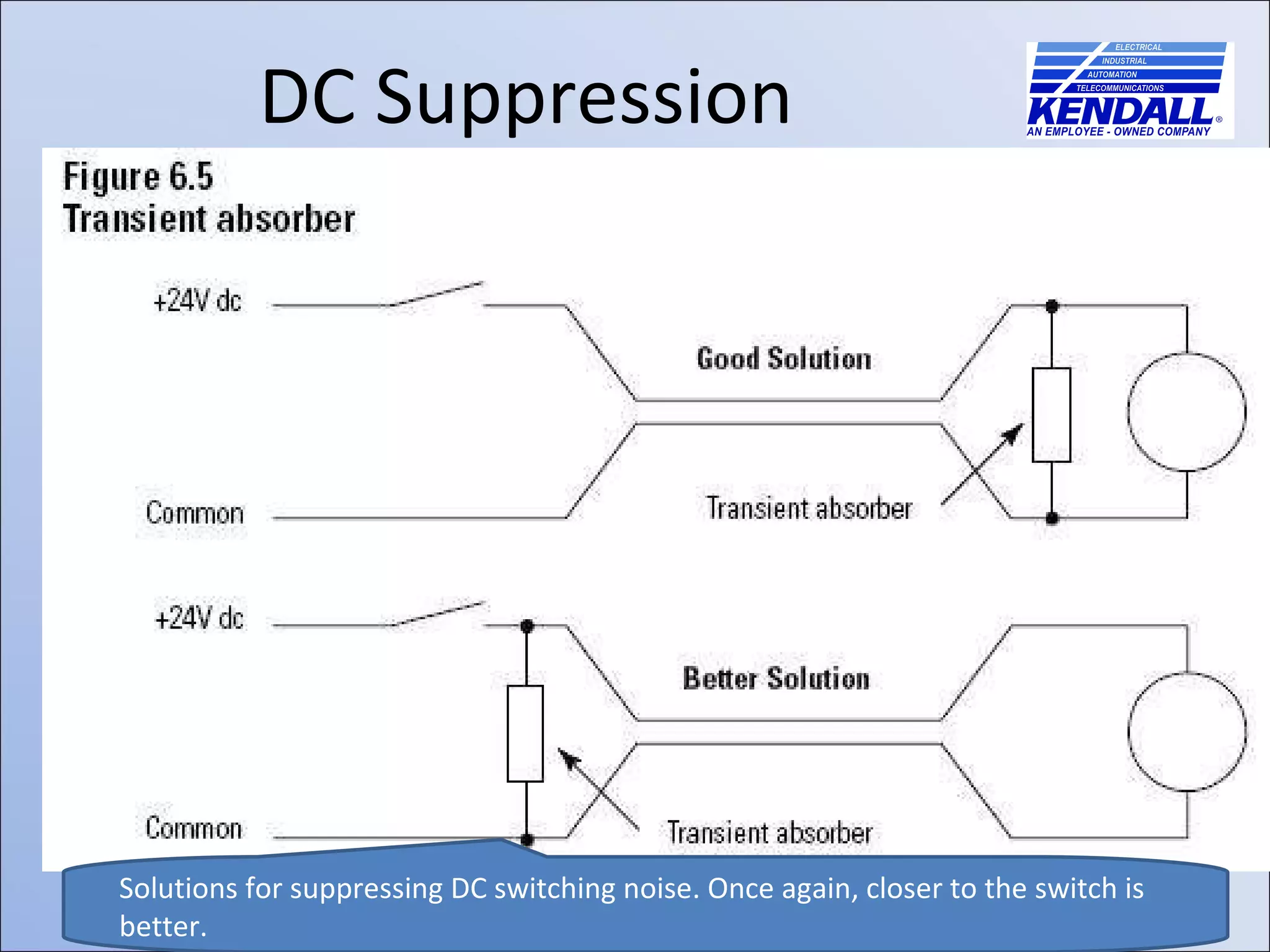
DC Suppression Solutions for suppressing DC switching noise. Once again, closer to the switch is better.
Wiring and Grounding Guidelines for Pulse Width Modulated (PWM) AC Drives Rockwell Automation Publication Number  Drives-IN001_-EN-P Reference Manuals
System Design for Control of Electrical Noise Rockwell Automation Publication Number  GMC-RM001A-EN-P Reference Manuals
Effective grounding and bonding can minimize electrical noise issues
Best Practices for Panel Building  include the use of: HF Bonding Techniques Segregation of Component Categories Proper Shielding Filtering Clamping and Contact Suppression
Thanks for Watching

Minimizing electrical noise in panels

  • 1.
    Best Practices in Panel Building for Minimizing Electrical Noise
  • 2.
    Best Practices in Panel Building for Minimizing Electrical Noise The focus of this presentation is on how to minimize electrical noise in the control system and the techniques used in panel building to minimize electrical noise.
  • 3.
    What is Grounding?According to NEC Connecting to the earth or to some conducting body that serves in place of the earth.
  • 4.
  • 5.
    The real purposeof grounding is to provide an alternative path around the electrical system for lightning and other surges that cause dangerously high voltage levels that can damage equipment.
  • 6.
    What is Bonding?According to NEC Connecting all metal parts together and to the system winding to provide a low-impedance path to the source to facilitate the opening of the circuit-protection device to remove dangerous voltages on metal parts.
  • 7.
  • 8.
    Bonding of devicesmaintains all metalwork at the same electrical potential. Bonding helps prevent this.
  • 9.
    High Frequency BondingSegregation Shielding Filtering Contact Suppression / Clamping These are the five considerations for reducing electrical noise in a panel.
  • 10.
    High Frequency BondingSegregation Shielding Filtering Contact Suppression / Clamping Maintaining all metalwork at the same electrical potential. If different potentials exist the voltage difference is seen as common-mode noise on all interconnect wiring internal and external to the cabinet.
  • 11.
    Why High FrequencyBonding? Drives and other electrically noisy devices can introduce common noise current. Good bonding techniques also meet the requirements for NEC. Diagram shows the potential paths for common mode noise and also shows that there is no low-impedance path for fault current. Return path is through ground. Faults could present dangerous levels of voltage and won’t necessarily cause circuit protection device to trip.
  • 12.
    Ground Fault CurrentPath Effective Bonding With effective bonding in place, the voltage potential for all devices should be closer thus attenuating the common mode noise. Further, in the case of a fault, a low impedance path is in place that should provide protection.
  • 13.
    Back plane ratherthan ground bus/bar (back plane maintains a uniform potential at higher frequencies) Paint must be removed at every mounting point and conductive coating reapplied Minimal wire lengths and each ground wire on its own stud Effective Bonding in the Panel The backplane provides a near perfect ground plane. All equipment properly bonded to it will be at the same voltage at all frequencies. Component ground conductors should be kept to a minimum length and each connection should be on its own stud. See example in following slide.
  • 14.
    Good Bond toBack Plane Paint must be removed at all mounting points. When the paint is removed some kind of conductive coating must be applied. If no conductive coating is applied over time oxidation will occur, resistance will build up, and noise will increase.
  • 15.
    High Frequency BondingSegregation Shielding Filtering Contact Suppression / Clamping Separating sources and victims of electrical noise into zones. Noise coupling reduces with the square of separation distance.
  • 16.
    Very Dirty Drives and Amplifiers, DC Bus, Ultrasonic Transducers, Contactors to Motors Dirty Switch-mode DC Power Supply, Contactors, Lamps, Limit/Proximity Switches, Solenoids Clean Controllers, Communication Devices, Analog Devices, Encoder/Resolver Feedback Cables Component Categories
  • 17.
    Very Dirty Drives and Amplifiers, DC Bus, Ultrasonic Transducers, Contactors to Motors Dirty Switch-mode DC Power Supply, Contactors, Lamps, Limit/Proximity Switches, Solenoids Clean Controllers, Communication Devices, Analog Devices, Encoder/Resolver Feedback Cables Component Categories Separate the panel layout and cable runs into different categories depending on how noisy the components are.
  • 18.
    Segregation in thePanel Front view of a panel with components segregated into clean and dirty zones. The strip of clean duct in the center of the panel running parallel to the PWM drive is actually not a good idea.
  • 19.
    Best Practice SegregationBest practice for panel building would be to move very dirty components onto a separate panel and bond that panel to the main back panel with braided straps.
  • 20.
    Segregating Component Categories Top view of cabinet with panel segregated according to component categories.
  • 21.
    High Frequency BondingSegregation Shielding Filtering Contact Suppression / Clamping Using shielded cable and steel barriers to reduce electrical noise when possible and cost effective and when devices in the cabinet cannot be separated by a sufficient distance (~6 inches).
  • 22.
    Use of ShieldedDrive Cable Shielded drive cable can attenuate common mode noise between the two ends of the drive cable by a factor of 1000:1 when the shield is bonded on both ends of the cable.
  • 23.
    Use of Shieldin Panel Use shielding in the cabinet any time zones cannot be physically separated.
  • 24.
    High Frequency BondingSegregation Shielding Filtering Contact Suppression / Clamping Use low-pass filters to attenuate RF noise on cable runs.
  • 25.
    Low-Pass Filters Lowpass filters are inexpensive and can be used to reduce the coupling effect between cable runs. The effectiveness of an in-line filter is dependent on a good bond between the DIN Rail and the back plane.
  • 26.
    Filtering between ZonesIn some instances it might be necessary to provide filtering between zones. Tests can be performed to determine if this is necessary and are described in detail in the manuals referenced.
  • 27.
    High Frequency BondingSegregation Shielding Filtering Contact Suppression / Clamping Adding contact suppression to switches is an easy and inexpensive way to reduce noise and is recommended for all applications.
  • 28.
    AC Suppression Solutionsfor suppressing AC switching noise. Suppressors that are located across the contact provide the best clamping.
  • 29.
    DC Suppression Solutionsfor suppressing DC switching noise. Once again, closer to the switch is better.
  • 30.
    Wiring and GroundingGuidelines for Pulse Width Modulated (PWM) AC Drives Rockwell Automation Publication Number Drives-IN001_-EN-P Reference Manuals
  • 31.
    System Design forControl of Electrical Noise Rockwell Automation Publication Number GMC-RM001A-EN-P Reference Manuals
  • 32.
    Effective grounding andbonding can minimize electrical noise issues
  • 33.
    Best Practices forPanel Building include the use of: HF Bonding Techniques Segregation of Component Categories Proper Shielding Filtering Clamping and Contact Suppression
  • 34.

Editor's Notes

  • #4 What is grounding? According to the NEC the definition is: Connecting to the earth or to some conducting body that serves in place of the earth.
  • #20 A