SUBJECT   -  SCIENCE TOPIC   - FOOD AND ADULTERATION STANDARD  - X TH NAME -  SMITA S. DOIPHODE ROLL NO. -  11 B.E D  2010-11
FOOD & ADULTERATION Food Adulteration What is adulteration? Common adulterates Harmful effects of adulteration Chemical test for identification of  Adulteration
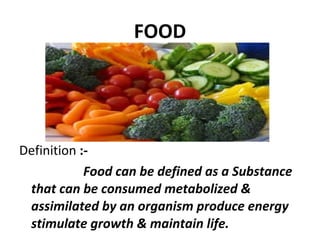
FOOD Definition  :-  Food can be defined as a Substance that can be consumed metabolized & assimilated by an organism produce energy stimulate growth & maintain life.
ELEMENTS OF FOOD Nitrogen Oxygen Hydrogen Sulphur etc. Food is essential as it provides energy for various life processes
ADULTERATION Simple definition: Reducing the purity of an article by the addition of a foreign or inferior substance Act of intentionally debasing the quality of food offered for sale either by admixture or substitution of inferior substances or by the removal of some valuable ingredient.
The food may get adulterated by pesticides and chemicals. Intentionally :  Substances added in food to improve appearance, flavour, texture or storage properties (food additives) Unintentionally : Pesticides, growth promoters, components of packaging materials, solvents and enzymes used in food processing etc.
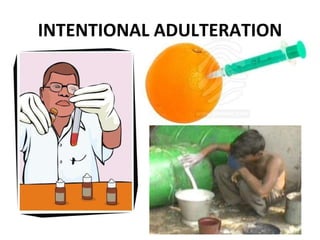
INTENTIONAL ADULTERATION
CHEMICAL CONTAMINANTS
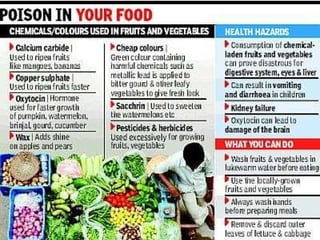
CHEMICAL CONTAMINANTS •  Chemical non-nutritive substances are added intentionally to food, generally in small quantities to improve its appearance, flavor, texture or storage properties. They are called food additives. •  Pesticides are used to protect the crops from insect-pests and by increasing the yield.
•  Fertilizers are used to provide nutrition to plant and hence increasing production. •  Pesticides are toxic substance and may pose variety of adverse effects if used indiscriminately.
 
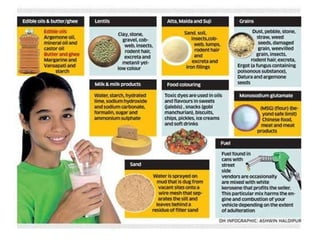
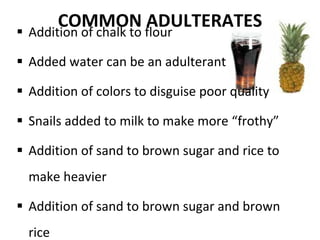
COMMON ADULTERATES Addition of chalk to flour Added water can be an adulterant Addition of colors to disguise poor quality Snails added to milk to make more “frothy” Addition of sand to brown sugar and rice to make heavier Addition of sand to brown sugar and brown rice
EVALUATION Q1. Why food is essential for living beings? Ans. Because it provides energy. Q2. Name some elements of food? Ans. Oxygen, hydrogen, nitrogen. Q3. What is adulteration? Ans. Reducing the purity of an article by the addition of a foreign substances
Q4. What are the types of adulteration? Ans. Intentionally and unintentionally Q5. Name some common adulterants? Ans. Chalk in flour, water in milk, etc.


Food & adulteration(Science)

  • 1.
    SUBJECT - SCIENCE TOPIC - FOOD AND ADULTERATION STANDARD - X TH NAME - SMITA S. DOIPHODE ROLL NO. - 11 B.E D 2010-11
  • 2.
    FOOD & ADULTERATIONFood Adulteration What is adulteration? Common adulterates Harmful effects of adulteration Chemical test for identification of Adulteration
  • 3.
    FOOD Definition :- Food can be defined as a Substance that can be consumed metabolized & assimilated by an organism produce energy stimulate growth & maintain life.
  • 4.
    ELEMENTS OF FOODNitrogen Oxygen Hydrogen Sulphur etc. Food is essential as it provides energy for various life processes
  • 5.
    ADULTERATION Simple definition:Reducing the purity of an article by the addition of a foreign or inferior substance Act of intentionally debasing the quality of food offered for sale either by admixture or substitution of inferior substances or by the removal of some valuable ingredient.
  • 6.
    The food mayget adulterated by pesticides and chemicals. Intentionally : Substances added in food to improve appearance, flavour, texture or storage properties (food additives) Unintentionally : Pesticides, growth promoters, components of packaging materials, solvents and enzymes used in food processing etc.
  • 7.
  • 8.
  • 9.
    CHEMICAL CONTAMINANTS • Chemical non-nutritive substances are added intentionally to food, generally in small quantities to improve its appearance, flavor, texture or storage properties. They are called food additives. • Pesticides are used to protect the crops from insect-pests and by increasing the yield.
  • 10.
    • Fertilizersare used to provide nutrition to plant and hence increasing production. • Pesticides are toxic substance and may pose variety of adverse effects if used indiscriminately.
  • 11.
  • 12.
    COMMON ADULTERATES Additionof chalk to flour Added water can be an adulterant Addition of colors to disguise poor quality Snails added to milk to make more “frothy” Addition of sand to brown sugar and rice to make heavier Addition of sand to brown sugar and brown rice
  • 13.
    EVALUATION Q1. Whyfood is essential for living beings? Ans. Because it provides energy. Q2. Name some elements of food? Ans. Oxygen, hydrogen, nitrogen. Q3. What is adulteration? Ans. Reducing the purity of an article by the addition of a foreign substances
  • 14.
    Q4. What arethe types of adulteration? Ans. Intentionally and unintentionally Q5. Name some common adulterants? Ans. Chalk in flour, water in milk, etc.
  • 15.
  • 16.