“Any food that does not
conform to minimum
standards is said to be
adulterated”
Moderator
Dr. Dhaval By
Rizwaan N
Food
Adulteration
Food Adulteration
Definition:
“non-nutritious substances which are
added intentionally to food, generally in
small quantity, to improve its appearance,
flavor, texture, or storage properties”
Reasons for food adulteration are
To get more profit
To increase the weight, adulterant is added
To increase volume of trade by showing lower prices
Adulteration Criteria
Poisonous and Deleterious
 Poisonous = injurious effect or deadly effect as
result of chemical reaction between substance and
body
 N2 gas in flour
 Deleterious = broader term which includes
mechanical, physical and bacterial agents
 Shell fragments in Oysters
Added Substances
Substances intentionally added to
foods are scrutinized more closely
substance is considered to be
“added” as a component of the food
Those are “food additives”
e.g: caffeine an “added substance”
in coca cola
May render injurious to health
Presence of a poison or
deleterious and added
substance in food article may
render “injurious to health”
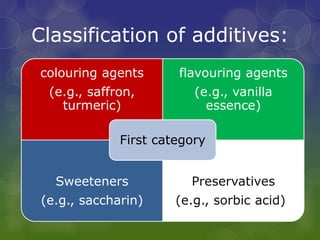
Classification of additives:
colouring agents
(e.g., saffron,
turmeric)
flavouring agents
(e.g., vanilla
essence)
Sweeteners
(e.g., saccharin)
Preservatives
(e.g., sorbic acid))
First category
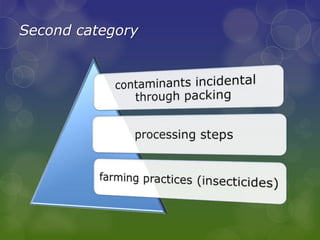
Second category
Misbranding
Definition - presence or
absence of information on label of
a product which is false,
deceptive or misleading
Regulation of labeling concerning
the presence or absence of
specific attributes of a food
product has great potential
impact on food market
Label & Labeling
 Label:
A display of written, printed or graphic
matter upon the immediate container of
any article
 Labeling:
All labels and other written material
upon any article or any of its containers
or wrapper, or accompanying the
product
 Purpose of labeling:
Inform the consumer about the product
Induce the consumer to buy the
product
 Why regulate labeling:
Prevent fraud, deception or misleading
statements
Require disclosure of information
necessary for consumer to make
“informed decision”
 Label must not be “false or misleading in
any particular”
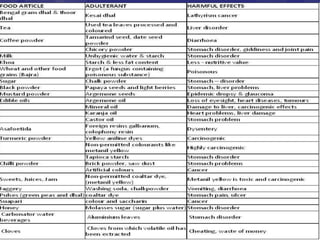
 Milk - Addition of water, removal of fat
 Ice-Cream –Cellulose, starch, non-permitted
colours
 Ghee –Vanaspati
 Vegetable oils -Cheap/non edible oil like
linseed, mineral oils.
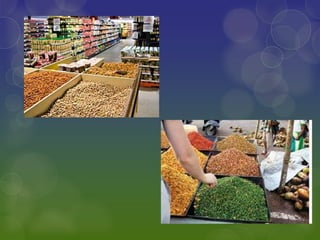
 Wheat and rice –mud, grits, soapstone bits
Coffee powder- Date husk, tamarind husk,
chicory
Butter- starch, animal fat
Chilli powder- saw powder, brick powder
Dhania powder- cow dung or horse dung
powder
Dals- coaltar dyes, khesari dal
FOOD REGULATORY
REQUIREMENTS IN INDIA
 To safeguard health and safety, Government of
India promulgates regulatory requirements for
manufacture and sale of goods and services,
including those imported
 Regulatory measures should have minimum
compliance costs
 Regulatory measures should benefit society
Contd..
 Regulations should be fair and treat all
equitably
 Regulations are stipulated through Various Acts/
Rules & Regulations by different Ministries under
Government of India
 Enactment of Acts, Rules & Regulations is done
taking cognizance of the relevant WTO & WHO
Agreements
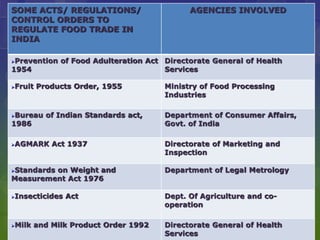
SOME ACTS/ REGULATIONS/
CONTROL ORDERS TO
REGULATE FOOD TRADE IN
INDIA
AGENCIES INVOLVED
Prevention of Food Adulteration Act
1954
Directorate General of Health
Services
Fruit Products Order, 1955 Ministry of Food Processing
Industries
Bureau of Indian Standards act,
1986
Department of Consumer Affairs,
Govt. of India
AGMARK Act 1937 Directorate of Marketing and
Inspection
Standards on Weight and
Measurement Act 1976
Department of Legal Metrology
Insecticides Act Dept. Of Agriculture and co-
operation
Milk and Milk Product Order 1992 Directorate General of Health
Services
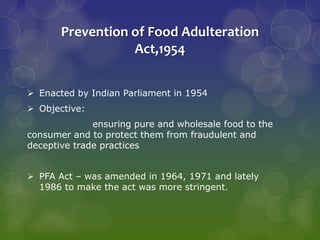
Prevention of Food Adulteration
Act,1954
 Enacted by Indian Parliament in 1954
 Objective:
ensuring pure and wholesale food to the
consumer and to protect them from fraudulent and
deceptive trade practices
 PFA Act – was amended in 1964, 1971 and lately
1986 to make the act was more stringent.
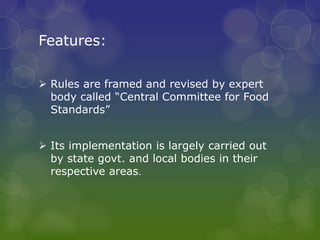
Features:
 Rules are framed and revised by expert
body called “Central Committee for Food
Standards”
 Its implementation is largely carried out
by state govt. and local bodies in their
respective areas.
However, Centre plays a vital role in:
1> coordination
2>monitoring
3>surveillance
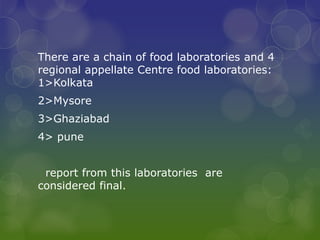
There are a chain of food laboratories and 4
regional appellate Centre food laboratories:
1>Kolkata
2>Mysore
3>Ghaziabad
4> pune
report from this laboratories are
considered final.
Features contd..
 Food inspectors, analysts and senior officers are
provided training
 Since training is an important component of
the programme for prevention of food
adulteration.
 This food inspectors are responsible for
perpetuating the food adulteration, considered as
the “THE SOCIAL EVIL”.
Some components of this social evil:
1)
• public lack of awareness and
disinterest
2)
• traders greed for money
3)
• food inspectors who find
adulteration a fertile ground to
make easy money.
Punishments
 For cases of proven adulteration- minimum
imprisonment of 6 months with a minimum a fine
of ₹.1000
 For the cases of adulteration which leads to
death or such harm may amount to griveous hurt
(acc. IPC 320) – Life imprisonment and fine not
less than ₹.5000
Fruit Product Order (FPO), 1955
Objective:
is to manufacture fruit &
vegetable products maintaining
sanitary and hygienic conditions in the
premises and quality standards laid
down in the Order.
Following minimum requirements are
laid down in the Fruit Product Order for
hygienic production and quality
standards:
 Location and surroundings of the factory
 Personal hygiene
 Sanitary and hygienic conditions of premises
 Portability of water
 Machinery & Equipment with installed capacity
 Quality control facility & Technical staff
 Product Standards
 Limits for preservatives & other additives
BUREAU OF INDIAN STANDARDS(BIS)
1986
INDIAN STANDARDS INSTITUTION [now known
as BUREAU OF INDIAN STANDARDS( BIS)] set
up on 6 JANUARY 1947
BIS is functioning under MINISTRY OF
CONSUMER AFFAIRS, FOOD AND PUBLIC
DISTRIBUTION, GOVT OF INDIA as a statutory
body under BIS ACT, 1986 with effect from 1
APRIL 1987
OBJECTIVES:
Harmonious, development of
standardization and quality control in
national and international arena
Certification schemes for products and
systems
Growth and development of Indian
industry, commerce and exports
Consumer protection
AGMARK Act, 1937
 The AGMARK Act,1937 is the first
legislation enacted for the quality control
of Agricultural products.
 AGRICULTURAL PRODUCE: Includes all
produce of agriculture or horticulture and
all articles of food or drink wholly or partly
manufactured from any such produce,
fleeces and the skin of the animals.
OBJECTIVE:
(1) To notify the agricultural commodities for
which grade standards are to be prepared under this
Act.
(2) To prepare standards for agricultural
commodities popularly known as
“Agmark Standards”
(3) To implement the grading of Agril.
Commodities on the basis of Agmark Standards
(4) To make rules to carry out the provisions of
this Act
(5) Fixing the grade designation to indicate the
quality of any scheduled article
PENALTY:
For unauthorized marking with grade designation
mark-six months imprisonment and fine not
exceeding ₹.5000
 For counterfeiting grade designation mark-
imprisonment for a term of not exceeding 3years
and fine not exceeding ₹.5000
 Penalty for selling misgraded article-
imprisonment for a term not exceeding 6 months
and fine not exceeding ₹.5000
Codex Alimentarius
Commission (CAC)
The Codex Alimentarius Commission
(CAC) was created in 1961/62 by
Food and Agriculture Organization of
the United Nations (FAO) and the
World Health Organization (WHO),
to develop food standards
Objective
The main purpose of this Programme
is to protect the health of consumers,
ensure fair practices in the food trade,
and promote coordination of all food
standards work undertaken by
governmental and non-governmental
organizations.
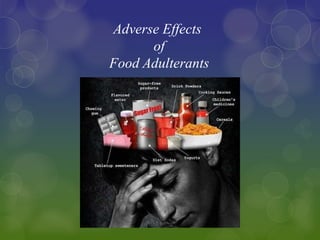
Adverse Effects
of
Food Adulterants
Acknowledgement
Moderator : Dr. Dhaval
Websites :
 Delhi.gov.in
 Standardsdata.in
 Fda.gov
 Fssai.gov.in
Books : K. Park
Let food be thy medicine, thy medicine shall
be thy food.
- Hippocrates
Thank You


Food adulteration

  • 1.
    “Any food thatdoes not conform to minimum standards is said to be adulterated”
  • 2.
  • 3.
    Food Adulteration Definition: “non-nutritious substanceswhich are added intentionally to food, generally in small quantity, to improve its appearance, flavor, texture, or storage properties”
  • 4.
    Reasons for foodadulteration are To get more profit To increase the weight, adulterant is added To increase volume of trade by showing lower prices
  • 5.
  • 6.
    Poisonous and Deleterious Poisonous = injurious effect or deadly effect as result of chemical reaction between substance and body  N2 gas in flour  Deleterious = broader term which includes mechanical, physical and bacterial agents  Shell fragments in Oysters
  • 8.
    Added Substances Substances intentionallyadded to foods are scrutinized more closely substance is considered to be “added” as a component of the food Those are “food additives” e.g: caffeine an “added substance” in coca cola
  • 9.
    May render injuriousto health Presence of a poison or deleterious and added substance in food article may render “injurious to health”
  • 11.
    Classification of additives: colouringagents (e.g., saffron, turmeric) flavouring agents (e.g., vanilla essence) Sweeteners (e.g., saccharin) Preservatives (e.g., sorbic acid)) First category
  • 13.
  • 14.
    Misbranding Definition - presenceor absence of information on label of a product which is false, deceptive or misleading Regulation of labeling concerning the presence or absence of specific attributes of a food product has great potential impact on food market
  • 15.
    Label & Labeling Label: A display of written, printed or graphic matter upon the immediate container of any article  Labeling: All labels and other written material upon any article or any of its containers or wrapper, or accompanying the product
  • 16.
     Purpose oflabeling: Inform the consumer about the product Induce the consumer to buy the product  Why regulate labeling: Prevent fraud, deception or misleading statements Require disclosure of information necessary for consumer to make “informed decision”  Label must not be “false or misleading in any particular”
  • 18.
     Milk -Addition of water, removal of fat  Ice-Cream –Cellulose, starch, non-permitted colours  Ghee –Vanaspati  Vegetable oils -Cheap/non edible oil like linseed, mineral oils.  Wheat and rice –mud, grits, soapstone bits
  • 19.
    Coffee powder- Datehusk, tamarind husk, chicory Butter- starch, animal fat Chilli powder- saw powder, brick powder Dhania powder- cow dung or horse dung powder Dals- coaltar dyes, khesari dal
  • 23.
    FOOD REGULATORY REQUIREMENTS ININDIA  To safeguard health and safety, Government of India promulgates regulatory requirements for manufacture and sale of goods and services, including those imported  Regulatory measures should have minimum compliance costs  Regulatory measures should benefit society
  • 24.
    Contd..  Regulations shouldbe fair and treat all equitably  Regulations are stipulated through Various Acts/ Rules & Regulations by different Ministries under Government of India  Enactment of Acts, Rules & Regulations is done taking cognizance of the relevant WTO & WHO Agreements
  • 25.
    SOME ACTS/ REGULATIONS/ CONTROLORDERS TO REGULATE FOOD TRADE IN INDIA AGENCIES INVOLVED Prevention of Food Adulteration Act 1954 Directorate General of Health Services Fruit Products Order, 1955 Ministry of Food Processing Industries Bureau of Indian Standards act, 1986 Department of Consumer Affairs, Govt. of India AGMARK Act 1937 Directorate of Marketing and Inspection Standards on Weight and Measurement Act 1976 Department of Legal Metrology Insecticides Act Dept. Of Agriculture and co- operation Milk and Milk Product Order 1992 Directorate General of Health Services
  • 26.
    Prevention of FoodAdulteration Act,1954  Enacted by Indian Parliament in 1954  Objective: ensuring pure and wholesale food to the consumer and to protect them from fraudulent and deceptive trade practices  PFA Act – was amended in 1964, 1971 and lately 1986 to make the act was more stringent.
  • 27.
    Features:  Rules areframed and revised by expert body called “Central Committee for Food Standards”  Its implementation is largely carried out by state govt. and local bodies in their respective areas.
  • 28.
    However, Centre playsa vital role in: 1> coordination 2>monitoring 3>surveillance
  • 29.
    There are achain of food laboratories and 4 regional appellate Centre food laboratories: 1>Kolkata 2>Mysore 3>Ghaziabad 4> pune report from this laboratories are considered final.
  • 30.
    Features contd..  Foodinspectors, analysts and senior officers are provided training  Since training is an important component of the programme for prevention of food adulteration.  This food inspectors are responsible for perpetuating the food adulteration, considered as the “THE SOCIAL EVIL”.
  • 31.
    Some components ofthis social evil: 1) • public lack of awareness and disinterest 2) • traders greed for money 3) • food inspectors who find adulteration a fertile ground to make easy money.
  • 32.
    Punishments  For casesof proven adulteration- minimum imprisonment of 6 months with a minimum a fine of ₹.1000  For the cases of adulteration which leads to death or such harm may amount to griveous hurt (acc. IPC 320) – Life imprisonment and fine not less than ₹.5000
  • 33.
    Fruit Product Order(FPO), 1955 Objective: is to manufacture fruit & vegetable products maintaining sanitary and hygienic conditions in the premises and quality standards laid down in the Order.
  • 34.
    Following minimum requirementsare laid down in the Fruit Product Order for hygienic production and quality standards:  Location and surroundings of the factory  Personal hygiene  Sanitary and hygienic conditions of premises  Portability of water  Machinery & Equipment with installed capacity  Quality control facility & Technical staff  Product Standards  Limits for preservatives & other additives
  • 35.
    BUREAU OF INDIANSTANDARDS(BIS) 1986 INDIAN STANDARDS INSTITUTION [now known as BUREAU OF INDIAN STANDARDS( BIS)] set up on 6 JANUARY 1947 BIS is functioning under MINISTRY OF CONSUMER AFFAIRS, FOOD AND PUBLIC DISTRIBUTION, GOVT OF INDIA as a statutory body under BIS ACT, 1986 with effect from 1 APRIL 1987
  • 36.
    OBJECTIVES: Harmonious, development of standardizationand quality control in national and international arena Certification schemes for products and systems Growth and development of Indian industry, commerce and exports Consumer protection
  • 37.
    AGMARK Act, 1937 The AGMARK Act,1937 is the first legislation enacted for the quality control of Agricultural products.  AGRICULTURAL PRODUCE: Includes all produce of agriculture or horticulture and all articles of food or drink wholly or partly manufactured from any such produce, fleeces and the skin of the animals.
  • 38.
    OBJECTIVE: (1) To notifythe agricultural commodities for which grade standards are to be prepared under this Act. (2) To prepare standards for agricultural commodities popularly known as “Agmark Standards” (3) To implement the grading of Agril. Commodities on the basis of Agmark Standards (4) To make rules to carry out the provisions of this Act (5) Fixing the grade designation to indicate the quality of any scheduled article
  • 39.
    PENALTY: For unauthorized markingwith grade designation mark-six months imprisonment and fine not exceeding ₹.5000  For counterfeiting grade designation mark- imprisonment for a term of not exceeding 3years and fine not exceeding ₹.5000  Penalty for selling misgraded article- imprisonment for a term not exceeding 6 months and fine not exceeding ₹.5000
  • 40.
    Codex Alimentarius Commission (CAC) TheCodex Alimentarius Commission (CAC) was created in 1961/62 by Food and Agriculture Organization of the United Nations (FAO) and the World Health Organization (WHO), to develop food standards
  • 41.
    Objective The main purposeof this Programme is to protect the health of consumers, ensure fair practices in the food trade, and promote coordination of all food standards work undertaken by governmental and non-governmental organizations.
  • 42.
  • 44.
    Acknowledgement Moderator : Dr.Dhaval Websites :  Delhi.gov.in  Standardsdata.in  Fda.gov  Fssai.gov.in Books : K. Park
  • 45.
    Let food bethy medicine, thy medicine shall be thy food. - Hippocrates Thank You 