FOOD ADULTERATION
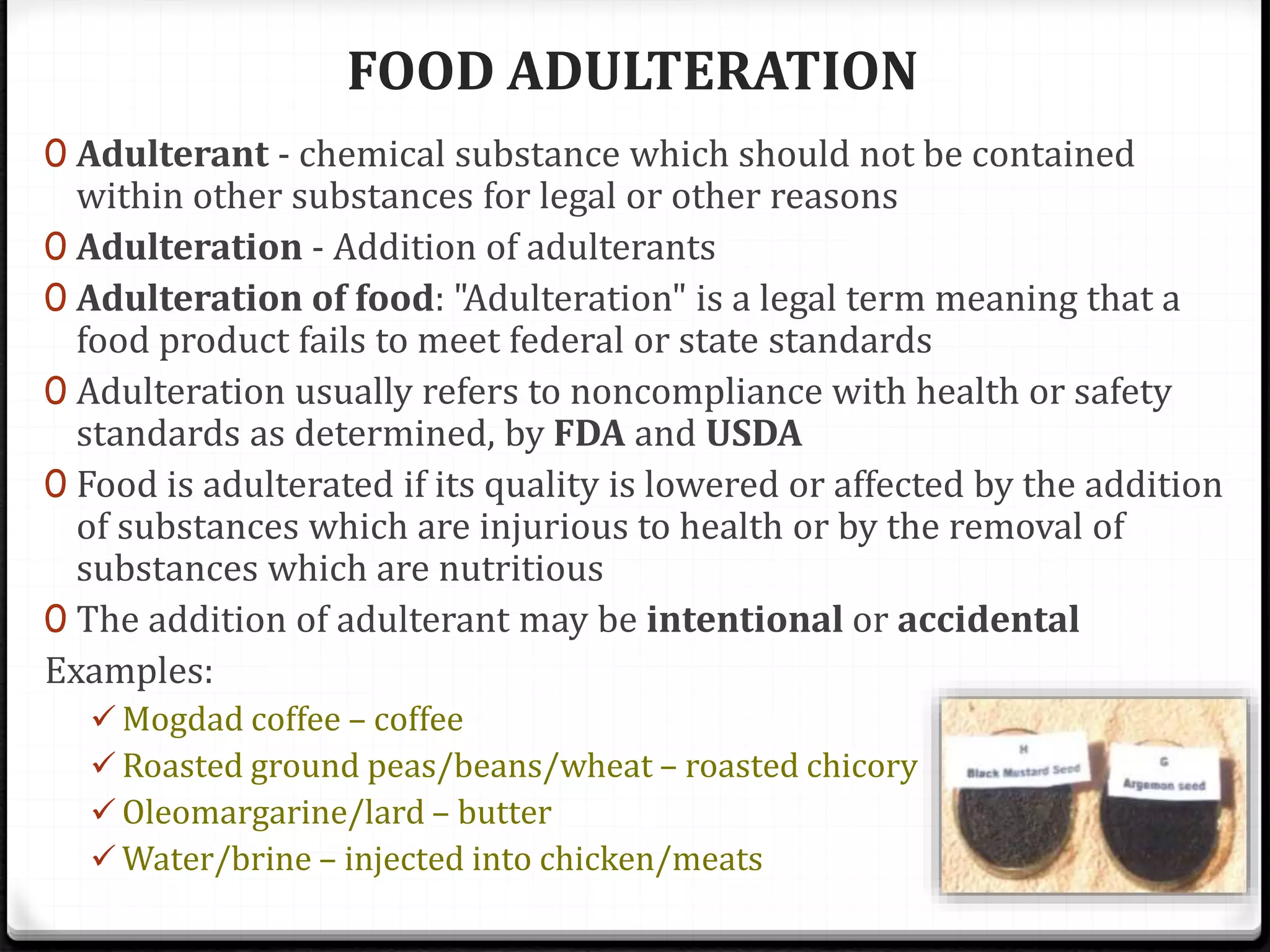
0 Adulterant - chemical substance which should not be contained
within other substances for legal or other reasons
0 Adulteration - Addition of adulterants
0 Adulteration of food: "Adulteration" is a legal term meaning that a
food product fails to meet federal or state standards
0 Adulteration usually refers to noncompliance with health or safety
standards as determined, by FDA and USDA
0 Food is adulterated if its quality is lowered or affected by the addition
of substances which are injurious to health or by the removal of
substances which are nutritious
0 The addition of adulterant may be intentional or accidental
Examples:
 Mogdad coffee – coffee
 Roasted ground peas/beans/wheat – roasted chicory
 Oleomargarine/lard – butter
 Water/brine – injected into chicken/meats
Food is declared adulterated if:
0 A substance is added which depreciates or injuriously affects it
0 Cheaper / inferior substances are substituted wholly or in part
0 Any valuable or necessary constituent has been wholly or in part
abstracted
0 It is an imitation
0 It is colored or otherwise treated, to improve its appearance or if it
contains any added substance injurious to health
0 For whatever reasons its quality is below the Standard
 Adulterated food is dangerous because it may be toxic and can affect
health and it could deprive nutrients essential for proper growth
and development
 A simple test of acute toxicity will be of limited application for
investigating the effect of chemicals used in food
Intentional adulteration:
0 Intentional adulteration is the act of adding, removing substances to food
0 25 to 30% of edibles sold in the market are adulterated
0 Addition of water to liquid milk, removal of milk solids
Unintentional adulteration:
0 Unintentional adulteration is usually attributed to ignorance, carelessness or
lack of facilities for maintaining food quality
0 This results from pesticide and insect residues or microorganisms entering
the food right from the farm leading to the customer
Natural adulteration:
0 Due to the presence of certain chemicals, organic compounds or radicals
naturally occurring in foods which are injurious to health and are not added
to the foods intentionally or unintentionally
0 Some of the examples are toxic varieties of pulses, mushrooms, green and
other vegetables, fish and sea foods. About 5000 species of marine fish are
known to be poisonous and many of these are among edible varieties
Health hazards of adulteration:
0 Some of the health hazards include stomach ache, body ache, anemia,
abortion, paralysis, increase in the incidence of tumors, pathological lesions in
vital organs, abnormalities of skin and eyes
FOOD ARTICLE ADULTERANT HARMFUL EFFECTS
Bengal Gram & Thoor Kesai dhal Cancer
Tea Used tea leaves Liver Disorder
Coffee Powder Tamarind seed, date seed powder Diarrhoea
Chicory powder Stomach disorder, Giddiness, joint pain
Milk Unhygenic water & Starch Stomach disorder
Khoa Starch & Less Fat content Less - nutritive value
Wheat Ergot Poisonous
Sugar Chalk powder Stomach – Disorder
Black powder Papaya Seeds and light berrys Stomach, liver problems
Mustard powder Argemone seeds Epidemic dropsy & Glucoma
Edible oils Argemone oil Loss of eyesight, heart diseases, tumour
Mineral oil Damage to liver, carcinogenic effects
Karanja oil Heart problems, liver damage
Castor oil Stomach problem
Asafoetida Foreign resins galbanum Dysentery
Turmeric powder Yellow aniline dyes Carcinogenic
Non-permitted colourants Highly Carcinogenic
Tapioca starch Stomach disorder
Chilli powder Brick powder, saw dust Stomach problems
Artificial Colours Cancer
Sweets, Juices, Jam Non-permitted dyes Metanil yellow is toxic, carcinogenic
Jaggery Washing soda, chalkpowder Vomiting, diarrhoea
Pulses coaltar dye Stomach pain, ulcer
Suapari colour and saccharin Cancer
Honey Molasses sugar (sugar plus water) Stomach disorder
Prevention of Food Adulteration Act & Rules
0 This Act may be called the Prevention of Food Adulteration Act, 1954
Central Committee for Food Standards :
0 The Central Government shall, as soon as may be after the
commencement of this Act, constitute a committee called the Central
Committee for Food standards to advise the Central Government and
the State Governments on matters arising out of the administration
of this Act and to carry out the other functions assigned to it under
this Act.
0 http://www.sarkaritel.com/news_and_features/infa/sept_2009/20food_ad
ulteration.htm
Food Adulteration
HUMAN HEALTH UNDER THREAT
By Dhurjati Mukherjee
New Delhi, September 20, 2009

FOOD ADULTERATION AND ITS.pptx

  • 2.
    FOOD ADULTERATION 0 Adulterant- chemical substance which should not be contained within other substances for legal or other reasons 0 Adulteration - Addition of adulterants 0 Adulteration of food: "Adulteration" is a legal term meaning that a food product fails to meet federal or state standards 0 Adulteration usually refers to noncompliance with health or safety standards as determined, by FDA and USDA 0 Food is adulterated if its quality is lowered or affected by the addition of substances which are injurious to health or by the removal of substances which are nutritious 0 The addition of adulterant may be intentional or accidental Examples:  Mogdad coffee – coffee  Roasted ground peas/beans/wheat – roasted chicory  Oleomargarine/lard – butter  Water/brine – injected into chicken/meats
  • 3.
    Food is declaredadulterated if: 0 A substance is added which depreciates or injuriously affects it 0 Cheaper / inferior substances are substituted wholly or in part 0 Any valuable or necessary constituent has been wholly or in part abstracted 0 It is an imitation 0 It is colored or otherwise treated, to improve its appearance or if it contains any added substance injurious to health 0 For whatever reasons its quality is below the Standard  Adulterated food is dangerous because it may be toxic and can affect health and it could deprive nutrients essential for proper growth and development  A simple test of acute toxicity will be of limited application for investigating the effect of chemicals used in food
  • 4.
    Intentional adulteration: 0 Intentionaladulteration is the act of adding, removing substances to food 0 25 to 30% of edibles sold in the market are adulterated 0 Addition of water to liquid milk, removal of milk solids Unintentional adulteration: 0 Unintentional adulteration is usually attributed to ignorance, carelessness or lack of facilities for maintaining food quality 0 This results from pesticide and insect residues or microorganisms entering the food right from the farm leading to the customer Natural adulteration: 0 Due to the presence of certain chemicals, organic compounds or radicals naturally occurring in foods which are injurious to health and are not added to the foods intentionally or unintentionally 0 Some of the examples are toxic varieties of pulses, mushrooms, green and other vegetables, fish and sea foods. About 5000 species of marine fish are known to be poisonous and many of these are among edible varieties Health hazards of adulteration: 0 Some of the health hazards include stomach ache, body ache, anemia, abortion, paralysis, increase in the incidence of tumors, pathological lesions in vital organs, abnormalities of skin and eyes
  • 5.
    FOOD ARTICLE ADULTERANTHARMFUL EFFECTS Bengal Gram & Thoor Kesai dhal Cancer Tea Used tea leaves Liver Disorder Coffee Powder Tamarind seed, date seed powder Diarrhoea Chicory powder Stomach disorder, Giddiness, joint pain Milk Unhygenic water & Starch Stomach disorder Khoa Starch & Less Fat content Less - nutritive value Wheat Ergot Poisonous Sugar Chalk powder Stomach – Disorder Black powder Papaya Seeds and light berrys Stomach, liver problems Mustard powder Argemone seeds Epidemic dropsy & Glucoma Edible oils Argemone oil Loss of eyesight, heart diseases, tumour Mineral oil Damage to liver, carcinogenic effects Karanja oil Heart problems, liver damage Castor oil Stomach problem Asafoetida Foreign resins galbanum Dysentery Turmeric powder Yellow aniline dyes Carcinogenic Non-permitted colourants Highly Carcinogenic Tapioca starch Stomach disorder Chilli powder Brick powder, saw dust Stomach problems Artificial Colours Cancer Sweets, Juices, Jam Non-permitted dyes Metanil yellow is toxic, carcinogenic Jaggery Washing soda, chalkpowder Vomiting, diarrhoea Pulses coaltar dye Stomach pain, ulcer Suapari colour and saccharin Cancer Honey Molasses sugar (sugar plus water) Stomach disorder
  • 6.
    Prevention of FoodAdulteration Act & Rules 0 This Act may be called the Prevention of Food Adulteration Act, 1954 Central Committee for Food Standards : 0 The Central Government shall, as soon as may be after the commencement of this Act, constitute a committee called the Central Committee for Food standards to advise the Central Government and the State Governments on matters arising out of the administration of this Act and to carry out the other functions assigned to it under this Act. 0 http://www.sarkaritel.com/news_and_features/infa/sept_2009/20food_ad ulteration.htm Food Adulteration HUMAN HEALTH UNDER THREAT By Dhurjati Mukherjee New Delhi, September 20, 2009