Food Additives, Adulteration
and Misbranding
A. B. M. Said Bin Saifullah
Department of Food Science and Nutrition
HSTU, Bangladesh
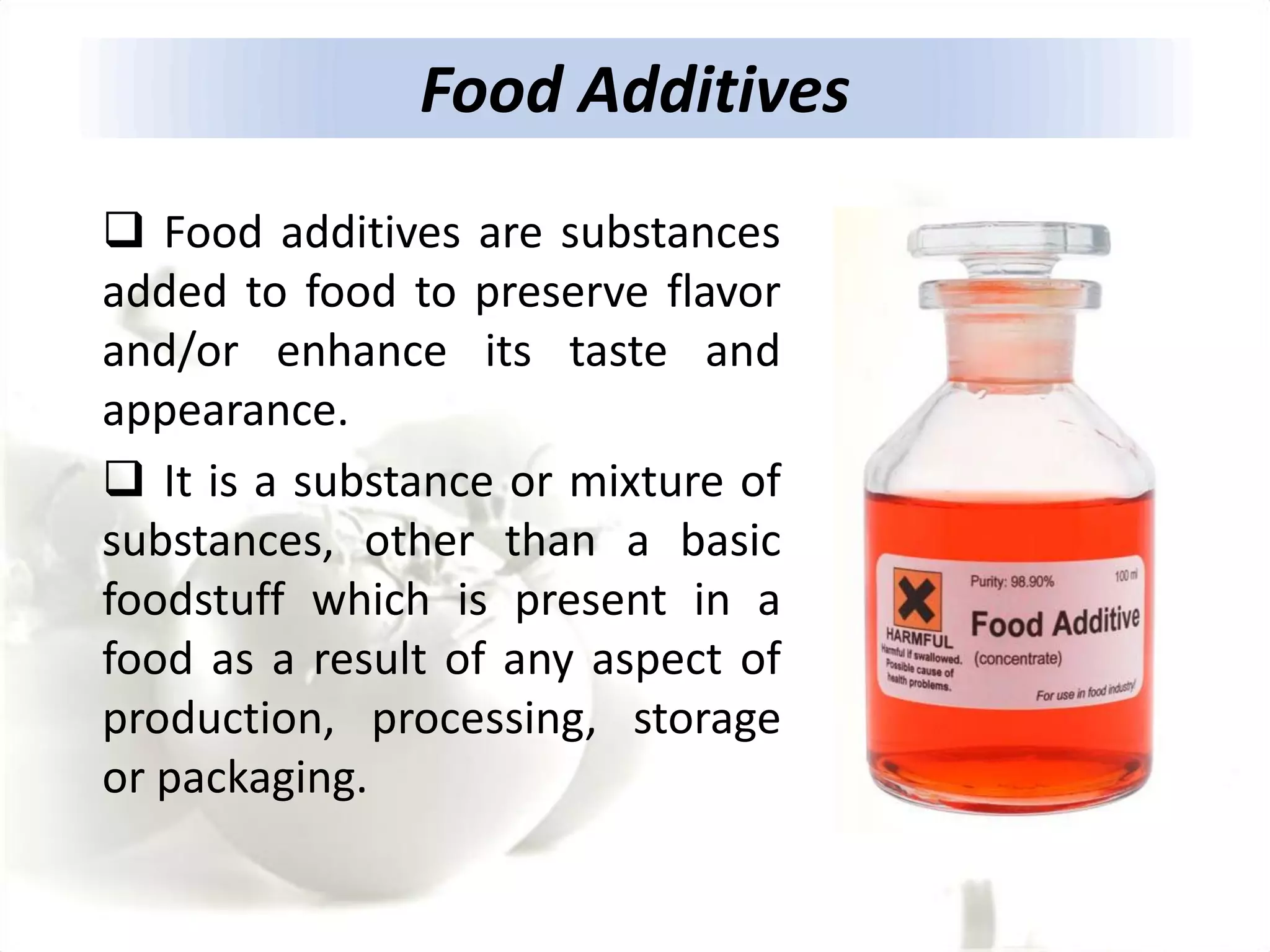
Food Additives
 Food additives are substances
added to food to preserve flavor
and/or enhance its taste and
appearance.
 It is a substance or mixture of
substances, other than a basic
foodstuff which is present in a
food as a result of any aspect of
production, processing, storage
or packaging.
Types of Additives
1. Preservatives
Preservatives are food additives that prolong the
shelf-life of foods or beverages by protecting against
deterioration caused by microorganisms. These
chemicals prevent or inhibit growth of spoilage
microorganisms.
2. Nutritional Additives
Nutritional additives are food additives that
minimize nutrients loss during processing, improve
nutrient quality and enhance the overall nutritive
value of the food.
Types of Additives
3. Flavoring Agents
Flavors are additives that give food a particular taste
or smell or enhance food's existing flavors and may
be derived from natural ingredients or created
artificially.
4. Coloring Agents
Coloring agents are food additives that add, stabilize,
restore or intensify the color in a food. Colorings are
added to food to replace colors lost during
preparation, or to make food look more attractive,
more visually appealing.
Types of Additives
5. Texturing Agents
Texturing agents are additives that add or modify the
overall texture or mouthful of food products.
6. Miscellaneous Additives
Miscellaneous additives are those which cannot be
categorized within the major groups are used or
intended to be used primarily as an additive but do
not include any processing aid.
Sub-classes of Additives
1. Preservatives
2. Antioxidants
3. Food Acids
4. Acidity regulator
5. Emulsifier
6. Emulsifying salt
7. Mineral salt
8. Stabilizers
9. Bulking agents
10. Thickener
11. Anti-caking agents
12. Anti-foaming agents
13. Firming agents
14. Gelling agents
15. Glazing agents
16. Flour treatment agents
17. Vegetable gums
18. Coloring
19. Color retention agents
20. Flavors
21. Flavor enhancers
22. Sweeteners
23. Seasonings
24. Tracer gas
25. Humectants
26. Sequestrants
27. Propellants
Naming of Food Additives
 The Codex Alimentarius Commission Committee
on Food Additives and contaminants has developed
an International Numbering System (INS) for food
additives based on the E system.
 The E numbers are categorized as follows:
E100-E199 Colors
E200-E299 Preservatives
E300-E399 Antioxidants, Acidity regulators
E400-E499 Thickeners, Stabilizers, Emulsifiers
E500-E599 Acidity regulators, Anticaking agents
E600-E699 Flavor enhancers
E900-E999 Surface coatings, gases, sweeteners
E1000-E1999 Additional chemicals
Food Additives and Safety
 Some artificial food additives have been linked
with cancer, digestive problems, neurological
conditions, Attention Deficit Hyperactivity Disorder
(ADHD), heart disease or obesity. Natural additives
may be similarly harmful or be the cause of allergic
reactions in certain individuals.
 The following additives should be avoided:
- Benzoates - Caffeine - Red Dye 40
- Bromates - Caramel - Saccharin
- Butylates - Glycerides - Sodium chloride
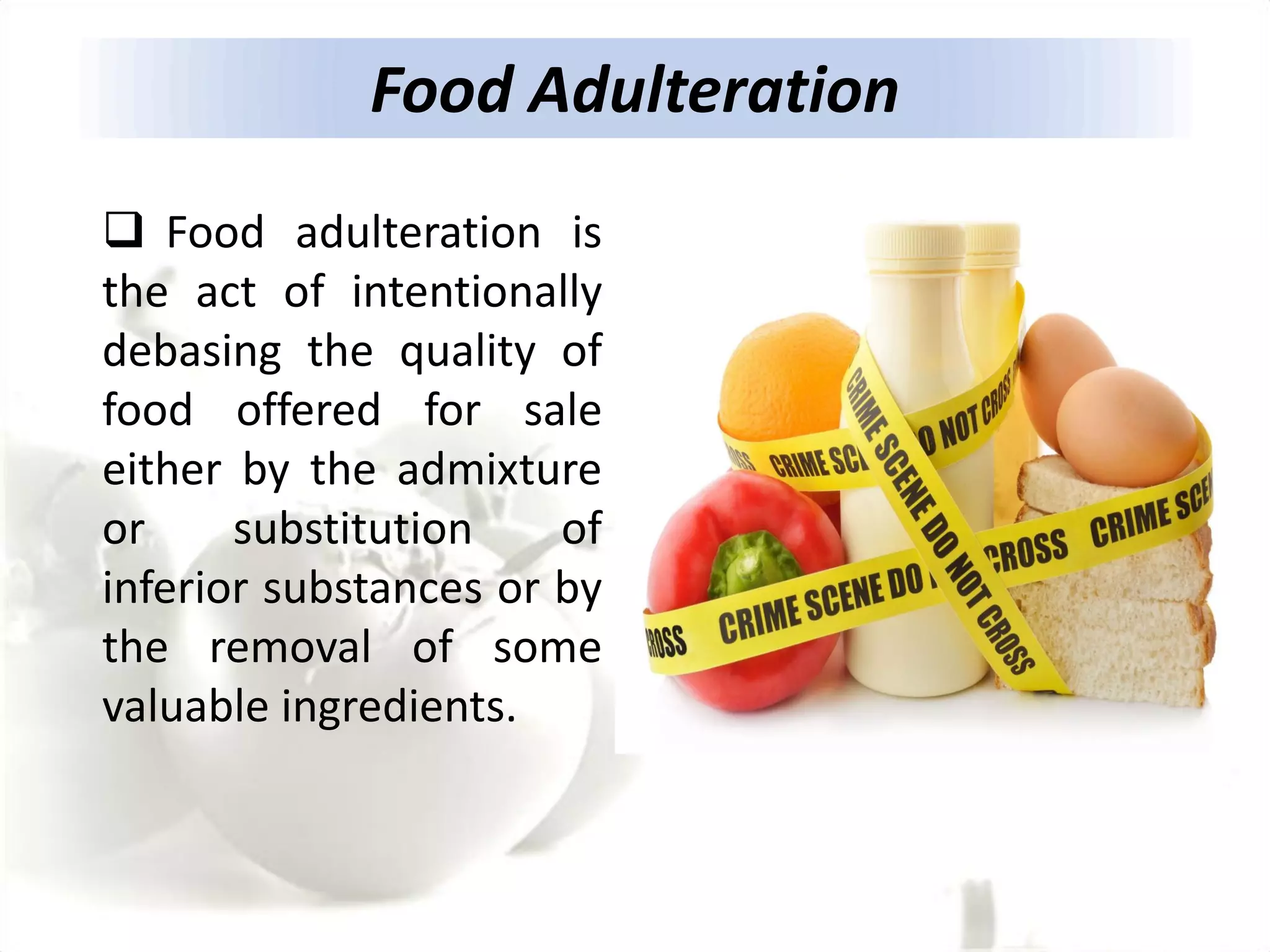
Food Adulteration
 Food adulteration is
the act of intentionally
debasing the quality of
food offered for sale
either by the admixture
or substitution of
inferior substances or by
the removal of some
valuable ingredients.
It is Food Adulteration
- If the product is not of the nature, substance or quality
demanded by the purchaser or which it purports to be.
- If the product bears or contains any poisonous or
deleterious substance or if it is so processed as to
injuriously affect its nature, substance, or quality.
- If any inferior or cheaper substance has been
substituted wholly or partly in the product, or any
natural constituent has been wholly or partly abstracted
from it, to affect its quality.
- If the product had been prepared, packed, or kept
under unsanitary conditions, has become contaminated,
injurious to health or is unfit for human consumption.
- If the container of the product is composed of any
poisonous or deleterious substance which renders its
contents injurious to health.
- If the product contains any prohibited coloring matter,
preservatives, or contains any permitted coloring matter
or preservative in excess of the prescribed limits.
- It the product is intentionally subjected to radiation
unless the use of radiation is in conformity with an
existing regulation or exemption.
- If the product bears or contains any expired ingredient.
- If the quality or purity of the product falls below the
current constituents are present in proportions other
than those prescribed, whether or not rendering it
injurious to health.
Food Adulterants
 An adulterant is a chemical substance which
should not be contained within other substances
(e.g. food, beverages, and fuels) for legal or other
reasons.
 The word is appropriate only when the additions
are unwanted by the recipient. Otherwise the
expression would be food additive.
 Adulterants when used in illicit drugs are called
cutting agents, while deliberate addition of toxic
adulterants to food or other products for human
consumption is known as poisoning.
Types of Adulterants
1. Intentional adulterants
Intentional food adulteration is done intentionally,
with knowledge for financial gain or to earn profit.
2. Incidental adulterants
Accidental food adulteration occurs accidentally in
nature, without our knowledge.
3. Metallic contaminants
Metallic contaminants are any metal in such amount
as to be dangerous or prejudicial to health that
contains in food or added to it.
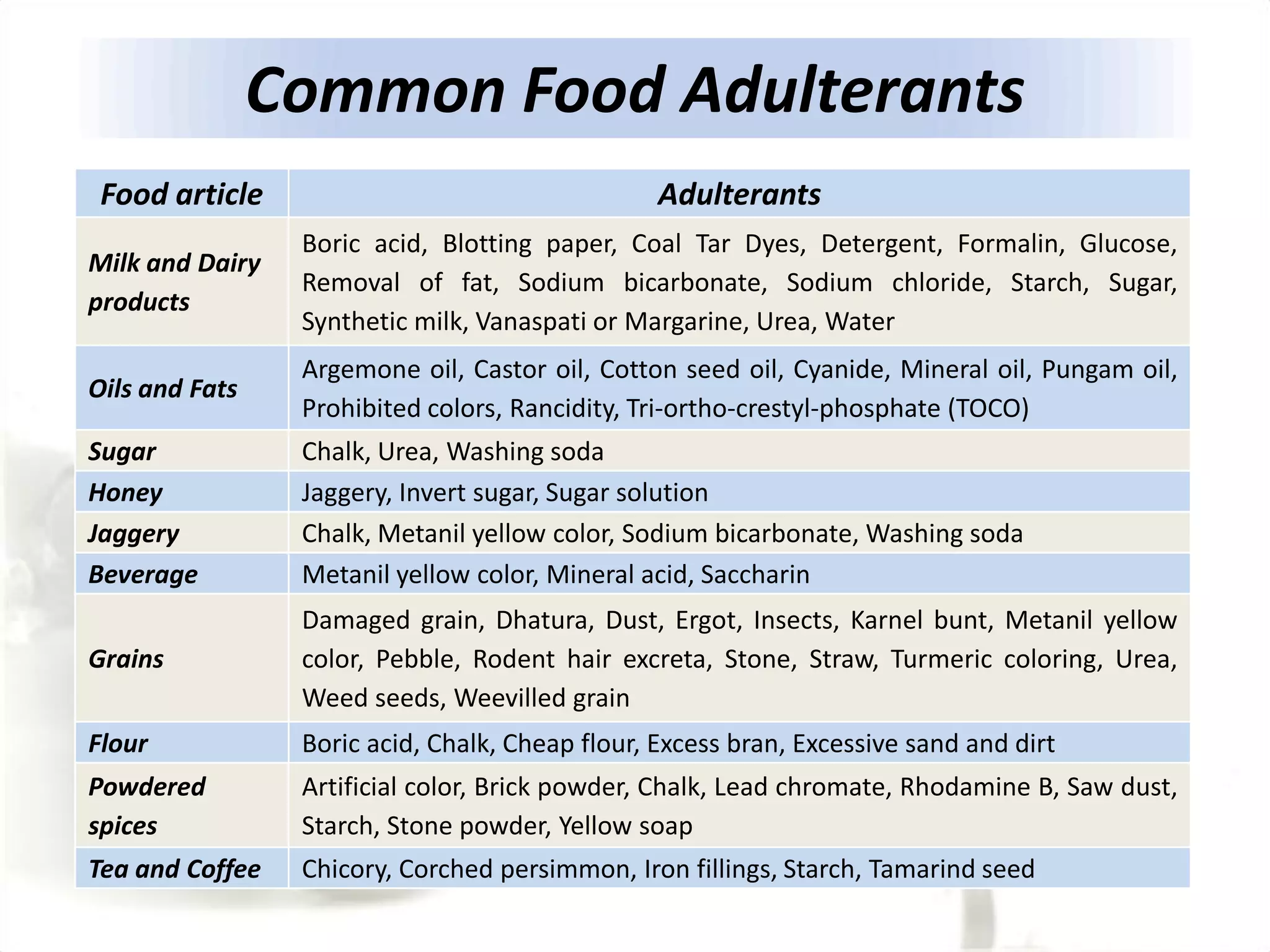
Common Food Adulterants
Food article Adulterants
Milk and Dairy
products
Boric acid, Blotting paper, Coal Tar Dyes, Detergent, Formalin, Glucose,
Removal of fat, Sodium bicarbonate, Sodium chloride, Starch, Sugar,
Synthetic milk, Vanaspati or Margarine, Urea, Water
Oils and Fats
Argemone oil, Castor oil, Cotton seed oil, Cyanide, Mineral oil, Pungam oil,
Prohibited colors, Rancidity, Tri-ortho-crestyl-phosphate (TOCO)
Sugar Chalk, Urea, Washing soda
Honey Jaggery, Invert sugar, Sugar solution
Jaggery Chalk, Metanil yellow color, Sodium bicarbonate, Washing soda
Beverage Metanil yellow color, Mineral acid, Saccharin
Grains
Damaged grain, Dhatura, Dust, Ergot, Insects, Karnel bunt, Metanil yellow
color, Pebble, Rodent hair excreta, Stone, Straw, Turmeric coloring, Urea,
Weed seeds, Weevilled grain
Flour Boric acid, Chalk, Cheap flour, Excess bran, Excessive sand and dirt
Powdered
spices
Artificial color, Brick powder, Chalk, Lead chromate, Rhodamine B, Saw dust,
Starch, Stone powder, Yellow soap
Tea and Coffee Chicory, Corched persimmon, Iron fillings, Starch, Tamarind seed
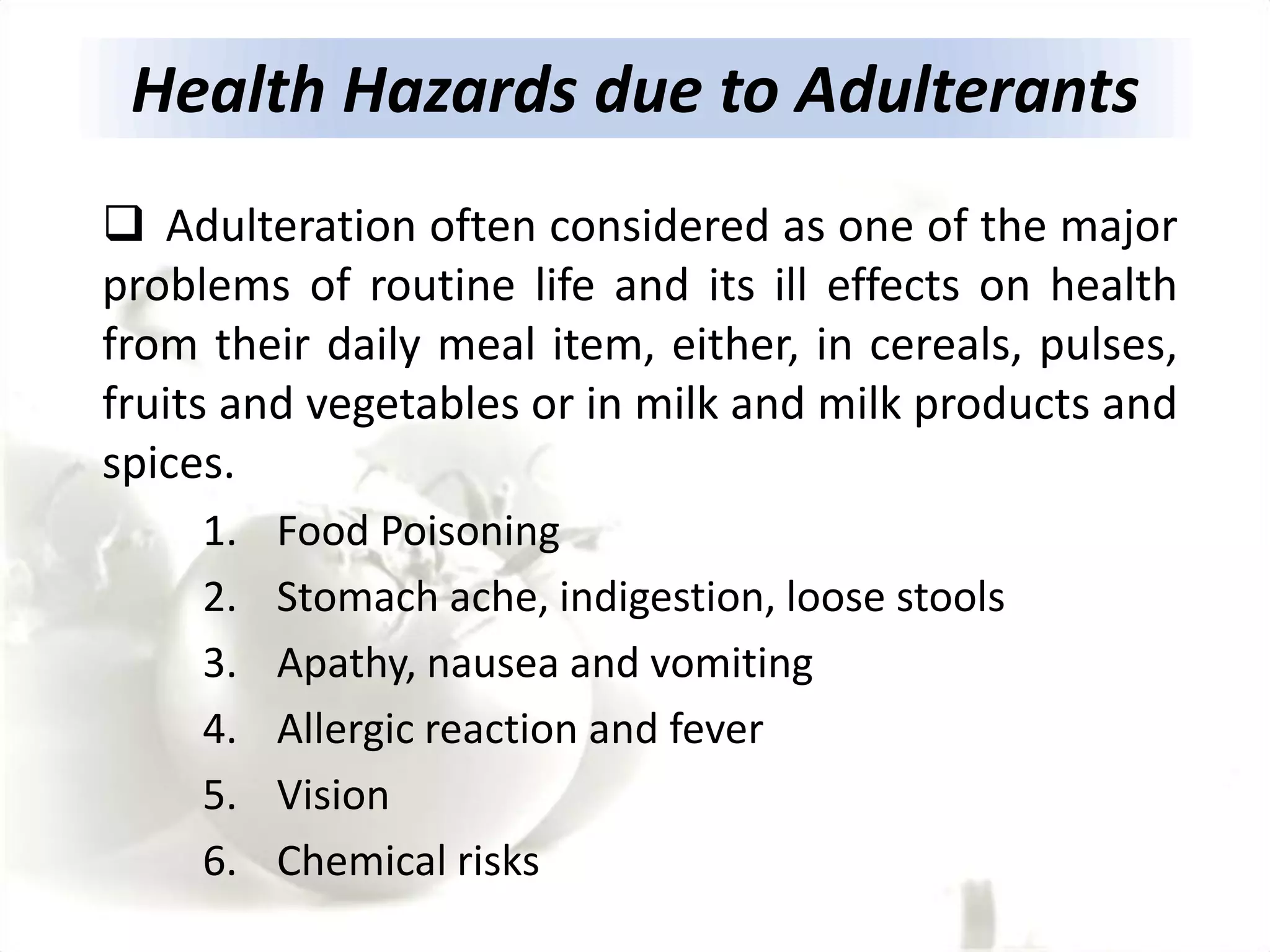
Health Hazards due to Adulterants
 Adulteration often considered as one of the major
problems of routine life and its ill effects on health
from their daily meal item, either, in cereals, pulses,
fruits and vegetables or in milk and milk products and
spices.
1. Food Poisoning
2. Stomach ache, indigestion, loose stools
3. Apathy, nausea and vomiting
4. Allergic reaction and fever
5. Vision
6. Chemical risks
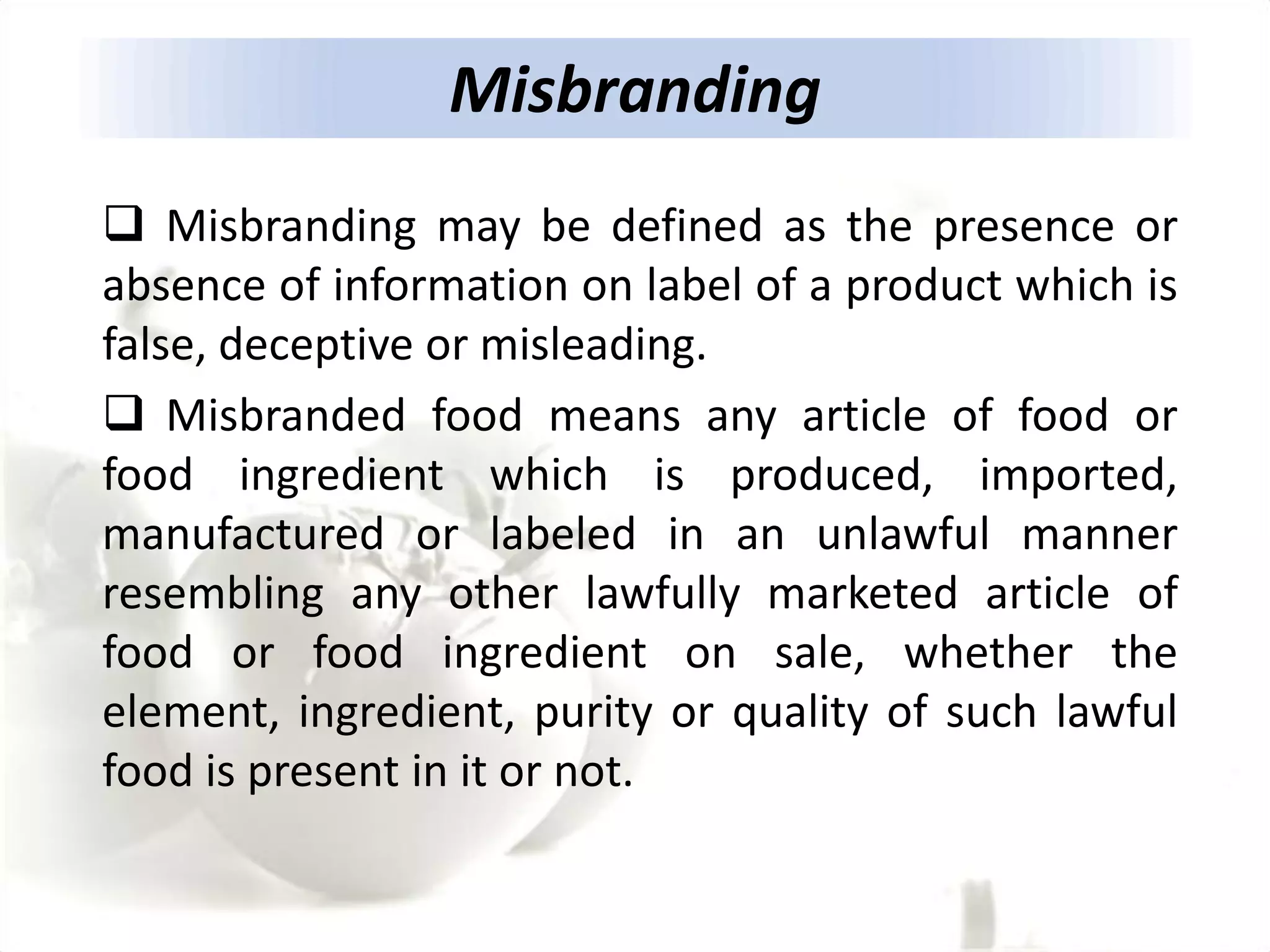
Misbranding
 Misbranding may be defined as the presence or
absence of information on label of a product which is
false, deceptive or misleading.
 Misbranded food means any article of food or
food ingredient which is produced, imported,
manufactured or labeled in an unlawful manner
resembling any other lawfully marketed article of
food or food ingredient on sale, whether the
element, ingredient, purity or quality of such lawful
food is present in it or not.
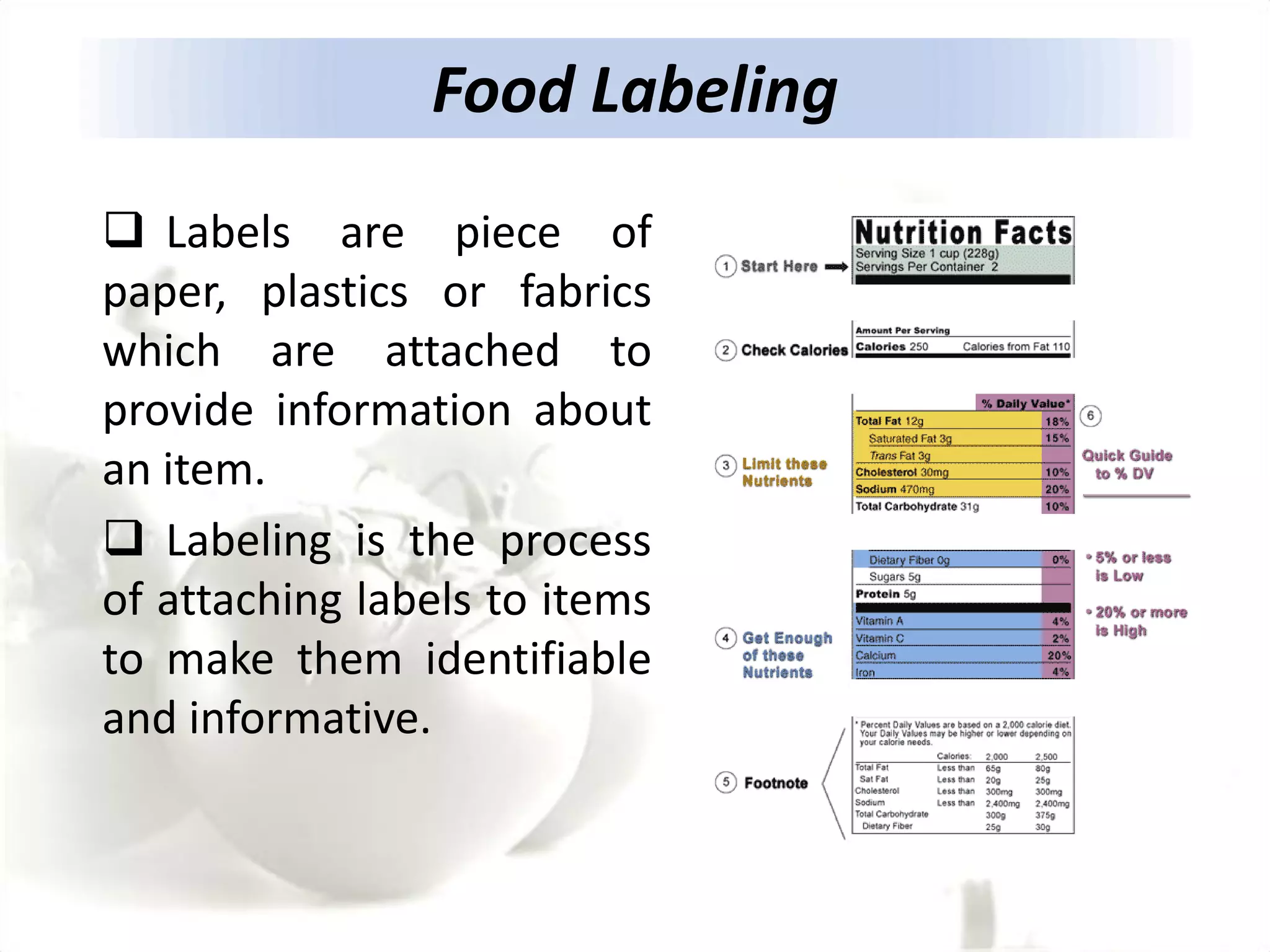
Food Labeling
 Labels are piece of
paper, plastics or fabrics
which are attached to
provide information about
an item.
 Labeling is the process
of attaching labels to items
to make them identifiable
and informative.
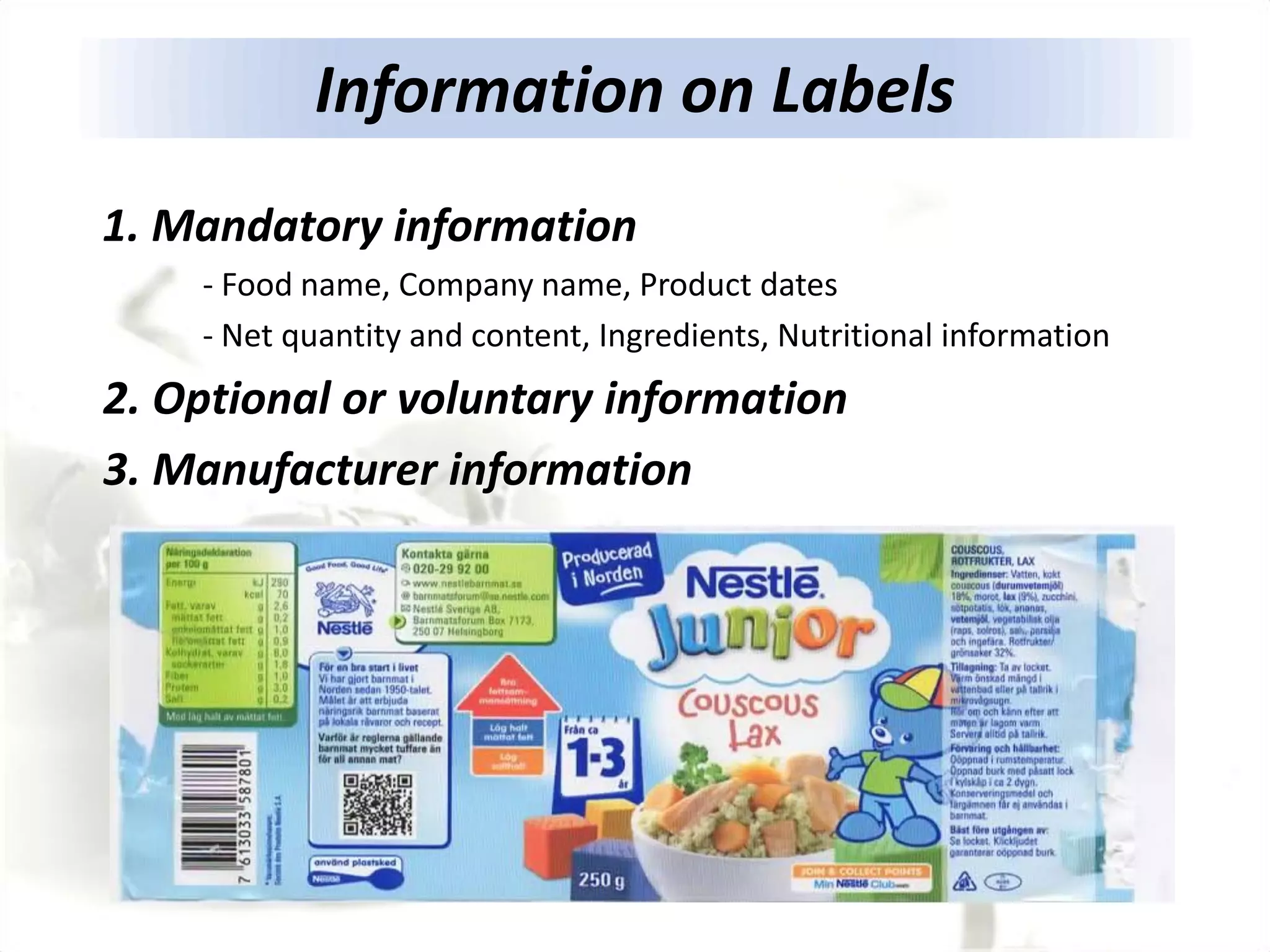
Information on Labels
1. Mandatory information
- Food name, Company name, Product dates
- Net quantity and content, Ingredients, Nutritional information
2. Optional or voluntary information
3. Manufacturer information
Misbranded Food
 Food is misbranded if:
- Its label is false or misleading in any way.
- It is offered for sale under the name of another
food product.
- It is an imitation of another food under clearly
labeled as an imitation.
- Its container is misleading in any particular such
as packaging material, size, fill or form.
The Author:
A. B. M. Said Bin Saifullah
https://www.linkedin.com/in/sbsriyad/

Food additives, adulteration and misbranding

  • 1.
    Food Additives, Adulteration andMisbranding A. B. M. Said Bin Saifullah Department of Food Science and Nutrition HSTU, Bangladesh
  • 2.
    Food Additives  Foodadditives are substances added to food to preserve flavor and/or enhance its taste and appearance.  It is a substance or mixture of substances, other than a basic foodstuff which is present in a food as a result of any aspect of production, processing, storage or packaging.
  • 3.
    Types of Additives 1.Preservatives Preservatives are food additives that prolong the shelf-life of foods or beverages by protecting against deterioration caused by microorganisms. These chemicals prevent or inhibit growth of spoilage microorganisms. 2. Nutritional Additives Nutritional additives are food additives that minimize nutrients loss during processing, improve nutrient quality and enhance the overall nutritive value of the food.
  • 4.
    Types of Additives 3.Flavoring Agents Flavors are additives that give food a particular taste or smell or enhance food's existing flavors and may be derived from natural ingredients or created artificially. 4. Coloring Agents Coloring agents are food additives that add, stabilize, restore or intensify the color in a food. Colorings are added to food to replace colors lost during preparation, or to make food look more attractive, more visually appealing.
  • 5.
    Types of Additives 5.Texturing Agents Texturing agents are additives that add or modify the overall texture or mouthful of food products. 6. Miscellaneous Additives Miscellaneous additives are those which cannot be categorized within the major groups are used or intended to be used primarily as an additive but do not include any processing aid.
  • 6.
    Sub-classes of Additives 1.Preservatives 2. Antioxidants 3. Food Acids 4. Acidity regulator 5. Emulsifier 6. Emulsifying salt 7. Mineral salt 8. Stabilizers 9. Bulking agents 10. Thickener 11. Anti-caking agents 12. Anti-foaming agents 13. Firming agents 14. Gelling agents 15. Glazing agents 16. Flour treatment agents 17. Vegetable gums 18. Coloring 19. Color retention agents 20. Flavors 21. Flavor enhancers 22. Sweeteners 23. Seasonings 24. Tracer gas 25. Humectants 26. Sequestrants 27. Propellants
  • 7.
    Naming of FoodAdditives  The Codex Alimentarius Commission Committee on Food Additives and contaminants has developed an International Numbering System (INS) for food additives based on the E system.  The E numbers are categorized as follows: E100-E199 Colors E200-E299 Preservatives E300-E399 Antioxidants, Acidity regulators E400-E499 Thickeners, Stabilizers, Emulsifiers E500-E599 Acidity regulators, Anticaking agents E600-E699 Flavor enhancers E900-E999 Surface coatings, gases, sweeteners E1000-E1999 Additional chemicals
  • 8.
    Food Additives andSafety  Some artificial food additives have been linked with cancer, digestive problems, neurological conditions, Attention Deficit Hyperactivity Disorder (ADHD), heart disease or obesity. Natural additives may be similarly harmful or be the cause of allergic reactions in certain individuals.  The following additives should be avoided: - Benzoates - Caffeine - Red Dye 40 - Bromates - Caramel - Saccharin - Butylates - Glycerides - Sodium chloride
  • 9.
    Food Adulteration  Foodadulteration is the act of intentionally debasing the quality of food offered for sale either by the admixture or substitution of inferior substances or by the removal of some valuable ingredients.
  • 10.
    It is FoodAdulteration - If the product is not of the nature, substance or quality demanded by the purchaser or which it purports to be. - If the product bears or contains any poisonous or deleterious substance or if it is so processed as to injuriously affect its nature, substance, or quality. - If any inferior or cheaper substance has been substituted wholly or partly in the product, or any natural constituent has been wholly or partly abstracted from it, to affect its quality. - If the product had been prepared, packed, or kept under unsanitary conditions, has become contaminated, injurious to health or is unfit for human consumption.
  • 11.
    - If thecontainer of the product is composed of any poisonous or deleterious substance which renders its contents injurious to health. - If the product contains any prohibited coloring matter, preservatives, or contains any permitted coloring matter or preservative in excess of the prescribed limits. - It the product is intentionally subjected to radiation unless the use of radiation is in conformity with an existing regulation or exemption. - If the product bears or contains any expired ingredient. - If the quality or purity of the product falls below the current constituents are present in proportions other than those prescribed, whether or not rendering it injurious to health.
  • 12.
    Food Adulterants  Anadulterant is a chemical substance which should not be contained within other substances (e.g. food, beverages, and fuels) for legal or other reasons.  The word is appropriate only when the additions are unwanted by the recipient. Otherwise the expression would be food additive.  Adulterants when used in illicit drugs are called cutting agents, while deliberate addition of toxic adulterants to food or other products for human consumption is known as poisoning.
  • 13.
    Types of Adulterants 1.Intentional adulterants Intentional food adulteration is done intentionally, with knowledge for financial gain or to earn profit. 2. Incidental adulterants Accidental food adulteration occurs accidentally in nature, without our knowledge. 3. Metallic contaminants Metallic contaminants are any metal in such amount as to be dangerous or prejudicial to health that contains in food or added to it.
  • 14.
    Common Food Adulterants Foodarticle Adulterants Milk and Dairy products Boric acid, Blotting paper, Coal Tar Dyes, Detergent, Formalin, Glucose, Removal of fat, Sodium bicarbonate, Sodium chloride, Starch, Sugar, Synthetic milk, Vanaspati or Margarine, Urea, Water Oils and Fats Argemone oil, Castor oil, Cotton seed oil, Cyanide, Mineral oil, Pungam oil, Prohibited colors, Rancidity, Tri-ortho-crestyl-phosphate (TOCO) Sugar Chalk, Urea, Washing soda Honey Jaggery, Invert sugar, Sugar solution Jaggery Chalk, Metanil yellow color, Sodium bicarbonate, Washing soda Beverage Metanil yellow color, Mineral acid, Saccharin Grains Damaged grain, Dhatura, Dust, Ergot, Insects, Karnel bunt, Metanil yellow color, Pebble, Rodent hair excreta, Stone, Straw, Turmeric coloring, Urea, Weed seeds, Weevilled grain Flour Boric acid, Chalk, Cheap flour, Excess bran, Excessive sand and dirt Powdered spices Artificial color, Brick powder, Chalk, Lead chromate, Rhodamine B, Saw dust, Starch, Stone powder, Yellow soap Tea and Coffee Chicory, Corched persimmon, Iron fillings, Starch, Tamarind seed
  • 15.
    Health Hazards dueto Adulterants  Adulteration often considered as one of the major problems of routine life and its ill effects on health from their daily meal item, either, in cereals, pulses, fruits and vegetables or in milk and milk products and spices. 1. Food Poisoning 2. Stomach ache, indigestion, loose stools 3. Apathy, nausea and vomiting 4. Allergic reaction and fever 5. Vision 6. Chemical risks
  • 16.
    Misbranding  Misbranding maybe defined as the presence or absence of information on label of a product which is false, deceptive or misleading.  Misbranded food means any article of food or food ingredient which is produced, imported, manufactured or labeled in an unlawful manner resembling any other lawfully marketed article of food or food ingredient on sale, whether the element, ingredient, purity or quality of such lawful food is present in it or not.
  • 17.
    Food Labeling  Labelsare piece of paper, plastics or fabrics which are attached to provide information about an item.  Labeling is the process of attaching labels to items to make them identifiable and informative.
  • 18.
    Information on Labels 1.Mandatory information - Food name, Company name, Product dates - Net quantity and content, Ingredients, Nutritional information 2. Optional or voluntary information 3. Manufacturer information
  • 19.
    Misbranded Food  Foodis misbranded if: - Its label is false or misleading in any way. - It is offered for sale under the name of another food product. - It is an imitation of another food under clearly labeled as an imitation. - Its container is misleading in any particular such as packaging material, size, fill or form.
  • 20.
    The Author: A. B.M. Said Bin Saifullah https://www.linkedin.com/in/sbsriyad/