SEMINAR
oN
MINERALS USED AS PIGMENTS
CONTENTS
• INTRODUCTION
• PIGMENTS
• OCHRE
• MODE OF OCCURRENCE AND ORIGIN
• USES
• DISTRIBUTION AND PRODUCTION
• CONCLUSION
• REFERENCES
INTRODUCTION
• The mineral pigments may be either natural or manufactured.
• Mineral pigments are utilized direclty as paints or to give
color, body or capacity to paints, stucco, plaster, cement,
rubber, plastics or other materials.
• Ochres are mixture of hematite,limonite and clay with 15 to
80 percent iron oxide, and provided yellowish and reddish
brown colours.
PIGMENTS
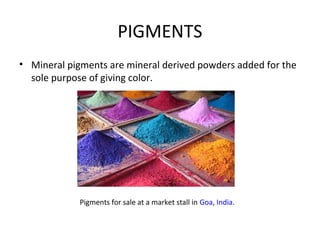
• Mineral pigments are mineral derived powders added for the
sole purpose of giving color.
Pigments for sale at a market stall in Goa, India.
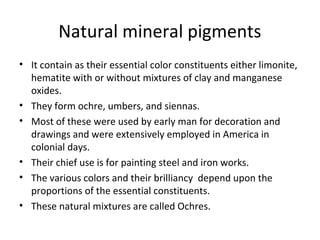
Natural mineral pigments
• It contain as their essential color constituents either limonite,
hematite with or without mixtures of clay and manganese
oxides.
• They form ochre, umbers, and siennas.
• Most of these were used by early man for decoration and
drawings and were extensively employed in America in
colonial days.
• Their chief use is for painting steel and iron works.
• The various colors and their brilliancy depend upon the
proportions of the essential constituents.
• These natural mixtures are called Ochres.
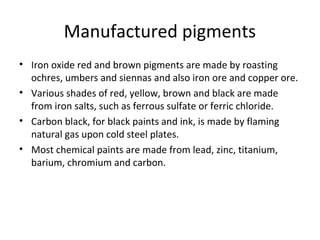
Manufactured pigments
• Iron oxide red and brown pigments are made by roasting
ochres, umbers and siennas and also iron ore and copper ore.
• Various shades of red, yellow, brown and black are made
from iron salts, such as ferrous sulfate or ferric chloride.
• Carbon black, for black paints and ink, is made by flaming
natural gas upon cold steel plates.
• Most chemical paints are made from lead, zinc, titanium,
barium, chromium and carbon.
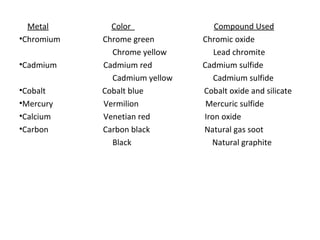
Metal Color Compound Used
•Chromium Chrome green Chromic oxide
Chrome yellow Lead chromite
•Cadmium Cadmium red Cadmium sulfide
Cadmium yellow Cadmium sulfide
•Cobalt Cobalt blue Cobalt oxide and silicate
•Mercury Vermilion Mercuric sulfide
•Calcium Venetian red Iron oxide
•Carbon Carbon black Natural gas soot
Black Natural graphite
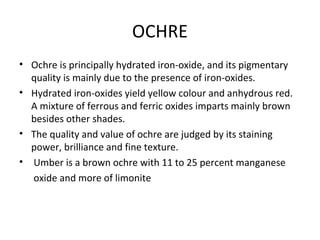
OCHRE
• Ochre is principally hydrated iron-oxide, and its pigmentary
quality is mainly due to the presence of iron-oxides.
• Hydrated iron-oxides yield yellow colour and anhydrous red.
A mixture of ferrous and ferric oxides imparts mainly brown
besides other shades.
• The quality and value of ochre are judged by its staining
power, brilliance and fine texture.
• Umber is a brown ochre with 11 to 25 percent manganese
oxide and more of limonite
Cont.……….
• Ochre is generally confined to deep weathered zones and
occur in lenses and pockets.
• In areas covered over by deccan traps,between individual
flows are usually found clay beds of rich red colour called red
bole.
• These are weathered indurated beds of ash and constitute
some type of an ochre.
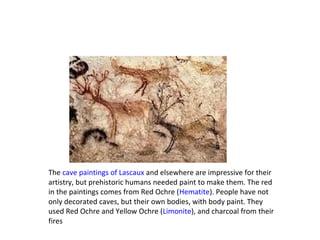
The cave paintings of Lascaux and elsewhere are impressive for their
artistry, but prehistoric humans needed paint to make them. The red
in the paintings comes from Red Ochre (Hematite). People have not
only decorated caves, but their own bodies, with body paint. They
used Red Ochre and Yellow Ochre (Limonite), and charcoal from their
fires
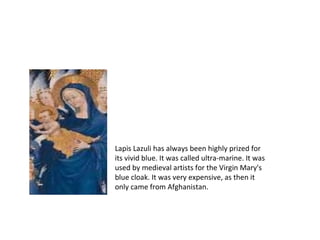
Lapis Lazuli has always been highly prized for
its vivid blue. It was called ultra-marine. It was
used by medieval artists for the Virgin Mary's
blue cloak. It was very expensive, as then it
only came from Afghanistan.
MODE OF OCCURRENCE AND ORIGIN
• Ochres occur as an alteration product of either iron minerals
or by degradation of highly ferruginous rocks in the form of
weathered residual concentrations.
• They are largely ferric hydroxide mixed with clay and other
impurities.
• The above rock and mineral succumb to mechanical
disintegration and chemical decomposition.
• The minerals that are unstable under weathering condition
suffer chemical decay, the soluble parts like silica, may be
removed and the insoluble residues, mainly iron-oxides and
other impurities, may accumulate in the form of ochre.
USES
• The principal use of ochre is as tinting colours.
• It is used for colour washes, distemper and oil paints. It is also
used in making coloured paper.
• For this particular use ochre and china-clay or soapstone,
after dissolving in water in paste form, are screened and
added in the beater for the preparation of coloured paper
pulp.
• Red oxide pigments are widely used as primers for painting
structural steel, automobile bodies, ship bottoms, etc.
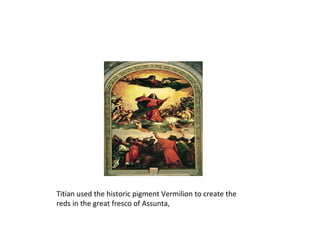
Titian used the historic pigment Vermilion to create the
reds in the great fresco of Assunta,
DISTRIBUTION
• Red ochre are chiefly found in Gujarat, Karnataka,
Madhya Pradesh, and Rajasthan.
• Yellow ochre in Andhra Pradesh, Madhya Pradesh, Rajasthan,
Uttar Pradesh and West Bengal.
• Jaitwara area in Satna district of Madhya Pradesh is the well
known area for yellow ochre.
• Red oxide mined in Bellary-Hospet area, Karnataka is also
marketed as ochre.
DISTRIBUTION OF IMPORTANT OCHRE DEPOSIT
• KARNATAKA: Bellary, Bidar, Chitradurga, Kolar .
• ANDHRA PRADESH: Cuddapah, Guntur.
• GUJARAT: Rajpur, kuchch.
• BIHAR: Singhbhum.
• MADHYA PRADESH: Gwalior, Jabalpur.
• MAHARASHTRA: Nagpur.
• RAJASTHAN: Udaipur, Alwar.
• UTTAR PRADESH: Banda
• WEST BENGAL: Mednipur
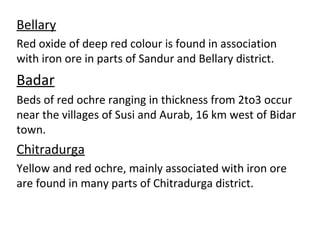
Bellary
Red oxide of deep red colour is found in association
with iron ore in parts of Sandur and Bellary district.
Badar
Beds of red ochre ranging in thickness from 2to3 occur
near the villages of Susi and Aurab, 16 km west of Bidar
town.
Chitradurga
Yellow and red ochre, mainly associated with iron ore
are found in many parts of Chitradurga district.
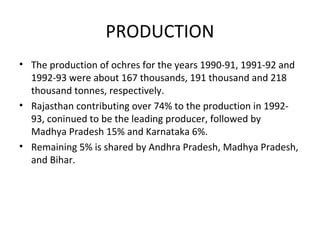
PRODUCTION
• The production of ochres for the years 1990-91, 1991-92 and
1992-93 were about 167 thousands, 191 thousand and 218
thousand tonnes, respectively.
• Rajasthan contributing over 74% to the production in 1992-
93, coninued to be the leading producer, followed by
Madhya Pradesh 15% and Karnataka 6%.
• Remaining 5% is shared by Andhra Pradesh, Madhya Pradesh,
and Bihar.
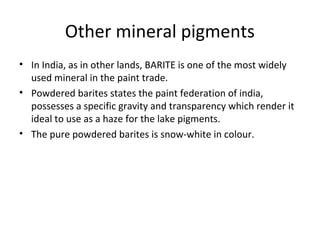
Other mineral pigments
• In India, as in other lands, BARITE is one of the most widely
used mineral in the paint trade.
• Powdered barites states the paint federation of india,
possesses a specific gravity and transparency which render it
ideal to use as a haze for the lake pigments.
• The pure powdered barites is snow-white in colour.
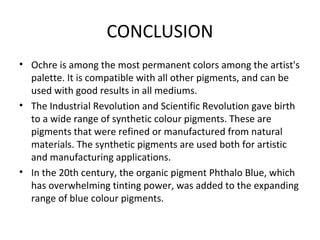
CONCLUSION
• Ochre is among the most permanent colors among the artist's
palette. It is compatible with all other pigments, and can be
used with good results in all mediums.
• The Industrial Revolution and Scientific Revolution gave birth
to a wide range of synthetic colour pigments. These are
pigments that were refined or manufactured from natural
materials. The synthetic pigments are used both for artistic
and manufacturing applications.
• In the 20th century, the organic pigment Phthalo Blue, which
has overwhelming tinting power, was added to the expanding
range of blue colour pigments.
REFERENCE
 2000, Umeshwar Prasad ,Economic Geology,CBS
Publishers,pp-279-281.
 1988,B.P Radhakrishna, Mineral resources of Karnataka, pp-
413-416.
 1925,Meadl.Jensen& Alan M.Bateman, Economic Mineral
Deposits , pp-518-519
Websites:
i)www.wikipedia.com
Minerals used as pigments

Minerals used as pigments

  • 1.
  • 2.
    CONTENTS • INTRODUCTION • PIGMENTS •OCHRE • MODE OF OCCURRENCE AND ORIGIN • USES • DISTRIBUTION AND PRODUCTION • CONCLUSION • REFERENCES
  • 3.
    INTRODUCTION • The mineralpigments may be either natural or manufactured. • Mineral pigments are utilized direclty as paints or to give color, body or capacity to paints, stucco, plaster, cement, rubber, plastics or other materials. • Ochres are mixture of hematite,limonite and clay with 15 to 80 percent iron oxide, and provided yellowish and reddish brown colours.
  • 4.
    PIGMENTS • Mineral pigmentsare mineral derived powders added for the sole purpose of giving color. Pigments for sale at a market stall in Goa, India.
  • 5.
    Natural mineral pigments •It contain as their essential color constituents either limonite, hematite with or without mixtures of clay and manganese oxides. • They form ochre, umbers, and siennas. • Most of these were used by early man for decoration and drawings and were extensively employed in America in colonial days. • Their chief use is for painting steel and iron works. • The various colors and their brilliancy depend upon the proportions of the essential constituents. • These natural mixtures are called Ochres.
  • 6.
    Manufactured pigments • Ironoxide red and brown pigments are made by roasting ochres, umbers and siennas and also iron ore and copper ore. • Various shades of red, yellow, brown and black are made from iron salts, such as ferrous sulfate or ferric chloride. • Carbon black, for black paints and ink, is made by flaming natural gas upon cold steel plates. • Most chemical paints are made from lead, zinc, titanium, barium, chromium and carbon.
  • 7.
    Metal Color CompoundUsed •Chromium Chrome green Chromic oxide Chrome yellow Lead chromite •Cadmium Cadmium red Cadmium sulfide Cadmium yellow Cadmium sulfide •Cobalt Cobalt blue Cobalt oxide and silicate •Mercury Vermilion Mercuric sulfide •Calcium Venetian red Iron oxide •Carbon Carbon black Natural gas soot Black Natural graphite
  • 8.
    OCHRE • Ochre isprincipally hydrated iron-oxide, and its pigmentary quality is mainly due to the presence of iron-oxides. • Hydrated iron-oxides yield yellow colour and anhydrous red. A mixture of ferrous and ferric oxides imparts mainly brown besides other shades. • The quality and value of ochre are judged by its staining power, brilliance and fine texture. • Umber is a brown ochre with 11 to 25 percent manganese oxide and more of limonite
  • 9.
    Cont.………. • Ochre isgenerally confined to deep weathered zones and occur in lenses and pockets. • In areas covered over by deccan traps,between individual flows are usually found clay beds of rich red colour called red bole. • These are weathered indurated beds of ash and constitute some type of an ochre.
  • 10.
    The cave paintingsof Lascaux and elsewhere are impressive for their artistry, but prehistoric humans needed paint to make them. The red in the paintings comes from Red Ochre (Hematite). People have not only decorated caves, but their own bodies, with body paint. They used Red Ochre and Yellow Ochre (Limonite), and charcoal from their fires
  • 11.
    Lapis Lazuli hasalways been highly prized for its vivid blue. It was called ultra-marine. It was used by medieval artists for the Virgin Mary's blue cloak. It was very expensive, as then it only came from Afghanistan.
  • 12.
    MODE OF OCCURRENCEAND ORIGIN • Ochres occur as an alteration product of either iron minerals or by degradation of highly ferruginous rocks in the form of weathered residual concentrations. • They are largely ferric hydroxide mixed with clay and other impurities. • The above rock and mineral succumb to mechanical disintegration and chemical decomposition. • The minerals that are unstable under weathering condition suffer chemical decay, the soluble parts like silica, may be removed and the insoluble residues, mainly iron-oxides and other impurities, may accumulate in the form of ochre.
  • 13.
    USES • The principaluse of ochre is as tinting colours. • It is used for colour washes, distemper and oil paints. It is also used in making coloured paper. • For this particular use ochre and china-clay or soapstone, after dissolving in water in paste form, are screened and added in the beater for the preparation of coloured paper pulp. • Red oxide pigments are widely used as primers for painting structural steel, automobile bodies, ship bottoms, etc.
  • 14.
    Titian used thehistoric pigment Vermilion to create the reds in the great fresco of Assunta,
  • 15.
    DISTRIBUTION • Red ochreare chiefly found in Gujarat, Karnataka, Madhya Pradesh, and Rajasthan. • Yellow ochre in Andhra Pradesh, Madhya Pradesh, Rajasthan, Uttar Pradesh and West Bengal. • Jaitwara area in Satna district of Madhya Pradesh is the well known area for yellow ochre. • Red oxide mined in Bellary-Hospet area, Karnataka is also marketed as ochre.
  • 16.
    DISTRIBUTION OF IMPORTANTOCHRE DEPOSIT • KARNATAKA: Bellary, Bidar, Chitradurga, Kolar . • ANDHRA PRADESH: Cuddapah, Guntur. • GUJARAT: Rajpur, kuchch. • BIHAR: Singhbhum. • MADHYA PRADESH: Gwalior, Jabalpur. • MAHARASHTRA: Nagpur. • RAJASTHAN: Udaipur, Alwar. • UTTAR PRADESH: Banda • WEST BENGAL: Mednipur
  • 17.
    Bellary Red oxide ofdeep red colour is found in association with iron ore in parts of Sandur and Bellary district. Badar Beds of red ochre ranging in thickness from 2to3 occur near the villages of Susi and Aurab, 16 km west of Bidar town. Chitradurga Yellow and red ochre, mainly associated with iron ore are found in many parts of Chitradurga district.
  • 18.
    PRODUCTION • The productionof ochres for the years 1990-91, 1991-92 and 1992-93 were about 167 thousands, 191 thousand and 218 thousand tonnes, respectively. • Rajasthan contributing over 74% to the production in 1992- 93, coninued to be the leading producer, followed by Madhya Pradesh 15% and Karnataka 6%. • Remaining 5% is shared by Andhra Pradesh, Madhya Pradesh, and Bihar.
  • 19.
    Other mineral pigments •In India, as in other lands, BARITE is one of the most widely used mineral in the paint trade. • Powdered barites states the paint federation of india, possesses a specific gravity and transparency which render it ideal to use as a haze for the lake pigments. • The pure powdered barites is snow-white in colour.
  • 20.
    CONCLUSION • Ochre isamong the most permanent colors among the artist's palette. It is compatible with all other pigments, and can be used with good results in all mediums. • The Industrial Revolution and Scientific Revolution gave birth to a wide range of synthetic colour pigments. These are pigments that were refined or manufactured from natural materials. The synthetic pigments are used both for artistic and manufacturing applications. • In the 20th century, the organic pigment Phthalo Blue, which has overwhelming tinting power, was added to the expanding range of blue colour pigments.
  • 21.
    REFERENCE  2000, UmeshwarPrasad ,Economic Geology,CBS Publishers,pp-279-281.  1988,B.P Radhakrishna, Mineral resources of Karnataka, pp- 413-416.  1925,Meadl.Jensen& Alan M.Bateman, Economic Mineral Deposits , pp-518-519 Websites: i)www.wikipedia.com