• TOPIC :
SYNTHETIC GEMSTONE
Topic out line
Synthetic Gemstones
• General Introduction
• Synthetic gemstone process
• Common synthetic gemstone
• Alexandrite
• Diamond
• Emerald
• Opal
• Ruby
• Sapphire
• Uses
SYNTHETIC GEMSTONE
• A synthetic gemstone is identical to a natural gemstone in almost every way.
This includes the same basic crystal structure, refractive index, specific gravity,
chemical composition, colors, and other characteristics. Since the same
gemological tests are used for stone identification on both natural and synthetic
gems, it is sometimes even possible for a gemologist to be puzzled as to whether
or not a stone is natural or synthetic. When this occurs, the best course of action
is to send the stone to an accredited gem laboratory, like the Gemological
Institute of America. They can positively determin ewhether a stone is synthetic or
naturally occuring. Only minor internal characteristics allow separation of a
synthetic gemstone from a natural gemston
PROCESS
A variety of process are currently used in the production of synthetic
crystals, resulting in different qualities, appearances and prices.
• Flame fusion or verneuil process (MELT PROCESS)
• Crystal pulling or czochralski process (MELT PROCE
• Flux growth (SOLUTION PROCESS)
• Hydrothermal growth (SOLUTION PROCESS)
• FLAME FUSION OR VERNEUIL PROCESS (MELT PROCESS)
The first commercially successful synthetic gems were created by the flame
fusion process. This process involves dropping powdered chemicals
a high-temperature flame, where it melts and falls onto a rotating pedestal
to produce a synthetic crystal. Today it remains the least expensive and
common way to make gems such as synthetic corundum and spinel.
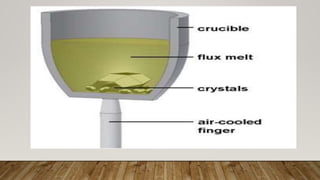
• FLUX GROWTH (SOLUTION PROCESS)
• Today some synthetic gems, such as emerald, ruby, sapphire, alexandrite,
and spinel can be created through a flux-growth process. Flux is a solid
material that, when melted, dissolves other materials in the same way
water dissolves sugar. As the dissolved chemical solution gradually cools,
synthetic crystals form.
• Growing a synthetic gem by the flux method requires patience and
significant investment. Crystal growth can take up to a year, and the
equipment is very expensive. But the results, especially when it comes to
emerald, are well worth the time and effort.
• HYDROTHERMAL GROWTH (SOLUTION PROCESS)
• Like the flux process, the hydrothermal growth process is slow and expensive.
it’s the only method for successfully growing synthetic quartz. This process
requires heat and pressure and imitates the conditions deep in the earth that
result in the formation of natural gems. Nutrients are dissolved in a water
solution, and then synthetic crystals form as the solution cools.
• While the following list encompasses the commonly seen synthetics, over the
years there have also been experimental synthetic gems. These include
color change synthetic spinel and others. But because nature produces these
products more readily, they are not often seen today. Some of the synthetic
that are more frequently encountered include:
THE FOLLOWING GEMSTONES ARE COMMON
SYNTHETICS:
• Alexandrite
• Diamond
• Emerald
• Opal
• Ruby
• Sapphire
• Spinel
SYNTHETIC DIAMOND (THIS IS NOT FREQUENTLY ENCOUNTERED)
These diamonds, grown in a laboratory, share most of the characteristics of
their natural counterparts: they are essentially carbon.
• Chemical vapor deposition (CVD) – diamond growth in a vacuum
chamber due to a chemical reaction which releases carbon atoms that
precipitate on diamond seed plates.
HIGH PRESSURE, HIGH TEMPERATURE (HPHT) –
.
Some diamonds are made in high pressure high temperature environments, including this collection of synthetic
diamonds in a variety of colors.
SYNTHETIC CORUNDUM (WIDELY AVAILABLE)
Synthetic corundum can be made in a variety of ways including this colorful collection of flame
fusion crystals, seen before cutting.
RUBY –
In the late 1800s, ruby became the first gem to be created in a laboratory by
Auguste Verneuil. In 1902, he announced the development of his flame-fusion
process for synthesizing this beautiful gem.
Synthetic ruby can be produced via flux growth processes (crystal and cut stone on left), and
flame fusion (boule and cut stone on right).
SAPPHIRE –
some of the earliest examples of synthetic sapphires are in original pieces of art deco
jewelry. Many synthetic sapphires are still made by flame fusion, but flux-grown
sapphires have been available since the 1960s. Flux-grown, pulled and hydrothermal
synthetic sapphires can be very convincing substitutes for the natural gem. Color
change synthetic sapphire, made to imitate alexandrite, has been popular since the
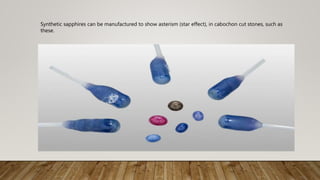
1900s. Induced inclusions caused star effects in some synthetic ruby and sapphire.
Synthetic sapphires can be manufactured to show asterism (star effect), in cabochon cut stones, such as
these.
SYNTHETIC EMERALD (WIDELY AVAILABLE) AND OTHER
BERYLS (RARE)
Synthetic beryl is available in many colors including yellow, red, blue (aquamarine) and
green (emerald). In the late 1980s and 1990s, Russia became a significant producer of
synthetic gems and is still a major supplier of hydrothermally grown gemstones such as
synthetic beryl and synthetic corundum, along with others like synthetic diamond and
synthetic alexandrite.
These are examples of synthetic beryl crystals and cut stones (including the synthetic emerald
variety—the green stones
SYNTHETIC QUARTZES (WIDELY AVAILABLE)
Gem-quality quartz, such as rose quartz, smoky quartz, and amethyst, is attractive. But
gem-quality quartz is plentiful so not the reason that researchers went to the trouble of
developing a way to synthesize gem-quality quartz. The reason is that it plays a key role in
technology. It can generate an electric current when it’s placed under pressure and can
in precise response to alternating current. These virtues are put to practical use in watches,
clocks, communications equipment, filters, and oscillators.
Amethyst: Lab-grown amethyst and other synthetic quartz varieties found their way into
jewelry after being developed for industrial applications. The first hydrothermal quartz
appeared in laboratories in the 1890s. It wasn’t until World War II that synthetic quartz was
widely available commercially
SYNTHETIC SPINEL (WIDELY AVAILABLE)
Early in the twentieth century, researchers trying to grow synthetic blue
sapphire produced synthetic blue spinel by accident. Since then, synthetic
spinel has been commonly used as a substitute for many natural gems. In
the 1990s, a new Russian-made, flux-grown synthetic spinel was introduced
in a variety of colors including red, a color not widely available through the
older flame-fusion process.
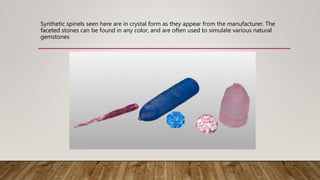
Synthetic spinels seen here are in crystal form as they appear from the manufacturer. The
faceted stones can be found in any color, and are often used to simulate various natural
gemstones
SYNTHETIC OPAL (OCCASIONALLY SEEN)
In the 1970s, the Gilson Company developed a three-step process to
make synthetic opal. First, microscopic spheres of silica are created
through precipitation. Next, the spheres settle in acidic water for more
than a year. Finally, a hydrostatic press consolidates the spheres without
distorting the stacked arrangement that creates opal’s play-of-color.
These synthetic opals are sometimes seen in the market, and to the unpracticed eye may appear to be
highly valuable, natural white and black opal.
SYNTHETIC ALEXANDRITE (RARE)
Since there is not enough natural alexandrite to meet demand, various
synthetics have appeared in the marketplace over the last few decades.
Alexandrite has been synthesized by a number of different processes,
including Czochralski, floating zone, and flux. Also, synthetic corundum
color-change is often used to imitate natural alexandrite. On rare
synthetic color-change spinel may be encountered in the market.
Synthetic alexandrites, such as this stone (shown in its incandescent and daylight colors) are somewhat
rare. Less rare are imitations of alexandrite, including color-change synthetic spinel and sapphire.
USES
• Gemstones are really helpful for mankind as they are used both in prospective of
astrology and fashion. Some of its uses are:
• Some people uses gemstones as they are advised by their astrologers to overcome
the effects of their particular planet.
• There are many gemstones such as Sapphires, Ruby, Coral, Pearl, Emerald. They all are
related to a particular planet and helps the human in health benefits, marriage, evil
eye etc.
• Some people uses gemstones only for fashion. Now days gemstone jewelry is the
latest fashion.
• The broadest optical transmission spectrum
• The highest known thermal conductivity
• A wide electronic band gap
• The highest known resistance to thermal shock
• Excellent electric insulator properties
• A very low coefficient of friction
• Chemically and biologically inert
SYNTHETIC GEMSTONE

SYNTHETIC GEMSTONE

  • 1.
  • 2.
    Topic out line SyntheticGemstones • General Introduction • Synthetic gemstone process • Common synthetic gemstone • Alexandrite • Diamond • Emerald • Opal • Ruby • Sapphire • Uses
  • 3.
    SYNTHETIC GEMSTONE • Asynthetic gemstone is identical to a natural gemstone in almost every way. This includes the same basic crystal structure, refractive index, specific gravity, chemical composition, colors, and other characteristics. Since the same gemological tests are used for stone identification on both natural and synthetic gems, it is sometimes even possible for a gemologist to be puzzled as to whether or not a stone is natural or synthetic. When this occurs, the best course of action is to send the stone to an accredited gem laboratory, like the Gemological Institute of America. They can positively determin ewhether a stone is synthetic or naturally occuring. Only minor internal characteristics allow separation of a synthetic gemstone from a natural gemston
  • 4.
    PROCESS A variety ofprocess are currently used in the production of synthetic crystals, resulting in different qualities, appearances and prices. • Flame fusion or verneuil process (MELT PROCESS) • Crystal pulling or czochralski process (MELT PROCE • Flux growth (SOLUTION PROCESS) • Hydrothermal growth (SOLUTION PROCESS)
  • 5.
    • FLAME FUSIONOR VERNEUIL PROCESS (MELT PROCESS) The first commercially successful synthetic gems were created by the flame fusion process. This process involves dropping powdered chemicals a high-temperature flame, where it melts and falls onto a rotating pedestal to produce a synthetic crystal. Today it remains the least expensive and common way to make gems such as synthetic corundum and spinel.
  • 11.
    • FLUX GROWTH(SOLUTION PROCESS) • Today some synthetic gems, such as emerald, ruby, sapphire, alexandrite, and spinel can be created through a flux-growth process. Flux is a solid material that, when melted, dissolves other materials in the same way water dissolves sugar. As the dissolved chemical solution gradually cools, synthetic crystals form. • Growing a synthetic gem by the flux method requires patience and significant investment. Crystal growth can take up to a year, and the equipment is very expensive. But the results, especially when it comes to emerald, are well worth the time and effort.
  • 12.
    • HYDROTHERMAL GROWTH(SOLUTION PROCESS) • Like the flux process, the hydrothermal growth process is slow and expensive. it’s the only method for successfully growing synthetic quartz. This process requires heat and pressure and imitates the conditions deep in the earth that result in the formation of natural gems. Nutrients are dissolved in a water solution, and then synthetic crystals form as the solution cools. • While the following list encompasses the commonly seen synthetics, over the years there have also been experimental synthetic gems. These include color change synthetic spinel and others. But because nature produces these products more readily, they are not often seen today. Some of the synthetic that are more frequently encountered include:
  • 15.
    THE FOLLOWING GEMSTONESARE COMMON SYNTHETICS: • Alexandrite • Diamond • Emerald • Opal • Ruby • Sapphire • Spinel
  • 16.
    SYNTHETIC DIAMOND (THISIS NOT FREQUENTLY ENCOUNTERED) These diamonds, grown in a laboratory, share most of the characteristics of their natural counterparts: they are essentially carbon. • Chemical vapor deposition (CVD) – diamond growth in a vacuum chamber due to a chemical reaction which releases carbon atoms that precipitate on diamond seed plates.
  • 18.
    HIGH PRESSURE, HIGHTEMPERATURE (HPHT) – . Some diamonds are made in high pressure high temperature environments, including this collection of synthetic diamonds in a variety of colors.
  • 20.
    SYNTHETIC CORUNDUM (WIDELYAVAILABLE) Synthetic corundum can be made in a variety of ways including this colorful collection of flame fusion crystals, seen before cutting.
  • 21.
    RUBY – In thelate 1800s, ruby became the first gem to be created in a laboratory by Auguste Verneuil. In 1902, he announced the development of his flame-fusion process for synthesizing this beautiful gem. Synthetic ruby can be produced via flux growth processes (crystal and cut stone on left), and flame fusion (boule and cut stone on right).
  • 22.
    SAPPHIRE – some ofthe earliest examples of synthetic sapphires are in original pieces of art deco jewelry. Many synthetic sapphires are still made by flame fusion, but flux-grown sapphires have been available since the 1960s. Flux-grown, pulled and hydrothermal synthetic sapphires can be very convincing substitutes for the natural gem. Color change synthetic sapphire, made to imitate alexandrite, has been popular since the 1900s. Induced inclusions caused star effects in some synthetic ruby and sapphire.
  • 23.
    Synthetic sapphires canbe manufactured to show asterism (star effect), in cabochon cut stones, such as these.
  • 24.
    SYNTHETIC EMERALD (WIDELYAVAILABLE) AND OTHER BERYLS (RARE) Synthetic beryl is available in many colors including yellow, red, blue (aquamarine) and green (emerald). In the late 1980s and 1990s, Russia became a significant producer of synthetic gems and is still a major supplier of hydrothermally grown gemstones such as synthetic beryl and synthetic corundum, along with others like synthetic diamond and synthetic alexandrite.
  • 25.
    These are examplesof synthetic beryl crystals and cut stones (including the synthetic emerald variety—the green stones
  • 26.
    SYNTHETIC QUARTZES (WIDELYAVAILABLE) Gem-quality quartz, such as rose quartz, smoky quartz, and amethyst, is attractive. But gem-quality quartz is plentiful so not the reason that researchers went to the trouble of developing a way to synthesize gem-quality quartz. The reason is that it plays a key role in technology. It can generate an electric current when it’s placed under pressure and can in precise response to alternating current. These virtues are put to practical use in watches, clocks, communications equipment, filters, and oscillators. Amethyst: Lab-grown amethyst and other synthetic quartz varieties found their way into jewelry after being developed for industrial applications. The first hydrothermal quartz appeared in laboratories in the 1890s. It wasn’t until World War II that synthetic quartz was widely available commercially
  • 28.
    SYNTHETIC SPINEL (WIDELYAVAILABLE) Early in the twentieth century, researchers trying to grow synthetic blue sapphire produced synthetic blue spinel by accident. Since then, synthetic spinel has been commonly used as a substitute for many natural gems. In the 1990s, a new Russian-made, flux-grown synthetic spinel was introduced in a variety of colors including red, a color not widely available through the older flame-fusion process.
  • 29.
    Synthetic spinels seenhere are in crystal form as they appear from the manufacturer. The faceted stones can be found in any color, and are often used to simulate various natural gemstones
  • 30.
    SYNTHETIC OPAL (OCCASIONALLYSEEN) In the 1970s, the Gilson Company developed a three-step process to make synthetic opal. First, microscopic spheres of silica are created through precipitation. Next, the spheres settle in acidic water for more than a year. Finally, a hydrostatic press consolidates the spheres without distorting the stacked arrangement that creates opal’s play-of-color.
  • 31.
    These synthetic opalsare sometimes seen in the market, and to the unpracticed eye may appear to be highly valuable, natural white and black opal.
  • 32.
    SYNTHETIC ALEXANDRITE (RARE) Sincethere is not enough natural alexandrite to meet demand, various synthetics have appeared in the marketplace over the last few decades. Alexandrite has been synthesized by a number of different processes, including Czochralski, floating zone, and flux. Also, synthetic corundum color-change is often used to imitate natural alexandrite. On rare synthetic color-change spinel may be encountered in the market.
  • 33.
    Synthetic alexandrites, suchas this stone (shown in its incandescent and daylight colors) are somewhat rare. Less rare are imitations of alexandrite, including color-change synthetic spinel and sapphire.
  • 34.
    USES • Gemstones arereally helpful for mankind as they are used both in prospective of astrology and fashion. Some of its uses are: • Some people uses gemstones as they are advised by their astrologers to overcome the effects of their particular planet. • There are many gemstones such as Sapphires, Ruby, Coral, Pearl, Emerald. They all are related to a particular planet and helps the human in health benefits, marriage, evil eye etc. • Some people uses gemstones only for fashion. Now days gemstone jewelry is the latest fashion.
  • 35.
    • The broadestoptical transmission spectrum • The highest known thermal conductivity • A wide electronic band gap • The highest known resistance to thermal shock • Excellent electric insulator properties • A very low coefficient of friction • Chemically and biologically inert